Who’s Smarter?

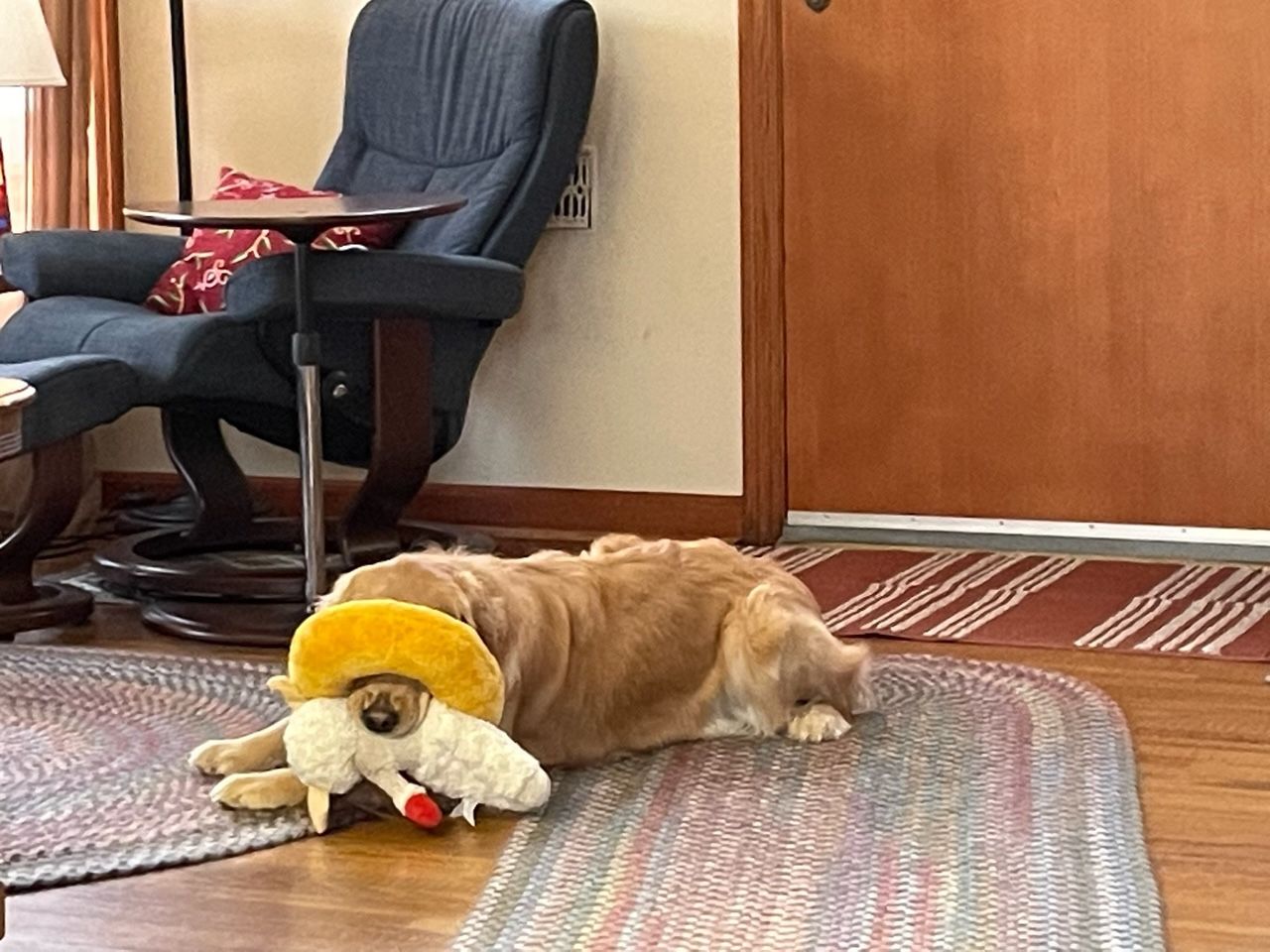
Orly holds a white lamb toy in her mouth while, her mouth stuck through the hole, an orange donut toy covers her eyesI was asked recently what I thought of this response to the question of whether dogs are smarter than wolves: “Wolves can’t be all that smart as a species, or they wouldn’t have become endangered over much of their range, while dogs are thriving, lounging inside our air-conditioned homes and relaxing in recliners.”

Where to begin with this idiocy?

That wolves still exist despite the efforts of humans around the globe and across centuries to eradicate them is a testament to both their intelligence and their resilience.

That dogs have trained humans to spoil them rotten is possibly also a statement about their intelligence, but likely more of a statement about humans …

But the comparison is absurd. They are different species living in different environments. Every aspect of dogs’ physical and mental makeup has been heavily influenced by human control over their breeding, environment, diet, social lives, and pretty much everything else in their lives. I guess the starting point should be how the author defines intelligence.

I’ve read dog books that define canine intelligence as trainability, that is, the willingness of a dog to do what a person wants them to do. I’ve seen it defined as problem-solving ability or as the ability to manipulate humans to do as the dog wishes. I’ve even seen it defined as mathematical ability.

I don’t have a simple definition or formula for deciding how intelligent dogs are as a species or even how intelligent an individual dog is. As with wolves, I see intelligence as the ability to understand the reality you live in and figure out how to thrive there. That looks very different for Orly or Hildy or  your own dog than it does for a wolf in Yellowstone, one in Isle Royale, or one in Siberia.

I also believe that there are multiple types of intelligence, such as:

  • Problem-solving: There was not a treat puzzle toy that Jana could not figure out and empty (in seconds) … until she met Squirrel Dude. Orly gives up after a few seconds on all but the easiest toys, but she loves her snuffle mat. Other dogs scheme, alone or in collaboration, to reach food on a counter, open containers, or escape from fenced yards. Some dogs use tools. Feral dogs use all kinds of problem-solving skill to survive, thrive, and even raise families.
  • Social intelligence — with dogs: Some dogs get along well with others. Some do not. They learn the dog social cues … or they don’t. Humans are similar.
  • Social intelligence — with humans and/or other non-dog species: Again, some dogs do better than others here. Cali never quite got the concept of a stranger. To her, all humans were delightful. She would get so excited to see a person, random unknown person, walking down the same sidewalk. If that person said hi to her, Cali welcomed them like a long-lost best friend. She made many, many people’s days a little brighter with that social intelligence. Dogs demonstrate social intelligence in their ability to get humans to do what they want and to outsmart us with patience and persistence.
  • Empathy: Another form of social intelligence perhaps; many dogs excel at intuiting the moods of their human packmates and comforting us if we’re sad. They’re also eager to make us laugh and often do — and repeat — goofy things just because we laugh when they do.
  • Sensory: This ranges from dogs’ astounding scent abilities to the way some dogs, including both Cali and Orly, had a mysterious ability to know when a loved human was coming home. That extends in Orly’s case to many friends. both were able to determine that someone they adored was heading home, several minutes before the person’s arrival.
  • And yes, trainability: By this I do not mean obedience or quick responsiveness to humans’ commands, though, but interest in learning new things, whether a dog sport, silly tricks, guide work, or any of myriad ways dogs learn to work with, collaborate with, and assist humans and each other. It can include developing a huge vocabulary (& learning grammar).

Wolves excel at problem solving, pack collaboration and planning, and social intelligence within and across species, but far less with humans. That makes sense. It does not make them less intelligent than dogs, just different. Dogs would not fare well in the environments where wolves thrive. Again, this does not reflect lower intelligence but a different ecological niche.

The same can be said about breeds. I don’t think that dogs of some breeds, or of mixed breeds are any more or less intelligent that dogs of other breeds. They might behave differently or have different temperaments and preferences — as do individuals within a breed. None of that makes one “smarter” than the others.

I suspect that the whole question of which dogs are smarter is simply a way for humans to feel superior that their dog or favored breed comes out on top… when they stack the deck by defining intelligence in a way that favors their dog or favorite breed.

Can’t we just love the individual dogs we’re lucky enough to share our lives with and appreciate their unique blend of abilities?



Dog On a Mission

Golden retriever Cali holds a tennis ball
Cali’s ready; where’s the bus stop?

A special, brilliant dog passed away recently: Eclipse, the most famous passenger to regularly ride Seattle buses.

Eclipse, a fun-loving black Lab mix, took herself to the dog park on the bus a couple times a week. She’d board the bus near her home … and somehow always knew where to get off.

Like most Labs, she loved her playtime. Unlike most, she was determined to get out to see her friends, no matter what! Truly a dog on a mission.

It’s cute and funny, but also revealing. Was she recognizing the stop by scent (likely); by watching for specific landmarks; by amount of time on the bus? We’ll never know for sure. The story points to yet another of the many areas of hidden talent and intelligence in dogs that we humans so often fail to notice, understand, or appreciate.

More mysteries to ponder: How did she know when the bus would come? And when the bus home was due? How did she pay her fare (or are buses free in Seattle, as they are in Missoula)? Should I teach Orly to take herself to the park by bus?

Sadly, aged only 10, Eclipse was diagnosed recently with cancer and passed away soon after.

I’m sure she’ll be missed by her human family and her co-riders.

Cherry Season

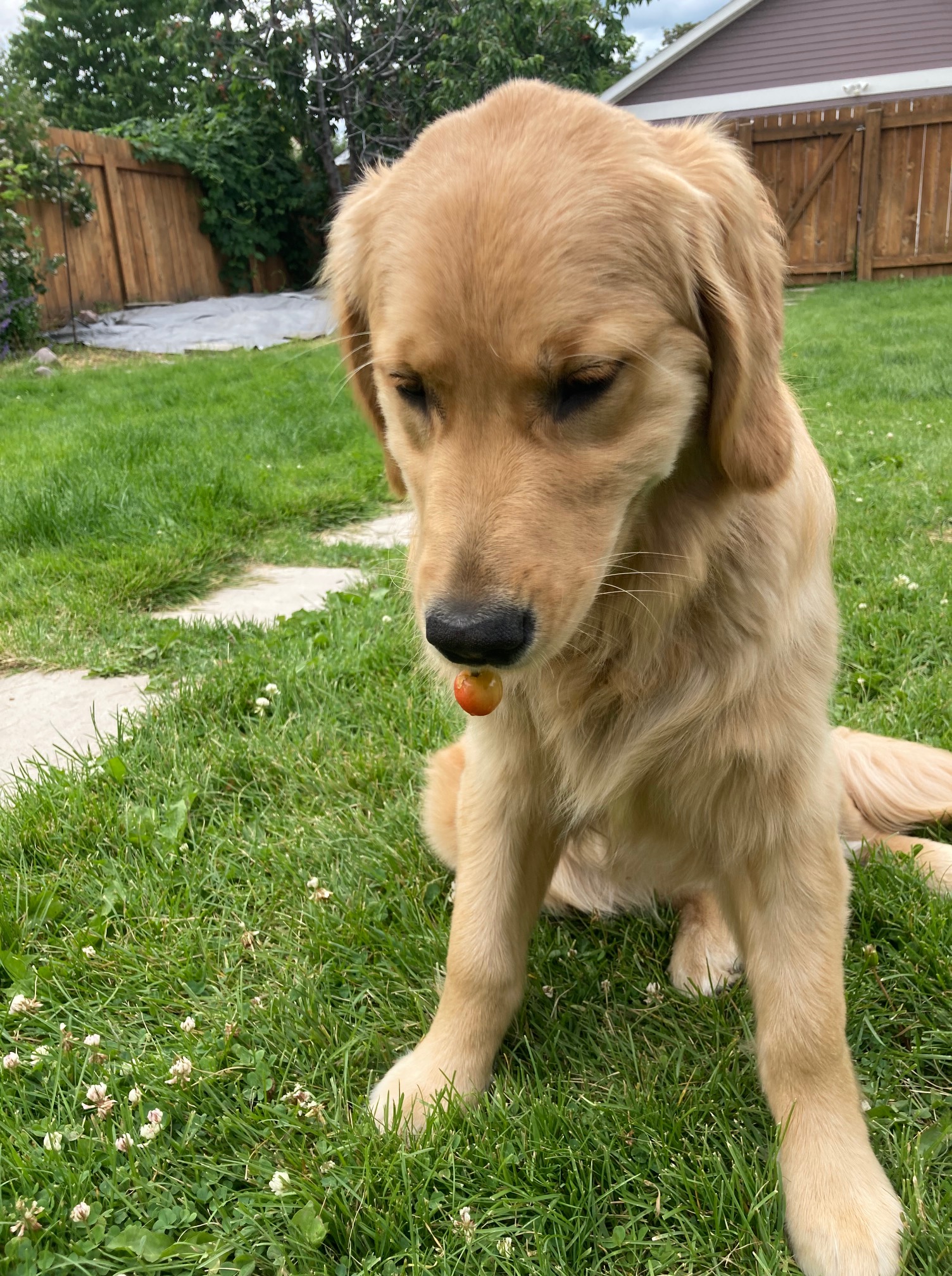
Golden retriever pup Orly has a cherry dangling from her mouth
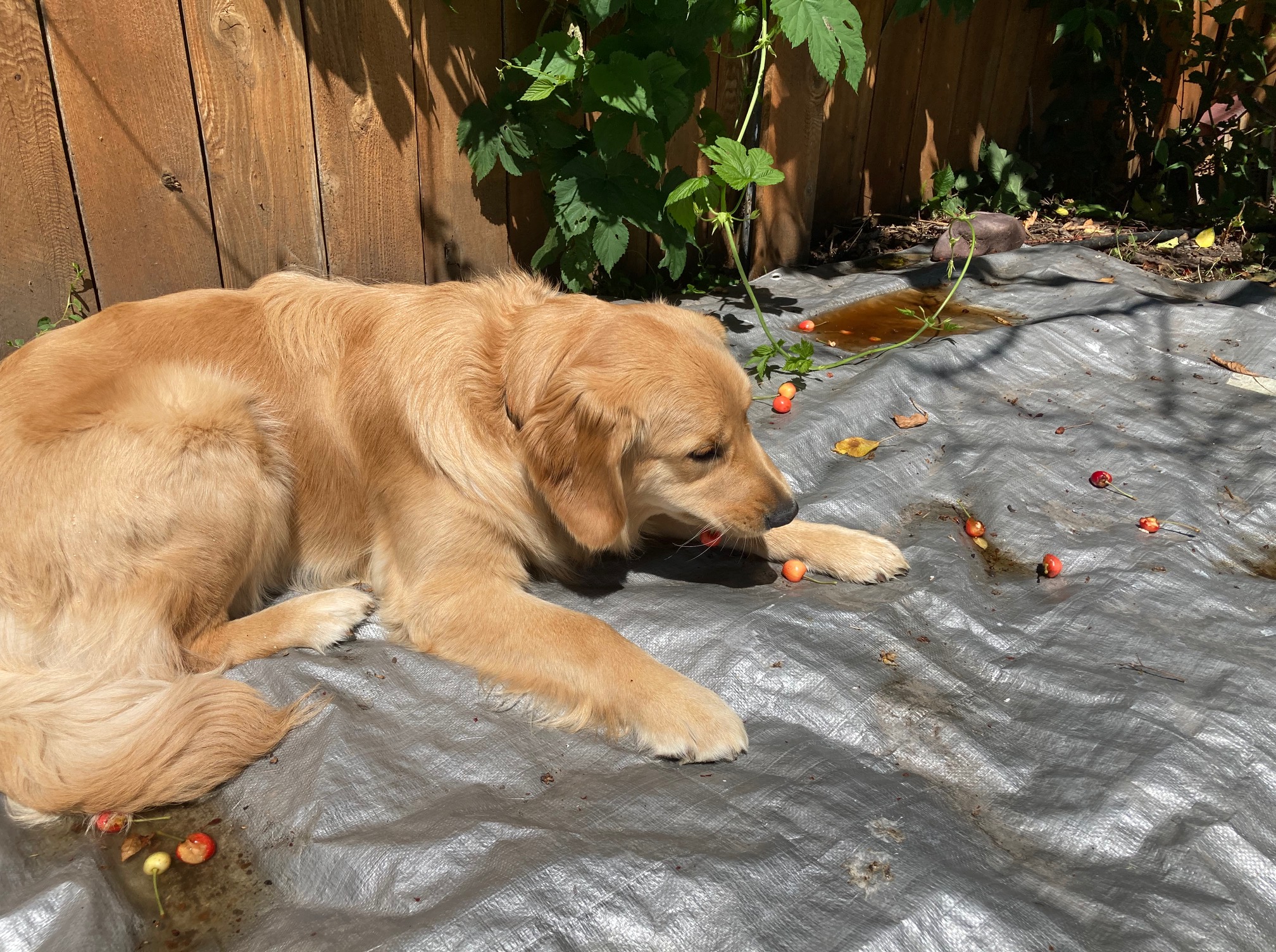
Orly tries to figure out how to eat a cherry

It’s the tail end of cherry season in my yard. I’m providing this hyper-local report because cherry season in this part of Montana is just getting going, but the cherry tree in my yard is done for the year. And I did not get a single cherry.

The birds and squirrels got most of them, but Orly and Cali had their share too.

Cherries are not great for dogs, so for a couple of weeks, I battled the dogs over this. I lost.

I spent a lot of time cleaning up fallen cherries and dropped partially eaten cherries from the ground. This is indeed as much fun as it sounds like it would be.

Nevertheless, those cherries get into every corner, under every leaf and vine, and into the far reaches of the yard. I even saw one hiding under the deck stairs.

Cali is pretty laid back and eats the ones she finds. She’s fully adopted the Koala approach to gobbling them whole, and that is what she taught to Orly.

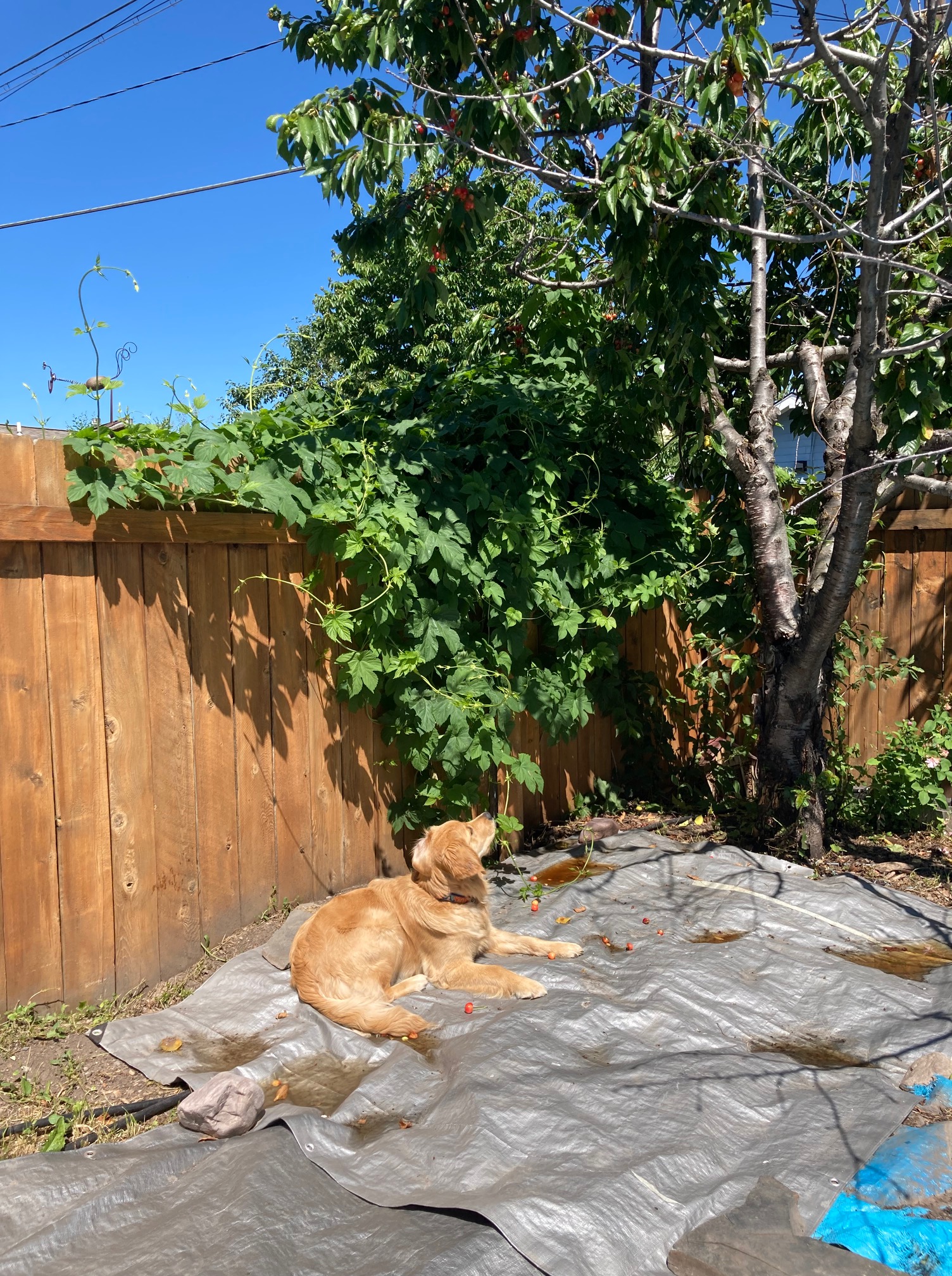
Orly gazes up at the cherry treeOrly is a whole different animal. Orly became especially adept at finding cherries; she has an admirable tenacity that I wish she’d apply to more beneficial ends. She spent long stretches of time nosing around the weed-filled, overgrown patch around the cherry tree, apparently with much success — and much effort. Then one day, a cherry fell at just the right moment.

And Orly discovered gravity.

Or she discovered that if she waited long enough, the cherries came to her. The end result is the same: She’d sit, rapt, watching for falling cherries to land in her mouth. Or on her head …

The cherries weren’t even fully ripe at this point, and there were a lot of them. I was looking forward to picking a few pounds; this was the first year the tree has had any fruit at all in a while.

One day, I looked up and saw the perfect shade of red. I called on some friends and we planned to pick the cherries.

But … that afternoon, the squirrels, the birds, and Orly were all very busy.

The next morning, I got out the ladder and looked into the branches. Not a single flash of red. That’s right; the tree had been picked clean!

And, like clockwork, the first few ripe raspberries appeared that very afternoon.

The girls aren’t getting too many of those, unfortunately, because they destroyed most of the raspberry bushes in the yard. I’m getting a nice amount from the surviving canes in the back alley, though, safely out of dog reach.

Up next will be a bumper crop of blackberries, many of which are in dog reach. I’m training to prepare for the competition …

Orly eats cherries that have fallen onto a silver tarp near the tree

Your Dog May Be a Math Genius

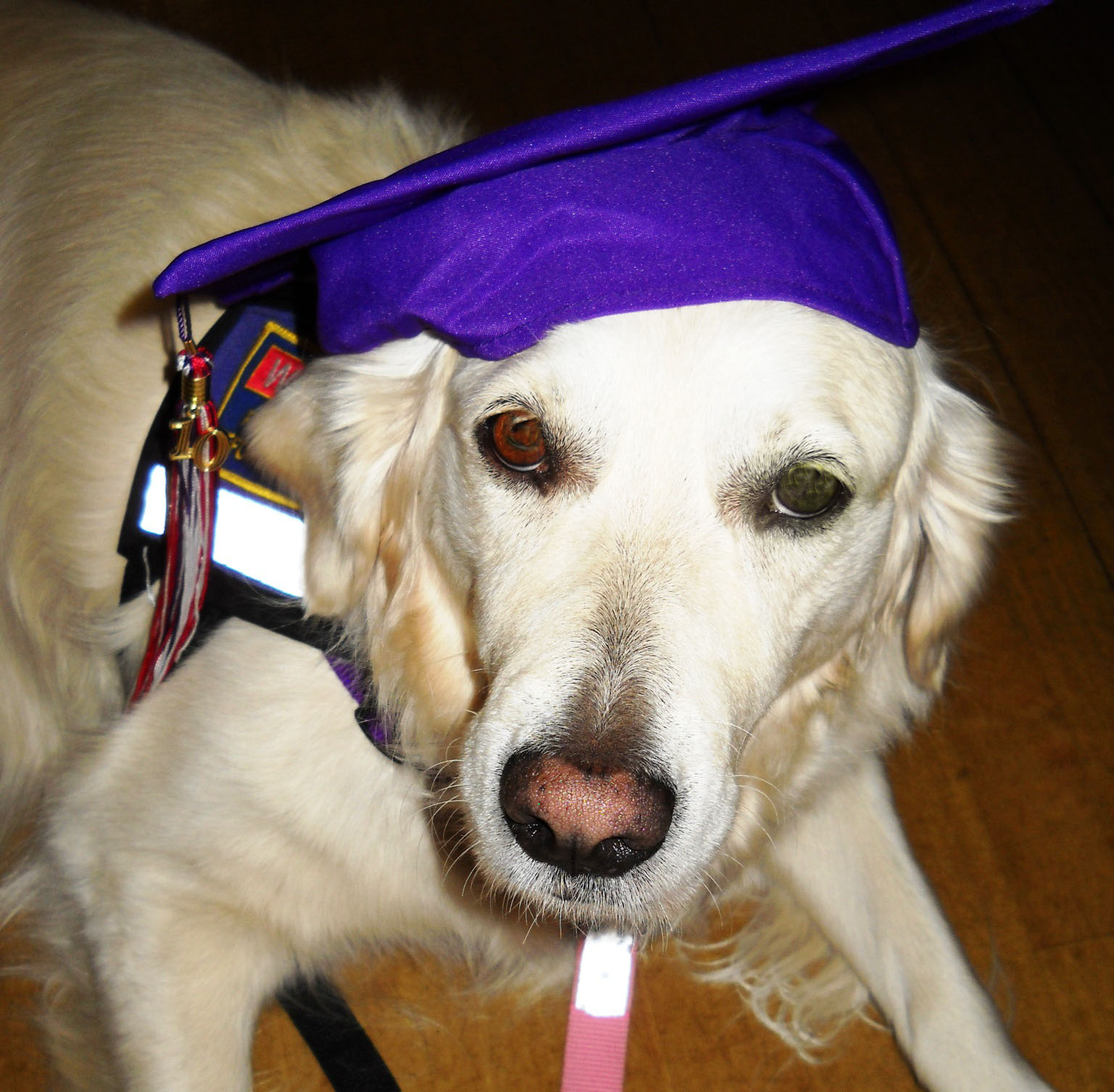
Jana, a golden retriever, wears a graduation mortorboardAnyone who has ever out two treats in her pocket and then given her dog only one knows that dogs can count.

Well, it’s more nuanced than that.

Despite many hoaxes and dubious claims, dogs can’t actually count, at least not without extensive training — but dogs are aware of quantities and relative sizes, without any training at all. And, it turns out, they use the same part of their brains that humans do to assess the approximate number of items in an array or group of items.

About those treats — they definitely know when they are being shorted, or the other dog is getting a bigger piece. And they always know when there is (or recently was) a treat in your pocket. They have excellent noses, you know.

Researchers at Emory University (including my favorite dog researcher, Dr. Gregory Berns) put their well-trained dogs back into the MRI and showed them various groupings of black dots on gray backgrounds. This study doesn’t sound like it was as much fun for the dogs as the ones where they got ordinary treats and good treats so the researchers could see how the pleasure centers in their brains lit up … but I bet the dogs were paid well in treats after all the dots.

The published paper talks a lot about the different parts of the brain, but the upshot is that humans and dogs (and lots of other mammals, apparently) react differently when seeing a small quantity of something (fewer than 4) vs. a larger quantity. This useful skill, called numerosity, benefits both predator and prey animals in their search for food or attempts to avoid becoming food.

The dogs in the study had no math training prior to their MRI experience. The advanced mathematical skills that (some) humans possess use the same area of the brain. I wonder how far the above-average dog could get in math with the right teacher.


A Mind of Her Own

A dirt path, some tall grass and trees. Cali, a golden retriever, is hiding
Where’s Cali?

I was talking to a friend the other day who said of her dog,”She’s smart. She doesn’t obey, but she is smart.”

I said that obedient is not at all the same as smart, and maybe the least obedient dogs are some of the smartest.

There’s a lot of disagreement over how to define or measure “intelligence” in non-humans. Some dog writers and scholars equate trainability and / or obedience with intelligence. I disagree.

Life is certainly simpler and often more pleasant if your dog generally does as you ask. But, unless the dog is likely to face severe punishment for disobeying, I don’t think that following orders has much to do with intelligence.

Cali is a case in point. When it really matters that she listen, she usually does. But one area where we constantly clash is that, when we’re in an off-leash area and I decide it’s time to go home, she nearly always disagrees.

Cali is nestled among grass and weeds, well hidden
Found her

She’ll then play her favorite game, “Snake in the Grass.” She lies down in the tallest grass she can find and suddenly, coincidentally experiences a bout of total deafness.

She does this at home, too, but the grass is greener and shorter so she’s not actually invisible (unless she’s hiding among the raspberry canes).

It’s not that she doesn’t know what I want; she knows. She simply disagrees and is asserting her own agenda. Often, she’s right; our hike or play session was much too short. She is not at all sympathetic to the argument that I need to get back to work (she thinks I work far too much).

She shares her own opinions often — in choosing the direction of our walks or picking a toy or choosing to sleep downstairs instead of in her bed in the bedroom or any number of things. She can be very determined, too.

She knows her own mind, has preferences, and figures out ways to communicate them. I see these as signs of intelligence — more than simply and consistently doing as she’s told. Though that would be nice sometimes.

Cali’s Quiet Competence

This slideshow requires JavaScript.

I was in charge of puppy lunch the other day.

Puppy lunch is Deni and Koala’s name for the midday treat ball break that Koala has trained Deni to give her. The time keeps moving up; it would be more aptly named Puppy brunch, since Koala starts asking for it around 10 am, but that is a different story. Deni and I call it PL, as if Koala, and now Cali, won’t know what we’re talking about. Right.

But I digress.

Koala gets about a quarter-cup of kibble in her large orange treat ball. Cali now gets a smaller amount of kibble in a smaller yellow treat ball. Before anyone howls about unfairness, keep in mind that most dogs stop getting puppy lunch at about 4 months of age. Koala is over 4 years old and Cali is 6. Neither needs puppy lunch, but Koala has everyone convinced that she must eat multiple small meals a day to survive.

Also, Cali doesn’t seem to care. When I gave her a larger treat ball, she lost interest in it well before it was empty. Her lack of fanatical, desperate obsession with food is the least golden-ey thing about her.

They get PL in the downstairs TV / dog play area.

I’ve written in the past about how good Koala is at avoiding obstacles and keeping her treat ball from rolling under things. This large open area is easy for her. She rolls and chases the ball the full length and width of the room, vacuuming up the kibble as it falls out.

Cali has a different strategy. She takes her ball to the dog bed that is in a corner. It’s got walls on two sides and the sofa on the third. She stands in the open end, and gently bats her ball around the small, contained space. It can’t roll under the sofa because the dog bed blocks the bottom opening. This gives her a very easy way to keep track of the ball, get all of the kibble, and stay out of Koala’s zooming, looping path.

This simple strategy shows Cali’s characteristic calm, almost offhand, intelligence. She figures things out and makes the world work for her, in a quiet, unassuming way. She’s fine letting Koala’s exuberance claim the spotlight, and she doesn’t seem to mind that Koala’s treat ball fun lasts a bit longer.

It’s similar when the girls are picking up their toys (which does not happen often enough). Koala leaps and runs and bounces around, flinging toys toward the basket. One occasionally lands inside; others land nearby. She’ll toss the same toy at the basket 3 or 4 times, growing increasingly agitated — at the lack of praise and cookies from Deni. Cali, meanwhile, slowly gets a toy and thrusts it into my hand. (She and I have not worked much on putting things into the basket, for which I take full responsibility.)

Cali’s not always quiet and calm; she’s true to her golden heritage when visitors come or we meet a human, any human, walking down the street. She’s as wriggly and excited to meet a new friend as to greet an old friend. But I really do enjoy her thoughtful approach to problem solving.

The Making of a Cherry Monster

Cali with her tennis ball, in the shade of a cherry tree
Cali discovered delicious snacks under the cherry trees.

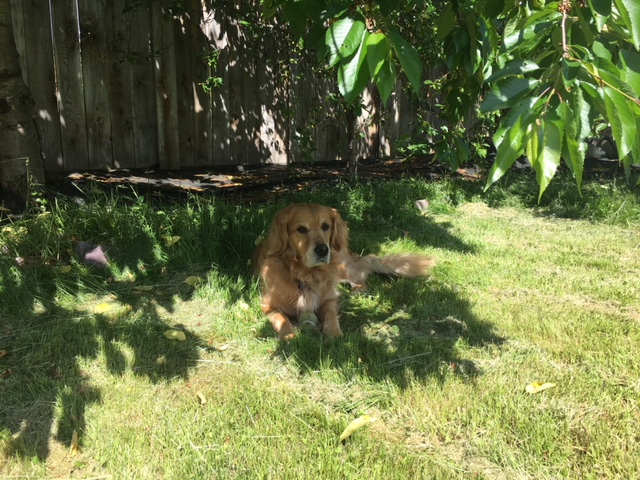
It started out innocently enough. Cali wandered over to that nice shady corner of her yard by the cherry trees. One day, she found something red that smelled delicious. She ate it. She found more of those delicious red balls and ate them, too.

I noticed and told her to cut it out. She carefully spit out the cherry pit that was in her mouth and wandered away.

If only it were that simple.

Soon Koala discovered cherries. She taught Cali that if you swallowed the pits, you could eat a whole lot more cherries, faster, even after one of the mean policemoms caught you and told you to stop.

We went from a pit spitter and a pit pooper to … well, you know.

Then Koala packed up and went back home to Florida. Cali had to figure out stealth cherry chomping on her own. She’d keep an eye on me to see if I was watching. If I was talking on the phone or (!) went inside, she’d steal over to the cherry patch and grab a few cherries. She’d still spit the pits if she felt as if she had time to dine more leisurely. But, if she saw that I’d looked her way or — worse — was walking over to ruin her snack — the gobble rate would speed up.

I chased her away from the cherries. She went back. I threatened to make her go inside. She stayed away for a few minutes but was always drawn back. I cleaned up the dropped cherries. She found more. The call of the cherries was irresistible.

She got very sneaky. She’d wander around the yard feigning nonchalance. If I didn’t react, her loops would take her closer and closer to the cherries … Or she’d head that way and glance casually over her shoulder. If I wasn’t paying attention (or she thought I wasn’t), she’d pick up the pace and head right there. If I was watching, she’d change direction, look again, react appropriately … this meandering ultimately always ended at the cherry feast.

Finally, nearly all the cherries were ripe. I picked several million one Sunday morning. A friend helped me pick most of the remaining billions of cherries one evening after work. We cleaned up the dropped cherries pretty well. Cali went into deep depression.

Now, the only cherries left are too high for me to reach, even with a ladder.  The birds and squirrels help Cali out by dropping and knocking them down.

But Cali has pretty much moved on.

She discovered the raspberries this week.

She picks the low-down ones, being careful to avoid the spiky branches. When I am out there picking, she’ll stick her nose into the bowl and try to steal the fruits of my labor. I tell her to go get her own raspberries. She does, even burrowing into the bushes to go after a particularly juicy berry.

There aren’t as many raspberries, and they have no pits, so I don’t worry as much about her eating those. But somehow, Raspberry Monster doesn’t have the same ring.

Where’s Cali?

Cali hides in tall grass

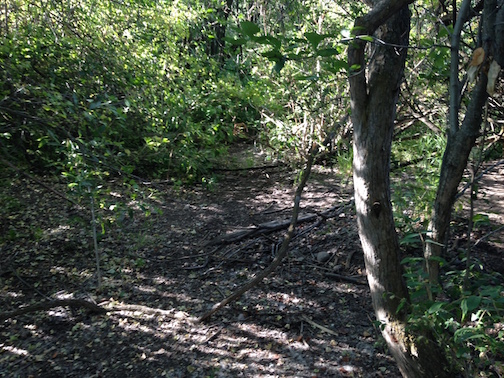
Cali has started a new game. When she doesn’t want to leave someplace (Jacob’s Island Bark Park in Missoula, for example), she hides. She’s really good at hiding, too. See if you can spot her in the photos.

I could get angry with her, say she’s misbehaving, that she’s a willful adolescent. I could also admire her intelligence, strategizing, and ability to read my intentions.

It takes a lot of thought and awareness to hide. Her ability to do so shows that she can think about what I can see and figure out where she can go that I won’t be able to see her. She can anticipate going home, decide that that’s not what she wants, and come up with a way to foil my intentions. She can plan and decide not to respond when I call her, and she understands that she has to be very still so I don’t see or hear her moving.

Cali hides deep in some thick bushes

She has to get the timing right, too. She wants to avoid going home, but it would be self-defeating to hide while I was still willing to play ball with her. So she has to read my body language carefully, in addition to parsing the verbal cues I give her. Finally, she also has to know when to resurface so as not to be abandoned (this would not happen, but how can she be sure of that?) or really get me angry.

A few days ago, she hid at the dog park. I might’ve very foolishly muttered something like “we need to get going” before throwing her ball. She took the ball, ducked under a branch, and disappeared. I called her. Nothing. I waited for about 10 minutes, then called some more. Nothing. I was pissed off. I had seen where she entered the bushes, and I went in after her. She was happy as can be, under some bushes with her ball. I grabbed the ball. That got her attention. We walked back to the car with me giving her an earful about what a terrible dog she was, bad to the bone. She laughed.

Then, the next day, she hid in a friend’s garden. I left her there (with the friend) and figured she’d have a nice afternoon in the grass, playing with dog and human friends. She did, but my friend reported that Cali cried when she realized that I had left. She recovered pretty quickly, though, and had fun; my friend also reported that Cali had a fence-fight with the next-door-neighbor-dog — which Cali instigated. But that’s a problem for another blog post.

I’m not really sure what to do about this new trick. I could just not take her to the dog park, but that’s a terrible solution. I don’t think that telling her to “come out right now or we won’t come back tomorrow” would work. She’s smart, but that is probably too abstract and verbose for her. I could punish her when I find her, but that would only motivate her to do a better job of hiding. I could keep her on a long leash, and risk getting it tangled in trees, picnic tables, other dogs …

She hides with her beloved tennis ball, and when she has her ball, she’s not interested in treats, so stooping to bribery is out. I could just wait her out, but I am not sure that my laptop battery would outlast her, and I do need to work.

Deni suggested letting Cali keep her tennis ball with her when we leave the park so that she’s not worried about losing it. In the apartment, all the time. Ick. Cali loves her tennis ball so much. She is happiest when it is really dirty, so she gets is all drooly and wet, then rolls it in dirt. Sometimes she digs a special pit just to make sure it gets totally covered in really fresh, dirty dirt. I’ve generally not allowed her to have the ball inside. If I get desperate enough, maybe …

Anyone have a better idea?

Breaking News: Researchers Discover That Dogs Can Remember Stuff!

Science has once again confirmed the obvious: Dogs can remember things.

Specifically, a new study shows that dogs might have something that resembles episodic memory in humans — the ability to remember and learn from events and experiences. It’s a different kind of memory than “semantic memory,” which is memory of facts, meanings, and concepts. While these are learned, they are not experiential or shared with others; they are general knowledge.

Note that I am not at all unsure about this; all the conditional language is how science tends to express “discoveries” about nonhumans doing things that some humans think only humans can do. Like remember or use language. I am sure that dogs can do both, often better than many humans do.

Much of what we formally teach dogs — to sit on cue, to play with their toys rather than chew our shoes, to eat their own food rather than graze the pickings on the kitchen counters — falls into the categories of learning facts and concepts.

But anyone who’s ever taken a puppy to a puppy class has been exposed to a kind of teaching that aims to create positive episodic memories. The goal of “socializing” a puppy — teaching him to love children or not fear loud noises or car horns or skateboards or to feel confident and comfortable when experiencing a loud, busy place — all of that builds on the ability to form and learn from experiences. Episodic memory, in other words.

If your puppy has very positive experiences at her vet’s clinic — Cali’s puppy vet gave out the best cookies — then your dog is less likely to be among those who tremble and shake when the car pulls into the clinic parking lot. Or, worse, those who associate every car ride with an unpleasant experience and don’t even want to get into the car.

If dogs didn’t have the ability to form episodic memories, why would Cali bounce around like a very excited pinball (well, she would if she weren’t securely attached to her doggy seatbelt) when we cross the bridge that takes us to Berkeley and sister Dora’s house?

So, yeah, the scientists have, once again, proven something really obvious about dogs.

What’s cool about this study, though, is that the researchers used “imitation” or “do as I do” training. This sort of training shows that dogs have great flexibility and creativity in their ability to learn and extrapolate. The training works a little like Simon Says. The person tells the dog to “watch me,” then does something unusual. In the study, it was touching an open umbrella. The person then tells the dog to “do it,” and the dog is supposed to imitate the human. It’s pretty cool that dogs can look at our very differently shaped bodies and imitate what we’re doing. That they can and eagerly do join in this silly and fun human game is just one of the, oh, trillions of wonderful things about dogs.

And, I think that the training itself requires that the dogs have episodic memory. It’s not like teaching a cue that means a specific action: You say sit, the dog’s butt hits the floor. Imitation training requires that the dog say to herself, in doggy language, hmmm, I shouldn’t do what I did last time we played this and she said “do it”; instead, I have to watch what she’s doing now and do that.

That is more similar to remembering what you experienced in a place (beach or vet clinic) and deciding whether you are happy to return to that place than it is to remembering that hearing this word means do that action. It’s a different kind of learning, and it is based on experience, not association or remembering a fact.

So. That the researchers could even do this study shows that dogs have episodic memory. Now, isn’t that obvious?

How much is that in dog money?

This slideshow requires JavaScript.

I had house-guests recently, and the girls put their entrepreneurial spirits to work. As I have described in other posts, the girls bring me my shoes when it’s time for a walk. They also bring their bowls when they are done eating. For each of these, as well as for getting the paper and for other tasks, they are paid in cookies.

There’s a cookie hierarchy in dogdom and therefore in our home. When requiring the girls to do something they dislike, such as submit to ear-cleaning or nail-trimming, I reward them (some would say bribe, but it happens after the fact) with high-value treats — freeze-dried liver, perhaps, or the dried beef patties we discovered at Costco. When we are practicing recall (come here, right NOW!) they get very high-value treats. We have special tooth-brushing cookies, which are of medium value. Ordinary chores like bringing the paper, shoes, etc. get ordinary treats — a few Charlee Bears or a small biscuit. This, it seems, is the currency of the dog world. They expect to be paid, and, so far, they have been willing to accept the prices I am willing to pay.

They showed a basic understanding of economics when they started bringing things I hadn’t asked for and expecting payment. It reminded me a bit of those kids who used to come out of nowhere and wash your car windshield while you were sitting at a red light, then ask for money. But the girls are cuter and very earnest.

Then my guests came along. One was so enchanted by the dogs bringing shoes — random shoes, no less, maybe taking my shoes to her or a single sandal when she needed her boots — that she inflated the payout. At least once, but I suspect more, she gave Cali a beef patty — a whole one! — and Cali had not even brought her the right shoes! I don’t even want to know what she paid for the girls’ dinner bowls.

Well. Jana and Cali don’t have MBAs, but they don’t need them. The girls quickly understood inflation and supply-and-demand economics. And bargaining: I’ll give you this shoe — and a boot — for one of those beef patties. I’ll throw in a phone or a TV remote if you’ll give me two. What? A measly Charlee Bear? I am going to hang on to this slipper. When your foot is cold, you’ll pay more.

Just what I need. A looming winter of cold feet and fat dogs. I’d better go to Costco this week. We’re gonna need more beef patties.