‘Talking Animals’ Podcast

I returned to the “Talking Animals” podcast recently to listen to the interview that host Duncan Strauss conducted with with Deni when Catching Sight was released. He asked insightful and often challenging questions and demonstrated a thorough and attentive read of the book.

Curious, I looked over the long list of past episodes. Talking Animals is a radio show on a Florida NPR station, so many of the guests are local to the Tampa-St. Petersburg area, and one fun interview was with Stan Kroh, who oversees the Manatee Viewing Center that Tampa Electric runs in Apollo Beach, FL, a place I loved to visit when I lived in St. Petersburg.

Some recent interviewees are more familiar to me, including Marc Bekoff and Bonnie Bergin. Strauss and Marc Bekoff discussed Bekoff’s new book on animal emotions, which sounds like something I need to read!

I haven’t (yet!) heard Strauss’s interview with Ronan Donovan, whose breathtaking photographs of wolves were on exhibit when Deni and I visited St. Petersburg’s Museum of Western & Wildlife Art in June.

A dog trainer and behaviorist is an occasional guest, taking listener questions about their dogs’ or cats’ behavior. Listeners submit questions by email or text or simply call in.

The podcast is not specifically dog- or even pet-focused; it addresses a wide variety of animal-related topics with interesting guests. Give it a try!

Who’s Smarter?

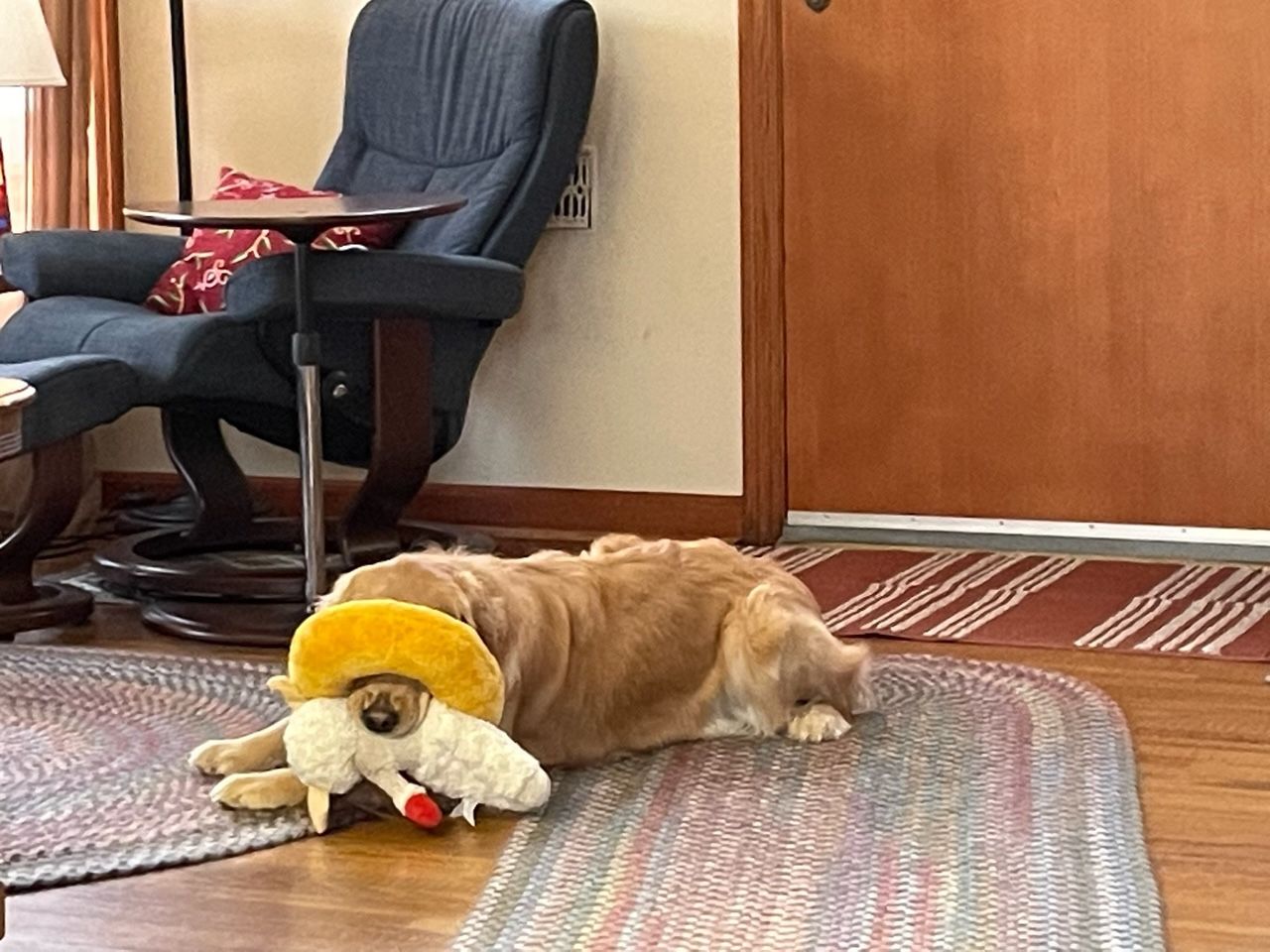
Orly holds a white lamb toy in her mouth while, her mouth stuck through the hole, an orange donut toy covers her eyesI was asked recently what I thought of this response to the question of whether dogs are smarter than wolves: “Wolves can’t be all that smart as a species, or they wouldn’t have become endangered over much of their range, while dogs are thriving, lounging inside our air-conditioned homes and relaxing in recliners.”

Where to begin with this idiocy?

That wolves still exist despite the efforts of humans around the globe and across centuries to eradicate them is a testament to both their intelligence and their resilience.

That dogs have trained humans to spoil them rotten is possibly also a statement about their intelligence, but likely more of a statement about humans …

But the comparison is absurd. They are different species living in different environments. Every aspect of dogs’ physical and mental makeup has been heavily influenced by human control over their breeding, environment, diet, social lives, and pretty much everything else in their lives. I guess the starting point should be how the author defines intelligence.

I’ve read dog books that define canine intelligence as trainability, that is, the willingness of a dog to do what a person wants them to do. I’ve seen it defined as problem-solving ability or as the ability to manipulate humans to do as the dog wishes. I’ve even seen it defined as mathematical ability.

I don’t have a simple definition or formula for deciding how intelligent dogs are as a species or even how intelligent an individual dog is. As with wolves, I see intelligence as the ability to understand the reality you live in and figure out how to thrive there. That looks very different for Orly or Hildy or  your own dog than it does for a wolf in Yellowstone, one in Isle Royale, or one in Siberia.

I also believe that there are multiple types of intelligence, such as:

  • Problem-solving: There was not a treat puzzle toy that Jana could not figure out and empty (in seconds) … until she met Squirrel Dude. Orly gives up after a few seconds on all but the easiest toys, but she loves her snuffle mat. Other dogs scheme, alone or in collaboration, to reach food on a counter, open containers, or escape from fenced yards. Some dogs use tools. Feral dogs use all kinds of problem-solving skill to survive, thrive, and even raise families.
  • Social intelligence — with dogs: Some dogs get along well with others. Some do not. They learn the dog social cues … or they don’t. Humans are similar.
  • Social intelligence — with humans and/or other non-dog species: Again, some dogs do better than others here. Cali never quite got the concept of a stranger. To her, all humans were delightful. She would get so excited to see a person, random unknown person, walking down the same sidewalk. If that person said hi to her, Cali welcomed them like a long-lost best friend. She made many, many people’s days a little brighter with that social intelligence. Dogs demonstrate social intelligence in their ability to get humans to do what they want and to outsmart us with patience and persistence.
  • Empathy: Another form of social intelligence perhaps; many dogs excel at intuiting the moods of their human packmates and comforting us if we’re sad. They’re also eager to make us laugh and often do — and repeat — goofy things just because we laugh when they do.
  • Sensory: This ranges from dogs’ astounding scent abilities to the way some dogs, including both Cali and Orly, had a mysterious ability to know when a loved human was coming home. That extends in Orly’s case to many friends. both were able to determine that someone they adored was heading home, several minutes before the person’s arrival.
  • And yes, trainability: By this I do not mean obedience or quick responsiveness to humans’ commands, though, but interest in learning new things, whether a dog sport, silly tricks, guide work, or any of myriad ways dogs learn to work with, collaborate with, and assist humans and each other. It can include developing a huge vocabulary (& learning grammar).

Wolves excel at problem solving, pack collaboration and planning, and social intelligence within and across species, but far less with humans. That makes sense. It does not make them less intelligent than dogs, just different. Dogs would not fare well in the environments where wolves thrive. Again, this does not reflect lower intelligence but a different ecological niche.

The same can be said about breeds. I don’t think that dogs of some breeds, or of mixed breeds are any more or less intelligent that dogs of other breeds. They might behave differently or have different temperaments and preferences — as do individuals within a breed. None of that makes one “smarter” than the others.

I suspect that the whole question of which dogs are smarter is simply a way for humans to feel superior that their dog or favored breed comes out on top… when they stack the deck by defining intelligence in a way that favors their dog or favorite breed.

Can’t we just love the individual dogs we’re lucky enough to share our lives with and appreciate their unique blend of abilities?


A Dog’s World

The subtitle of this book is what really caught my attention: Imagining the Lives of Dogs in a World Without Humans.

The premise, that all humans vanish one day and dogs have to quickly pivot to self-sufficiency, is an interesting idea to ponder. And the book felt more like a collection of notes on conversations between the coauthors, Jessica Pierce and Marc Bekoff. But… it never really addressed the topic.

The book is full of speculation about how dogs’ body shape and size would impact their survival and ability to thrive, for example, with far too much commentary on breeding practices. And dozens of comments on how dogs are so dependent upon human food and waste (mostly trash/thrown-out food but they used the word ‘waste’ so often that I wondered whether they meant biowaste as well) that they would struggle to identify potential food sources.

But I kept waiting for the conversation on how a human-less world would look and feel from a more nature-focused perspective. It never came. Other species, both plant and animal, would change dramatically without humans in the picture, often for the better. I had hoped for some attention to how that might look — and, of course, how that might benefit or harm dogs.

An even bigger miss, in my opinion, was a lack of attention to dogs’ mental abilities. Would dogs bred for work, whether agricultural, military, or assistance, perform better at solving the new challenges of life without their servants-with-handy-thumbs?

Finally, the chapter on “doomsday prepping.” Prepping your dog. For the day that all humans instantly, simultaneously, mysteriously vanish, leaving everything else in the world intact. First, prepping for that is not necessary. Second, the suggestions are absurd. Maybe that chapter is intended as comic relief (I hope so) but … I even more fervently hope that no one takes seriously suggestions to let dogs:

  • “forage for themselves while out on walks (goose poop,a half-eaten hamburger or tofu hot dog that has fallen out of a trash can…”
  • “dig holes in the yard”
  • “snatch food from the counter or even from our hands”
  • “stop trying to ‘un-teach’ or constrain natural behaviors (marking outside the home, sniffing butts or crotches… digging, and roaming.)”

Don’t do any of these.

Their other suggestions, though, are great (and also: are basic dog parenting):

Conveniently, these activities provide dogs and their humans with relationship-building opportunities and a lot of fun!

I like both authors, so I wish I could recommend this book but … I can’t.

Don’t Miss ‘Dog Words’!

Podcast logo reading Dog Words Just Talking About DogsThe rollout of Catching Sight: How a Guide Dog Helped Me See Myself has brought unexpected benefits. One that I can share with all of you is the discovery of the Dog Words podcast.
The episode where Deni and coauthor Graham Buck describe their initial meeting, how Alberta came to be Deni’s partner, and key aspects of service dog partnerships is not to be missed!

After playing that episode, I explored their archives, and found that Dog Words has more than 200 dog-focused episodes. The website is a project of the Rosie Fund. Curiosity piqued, I needed to know about the Rosie Fund…

Which turns out (not surprisingly) to be a dog-focused charitable organization. The Rosie Fund’s mission is to “provide humans with the resources and education they need to give senior and harder-to-adopt dogs a better life.” 

While not specifically dog-focused, the “He’s Just” podcast has interviewed Deni, as has the Friends in Art Authors Collective (look for the May 22 episode). Find these wherever you get your podcasts.

And of course, you can still order your copy from Bookshop.org!

Catching Sight Is Launched!

Catching Sight: How a Guide Dog Helped Me See MyselfCatching Sight: How a Guide Dog Helped Me See Myself by Deni Elliott
My rating: 5 of 5 stars


Have you ever wondered how a guide dog knows how to __ ? (Fill in the blank: Find a chair, find a bathroom, find your hotel room…). Catching Sight will answer these questions and more.

When I asked the author why she wrote it, she said, “I met a dog I could trust with my life.” She then added, “Once I got past how amazing that was, I wanted to know how a dog gets to be that way.”

Catching Sight is part memoir, part training journal, and all great story. It describes the extraordinary training and inter-species communication that goes into transforming a puppy into a competent, confident guide dog — and a human with limited vision into a competent, confident guide-dog handler. In examining the guide-dog partnership from every angle, the book shares insights that might make you look at your own dog with new respect (unless she’s got her stuffed doughnut toy stuck on her nose as she dances around the living room … again).

Anyone who wonders how guide dogs work, how they know what to do, and what makes them extraordinary will get answers in Catching Sight. You’ll glean tips on how to improve your relationship with your dog (or human) family members. And, you will learn about how and why a person might hide their disability — and the author’s struggle come to terms with being publicly, obviously identifiable as a blind person.


View all my reviews

Outfoxed Again!

Cover of How Dogs Love Us by Gregory Berns, showing a golden dog's face on a black backgroundOrly is always (at least) a step ahead of me.

We’re constantly innovating on our Explorer Walks, and we try out new routes and variations of routes constantly.

Let me amend that: Orly is constantly innovating, and I am always a bit behind in figuring out the real motivation. Let’s be honest here: The One True motivation is food. But it’s a little more challenging (to me, anyhow) to tease out just how Orly thinks a new route or new behavior will increase her treat intake.

I know that she intentionally guides me past yards where a barky dog is likely to be outside. And that she requests a treat whenever we pass yards that might have had a barking dog, even if the resident dog is nowhere to be seen. She recently led me past Milo’s yard twice on the same walk (Milo’s brother is a reliable barker, and their mom keeps a jar of treats hidden in a planter).

I eventually caught on to at least some of the ways that she, um, encourages other dogs in yards to bark as we walk by, such as sticking her nose under the fence or muttering something rude under her breath.

But it wasn’t until I read a recent review of an old favorite book (How Dogs Love Us by Gregory Berns) that I started thinking about all of the cognitive skill behind her masterminding our walks.

The author of the review, Daniel Antolec, describes putting together his dog’s excited expectation on days that a doggy friend was visiting with his dog’s ability to identify a pattern. Daniel’s morning routine varied in specific ways only on the days the dog friends were coming over. Daniel describes the book’s discussion of dogs’ ability to anticipate and dogs’ skill at learning from, communicating with, and forming bonds with other species.

Looking at Orly’s navigation of our walks with a bigger-picture view, I finally understand that she plans the route and engineers encounters with other dogs based on much more than a passing scent. She sets out with her goal firmly in mind (maximum number of treats) and is able to shift gears and redirect us by a block or a half mile if she picks up a promising cue.

I have accepted the truth that she will consistently outfox me. Lead on, Orly!

Catching Sight: Thinking Dog Alberta’s New Biography

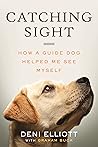
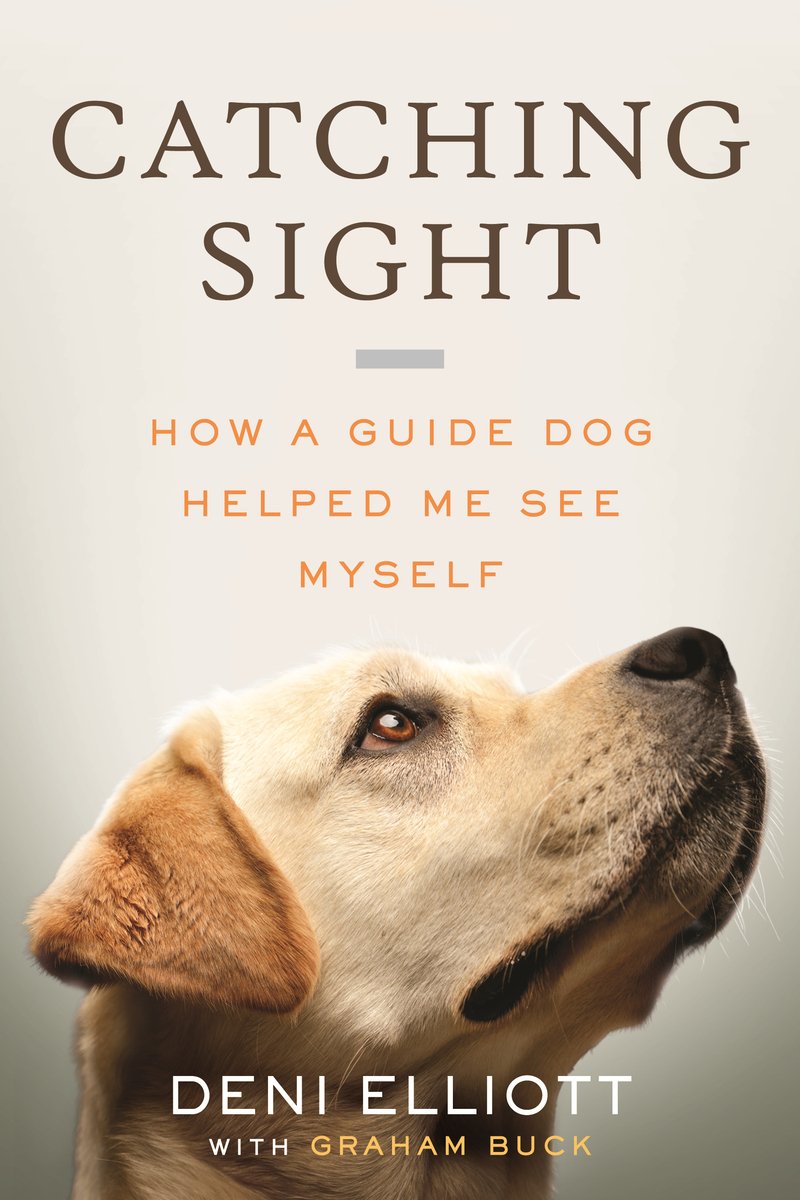
Catching Sight book cover shows guide dog Alberta, a yellow Lab looking up and to the right“I met a dog I could trust with my life,” author Deni Elliott says about her motivation to write Catching Sight: How a Guide Dog Helped Me See Myself. “Once I got past how amazing that was, I wanted to know how a dog gets to be that way.”

Catching Sight presents a three-pronged narrative that describes the extraordinary training and inter-species communication that goes into transforming a puppy into a competent, confident guide dog.

While researching Guiding Eyes Alberta’s early-puppyhood experience—and indeed, the pre-puppy experience at Guiding Eyes, which conducts deep research into genetics and past results—Deni explored every aspect of what makes it possible for a human with a disability to have a collaborative relationship with a dog who helps to mitigate that disability.

Anyone who wonders how guide dogs work, how they know what to do, and what makes them extraordinary will get answers in Catching Sight. They’ll also learn about how and why a person might hide their disability and Deni’s struggle come to terms with being publicly, obviously identifiable as a blind person.

But Catching Sight is about more than the guide dog-human partnership. It is relevant to anyone who wants to raise their puppy to become what Deni describes as “a true collaborative companion.”

Combining serious, fascinating information about Guiding Eyes Alberta’s education with humorous stories, it’s also a great read. I should know; I have read it at least a dozen times in various drafts over the past couple of years—and I will happily read it again, once I have the ‘real’ book in my hands.

Pre-order your copy at Bookshop.org, where you can support your local independent bookstore from the comfort of your living room—and get the book delivered still hot off the digital press. It will be in bookstores on June 16.


Smell Walks 3.0: Introducing Explorer Walks

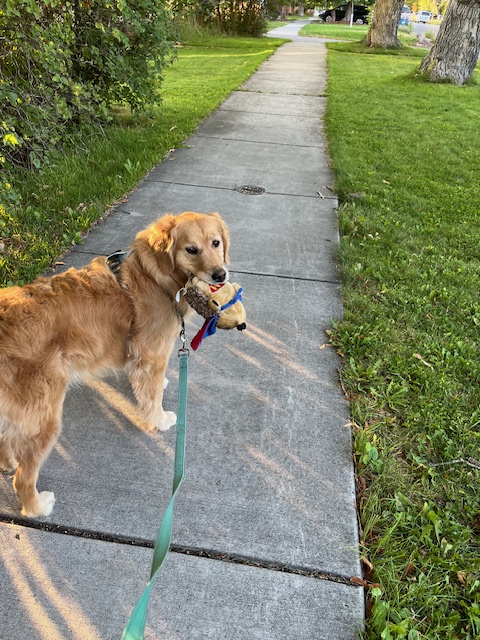
Orly, a golden retriever, holds the hedgehog toy and looks back at me. We're connected with a light blue leash.The Thinking Dog’s first iteration of Smell Walks (also called “Sniffaris”) was released in 2016, while I was reading Being a Dog by Alexandra Horowitz. When Koala, Cali, and I walked in my current neighborhood, the Walks got their first serious update.

Orly, who is very much her own dog, has spurred a third release with a new name: Explorer Walks. Huh, she sniffed virtually to Koala (who retired a couple of years ago). “I’ll take your sniff budget and raise it … exponentially.”

Orly enjoys deep, long sniffs of anything I will let her investigate. And she loves our usual morning walking route, which takes us through a couple of neighborhoods, past three schools, and through the alley behind a restaurant and a mini-market. That was Orly’s choice; she does not like going past those businesses on the front sidewalk.

This route connected her with Super Hedgie, whom she carried all the way home.

She definitely has her favorite stop-and-sniff spots, but she is more novelty-seeking than Cali or Koala.

At least once a week, she chooses a different route. We start off the same way, and at some point she turns left or right where we’d usually go straight, or continues down a street, breezing past our usual left turn.

We’ve explored the Rose Park, many side streets, and a significant chunk of the neighborhoods around the university and a high school. We’ve walked the wrong way on one-way streets, explored small parks, met new dogs and, presumably, different neighborhood deer. We pass a couple of friends’ houses, countless interesting gardens, and a couple of fences with windows at dog-height, but no dogs.

Orly’s other enhancement to the Smell Walks is the pursuit of yards with barky dogs.

Orly has expertly engineered our morning walks to maximize:

  • New and interesting sniff spots
  • Old, reliable news sites
  • Treats extracted for provoking but not responding to barky dogs
  • Number of times we pass by the Big Dipper each week, just in case it has decided to open before 8 am

All this, and we (almost) always get home in time for me make some coffee before I start work at 8:30. Not surprisingly, I nearly always need more coffee…


Keeping Dogs with Their People

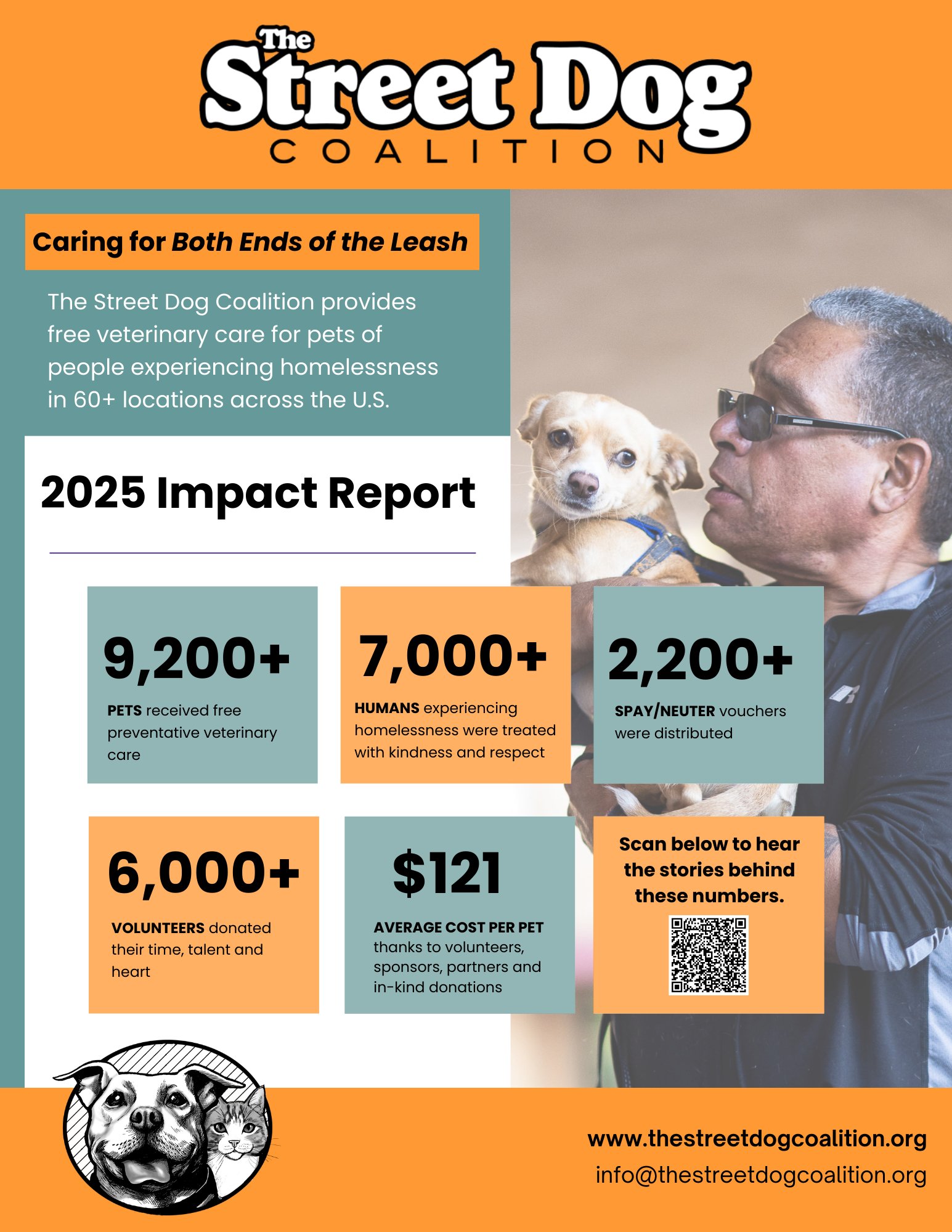
Graphic showing the impact of the Street Dog Coalition, with 9,200 pets and more than 7,000 humans served in 2025.

I recently joined the volunteer team for the Missoula chapter of the Street Dog Coalition. This Colorado-based organization provides “pop-up” vet clinics for people experiencing homelessness or housing insecurity. Its 60+ chapters served more than 9,000 pets and their humans in 2025.

In Missoula, the vet clinics occur once a month and are advertised at shelters, food pantries, and other places people who might need them might be. The vets and vet techs, along with a dozen or so pet-loving volunteers, serve a seemingly unending stream of people of all ages with dogs and cats of all sizes over a few very busy hours.

The vets provide vaccines, check-ups, advice, and vouchers for to get the pets spayed or neutered. The vet techs clean ears, trim nails, and more. The volunteers weigh the pets, dispense food, donated leashes, collars, and toys, fill in paperwork, hold squirming pets for nail trims, clean messes, and hand out treats. Lots of treats.

Assigned to assist one of the vets, I got to hold dogs ranging from a 9-week-old puppy to an older dog who had been through a lot before finding her current human, a warm and loving woman who was working every angle to try to get the dog some care she urgently needed.

The chaos of vets, techs, and volunteers, along with a crowd of waiting patients, didn’t help reassure the already nervous dogs. (The cats were in a separate, quieter space.) Many of the dogs were too stressed to even take treats. Those dogs generally skipped the nail trim.

It’s still pretty chilly in Missoula, and many of the pets come in wearing sweaters, jackets, and onesies of all types and colors. Donated dog- and cat-clothing is popular and disappears quickly from the giveaway table.

Next to the giveaway table is a second table, piled high with bags of dog and cat food, separated into adult and puppy or kitten foods, most of it donated by area pet stores. At this clinic, the vets were also giving out flea & tick preventive and heartworm preventive, also donated by clinics that were clearing out stock that is close to expiring.

Chatting with one of the vets, I heard about a continuing ed seminar she’d been to recently about mosquito-borne illnesses, including heartworm. Since we barely  had winter this year, she said that we should be giving the preventive tablets year-round, since we can’t count on having enough days of weather cold enough to kill the mosquitos. That’s probably as surprising to most Montanans as it was to me!


Drive-Through? Think Again…

I made an unforgivable mistake recently.

I invited Orly to ride along on my weekend errands. Quick trip to the grocery store; Lowe’s (dog-friendly; treat-bearing staff), a gas station, and the credit union.

Which was closed.

The fatal error was using the drive-up ATM.

You see, drive-throughs, at least in Missoula, are generally very dog-friendly. Orly has an elaborate rating system; I wouldn’t be surprised to find a doggy social media platform that ranks the drive-throughs and offers tips on steering your chauffeur to the right ones.

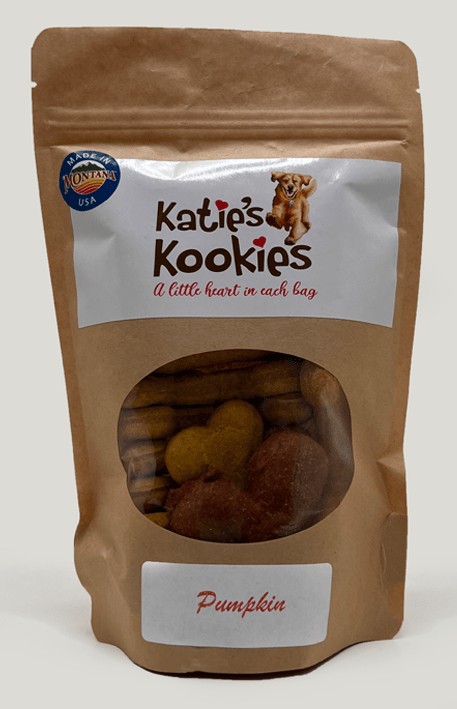
My credit union is in the top two: They give out the “good” biscuits, Katie’s Kookies. It’s a toss-up between them and Bridge Pizza for the top spot (Bridge gives out slices of pepperoni, a delicacy that Orly has never seen at home).

But, obviously, the drive-up ATM does not dispense biscuits.

Actually, that’s not obvious! I can choose the assortment of bills I get with my withdrawal. How hard would it be to add a “biscuit” option?! Two 50’s, five 20’s, and a dog cookie. Why not?

Orly has a point. She patiently rode around with me all morning. She sat politely for her treats at Lowe’s. I didn’t let her drive at all, not even in the Lowe’s parking lot. Didn’t she deserve a Katie’s Kookie?

We’ve been through the credit union and Bridge drive-throughs since, and she’s happily collected her due. We visit the Loose Caboose (jerky treats) most Sundays with Orly’s friend Maisy and Maisy’s mom, after our weekly walk.

Despite the frequent drive-through successes, I think she’s still holding a grudge.

And I definitely think twice about heading to the credit union unless there will be cookie-dispensing humans on duty!