Agility Offers Fun for Thinking Dogs

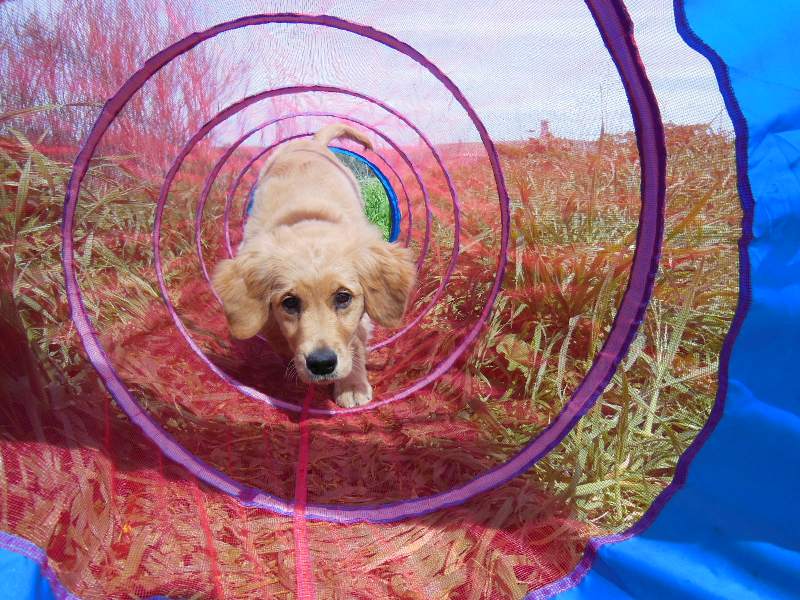
lost in the tunnelCali and Alberta started taking agility classes a few weeks ago. Watching Cali puzzle through things and figure out what we want has been fun. I can almost see the wheels turning in her little head.

Alberta is more experienced with dog sports and classes, having nearly completed her Rally Advanced Excellent title. She catches on very quickly, but knowing what we want her to do doesn’t keep Alberta from showing her silly side in class sometimes.

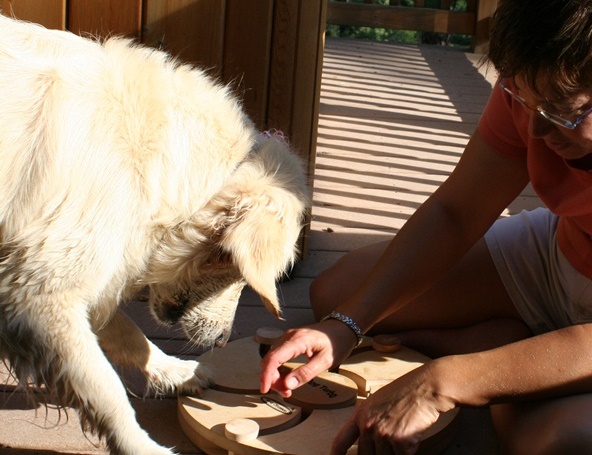
In the first couple of classes, we worked on targeting a small piece of foam on the floor. Both girls are proficient at hand targeting and were able to touch our hands, on cue, no matter whether we placed them high, low, on our backs, or anywhere else. Getting them to touch the foam mat was easy, too, but … both Cali and Alberta quickly went from simply touching it to retrieving it. Alberta, in particular, has a great working retrieve and has often been rewarded for bringing Deni items that Deni didn’t even know she had dropped.

I’ve been working on teaching Cali to bring my shoes, and, like Jana and Oriel before her, she has shown some entrepreneurial spirit, bringing things that I don’t even know that I need (or want) — in hopes of exchanging them for a small cookie.

So it’s not surprising that both Cali and Alberta think that we want them to retrieve the small mat, rather than simply touch it. Or perhaps they know that we want them to touch it but prefer to retrieve it.

They both are eager to jump onto the agility equipment, out of turn or when we’re waiting for our turn at a different piece of equipment. No fear from either of them; just eagerness to learn more and try out new challenges.

Practicing at home is also fun (and can become a three-dog circus pretty quickly). Jana wants in on the action, and when I was guiding Cali through some fake weave poles, Jana knocked one over with a swish of her tail — while grabbing another and running off with it in her mouth. Meanwhile, Alberta knocked over the other two! Poor Cali never had a chance. With more practice, though, we have managed to get all three girls to walk between the poles, though we still occasionally lose a pole or two to a swishing tail.
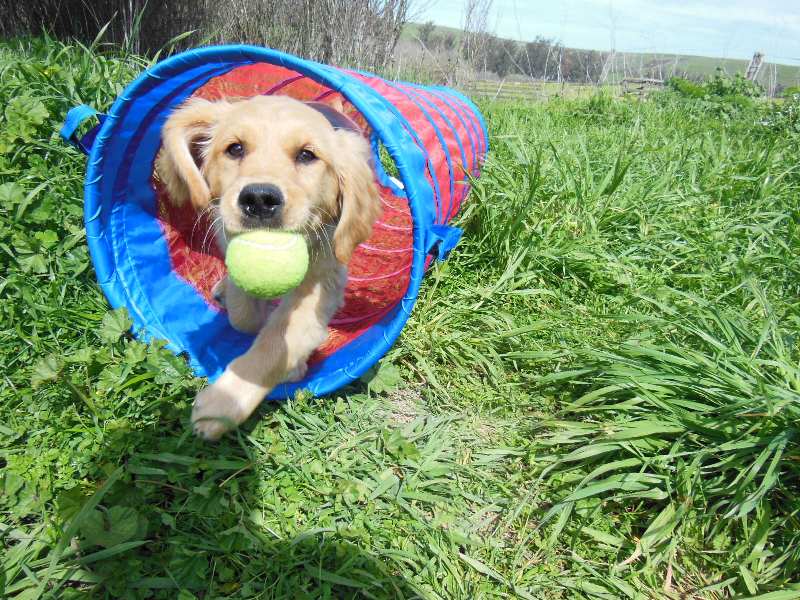
Out of the tunnelNone of our girls has any trouble with tunnels, though Cali did try to circumvent the tunnel once, taking a shortcut to where I was standing. She has always loved tunnels. Cali had a wonderful little play tunnel when she was a puppy, and Jana had plenty of exposure to tunnels before her first agility class. So neither of them hesitates, even when the tunnels are curved or have a piece of fabric covering one end, though many dogs resist entering a tunnel if they cannot see through to the end of it.

I thought about this last week as I was working with a neighbor’s dog, an adolescent golden retriever who is unwilling to use her dog door. The door flap makes her nervous. I rigged up a tunnel using a small table and a towel, and after a couple of sessions, she was willing (though still not exactly eager) to go through it for cookies. She’s uncomfortable with the small space, the towel brushing her back, and her inability to see what is coming. She’s improving, but she reminded me of how important it is to expose dogs to all sorts of tactile experiences, starting at a very young age.

Even that is not foolproof, though; this dog did use the door flap when she was younger, until she had a scary head-to-head confrontation with the cat as she went through the flap. My jerry-rigged tunnel will (I hope) help build her confidence in the same way that agility classes are boosting Cali’s confidence and awareness of where her body is. Classes in agility or other dog sports are a lot of fun — and they improve the dog’s focus on you and your communication with each other. Besides, they provide plenty of mental challenges to your thinking dog!

Her Very Own Key

Surveying her territory

Cali got her own key last night.

Readers of Merle’s Door — or Cali, the Ghost, and the Dog Door or A Doorway to Your Dog’s Independence — will understand the significance of this moment.

Deni’s house in Montana has an electronic dog door. The dogs each wear a magnet on their collars. The magnet opens the door, letting the dog go outside, into the fenced dog yard. It’s a nice dog yard with its own deck and a fabulous view of the mountains and valley. Lucky dogs.

Cali had learned about dog doors in our Florida house, but her key privileges were quickly rescinded when she spent her time chasing and eating lizards, digging, and going in and out and in and out and in and out … Our California apartment has no dog door, and Cali’s outdoor privileges are often suspended due to incessant digging and / or barking at the neighbors. If you can’t handle the freedom, I tell her, you have to stay with me.

Cali clearly treasures the privilege, as she showed us the first time she got a key and went in and out and in … She no longer does that, but she does relish opening her own door — often waiting for the dog door to open and using it even when we’re walking through the people door at the same time. Jana and Alberta, on the other paw, will stand by the people door and bark for their staff. When we fail to materialize and open the door promptly enough, they’ll disdainfully resort to using the dog door.

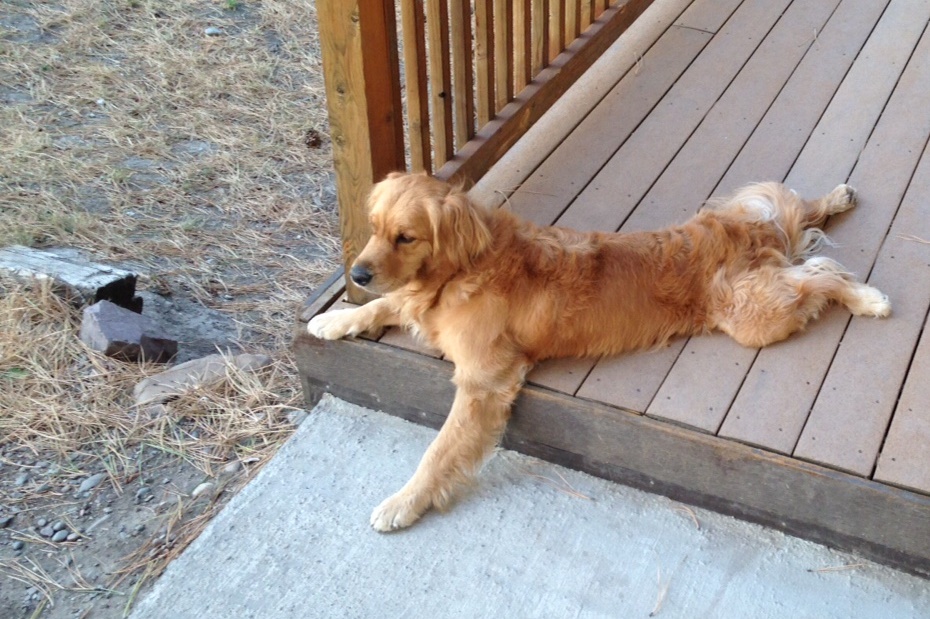
Cali convinced us of her increasing maturity, after spending most of an afternoon stretched out in her “bearskin rug” pose, watching the world go by. That world included a few deer, many squirrels, and an enormous truck that dumped four loads of dirt and gravel on the driveway. Nary a bark was heard nor a hole dug. Our baby is growing up!

Well … not so fast. Increased wildlife activity in the evening required closing the dog door. Barking at deer in the morning prompted a brief suspension of Cali’s privileges.

Even with these bumps in the road, it’s clear that Cali has turned a corner. She’s much more thoughtful and better able to rein in her abundant enthusiasm. She still gets excited (very excited) about meeting new people or heading out to play ball, but she can get a grip on her enthusiasm, sitting and trembling all over rather than jumping straight into a stranger’s arms, for example. As we walk to the play yard, she skips ahead, remembers, backs up, skips ahead, remembers, backs up … over and over. I don’t have to say a word. She rarely even gets to the point of pulling at the end of the leash anymore. And, last week, a friend asked whether 6-month-old Scarlett would “be as nice and calm as Cali when she grows up.” Granted, the friend hadn’t known Cali for very long …still, it was a nice compliment.

Scarlett, at 6 months, already shows her strong personality and intelligence. However, she’s heading full-speed-ahead into adolescence, and she lacks impulse control. Cali was similar at that age. Watching them together provides a nice reminder that, if you get through those crazy months, you just might end up with a wonderful adult dog at the other end of that long, dark, frustrating tunnel.

Hoping for a Doggy Sequel

I’ll admit it up front: I might be just a bit obsessed with figuring out what goes on inside a dog’s mind. But many of you more “normal” dog lovers might appreciate a movie that helps by way of metaphor.

If you haven’t seen it yet, get yourself to the next showing of “Inside Out.” Stay for the credits. “Inside Out,” a summer blockbuster, is an animated movie that takes viewers inside the head of 11-year-old Riley Anderson. The main characters are her five primary emotions: Joy, Sadness, Anger, Fear and Disgust.

The metaphor should be obvious: Of course dogs experience these emotions. The real question is: How is their experience similar to (and different from) ours?

I’ve always been sure that dogs experience their own versions of joy, sadness, anger, and fear. I was on the fence about dogs and disgust for a long time, though. I’ve seen dogs eat and/or roll in many, many things that certainly trigger my disgust. Their concept of disgust, if it existed, was a mystery.

Then we offered Wylie, a fussy German shepherd, a peanut butter treat. The expression on his face: Pure disgust. He actually flinched. Then he wrinkled his nose, curled his lips, and backed away. That, and the accompanying reflexive gag, couldn’t be anything else. Peanut butter was clearly a human attempt to poison him.

Then there’s Jana’s priceless, very teenagery, eye-roll when Cali and Dora get too wild. Yep. Pure disgust: Puppies. Ick.

“Inside Out,” which I personally think is meant for adults — the best stuff goes right over the kids’ heads! — explains the necessity for and connections among all of those complicated emotions. Fear makes you pay attention: It can literally wake you up. Joy helps create the core elements of your personality. Sadness makes happy memories more precious. It can also influence your choices, pushing you to make decisions that allow you to hold onto memories — or connections — that once were joyful. Anger can make you notice injustice, or even speak out against it.

Which brings us back to disgust. A key role of Disgust, according to the movie is keeping us from being poisoned; toddler Riley is sure that broccoli will kill her. Disgust doesn’t seem to play the same role for Jana, who happens to love broccoli. She also wolfs down acorns every chance she gets, despite the cramps and upset tummy that inevitably follow. She is among the many dogs who eagerly lap up things that could (and do) poison them, ranging from antifreeze to raisins or chocolate. So I am still puzzling out what the emotion of disgust does for dogs — other than convince them that their own humans are trying to poison them.

A key lesson in the film that applies equally to dogs is the link between emotions and memory. Memories without a strong emotional component fade away, turn a dull gray, and are swept into a dump by an army of technicians in Riley’s brain. (The same guys periodically send up an annoying jingle from a gum commercial to bounce around in her head all day for no particular reason. I wonder if that happens to dogs.)

One of the ways that the other emotions kept Fear under control was by creating frequent associations with Joy. This is an essential fact for anyone with a dog, particularly a puppy, to understand. To forestall fears, dogs need frequent association of positive, joyful emotions with things that could be scary — people in hats, loud noises, balloons … Ideally, this happens in early puppyhood, before the dog hits adolescence.

But even fearful adult dogs can be helped. As “Inside Out” shows, recalling a memory while in a different emotional state can alter the emotion associated with the memory. In the movie, this is dramatically illustrated when every joyful memory that Sadness touches takes on her hue of blue … but it can work the other way, too. As trainers who advocate counter-conditioning and desensitization know, we can sometimes change fearful associations to joyful ones with careful, controlled exposure and appropriate positive reinforcement.

OK, so, why should you stay for the credits? I don’t want to give too much away, but the glimpse inside the dog’s mind is enough for me to want a canine sequel. The cat might even be better …


Duck-Induced Deafness

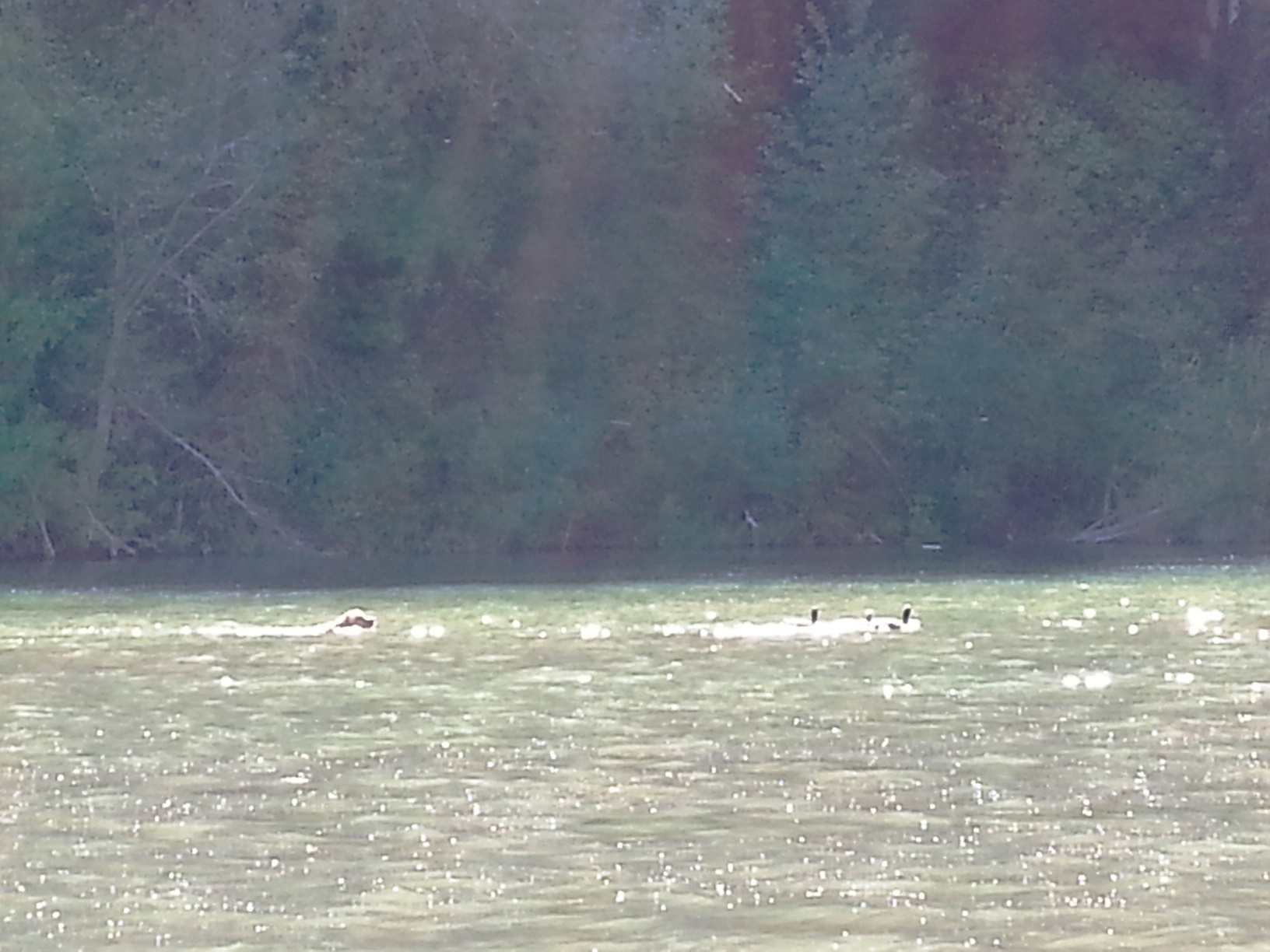
cali and ducksI’m a whole lot less interesting than three mallards. I’m trying not to take it personally.
I took the girls swimming the other day at the Russian River. We were having a nice time splashing around, and Cali was happily swimming after a ball. Jana was searching for rocks. Russian RIver April 2015She likes to find heart-shaped rocks, as I have described in an earlier post. She added this one (right) to our collection on this particular river excursion. In short, all was well.
Until those darn ducks swam by. There were about 10 ducks, enjoying a sunny day. Jana noticed them first. She’d swim in their general direction, and they’d fly up a few feet into the air, and she’d lose interest.

Then Cali got in on the game. She just followed them around, never getting too close. She was no threat. She was holding a tennis ball in her mouth the whole time, and she never got closer than about 10 feet. Three of the ducks decided to play a little game with her. They did not fly away. They stayed just far enough in front of her that they (apparently) felt safe but close enough that she stayed interested. And they swam around in big circles. They swam across the river, around a big island, back to our side. Upriver. Downriver. Big circles.

Cali paddled doggedly after them.

At first, it was funny. She never let go of her tennis ball. She’s a strong swimmer, but after a few minutes, I started worrying that she’d get tired. My friend and I waded farther into the river, determined to head them off if they headed downriver. They didn’t.

We called Cali and waved. But she was suffering a bout of duck-induced deafness and never heard a thing. Jana had long since given up on following the ducks and was nosing around for sticks on the beach. The other golden in our group had gone back to tennis balls. But not Cali. Back and forth, around and around. Finally, my friend couldn’t stand it any longer. She crossed the river and grabbed Cali, getting soaked in the process. Cali still had her tennis ball. She was not even winded.

Jana used to do the same thing. She once followed a leaping fish pretty far out into the Gulf at a Florida dog beach. But Jana has more sense than Cali. After a while, she looked back, saw how far she was, got a very worried look on her face — and turned and paddled for shore as quickly as she could. I don’t worry about Jana disappearing into the wild. She never wants to lose sight of me.

But Cali is more impulsive and less aware of her surroundings. Was Cali even a tiny bit aware that she had worried us? Nothing doing. Within minutes, she was bugging us to throw the ball some more.

Does this mean that Cali has a poor recall? Not necessarily; even the best-trained dog is likely to go temporarily deaf when confronted with a really interesting distraction. It does teach me to keep a closer eye (and shorter leash) on Cali when I see ducks on future water adventures, though. And it’s a good reminder that I need to practice recalls with Cali in more places with lots of interesting things going on. I may never be able to cure duck-induced deafness, but I can probably relieve some of the symptoms.

Turning Shoes into Treats

This slideshow requires JavaScript.


Since I share my home with two retrievers, I figure that they should help out a little around the house by, well, retrieving. I’ve written about how seriously Jana takes her newspaper delivery job. Cali has belatedly decided that she wants in on the treat action, so I thought about what a suitable job for her might be.

Cali lives for our daily walks (sometimes twice daily) to the nearby park where dogs can run free and she can avoid playing with the other dogs while holding onto her ball and occasionally actually retrieving it. I have a pair of shoes that I rarely put on for any purpose other than walking the girls. So I decided that bringing my walking shoes could be her new job. She has a passable retrieve, and, I figured, she’d be highly motivated — the reward, in addition to the requisite cookie-per-shoe going rate, would consistently be an immediate walk, often to her favorite park.

The training went pretty well, except for that incident where I got kicked in the face by my own dog wielding my own shoe, but we don’t need to dwell on that. Cali was very enthusiastic, if a little unclear on the concept at first. Jana helpfully showed her what to do, eagerly grabbing the nearest shoe and bringing it and even more eagerly accepting a cookie in exchange.

On day 1, Cali tried her first shortcut — offering a toy.

The next shortcut: stealing the shoe from Jana. Well, Jana was having none of that. I rescued my shoe from the tug of war and asked for the other shoe.

That was the next challenge. Incredibly, though, Cali seems to have picked up that concept with only a few days of repetition.

We also had to work on the delivery. From overly enthusiastic (see reference to being kicked in the face) to lackluster (dropping the shoe a couple of feet away), Cali’s finish needed polish. I’ve almost got her somewhat consistently putting the shoe into my hand not terribly roughly. Progress, right? Baby steps, baby steps …

But this is where it gets interesting. I know from reading about Chaser, one of my favorite dogs in the world, that dogs can learn to put items into categories. Cali and Jana bear this out, and throw in evidence of a sense of humor, too.

Clearly trying for additional treats, Jana gets this sly look as she sees Cali delivering the second and final walking shoe. She then runs into the bedroom and returns, tail held high and waving triumphantly, with a shoe, any shoe. Give me my treat, her bright eyes and wagging tail say. If I don’t seal off all other shoes behind a firmly closed door, I might get, in addition to my walking shoes, a slipper or two, a flip-flop, a sandal, a rain boot … They have definitely mastered the concept of “shoe.” They’ve even gone outside and brought in a Croc from the porch.

They also instantly made the transition from my laced walking shoes to Keen sandals when the weather warmed up a bit. I do keep the current walking shoes right next to the door, and I am sure that the context is a big help.

I did not try to teach them the category of “shoe.” I have, years ago, worked with Jana on categories and concepts: big and small, toy, ball, and, of course “other” to send her after an item similar to the one she’s just brought. Cali learned all of this on the fly — by watching Jana and by seeing what I did and did not reward.

I’m still in awe of what Dr. John Pilley has accomplished with Chaser and grateful to him for painstakingly documenting his teaching efforts and publishing solid scientific evidence of dogs’ abilities to map words to items, remember hundreds of item names, and group items into categories. I am also, though, delighted and surprised by the constant examples of dogs who learn some of those same things in less-than-ideal home-schooling environments with inconsistent teachers (such as myself).

What have your dogs learned that blows your mind?

Thinking Dogs

A young Jana thinks about how to get the peanut butter out of her Kong
Do dogs think?

Many of you are thinking, Of course they do!

So, why am I even asking that question?

I recently taught a class on dog intelligence where we tried to decide what and how dogs think and how to define dog intelligence. I had just seen the movie The Imitation Game, and I mentioned the scene where the police investigator asks Alan Turing whether machines think. Turing’s response (paraphrased considerably) is that, if someone we know has different taste than we do — likes a book we hated or loves a food we don’t care for — we wouldn’t say that the person is not thinking, but that his or her thinking is different from ours. In the same vein, machines do not think as humans do, but they can follow a process that approximates human thinking, according to Turing.

Human thinking is conscious and active — that is, we are aware that we are doing it and do it intentionally. It is an attempt to understand something, solve a problem, answer a question, create connections or meaning. Human thinking is mostly done in words, though, as Temple Grandin points out in many of her books, people with autism do not always think in words but often in pictures or even video.

Dogs don’t necessarily think in the same ways as humans — or agree on everything or reach the same conclusions — but I would argue that dogs’ thinking is more similar to humans’ thinking than a computer’s is, if only because dogs are conscious and machines are not.

So, the simple answer is: Dogs do think, but they do it differently from the way humans think. They probably do not spend a lot of time planning for retirement or worrying about the bills or speculating about which stocks to invest in, for example. They do not appear to worry about things that they cannot control (unless it seems that dinner might be late …). They might think about their next meal or the dog beach or the cute shepherd down the block — not so different from some of what people think about.

All grown up and still thinking about how to get food out of her toys ...
All grown up and still thinking about how to get food out of her toys …
But even where their thoughts might meander to some of the same topics we’d think about, I bet that dogs do it very differently. While dogs are often taught to understand many, many words, I doubt that dogs actually think in words. Alexandra Horowitz, in Inside of a Dog, suggests that dogs think in smells and maybe in pictures. That makes sense when you consider how powerful their experience of scent is.

Another wonderful dog book, How Dogs Love Us by Gregory Berns opens the door a little bit toward understanding how thinking in smells might work. Berns trained his own dog, and then several other dogs, to lie still in an MRI so that he could get images of their brains — while they were awake. He did several experiments, including one where he mapped dogs’ reactions to the scent of a human from their own family and the scent of a different person. He also mapped their responses to a familiar and an unfamiliar dog. These tests, and others that measured response to cues indicating a desirable reward (bits of hot dog, I think) and cues indicating no reward, showed that dogs brains look very much like human brains. Dogs scenting their own humans showed similar responses to humans viewing photos of their loved ones, for example.

Regardless of how they do it, evidence that dogs think is all around us. When they bring a toy and ask us to play, beg for a bite of our sandwich, or stand by the door asking to go out, they are thinking and planning. The dog who creates a diversion so he can steal a coveted bone from his sibling dog is thinking and planning. The ability to anticipate where the Frisbee will come down and then to jump in a graceful arc to meet it reflects thinking (and a far better grasp of physics than I ever had). Service dogs show their thinking skills constantly in their ability to intuit what their partners need and offer it. The examples are endless; share yours in the comments!

Hide and (Don’t) Seek

Albee sleeps_small
Alberta sleeps — or pretends to?

My last post, Hide and Seek, talked about how Cali hides when she is avoiding something, such as having her teeth brushed. This week, I encountered an example of hiding that has a different purpose — and shows some high-level, and rather devious, thinking.
We were visiting at a home where there is a resident cat. Early one morning, the cat’s mom got up, gave the cat his breakfast in a plastic bowl, placed on the floor. Cat and mom then wandered away. Alberta, who had been sleeping on blankets next to the bed, noticed the cat and mom as they passed by into another room and closed the door. Very quietly, which took some effort, as she had several jangly tags on her collar, Alberta slipped out of the bedroom. Minutes later, without waking Deni, she slipped back in and either went back to sleep or did a stellar job of faking it. None of the three people in the house had any idea that she had slipped out of the bedroom or back in.
Later that morning, cat-mom asked us whether we’d seen the cat’s food bowl, which she had last seen at 5:30 a.m., still filled with kibble. Nope. We looked high and low. We looked in closets, cupboards, even the refrigerator, the bathrooms, and the garage. Nope, nope, and nope. Cat-mom wondered whether she really had fed the cat. Was she losing her marbles? Regardless, the bowl itself had disappeared.
Several hours later, walking through the bedroom, I noticed the edge of a plastic bowl under the bed, right near Alberta’s dog bed. Hmmm. Bending over, I reached waaayyy under the bed … and pulled out the cat’s (now empty) bowl.
Our best guess is that Alberta snuck out to eat the cat’s food and then, as is her habit, picked up the bowl and headed toward Deni to hand it over for an after-meal treat. Somewhere along the way, she must have remembered that she wasn’t supposed to let anyone know that she’d stolen the cat’s breakfast. Was she deliberately hiding the bowl? Had that been her plan all along? Or did she only think of it once she got back and saw Deni sleeping? At what point did she realize her error?
Her extreme stealth tells us that she knew she was doing something wrong; the distance the bowl was shoved under the bed indicates the same. If Alberta needs to go outside or decides that breakfast is long overdue before Deni wakes up, she noses Deni and whines until Deni responds. When Alberta picks up her bowl after a legitimate meal, she usually dances around, makes noise, doing whatever it takes to get Deni’s attention — because she is eager to collect her dessert (a cookie for returning the bowl). That she did not do this, and did not leave the bowl where anyone could see it, indicates deliberate hiding.
There’s a whole lot of higher-level thinking going on in her mind — all put to work for devious purposes. Alberta is showing multilayered understanding of a situation: knowledge that she can work a situation to her advantage (steal the food while cat and humans are sleeping or otherwise occupied) and hide the evidence where humans can’t see it.
Despite her impeccable breeding and fancy education, and regardless of her usual angelic behavior, what we learn here is that Alberta is also still a true Labrador — primarily a food-seeking missile. We also see that, whatever we teach our dogs and however we nurture their intelligence and try to shape it in ways that we want, each dog is still an individual who can put that intelligence to work in the ways that best serve her own interests.

Is Your Dog Smarter Than A …

Is your dog as smart as a human 2-year-old? A 5-year-old? A (gasp) teenager? Does it depend on what breed your dog is?
We can’t help it, we humans. We want to put everything into neat little human-constructed boxes. That is, I think, what is going on when people try to define dogs’ (or other non-humans’) intelligence in human terms. That and the common, if arrogant, human assumption that we are the smartest creatures, so everyone else — dolphins, dogs, starfish — can and should be evaluated, based in how they compare with us in human-like ways.
But really, how many human 2-year-olds would you trust to guide you across a busy street? Or turn loose in the wreckage of a natural disaster or terror site, with the expectation that the little tyke would let you know where the survivors are trapped? We use dogs to find lost 2-year-olds, don’t we? And protect them (and other humans) from diabetic coma or severe peanut allergies, warn of their impending seizures, coax those who have autism or have suffered trauma to connect — and so, so much more.
The basis for comparison is obviously flawed. Dogs are much like human toddlers in many ways, it’s true — their unbounded love of play; their sweet willingness to befriend just about anyone. Yet they are so much better at some things than any child could ever be — better at some things, such as anything based on scent, than any human of any age could ever be.
So, how should we measure, evaluate, understand canine intelligence?
We can start by acknowledging that intelligence is a complicated concept — there are many types of intelligence. Among people for example, there is social intelligence or emotional intelligence, there is numerical or problem-solving or analytical intelligence. Business acumen, logic, performing well under extreme stress — all of these might be considered different skill areas or types of intelligence. Intelligence is what helps you (or your dog) navigate life, with all the challenges and detours it throws in your path. We are all stronger in some areas, weak or ridiculously incompetent in others. The same is true of dogs.
We can also think about the skills that dogs have that have no parallel in human ability or intelligence — and the myriad ways we can help dogs develop and use those skills in partnerships that make life better for humans and dogs.
Some dogs excel at reading people’s body language. According to several prominent dog cognition researchers, among them superstars Brian Hare and Adam Miklosi, dogs — even very young puppies — excel at reading humans’ pointing gestures and where their humans gaze. This is a type of social intelligence. I am sure that many, many dogs excel at this. However, not all dogs do. I know. I live with one who fails miserably at reading gestures.
Other dogs (including the one who cannot follow a pointing finger to save her life), can intuit a person’s mood and provide exactly what is needed: comfort, humor, affection, appeasement, a favorite toy.
Still other dogs are great problem-solvers. They analyze each new situation and map out a solution.
Some dogs are born to … fill in the blank: Provide mobility assistance, search out bombs or drugs, find lost or hurt people, detect tumors, comfort lonely elderly people, make children laugh.
I don’t think it matters whether your dog is smarter than a toddler. I don’t think it is a fair or relevant comparison. What does matter is assessing each dog’s strengths and weaknesses, his or her specific areas of intelligence. Then, we can figure out how to stimulate and challenge each dog in the ways that will allow him or her to succeed, thrive, and enjoy life to the fullest.

Sisters at Play

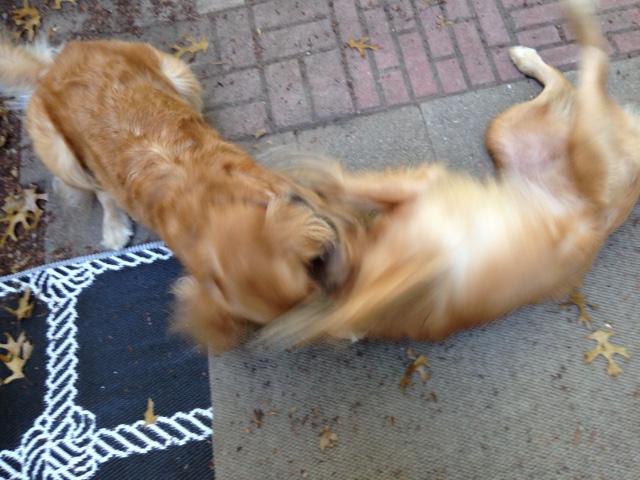
IMG_1137Cali’s sister Dora visited recently for the weekend, which meant nonstop action. Cali actually has lots of sisters. She lives with Big Sister Jana full time. Jana has been an excellent role model, teaching Cali necessary life skills, including barking at passersby and rolling in sand so joyously and thoroughly that, between them, they make sure to take the beach home with them. Then there is Alberta, the part-time sister and playmate. They are evenly matched in size and have similar energy levels. When they are together, everything becomes a tug toy.
But DorIMG_1141a is special. Dora is Cali’s litter sister. They were plucked from their siblings on the same day (Cali by me and Dora by my close friends) and whisked away, first on a long car ride, then on an airplane where everyone made a huge fuss over them. They spent a scary first night away from Mom snuggled together in a crate. Since then (or maybe even before) they’ve shared a special bond. Whether it’s been days, weeks or even months since they last met, their greeting is rowdy, loud, and energetic. Their play is very physical and rough, but no one ever gets hurt. At rest, they often touch paws or sleep in a heap.
Play is often seen by researchers as practice for important life skills. One researcher, Dr. Marc Bekoff, suggests an additional crucial role for play: it is the basis for developing social ethics. In play, young dogs (or other social beings) learn not to hurt each other, to follow certain rules, to communicate their intentions honestly.
Both Dora and Cali have excellent social manners. When meeting new dogs, they exhibit all of the correct doggy signs for getting acquainted and inviting play. Both are wise enough to be deferential to larger dogs and to show respect for elderly dogs. They’ve internalized those ethical practices that they have learned through playing with a variety of dogs. But sister play is different.
InIMG_1134 their sister play, they also bow and use the full range of doggy play signals, but the signs are sometimes abbreviated or perfunctory. They feel safe enough to throw themselves into play without worrying about being misunderstood. There is lots of ear-pulling and gnashing of teeth. Their faces wear fierce expressions. They emerge panting and wet. And wearing huge smiles. There is a level of familiarity and trust between them that gives their connection a quality that Cali’s play with others — even Alberta and Jana — lacks. Social manners matter most when dogs assess the intent of strangers. Smart dogs know when they need to be polite. And when they don’t. And, for Cali and Dora, family is safe enough that politeness can take a backseat to full-on fun.

What Is Cognitive Education for Dogs?


Jana and Turbo toy_crop
Welcome to an all-new, improved Thinking Dog blog! It is re-launching with a new focus — cognitive approaches to educating dogs.

What does that mean? Think of it as a contrast to the more traditional approaches, many of which use force, to train dogs.

Cognitive-based dog education means teaching dogs to think their way to becoming their best selves.

Their best what, you ask? Well, that answer is different for every dog — just as it is for every person.

It’s not a new idea: In 1963, Clarence Pfaffenberger wrote a book called The New Knowledge of Dog Behavior. A line in that book beautifully captures the essence of cognitive education.  Pfaffenberger writes that the first time a puppy to removed from his or her littermates for training, the puppy is given “the dignity of being an individual.” All dogs deserve this. It is this understanding that forms the basis of cognitive education for dogs.

In 1995, Vicki Hearne published a classic piece, “A Taxonomy of Knowing: Animals Captive, Free-Ranging, and at Liberty.”  In it, she describes the ideal relationship between a human and a non-human partner (most of her examples are dogs): the team shares a goal, recognizing and respecting the unique abilities that each member of the team brings to the joint pursuit of that goal.

An animal working at liberty, Hearne writes, is one “whose condition frees her to make the fullest use of some or all of her powers.” A great example is a search-and-rescue team. The dog brings amazing powers of scent detection and tracking to the partnership; the human brings logistical planning abilities and much more. The point is, neither partner, alone, could be as successful in the goal of finding a lost child as they are as a team.

Dogs in at-liberty partnerships are being the best that they can be. Cognitive education can get you and your dog there.

Remember Maslow’s hierarchy of needs (Psych 101)? Basic stuff like food and shelter are at the bottom. More esoteric needs, like social acceptance and aesthetic enjoyment, are higher up. The highest level is self-actualization — being the best you that you can be. That is what cognitive educators want for each and every dog.

As Pfaffenberger acknowledged, each dog is a unique individual with likes, dislikes, strengths, weaknesses — and an idea of what he or she wants (and does not want) to do. Cognitive educators understand this and teach each dog as an individual. There is no one-size-fits-all approach to training.

This approach enables each dog to be the best (fill in the blank) that he or she can. Some dogs can become fantastic service dogs; others are destined to work as scent detection or search and rescue dogs, serve in the military, or provide loving companionship to their humans. Some pets are great athletes who enjoy dock diving; others prefer Rally, flyball, agility, or freestyle dancing. Whatever your pet’s skills and preferences, you, as a cognitive educator, friend, and companion to that dog, can help your dog explore and develop and grow.

If this sounds like something you believe in or want to learn more about, stick with The Thinking Dog blog. We’ll be exploring cognitive education from every angle — who does it and how; what it looks like in daily life; how to think like a cognitive educator; what dogs are telling you about their likes and dislikes and how to better understand them … and so much more.

Check back often, subscribe to the blog, and be sure to share it with all of your dog-loving friends.