It’s All About Strategy

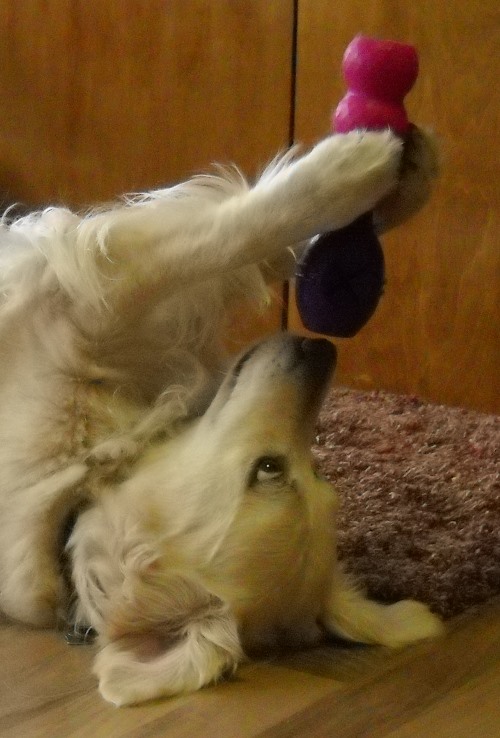
I recently wrote about how Koala uses tools, using a round chew toy as a base and holder to position a more desirable chew (an antler) for better chewing. But there’s more to her entertainment strategy than tool use.

Although she is a two-and-a-half-year-old working adult, Koala still gets puppy lunch. This is a point of contention in the family, because Jana thought she should get puppy lunch forever (but I did not agree), and Cali thinks, not unreasonably, that if Koala gets puppy lunch, she, too, should get puppy lunch.

What is puppy lunch, you ask. Large-breed puppies, because they are growing quickly, get three meals a day. Adult dogs, who only grow wider, get two (and in some cases, one!) meal a day. Puppy lunch is the mid-day meal that goes away when a dog is about a year old. Unless she’s Koala.

The first puppy-lunchless day is a day of infamy and trauma in the lives of goldens and Labs everywhere. Jana never really recovered.

Koala’s puppy lunch is a portion of kibble, served in a treat ball. The ball gets rolled and batted around, dribbling bits of food for Koala to munch. It’s fun. I have several treat balls, and sometimes give Cali food in one. She gets bored with it far more quickly than Koala, partly because she’s less food-focused. But Koala really enjoys her mid-day snack-and-play breaks.

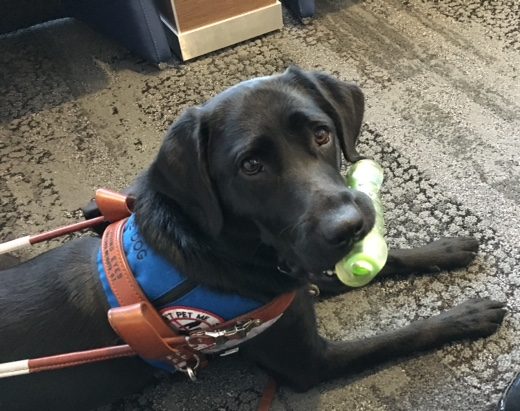
All of that background offers the context for Koala’s strategic play approach. I was watching her eat her puppy lunch not long ago and I saw her using a fairly sophisticated tactic. We were at a hotel (at the Guiding Eyes weekend, actually) and the room had a dresser, sofa, bench, bed, etc. Lots of places a ball could roll out of reach. Koala is an exuberant dog, never more so than when playing, so the ball was getting batted around at a good clip. But it was not uncontrolled ball batting. She’d pounce, roll the ball, whap it with a paw … but always, always keeping track of the many sand-trap equivalents. Never once did she let the ball roll under or behind something. She’d pounce on it or bat it just in time, sending it in a different direction. She almost seemed to be gauging how close it could get to the edge of the bed, say, before she’d lose the ability to steer it out of danger. She’d watch, position herself, and, bam, send it careening away toward the next potential obstacle. It only takes her about 10 minutes to empty the treat ball, so this high-stakes bowling / golf game took place at an impressive level of intensity and speed. She’s really good at this entirely made-up game.

This is certainly not the first time that I’ve seen a dog play a game that she has created. What held me spellbound was both the intensity and the advanced strategy. She had an intuitive understanding of a fluid situation. Much as dogs do when they catch a Frisbee or dive into a river at the precise moment needed to grab the ball or stick as it floats by, she showed a far better grasp of physics than I ever could.

The geneticist at Guiding Eyes says that each generation of their dogs is “better” — smarter, more suited to guide work, healthier — than earlier generations. If the dogs get any smarter than Koala, we won’t need to worry about robots taking over our jobs; the dogs will beat them to it.
 

Breaking News: Researchers Discover That Dogs Can Remember Stuff!

Science has once again confirmed the obvious: Dogs can remember things.

Specifically, a new study shows that dogs might have something that resembles episodic memory in humans — the ability to remember and learn from events and experiences. It’s a different kind of memory than “semantic memory,” which is memory of facts, meanings, and concepts. While these are learned, they are not experiential or shared with others; they are general knowledge.

Note that I am not at all unsure about this; all the conditional language is how science tends to express “discoveries” about nonhumans doing things that some humans think only humans can do. Like remember or use language. I am sure that dogs can do both, often better than many humans do.

Much of what we formally teach dogs — to sit on cue, to play with their toys rather than chew our shoes, to eat their own food rather than graze the pickings on the kitchen counters — falls into the categories of learning facts and concepts.

But anyone who’s ever taken a puppy to a puppy class has been exposed to a kind of teaching that aims to create positive episodic memories. The goal of “socializing” a puppy — teaching him to love children or not fear loud noises or car horns or skateboards or to feel confident and comfortable when experiencing a loud, busy place — all of that builds on the ability to form and learn from experiences. Episodic memory, in other words.

If your puppy has very positive experiences at her vet’s clinic — Cali’s puppy vet gave out the best cookies — then your dog is less likely to be among those who tremble and shake when the car pulls into the clinic parking lot. Or, worse, those who associate every car ride with an unpleasant experience and don’t even want to get into the car.

If dogs didn’t have the ability to form episodic memories, why would Cali bounce around like a very excited pinball (well, she would if she weren’t securely attached to her doggy seatbelt) when we cross the bridge that takes us to Berkeley and sister Dora’s house?

So, yeah, the scientists have, once again, proven something really obvious about dogs.

What’s cool about this study, though, is that the researchers used “imitation” or “do as I do” training. This sort of training shows that dogs have great flexibility and creativity in their ability to learn and extrapolate. The training works a little like Simon Says. The person tells the dog to “watch me,” then does something unusual. In the study, it was touching an open umbrella. The person then tells the dog to “do it,” and the dog is supposed to imitate the human. It’s pretty cool that dogs can look at our very differently shaped bodies and imitate what we’re doing. That they can and eagerly do join in this silly and fun human game is just one of the, oh, trillions of wonderful things about dogs.

And, I think that the training itself requires that the dogs have episodic memory. It’s not like teaching a cue that means a specific action: You say sit, the dog’s butt hits the floor. Imitation training requires that the dog say to herself, in doggy language, hmmm, I shouldn’t do what I did last time we played this and she said “do it”; instead, I have to watch what she’s doing now and do that.

That is more similar to remembering what you experienced in a place (beach or vet clinic) and deciding whether you are happy to return to that place than it is to remembering that hearing this word means do that action. It’s a different kind of learning, and it is based on experience, not association or remembering a fact.

So. That the researchers could even do this study shows that dogs have episodic memory. Now, isn’t that obvious?

Mind Your Manners

Wylie, a polite dog?Wylie hates peanut butter. It literally makes him gag. That’s why this story, from several years ago, is still one of my favorites: It tells me something really cool about dogs.

When Wylie was about to retire as a guide dog, his best friend t work brought him cookies. Very special gourmet dog cookies. One problem: They were peanut-butter cookies. Deni graciously thanked her colleague and said gently that she wasn’t sure Wylie would like them; he was fussy. The friend said, let’s see. He offered Wylie a cookie. Wylie accepted the cookie with appropriate doggy gratitude and ate it. The friend went happily on his way, feeling good that his gift had been accepted and enjoyed.

Surprised, Deni offered Wylie another cookie. He gave her what she can only describe as a disgusted “Are you nuts? I don’t eat that garbage” look, turned, and walked away. He never ate another one of those cookies.

Was Wylie “just being polite,” telling one of those little “white” lies we all tell when we want to avoid hurting someone’s feelings? Can a dog do that?

Here’s a different way to think about it, though, really, we’ll arrive at the same conclusion: Dogs are very empathetic. They excel at reading and responding to our emotions. Many dog people have stories of dogs offering comfort when they were sad; getting excited when were excited; responding in a way that many people regard as “guilty” when we are angry. In truth, the dogs are more likely to be trying to appease a person they perceive as angry, but they are accurately reading the person’s emotion.

If Wylie got excited about the cookies, he could be said to be mirroring the friend’s emotion: The guy was presenting a gift that he had selected with Wylie in mind, and he was happy to see Wylie get the gift and enjoy it. Or the friend was sad to be saying good-bye. But Wylie didn’t get excited or offer comfort. He offered a gracious and appropriate, but not overly happy, response. (I don’t think Wylie is capable of phoniness.) And he clearly rejected the gift as soon as his buddy left the room.

My explanation is that Wylie was reading the situation clearly and accurately. He’d been around lots of people in lots of social situations, and he knew these two people really well. He behaved as he’d learned was appropriate. He wasn’t, I don’t think, consciously deciding to lie — any more than we consciously decide to lie each and every time we say something that will make someone feel good — or, to more clearly match this situation, every time we say or do something that is nice and socially expected rather than blurt out our first or most honest thought.

Jana, who really has no use for children of any species, is perfectly gracious and polite when being “enthusiastically petted” (she’d say “mauled”) by a child, but she gives me that look that says loud and clear: “Get me out of here, now, please.” And Alberta would dutifully “say hello” to people she and Deni met, but she really didn’t want to; and she expected a cookie as a reward afterward.

So, I would argue, that dogs read social situations and respond appropriately. What is “appropriate” in a given situation varies widely, and it is learned, not instinctive. Some dogs, and some humans, learn better than others. Some dogs do this well with dogs and poorly with humans, or the reverse. Wylie’s social instincts with other dogs were often less astute than his social instincts in this particular human instance.

So, while I’m not arguing that dogs adopt human social manners, I would say that they learn, over time with the same people, what those people think is acceptable. Much about dog-human relationships entails dogs trying to do what they think their human wants; it’s not surprising that this can get nuanced or that Wylie and Jana are good at it.

How much is that in dog money?

This slideshow requires JavaScript.

I had house-guests recently, and the girls put their entrepreneurial spirits to work. As I have described in other posts, the girls bring me my shoes when it’s time for a walk. They also bring their bowls when they are done eating. For each of these, as well as for getting the paper and for other tasks, they are paid in cookies.

There’s a cookie hierarchy in dogdom and therefore in our home. When requiring the girls to do something they dislike, such as submit to ear-cleaning or nail-trimming, I reward them (some would say bribe, but it happens after the fact) with high-value treats — freeze-dried liver, perhaps, or the dried beef patties we discovered at Costco. When we are practicing recall (come here, right NOW!) they get very high-value treats. We have special tooth-brushing cookies, which are of medium value. Ordinary chores like bringing the paper, shoes, etc. get ordinary treats — a few Charlee Bears or a small biscuit. This, it seems, is the currency of the dog world. They expect to be paid, and, so far, they have been willing to accept the prices I am willing to pay.

They showed a basic understanding of economics when they started bringing things I hadn’t asked for and expecting payment. It reminded me a bit of those kids who used to come out of nowhere and wash your car windshield while you were sitting at a red light, then ask for money. But the girls are cuter and very earnest.

Then my guests came along. One was so enchanted by the dogs bringing shoes — random shoes, no less, maybe taking my shoes to her or a single sandal when she needed her boots — that she inflated the payout. At least once, but I suspect more, she gave Cali a beef patty — a whole one! — and Cali had not even brought her the right shoes! I don’t even want to know what she paid for the girls’ dinner bowls.

Well. Jana and Cali don’t have MBAs, but they don’t need them. The girls quickly understood inflation and supply-and-demand economics. And bargaining: I’ll give you this shoe — and a boot — for one of those beef patties. I’ll throw in a phone or a TV remote if you’ll give me two. What? A measly Charlee Bear? I am going to hang on to this slipper. When your foot is cold, you’ll pay more.

Just what I need. A looming winter of cold feet and fat dogs. I’d better go to Costco this week. We’re gonna need more beef patties.


The Experts Finally Noticed

That dogs have feelings, emotions, and thoughts probably seems obvious to readers of this blog, as well as to most people who share their lives with pets. But, as I tell my students at Bergin U, sometimes things need the stamp of approval of science, via peer-reviewed research, to be fully accepted as Truth. Many, many studies of dogs’ behavior and cognitive abilities do not, actually, reveal anything that we didn’t already “know.” But these studies solidify that knowledge and induct it into the Body of Knowledge that gets academic credit, credibility, proof.

That’s why the establishment of a new scientific journal dedicated to the study of animal sentience is significant. Acknowledgement and study of animals’ thoughts and emotions has grown tremendously over the past twenty years or so. Now, those studies have their own journal. Animal Sentience: An Interdisciplinary Journal on Animal Feeling is a publication of the Humane Society Institute for Science and Policy (HSISP), based in Washington D.C.

Alva Noë, a philosopher, says in an NPR article that “A new scientific journal is not merely a new venue for publishing research, it can encourage new science, create a new community of investigators and, to some degree, contribute to the establishing of new fields.”

That’s an exciting thought for people who care about nonhuman animals — and dogs in particular. For centuries, dogs were not considered worthy of academic study. Now, several universities host canine cognition labs; at Bergin U and elsewhere, students study the canine mind, along with canine behavior and communication, as they explore ways to expand the human-canine partnership.

The journal embraces a broad definition of sentience or “feeling”: “Feeling can be any sensation, such as seeing, hearing, touching, tasting, smelling, moving, wanting, pain, pleasure, emotion, mood, anticipation or intention.” Intention. Anticipation. I know that my dogs experience these higher-level “feelings.” I also know that generations of researchers have been ridiculed for asserting that dogs (or any nonhumans) could.

It matters that people recognize dogs’ sentience so that the we can improve how we, as individuals and as a society, treat dogs. Before we had anticruelty laws, we had to know that animals could suffer, could feel pain. Now, as we consider how dogs fit into our lives and our society, it is equally important to recognize that they feel more than pain. They think, wonder, plan, feel happy or sad, they grieve — and they empathize when we feel sadness or grief. How do we need to change our laws and our treatment of dogs to accommodate this new understanding?

Maybe She Had a Cold

I watched Cali run to and fro one morning, searching for her ball at the field where we play. She was so busy anticipating my throw that she ran full-on in the wrong direction and therefore had no idea where the ball landed.

She does not use the logical grid search technique that Wylie, the German shepherd who once shared my life, used. She often runs right past the ball without seeing it. She usually seems to follow her nose, and she always does manage to find her ball, eventually. It’s a large field and sometimes the search takes a while. She wants only her ball; she sniffs and rejects any other ball that happens to be in her path.

But her nose seemed to be broken on this particular morning. Or maybe she just had a bad cold. She ran past the ball several times, almost touching it, without noticing it.

Cali also does not appear to have read those studies that say that dogs, even very young puppies, can and do follow human pointing gestures. Or the training manuals that assure us that our body language looms large in our dogs’ minds, and they will go in the direction that our body, eyes, and feet are pointing, no matter what verbal cues we’re giving them.

Nope. My voice, arms, feet, and body were all telling her the same thing. I even walked toward the ball, stood two feet away, and pointed. No response from Cali, who glanced briefly at me before continuing her random search.

She did, ultimately, strike gold. She then watched me throw the ball once, brought it back — and lost it again on the next throw.

Another thing. Those studies about how dogs know what people can see and therefore tend to deliver the ball to a person’s front rather than her back? Cali hasn’t read those either. Or maybe she thinks that, because I am her mom, I have eyes in the back of my head (my mom did!). I tell her that doesn’t work for adopted kids. I pretend not to know where the ball is. I beg her to bring it to me. I demand that she bring it. I walk away. No luck. She loves dropping the ball behind me. Maybe she just has an odd sense of humor.

I enjoy reading all these studies about dogs’ cognitive abilities, and I really believe that (most) dogs do have great potential for problem solving, interspecies communication, and other feats of intellectual greatness. But playing with actual dogs like Cali is a good reality check sometimes.

A Conscious Struggle

This slideshow requires JavaScript.


Our dogs have jobs that they are expected to do, similar to assigning household chores to a child. Jana brings in the morning paper. Jana and Cali each bring me a shoe when we’re getting ready for a walk. And each dog is expected to bring me her food bowl when she’s done eating.

Jana learned this task very quickly. She does it eagerly, always happy to receive her dessert in exchange (a small cookie). Alberta is also an eager participant, usually the first to finish her meal and deliver her bowl. If I am not paying attention, she’ll push it into my leg, hard, in a not-at-all-subtle demand for her pay. Past dogs have learned the task too, though Wylie made it quite clear that he saw this task as beneath him — girls’ work — and he would immediately depart for more masculine pursuits upon finishing his meals. Jana was happy to pick up the slack (and the extra cookie).

Then there’s Cali. For months, she’d pretend to try, lifting the bowl by one edge before dropping it with a loud clang. Putting on her saddest golden retriever face, she look at me as if to say, “I tried, Mom, but I just can’t lift it. It’s a very large bowl, and I am a very small puppy.” As the very small puppy became 56 lbs. of solid muscle, this excuse held less and less water, but the sad eyes … well, let’s just say that she does a very good “sad golden” face.

Along came Deni. Not only did we switch Cali to a smaller bowl this summer, but Deni took over much of the feeding supervision. Deni wasn’t moved by the sad face. Weeks of cajoling and praise and cookies paid off. Cali started bringing her bowl, but reluctantly and only with much encouragement. Once we knew that Cali understood what was expected and that she was fully capable of doing it, the coddling was phased out.

Now, as Deni explains, Cali broods over the looming task or “stands there and glowers at her bowl.” She knows she’s supposed to pick it up; she simply does not want to. It’s similar to her reluctant acquiescence to brushing her teeth. But, more and more, Cali talks herself into bringing the bowl with no prompting from either of us. Deni reports that if Cali sees that extra-special treats are being offered for dessert, she is able to convince herself to pick up the bowl much more quickly, and she does so with far more energy and enthusiasm.

The battle of the bowl shows Cali’s increasing maturity and offers a window on her personality and intelligence. We all sometimes choose to do things that we do not want to do. Sometimes we do them for rewards (a paycheck, working extra hours to earn a vacation …) or to avoid worse consequences (dental checkups) or because we don’t want to disappoint someone we care about. Whatever the reason, we all face large and small decisions every day. Cali is no different.

Beyond WordsIn his wonderful book Beyond Words, which I have mentioned before, Dr. Carl Safina talks about sentience, cognition, and thought as the “overlapping processes of conscious minds.” He defines sentience as “the ability to feel sensations”; cognition as “the capacity to perceive and acquire knowledge and understanding”; and thought as “the process of considering something that has been perceived” (page 21).

We see all of these at work in Cali’s struggle. She understands what she needs to do and how to do it; she feels stress, anxiety or discomfort of some kind when she thinks about this expectation, and she considers how to resolve it. Sometimes the feeling of anticipation or desire for a treat wins; sometimes, probably, the desire not to disappoint Deni or me tips the balance; sometimes she needs some prodding. But she is very definitely making a choice. Whether she decides to go for the cookie or she’s concerned about our reaction or she walks away and lets Alberta or Jana pick up her bowl, she is in control; she weighs the options and makes her choice. She is not instinctively or automatically responding to a stimulus in a conditioned way, as some behaviorists would argue. Every day, every meal, Cali shows what it means to be a thinking dog.


Minding Their Manners

I recently read a study that compared wolves’ and dogs’ ability to solve a “puzzle” — opening a plastic box with a piece of sausage inside. The wolves did much better than the dogs, and, from the articles I read about the study, it seems that many researchers are interpreting that to mean that the dogs are dumber than the wolves, at least when it comes to problem-solving. The comments were rather unkind to dogs, and, I think, wrong.

One comment, in the New York Times, came closest to “getting it.” This person suggested that perhaps the dogs had been taught not to take human food or open food containers. Paired with the fact that most dogs’ food is handed to them by humans, while most wolves must find their own food, I’d say the dogs were set up to fail.

The study was published in a British journal by an Oregon State University researcher, Monique Udell. In her own analysis, she paid more attention to the fact that the dogs spent more time looking at the familiar human (who was present for some trials of the test and who provided encouragement in some trials) than at the box. Various commenters’ interpretations of the dogs’ looks ranged from “seeking assistance” to “slavish.”

Half the dogs tested were pets; the other half were shelter dogs, but no information was provided about how many of those had spent part or most of their lives in homes before landing at the shelter. The wolves had been socialized to humans, but even a tame wolf is still a wolf, not a domestic pet.

It makes sense that the dogs would have been taught not to take food or been punished for taking food. It also makes sense that, if a familiar human were present, they would seek help, information, or even permission before helping themselves. When I give my dogs a particularly spectacular treat (a 2-inch piece of sausage would certainly qualify), they often look at me, look at it, look at me — going back and forth a few times, seemingly questioning whether this bounty is truly meant for them. They are polite. They know the rules. They are also quite happy to indulge in exceptions to those rules, once they’re sure they won’t get reprimanded for doing so.

I would have been much more surprised if the dogs didn’t look to the human for permission or help. After all, thousands of years of living together has resulted in close partnerships and, at least on the dogs’ part, exquisite ability to read human’s communication. We humans are less successful at reading the dogs, sadly. Their survival depends on reading humans’ cues and behaving accordingly. Wolves have no such hangups (nor should they).

Some comments on the study went so far as to suggest that training dogs has made them dumber and less able to solve problems, that their social connection to humans puts them at a cognitive disadvantage. I disagree. While some training approaches do discourage dogs from thinking, modern approaches to training that use motivation and reward actually encourage problem-solving. Far from dumbing dogs down, their enhanced social sensitivity to humans enables them to thrive in our world and, in many cases, enjoy comfortable lives and strong connections with their adopted families.

And if those strong connections compel dogs to ask before eating your food, what’s wrong with that? Many people wish their roommates were as considerate.

For more about the study, see these articles:

OSU study: Have we made dogs lazier or dumber than their ancestor wolves?, the Register-Guard, Oct. 2, 2015

Why Is That Dog Looking at Me?, The New York Times, Sept. 15, 2015

The study, “When dogs look back: Inhibition of independent problem-solving behavior in domestic dogs,” by Monique Udell, was published in the British journal Biology Letters on Sept. 16, 2015.

See also my related post on the PPG Barks blog.

Secure in Her Dogness

Of our three girls, only Cali is truly secure and comfortable in her dogness. Alberta and Jana are quite sure that they are not dogs.

How do I know this?

  • Cali happily goes in and out the dog door, delighted with her independence and freedom to enjoy a large yard, from which she can survey the surrounding hills and valleys. Jana and Alberta go to the people door and bark. If their staff fails to appear in a timely fashion and let them in, they bark louder. They both will, if forced, use their keys to open the dog door and step disdainfully inside. But they really shouldn’t have to resort to that.
  • Cali is fine being left home, particularly if she can let herself out. She calmly accepts being banished to the porch with a visiting puppy to play. She’s perfectly content hanging out with other dogs, so long as she knows and likes these dogs. Alberta, rightly, assumes that Deni should take her along everywhere she goes. Jana just plain does not want to be left with the dogs. She does not want to be excluded from adult company, relegated to the puppies’ table (or porch), or treated like a dog. If left at a dog place — she has, on rare and very stressful occasions, been left at a groomer’s or a boarding facility — her facial expression, resistance, and loud protests all say: PLEASE don’t leave me with all these dogs!

I would say that Jana and Alberta are anomalies, shaped by our treatment of them to believe that they are somehow not quite dogs — but I have met so many other dogs who seem to be equally certain that they are not dogs. Molly, for example, whom I mentioned in a recent post. Of course, she’s a standard poodle, and I for one do not think that poodles are dogs. They are so close to being human. Molly clearly agrees.

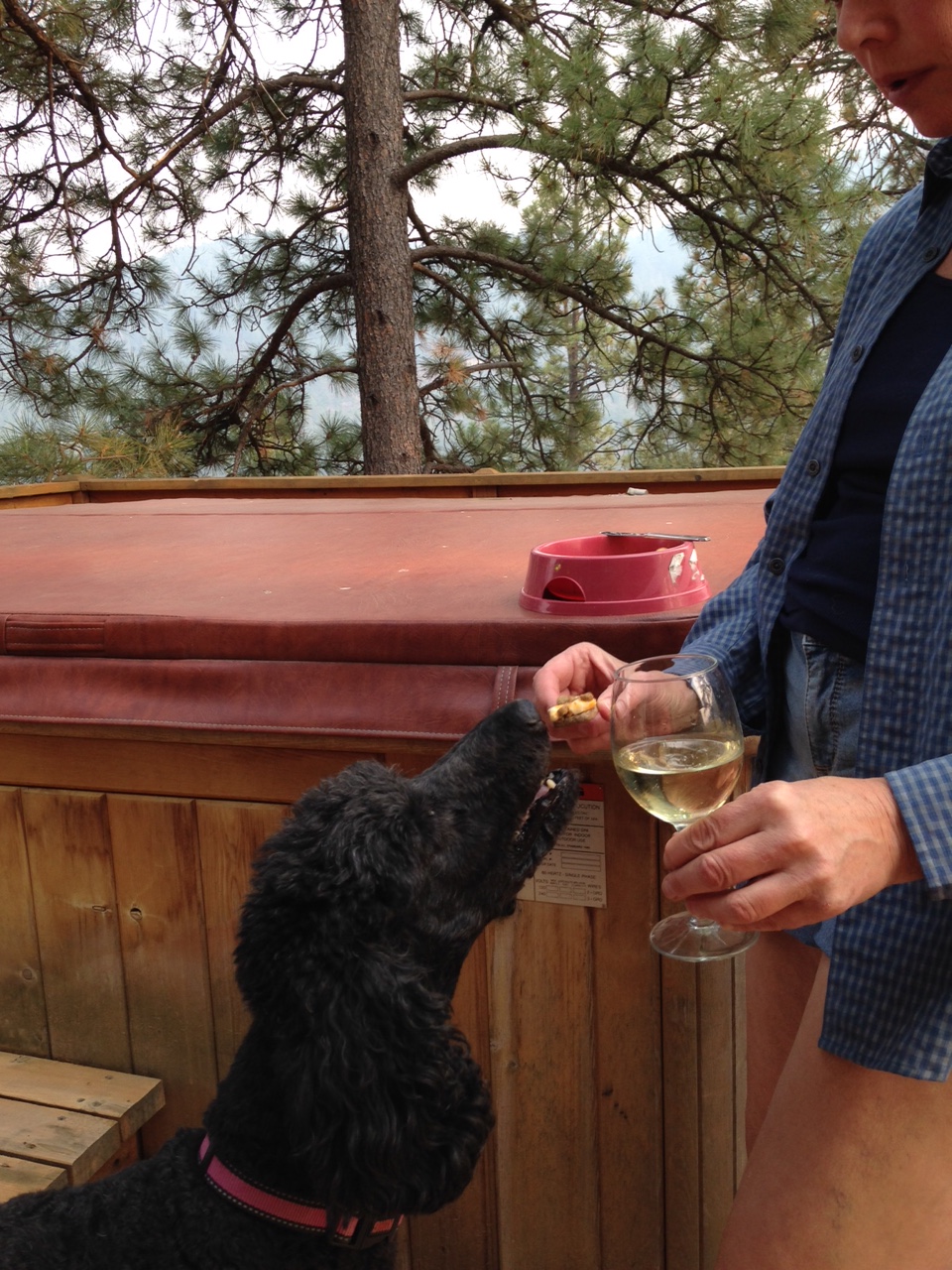
IMG_2095IMG_2090When Molly was visiting, she would not — could not — eat in the laundry room with the other dogs. Excuse me. With the dogs. She dined solo, al fresco, with a white-jacketed server in attendance. OK, so maybe Deni wasn’t wearing a white jacket, but the rest is true. Not only did she dine in solitary patio splendor, she had special meals. Chunks of cheese, biscuit crackers, slices of deli meat … the only way that Molly would eat kibble was on a cracker (biscuit) or in a turkey roll-up. She prefers white wine, not too dry and not bubbly. (OK, OK, she didn’t actually get any wine, either. But the rest is true. Really.)

But back to Cali. It is nice to have at least one dog who actually is comfortable being a dog and is happy to fulfill her role as the family dog. She’s very cuddly, for example, and loves to be petted. She’s always enthusiastic about going for a walk or out to play. She enjoys doggy things, like chasing after a tennis ball and refusing to bring it back, barking at deer, licking all the hand lotion off of my fingers, and begging for treats. She wants to be near me most of the time, even when I am doing boring (to her) things, like writing a blog post (she’s at my feet) or grading papers. Like her ancestor Oriel, Cali embodies everything people  love about dogs. She’s sweet, affectionate, playful and goofy sometimes. She’s great company and very friendly. And secure in her dogness.


Missing You?

Does Jana still miss her best friend, Oriel?

Do dogs miss us when we’re away? Do they miss places they’ve been or items they’ve loved?

It’s clear that dogs remember people and places — and often, the landmarks or scents on the way to places that they either love or hate. Dogs can recognize a person whom they haven’t seen in years. Or a place that they haven’t visited in years: Oriel, our late and much-missed golden retriever once ran joyfully to the site of a small pond that had been dry for about a decade. The former pond was a short walk from her former home in Montana, and she hadn’t been there for at least 3 years. She became very excited as we approached the road to the house, too. And of course all of our dogs know the way to fun places and begin to show excitement ridiculously early in any journey in the general direction of the dog beach, Cali’s sister Dora’s house, the park where we play ball …

It’s also clear that dogs use these memories to anticipate, with pleasure or dread, future experiences. Dogs generalize and can become fearful of people or situations that remind them of unpleasant experiences in the past. A dog who fears going to the vet, for example, can recognize a vet’s office, any vet’s office, from several blocks away. Happy experiences have the same effect. Thus a dog who loves to run and play will decide that any open green space you happen to drive past would be a really fun place to stop and play ball. He might helpfully point out all the nice play opportunities say, between Northern California and Missoula, Montana, as you are driving. Believe me, there are hundreds of open green spaces in the American Northwest.

But do they miss us? Do they miss places?

This question becomes more relevant each day, as our departure from Montana gets closer and closer. Does Cali miss her play park and friends in Petaluma? More to the point: Will she miss her private play yard in Montana? Will she ever forgive me for taking her away from this idyllic place where she is so happy?

It’s also a question that many dog owners ponder if / when they leave their dogs with a dog sitter or boarding kennel when they travel. Does the dog pine for them? Wonder where they are? Or, as dogs do so well, does the dog simply live in the present moment, enjoying the attention of the dog sitter?

I’ve heard enough stories about how dogs behave after the death of a loved human or canine playmate or family member to believe that dogs grieve. Isn’t that an indication that dogs miss people or dogs who aren’t present?

I don’t have a definitive answer to any of these questions. I suspect that some individual dogs form closer ties to people, dogs, places, and other beings or objects and do, indeed, miss them. Other dogs appear to be — and may truly be — happy in the present moment, loving the ones they’re with.

So the answer might be similar to my answer to so many questions about dogs: It depends. Dogs are individuals. Your individual dog might miss you very much when you are gone. Or she might happily hang out with whomever is nearby. Cali might miss Montana. But Cali’s such a sunny optimist that I am betting she’ll be happy to be back in Petaluma and enjoy picking up our old routine and reconnecting with her playmates there.

At least, I hope that’s the case!