A Dog Can Help You With That …

Whatever you need help with, chances are, a dog can help out. Need help finding your way around? Easy-peasy. Need a guide who also lets you know about important sounds? Dog’s got that handled too.

Funny thing is, not too many humans believe that dogs can do all that (and more). Fortunately for some people, Guiding Eyes is an organization that takes chances on people — and dogs.

As someone who’s sure that we haven’t come close to tapping dogs’ full potential, I see this as a sign that Guiding Eyes (or GEB) really “gets” dogs in a way that few people, even dog professionals, do.  This understanding leads the organization and its trainers to willingly take on challenges that few people would even think possible: Tasks that require a belief in dogs’ ability to be adaptable and to become creative problem solvers, for example. GEB dogs do things that it’s really not possible to teach them without a shared understanding and buy-in to shared goals, so the trainers have to know that dogs are capable of higher-level thinking, problem solving, and working toward goals.

What do I mean? GEB places dogs with a tremendous variety of clients, including individuals who have both visual impairments and another disability, such as a mobility or hearing impairment. The clients whose dogs alert to sounds as well as guiding range from people who are legally blind and hard of hearing to individuals who are both blind and deaf. I could be wrong about this, but I believe that GEB is the only U.S. guide dog school that is willing to provide these clients with a guide dog. In any case, it was the first organization to do so.

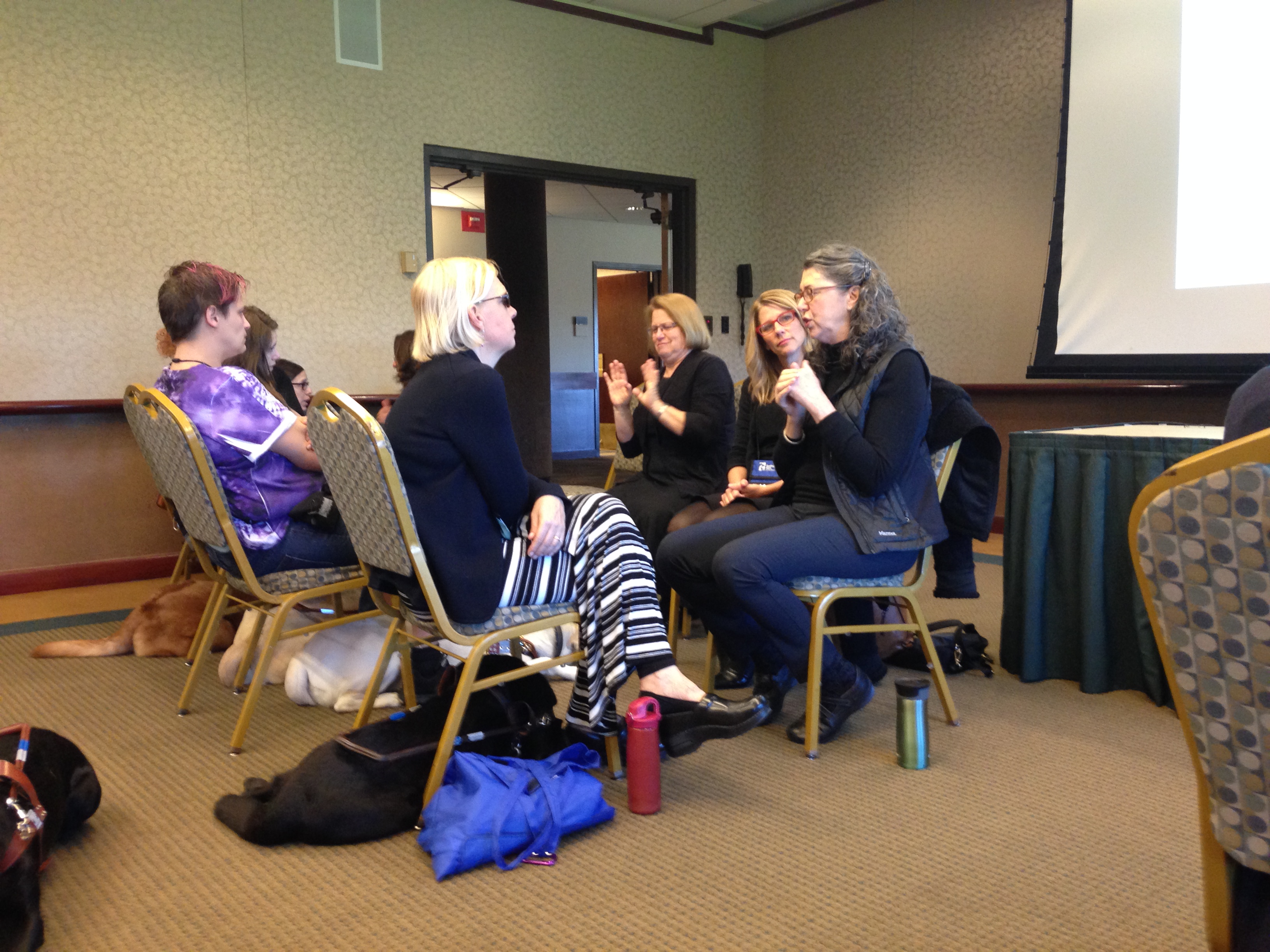
As registration opened for the Guiding Eyes continuing education weekend, a number of these grads registered. Planning committee member, grad, and GEB consumer outreach and graduate support manager Becky Barnes Davidson waved a magic wand and somehow found funding to bring a cadre of interpreters to the weekend, ensuring that all of the grads could participate fully in the events.
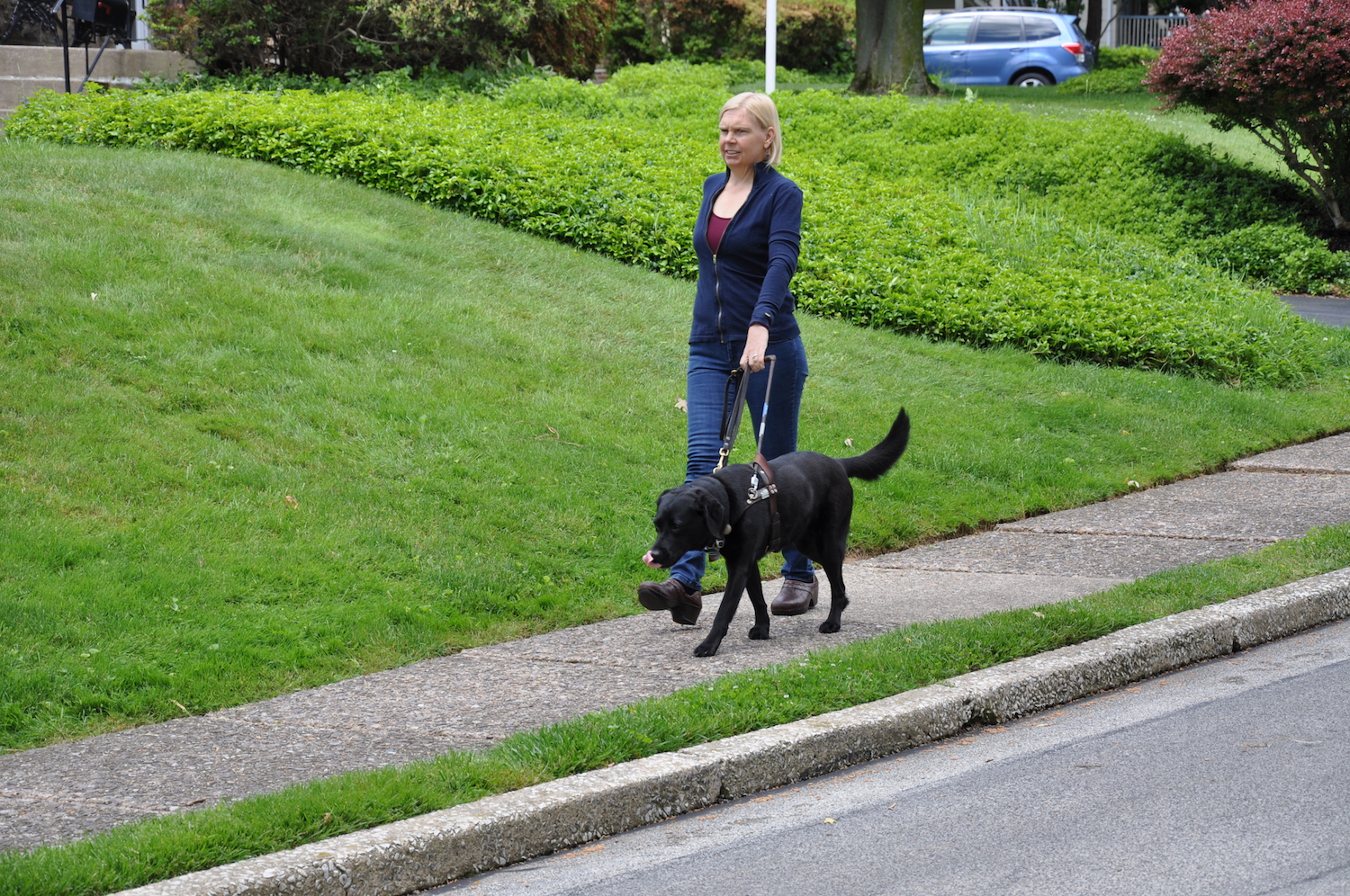
Deborah and Gypsy walk togetherI had the opportunity to chat with one of these grads, Deborah Groeber. She got her first Guiding Eyes dog in 1987. GEB didn’t yet have its “Special Needs” training program, which got off the ground in 1990, but, Deborah said, it was the only guide dog school willing to try training a guide for her.

Having guide dogs has, of course, made a tremendous difference for Deborah, especially in her frequent travels. She describes traveling with her dogs (current guide Gypsy is her fifth) as “phenomenally different” from traveling with a cane.

“I think Gypsy is a great match for me because she loves going from the suburbs into the city every day, loves taking trains, buses, escalators, stairs, revolving doors and working obstacles and construction sites. She is bright, confident and self-motivated, but she also loves praise and food rewards,” Deborah said.

Deborah is about to participate in another unique Guiding Eyes program. Gypsy is nearing retirement, and Deborah’s next guide will be a member of GEB’s new program, Running Guides.

Running Guides perform the usual guide dog work as well as guiding their partners while running. The first Running Guide team graduated in 2015. And Deborah’s dog will, as Gypsy has, learn to alert her to sounds, such as smoke alarms, phones, and doorbells. Deborah knows how to teach her additional alerts as needed. Sometimes Gypsy figures it out on her own, too.

Once, not long ago, Gypsy alerted her to a carbon monoxide alarm when Deborah’s husband was traveling for work. Gypsy is not allowed in the basement, Deborah explained, but she kept alerting to the basement door, because she heard the unexpected sound of the alarm. She’d not been trained to respond to that sound, but somehow understood that it was an urgent problem. Deborah got both the CO and smoke alarms, Gypsy told her which one was making noise, and she was able to respond and resolve the problem.

That story underscores the connection and communication that develop between members of a guide team. Many of us plain old pet-dog owners, who have the good fortune to be able to see our dogs’ body language and hear their vocalizations, are nonetheless unable to figure out what they are telling us. And I bet most of our dogs would react to an alarm and try really hard to get us to do something about it. That we’d all die of carbon monoxide poisoning anyhow would not be the dogs’ fault…

As someone who has tremendous faith in dogs’ abilities to figure things out, communicate, get what they need, figure out what their humans need, and so much more, I am not amazed that a single dog can perform both guide and hearing work, with a side gig as a personal fitness trainer. I am impressed that enough people at Guiding Eyes believed in dogs back in 1987 to give combined guiding and hearing dogs a try, and that the organization is continually coming up with new ways to stretch and grow the partnerships between their amazing dogs and clients.
What Marshmallow Tests Mean

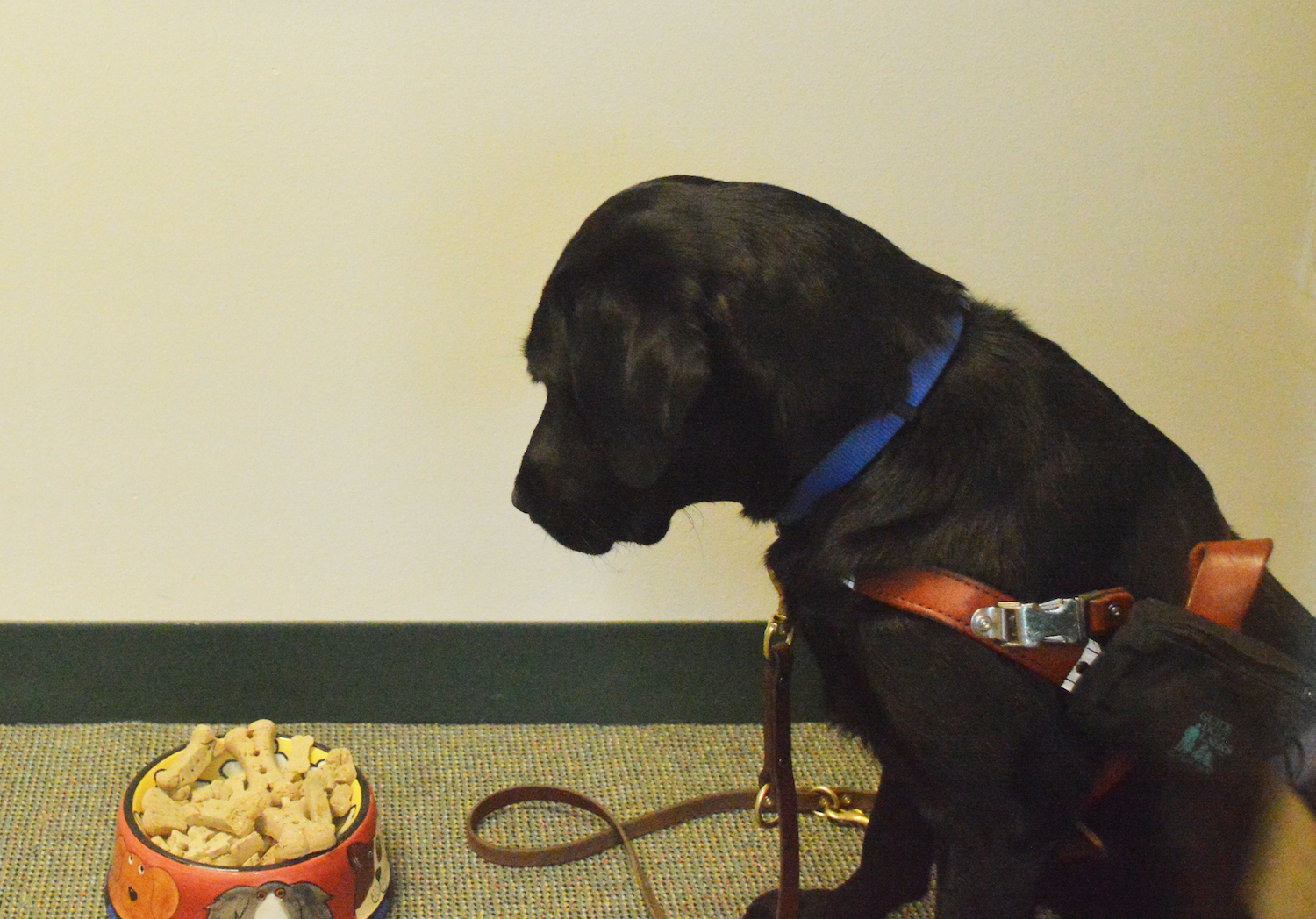
I’ve written about both Alberta’s and Koala’s adventures with the marshmallow test and I’ve been thinking about what it tells us about each dog. Is Koala a “better” dog because she didn’t have to work as hard as Alberta? Is she more obedient ? (No!) More — or less — intelligent?

Dr. Walter Mischel, the psychologist who originated the test, wrote a book about it a few years ago; he also was interviewed in The Atlantic. The topic of both book and interview was some common misunderstandings about the test.

Mischel said that it is less about self-control than about achievement and making choices. It’s also, to some extent, about how and when a person (or dog) chooses to exercise self-restraint, not whether she can. Other research shows a phenomenon called willpower fatigue; exercising self-control takes cognitive energy. Using that energy on one task means you have less of it available for other tasks, whether they are cognitive tasks or exercising self-restraint.

Maybe Koala would do less well on the marshmallow test after navigating Deni through a strange airport, hotel, and restaurant than she did in the morning on her home turf.

After reading the interview with Dr. Mischel, I don’t think that the test tells us whether a dog is “good” or smart or even obedient. It tells us that training helps a dog make good decisions, and that making those decisions comes more easily to some individuals or at some times. Dr. Mischel told The Atlantic, “What we do when we get tired is heavily influenced by the self-standards we develop and that in turn is strongly influenced by the models we have.”

In other words, when we’re challenged, we fall back on our training and experience.

Alberta and Koala both had excellent training and socialization. They were also both taught the “leave it” cue. The original children tested were from affluent, educated families. These children, as well as Koala and Alberta, had some respect for and trust in authority figures (the children were tested, as were the dogs, by a familiar adult). These circumstances set up a person or dog to succeed. A random puppy pulled from a shelter pen by a stranger would likely not fare so well on the test.

That’s why it is so important to teach puppies to sit quietly, even if only for a few seconds, before they get to eat or greet someone; it’s why it’s important to ask them to wait at doorways and before jumping out of a car. Yes, we are teaching them manners and protecting their safety. We’re also giving them models and a basis to form “self-standards” that include self-restraint.

They might slip up sometimes. Cali gets so excited about meeting new people that she wriggles and dances. And when we approach the office of her friend the cookie lady, she’s a jumping, pulling, dancing demon.

It’s not just Cali. We all experience willpower fatigue. For instance when the scent of fresh-baked chocolate chip cookies … mmmmm!

The Original Thinking Dog

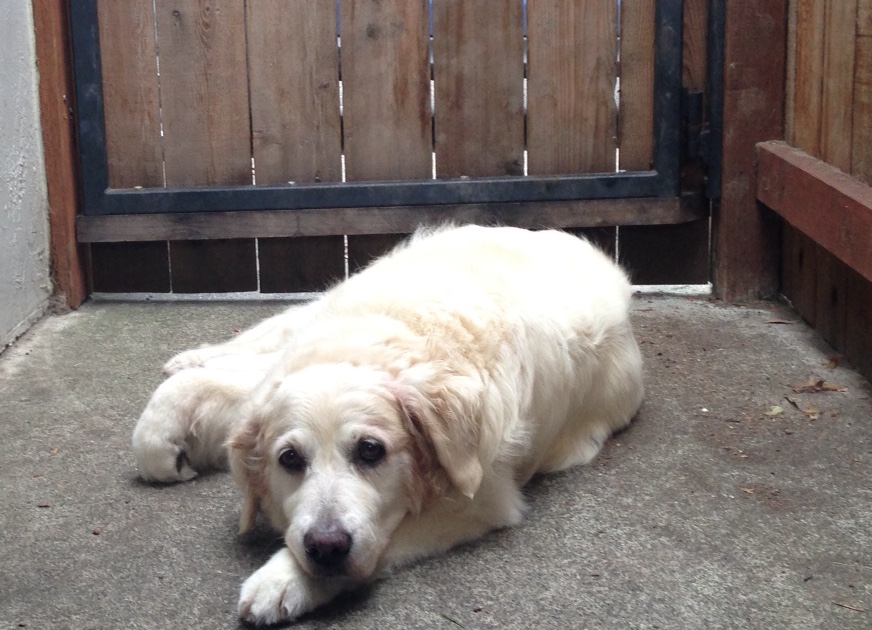
Jana, a white golden retriever, lying in front of a gate

She was only about 4 weeks old when we met. She stood out from the litter because, well, she tumbled right over to say hi. Jana had 2 sisters and 3 or 4 brothers; I looked only at the girls. After the first few minutes, I really looked only at Jana. I saw friendliness and curiosity each time she ran over to greet me; what she really was, I soon understood, was a girl who knew what she wanted and always, always got it.

I initially planned to raise and train Jana as a service dog. That idea lasted, well, maybe for a few weeks after she came home. But it was soon clear that I was Jana’s person and that was that. She wasn’t going anywhere unless I went too.

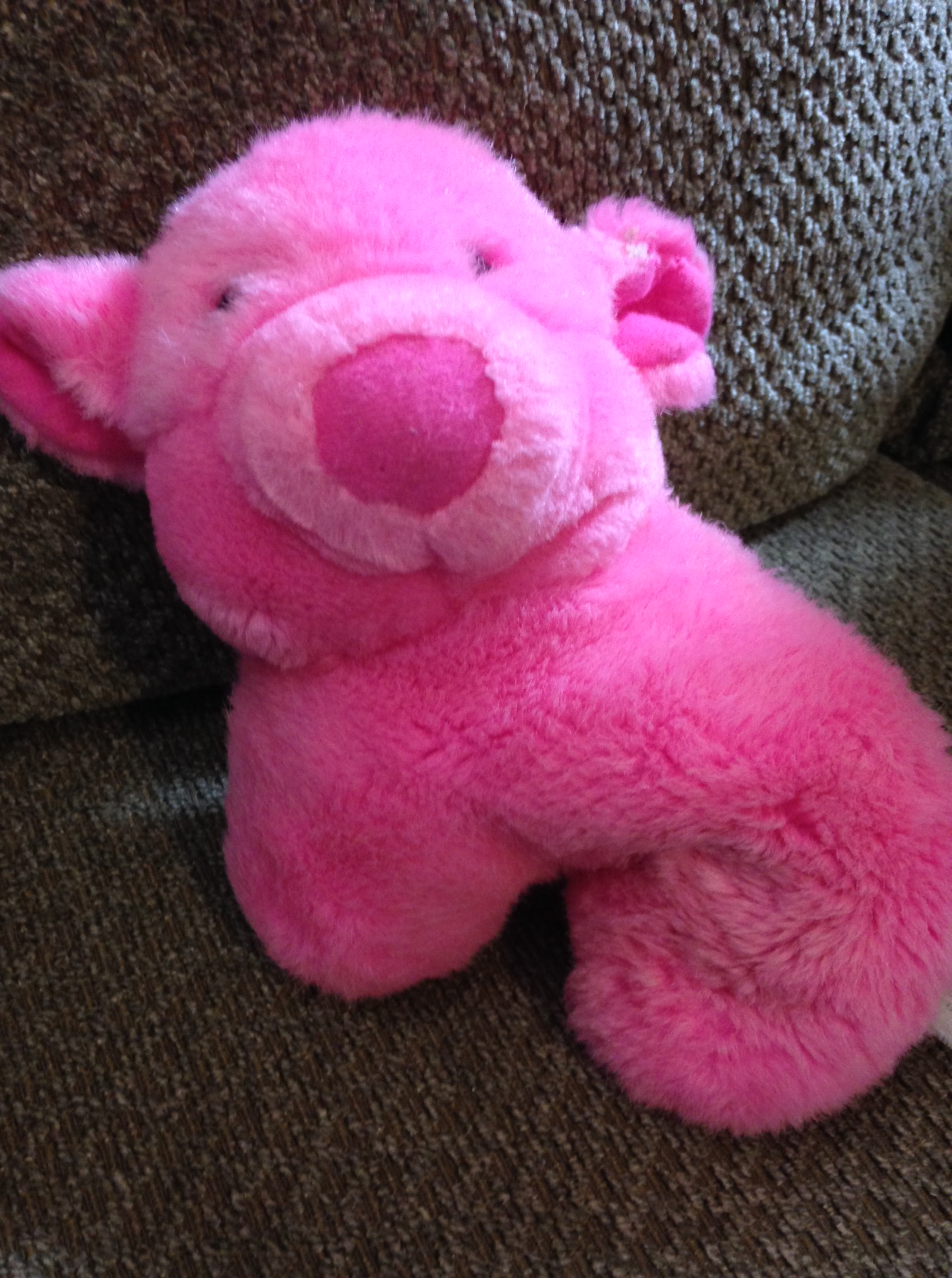
We moved from Israel, where Jana was born, to the U.S. a little before her second birthday. I took her to Petsmart to choose a birthday toy. She’d never seen anything like a Petsmart. Rows and rows and rows of treats and toys — and fish in aquariums, and hamsters and guinea pigs and iguanas — what an amazing plaPink stuffed pigce! When she finally focused on selecting her birthday present, Jana zeroed in on a bright pink pig. Jana, I said to her, Jana, you are a Jewish girl from Israel. This toy is not an appropriate choice. How about this nice fleece doggy?

Jana got the pig (and the doggy).

I could tell Jana stories for pages and pages. Or I could write the usual obit stuff about Jana — where she traveled, for example. She drove cross-country with me several times and visited at least 45 states. I could write about all of her skills — how seriously she took her newspaper job, how quickly she learned new skills — or about her strong, independent personality, or how she invented no-touch cuddling. She wanted to be nearby, possibly leaning against a beloved person, but the person had better not pet her. She accepted touching only on her terms; anything else was considered an assault on her dignity. She’d give the clueless human a dirty look and walk away, settling in the farthest corner of the room. Jana did not like to be treated in any way like a dog.

But Jana was so much more than stories and adventures. Jana was my teacher.

From Jana, I learned to see dogs in a completely new way and to appreciate their complex intelligence, their ability to communicate their needs and preferences. I learned to pay attention to each dog’s unique foibles and personality. I learned to see the thinking, feeling individual inside each dog.

I’m not alone. Jana touched so many people and showed them, too, what she — and other dogs — could do, learn, understand, communicate. I knew that Jana had many friends and fans, but the sheer volume of notes, comments, Facebook posts, phone calls, and cards that I got this week showed me how badly I’d undercounted. Some were from people we hadn’t seen in years; others from people we’ve never even met. And every memory that comes to mind includes more people. Knowing how many other people loved Jana means a lot to me; Jana lives on through all that she has taught us about seeing dogs more clearly.

The Thinking Dog blog itself was named for Jana, a deep thinker. She planned, she analyzed, she weighed her options — starting when she was only a few weeks old and she chose me to be her person. Nothing would ever be the same again.

Beyond Words: What Animals Think and Feel

Beyond WordsI’ve read a lot of academic studies of dogs and other non-humans that seemed silly, but I somehow missed this one, described by Carl Safina in Beyond Words. Safina pokes fun at a researcher who gathered and analyzed video of dogs playing for two years before reaching the somewhat obvious conclusion that when a dog wants to invite another dog to play, he behaves differently if the other dog is facing away from him: He tries to get that dog’s attention before offering a play bow. The dog either barks or uses his paw to attract the other dog’s attention. Dogs don’t play bow to other dogs’ rear ends. Amazing. (For more on this and what it can teach us, see Learning from Real Dogs.)

In ridiculing this and other studies, Safina makes the point that researchers should get out of the lab and watch how real animals interact with members of their own and other species. There is much to love in Beyond Words: The sections on elephants, wolves, and orcas are chock-full of detail, stories, and heartbreaking information about how badly humans screw things up when we don’t understand other species. I’ve written about his discussion of self-awareness and the mirror test. But my favorite section, naturally, had to do with dogs. He writes engagingly about his own dog when he takes on the controversial issue of whether dogs (or any non-humans) have “theory of mind.”

Safina offers several definitions for theory of mind drawn from real studies. My favorite is the one that claims that theory of mind is the ability “to read the minds of others.” Based on the divorce statistics and the number of wars and conflicts of all sorts, it seems that all humans would fail that test. A better definition is “knowing that another can have thoughts that differ from yours.”

Safina provides many, many examples of non-humans, including dogs, showing that they meet this definition; he calls the evidence “blinding” (his emphasis). Any time your dog anticipates your behavior — putting on those shoes means a walk — or asks for anything, like a belly rub, treat, or dinner, your dog is showing that he understands, or at least can make a plausible guess at, what you are thinking or planning and might even be able to influence your decision. Any time a dog fakes you out (or another dog) by playing keep-away with a toy or takes advantage of your inattention — barking while you are on the phone, for example — your dog is demonstrating his mastery of theory of mind.

Safina also takes on the definition of self-awareness, as well as other traits or abilities that some scientists, absurdly, continue to insist that only humans possess, skewering the human-centered irrelevance of the “tests” that purport to demonstrate other species’ lack of these abilities. A thorough discussion of humans’ penchant for believing things that we know not to be true versus non-humans’ evidence-based actions and beliefs leads to his conclusion that “maybe more than anything, what ‘makes us human’ is our ability to generate wacky ideas.”


A Conscious Struggle

This slideshow requires JavaScript.


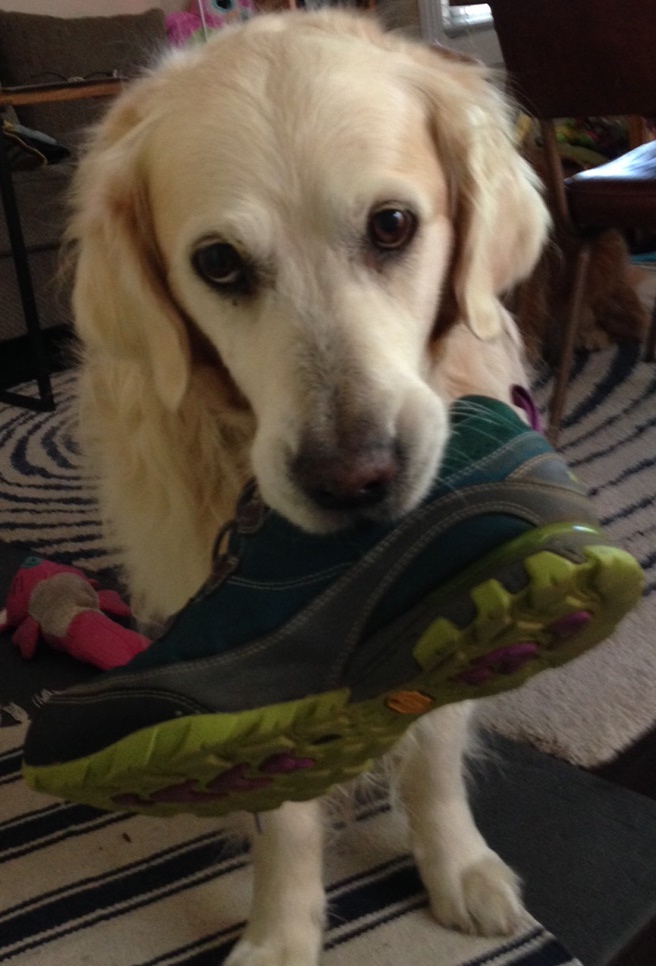
Our dogs have jobs that they are expected to do, similar to assigning household chores to a child. Jana brings in the morning paper. Jana and Cali each bring me a shoe when we’re getting ready for a walk. And each dog is expected to bring me her food bowl when she’s done eating.

Jana learned this task very quickly. She does it eagerly, always happy to receive her dessert in exchange (a small cookie). Alberta is also an eager participant, usually the first to finish her meal and deliver her bowl. If I am not paying attention, she’ll push it into my leg, hard, in a not-at-all-subtle demand for her pay. Past dogs have learned the task too, though Wylie made it quite clear that he saw this task as beneath him — girls’ work — and he would immediately depart for more masculine pursuits upon finishing his meals. Jana was happy to pick up the slack (and the extra cookie).

Then there’s Cali. For months, she’d pretend to try, lifting the bowl by one edge before dropping it with a loud clang. Putting on her saddest golden retriever face, she look at me as if to say, “I tried, Mom, but I just can’t lift it. It’s a very large bowl, and I am a very small puppy.” As the very small puppy became 56 lbs. of solid muscle, this excuse held less and less water, but the sad eyes … well, let’s just say that she does a very good “sad golden” face.

Along came Deni. Not only did we switch Cali to a smaller bowl this summer, but Deni took over much of the feeding supervision. Deni wasn’t moved by the sad face. Weeks of cajoling and praise and cookies paid off. Cali started bringing her bowl, but reluctantly and only with much encouragement. Once we knew that Cali understood what was expected and that she was fully capable of doing it, the coddling was phased out.

Now, as Deni explains, Cali broods over the looming task or “stands there and glowers at her bowl.” She knows she’s supposed to pick it up; she simply does not want to. It’s similar to her reluctant acquiescence to brushing her teeth. But, more and more, Cali talks herself into bringing the bowl with no prompting from either of us. Deni reports that if Cali sees that extra-special treats are being offered for dessert, she is able to convince herself to pick up the bowl much more quickly, and she does so with far more energy and enthusiasm.

The battle of the bowl shows Cali’s increasing maturity and offers a window on her personality and intelligence. We all sometimes choose to do things that we do not want to do. Sometimes we do them for rewards (a paycheck, working extra hours to earn a vacation …) or to avoid worse consequences (dental checkups) or because we don’t want to disappoint someone we care about. Whatever the reason, we all face large and small decisions every day. Cali is no different.

Beyond WordsIn his wonderful book Beyond Words, which I have mentioned before, Dr. Carl Safina talks about sentience, cognition, and thought as the “overlapping processes of conscious minds.” He defines sentience as “the ability to feel sensations”; cognition as “the capacity to perceive and acquire knowledge and understanding”; and thought as “the process of considering something that has been perceived” (page 21).

We see all of these at work in Cali’s struggle. She understands what she needs to do and how to do it; she feels stress, anxiety or discomfort of some kind when she thinks about this expectation, and she considers how to resolve it. Sometimes the feeling of anticipation or desire for a treat wins; sometimes, probably, the desire not to disappoint Deni or me tips the balance; sometimes she needs some prodding. But she is very definitely making a choice. Whether she decides to go for the cookie or she’s concerned about our reaction or she walks away and lets Alberta or Jana pick up her bowl, she is in control; she weighs the options and makes her choice. She is not instinctively or automatically responding to a stimulus in a conditioned way, as some behaviorists would argue. Every day, every meal, Cali shows what it means to be a thinking dog.


Apologies to Jana

I owe Jana an apology.

I’m reading a wonderful book (go get it right now!), Beyond Words by Carl Safina. A review will be posted … once I finish the book. I’ve finished the sections on elephants, wolves, and, best of all, dogs. Orcas are up next.

He takes great delight in lampooning several ludicrous studies that purport to prove humans’ superiority in matters of self-awareness and “theory of mind.” In reading Safina’s analysis of the mirror test, I realized that I got it all wrong. His explanation is brilliant — and so obvious.

The mirror test has been used for decades to establish, so some researchers say, whether an animal has self-awareness. This is variously defined as recognizing that you exist as an individual separate from other individuals (and your environment) to, more absurdly, the definition put forth by the creator of the test and quoted in Safina’s book: “Self-awareness provides the ability to contemplate the past, to project into the future, and to speculate on what others are thinking.” Other definitions include the “capacity for introspection.” I’m not sure how recognizing yourself in the mirror reveals a capacity for introspection or an ability to project into the future, but the folks who wrote those definitions did not explain that detail.

The test involves surreptitiously putting some sort of mark on the test subject’s forehead. When the person (whether human, ape, dolphin, dog, etc.) looks in the mirror, if the person touches or tries to remove the mark, he or she is recognizing that the reflection is not some other creature but an image of himself or herself. I understand that. What Safina points out, though, is that that says nothing at all about self-awareness. What it reveals is an understanding of how reflection works. Seems pretty obvious, no?

He goes on to talk about what self-awareness really means — being aware that you, yourself, are separate from other “selves” and from the environment. He says that a creature that does not recognize this would assume that the reflection was itself since it would not differentiate its own “self” from anything else, but that would also make it impossible to move, eat, find a mate, or do much of anything, like survive. He provides wonderful examples of all kinds of non-humans showing exquisite understanding of their environments and other beings that populate those environments.

I’ll leave his discussion of theory of mind for another post.

So, what does all of this have to do with Jana? In a long-ago post, I described Jana’s experience with the mirror test, and I described her as not only self-aware but also as self-absorbed. While this might be true, I did not give her enough credit. You see, Safina points out that what some non-humans (and who knows, maybe some toddlers as well) do when they first encounter mirrors and do not (yet) understand reflection is that they try to engage with or attack the other being in the mirror. While many psychologists will say that this means that they are not self-aware, Safina makes the (again obvious) point that it absolutely shows self-awareness. Trying to play with or attack another being requires that understanding that you and he are not the same creature!

So. Jana. When Jana was a puppy, we had an older dog, Timo, who resented the puppy and did not play with her. My mom had two adult dogs, Buddy and Daisy, who also were not keen on playing with this relatively large, high-energy puppy. But at my mom’s apartment, Jana made a wonderful discovery: a puppy who kept play-bowing and acting friendly and excited to see her. Jana could not understand why this other puppy never moved beyond the play bow, however. Within a few weeks, Jana did recognize that the puppy in the mirror was actually her, and she stopped trying to get the puppy to play. I used to tell this story and say it meant that little Jana didn’t yet have self-awareness. How wrong I was!

Thanks, Dr. Safina, for pointing out that of course my brilliant puppy knew that she was a distinct individual — an individual who simply wanted a playmate.


Agility Offers Fun for Thinking Dogs

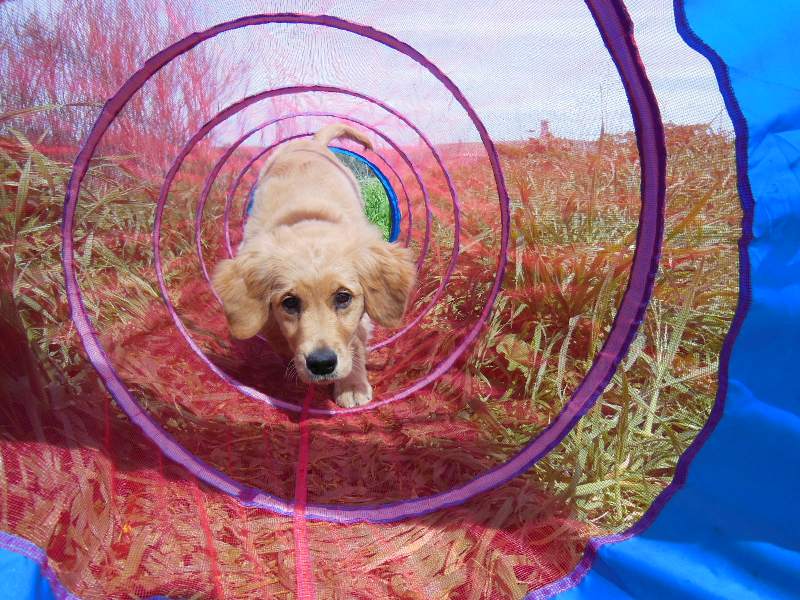
lost in the tunnelCali and Alberta started taking agility classes a few weeks ago. Watching Cali puzzle through things and figure out what we want has been fun. I can almost see the wheels turning in her little head.

Alberta is more experienced with dog sports and classes, having nearly completed her Rally Advanced Excellent title. She catches on very quickly, but knowing what we want her to do doesn’t keep Alberta from showing her silly side in class sometimes.

In the first couple of classes, we worked on targeting a small piece of foam on the floor. Both girls are proficient at hand targeting and were able to touch our hands, on cue, no matter whether we placed them high, low, on our backs, or anywhere else. Getting them to touch the foam mat was easy, too, but … both Cali and Alberta quickly went from simply touching it to retrieving it. Alberta, in particular, has a great working retrieve and has often been rewarded for bringing Deni items that Deni didn’t even know she had dropped.

I’ve been working on teaching Cali to bring my shoes, and, like Jana and Oriel before her, she has shown some entrepreneurial spirit, bringing things that I don’t even know that I need (or want) — in hopes of exchanging them for a small cookie.

So it’s not surprising that both Cali and Alberta think that we want them to retrieve the small mat, rather than simply touch it. Or perhaps they know that we want them to touch it but prefer to retrieve it.

They both are eager to jump onto the agility equipment, out of turn or when we’re waiting for our turn at a different piece of equipment. No fear from either of them; just eagerness to learn more and try out new challenges.

Practicing at home is also fun (and can become a three-dog circus pretty quickly). Jana wants in on the action, and when I was guiding Cali through some fake weave poles, Jana knocked one over with a swish of her tail — while grabbing another and running off with it in her mouth. Meanwhile, Alberta knocked over the other two! Poor Cali never had a chance. With more practice, though, we have managed to get all three girls to walk between the poles, though we still occasionally lose a pole or two to a swishing tail.

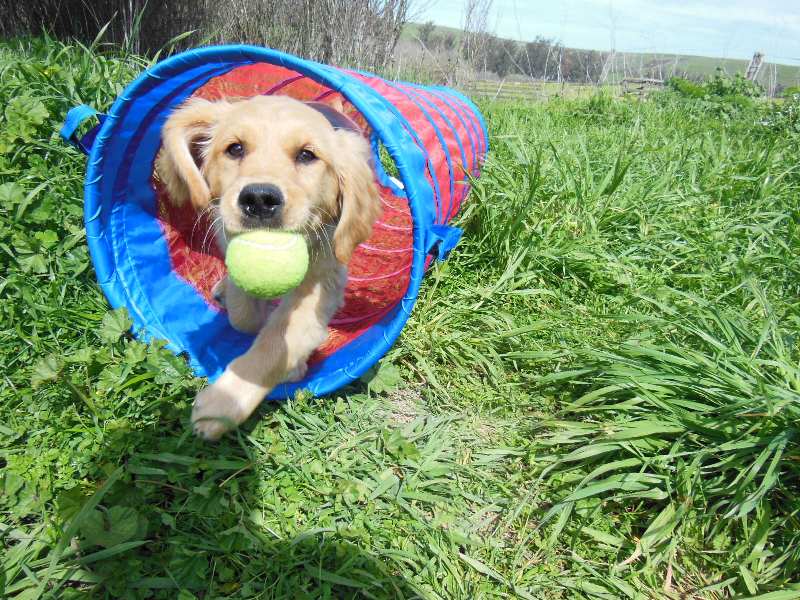
Out of the tunnelNone of our girls has any trouble with tunnels, though Cali did try to circumvent the tunnel once, taking a shortcut to where I was standing. She has always loved tunnels. Cali had a wonderful little play tunnel when she was a puppy, and Jana had plenty of exposure to tunnels before her first agility class. So neither of them hesitates, even when the tunnels are curved or have a piece of fabric covering one end, though many dogs resist entering a tunnel if they cannot see through to the end of it.

I thought about this last week as I was working with a neighbor’s dog, an adolescent golden retriever who is unwilling to use her dog door. The door flap makes her nervous. I rigged up a tunnel using a small table and a towel, and after a couple of sessions, she was willing (though still not exactly eager) to go through it for cookies. She’s uncomfortable with the small space, the towel brushing her back, and her inability to see what is coming. She’s improving, but she reminded me of how important it is to expose dogs to all sorts of tactile experiences, starting at a very young age.

Even that is not foolproof, though; this dog did use the door flap when she was younger, until she had a scary head-to-head confrontation with the cat as she went through the flap. My jerry-rigged tunnel will (I hope) help build her confidence in the same way that agility classes are boosting Cali’s confidence and awareness of where her body is. Classes in agility or other dog sports are a lot of fun — and they improve the dog’s focus on you and your communication with each other. Besides, they provide plenty of mental challenges to your thinking dog!

Anticipation … Is Making Me Worry

Cali worries.

Many people worry. They dream up scenarios that could never happen. Then they worry that those unlikely events can and will happen. And they worry about what would follow … I don’t know if Cali does that, but she does worry about things that she knows are about to happen.

She worries about brushing her teeth. This is odd, because, when she was a puppy, she actually asked to have her teeth brushed, perhaps anticipating the treat to follow. She walked over to where the dog toothbrushes and toothpaste were kept and touched them with her nose. Looked at me. If I failed to notice, she nudged my hand, then walked over and touched the brush again.

Now, when it’s getting close to bedtime, she’ll go out for “last call,” then come in and immediately disappear when I say, “Time to brush your teeth,” or even move toward the bathroom. Disappearing a 60-lb dog is not an easy feat in a tiny one-bedroom apartment, yet Cali is gone. Jana comes right over to the sink, tail wagging, ready for the nightly tooth-brushing routine. I call Cali. She hides behind the bathroom door. Or I find her in the dog bed on the other side of my bed, pretending to be asleep. I’m willing to provide delivery service for the actual tooth-brushing but not for the cookie that follows. That’s only for dogs who line up to get their teeth brushed (she usually shows up for that part). Tooth-brushing doesn’t hurt. She’s never had a toothache or broken tooth or even an abscess. She likes the taste of the (chicken-flavored) toothpaste. But, somehow, when she knows that it is coming, she worries. The anticipation is much worse than the experience.

This is also the case for some other grooming tasks: Ear cleaning is admittedly as bad as she expects it to be, but getting the fur on her feet trimmed doesn’t hurt at all. It might tickle a bit, but then she’s amply rewarded with really special cookies. Nail trimming is even worse to anticipate: Both the Dremel that files her nails and that horrid clipper thingy are clearly medieval torture implements, in her view. In her entire 2 ½ years, no one has ever over-trimmed and cut the quick. Even so, no one can convince Cali that nail trimming is not worth every ounce of dread she can summon.

Cali worries about other things too. When I am working at my home computer, she catches sight of her ball and then looks worriedly at it, as if wondering whether anyone will ever throw it for her again. When we’re at the park and I do throw it, she catches it and then holds it between her paws, lying on the grass and looking worriedly around her at the other dogs who might come by and nab it. When she decides other dogs are too close, she picks up her ball and moves to a different part of the field. When no possible dog threats are near her in the park, she stretches her back legs out, ball loosely held between her teeth, and wags her tail at the activity happening at a safe distance. But she is reluctant to let the ball go for me to throw it — and start up the whole worry sequence again.

Her other big source of worry is the vacuum cleaner. It looks innocent, tucked into its little corner of the kitchen, but it sometimes roars to life. She avoids it, though she had no such fear as a puppy. When it comes out of its corner, Cali is nowhere to be found. What is her concern? She’s been around vacuums her whole life without ever suffering the smallest chance of being sucked up.

Cali’s worried anticipation, much like her eager expectation when we are driving toward a beloved location, dispels the myth that dogs are unable to think about future events. Dogs do appear to extrapolate from past experiences what the future might bring, good or bad. The best I can do when she’s nervous is acknowledge her concerns and insist that she face her fears and move on. While I hope that her anxiety is just a phase, I do wish that I were fluent enough in Dog to figure out why some future events seem so frightening to Cali.

Be Careful What You Teach Them …

When I was first learning to train service dogs, my instructor taught me that, once you put something on “cue control,” that is, teach the dog to do it when asked, the dog will no longer do it unasked.

Those of you with dogs and a little training experience, stop laughing.

This is one rationale behind teaching dogs to “speak” — bark on command.

Problem is, no one told the dogs about this bit of learning theory.

There is a key caveat to this piece of wisdom: The dog will no longer do it unasked unless he really, really wants to.

Bonnie Bergin (my teacher) discovered this one morning, when a particularly rambunctious group of adolescent Labrador service-dog trainees learned about tugging open a refrigerator door. One day, the ringleader of the litter, Xavier, let himself and some buddies into the training room (opening the door from the outside yard), tugged open the fridge, and helped himself to a large hambone.

The ensuing melee was quite dramatic. None of those Labs became service dogs.

I learned about the “unless they really want to” caveat to the lesson about dogs not volunteering named behaviors too late: I had already taught Jana to speak on cue. She uses her words. A lot. She’s quite opinionated, in fact.

Cookie, please

But I digress. The latest example of dogs doing unbidden that for which they have been amply rewarded in the past involves my shoes. I recently wrote about how eagerly Cali and Jana bring my shoes or sandals when it’s time for our morning walk.

Well, now they bring my shoes and my sandals. And a pair of slippers or flip-flops too. I reward the correct two shoes and wordlessly return the others to their proper place, hoping to extinguish this behavior. Not only is the flood of shoes not diminishing, it’s extending beyond walk time.

I occasionally turn around to find Jana, hopeful look on her face, shoe in mouth, standing behind me … at any hour of the day or evening. When I ask for anything — bowl, leash, collar, toy — Cali will often dash off enthusiastically … and return with a shoe.

On the bright side, they are both really good at “getting the other one,” so I never need to worry about being barefoot or mismatched.

So, be careful what you teach your dog; she might be smart enough to turn it into a game you never anticipated.

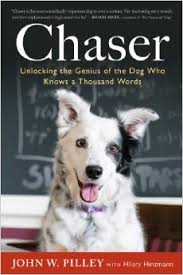
Chaser: Unlocking the Genius of the Dog Who Knows a Thousand Words

CHaserAmazing dog. Amazing and super-friendly author. I got in touch w/Dr. Pilley after reading the book (and his research papers) and he did a Skype conversation with a class I was teaching on dog-human communication. He is one in a million, as is Chaser. He is such a great example of positive training that respects a dog and her abilities… and he is a fantastic teacher as well.
No one is surprised to hear that a border collie is intelligent and learns easily. But Chaser has gone far beyond what any other dog has been documented to learn in terms of human language comprehension. Dr. Pilley set out to teach her as many words as he could — names of objects — after reading the dismissive comments that greeted publications describing the accomplishments of Rico, a border collie in Germany who learned several hundred words. Dr. Pilley analyzed the linguists’ and other academics’ critiques of the training and testing of Rico — and set out to train his dog in a way that addressed all of their objections. And he accomplished his goal. (An interesting chapter in the book describes the resistance he faced when attempting to publish his initial results.) The opposition to admitting that any creature but humans can use language is still deeply entrenched.
But it’s also dead wrong. Chaser truly does understand human language. She learned and retains the names of more than a thousand items. She has demonstrated her ability to categorize them, grouping round bouncy things into the “ball” category and flat flying things into the “Frisbee” category, for example. And, like most dogs, she clearly distinguishes the category of “my toys” from “things in the house that I’d like to chew but am not allowed to chew.”
But Dr. Pilley realized that he had not pushed the boundaries of Chaser’s abilities. So, they tackled grammar next. Chaser understands the concepts of subject, verb, object — and indirect object. As an editor and college instructor, I have to point out that many writers and college students do not reach Chaser’s level of grammatical knowledge.
Toward the end of the book, Dr. Pilley describes his initial attempts to teach Chaser to imitate long, complex strings of behaviors. His description inspired me to try simple imitation games with my dogs, which have been fun and very funny.
The best part about this book though, is its constant message: Keep training fun and rewarding for the dog; make it a game; play to your dog’s strengths and preferences and, most important, make sure she has time do play and engage in her favorite activities. For Chaser, that means regular opportunities to herd sheep at a near