Is your dog as smart as a human 2-year-old? A 5-year-old? A (gasp) teenager? Does it depend on what breed your dog is?
We can’t help it, we humans. We want to put everything into neat little human-constructed boxes. That is, I think, what is going on when people try to define dogs’ (or other non-humans’) intelligence in human terms. That and the common, if arrogant, human assumption that we are the smartest creatures, so everyone else — dolphins, dogs, starfish — can and should be evaluated, based in how they compare with us in human-like ways.
But really, how many human 2-year-olds would you trust to guide you across a busy street? Or turn loose in the wreckage of a natural disaster or terror site, with the expectation that the little tyke would let you know where the survivors are trapped? We use dogs to find lost 2-year-olds, don’t we? And protect them (and other humans) from diabetic coma or severe peanut allergies, warn of their impending seizures, coax those who have autism or have suffered trauma to connect — and so, so much more.
The basis for comparison is obviously flawed. Dogs are much like human toddlers in many ways, it’s true — their unbounded love of play; their sweet willingness to befriend just about anyone. Yet they are so much better at some things than any child could ever be — better at some things, such as anything based on scent, than any human of any age could ever be.
So, how should we measure, evaluate, understand canine intelligence?
We can start by acknowledging that intelligence is a complicated concept — there are many types of intelligence. Among people for example, there is social intelligence or emotional intelligence, there is numerical or problem-solving or analytical intelligence. Business acumen, logic, performing well under extreme stress — all of these might be considered different skill areas or types of intelligence. Intelligence is what helps you (or your dog) navigate life, with all the challenges and detours it throws in your path. We are all stronger in some areas, weak or ridiculously incompetent in others. The same is true of dogs.
We can also think about the skills that dogs have that have no parallel in human ability or intelligence — and the myriad ways we can help dogs develop and use those skills in partnerships that make life better for humans and dogs.
Some dogs excel at reading people’s body language. According to several prominent dog cognition researchers, among them superstars Brian Hare and Adam Miklosi, dogs — even very young puppies — excel at reading humans’ pointing gestures and where their humans gaze. This is a type of social intelligence. I am sure that many, many dogs excel at this. However, not all dogs do. I know. I live with one who fails miserably at reading gestures.
Other dogs (including the one who cannot follow a pointing finger to save her life), can intuit a person’s mood and provide exactly what is needed: comfort, humor, affection, appeasement, a favorite toy.
Still other dogs are great problem-solvers. They analyze each new situation and map out a solution.
Some dogs are born to … fill in the blank: Provide mobility assistance, search out bombs or drugs, find lost or hurt people, detect tumors, comfort lonely elderly people, make children laugh.
I don’t think it matters whether your dog is smarter than a toddler. I don’t think it is a fair or relevant comparison. What does matter is assessing each dog’s strengths and weaknesses, his or her specific areas of intelligence. Then, we can figure out how to stimulate and challenge each dog in the ways that will allow him or her to succeed, thrive, and enjoy life to the fullest.
puppy training
The Daily News

Jana spends considerable time on every walk catching up on the local news. She sniffs out the usual trees and bushes on our daily route. When we take a different route or an extra walk, I know to leave extra sniff time.
But that’s not enough for my newshound. Jana does her best to ensure that I, too, have a steady stream of news and information. Knowing how sadly lacking my sense of smell is — and sensing my inability to understand the dog news, should I somehow manage to gather it — she wants me to read the daily paper.
Since our recent move, we’ve had Sunday-only delivery of The New York Times. But every morning, Jana has headed to the gate with an eager expression and a spring in her step. Bringing in the paper has been her job. Forever. She fetched The Jerusalem Post as a puppy. As a secular dog, she resented the lack of a Saturday edition.
As a young adult, she fetched the Boston Globe, carrying it the length of a very long driveway. (At one point, she suffered the humiliation of having to fetch it wearing a long leash, the result of an unfortunate decision one morning to take off after a jogger, rather than bring the paper home.)
She has fetched the Santa Rosa Press Democrat, the St. Petersburg Times (and, more recently, the Tampa Bay Times) and, last year, the San Francisco Chronicle. For the Chronicle, she was forced to fend off a job-stealing challenge from puppy Cali; having held on to her position, she proudly, carefully, carried her prize a great distance to our little rural cottage each morning.
So, when we moved to Petaluma, Jana simply could not understand — or accept — my decision to take Sunday-only delivery. Online news access, it seems, is an even more foreign concept to dogs than to us over-40 humans. I am fumbling along with it, but she refuses to accept this transformational technology and the havoc it wrought in her world.
I simply could not face the daily sad face, the disappointment. She’d head happily to the gate, and I would open it and show her: no paper. Her head would hang, and she’d slowly walk back to the house. Unemployment. Downsized. Made redundant by a computer. Unneeded. The worst fate for a smart, educated adult. Jana could relate. It was a terrible thing to watch.
So, I upgraded my newspaper subscription.
Now, our paper appears at the gate daily. Not rain, nor sleet, nor snow … even better than the mail, since we get seven-day-a-week service. Every morning, even before the sun comes up, Jana has a paper to retrieve. Full employment has returned. Jana’s sense of self-worth is restored.
Life is good for this thinking dog.
You Need a Large Toolbox
I met a wonderful family recently. They are puppy raisers for a guide dog school in the Northeast (one of the best assistance dog organizations that I am familiar with, Guiding Eyes for the Blind, in Yorktown Heights, NY). They told me a story that perfectly illustrates the importance of knowing and treating each dog as an individual.
The ability to lie still and just hang out is a crucial skill for service and guide dogs in particular, but, really, all dogs need to learn to do this. After all, we humans can rarely provide 24/7 entertainment and fun. Even if we could, this would be over-stimulating for the dog. Dogs need to learn how to calm themselves and just chill out.
These puppy raisers said that the way they had originally learned to teach dogs the importance of just being still (often using a cue like “settle”) was to give the dog food treats as rewards for lying quietly near them. For many dogs, this works well — the dog can initially be rewarded simply for lying down (when working on a strong “down”), and, very gradually, the rewards can be delayed until the dog has remained quiet for a few seconds, then 10 seconds, 15, etc. When the dog is able to relax in place for longer times, intermittent treats, with the interval getting longer, can reinforce this behavior and convince the dog that just lying there really isn’t so bad.
What was wrong with this approach? For many dogs, nothing. Then there were those extremely food-focused dogs. Funny how many of those are Labs and goldens — the very dogs that service and guide organizations use the most. Some of these dogs, it seems, would take to asking for food. The more independent ones would cut out the middleman entirely and start looking for dropped crumbs on the ground. These behaviors are annoying in any dog, but particularly unacceptable in a dog who works in public. These dogs need to learn to ignore tempting morsels in restaurants, supermarkets, and other places where there could be food on the floor.
So, the trainers came up with a solution: Reward the dog for lying quietly with a very gentle stroke along the dog’s back. Not active petting or interaction; simply a single, gentle, calming stroke. Again, for many dogs, this is indeed a desirable reward and something that will even deepen the calm, relaxed state the dog is in.
Then there are all of those other dogs. The ones that get wildly excited at the slightest stimulation. Even reaching toward these pups to stroke them is likely to be read as an invitation — and is more likely to elicit a play bow than a calm, relaxed dog. Or the dogs who regard touch as an invitation to cuddle or the ones who roll on their backs to solicit a belly-rub at the slightest hint that a hand is near. And don’t forget our analytical canines — the ones for whom touch is not rewarding, those whose social styles tend more toward more reserved contemplation of humans than actual up-close-and-physical contact.
You get the picture. This method of rewarding lying still is not going to work for all dogs — any more than food rewards would work for all dogs. That is exactly the point of using a cognitive approach to teaching dogs: Treat each dog as an individual. Starting with that essential principle, we can figure out which dogs to reward with food, which to reward with stroking — and which need something else entirely.
There is no one correct way to teach or reward any particular behavior, as my new friends learned. And individual dogs may respond to different rewards at different times. Applying this knowledge has made them better puppy raisers — and, I am sure, better people.
The methods and rewards are as varied as the dogs (and trainers) are. Be on the lookout for new ideas and ways of teaching or rewarding a dog. Every trainer needs a constantly expanding toolbox of techniques.
What Is Motivation?
When we are trying to understand why individuals — canine or human — behave in a certain way, we are trying to understand what motivates them. When trying to convince someone to do something he or she is not especially eager to do, we need to come up with a strong enough motivation to overcome that resistance.
For many dog trainers, food rewards are the only “motivator” they employ. Other trainers refuse to use food rewards in training, scornfully saying that dogs trained that way will work throughout their lives only for the food. In some cases, this might be true; skilled trainers, though, fade out the food rewards once a dog has learned a cue. Which leads to the interesting question of motivation: If the dogs are not working only for the food, what are they working for?
What do you work for? The satisfaction of a job well done? Money? The chance for a guilt-free rest or vacation? The admiration of your boss, colleagues, or friends? To impress your family? The pleasure you get from your work?
People work for many things. Some are tangible (money or food); some are external (popularity, praise, satisfaction) and some are internal (feeling proud of accomplishment, understanding the importance of the goal). The same is true of dogs (except maybe the money part).
What motivates you is as individual as you are. It is as variable as the situation or task at hand, your mood or energy level, where you are (in life or at a given moment), who’s nearby … any number of things can affect your motivation. What remains true is this: You decide what motivates you at any given moment or to perform any particular task. If you don’t care about money, no amount will drive you to do a task you loathe. If you are not hungry, the promise of a snack is unlikely to propel you to quickly complete your homework.
Next time you are having a hard time getting your dog to do something that you want her to do, think about motivation. Try a different motivator. Maybe you are asking her to do something that is very important to you but irrelevant or even unpleasant to her. Examples range from calling your dog to you when she is playing at the dog park or chasing a squirrel to asking her to pick up an object that is heavy, awkward, or just plain inconvenient to hold. In many cases, she’ll be willing to do as you ask — given the right motivation.
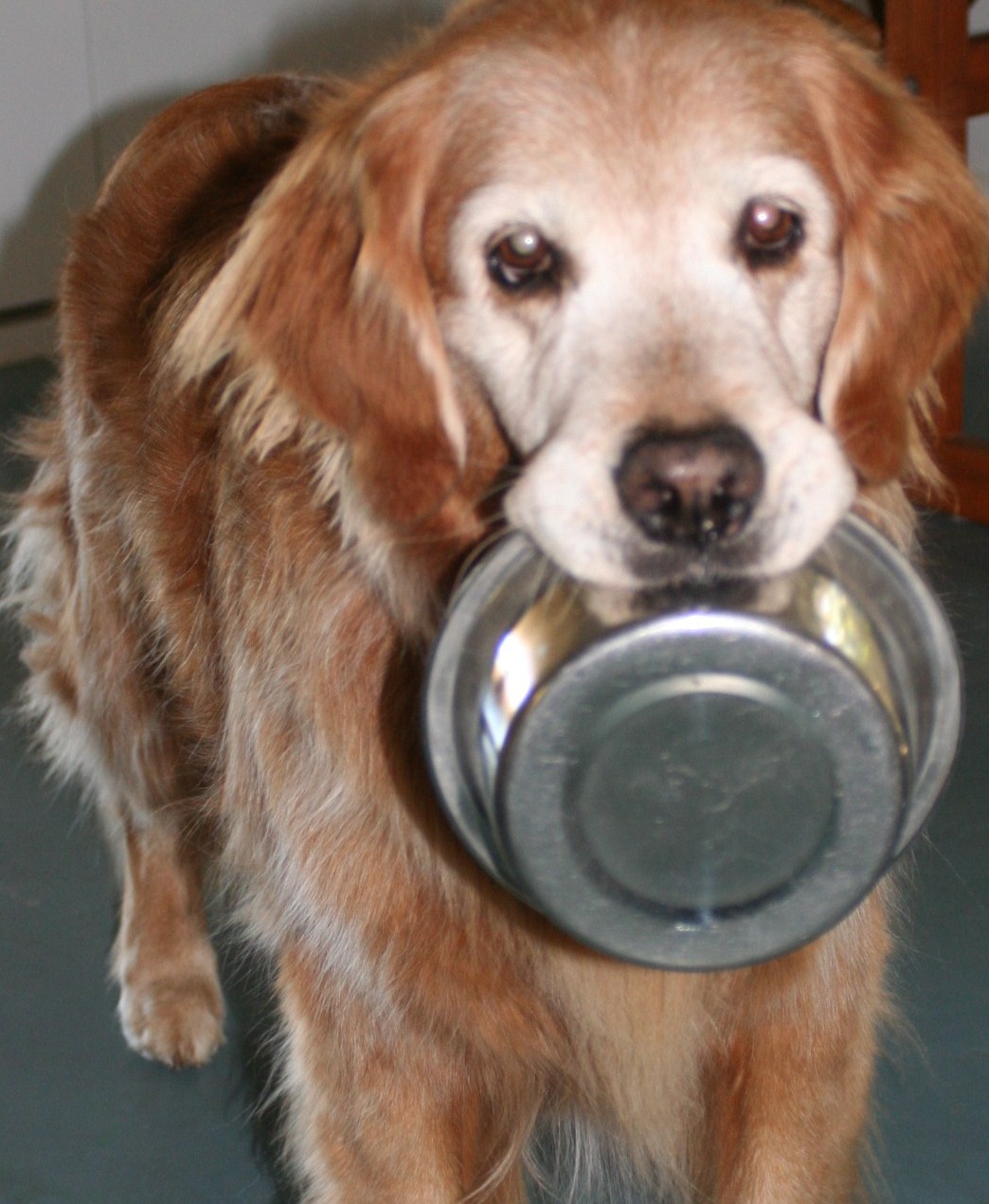
I know that it’s hard to be more interesting and appealing than a fleeing squirrel. But waiting a moment, until the squirrel reaches a nearby tree, perhaps, then calling the dog and offering a really tasty treat … well, now you might be getting somewhere. If your dog loves to play tug, use a few rounds as a reward when she does something that is really important to you — like picking up her heavy, awkward food bowl after dinner. Improve your tennis-ball-obsessed pup’s recall by rewarding her for a quick response with a few throws.
Finding the right motivation sometimes requires creative thinking on your part. It also requires looking at your dog as an individual. To figure out what motivates your dog, pay attention to what your dog pays attention to. What turns that light on in her eyes or gets her running over to you? Dogs whose owners say they are “not interested” in food might discover a culinary bent in their pooch when they offer freeze-dried liver or bison jerky or bits of roast beef. Maybe you haven’t hit on the right toy to turn on your dog’s inner retriever or you haven’t found the scratch spot that’ll have him not only picking up but washing and drying the dishes — just to get a little more of what you are offering.
We all will work for something. We will often do even unpleasant chores for the right reward. The trick, in every relationship, is figuring out which rewards work. You’ll know when you find the ones that work — but remember, make sure that the dog knows that it’s always her decision.
Rethinking Obedience
 “The walls and grids that restrain your animals restrain also your own knowledge.”
— Vicki Hearne
What I call “old-school” dog trainers — those who operate from the assumption that the human has “to be the alpha” in his or her relationship with a dog — don’t, in my opinion, credit dogs with much in the way of cognitive ability.
Some, like the 1920-era European trainer Konrad Most, bluntly state an approach to education that many of us would recoil from today: “In the absence of compulsion, neither human education nor canine training is possible.” Others, like William Koehler (circa 1960s), give rational-sounding advice: “Lay down a set of rules, and see that your dog lives by them.” But the means used to accomplish that goal are harsh and authoritarian.
What these trainers share is an emphasis on punishment over motivation or reward and an expectation that a dog should offer instant, precise obedience to any command given by a human. The expected response is almost robotic in its uniformity and immediacy.
Trainers with these expectations do not believe that dogs can — or should — think or be part of a decision-making process. No, the dog should know who’s boss and, according to Most, “do what we find convenient or useful and refrain from doing what is inconvenient or harmful to us.”
While both Most and Koehler were both enormously influential in the development of dog training, much about their approach is antithetical to the goal of raising a thinking dog.
Demanding instant, precise obedience to all commands in all situations does not allow for the dog to think or process the command in any way. When you expect instant, unquestioning obedience from your dog, you are essentially prohibiting him from thinking. In human relationships, we talk about such expectations this way: “When I say jump; you may ask only, ‘how high?’ ”
To raise a thinking dog, that is, to use a cognitive approach to your dog’s education, you must have expectations that not only allow for but encourage the dog to think and solve problems. The cognitive dog needs to learn, understand, and, ultimately, buy into a shared goal. Expecting unquestioning obedience at every request, mapping out not only the end result but every step the dog must perform to get there does not — cannot — allow dogs to think conceptually about what you are trying to accomplish, learn to solve problems, or offer a different (maybe better!) solution.
Granted, there are situations where an instant response is necessary — if your dog is unthinkingly following a bouncing tennis ball into a street, for example. But developing your dog’s cognitive abilities does not prevent you from also teaching your dog a strong recall and an “emergency recall” cue that, when taught and practiced with the highest-value treats possible, will ensure an automatic response in a true emergency.
There are many ways to lead or manage (or parent). Those of us who want to share our lives with thinking dogs should be wary of dog professionals who talk a lot about alpha roles and hierarchical relationships. Instead, we should look for ways to develop our dogs’ considerable cognitive abilities. Start by figuring out what motivates your dog. Read future blogs for tips on how to do that and more.
Teaching or Training?

Puppies, like babies, are born with the potential to learn and problem solve and think. They are innately curious and begin investigating their world even before they open their eyes.
Our job is to develop these skills in our puppies and dogs by providing opportunities for them to learn and develop their conceptual thinking abilities. We can expose them to lots of novel items and situations and provide encouragement and motivation. We can also be on the lookout — especially with puppies — for opportunities to turn potential problem behaviors into desirable, adorable, and even helpful skills!
Dogs who are taught, especially by handlers who use methods that encourage problem-solving, become better problem-solvers. A study called “Does training make you smarter?” compared dogs who had received training with dogs who had not. Dogs who had received training solved a problem — opening a box that had a pad that could be pressed by the dog’s paw — spent more time trying to open the box (and were less likely to seek help from their owners) than dogs who had no formal education. The study’s authors speculate that trained dogs have “learned to learn” in a way that unschooled dogs have not.
But, and this is a big but — not all education is equal. There are many approaches to teaching or training, and the methods you choose will affect more than just how fast your dog learns — it can affect the bond between you and your dog, and it can shape or reflect your attitudes toward dogs. And it’s not just the method. The words matter, too.
I make a distinction between training dogs and teaching them because I think the word choice reflects a difference in attitude and goals.
Training dogs is what I call educational approaches that are narrowly focused on eliciting specific reactions to cues or commands. The trainer has a clear end result in mind for each command. The trainer says, “sit;” the dog sits. Practice emphasizes precision of the dog’s response, speed of the response, and the dog’s ability to respond quickly and precisely even when distractions are present.
When I refer to teaching, on the other hand, I am referring to a process that develops the dog’s thinking and problem-solving abilities. The teacher’s goal is to give his or her students the tools and the confidence to figure out what to do in a variety of situations. Sometimes, a teacher might seek a precise response, like the sit; other times, the teacher makes a request that requires the dog to figure out what to do. “Find a pen” gives the dog a goal but no precise instructions for reaching that goal.
Teaching brings the dog to a level of independent thought and problem solving that enables him to respond to a command or cue that is as vaguely defined as “find a pen;” training does not.
Any approach to training or teaching is based on an underlying mindset or set of assumptions: assumptions about what dogs are capable of learning; assumptions about how dogs learn and how much of what we say and do they actually understand; and assumptions about what the dog-person relationship should be.
Trainers who do not believe that dogs are capable or reasoning or problem-solving are unlikely to put any effort into developing these skills in the dogs they train. Trainers or handlers who believe the dog’s “job” is to be obedient and submissive are unlikely to tolerate a free-thinking dog. Some trainers talk about “getting dominance” or “being the alpha” as ways to ensure that dogs remain obedient and submissive.
Methods of dog “training” or education can be placed on a continuum that ranges from those that do not encourage the dog to think at all to those that practically make the dog do all of the thinking. The Thinking Dog blog will teach you to recognize various approaches and their goals — and encourage and equip you to explore methods that help your dog become the best thinking dog he or she can be.
Cali, the Ghost, and the Dog Door
 Our electronic dog door continues to be a wonderful window on the dogs’ personalities. The dog door is operated (ostensibly) by a magnet attached to each dog’s collar. The idea is that only animals with magnets can open the door, keeping out neighbor cats, possum, raccoons and the like.
Well, in one of Florida’s daily summer thunderstorms, the door suffered damage. The motor would hum but the door would not open. We summoned our electrician, ordered a part, summoned the electrician again, and, after a few dog-doorless weeks, were back in business. With a twist.
The door started opening and closing all on its own. We joked that not only had we acquired a resident ghost, but the ghost somehow had been given its own key and had learned to use the dog door. As I sit at my desk, not a dog in sight, the door will occasionally open and close. Then do it again a few minutes later. The ghost going out for a potty break and returning? Or the ghost entering for a brief reconnaissance and leaving? Hard to tell, since I can’t actually see the ghost.
Meanwhile, Cali, who learned to use the dog door in just seconds flat, has lost key privileges. She, it turns out, wants to spend all of her time outside chasing lizards. And occasionally catching them, with gruesome results for the lizard and anyone watching. She has recently taken up stalking those huge, bright yellow Florida grasshoppers that are apparently quite tasty. Her other hobby is digging small ditches all over the backyard. Some dogs, it seems, are too immature to handle the freedom a dog door brings. Unable to convince her to take up knitting, gnawing chew toys, or even sunbathing (with sunscreen!), I took her key away.
With no key, Cali has to ask permission to go out, and she now has supervised playtime. She hates that. She has figured out that she can sometimes follow her big sister Jana out. Occasionally, I think when Cali is being particularly, er, adolescent, I have seen Jana walk with her over to the door. Door opens; Cali runs out; big sis walks away with, I swear, a big smile on her face.
The next step was probably inevitable: Cali discovered the ghost. And decided to train it. She could get the ghost to let her out! Who needs a key when you have a trained ghost?
Now, when Cali wants to go out, she sits, patiently staring at the dog door. Eventually, usually within a couple of minutes, the ghost does, indeed, let her out.
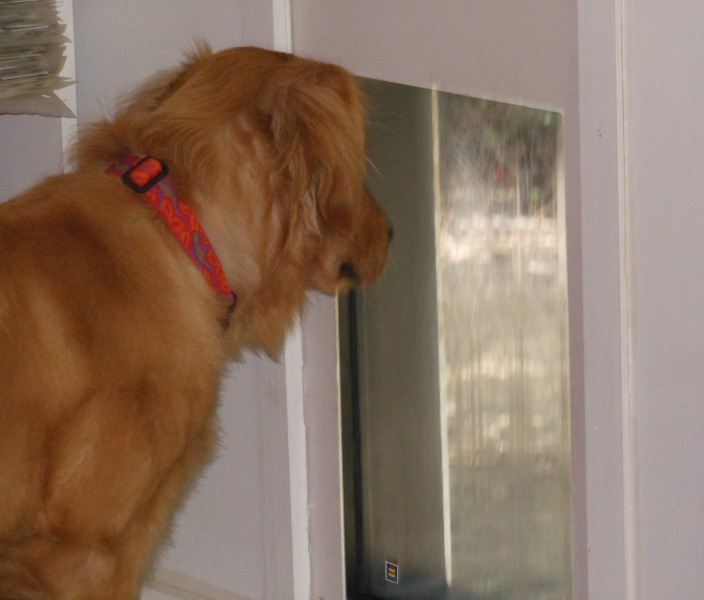 Cali has had less success at training the ghost (or her big sisters) to let her back in, however. When she gives up on the ghost, she’ll sit, looking sadly at the back door and occasionally jumping on the glass, until I let her in. Twice I have come home from errands to find her outside, stretched out in the shade, waiting patiently.
I haven’t seen her sitting by the dog door on the outside, waiting for the ghost. But she has gotten back in without my help on occasion. So maybe the ghost training is going better than I think.
Sometimes, when Jana or Albee opens the door to go out, Cali seizes the moment and slips in very quickly. Jana isn’t quite as agile as she used to be, and the door only stays open for about 5 seconds. So when Cali does this, Jana is left inside. As Cali enters and the door closes, Jana gets a perplexed look. I am sure that, as she waits for the door to open again, she’s wondering why she wasn’t lucky enough to be an only dog.
Puppy Tries to Downsize Older Dog, Steal Her Job
At the ripe old age of not-quite-three-months, Cali made her first play for Jana’s job. She liked the idea of a paycheck, in the form of some treats, delivered as soon as the work was complete.
The newspaper was still bigger than Cali the first time she grabbed it and dashed off ahead of Jana. Reined in by a too-short leash, Cali was soon overtaken by Jana. Jana looked at her in annoyance, then reached over and snatched “her” newspaper back.
Jana’s held this job since she was a tiny pup, and she is not ready to retire.
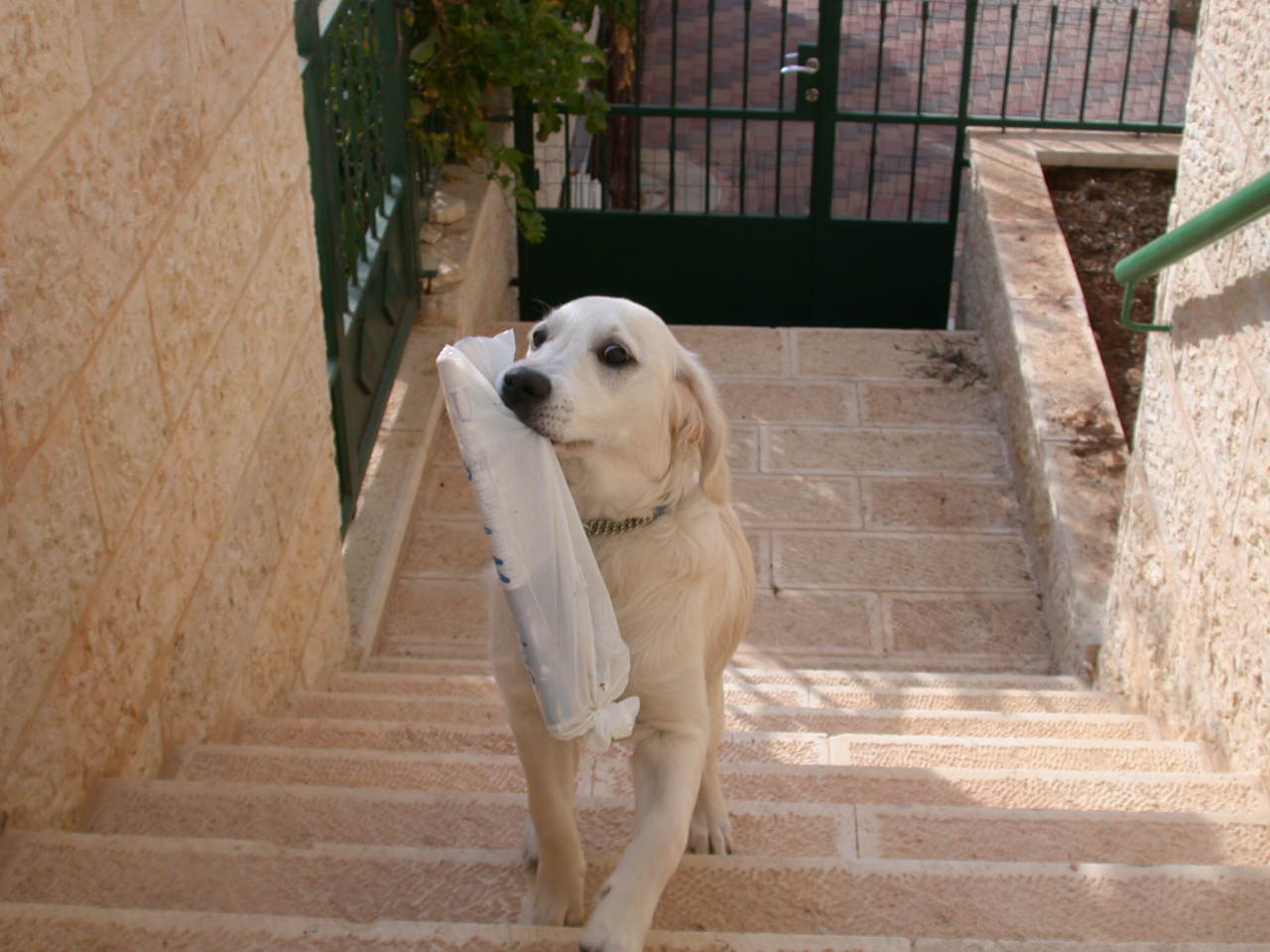
Since that day, I try to get the girls to take turns, and I give each one a reward, but Cali still wants that job. And Jana is not giving up without a fight. Sometimes the paper bears the brunt of this literal tug-of-war.
Dogs need jobs. Ever more, dogs need opportunities to earn rewards. But I think what is really at play here is that Cali looks up to — worships — Jana and wants to do everything that Jana does. Cali learns new skills very quickly and I am sure it is partly because she is watching what her adored big sister does and copying every move, albeit in her clumsy puppy way.
Still, I think the best solution might be a second newspaper subscription.
Introducing Cali!
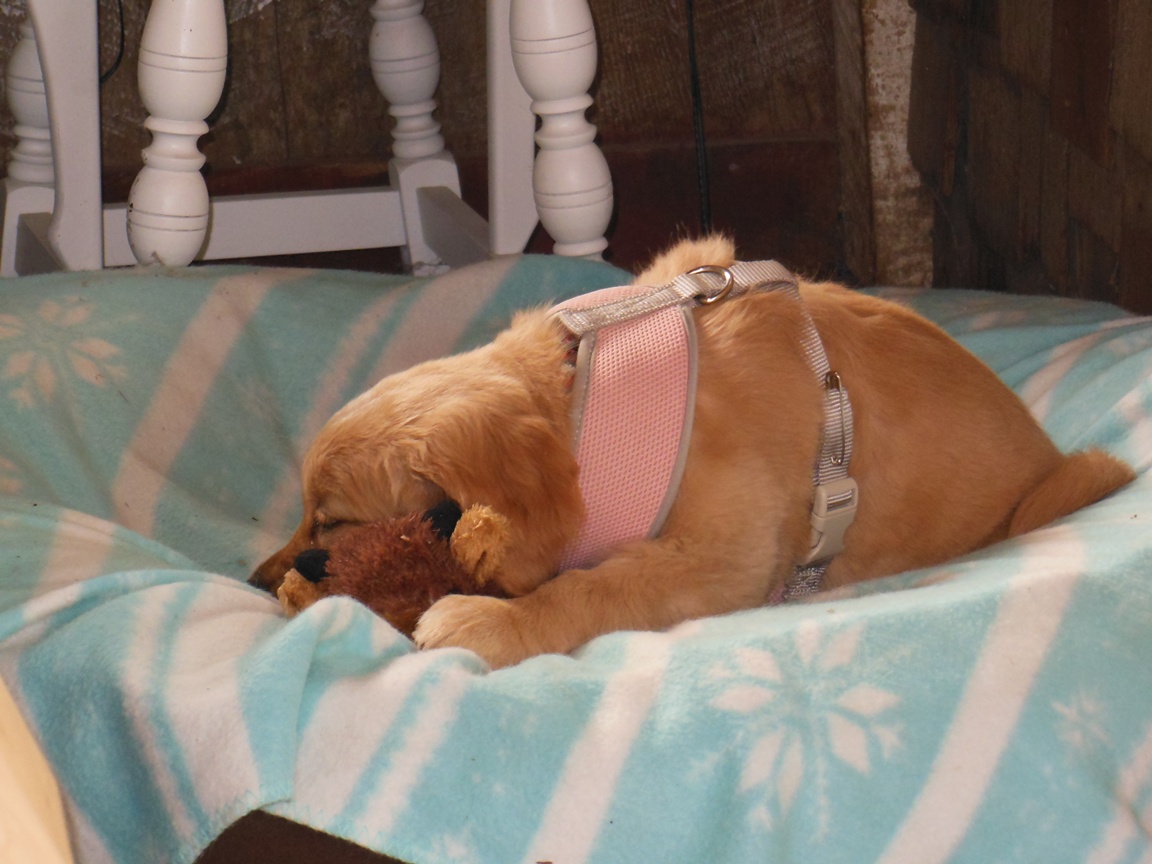
Our family is growing! Meet Cali, the newest member of the Hogle and Elliott household. Except, of course, she’s in California with me and Jana now, not home in Florida with Deni.
Single puppy parenthood is a challenge! Cali is wonderful about asking to go out when she needs to … but that means that I have to be quick to respond, whatever the time of day — or night. How do parents survive months of this? After just over a week, Cali is waking up pretty consistently around 1 a.m. and again between 4 and 5 a.m. The second time, I just let her cuddle with me until it is time to get up at 5:15 or 5:30.
Yes, mornings begin early with a puppy. She’s full of energy, happily greeting her toy box like a long-lost friend, bouncing from one end of the small studio to the other, trying to get Jana to play, turning somersaults, and generally being a puppy. All while I am trying to find the ON button for the coffee pot.
By the time dogs go out, dogs come in and wipe their feet, I build a fire in the wood stove and take a shower, dogs have breakfast, we all walk down to fetch the paper (Jana does all the work here), I have breakfast, we play, puppy goes out again … well, I am ready to go back to bed. And it is only about 7 a.m.
The good thing about puppies is, they take a lot of naps. But, many of these are power naps, which means that, after 20 short minutes, Cali is wide awake, full of energy, and eager to play. I, having tried to get 3 hours’ worth of work done during those 20 minutes as well as pay some attention to Jana, am less refreshed and eager to play. Sometimes, she’s lucky she’s so cute.
She uses her cuteness on others as well. At Bergin U, where I am teaching this semester, Cali has charmed the students, staff, and volunteers. She is easily the most popular girl on campus. The benefit for me is that, the more people who come play with her, the more naps she takes! In fact, she’s taking one now, having been thoroughly worn out by a dedicated volunteer who drove in from more than a half-hour away — to play with Cali!
I was a little worried about her the first few days she was home. She didn’t show much interest in eating and even left food in her bowl! She has adjusted quickly, though, learning the attraction of food-filled Kong toys, solving her Brainy Bone puzzle (to get at the hidden Charlee Bear), and begging for meals and training treats.
Speaking of training, this puppy is clearly a genius, well on her way to learning several cues and tricks. I think she’s a lefty; she shakes with her left paw about 3 times out of 4. She’s got a nice “sit” and is catching on to “down,” “turn,” and a few others. She’ll even pick up a wooden dumbbell, but is not quite reliable about giving it back to me yet.
Most miraculous of all, Cali seems to be on her way to charming big sister Jana. She is definitely the annoying little sister sometimes — clamoring for attention, bugging Jana to play, appropriating Jana’s bed and toys. But, yesterday morning, something momentous occurred. Jana asked Cali to play. The two romped and tugged with her for a few minutes before Jana remembered her older-dog dignity and her opposition to puppies and went back to bed. The puppy tires her out too!
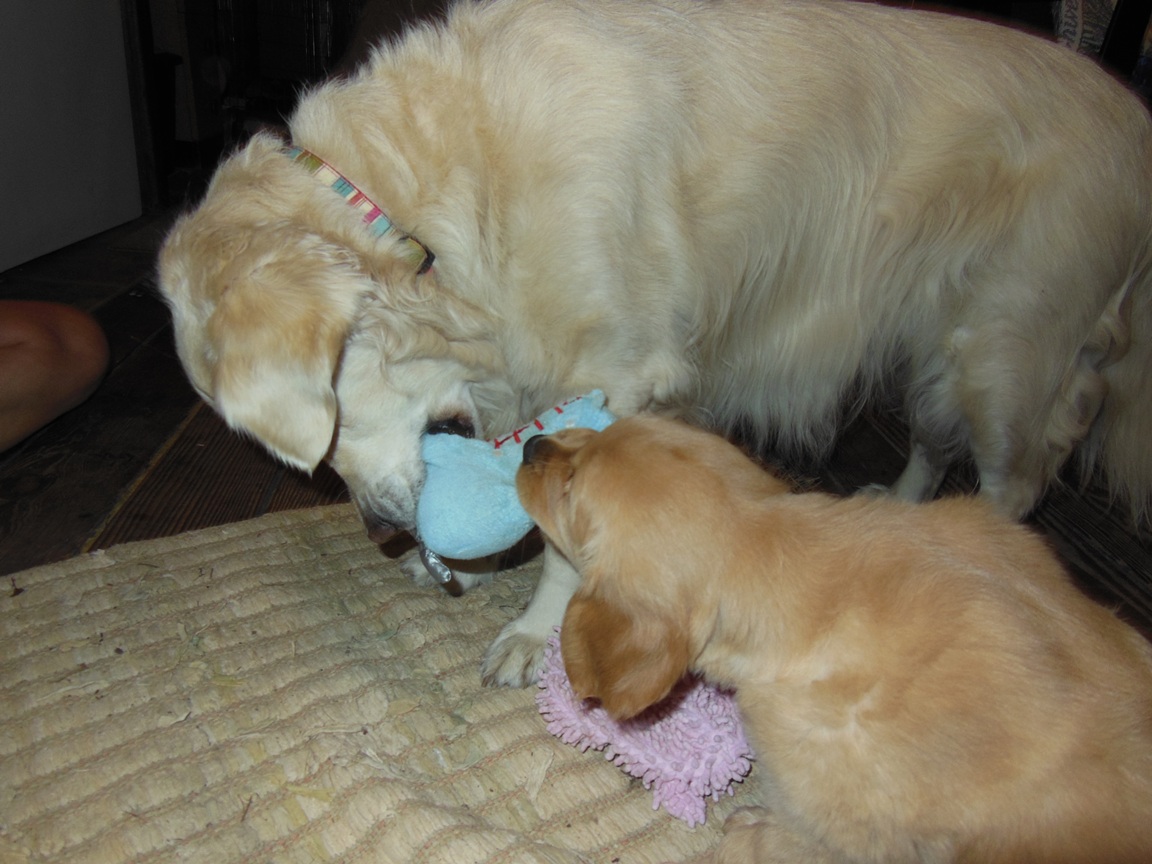
Teach “Incompatible” Behaviors for a Well-Mannered Pup
New puppy parents are often advised to keep a supply of puppy chew toys handy in every room. If the puppy starts to chew on something inappropriate, such as the sofa leg or a shoe, the humans can easily reach for a puppy toy and offer a trade. This is good advice and a good introduction to teaching an “incompatible behavior” to replace an undesired behavior: If the puppy is chewing on her own teething bone, she’s not destroying the furniture.
In my last blog post, The Best Alarm Clocks Ever, I mentioned procedural memory in a description of how and why dogs remind us that it is time to get up, feed them, or even take our medication. Procedural memory is even more significant in the way it affects other routines and behaviors.
Some psychologists say that procedural memories form aspects of character or habits. That means that a behavioral or emotional response to a particular situation could become an automatic or ingrained response. This is a valuable piece of knowledge in educating dogs (or humans). Old habits are hard to break, but understanding where a behavior comes from might mean that you can work to change it — replacing the “bad” habit with an incompatible good habit. An incompatible behavior is simply any different behavior that cannot be done at the same time as the undesired behavior. Learning the new “routine” will replace the old, undesired one.
A common example is doggy greetings. Jumping up to greet people (or adult dogs) is a very common puppy behavior. This probably hearkens back to dogs’ wolf ancestors. When young wolf pups jump up and lick adults’ muzzles, it stimulates regurgitation feeding. Ick. (It’s also a submissive behavior.) When our cute puppies jump on us to greet us, we might not feed them in the style of wolves, but we do tend to reach down and pet and cuddle them. We might laugh and tell them how wonderful they are. This is fun and rewarding for puppies, and it encourages puppies to continue to jump on returning human family members and guests. Many small puppies grow, though, and become large, gangly adolescents, then 60- or 100-pound adult dogs. Jumping is not cute anymore, but the puppy has never learned not to do it; in fact, the puppy has been rewarded for jumping.
Some old-fashioned trainers might suggest stepping on the dog’s toes or kneeing the dog in the chest to stop the jumping behavior. This is cruel and does not teach the dog anything other than that his human can’t be trusted. From the dog’s perspective, his human has suddenly started hurting him for no reason. After all, the human allowed and even encouraged the jumping when the puppy was small.
A more fair and humane approach is to teach an incompatible behavior, for example teaching the puppy or dog to sit to greet people. If the puppy is sitting, she can’t jump, right? (Another option for overly enthusiastic canine greeters is to teach the puppy to fetch a toy and bring it to the visitor.)
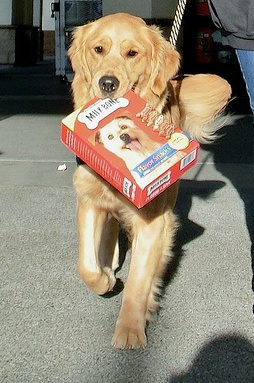
When Jana was a puppy, I wanted to teach her to sit to greet visitors. I put the “incompatible behaviors” principle to work successfully — both on puppy Jana and on our guests. First, I taught Jana to sit when I crossed my arms over my chest. Then I asked entering guests to cross their arms. This action was “incompatible” with petting the jumping puppy. It also gave Jana the cue to sit (incompatible with jumping). Viola! Jana sat and was rewarded with praise, petting, and, often, treats; I could happily greet visitors without fretting that they were teaching Jana bad habits.
In The Best Alarm Clocks Ever, I also mentioned Jana’s propensity to remind me of mealtimes — well ahead of time. Doggy dinner is at 6 p.m., but Jana often starts hinting, nudging, trying to lead me to the kitchen, pointing out her empty bowl, etc. long before 5 p.m. Do you suppose that, if I taught Jana to make cocktails at 5 p.m., she would stop bugging me for her dinner? It’s worth a try …
