Too Much Nurturing?

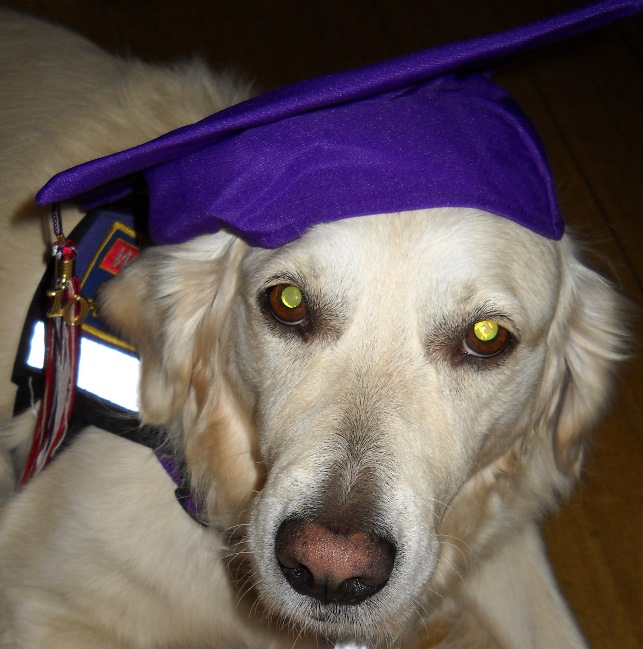
Jana, a white golden retriever, wears a mortarboardReading about this study will make you want to go back to college.  A team of undergrad researchers had the best job ever: Watching hundreds of hours of puppy videos.

They were looking at the differences in how moms at The Seeing Eye, a guide dog school in New Jersey, treated their pups. Some were very attentive, constantly licking and cuddling their newborn pups. Others spent as much time as they could out of the whelping box, away from the babies. Some lay down to nurse, making it easy for the pups to gorge themselves. Others stood, perhaps longingly eyeing the happy hour menu just out of reach. The researchers not only studied the moms’ behavior, they also measured their levels of cortisol, a hormone that indicates stress. Moms with higher anxiety tended to spend more time with their pups and coddle them more.

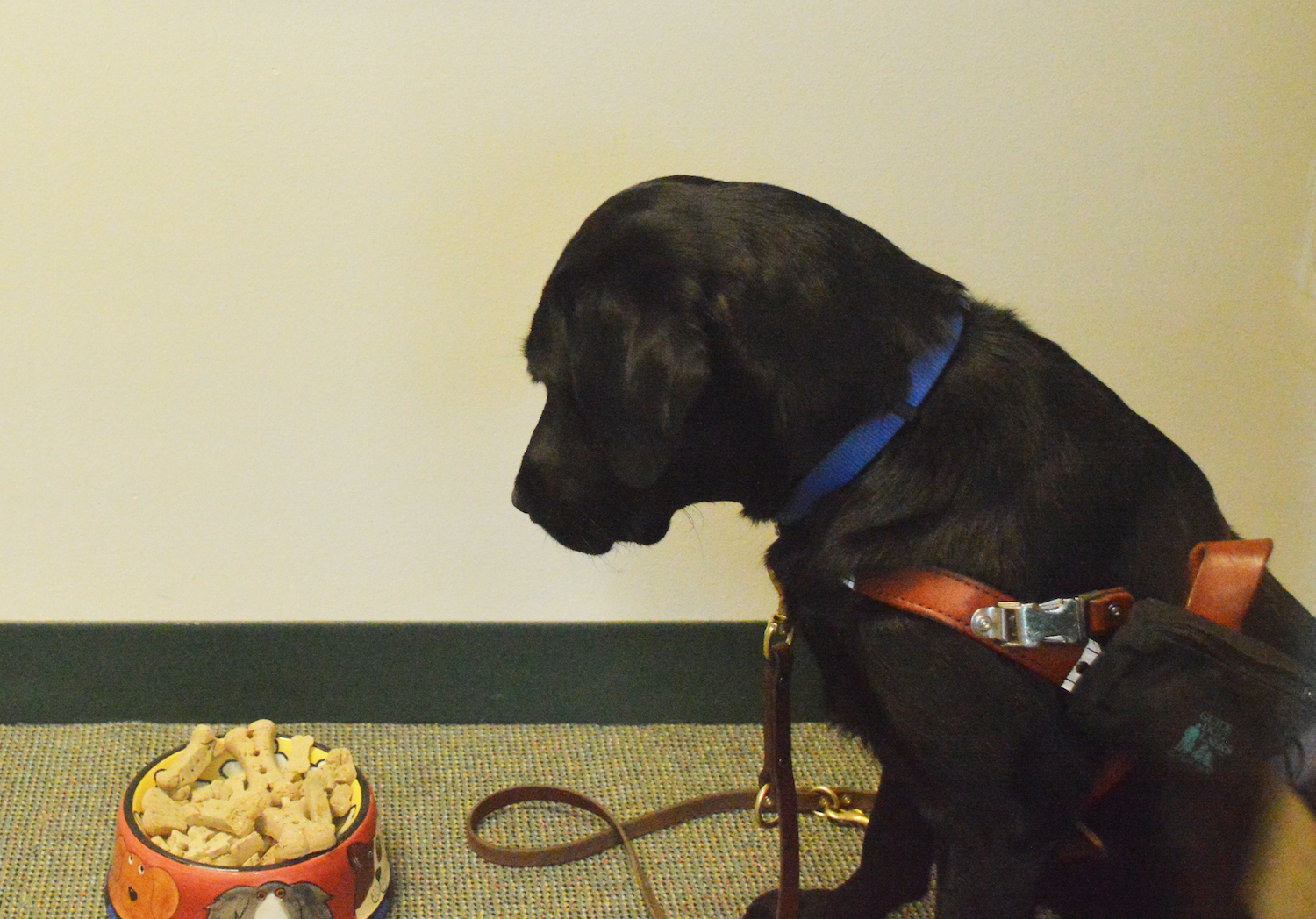
Guide dog puppies are set up to succeed. They have great genetics and prenatal health care, as well as top-notch vet care throughout their lives. They get early enrichment and socialization, lots of training. Even so, many don’t make it. A dog who is nervous or fearful makes a poor guide, as does one who can’t think independently and solve problems. Puppies who learn faster, solve puzzles faster, or figure out how to contend with obstacles naturally make better guide dogs. So do puppies who are confident and unafraid of new or potentially scary objects or situations. Temperament tests for puppies abound, but it’s still hard to reliably predict adult temperament or success.

It might seem that pups with attentive moms would be more confident and therefore more likely to succeed. But that’s not what the research indicated. The pups who had to work a little harder to eat and those who were less coddled by their moms turned out to be more independent and better problem solvers — scrappy, tough little dogs who had higher success rates in guide dog school. The coddled pups showed higher anxiety and less problem-solving ability. Even these pups are far ahead of the average pet dog in terms of temperament, ability to cope with the everyday stresses of life, and general health, though. But helicopter moms seemed to put their pups at a disadvantage.

It’s hard to determine just how much of the pups’ success or failure is linked to maternal behavior and how much is genetic, so more study is needed. But the attention to maternal behavior could help shape early training and enrichment. It could also point to ways that we could more successfully help our older puppies and adult dogs cope with anxiety (less coddling?).

Anyhow, doing more research is so appealing. Sign me up to watch those puppy cams!

The early study on maternal behavior is available online: Characterizing Early Maternal Style in a Population of Guide Dogs.

The abstract of the later study is available here: Effects of maternal investment, temperament, and cognition on guide dog success.
Bit by Bit

Her motto is “don’t fence me in”; she needs a reliable recall!

For a little over a year, I have been writing for an online “magazine” that covers online learning. Some of my articles touch on various learning theories and how these might be applied in “eLearning” or online training and performance support. Every so often, a source talks about “spaced learning” or “spaced repetition.” It’s funny to me that many of them think they’ve stumbled on a new secret weapon.

Spaced practice is simply practicing a skill or recalling information, maybe by taking a quiz or using flash cards, at short intervals over a period of time. It’s long been known to be effective both in the education of children (and adults) and in the education of dogs.

I first learned about spaced repetition in my first dog training classes. Particularly when working with very young puppies, we paired very short training sessions with spaced practice on the same set of skills. Hmmm, did we also discover microlearning, another current hot topic in eLearning? Maybe so.

Microlearning — very short lessons — certainly worked with our 4-week-old puppies. Two five-minute sessions a day (even one, if we got busy) were enough to teach one puppy I worked with about 15 cues by the time she was 10 weeks old. I’ve used the approach, with great success, with dozens of other puppies and adolescent dogs, but my training skills are becoming rusty from disuse.

I’ve been thinking about both microlearning and spaced learning for two different reasons this week.

One is a conversation I had about a friend of hers who wants to train her dog to help her with some aspects of her MS. The dog already has some foundational skills. The friend, due to her MS, has limited stamina and would only likely have enough energy to work with her dog for a few minutes a day. I found myself telling my friend that that was not an insurmountable obstacle. If she were able to spend a few minutes a day practicing a skill, the dog could learn it very well.

The second reason is my own lapse in spaced practice. When Cali was a puppy, I was very diligent about practicing her recall and working on her willingness to accept grooming, especially handling of her feet and nails. I did everything by the book, practiced almost every day, sometimes two or three short sessions. Cali was a great student. Then life got in the way and I stopped practicing. She now has a mediocre recall and hates having her feet handled. Great.

I know that I can find five minutes a day to work with Cali, and I know that, with the right treats, her recall could again become speedy and eager. That matters here in Montana, where there are many places that Cali could run off-leash.

I’m less sure about the feet, but I could probably get her to be a little less skittish and a little more cooperative. It’s certainly worth a few minutes a day to try. I have a new bag of very desirable treats; maybe I will use them for some remedial training. Wish us luck!


What Marshmallow Tests Mean

I’ve written about both Alberta’s and Koala’s adventures with the marshmallow test and I’ve been thinking about what it tells us about each dog. Is Koala a “better” dog because she didn’t have to work as hard as Alberta? Is she more obedient ? (No!) More — or less — intelligent?

Dr. Walter Mischel, the psychologist who originated the test, wrote a book about it a few years ago; he also was interviewed in The Atlantic. The topic of both book and interview was some common misunderstandings about the test.

Mischel said that it is less about self-control than about achievement and making choices. It’s also, to some extent, about how and when a person (or dog) chooses to exercise self-restraint, not whether she can. Other research shows a phenomenon called willpower fatigue; exercising self-control takes cognitive energy. Using that energy on one task means you have less of it available for other tasks, whether they are cognitive tasks or exercising self-restraint.

Maybe Koala would do less well on the marshmallow test after navigating Deni through a strange airport, hotel, and restaurant than she did in the morning on her home turf.

After reading the interview with Dr. Mischel, I don’t think that the test tells us whether a dog is “good” or smart or even obedient. It tells us that training helps a dog make good decisions, and that making those decisions comes more easily to some individuals or at some times. Dr. Mischel told The Atlantic, “What we do when we get tired is heavily influenced by the self-standards we develop and that in turn is strongly influenced by the models we have.”

In other words, when we’re challenged, we fall back on our training and experience.

Alberta and Koala both had excellent training and socialization. They were also both taught the “leave it” cue. The original children tested were from affluent, educated families. These children, as well as Koala and Alberta, had some respect for and trust in authority figures (the children were tested, as were the dogs, by a familiar adult). These circumstances set up a person or dog to succeed. A random puppy pulled from a shelter pen by a stranger would likely not fare so well on the test.

That’s why it is so important to teach puppies to sit quietly, even if only for a few seconds, before they get to eat or greet someone; it’s why it’s important to ask them to wait at doorways and before jumping out of a car. Yes, we are teaching them manners and protecting their safety. We’re also giving them models and a basis to form “self-standards” that include self-restraint.

They might slip up sometimes. Cali gets so excited about meeting new people that she wriggles and dances. And when we approach the office of her friend the cookie lady, she’s a jumping, pulling, dancing demon.

It’s not just Cali. We all experience willpower fatigue. For instance when the scent of fresh-baked chocolate chip cookies … mmmmm!

A Conscious Struggle

This slideshow requires JavaScript.


Our dogs have jobs that they are expected to do, similar to assigning household chores to a child. Jana brings in the morning paper. Jana and Cali each bring me a shoe when we’re getting ready for a walk. And each dog is expected to bring me her food bowl when she’s done eating.

Jana learned this task very quickly. She does it eagerly, always happy to receive her dessert in exchange (a small cookie). Alberta is also an eager participant, usually the first to finish her meal and deliver her bowl. If I am not paying attention, she’ll push it into my leg, hard, in a not-at-all-subtle demand for her pay. Past dogs have learned the task too, though Wylie made it quite clear that he saw this task as beneath him — girls’ work — and he would immediately depart for more masculine pursuits upon finishing his meals. Jana was happy to pick up the slack (and the extra cookie).

Then there’s Cali. For months, she’d pretend to try, lifting the bowl by one edge before dropping it with a loud clang. Putting on her saddest golden retriever face, she look at me as if to say, “I tried, Mom, but I just can’t lift it. It’s a very large bowl, and I am a very small puppy.” As the very small puppy became 56 lbs. of solid muscle, this excuse held less and less water, but the sad eyes … well, let’s just say that she does a very good “sad golden” face.

Along came Deni. Not only did we switch Cali to a smaller bowl this summer, but Deni took over much of the feeding supervision. Deni wasn’t moved by the sad face. Weeks of cajoling and praise and cookies paid off. Cali started bringing her bowl, but reluctantly and only with much encouragement. Once we knew that Cali understood what was expected and that she was fully capable of doing it, the coddling was phased out.

Now, as Deni explains, Cali broods over the looming task or “stands there and glowers at her bowl.” She knows she’s supposed to pick it up; she simply does not want to. It’s similar to her reluctant acquiescence to brushing her teeth. But, more and more, Cali talks herself into bringing the bowl with no prompting from either of us. Deni reports that if Cali sees that extra-special treats are being offered for dessert, she is able to convince herself to pick up the bowl much more quickly, and she does so with far more energy and enthusiasm.

The battle of the bowl shows Cali’s increasing maturity and offers a window on her personality and intelligence. We all sometimes choose to do things that we do not want to do. Sometimes we do them for rewards (a paycheck, working extra hours to earn a vacation …) or to avoid worse consequences (dental checkups) or because we don’t want to disappoint someone we care about. Whatever the reason, we all face large and small decisions every day. Cali is no different.

Beyond WordsIn his wonderful book Beyond Words, which I have mentioned before, Dr. Carl Safina talks about sentience, cognition, and thought as the “overlapping processes of conscious minds.” He defines sentience as “the ability to feel sensations”; cognition as “the capacity to perceive and acquire knowledge and understanding”; and thought as “the process of considering something that has been perceived” (page 21).

We see all of these at work in Cali’s struggle. She understands what she needs to do and how to do it; she feels stress, anxiety or discomfort of some kind when she thinks about this expectation, and she considers how to resolve it. Sometimes the feeling of anticipation or desire for a treat wins; sometimes, probably, the desire not to disappoint Deni or me tips the balance; sometimes she needs some prodding. But she is very definitely making a choice. Whether she decides to go for the cookie or she’s concerned about our reaction or she walks away and lets Alberta or Jana pick up her bowl, she is in control; she weighs the options and makes her choice. She is not instinctively or automatically responding to a stimulus in a conditioned way, as some behaviorists would argue. Every day, every meal, Cali shows what it means to be a thinking dog.


Minding Their Manners

I recently read a study that compared wolves’ and dogs’ ability to solve a “puzzle” — opening a plastic box with a piece of sausage inside. The wolves did much better than the dogs, and, from the articles I read about the study, it seems that many researchers are interpreting that to mean that the dogs are dumber than the wolves, at least when it comes to problem-solving. The comments were rather unkind to dogs, and, I think, wrong.

One comment, in the New York Times, came closest to “getting it.” This person suggested that perhaps the dogs had been taught not to take human food or open food containers. Paired with the fact that most dogs’ food is handed to them by humans, while most wolves must find their own food, I’d say the dogs were set up to fail.

The study was published in a British journal by an Oregon State University researcher, Monique Udell. In her own analysis, she paid more attention to the fact that the dogs spent more time looking at the familiar human (who was present for some trials of the test and who provided encouragement in some trials) than at the box. Various commenters’ interpretations of the dogs’ looks ranged from “seeking assistance” to “slavish.”

Half the dogs tested were pets; the other half were shelter dogs, but no information was provided about how many of those had spent part or most of their lives in homes before landing at the shelter. The wolves had been socialized to humans, but even a tame wolf is still a wolf, not a domestic pet.

It makes sense that the dogs would have been taught not to take food or been punished for taking food. It also makes sense that, if a familiar human were present, they would seek help, information, or even permission before helping themselves. When I give my dogs a particularly spectacular treat (a 2-inch piece of sausage would certainly qualify), they often look at me, look at it, look at me — going back and forth a few times, seemingly questioning whether this bounty is truly meant for them. They are polite. They know the rules. They are also quite happy to indulge in exceptions to those rules, once they’re sure they won’t get reprimanded for doing so.

I would have been much more surprised if the dogs didn’t look to the human for permission or help. After all, thousands of years of living together has resulted in close partnerships and, at least on the dogs’ part, exquisite ability to read human’s communication. We humans are less successful at reading the dogs, sadly. Their survival depends on reading humans’ cues and behaving accordingly. Wolves have no such hangups (nor should they).

Some comments on the study went so far as to suggest that training dogs has made them dumber and less able to solve problems, that their social connection to humans puts them at a cognitive disadvantage. I disagree. While some training approaches do discourage dogs from thinking, modern approaches to training that use motivation and reward actually encourage problem-solving. Far from dumbing dogs down, their enhanced social sensitivity to humans enables them to thrive in our world and, in many cases, enjoy comfortable lives and strong connections with their adopted families.

And if those strong connections compel dogs to ask before eating your food, what’s wrong with that? Many people wish their roommates were as considerate.

For more about the study, see these articles:

OSU study: Have we made dogs lazier or dumber than their ancestor wolves?, the Register-Guard, Oct. 2, 2015

Why Is That Dog Looking at Me?, The New York Times, Sept. 15, 2015

The study, “When dogs look back: Inhibition of independent problem-solving behavior in domestic dogs,” by Monique Udell, was published in the British journal Biology Letters on Sept. 16, 2015.

See also my related post on the PPG Barks blog.

Agility Offers Fun for Thinking Dogs

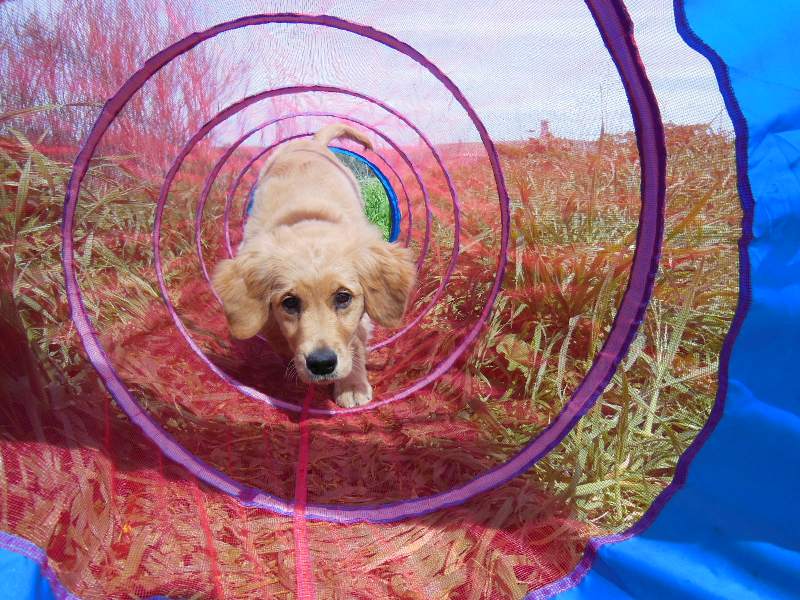
lost in the tunnelCali and Alberta started taking agility classes a few weeks ago. Watching Cali puzzle through things and figure out what we want has been fun. I can almost see the wheels turning in her little head.

Alberta is more experienced with dog sports and classes, having nearly completed her Rally Advanced Excellent title. She catches on very quickly, but knowing what we want her to do doesn’t keep Alberta from showing her silly side in class sometimes.

In the first couple of classes, we worked on targeting a small piece of foam on the floor. Both girls are proficient at hand targeting and were able to touch our hands, on cue, no matter whether we placed them high, low, on our backs, or anywhere else. Getting them to touch the foam mat was easy, too, but … both Cali and Alberta quickly went from simply touching it to retrieving it. Alberta, in particular, has a great working retrieve and has often been rewarded for bringing Deni items that Deni didn’t even know she had dropped.

I’ve been working on teaching Cali to bring my shoes, and, like Jana and Oriel before her, she has shown some entrepreneurial spirit, bringing things that I don’t even know that I need (or want) — in hopes of exchanging them for a small cookie.

So it’s not surprising that both Cali and Alberta think that we want them to retrieve the small mat, rather than simply touch it. Or perhaps they know that we want them to touch it but prefer to retrieve it.

They both are eager to jump onto the agility equipment, out of turn or when we’re waiting for our turn at a different piece of equipment. No fear from either of them; just eagerness to learn more and try out new challenges.

Practicing at home is also fun (and can become a three-dog circus pretty quickly). Jana wants in on the action, and when I was guiding Cali through some fake weave poles, Jana knocked one over with a swish of her tail — while grabbing another and running off with it in her mouth. Meanwhile, Alberta knocked over the other two! Poor Cali never had a chance. With more practice, though, we have managed to get all three girls to walk between the poles, though we still occasionally lose a pole or two to a swishing tail.

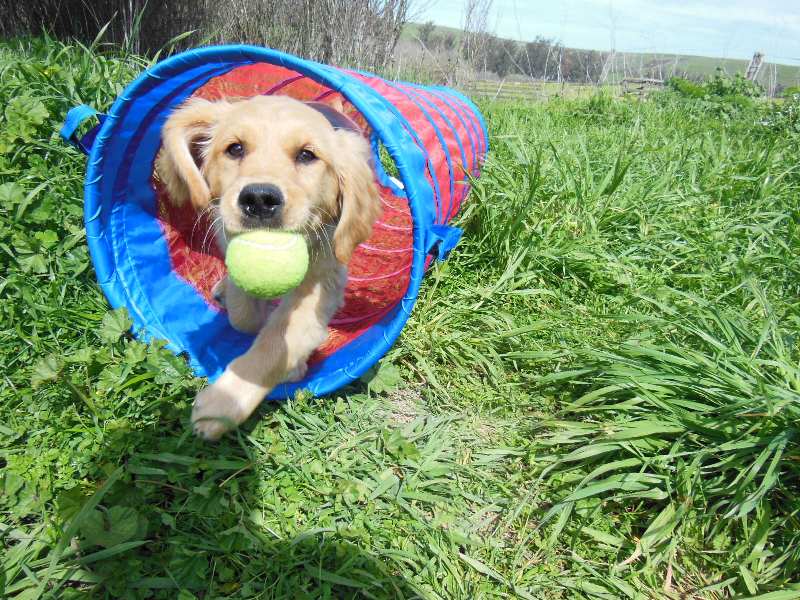
Out of the tunnelNone of our girls has any trouble with tunnels, though Cali did try to circumvent the tunnel once, taking a shortcut to where I was standing. She has always loved tunnels. Cali had a wonderful little play tunnel when she was a puppy, and Jana had plenty of exposure to tunnels before her first agility class. So neither of them hesitates, even when the tunnels are curved or have a piece of fabric covering one end, though many dogs resist entering a tunnel if they cannot see through to the end of it.

I thought about this last week as I was working with a neighbor’s dog, an adolescent golden retriever who is unwilling to use her dog door. The door flap makes her nervous. I rigged up a tunnel using a small table and a towel, and after a couple of sessions, she was willing (though still not exactly eager) to go through it for cookies. She’s uncomfortable with the small space, the towel brushing her back, and her inability to see what is coming. She’s improving, but she reminded me of how important it is to expose dogs to all sorts of tactile experiences, starting at a very young age.

Even that is not foolproof, though; this dog did use the door flap when she was younger, until she had a scary head-to-head confrontation with the cat as she went through the flap. My jerry-rigged tunnel will (I hope) help build her confidence in the same way that agility classes are boosting Cali’s confidence and awareness of where her body is. Classes in agility or other dog sports are a lot of fun — and they improve the dog’s focus on you and your communication with each other. Besides, they provide plenty of mental challenges to your thinking dog!

Her Very Own Key

Surveying her territory

Cali got her own key last night.

Readers of Merle’s Door — or Cali, the Ghost, and the Dog Door or A Doorway to Your Dog’s Independence — will understand the significance of this moment.

Deni’s house in Montana has an electronic dog door. The dogs each wear a magnet on their collars. The magnet opens the door, letting the dog go outside, into the fenced dog yard. It’s a nice dog yard with its own deck and a fabulous view of the mountains and valley. Lucky dogs.

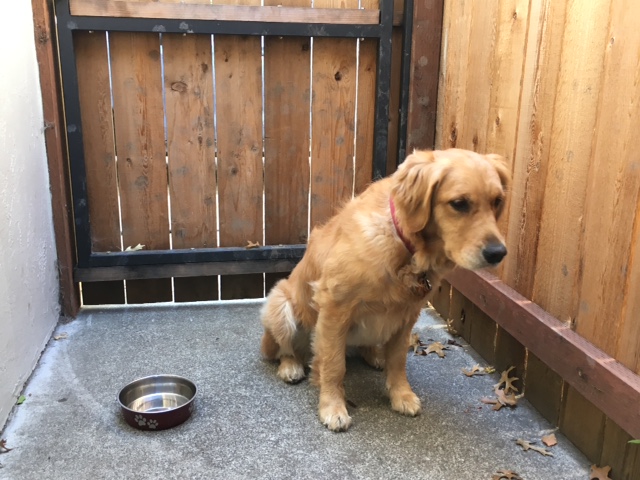
Cali had learned about dog doors in our Florida house, but her key privileges were quickly rescinded when she spent her time chasing and eating lizards, digging, and going in and out and in and out and in and out … Our California apartment has no dog door, and Cali’s outdoor privileges are often suspended due to incessant digging and / or barking at the neighbors. If you can’t handle the freedom, I tell her, you have to stay with me.

Cali clearly treasures the privilege, as she showed us the first time she got a key and went in and out and in … She no longer does that, but she does relish opening her own door — often waiting for the dog door to open and using it even when we’re walking through the people door at the same time. Jana and Alberta, on the other paw, will stand by the people door and bark for their staff. When we fail to materialize and open the door promptly enough, they’ll disdainfully resort to using the dog door.

Cali convinced us of her increasing maturity, after spending most of an afternoon stretched out in her “bearskin rug” pose, watching the world go by. That world included a few deer, many squirrels, and an enormous truck that dumped four loads of dirt and gravel on the driveway. Nary a bark was heard nor a hole dug. Our baby is growing up!

Well … not so fast. Increased wildlife activity in the evening required closing the dog door. Barking at deer in the morning prompted a brief suspension of Cali’s privileges.

Even with these bumps in the road, it’s clear that Cali has turned a corner. She’s much more thoughtful and better able to rein in her abundant enthusiasm. She still gets excited (very excited) about meeting new people or heading out to play ball, but she can get a grip on her enthusiasm, sitting and trembling all over rather than jumping straight into a stranger’s arms, for example. As we walk to the play yard, she skips ahead, remembers, backs up, skips ahead, remembers, backs up … over and over. I don’t have to say a word. She rarely even gets to the point of pulling at the end of the leash anymore. And, last week, a friend asked whether 6-month-old Scarlett would “be as nice and calm as Cali when she grows up.” Granted, the friend hadn’t known Cali for very long …still, it was a nice compliment.

Scarlett, at 6 months, already shows her strong personality and intelligence. However, she’s heading full-speed-ahead into adolescence, and she lacks impulse control. Cali was similar at that age. Watching them together provides a nice reminder that, if you get through those crazy months, you just might end up with a wonderful adult dog at the other end of that long, dark, frustrating tunnel.

Play By the Rules

Dogs just seem to know how to play by the rules. Ethologist Marc Bekoff makes this argument based on years of observing dogs and their wild relatives — at play. In a 2010 article in Scientific American, “The Ethical Dog,” Bekoff describes four rules that dogs use to govern their social relations: Communicate clearly; mind your manners; admit when you are wrong; be honest.

Social play helps dogs (and humans and other social beings) manage and maintain social connections. Individuals who do not play well with others often suffer in other areas of their lives. Coyotes who don’t play fairly and are ostracized when young tend to leave their family packs more than better-socialized coyotes — and they have a significantly shorter life span.

While the stakes for domestic dogs are lower — they can survive nicely in one-dog homes — there are still consequences, as anyone who has lived with a poorly socialized dog knows well. Some people cannot board their dogs or must avoid any outing where another dog is likely to appear. Some walk their dogs very early in the morning to avoid other dog-walkers.

Some people, unaware or uncaring that their dogs lack social skills, go to the park anyhow. Fortunately for Cali and Alberta, they have a big sister who’s willing to enforce the rules.

Not long ago, Alberta was happily playing with another Lab at our neighborhood park. The Lab was excited and got overly rough. Alberta, in her sweet, polite way, told him that he was being too rough. That didn’t work. She tried to avoid him, but he still didn’t get the hint. Jana had had enough. She got up and, with all of her senior-dog-dignity, approached the other dog — and gave him an earful.

After being told off by his elder, the Lab finally got the message. He apologized, and play continued at a more appropriate energy level. All was immediately forgiven.

A dog I lived with many years ago even applied the principles of fair play to human-human interactions. We were on a walk once when we came upon a group of young boys, around 8 or 9 years old. Two or three of the boys were hassling a smaller boy. Timo, all 12 pounds of him, was incensed. Though leashed, he lunged, barked, and snarled at them. Startled, the bullies ran away. Timo shook himself off and strutted home.

Most dogs learn the “rules” from their littermates, which is one key reason that puppies should stay with their siblings until they are eight weeks old. Good puppy classes are another place for puppies to acquire these all-important social skills.

Wherever your pup learns, make sure to play, and play often with him. As I’ve written, it is the best way to maintain a close bond.

Hoping for a Doggy Sequel

I’ll admit it up front: I might be just a bit obsessed with figuring out what goes on inside a dog’s mind. But many of you more “normal” dog lovers might appreciate a movie that helps by way of metaphor.

If you haven’t seen it yet, get yourself to the next showing of “Inside Out.” Stay for the credits. “Inside Out,” a summer blockbuster, is an animated movie that takes viewers inside the head of 11-year-old Riley Anderson. The main characters are her five primary emotions: Joy, Sadness, Anger, Fear and Disgust.

The metaphor should be obvious: Of course dogs experience these emotions. The real question is: How is their experience similar to (and different from) ours?

I’ve always been sure that dogs experience their own versions of joy, sadness, anger, and fear. I was on the fence about dogs and disgust for a long time, though. I’ve seen dogs eat and/or roll in many, many things that certainly trigger my disgust. Their concept of disgust, if it existed, was a mystery.

Then we offered Wylie, a fussy German shepherd, a peanut butter treat. The expression on his face: Pure disgust. He actually flinched. Then he wrinkled his nose, curled his lips, and backed away. That, and the accompanying reflexive gag, couldn’t be anything else. Peanut butter was clearly a human attempt to poison him.

Then there’s Jana’s priceless, very teenagery, eye-roll when Cali and Dora get too wild. Yep. Pure disgust: Puppies. Ick.

“Inside Out,” which I personally think is meant for adults — the best stuff goes right over the kids’ heads! — explains the necessity for and connections among all of those complicated emotions. Fear makes you pay attention: It can literally wake you up. Joy helps create the core elements of your personality. Sadness makes happy memories more precious. It can also influence your choices, pushing you to make decisions that allow you to hold onto memories — or connections — that once were joyful. Anger can make you notice injustice, or even speak out against it.

Which brings us back to disgust. A key role of Disgust, according to the movie is keeping us from being poisoned; toddler Riley is sure that broccoli will kill her. Disgust doesn’t seem to play the same role for Jana, who happens to love broccoli. She also wolfs down acorns every chance she gets, despite the cramps and upset tummy that inevitably follow. She is among the many dogs who eagerly lap up things that could (and do) poison them, ranging from antifreeze to raisins or chocolate. So I am still puzzling out what the emotion of disgust does for dogs — other than convince them that their own humans are trying to poison them.

A key lesson in the film that applies equally to dogs is the link between emotions and memory. Memories without a strong emotional component fade away, turn a dull gray, and are swept into a dump by an army of technicians in Riley’s brain. (The same guys periodically send up an annoying jingle from a gum commercial to bounce around in her head all day for no particular reason. I wonder if that happens to dogs.)

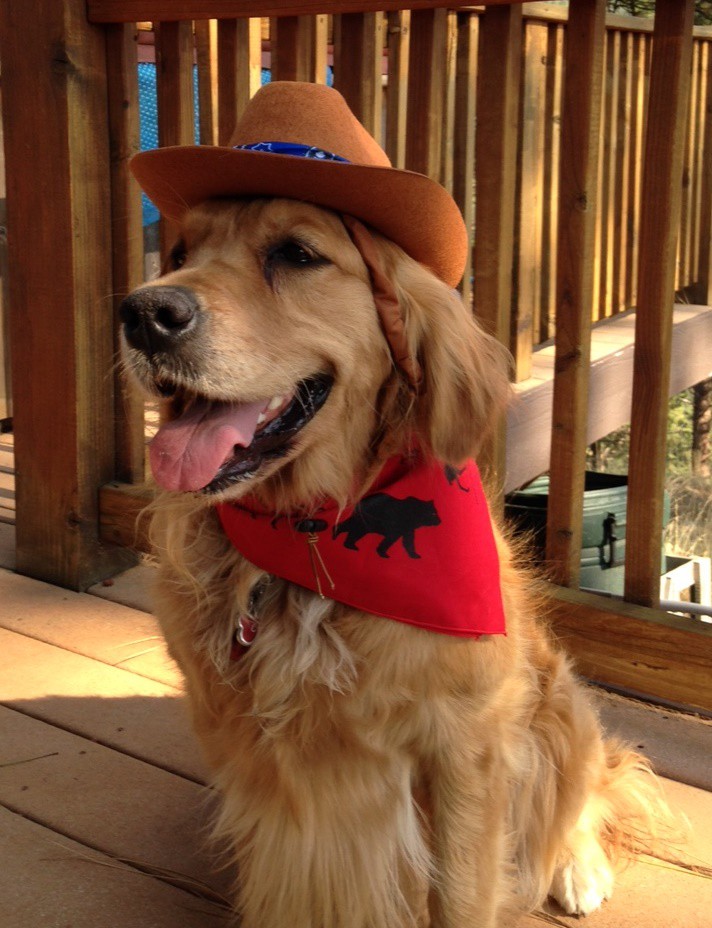
One of the ways that the other emotions kept Fear under control was by creating frequent associations with Joy. This is an essential fact for anyone with a dog, particularly a puppy, to understand. To forestall fears, dogs need frequent association of positive, joyful emotions with things that could be scary — people in hats, loud noises, balloons … Ideally, this happens in early puppyhood, before the dog hits adolescence.

But even fearful adult dogs can be helped. As “Inside Out” shows, recalling a memory while in a different emotional state can alter the emotion associated with the memory. In the movie, this is dramatically illustrated when every joyful memory that Sadness touches takes on her hue of blue … but it can work the other way, too. As trainers who advocate counter-conditioning and desensitization know, we can sometimes change fearful associations to joyful ones with careful, controlled exposure and appropriate positive reinforcement.

OK, so, why should you stay for the credits? I don’t want to give too much away, but the glimpse inside the dog’s mind is enough for me to want a canine sequel. The cat might even be better …


Nice to Meet You

Wanna play?
Wanna play?

Dogs are as individual as people; therefore, getting to know them takes time and happens on different levels. There’s a big difference in “knowing” someone you’ve met at a party or been introduced to over coffee by a mutual friend, and “knowing” a friend who’s been part of your life for years, right? The same is true with dogs.
It takes time to get to know a dog and identify his or her personality and behavior patterns, just as it would with a person. But what about when you meet a dog briefly, say, walking down the street or hanging out at a coffee shop?
When you meet a person with a dog, greeting the dog probably won’t get much more intimate than saying hello and maybe giving the dog a pat or a hug. You might note the breed or notice whether the dog seems friendly — but even at this level, you can look for cues from the dog about his or her personality.
Cali and Jana perfectly illustrate the polar opposites in terms of their reaction to new people.
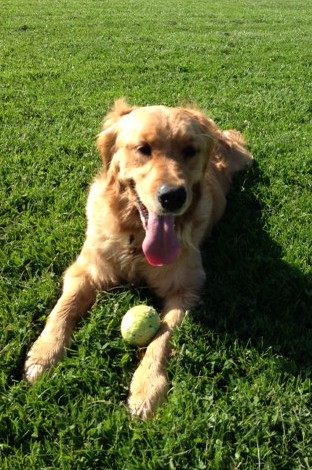
Cali was put on this planet to greet every single human being and become his or her new best friend. She rushes toward strangers with her whole rear half wagging and a huge smile on her face. If we’re on the way back from the park, she’s also got a slobbery tennis ball in her mouth, ropes of drool dangling, a wet “bib” (from the drool), muddy paws and legs, and she feels sweaty to the touch. On really energetic play days, she’s also given herself a good all-over shake and has, in the process, managed to drool on top of her own head. Never mind. She doesn’t notice any of that, and neither should you. She greets each and every person we meet with enthusiastic joy, secure in the certainty that every single human will love her back. Of course you can pet this girl, hug her, take her home and play ball with her. She’s your new best friend, after all.
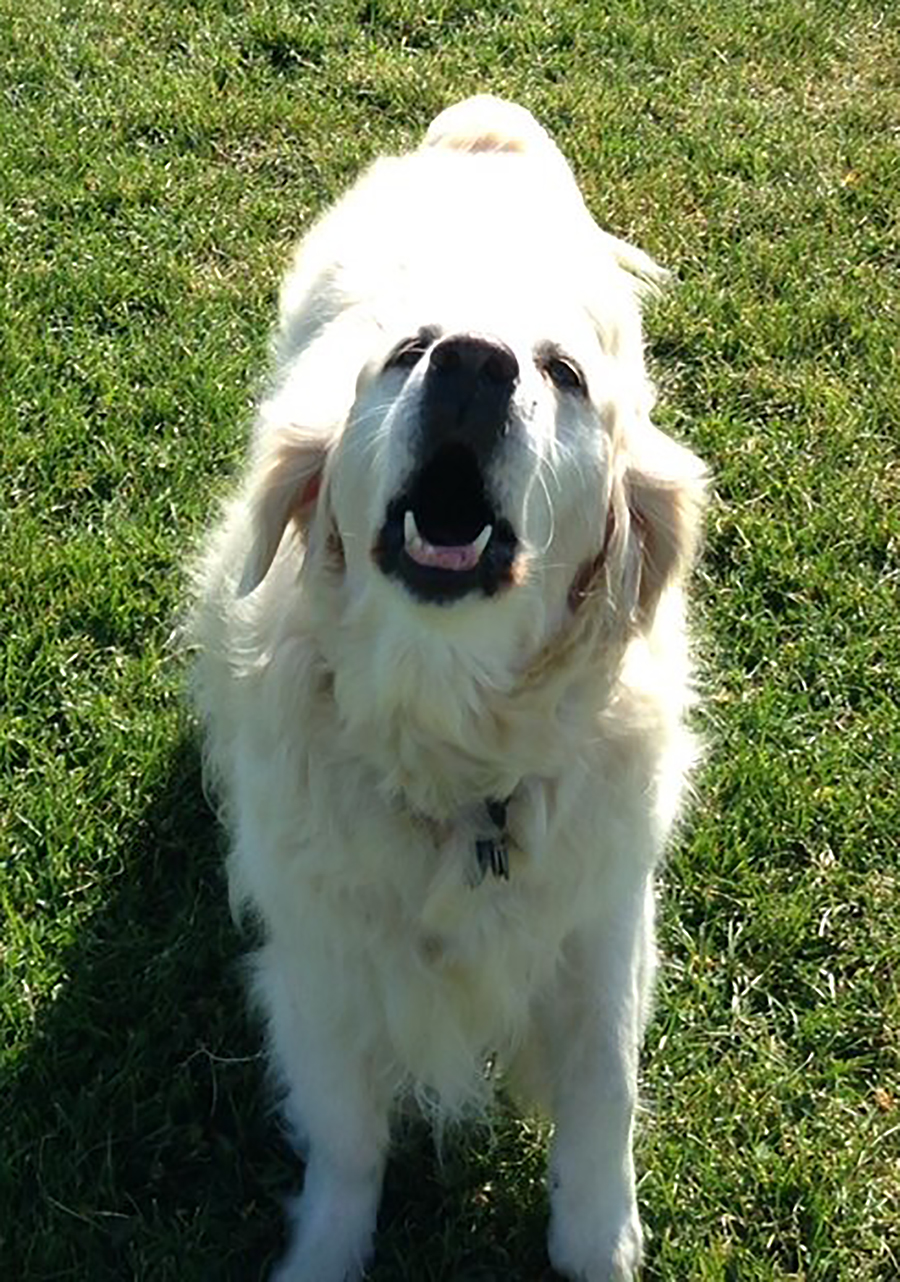
Jana stands back and watches this all with horrified disapproval. Sometimes she barks. Usually she stands behind me, ensuring that there is a large, solid barrier between the stranger and the nut-job puppy greeting the stranger — and herself. This is not a dog who is inviting or would welcome a getting-to-know-you pat. This is the dog who invented “no-touch cuddling”: when she’s feeling affectionate, she will agree to lie upon a corner of my bed, so long as we’re not touching. After a few minutes, never more than five, she, with great dignity, descends from the bed and gets on with her life. This is what counts as “cuddling” in Jana’s world.
OK, so when you’re encountering a new dog, the first thing to notice is whether the dog is approaching you or standing back? That’s easy. But most dogs just kind of stand or sit next to their owners. They are not as clear about where they are on the Jana‒Cali continuum as, well, Jana and Cali are. What then?
Most dogs, even the friendly ones, dislike being patted on the head and being hugged. Sadly for them, most humans do one or both of those things when meeting a dog. According to Turid Rugaas, a dog communication expert who has identified what she calls “calming signals” — subtle body language cues dogs use with each other — the best way to introduce yourself to a dog is to approach slowly and from the side.
If the dog is sitting next to the person, you can just pet the dog on the side — stroke his shoulder, say — or reach around (not over the head) to scratch his ears. Making direct eye contact, leaning over a dog’s head, or reaching for the top of his head can be perceived as threatening by a dog, so it’s better to use the sideways approach. You can always crouch down to be more at the dog’s level; you’ll be less threatening and the dog will probably see it as a friendly gesture. If you are face to face, rather than reach for the top of the dog’s head, it’s better to scratch his chest. In any case, a slow approach lets the dog get your scent before you actually touch him.
Most people aren’t very observant around dogs, and dogs’ body language cues can be very subtle. A dog that is constantly looking back and forth, between the owner and you, for example, is showing nervousness, as is a dog who constantly licks her lips. A nervous dog might yawn or show a “stress smile.” (See “Communication Goes Two Ways” for examples.) These dogs will be happier if you don’t try to pat them when you first meet them.
If your dog is particularly sensitive or will meet a lot of people, it’s a good idea to play a pat-the-puppy game — pat the dog on the head, then immediately praise him and offer a treat. This can revise his thinking about this unpleasant encounter and may even turn it into something he likes. It’s also a good idea to teach your dog to look at you when people approach. You can reward this focus with a treat. The dog may develop better associations with meeting people. The dog will also be learning to look to you when she is stressed, which is a good “default” behavior. Because the bottom line is, whether your dog is Cali-style friendly, Jana-style reserved, or somewhere in between, your job is to keep him safe — and that means running interference with strangers, whether human or canine.