Is your dog as smart as a human 2-year-old? A 5-year-old? A (gasp) teenager? Does it depend on what breed your dog is?
We can’t help it, we humans. We want to put everything into neat little human-constructed boxes. That is, I think, what is going on when people try to define dogs’ (or other non-humans’) intelligence in human terms. That and the common, if arrogant, human assumption that we are the smartest creatures, so everyone else — dolphins, dogs, starfish — can and should be evaluated, based in how they compare with us in human-like ways.
But really, how many human 2-year-olds would you trust to guide you across a busy street? Or turn loose in the wreckage of a natural disaster or terror site, with the expectation that the little tyke would let you know where the survivors are trapped? We use dogs to find lost 2-year-olds, don’t we? And protect them (and other humans) from diabetic coma or severe peanut allergies, warn of their impending seizures, coax those who have autism or have suffered trauma to connect — and so, so much more.
The basis for comparison is obviously flawed. Dogs are much like human toddlers in many ways, it’s true — their unbounded love of play; their sweet willingness to befriend just about anyone. Yet they are so much better at some things than any child could ever be — better at some things, such as anything based on scent, than any human of any age could ever be.
So, how should we measure, evaluate, understand canine intelligence?
We can start by acknowledging that intelligence is a complicated concept — there are many types of intelligence. Among people for example, there is social intelligence or emotional intelligence, there is numerical or problem-solving or analytical intelligence. Business acumen, logic, performing well under extreme stress — all of these might be considered different skill areas or types of intelligence. Intelligence is what helps you (or your dog) navigate life, with all the challenges and detours it throws in your path. We are all stronger in some areas, weak or ridiculously incompetent in others. The same is true of dogs.
We can also think about the skills that dogs have that have no parallel in human ability or intelligence — and the myriad ways we can help dogs develop and use those skills in partnerships that make life better for humans and dogs.
Some dogs excel at reading people’s body language. According to several prominent dog cognition researchers, among them superstars Brian Hare and Adam Miklosi, dogs — even very young puppies — excel at reading humans’ pointing gestures and where their humans gaze. This is a type of social intelligence. I am sure that many, many dogs excel at this. However, not all dogs do. I know. I live with one who fails miserably at reading gestures.
Other dogs (including the one who cannot follow a pointing finger to save her life), can intuit a person’s mood and provide exactly what is needed: comfort, humor, affection, appeasement, a favorite toy.
Still other dogs are great problem-solvers. They analyze each new situation and map out a solution.
Some dogs are born to … fill in the blank: Provide mobility assistance, search out bombs or drugs, find lost or hurt people, detect tumors, comfort lonely elderly people, make children laugh.
I don’t think it matters whether your dog is smarter than a toddler. I don’t think it is a fair or relevant comparison. What does matter is assessing each dog’s strengths and weaknesses, his or her specific areas of intelligence. Then, we can figure out how to stimulate and challenge each dog in the ways that will allow him or her to succeed, thrive, and enjoy life to the fullest.
puppies
Sisters at Play
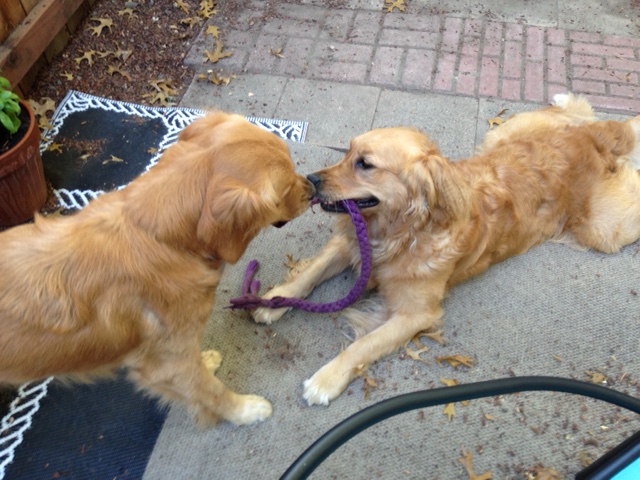 Cali’s sister Dora visited recently for the weekend, which meant nonstop action. Cali actually has lots of sisters. She lives with Big Sister Jana full time. Jana has been an excellent role model, teaching Cali necessary life skills, including barking at passersby and rolling in sand so joyously and thoroughly that, between them, they make sure to take the beach home with them. Then there is Alberta, the part-time sister and playmate. They are evenly matched in size and have similar energy levels. When they are together, everything becomes a tug toy.
But Dor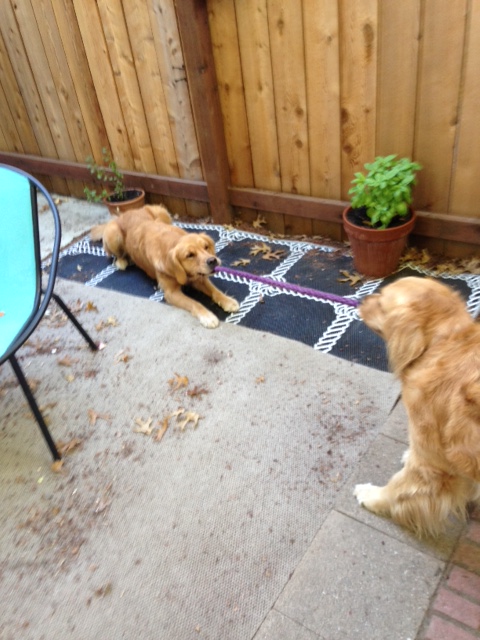 a is special. Dora is Cali’s litter sister. They were plucked from their siblings on the same day (Cali by me and Dora by my close friends) and whisked away, first on a long car ride, then on an airplane where everyone made a huge fuss over them. They spent a scary first night away from Mom snuggled together in a crate. Since then (or maybe even before) they’ve shared a special bond. Whether it’s been days, weeks or even months since they last met, their greeting is rowdy, loud, and energetic. Their play is very physical and rough, but no one ever gets hurt. At rest, they often touch paws or sleep in a heap.
Play is often seen by researchers as practice for important life skills. One researcher, Dr. Marc Bekoff, suggests an additional crucial role for play: it is the basis for developing social ethics. In play, young dogs (or other social beings) learn not to hurt each other, to follow certain rules, to communicate their intentions honestly.
Both Dora and Cali have excellent social manners. When meeting new dogs, they exhibit all of the correct doggy signs for getting acquainted and inviting play. Both are wise enough to be deferential to larger dogs and to show respect for elderly dogs. They’ve internalized those ethical practices that they have learned through playing with a variety of dogs. But sister play is different.
In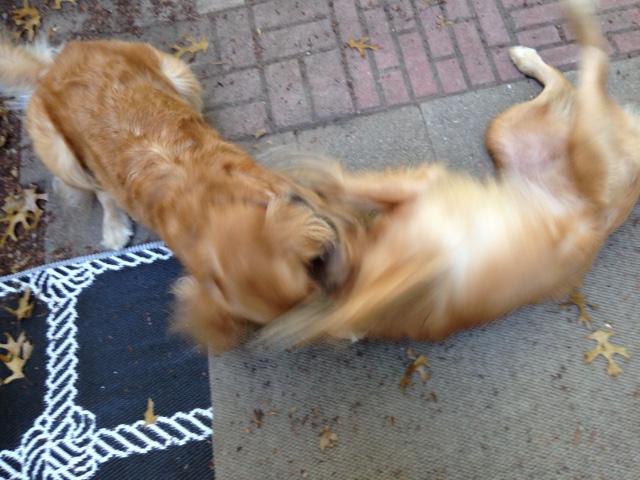 their sister play, they also bow and use the full range of doggy play signals, but the signs are sometimes abbreviated or perfunctory. They feel safe enough to throw themselves into play without worrying about being misunderstood. There is lots of ear-pulling and gnashing of teeth. Their faces wear fierce expressions. They emerge panting and wet. And wearing huge smiles. There is a level of familiarity and trust between them that gives their connection a quality that Cali’s play with others — even Alberta and Jana — lacks. Social manners matter most when dogs assess the intent of strangers. Smart dogs know when they need to be polite. And when they don’t. And, for Cali and Dora, family is safe enough that politeness can take a backseat to full-on fun.
You Need a Large Toolbox
I met a wonderful family recently. They are puppy raisers for a guide dog school in the Northeast (one of the best assistance dog organizations that I am familiar with, Guiding Eyes for the Blind, in Yorktown Heights, NY). They told me a story that perfectly illustrates the importance of knowing and treating each dog as an individual.
The ability to lie still and just hang out is a crucial skill for service and guide dogs in particular, but, really, all dogs need to learn to do this. After all, we humans can rarely provide 24/7 entertainment and fun. Even if we could, this would be over-stimulating for the dog. Dogs need to learn how to calm themselves and just chill out.
These puppy raisers said that the way they had originally learned to teach dogs the importance of just being still (often using a cue like “settle”) was to give the dog food treats as rewards for lying quietly near them. For many dogs, this works well — the dog can initially be rewarded simply for lying down (when working on a strong “down”), and, very gradually, the rewards can be delayed until the dog has remained quiet for a few seconds, then 10 seconds, 15, etc. When the dog is able to relax in place for longer times, intermittent treats, with the interval getting longer, can reinforce this behavior and convince the dog that just lying there really isn’t so bad.
What was wrong with this approach? For many dogs, nothing. Then there were those extremely food-focused dogs. Funny how many of those are Labs and goldens — the very dogs that service and guide organizations use the most. Some of these dogs, it seems, would take to asking for food. The more independent ones would cut out the middleman entirely and start looking for dropped crumbs on the ground. These behaviors are annoying in any dog, but particularly unacceptable in a dog who works in public. These dogs need to learn to ignore tempting morsels in restaurants, supermarkets, and other places where there could be food on the floor.
So, the trainers came up with a solution: Reward the dog for lying quietly with a very gentle stroke along the dog’s back. Not active petting or interaction; simply a single, gentle, calming stroke. Again, for many dogs, this is indeed a desirable reward and something that will even deepen the calm, relaxed state the dog is in.
Then there are all of those other dogs. The ones that get wildly excited at the slightest stimulation. Even reaching toward these pups to stroke them is likely to be read as an invitation — and is more likely to elicit a play bow than a calm, relaxed dog. Or the dogs who regard touch as an invitation to cuddle or the ones who roll on their backs to solicit a belly-rub at the slightest hint that a hand is near. And don’t forget our analytical canines — the ones for whom touch is not rewarding, those whose social styles tend more toward more reserved contemplation of humans than actual up-close-and-physical contact.
You get the picture. This method of rewarding lying still is not going to work for all dogs — any more than food rewards would work for all dogs. That is exactly the point of using a cognitive approach to teaching dogs: Treat each dog as an individual. Starting with that essential principle, we can figure out which dogs to reward with food, which to reward with stroking — and which need something else entirely.
There is no one correct way to teach or reward any particular behavior, as my new friends learned. And individual dogs may respond to different rewards at different times. Applying this knowledge has made them better puppy raisers — and, I am sure, better people.
The methods and rewards are as varied as the dogs (and trainers) are. Be on the lookout for new ideas and ways of teaching or rewarding a dog. Every trainer needs a constantly expanding toolbox of techniques.
What Is Cognitive Education for Dogs?
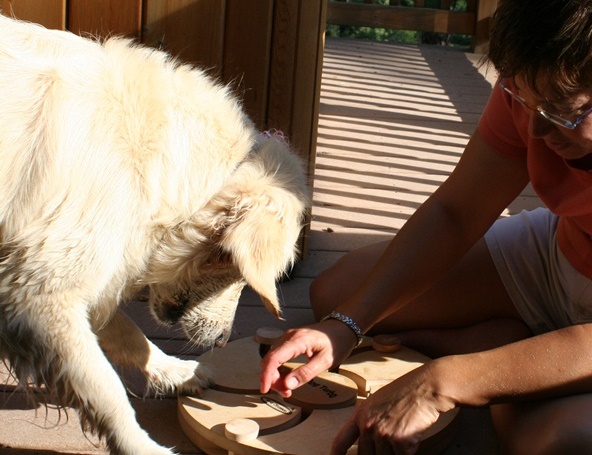
Welcome to an all-new, improved Thinking Dog blog! It is re-launching with a new focus — cognitive approaches to educating dogs.
What does that mean? Think of it as a contrast to the more traditional approaches, many of which use force, to train dogs.
Cognitive-based dog education means teaching dogs to think their way to becoming their best selves.
Their best what, you ask? Well, that answer is different for every dog — just as it is for every person.
It’s not a new idea: In 1963, Clarence Pfaffenberger wrote a book called The New Knowledge of Dog Behavior. A line in that book beautifully captures the essence of cognitive education. Pfaffenberger writes that the first time a puppy to removed from his or her littermates for training, the puppy is given “the dignity of being an individual.” All dogs deserve this. It is this understanding that forms the basis of cognitive education for dogs.
In 1995, Vicki Hearne published a classic piece, “A Taxonomy of Knowing: Animals Captive, Free-Ranging, and at Liberty.” In it, she describes the ideal relationship between a human and a non-human partner (most of her examples are dogs): the team shares a goal, recognizing and respecting the unique abilities that each member of the team brings to the joint pursuit of that goal.
An animal working at liberty, Hearne writes, is one “whose condition frees her to make the fullest use of some or all of her powers.” A great example is a search-and-rescue team. The dog brings amazing powers of scent detection and tracking to the partnership; the human brings logistical planning abilities and much more. The point is, neither partner, alone, could be as successful in the goal of finding a lost child as they are as a team.
Dogs in at-liberty partnerships are being the best that they can be. Cognitive education can get you and your dog there.
Remember Maslow’s hierarchy of needs (Psych 101)? Basic stuff like food and shelter are at the bottom. More esoteric needs, like social acceptance and aesthetic enjoyment, are higher up. The highest level is self-actualization — being the best you that you can be. That is what cognitive educators want for each and every dog.
As Pfaffenberger acknowledged, each dog is a unique individual with likes, dislikes, strengths, weaknesses — and an idea of what he or she wants (and does not want) to do. Cognitive educators understand this and teach each dog as an individual. There is no one-size-fits-all approach to training.
This approach enables each dog to be the best (fill in the blank) that he or she can. Some dogs can become fantastic service dogs; others are destined to work as scent detection or search and rescue dogs, serve in the military, or provide loving companionship to their humans. Some pets are great athletes who enjoy dock diving; others prefer Rally, flyball, agility, or freestyle dancing. Whatever your pet’s skills and preferences, you, as a cognitive educator, friend, and companion to that dog, can help your dog explore and develop and grow.
If this sounds like something you believe in or want to learn more about, stick with The Thinking Dog blog. We’ll be exploring cognitive education from every angle — who does it and how; what it looks like in daily life; how to think like a cognitive educator; what dogs are telling you about their likes and dislikes and how to better understand them … and so much more.
Check back often, subscribe to the blog, and be sure to share it with all of your dog-loving friends.
What are the BEST dog toys?

A friend recently asked me for advice on addressing some behavior issues with a young golden retriever. Since I have extensive experience with young golden retrievers, I quickly deduced that the main issue was that the golden’s energy level far surpassed that of her human. She needed a way to burn off some of that energy, something that would provide mental stimulation as well. Bored, smart dogs with energy to burn can be a dangerous combination!
I suggested several chew toys and treat toys, both of which will engage the attention of food-motivated dogs (goldens define food-motivated) and pose a mental challenge. In other words, burn off physical and mental energy, keep the dog busy, and make everyone’s life a little more peaceful. Sounds great, right?
These toys work for any dog who is willing to put some effort into obtaining a yummy reward. All have been thoroughly vetted by an expert panel consisting of:
- Jana, a 10-year-old golden who will work for hours for the tiniest morsel of food
- Cali, an 11-month-old golden who has about a 20-second attention span, but who enjoys most of these toys and will actually play with some of them for as long as half an hour (!!)
- Albee, a 2-year-old Labrador who prefers not to have to work for her food after spending a long day at the office, but who also enthusiastically approved several of these toys
Chew Toys
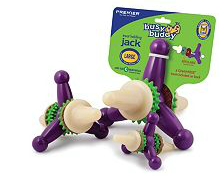
Our newest favorites are all in the “Busy Buddy” family — The Bristle Bone, which is used with rawhide or cornstarch rings, is beloved by all three expert testers. Albee has managed to de-bristle the bristle rings, though, which makes it really easy to get the rawhide and also diminishes the teeth cleaning action of the toy. The Jack toy is Cali’s favorite, but Jana has managed to take it apart several times, making it far too easy to slip off the rawhide ring and devour it. The Ultra Stratos is a new addition to this toy collection and seemed promising, but again, Jana managed to defeat it fairly quickly. Now that we have several of these Busy Buddy toys, I make up new configurations of rings, bristles and rawhide, and I am going to get smaller rings to make it even harder for top expert Jana to get to the rings. Still, she will spend a good hour chewing on one of these toys if I manage to screw it together tightly enough. In my book, that is a huge success.
I can’t write about chew toys without mentioning old standbys: Rawhide, bones, Nylabones, and antlers.
All members of the expert panel love antlers, but I stopped getting them because we got a soft one once; Jana managed to eat a couple inches of it before I noticed, and she got really sick. In general, though, they are safe, long-lasting chews. If you get them, purchase from a U.S.-company that uses wild-shed antlers. Antlers don’t splinter like bones, and they are all natural.
Bones can be OK if they are fresh, boiled just a couple min to kill germs. When they’ve been around a while, they get brittle, though, and they can splinter or crack. That is how Jana cracked a molar recently, a very expensive lesson! We sometimes get the ones with some gristle still on, give them to the dogs outside (separated so they don’t kill each other) and throw them out when the bone part starts to look dry.
Cali has recently discovered Nylabones, and she’s a big fan. Jana and Albee will occasionally get into a chewing frenzy as well. These last a long time and are safe chew toys.
I generally avoid rawhide, since dogs can bite off large enough chunks that they can choke, and since most rawhide is treated with really toxic chemicals. There are some U.S. made brands that claim to be organic, but I still stay away from rawhide. There are so many preferable toys to choose from.
Treat Toys
These are great for mental stimulation as well as fun. You can feed the dog part of each meal in one or more of these, which will burn some mental energy.
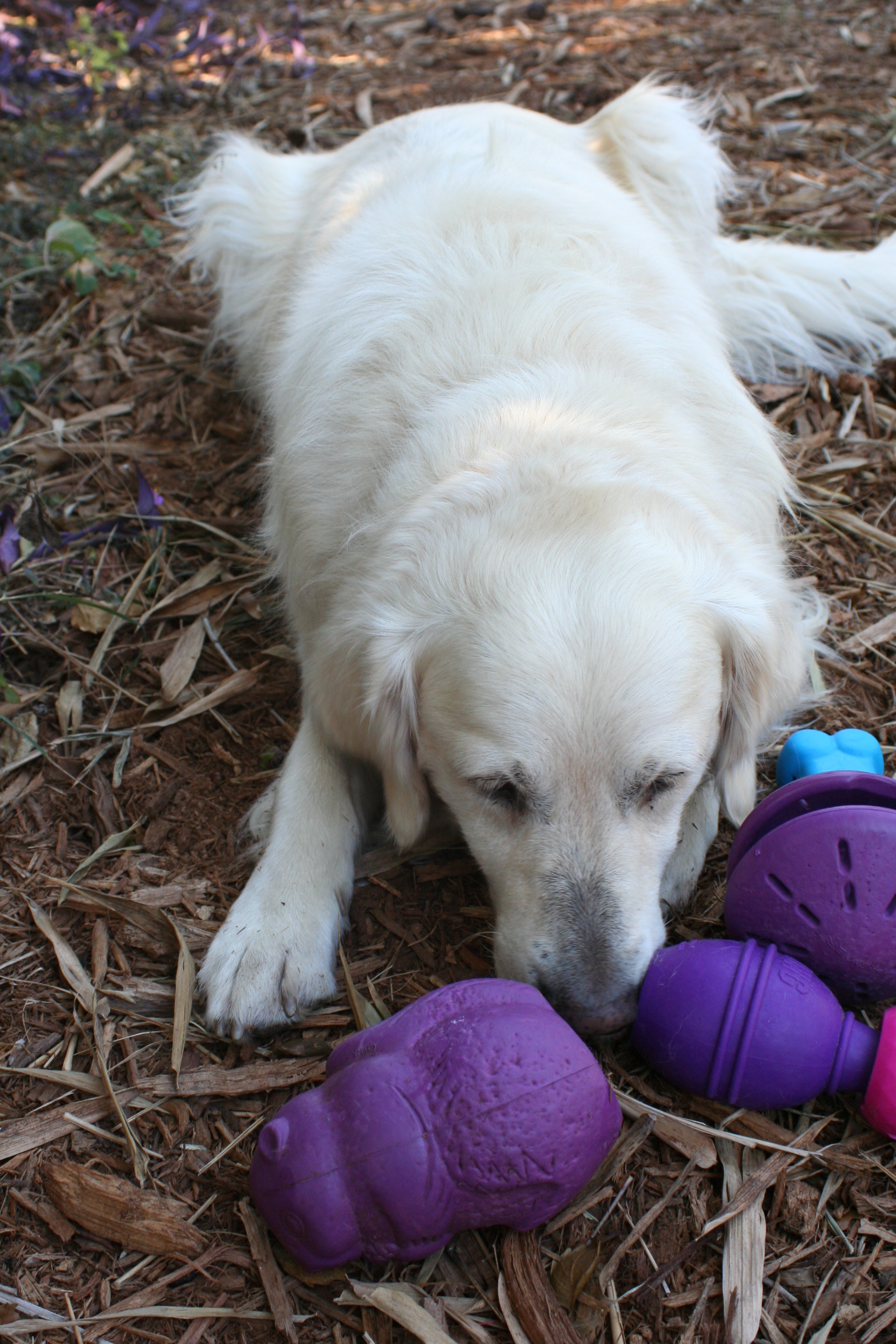 Our experts give 4 paws up to:
- The classic Kong, stuffed with … just about anything. Some favorites are kibble mixed w/peanut butter or yogurt and frozen; kibble softened in chicken broth (or warm water) and frozen; plain yogurt (also frozen) — this one is messy and best enjoyed outside. There are literally hundreds of Kong “recipes” if you Google “Kong stuffing.”
- Squirrel Dude is still the reigning champion at our house. Jana loves him and cannot get all the food out. (The other dogs are less willing to work that hard, but he’s very popular will all testers.)
- Busy Buddy Twist n’ Treat — good with peanut butter and kibble. Plain kibble falls out too easily.
- Kong Genius toys are challenging — Cali hasn’t mastered them yet! Jana loves them. Albee doesn’t want to work that hard. They link together to make it even harder to get the food out.
- Other favorites, beloved by Albee in particular, are the Omega Paw Tricky Treat Ball and the TreatStik. These both hold kibble and the dog bats the toy around to make the kibble fall out.
- And of course, Jana’s longtime favorite, the Orbee ball with a large biscuit stuffed inside. She has to break the biscuit into small enough pieces that they will fall out of the small hole. She’s gotten so good at this, though, that unless the biscuit is very hard to break, she’s done in a few minutes.
General advice — Avoid toys that use a specially designed treat. The refill treats are usually overpriced. There are many, many toys that can be filled with the dog’s kibble, which means you can make the dog work for part of each meal. The only exception I’ve made is the Busy Buddy toys, because they are among the few toys that keep Jana busy for hours (really!) and the rings last a while. I also advise avoiding the ones that are a harder plastic (like the Buster Cube); they are very noisy on the floor as the dog bangs them around to get the food out.
This stuff is all available on Dog.com and Amazon. Local St. Petersburgers can get them at Pet Food Warehouse, a wonderful, locally owned pet store. If you get on their email list, you get a monthly newsletter with a $5 coupon!
Dogs Are Not Merchandise
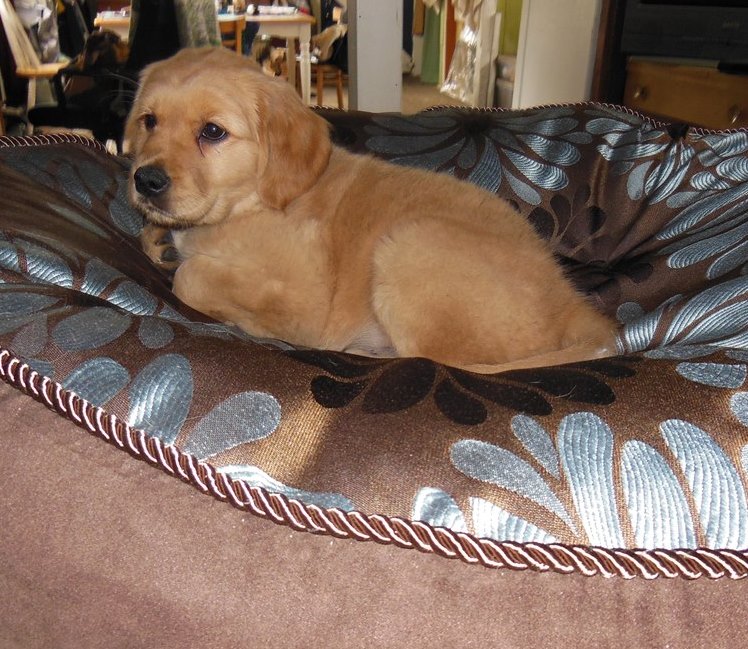
Cali at 9 weeks: Too small to travel alone
The USDA recently revised its definition of a “pet store” to target breeders, primarily puppy mills, that sell dogs online. In a nutshell, people who sell large numbers of pets must now sell them in a place (retail store, home, public space) where the buyers can see the animals before purchase. (Read the new rules and find out more here and here.) Previously, anyone who sold pets directly to pet owners could identify his or her business as a “retail pet store” and be exempt from licensing and inspection requirements that apply to commercial animal breeders but not to pet stores. This loophole was exploited by large-scale breeders, who called themselves retail pet stores because they sold pets directly to customers online. Thus puppy mills could escape any kind of oversight or regulation. (Large-scale breeders who sell only to pet stores are a whole different category and, unfortunately, are not affected by these regulations.) There is a list of exceptions, notably most shelters and rescue groups, working dog breeders, and people with fewer than five breeding animals.A Facebook group of service dog trainers that I participate in has been discussing these changes. Many participants in this Facebook discussion are furious about the new rules, claiming they are an attack on small breeders. I’ve read the regulations, though, and from my reading, it’s clear that the regulations don’t apply to anyone with fewer than five breeding females or to service dog breeders.
It seems to me that requiring people to meet the buyer / seller of a dog makes sense. I also think that having some oversight of people breeding large numbers of dogs is a good thing — though I do not for a moment believe that government regulation will solve all problems and make puppy mills disappear. I think that consumers have to make that happen simply by not buying from irresponsible breeders or pet stores. The worst fallout that I can see is that some medium-sized breeders might have to get licensed under these new rules, but if they treat their animals well and run a clean, safe operation, they should have nothing to worry about.
If you see something in these rules that I am missing, please post your comments here. The more people who care and who talk about issues of responsible dog breeding and sales, the better. But, right now, the new rules seem like a good start to me.
In the discussion, someone pointed out that the AKC opposes the rule change. I commented that that was not surprising; purebred puppy mill puppies are the AKC’s largest revenue source. One poster called this statement inflammatory and the farthest thing from the truth.
While I cannot pinpoint how many AKC-registered dogs and puppies come from puppy mills, certainly anyone who’s ever been active in dog rescue knows that there are an awful lot of them, compared with relatively small numbers of dogs from quality breeders. And puppy and dog registrations are by far the largest source of AKC revenue, earning the AKC more than $25 million in 2012.
I did not mean my statement to be inflammatory, either. I merely meant to point out that an organization with a huge financial stake in the sale of puppies naturally opposes any restriction of those sales. Therefore, the AKC might not be the best judge of whether the rules are desirable.
Critical thinking is needed when we think about how dogs are bred, bought and sold. While I don’t think that the AKC is evil, I certainly don’t think that it always places dogs’ best interests above its own financial interests. It is a business. A business that makes a lot of money from registering puppies.
The AKC has a long and sordid (and well-documented) history of willingness to register any purebred puppy, regardless of health. (Read some of Donald McCaig’s work if you’re interested in finding out more — for example, “The Dog Wars,” chronicling the opposition of many border collie breeders and breed enthusiasts to having the breed become an AKC breed.)
Some breed clubs, mostly in Europe, will register an animal for breeding only if the dog passes certain health clearances. The AKC does not take this logical step. The AKC is a large, influential organization. It could do a lot to improve the health and welfare of purebred dogs. In many instances, it chooses not to.
While many breeders are ethical people who truly love their dogs, for others, dog breeding is just a business. Hence puppy mills. And unscrupulous breeders who will breed from a champion dog that has known genetic issues — issues that could easily be eradicated simply by not breeding dogs who carry the genes. All of this, apparently, is fine with the AKC, which registers these puppies and collects its fees. This alone is enough to thoroughly discredit the AKC in my mind.
Despite what many dog owners believe, the mere fact that a dog is purebred does not mean that the dog is healthy or well-bred. It does not mean that the dog has a good temperament. It does not mean that the puppy did not start life in horrible, cruel circumstances. All it means is that the dog’s parents were registered (by the AKC, for a fee) as purebred. And their parents were, and so on.
While many things about purebred dog breeding make me somewhat uneasy, I do understand the allure of purebred dogs. I have done a lot of work with service dogs. Being able to (somewhat) predict a dog’s temperament and aptitudes based on the dog’s breed and pedigree is definitely helpful. I do understand the need for some breeding of purebred dogs and for a registry of those dogs.
But I don’t think that requiring breeders to follow minimal rules to ensure that their dogs are bred humanely, kept healthy and treated well is unreasonable. I don’t think that forbidding most sales of dogs via the Internet, between strangers, is unreasonable. And I don’t think that the AKC should get to write or influence the rules.
A dog is not merchandise, like books or a pair of shoes, that can reasonably be bought and sold online and shipped to buyers. Acquiring a dog is acquiring a family member. Ordering an unseen dog from strangers (who could be lying about any and every detail of their operation) is a terrible idea. Sending small puppies on long plane flights in crates, terrified and alone, is a terrible idea. (Pet stores are horrific places to buy or sell puppies too, and, unfortunately, this law does not tackle that issue.) But there are hundreds, maybe thousands of breeders who breed and sell puppies simply to make money. They do not think about the dogs as living, thinking, feeling beings. They do not care whether the buyer will treat the puppy well or whether the plane flight will traumatize the puppy. They think of the puppies — and treat them — as merchandise. Like a pair of shoes or a book. I find that reprehensible.
A responsible breeder would not sell a puppy to a total stranger. A responsible breeder would not pack a puppy into a crate and drive him to the airport and send the crate as cargo for a stranger to pick up at the other end. A responsible breeder makes sure that the adopters are the right people for that puppy and they will take proper care of the puppy — starting with picking up the puppy in person or sending a trustworthy emissary. A responsible breeder will take back any puppy that is not a good match for the adopting family. These breeders are not the target of this law. Even if they have more than four breeding dogs and now need a license, they should have nothing to fear, since a responsible breeder no doubt keeps her dogs in humane, clean conditions.
This new regulations are not ideal. They are not without problems. They certainly don’t solve the problem of puppy mills. But, to me, they seem like a good start. If we dog people want to make life better for dogs, we should save our anger for the many worthy targets. And use our passion and our energy to educate dog owners about where to — and not to — buy puppies.
Big Girls Just Wanna Look Cute
Cali, at 8 months old, is dashing full speed ahead into adolescence. Having read the latest studies and talked to her breeder, I know that it is better for her health to wait to spay her until she is done growing — in about another year. That means that she will have a “season” (or three).
Before all the spay and neuter people howl, let me say this: I do not think that having an intact dog of either sex is easy or desirable. I agree that most pets should be spayed or neutered. I also want what is best for my dog, and I know that I can ensure that Cali is safe and does not inadvertently become a teen mom.
Back to Cali’s impending womanhood. We’ve had the talk about birds, bees, and handsome boy dogs. And I went online to search for some britches for my soon-to-be bitch in heat. That’s not the only reason a furry girl (or guy) might need to go shopping. Dogs need clothing for different reasons. As dogs age, some (like some humans) become a bit leaky. Then there are the ones who lose control when they get excited.
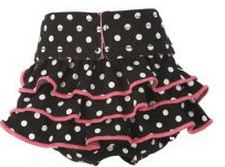 Whatever the reason, there are dozens and dozens of fashion options out there. Anything from princess skirts to rhinestone jeans to cargo pants. Camouflage and spangles. Cotton candy pink to red plaid flannel. Miniskirts, shorts, and overalls with little criss-cross straps — even thongs — for the girls. Overalls, jeans, jock straps and cummerbunds for the boys. Unisex tracksuits, girlie ball gowns, Hawaiian-style board shorts, you name it.
If your dog fits into a purse, that is.
Unwilling to give up after a short search turned up … nothing, I kept digging. I optimistically clicked to a link for X-large Petego Hot Pants. They come in black or hot pink and feature a small ruffle bow. Sounded good (in conservative black, maybe), but … an extra-large measures 16 inches at the waist. Sixteen inches! Cali was 16 inches around the waist when she was 3 months old. Waaay before puberty.
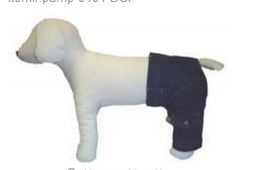 She’d look great in a pair of cargo pants, which were offered in sizes 00 to 6. Sounded promising. But a size 6 fits dogs only up to 25 lbs. That mark on the scale is in Cali’s very distant past. (The 00 is for dogs who weigh under 2 pounds. Are there really adult dogs that small?)
Maybe a ruffled miniskirt with polka dots would do? Adorable, age-appropriate, and available in extra-small to extra-large. But wait. The extra-large fits dogs up to 22 lbs. In what universe is a 22-pound dog “extra-large”?!
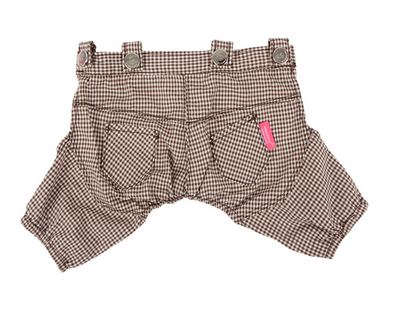 Cali could have ordered the urban ski pants for dogs from Baxterboo (up to a 26-inch waist) but they seemed a bit warm for a Florida summer. The cute checkered pants, in brown or pink, however, only go up to a waist of 11 inches. Baxterboo did have lavender bell bottoms in Cali’s size (on sale)! But Cali’s not really the hippy chick type. She wants to fit in with Florida’s sundress-and-flip-flops vibe.
Finally, I found what Cali needed at two retailers on Etsy.com. Thank goodness for creative, entrepreneurial people. Both Etsy retailers will customize for size and fabric, so dogs of all sizes, shapes, and tastes can dress stylishly during their time of the month.
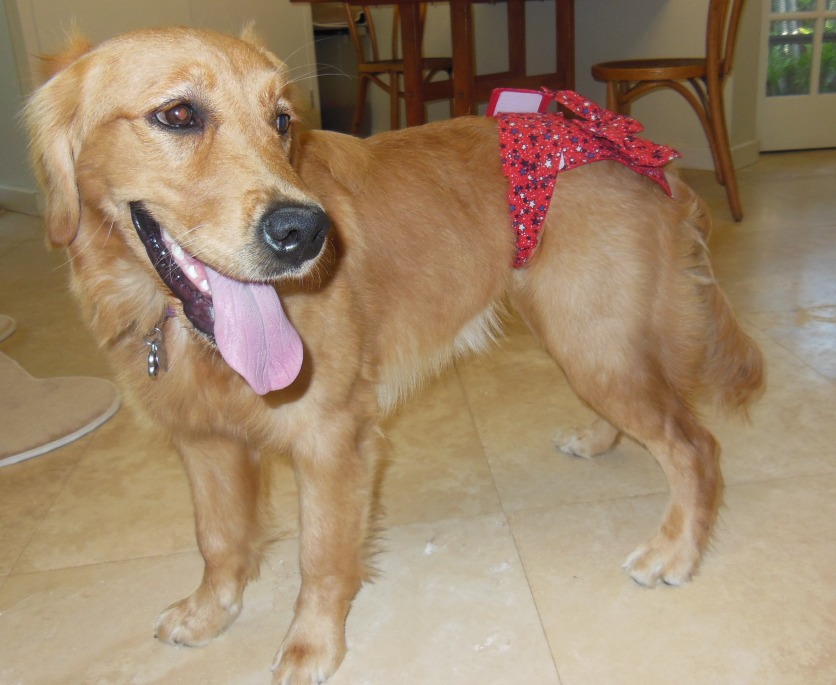 The first retailer, CodysHaven, proclaims that “Larger breed girls need to look good too.” Darn right they do. CodysHaven sent us a red, star-spangled pair of shorts for Cali that are adorable. There are dozens of fabrics to choose from, in case stars aren’t your style.
Cali’s second, dressier outfit is from The Purple Puppy. It is more of a miniskirt, with big, colorful daisies and a white ruffle.
Flowers and stars. Cali is, after all, still a little girl. Maybe it’s better that the hot pants didn’t come in her size.

The Inclusive Dog
 Cali, Albee, and Deni are playing fetch with a Zipflight (a Frisbee-like toy for dogs that Cali is crazy about). I wander over with Jana. Deni throws the disc. Cali catches it. Cali then brings it over and offers it to me for a throw.
If more than one person is in the area where Cali is playing fetch, she always does this. I find it charming. She takes the toy to one person, and then to the other, as if to include everyone in the game. She’ll include people she doesn’t know well, too, if they happen to be standing near and watching.
Oriel did this too. Cali and Oriel are closely related, but since Albee occasionally does it too, I don’t think genetics fully explains this behavior.
A professor I had in graduate school, ethologist Marc Bekoff, has hypothesized that play behavior forms the foundation of social ethics for a species. That is, youngsters learn how to get along in the group — what is “good” and “bad” behavior in their society, what the rules are for acceptable social interactions — at least partly through their games. They learn to play by the rules, not hurt each other, not to cheat or deceive, and to self-handicap when playing with younger or smaller friends. We observe all of this as our well-bred and well-socialized canines play with one another and with other dog friends. This might be a partial explanation, but Cali’s behavior seems to go a step farther.
I’ve seen dogs take turns in other situations — at the school where I teach, it’s not unusual to see three or four dogs lined up, waiting for a turn at the water bowl! And of course, when we play with our three dogs they must take turns chasing the ball when we throw it. Our dogs wait their turn to get their treats, to get brushed, even to get their dinners. Taking turns is nothing new in multi-dog homes. But dogs ensuring that all of the people and dogs get to join the game is unusual and shows an even higher level of social awareness. Cali’s not waiting for her own turn to do something fun or trying to get extra turns. She’s going out of her way, sometimes across a large lawn, to invite someone else to take a turn, to join the game.
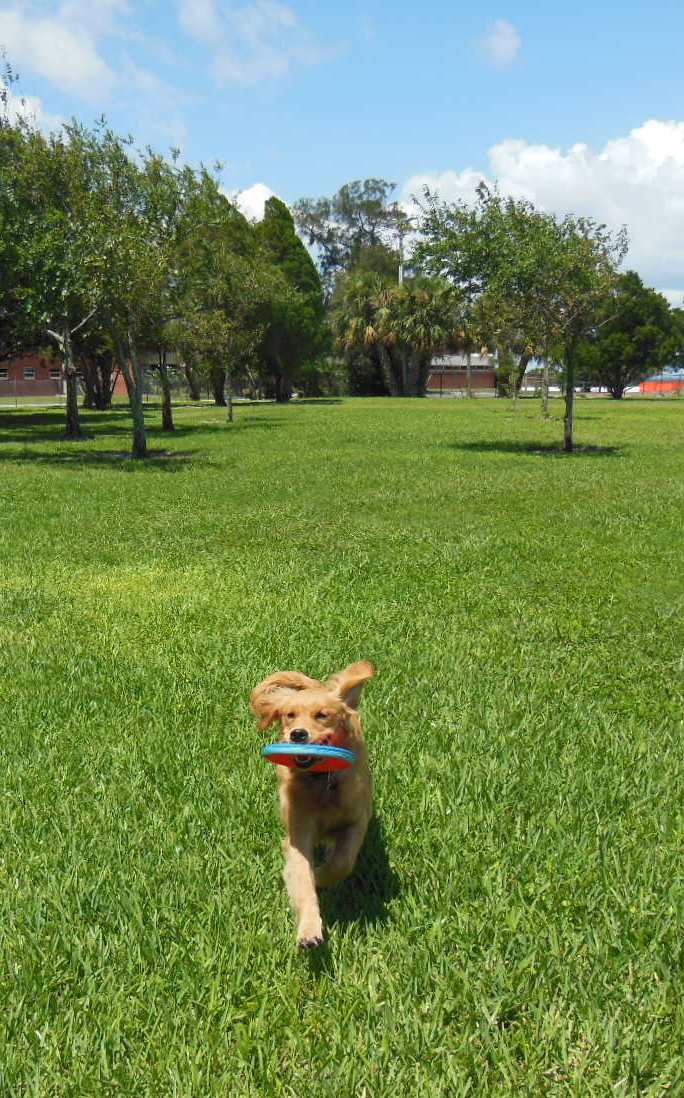 It’s impossible to know exactly what motivates her to offer me a chance to throw the ball when she’s playing with Deni, but it does bring the family together. She even takes the ball over to Jana to offer her oldest sister the chance to chase the ball! Cali’s desire to include everyone reflects something that matters to her. Empathy, or possibly inclusiveness.
An inclusive organization is defined as one that values the contributions of all people (human and canine!); one that incorporates different members’ needs, assets, and perspectives. That sounds like the kind of dog-human family I want. And, from her actions, it appears to be the kind of dog-human family that Cali wants too.
My Dog is a Research Subject

Usually, when I hear about dogs being used as research subjects, I get very upset. I imagine rows of caged dogs, suffering and lonely. But not this time.
This time, we volunteered our new golden retriever puppy to be a research subject: We’ve signed Cali up to participate in the Morris Animal Foundation’s Golden Retriever Lifetime Study. This study is an effort to learn how to prevent cancer and other diseases in dogs.
Half of all golden retrievers die of cancer. According to the Morris Animal Foundation, cancer is the leading cause of death for all dogs over age 2.
This study will look at genetics, diet, lifestyle, and environment in an attempt to identify risk factors or causes of cancer. It could identify risk factors for other diseases as well. It could help researchers learn how to prevent or treat cancer in dogs. Ultimately, some of what is learned might even lead to better understanding of cancer prevention and treatment in humans.
Each participating golden must have a three-generation pedigree and be at least six months old but less than 2 years old at the time of the intake exam.
All of this comes at a cost, of course. And poor Cali is the one paying. Us, too. Anyone who would like to participate must complete a fairly rigorous application process. The annual questionnaire is long and comprehensive. The questionnaire asks for a detailed description of the dog’s diet — primary and secondary foods, treats, supplements. It asks about exercise habits, medications, illnesses or diseases. Temperament and behavior. Cleaning products and pesticides used in the home. Even whether a member of the household is a smoker.
Oh, yeah, then comes the intake exam. Cali, who turned 6 months old a few weeks ago, had her intake exam last week. We’d prepared her carefully to meet her new doctor. We’d brushed her, trimmed the fuzz on her feet — and filed her nails. Oops. Among myriad other samples, the veterinary nurse had to collect ten nail clippings! A hair sample, too. And large quantities of blood and other bodily fluids, etc. The vet took a detailed family medical history—of Cali’s canine family.
The exam took more than an hour. Poor Cali was poked, prodded, and drained. She was quite a trouper, though, not only bravely enduring the needles, but quite cheerfully allowing the veterinary nurses to handle, move, restrain, and otherwise manipulate her as needed.
Our best guess is that the hair and nail clippings will be analyzed for chemicals — anything Cali is exposed to, whether from her diet or her environment, is likely to show up in hair and nails. In fact, one of the nurses said it was like doing a drug test.
Participating vets must also register with the Foundation. The annual visit generates quite a bit of work for them, but our vet team was eager to participate and learn more about the study.
Cali will submit to this thorough exam once a year, throughout her life. The Foundation sent us a sample collection kit ahead of the visit, and I expect that this, too will be an annual ritual. The owner questionnaire is to be filled out each year as well. This way, the researchers can collect volumes of data over the lifetime of each participant. Up to 3,000 goldens will be accepted into the study.
If you are fortunate enough to share your life with a golden who meets the criteria — under age 2 and with a three-generation pedigree — consider participating. The annual visit and questionnaire are comprehensive, but certainly doable. The Foundation will reimburse part of the cost of the visit and testing. As someone who has seen too many wonderful dogs die of cancer, I am happy that Cali is such a cheerful participant in a study that could make a huge difference for future dogs. Click here for more information.
Precious Precocious Puppy
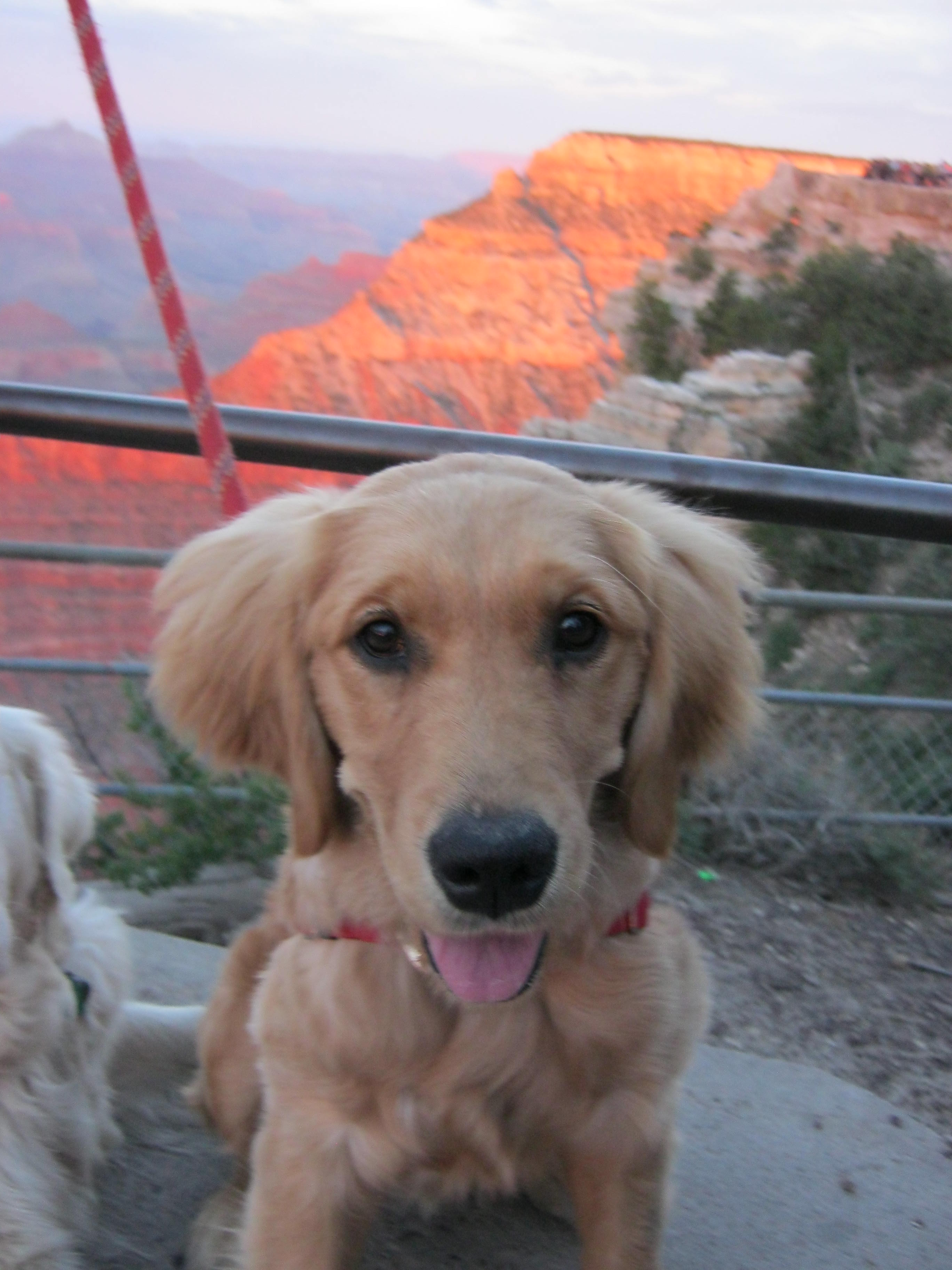
Not every five-month-old-puppy can handle a 3,800 mile drive, so I was a bit nervous about driving from California to Florida with Cali and Jana. Fortunately, my mom came along to help. Cali, like big sister Jana, turned out to be an excellent traveler, though.
Cali took the Grand Canyon at sunset in stride. This was after a morning spent at The London Bridge in Lake Havasu City, AZ (a consolation trip, once we discovered that the Hoover Dam does not allow pet dogs on site at all, ever, no matter what). Near the river in Lake Havasu City, Cali and Jana also encountered a weird piece of sidewalk that spouted water. And had ducks. Very cool, they thought.
 Cali liked the Painted Desert and Petrified Forest, too. Kansas City and a visit with cousins Hannah and Ziggy was a huge success. Cali then slept through a few more days in the car, and we were home. In Florida.
Scary, scary Florida.
We arrived home on a Wednesday. First thing, Mom and I opened the windows and turned on the ceiling fans. I turned around, wondering where my puppy had gone in this huge house, so different from our one-room studio in Valley Ford, CA. She was hiding under a table in the dressing room. Would not come out, even for food. Well, after some coaxing, Cali was able to dash into the kitchen for her dinner, but she kept casting nervous glances at the dining room ceiling. Ah. Ceiling fans. Terrifying. Who knew?
The truth is, it is pretty normal for a puppy to be afraid of a weird thing moving overhead and casting all sorts of weird shadows. I just hadn’t thought about it.
After dinner, it was time to visit the back yard. Which requires navigating a bead curtain. Again, very scary.
By bedtime, Cali had conquered her fear of the curtain. The fans took longer. But, by dinner time the next day, Cali was willing to hang out in the same room as the fans, though she still gave them a wary look from time to time.
That same Thursday afternoon, we took her (poor kid) to the beach across the street. Not surprisingly, calm, shallow, warm, waveless Tampa Bay is much more to her liking than the ferocious Pacific Ocean. She bounded right in. When the ball floated out to sea a bit, she bounded after it. Until, on landing from her leap, there was nothing under her paws. A panicked look at me — then she quickly realized that her paws were paddling of their own accord. “I can swim!!” her happy expression said.
What else did Florida throw at this poor puppy? A dog door lesson. She’d been watching her all-powerful big sister Jana use her magic to open this amazing portal. Now it was Cali’s turn. She got her key (our dogs wear magnetic “keys” to open the dog door; this keeps out cats, opossum, and other local wildlife) and we headed to the back office.
With my helpful mom standing on one side and me on the other, both armed with treats, the lesson was quick. About 12 seconds, I think. I called her. Out she came. Treat. Mom called her. In she went. Treat. Four or five repetitions and Cali was a dog door pro. She loves going in and out, just because she can. (Her reaction is not so different from Wylie’s, when we first installed the dog door.)
Is anyone counting? Cali has conquered ceiling fans and bead curtains, mastered electronic dog doors, and found out that she could swim. All before she turned 6 months old. Actually, all in about a day. The resilience of youth!
While we were on the road, Cali was showing some hesitancy around things she’d seen before — statues, motorcycles — and I was worried that she’d hit a fear period. Puppies go through stages in their development where they suddenly become fearful of new things, or not-so-new things, and a fear period and a cross-country drive are not a good combination. But she seems to have passed through the fear period quickly and without a scratch.
Since arriving in Florida, Cali has also discovered things like neighbors and traffic. While our neighborhood is relatively quiet, it’s a far cry from our rural home in California. People come and deliver or remove things — mail, trash, dry cleaning — regularly. Cars pass by. Pedestrians, too — many with dogs. Cats wander through the yard. Other critters too, though we had our fair share of those in California. Lizards are everywhere here, and endlessly fascinating to a puppy. There are so many people to meet, so many things to bark at in Florida!
Cali’s next challenge is convincing her new sister Albee to play the way she wants. Albee invites Cali to play tug by whacking her on the head with a tug toy. Cali invites Albee to play by choosing a toy and playing keep away. Neither is getting what she wants — yet. Both love to play ball and Frisbee, though, so we’re confident that they will figure out how to communicate about other games.
Cali is lucky that she gets to experience so many new and exciting things. I am lucky that she is mostly confident and curious, and that, when she is fearful, she overcomes it fairly quickly. This combination is setting her up to be a confident and calm dog who won’t be easily overwhelmed by new sights and sounds — a dog who could, someday, be a service dog working comfortably out in public.
