Get Healthy, Get a Dog

I was excited when I read about Get Healthy, Get a Dog, a new report from the Harvard Medical School that describes the connections between life with a dog (or dogs) and better health. The article I read in Bark magazine was very enthusiastic, and I immediately purchased a copy of the report, a collaboration between Harvard Medical School and Angell Animal Medical Center (in Boston). A few days later, I settled in to read the whole 50-page document … and was deeply disappointed .

It’s not that the report contains anything negative. In fact, the first section is an excellent review of the many studies that have shown physical and emotional benefits of sharing life with a dog. It offers scientific support for what we all know: Dogs are great company, get people to exercise and take better care of themselves, and help people connect socially and feel less isolated. Great!

There’s a big problem with this part of the report, though: It lacks proper citation of the studies, and there is no list of references. The report does not offer enough information for readers to find the original studies. I expected more professional work from Harvard.

As a person with considerable expertise and experience in working with service dogs, I was especially disgusted by the section on service dogs. The definition provided for service dogs is wrong and misleading, and the authors confuse therapy dogs with service dogs, a common, but inexcusable, error.

I was especially looking forward to the section mentioned in the Bark article where dogs get their turn: Half the report is dedicated to describing what responsible dog ownership entails. Sadly, this portion of the report is very superficial. It reads more like the pet column of a newspaper than a carefully researched report. An example: After a thorough description of canine obesity (complete with the ubiquitous diagram), the authors suggest “limiting” treats to 10 percent of food intake, or “about seven medium-size dog biscuits” for a 70-lb. Labrador. Seven biscuits a day? Just for existing? Not in my house!! (To be fair, they do mention the possibility of using carrots or apple slices as treats and suggest putting the treats into a Kong so the dog has to “work” for them.)

There’s a lengthy section on exercising with your dog with heavy emphasis on exercising safely. As many dog owners do, I live in a moderate climate, so I found the inclusion of skijoring on the list of suggested activities a bit odd and the absence of activities like Rally, flyball, dock diving — and other dog sports that people have actually heard of — unfortunate.

The paper concludes with a short and not comprehensive list of dog resources, primarily a disjointed collection of dog-related organizations, and a brief glossary (which defines skijoring but not service dog). While such a list can never be exhaustive, it would be easy to prepare a better, more coherent list, as well as a list of the studies and books cited.

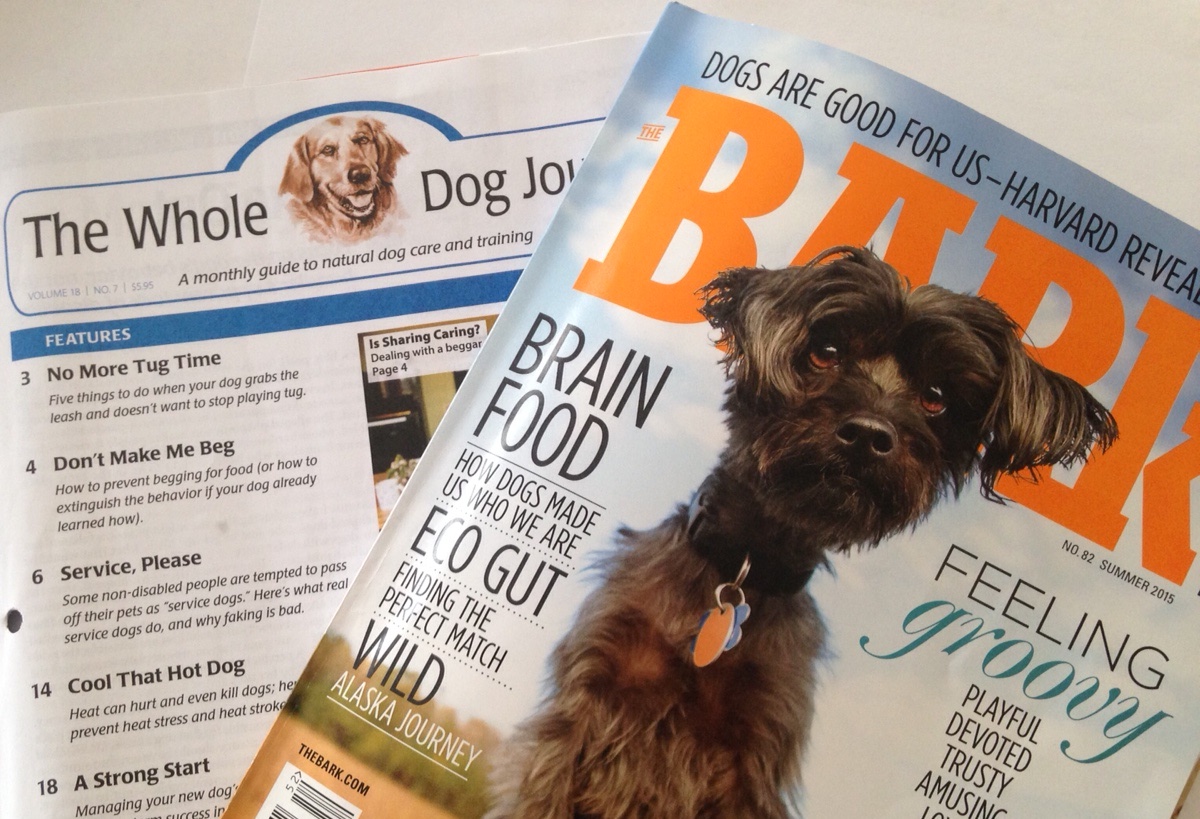
Save your $18 ($20 for a print copy); better yet, spend it on a subscription to Whole Dog Journal  or Bark. One issue of either of these outstanding dog magazines offers more, and more current, information than this second-rate report.

Note: A longer version of this blog post is published on Barks from the Guildthe blog of the Pet Professional Guild, where I am a monthly contributor. 
 

The Price of Being a Hero

Cali had a terrible, horrible, no-good, very bad day.

It all started in the evening, when, as Cali sees it, her mom attacked her with a machete, leaving her paw a bloody stump. It’s true that, for the first time in her life, I nicked a nail, clipping a bit too short. I saw a total of three drops of blood. Cali ran outside and sulked, then came back in and put herself to bed. She soon fell asleep, holding paws with her now disarmed, and very sorry, mom.

Then, in the morning, I faced down the stares of two disbelieving goldens as I failed to serve breakfast on time. Unable to take the pressure, I fled to the relative safety of the gym. On the way home, I got confirmation that Cali’s annual appointment for the Morris Animal Foundation’s Golden Retriever Lifetime Study would take place as scheduled.

Cali’s day was going downhill, fast.

Cali was initially delighted by the impromptu ball game when I got home … until she realized that she was being played (with). While big-sis Jana was getting breakfast.

Then, in Cali’s mind, her mom truly went nuts. She started chasing poor, hungry Cali around the yard wielding a paper plate. Every time Cali squatted, Mom shoved that darn plate in places that really shouldn’t be mentioned in a family-friendly blog. No way was Cali going to pee on that thing! They then walked up and down the street, with Mom still carrying the plate, and Cali thoroughly sniffed everything. She even faked Mom out a few times. Cali sure showed Mom, though: No pee.

Finally, things started looking up. Cali was excited that she got to go in the car with me, and Jana had to stay home with her super-duper treat toy. Hey, wait a minute …

At the vet’s office, Cali danced in, eager to see all those nice people who would ply her with cookies and tell her what a good girl she is. She got her wish: lots of attention, but … no cookies. Instead, they stuck her with needles and drained some of her blood. They cut some of her hair. And they tried to suck out some pee with a syringe, but she fixed them, too. No pee. Then she got some cookies. Finally!

Next, we got to go out for lunch. At last; something fun for Cali! Cali finally got her breakfast and a big bowl of water, and she got to say HI! to about 20 people on that patio. They all told Cali that she was a good girl. Except the one lady who said she was a good boy. A boy? With those long blonde eyelashes?

Then … oh, no! Back to the vet! Poor Cali got poked and prodded some more; the vet techs scraped off the edges of her toenails (no blood this time), gave her a shot, and finally got some pee, and the vet looked into her eyes with a very uncomfortable bright light, examined her teeth and her ears, took her temperature (she didn’t like that part at all), filled out an endless questionnaire … and pronounced her perfect. And they all gave her cookies, of course. Lots of cookies. She didn’t plan to tell Jana that part.

When we left, we took two huge packages — which smelled very much like Cali — and raced to the FedEx dropoff. Just in time. Off the samples went, to join those of 2,999 other golden retrievers who go through this exhaustive exam every year as part of the study.

Cali, along with two of her brothers, is one of the Morris Foundation’s golden retriever “heroes,” hero #608, to be exact. They’ll each give up a day every year, throughout their entire lives, as well as copious amounts of samples, so that the study researchers can try to figure out what causes cancer in golden retrievers. And other dogs. And what can be done to prevent it. From there, who knows who else Cali and the other heroes will help.

Best of all, we got home in time for dinner (and a trip to the park)!

Anticipation … Is Making Me Worry

Cali worries.

Many people worry. They dream up scenarios that could never happen. Then they worry that those unlikely events can and will happen. And they worry about what would follow … I don’t know if Cali does that, but she does worry about things that she knows are about to happen.

She worries about brushing her teeth. This is odd, because, when she was a puppy, she actually asked to have her teeth brushed, perhaps anticipating the treat to follow. She walked over to where the dog toothbrushes and toothpaste were kept and touched them with her nose. Looked at me. If I failed to notice, she nudged my hand, then walked over and touched the brush again.

Now, when it’s getting close to bedtime, she’ll go out for “last call,” then come in and immediately disappear when I say, “Time to brush your teeth,” or even move toward the bathroom. Disappearing a 60-lb dog is not an easy feat in a tiny one-bedroom apartment, yet Cali is gone. Jana comes right over to the sink, tail wagging, ready for the nightly tooth-brushing routine. I call Cali. She hides behind the bathroom door. Or I find her in the dog bed on the other side of my bed, pretending to be asleep. I’m willing to provide delivery service for the actual tooth-brushing but not for the cookie that follows. That’s only for dogs who line up to get their teeth brushed (she usually shows up for that part). Tooth-brushing doesn’t hurt. She’s never had a toothache or broken tooth or even an abscess. She likes the taste of the (chicken-flavored) toothpaste. But, somehow, when she knows that it is coming, she worries. The anticipation is much worse than the experience.

This is also the case for some other grooming tasks: Ear cleaning is admittedly as bad as she expects it to be, but getting the fur on her feet trimmed doesn’t hurt at all. It might tickle a bit, but then she’s amply rewarded with really special cookies. Nail trimming is even worse to anticipate: Both the Dremel that files her nails and that horrid clipper thingy are clearly medieval torture implements, in her view. In her entire 2 ½ years, no one has ever over-trimmed and cut the quick. Even so, no one can convince Cali that nail trimming is not worth every ounce of dread she can summon.

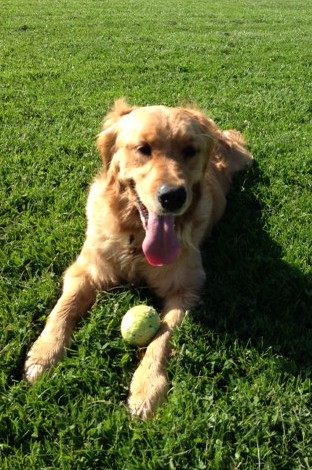
Cali worries about other things too. When I am working at my home computer, she catches sight of her ball and then looks worriedly at it, as if wondering whether anyone will ever throw it for her again. When we’re at the park and I do throw it, she catches it and then holds it between her paws, lying on the grass and looking worriedly around her at the other dogs who might come by and nab it. When she decides other dogs are too close, she picks up her ball and moves to a different part of the field. When no possible dog threats are near her in the park, she stretches her back legs out, ball loosely held between her teeth, and wags her tail at the activity happening at a safe distance. But she is reluctant to let the ball go for me to throw it — and start up the whole worry sequence again.

Her other big source of worry is the vacuum cleaner. It looks innocent, tucked into its little corner of the kitchen, but it sometimes roars to life. She avoids it, though she had no such fear as a puppy. When it comes out of its corner, Cali is nowhere to be found. What is her concern? She’s been around vacuums her whole life without ever suffering the smallest chance of being sucked up.

Cali’s worried anticipation, much like her eager expectation when we are driving toward a beloved location, dispels the myth that dogs are unable to think about future events. Dogs do appear to extrapolate from past experiences what the future might bring, good or bad. The best I can do when she’s nervous is acknowledge her concerns and insist that she face her fears and move on. While I hope that her anxiety is just a phase, I do wish that I were fluent enough in Dog to figure out why some future events seem so frightening to Cali.

Hoping for a Doggy Sequel

I’ll admit it up front: I might be just a bit obsessed with figuring out what goes on inside a dog’s mind. But many of you more “normal” dog lovers might appreciate a movie that helps by way of metaphor.

If you haven’t seen it yet, get yourself to the next showing of “Inside Out.” Stay for the credits. “Inside Out,” a summer blockbuster, is an animated movie that takes viewers inside the head of 11-year-old Riley Anderson. The main characters are her five primary emotions: Joy, Sadness, Anger, Fear and Disgust.

The metaphor should be obvious: Of course dogs experience these emotions. The real question is: How is their experience similar to (and different from) ours?

I’ve always been sure that dogs experience their own versions of joy, sadness, anger, and fear. I was on the fence about dogs and disgust for a long time, though. I’ve seen dogs eat and/or roll in many, many things that certainly trigger my disgust. Their concept of disgust, if it existed, was a mystery.

Then we offered Wylie, a fussy German shepherd, a peanut butter treat. The expression on his face: Pure disgust. He actually flinched. Then he wrinkled his nose, curled his lips, and backed away. That, and the accompanying reflexive gag, couldn’t be anything else. Peanut butter was clearly a human attempt to poison him.

Then there’s Jana’s priceless, very teenagery, eye-roll when Cali and Dora get too wild. Yep. Pure disgust: Puppies. Ick.

“Inside Out,” which I personally think is meant for adults — the best stuff goes right over the kids’ heads! — explains the necessity for and connections among all of those complicated emotions. Fear makes you pay attention: It can literally wake you up. Joy helps create the core elements of your personality. Sadness makes happy memories more precious. It can also influence your choices, pushing you to make decisions that allow you to hold onto memories — or connections — that once were joyful. Anger can make you notice injustice, or even speak out against it.

Which brings us back to disgust. A key role of Disgust, according to the movie is keeping us from being poisoned; toddler Riley is sure that broccoli will kill her. Disgust doesn’t seem to play the same role for Jana, who happens to love broccoli. She also wolfs down acorns every chance she gets, despite the cramps and upset tummy that inevitably follow. She is among the many dogs who eagerly lap up things that could (and do) poison them, ranging from antifreeze to raisins or chocolate. So I am still puzzling out what the emotion of disgust does for dogs — other than convince them that their own humans are trying to poison them.

A key lesson in the film that applies equally to dogs is the link between emotions and memory. Memories without a strong emotional component fade away, turn a dull gray, and are swept into a dump by an army of technicians in Riley’s brain. (The same guys periodically send up an annoying jingle from a gum commercial to bounce around in her head all day for no particular reason. I wonder if that happens to dogs.)

One of the ways that the other emotions kept Fear under control was by creating frequent associations with Joy. This is an essential fact for anyone with a dog, particularly a puppy, to understand. To forestall fears, dogs need frequent association of positive, joyful emotions with things that could be scary — people in hats, loud noises, balloons … Ideally, this happens in early puppyhood, before the dog hits adolescence.

But even fearful adult dogs can be helped. As “Inside Out” shows, recalling a memory while in a different emotional state can alter the emotion associated with the memory. In the movie, this is dramatically illustrated when every joyful memory that Sadness touches takes on her hue of blue … but it can work the other way, too. As trainers who advocate counter-conditioning and desensitization know, we can sometimes change fearful associations to joyful ones with careful, controlled exposure and appropriate positive reinforcement.

OK, so, why should you stay for the credits? I don’t want to give too much away, but the glimpse inside the dog’s mind is enough for me to want a canine sequel. The cat might even be better …


Play Ball!

Wanna play?
Wanna play?

“She’s such a mama’s girl,” Deni said of Cali the other day. “If we get too far ahead, she looks back and wants to stop and wait for you.”

“Nah,” I said. “She knows that I have her precious tennis ball, and she’s worried that she won’t have it when she gets to the park.”

I may be a bit too cynical, and I do know that Cali and I have a close bond, but … when it comes to morning play, I really am just the tennis-ball carrier and tennis-ball thrower.

We tested our competing theories the next morning. As Deni, Cali and Alberta set off at a brisk pace, leaving Jana and me plodding at 12-year-old-golden speed, Cali glanced back once, then marched off, tail wagging. A key difference from the previous morning: Deni was wearing the all-important black backpack with Cali’s filthy, spit-coated, utterly disgusting tennis ball — the only one that Cali wants to play with.

Soon they were out of sight. When I got to the park with Jana, I asked Deni what had happened.

“Well,” she said. “Cali did look back twice, but she did not want to stop or even slow down.”

I knew it. Tennis-ball carrier status confirmed.

As I have mentioned before, play is very important to Cali and a huge part of our daily routine. She’s a very fair and friendly dog, and makes every effort to include all the humans present in whatever game is going on. When we’re not playing, she thinks that we should be.

In fact, Cali is my best balanced-life coach, nudging me at regular intervals to gently point out that it is time to take a break from this horrid computer, go outside, and play with her. And that darned tennis ball.

Cali knows what dogs have known for thousands of years and what has contributed significantly to the human-canine partnership: People and dogs play well together. Play makes all of our lives better. And playing with ours dogs makes our relationships with them better. According to a recent study by dog expert John Bradshaw, dogs who have frequent, positive play sessions with their owners (no scolding!) are more obedient and more engaged with their humans.

So, what are you waiting for? Get out there and throw that (disgusting) tennis ball!

Thunderboy!


Poor Ziggy. Summer in Kansas is a never-ending cycle of thunderstorms and frenetic lawn-mowing. To make matters worse, his neighbors seem to tag-team each other. No sooner does one mower stop its terrifying buzz than another starts up. When all the lawns are neatly groomed … the thunder clouds roll in.

Ziggy cannot click his heels together, murmur “there’s no place like home,” and wind up back in thundercloud-free Southern California, where he grew up. He wouldn’t even need to worry about lawnmowers there; lawns are practically illegal in California these days. There’s no place like home indeed.

So what’s a poor thunder- and mower-phobic dog to do?

Rescue Remedy did not live up to its name; hiding under the sofa failed to quell his fears, and even the trusty closet let him down, seeing as it has an external wall. His mom’s planning to turn his kennel into a man-cave in the hall, the only place without windows or outside walls, but meanwhile, well, it’s raining. Again. And rain means thunder. When the rain stops, the neighbors fire up their mowers. Again. The cycle continues.

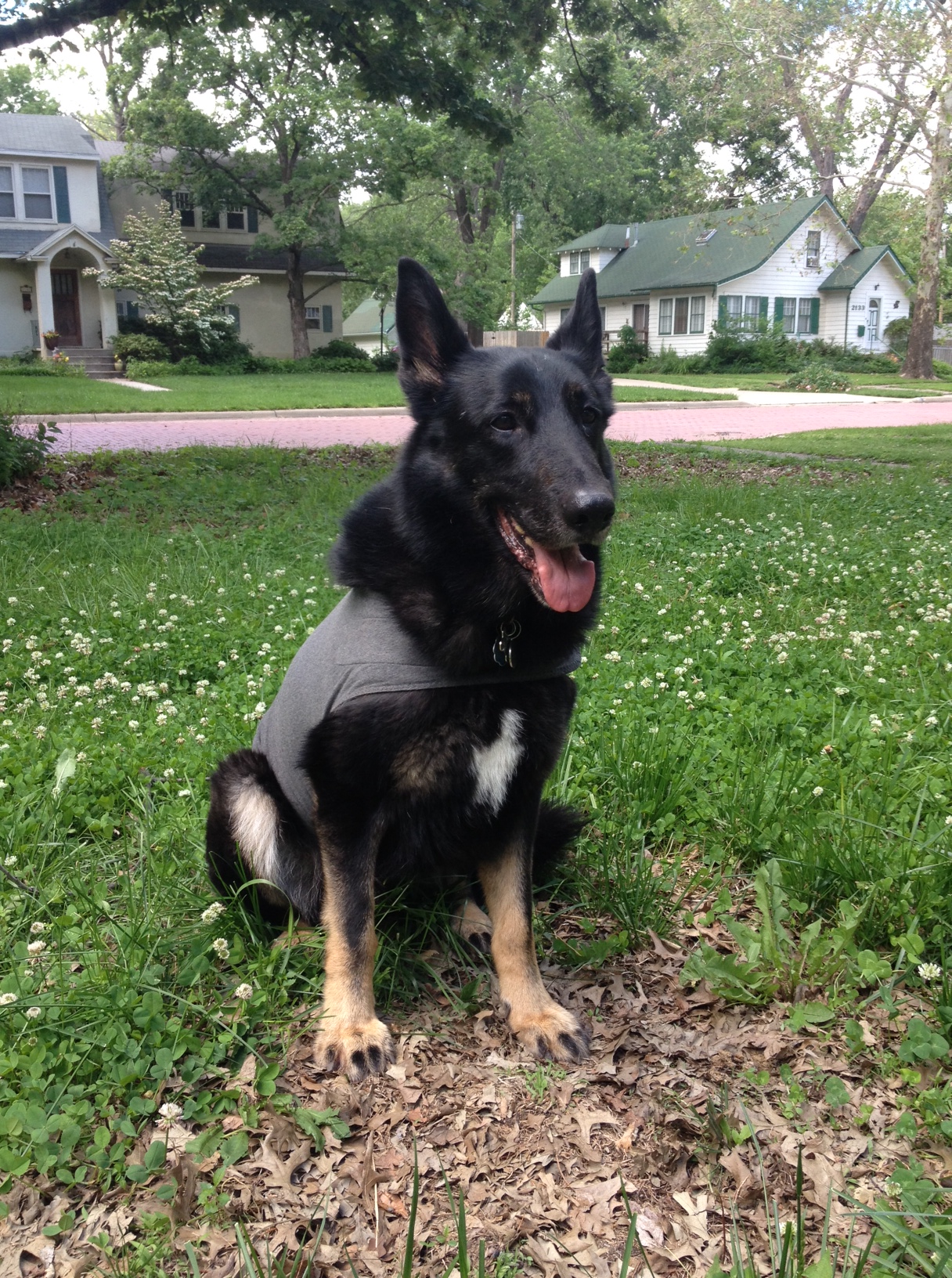
In Ziggy’s case, the ThunderShirt™ does the trick. Donning his trusty gray garment, Ziggy, a.k.a. Thunderboy®, acquires the superpower he needs to survive the back-to-back threats of local lawnmowers and ubiquitous thunderstorms.

Ziggy’s hardly alone in his quandary. And thunder and lawnmowers are not the only anxiety triggers of summer. The suggestions here can help dogs deal with Fourth of July fireworks as well.

WrapNot all dogs are lucky enough to gain superpowers by putting on a ThunderShirt. Other forms of wraps work for some anxious dogs — Jana favors hot pink elastic bandages, for example, when her nerves are on edge. Some dogs opt for a ThunderCap™, but Ziggy prefers to confront his fears with eyes wide open.

Some dogs just need a cuddle. Or a lot of cuddles. In the bed with you. Or on top of you. Others dogs are happier in their own secure fortresses — under or behind furniture or in a secure crate. Closed-sided crates or wire crates draped with towels or blankets work best. Pheromone sprays, collars, and plug-in diffusers work for some anxious dogs, while others can be distracted by music (or TV, for the couch potatoes) or games. A food toy (who doesn’t feel better with a nosh at hand — er, paw?), such as a stuffed Kong, inside the crate could work wonders for your pup’s nerves, if not his waistline.

A warning — dogs with extreme noise phobias might bolt during especially loud thunderstorms or fireworks. Make sure your dog is secured inside your home; a dog who escapes could cover a large distance trying to outrun his fear.

For many dogs, the issues is not the noise, it’s the air pressure and other changes they can feel when a thunderstorm is approaching. Some dogs’ anxiety can kick into high gear well before the first raindrops fall or thunder rumbles. If there’s no escape and no distracting him, medication might be necessary. In extreme cases, a Valium can pacify your perturbed pooch.

If even that fails? Dip into his Valium yourself … one little tablet (or a nice glass of Cabernet) and those anxieties will soon slide into the background.

Potty Parity for Pets, Pros

A new era for traveling dogs

Jet-setting working dogs, along with small traveling pets, have reason to rejoice! They are on their way to potty parity.

A recent trip took me through several large airports, and I noticed something new in Detroit: A service dog and traveling pet relief area inside the secure area. Update: A new relief area was opened at O’Hare airport in October! From the pictures, it looks a lot like the Detroit one.

Now, according to the law, this should not be a novel find. Air carriers are required to ensure that all traveling service dogs, whether departing, arriving or connecting, have access to appropriate facilities. The relevant law, 14 CFR Part 382 (Nondiscrimination on the Basis of Disability in Air Travel) Subpart D, 382.51(a)(5) states: “In cooperation with the airport operator and in consultation with local service animal training organization(s), [air carriers] must provide animal relief areas for service animals that accompany passengers departing, connecting, or arriving at an airport on your flights.”

Sadly for all those dogs running between flights with their legs tightly crossed, if these facilities exist at all, they are most often outside the terminal — meaning that they are on the wrong side of security if you are transferring to a connecting flight. Solutions have included teaching dogs to use pee pads, then taking them into the family restrooms that are commonly found in airports to squat alongside their human partners; running them outside — then trekking back through security; or asking airline personnel for an escort to the tarmac, where many a service dog is too distracted by the unusual scents and sounds to, uh, deliver the goods. A tight connection can make either of the last two options impractical. The outdoor pet relief area might be at the very far end of a terminal — or even a few terminals away, making for a very long trek.

The situation is finally improving, though, with a few airports now providing potty facilities inside the terminal.

Unacceptable!
Unacceptable!

The first one I discovered was in Seattle; I found it — and I am being very generous — rather disappointing. When I was there, a few years ago, it offered essentially a large litter box, some pee pads, a dirty concrete floor and a trash can. A dog I was traveling with turned up his nose and decided to hold on until we reached our destination where, he hoped, some grass — or even a patch of dirt — might be available.

Detroit’s offering elevates indoor canine commodes to a new level. I hadn’t been through the Detroit airport in a while, and the new facilities, in the center of the main Delta concourse, were quite a pleasant surprise.

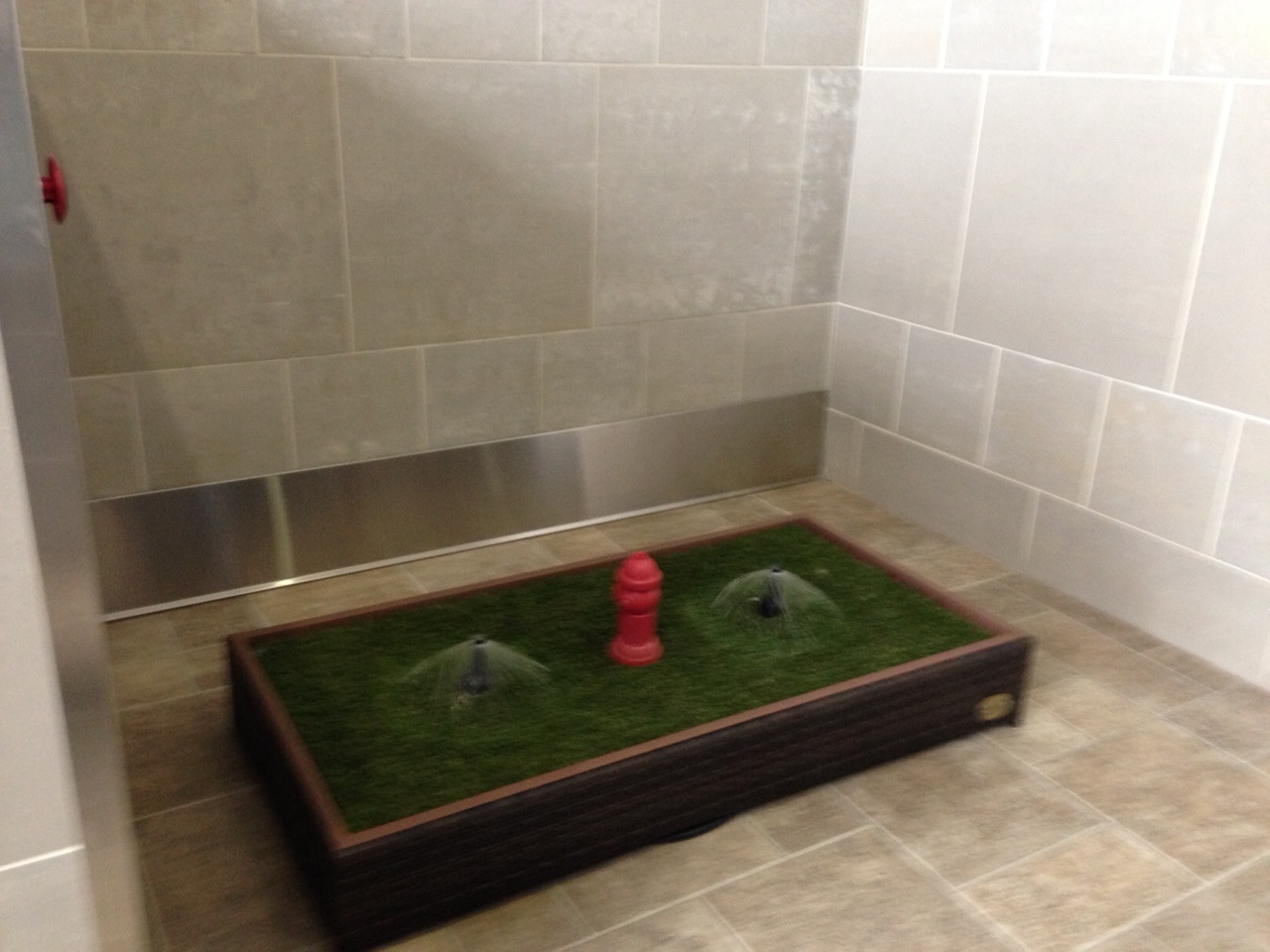
IMG_1815First of all, the service dog relief area contains two stalls, each offering the dignified or shy dog a reasonable degree of privacy. A shared hand-washing area, presumably for the humans’ use, divides the stalls. Each stall offers a small fire-hydrant-shaped urinal (female dogs might find these distasteful, but we must all adjust to this dawning era of non-gendered relief facilities, mustn’t we?). The hydrant occupies the center of a smallish patch of fake, very green, grass. Bags and trash cans are also provided. The nicest touch, however, was the built-in sprinkler system. With the push of a button, cleanup is accomplished, leaving the stall fresh and green for the next working dog in need of a restroom.

Let’s hope this becomes the new standard for powder rooms for peripatetic pooches.

Makes Scents

Follow your nose … wherever it takes you!

In a recent conversation, a friend described her memories of her grandparents’ house — each room had, obviously, a visual memory, but also a unique scent memory. Many people have experienced being transported back to a meaningful childhood moment upon smelling a familiar scent — Grandma’s perfume, cinnamon rolls, Thanksgiving turkey roasting … But until I read Dr. Gregory Berns’s study “Scent of the Familiar,” I hadn’t really thought of memories, scents, and dogs in the same context. This study, published in the journal Behavioural Processes in 2015, shows that dogs have a pleasurable association with some scents. Berns’s team analyzed MRI scans of several dogs, comparing their brain response to sniffing the scents of familiar and unfamiliar people and dogs. The dogs were all trained, using only positive methods, to lie still in MRI machines, as described in Berns’s book, How Dogs Love Us.

What the team found was that, while the scent-processing areas of the dogs’ brains responded similarly to all the scents, only the scent of a familiar human triggered a strong reaction in the “pleasure center” of their brains. The study was carefully controlled — the scents were from people in the dogs’ households but not the dogs’ primary caregivers and not individuals who were present in the lab for the testing.

Berns compares the dogs’ ability to recognize and happily respond to the scent of a loved but distant human to the response humans show when viewing photos of loved ones who are not present.
In simple English, this study confirms that dogs, like my friend, can experience pleasant memories via scent. It makes perfect sense, since dogs’ ability to detect and identify scents is so powerful. Humans tend to rely more on visual cues to identify and remember places, people and, maybe, dogs. But dogs are far less visually oriented, and their eyesight works differently from ours — fewer colors, more emphasis on shadows and movement, for example.

It also most likely explains how dogs remember people they have not seen in a very long time. As a student at Bergin University (then called the Assistance Dog Institute), I trained a young puppy, from her birth to about 13 weeks of age. Cassie was a brilliant puppy, and we spent time together every day. Then, the semester ended, and I left for my home. I did not visit the school again until a year and a half later. I knew that Cassie was still there, but there was no way that I could pick out this now-grown golden retriever from a sea of beautiful, but very similar-looking, goldens. I’m sure I looked different too, but she had no trouble recognizing me. I quickly guessed that the enthusiastic, whole-body-wagging-with-joy girl who was leaping into my arms was Cassie. The nose knows!

Be Careful What You Teach Them …

When I was first learning to train service dogs, my instructor taught me that, once you put something on “cue control,” that is, teach the dog to do it when asked, the dog will no longer do it unasked.

Those of you with dogs and a little training experience, stop laughing.

This is one rationale behind teaching dogs to “speak” — bark on command.

Problem is, no one told the dogs about this bit of learning theory.

There is a key caveat to this piece of wisdom: The dog will no longer do it unasked unless he really, really wants to.

Bonnie Bergin (my teacher) discovered this one morning, when a particularly rambunctious group of adolescent Labrador service-dog trainees learned about tugging open a refrigerator door. One day, the ringleader of the litter, Xavier, let himself and some buddies into the training room (opening the door from the outside yard), tugged open the fridge, and helped himself to a large hambone.

The ensuing melee was quite dramatic. None of those Labs became service dogs.

I learned about the “unless they really want to” caveat to the lesson about dogs not volunteering named behaviors too late: I had already taught Jana to speak on cue. She uses her words. A lot. She’s quite opinionated, in fact.

Cookie, please

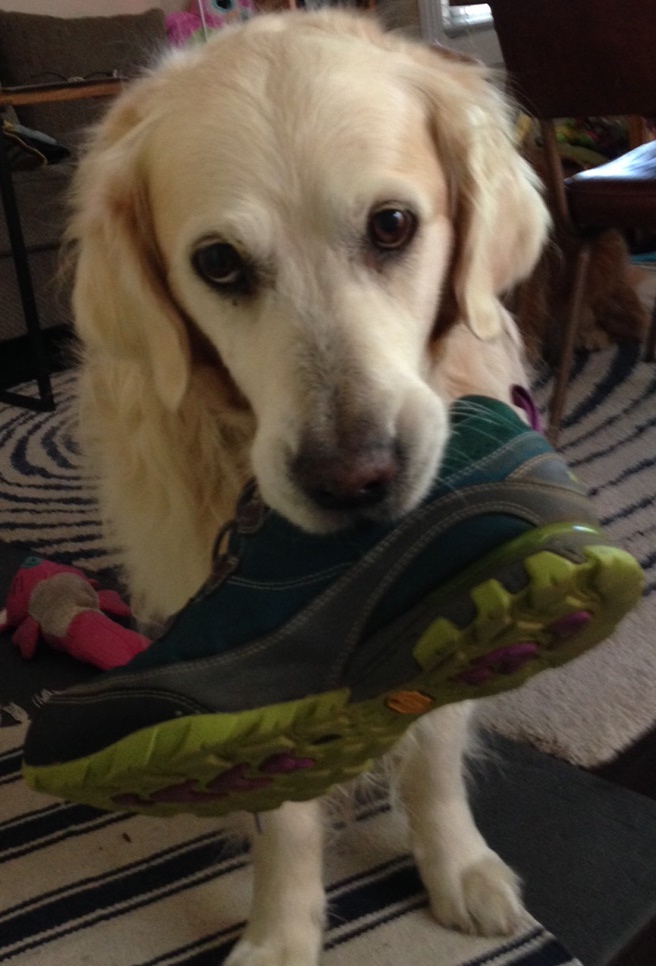
But I digress. The latest example of dogs doing unbidden that for which they have been amply rewarded in the past involves my shoes. I recently wrote about how eagerly Cali and Jana bring my shoes or sandals when it’s time for our morning walk.

Well, now they bring my shoes and my sandals. And a pair of slippers or flip-flops too. I reward the correct two shoes and wordlessly return the others to their proper place, hoping to extinguish this behavior. Not only is the flood of shoes not diminishing, it’s extending beyond walk time.

I occasionally turn around to find Jana, hopeful look on her face, shoe in mouth, standing behind me … at any hour of the day or evening. When I ask for anything — bowl, leash, collar, toy — Cali will often dash off enthusiastically … and return with a shoe.

On the bright side, they are both really good at “getting the other one,” so I never need to worry about being barefoot or mismatched.

So, be careful what you teach your dog; she might be smart enough to turn it into a game you never anticipated.

Chaser: Unlocking the Genius of the Dog Who Knows a Thousand Words

CHaserAmazing dog. Amazing and super-friendly author. I got in touch w/Dr. Pilley after reading the book (and his research papers) and he did a Skype conversation with a class I was teaching on dog-human communication. He is one in a million, as is Chaser. He is such a great example of positive training that respects a dog and her abilities… and he is a fantastic teacher as well.
No one is surprised to hear that a border collie is intelligent and learns easily. But Chaser has gone far beyond what any other dog has been documented to learn in terms of human language comprehension. Dr. Pilley set out to teach her as many words as he could — names of objects — after reading the dismissive comments that greeted publications describing the accomplishments of Rico, a border collie in Germany who learned several hundred words. Dr. Pilley analyzed the linguists’ and other academics’ critiques of the training and testing of Rico — and set out to train his dog in a way that addressed all of their objections. And he accomplished his goal. (An interesting chapter in the book describes the resistance he faced when attempting to publish his initial results.) The opposition to admitting that any creature but humans can use language is still deeply entrenched.
But it’s also dead wrong. Chaser truly does understand human language. She learned and retains the names of more than a thousand items. She has demonstrated her ability to categorize them, grouping round bouncy things into the “ball” category and flat flying things into the “Frisbee” category, for example. And, like most dogs, she clearly distinguishes the category of “my toys” from “things in the house that I’d like to chew but am not allowed to chew.”
But Dr. Pilley realized that he had not pushed the boundaries of Chaser’s abilities. So, they tackled grammar next. Chaser understands the concepts of subject, verb, object — and indirect object. As an editor and college instructor, I have to point out that many writers and college students do not reach Chaser’s level of grammatical knowledge.
Toward the end of the book, Dr. Pilley describes his initial attempts to teach Chaser to imitate long, complex strings of behaviors. His description inspired me to try simple imitation games with my dogs, which have been fun and very funny.
The best part about this book though, is its constant message: Keep training fun and rewarding for the dog; make it a game; play to your dog’s strengths and preferences and, most important, make sure she has time do play and engage in her favorite activities. For Chaser, that means regular opportunities to herd sheep at a near