Apologies to Jana

I owe Jana an apology.

I’m reading a wonderful book (go get it right now!), Beyond Words by Carl Safina. A review will be posted … once I finish the book. I’ve finished the sections on elephants, wolves, and, best of all, dogs. Orcas are up next.

He takes great delight in lampooning several ludicrous studies that purport to prove humans’ superiority in matters of self-awareness and “theory of mind.” In reading Safina’s analysis of the mirror test, I realized that I got it all wrong. His explanation is brilliant — and so obvious.

The mirror test has been used for decades to establish, so some researchers say, whether an animal has self-awareness. This is variously defined as recognizing that you exist as an individual separate from other individuals (and your environment) to, more absurdly, the definition put forth by the creator of the test and quoted in Safina’s book: “Self-awareness provides the ability to contemplate the past, to project into the future, and to speculate on what others are thinking.” Other definitions include the “capacity for introspection.” I’m not sure how recognizing yourself in the mirror reveals a capacity for introspection or an ability to project into the future, but the folks who wrote those definitions did not explain that detail.

The test involves surreptitiously putting some sort of mark on the test subject’s forehead. When the person (whether human, ape, dolphin, dog, etc.) looks in the mirror, if the person touches or tries to remove the mark, he or she is recognizing that the reflection is not some other creature but an image of himself or herself. I understand that. What Safina points out, though, is that that says nothing at all about self-awareness. What it reveals is an understanding of how reflection works. Seems pretty obvious, no?

He goes on to talk about what self-awareness really means — being aware that you, yourself, are separate from other “selves” and from the environment. He says that a creature that does not recognize this would assume that the reflection was itself since it would not differentiate its own “self” from anything else, but that would also make it impossible to move, eat, find a mate, or do much of anything, like survive. He provides wonderful examples of all kinds of non-humans showing exquisite understanding of their environments and other beings that populate those environments.

I’ll leave his discussion of theory of mind for another post.

So, what does all of this have to do with Jana? In a long-ago post, I described Jana’s experience with the mirror test, and I described her as not only self-aware but also as self-absorbed. While this might be true, I did not give her enough credit. You see, Safina points out that what some non-humans (and who knows, maybe some toddlers as well) do when they first encounter mirrors and do not (yet) understand reflection is that they try to engage with or attack the other being in the mirror. While many psychologists will say that this means that they are not self-aware, Safina makes the (again obvious) point that it absolutely shows self-awareness. Trying to play with or attack another being requires that understanding that you and he are not the same creature!

So. Jana. When Jana was a puppy, we had an older dog, Timo, who resented the puppy and did not play with her. My mom had two adult dogs, Buddy and Daisy, who also were not keen on playing with this relatively large, high-energy puppy. But at my mom’s apartment, Jana made a wonderful discovery: a puppy who kept play-bowing and acting friendly and excited to see her. Jana could not understand why this other puppy never moved beyond the play bow, however. Within a few weeks, Jana did recognize that the puppy in the mirror was actually her, and she stopped trying to get the puppy to play. I used to tell this story and say it meant that little Jana didn’t yet have self-awareness. How wrong I was!

Thanks, Dr. Safina, for pointing out that of course my brilliant puppy knew that she was a distinct individual — an individual who simply wanted a playmate.
 

Secure in Her Dogness

Of our three girls, only Cali is truly secure and comfortable in her dogness. Alberta and Jana are quite sure that they are not dogs.

How do I know this?

  • Cali happily goes in and out the dog door, delighted with her independence and freedom to enjoy a large yard, from which she can survey the surrounding hills and valleys. Jana and Alberta go to the people door and bark. If their staff fails to appear in a timely fashion and let them in, they bark louder. They both will, if forced, use their keys to open the dog door and step disdainfully inside. But they really shouldn’t have to resort to that.
  • Cali is fine being left home, particularly if she can let herself out. She calmly accepts being banished to the porch with a visiting puppy to play. She’s perfectly content hanging out with other dogs, so long as she knows and likes these dogs. Alberta, rightly, assumes that Deni should take her along everywhere she goes. Jana just plain does not want to be left with the dogs. She does not want to be excluded from adult company, relegated to the puppies’ table (or porch), or treated like a dog. If left at a dog place — she has, on rare and very stressful occasions, been left at a groomer’s or a boarding facility — her facial expression, resistance, and loud protests all say: PLEASE don’t leave me with all these dogs!

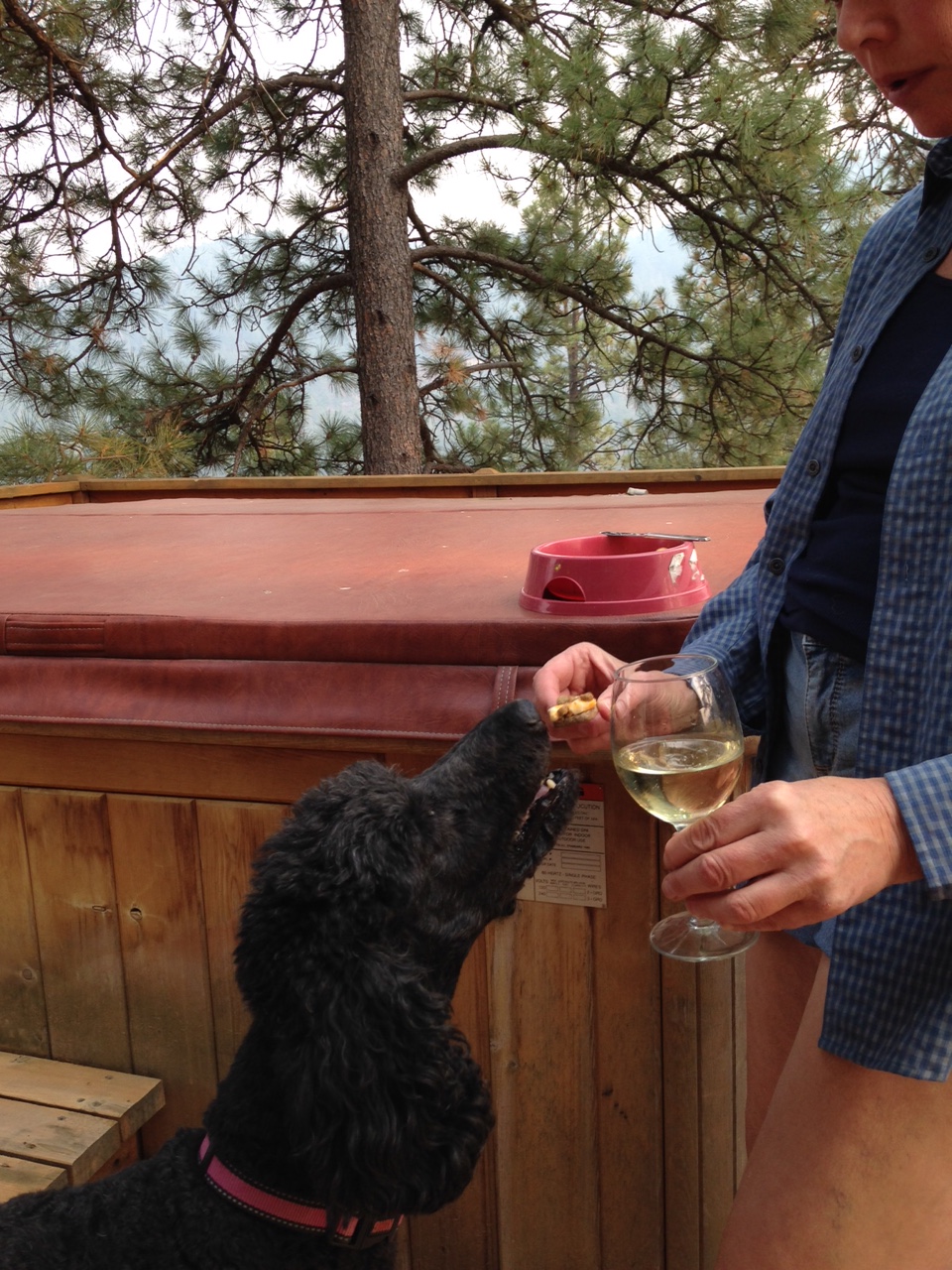
I would say that Jana and Alberta are anomalies, shaped by our treatment of them to believe that they are somehow not quite dogs — but I have met so many other dogs who seem to be equally certain that they are not dogs. Molly, for example, whom I mentioned in a recent post. Of course, she’s a standard poodle, and I for one do not think that poodles are dogs. They are so close to being human. Molly clearly agrees.

IMG_2095IMG_2090When Molly was visiting, she would not — could not — eat in the laundry room with the other dogs. Excuse me. With the dogs. She dined solo, al fresco, with a white-jacketed server in attendance. OK, so maybe Deni wasn’t wearing a white jacket, but the rest is true. Not only did she dine in solitary patio splendor, she had special meals. Chunks of cheese, biscuit crackers, slices of deli meat … the only way that Molly would eat kibble was on a cracker (biscuit) or in a turkey roll-up. She prefers white wine, not too dry and not bubbly. (OK, OK, she didn’t actually get any wine, either. But the rest is true. Really.)

But back to Cali. It is nice to have at least one dog who actually is comfortable being a dog and is happy to fulfill her role as the family dog. She’s very cuddly, for example, and loves to be petted. She’s always enthusiastic about going for a walk or out to play. She enjoys doggy things, like chasing after a tennis ball and refusing to bring it back, barking at deer, licking all the hand lotion off of my fingers, and begging for treats. She wants to be near me most of the time, even when I am doing boring (to her) things, like writing a blog post (she’s at my feet) or grading papers. Like her ancestor Oriel, Cali embodies everything people  love about dogs. She’s sweet, affectionate, playful and goofy sometimes. She’s great company and very friendly. And secure in her dogness.


Missing You?

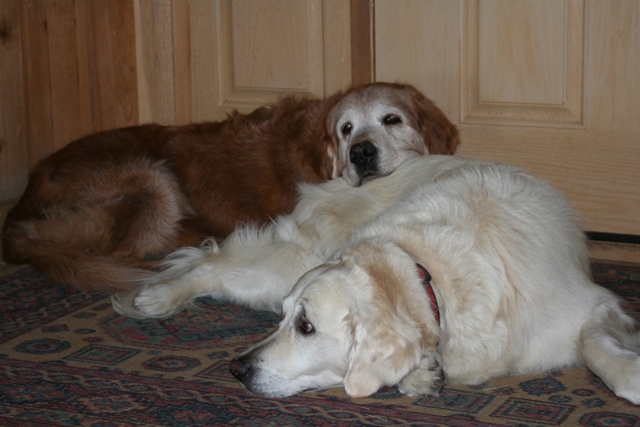
Does Jana still miss her best friend, Oriel?

Do dogs miss us when we’re away? Do they miss places they’ve been or items they’ve loved?

It’s clear that dogs remember people and places — and often, the landmarks or scents on the way to places that they either love or hate. Dogs can recognize a person whom they haven’t seen in years. Or a place that they haven’t visited in years: Oriel, our late and much-missed golden retriever once ran joyfully to the site of a small pond that had been dry for about a decade. The former pond was a short walk from her former home in Montana, and she hadn’t been there for at least 3 years. She became very excited as we approached the road to the house, too. And of course all of our dogs know the way to fun places and begin to show excitement ridiculously early in any journey in the general direction of the dog beach, Cali’s sister Dora’s house, the park where we play ball …

It’s also clear that dogs use these memories to anticipate, with pleasure or dread, future experiences. Dogs generalize and can become fearful of people or situations that remind them of unpleasant experiences in the past. A dog who fears going to the vet, for example, can recognize a vet’s office, any vet’s office, from several blocks away. Happy experiences have the same effect. Thus a dog who loves to run and play will decide that any open green space you happen to drive past would be a really fun place to stop and play ball. He might helpfully point out all the nice play opportunities say, between Northern California and Missoula, Montana, as you are driving. Believe me, there are hundreds of open green spaces in the American Northwest.

But do they miss us? Do they miss places?

This question becomes more relevant each day, as our departure from Montana gets closer and closer. Does Cali miss her play park and friends in Petaluma? More to the point: Will she miss her private play yard in Montana? Will she ever forgive me for taking her away from this idyllic place where she is so happy?

It’s also a question that many dog owners ponder if / when they leave their dogs with a dog sitter or boarding kennel when they travel. Does the dog pine for them? Wonder where they are? Or, as dogs do so well, does the dog simply live in the present moment, enjoying the attention of the dog sitter?

I’ve heard enough stories about how dogs behave after the death of a loved human or canine playmate or family member to believe that dogs grieve. Isn’t that an indication that dogs miss people or dogs who aren’t present?

I don’t have a definitive answer to any of these questions. I suspect that some individual dogs form closer ties to people, dogs, places, and other beings or objects and do, indeed, miss them. Other dogs appear to be — and may truly be — happy in the present moment, loving the ones they’re with.

So the answer might be similar to my answer to so many questions about dogs: It depends. Dogs are individuals. Your individual dog might miss you very much when you are gone. Or she might happily hang out with whomever is nearby. Cali might miss Montana. But Cali’s such a sunny optimist that I am betting she’ll be happy to be back in Petaluma and enjoy picking up our old routine and reconnecting with her playmates there.

At least, I hope that’s the case!

What the Dog Knows

what the dog knows

Cadaver dog training? Don’t make the same mistake I made — I was put off by the topic of this book and didn’t read it when it first came out (or even when I first got my copy). Once I started reading it, though, I was hooked. I breezed through it in a few days. Author Cat Warren does a wonderful job of weaving the history and technique of training scent dogs, and in particular cadaver dogs, into her story of training Solo, a German shepherd.

Like most of the books I love and recommend highly, this on puts heavy emphasis on the relationship between handler and dog. Warren is brave; she reveals her mistakes and failures as both the guardian of a high-energy puppy and as a novice trainer. She even admits to feeling overwhelmed by the intense, high-energy, demanding adolescent dog who shares her life, home, and hobby. We readers gain tremendously from her bravery, as these admissions both increase our understanding of how difficult cadaver training is and help us learn from someone else’s very understandable gaffes.

The book is rich with portraits of top cadaver dog trainers and handlers and with detailed descriptions of the training and the work. In her honesty and detail, Warren even mentions a great taboo among scent dog people: false alerts. They do happen. Her discussion of this raised a question in my mind about how deliberate the dogs are. I don’t know (yet) whether any formal studies have been done, but I am intrigued about whether the dogs are actually lying (intentionally alerting to get a reward) or whether they are simply unsure or scenting something that might be the target and responding because it seems to be what the handler wants or because they truly think they have identified the target scent. Look for more on this topic in an upcoming post .

Meanwhile, if you have any interest in scent dog training or cadaver dog training — or merely in a great dog-and-person story — read this book.


Playing Around

This slideshow requires JavaScript.

Cali and Alberta both have great social skills, and their play together is cooperative and fun. They never fight and are good at reading each other’s signals. When one wants a break, the other complies.

Bringing a third dog into play always changes the dynamic, and when it’s a puppy or adolescent who’s still learning the rules of social interaction, everything changes. So, when Scarlett joins Cali and Alberta in play, the energy level goes up — and sometimes the tension level escalates as well.

Often, the three girls have a ball chasing each other around Scarlett’s huge yard, tugging on Alberta’s ears, sneaking veggies from the garden, and generally being silly together. Sometimes, though, one dog — most often Cali — seems to be trying to calm things down. When she’s not able to do this, I know that I have to get involved.

How do dog owners know when play is going well and when they need to intervene? This question is especially important at dog parks, where the playing dogs might not know each other well and where, unfortunately, many owners don’t pay enough attention to what their dogs are doing.

As our dogs’ protectors and advocates, it’s important that we are aware of what’s going on whenever our dogs are playing with other dogs (or with children). I suspect that, even among friends and family, most dogs don’t play much when their people aren’t around. I think that our presence helps them feel safe and confident that things won’t spiral out of control. It’s our job to understand that responsibility — and to step in when our dogs need our help.

So, back to Cali, Alberta, and Scarlett. The photos at the top of this blog post show healthy play. The dogs’ tails are held high. Their faces are animated, and their mouths are open in relaxed (not stressed) smiles. They are not holding their ears back tightly or tucking their tails.

The way they are playing is also important: There is not one dog who is always being chased — or doing all of the chasing. When they are wrestling, again, there is not one dog who always seems to be the target (or aggressor). They change roles, change games, go from chase to wrestle to tug to chase with a fluidity that comes from reading each other’s body language and paying attention to each other’s signals.

What does it look like when it goes wrong?

I step in if I see Cali’s tail go down or I see her trying to walk away. If she’s trying to leave the group and one of the others (usually Scarlett, an energetic eight-month-old) jumps on her or runs after her, I know that Cali needs a little help. Sometimes, she just stands there with her head and tail down, looking overwhelmed. Calling her to me or gently redirecting Scarlett to a toy works. Scarlett is a smart girl and wants to play — she’s not bullying Cali. She simply is not always ready to stop playing or quick enough to read the signal that Cali has had enough. I know these dogs and can read their body language pretty well. I can step in and ask everyone to calm down — and get them all to cooperate.

In more public spaces, like dog parks, owners might need to intervene more forcefully to help their dogs if play with unfamiliar dogs starts to deteriorate into something too wild or rough. Also, if there are a lot of dogs around, “dogs getting carried away playing” can turn into bullying or even a fight in seconds, with more dogs piling on.

Owners of relatively soft dogs (like Cali) who won’t stand up for themselves should be prepared to extricate their dogs if a situation becomes overwhelming — and this can happen any time a softer dog is playing with other dogs. Body language to watch for includes repeated looks to you, as if seeking help; lowered ears or head; a tucked tail; or any baring of teeth.

If you’re not sure of the other dogs, it’s best to avoid the situation. We’re fortunate to have a play area where we live that attracts a regular crowd of very nice dogs. Cali has become comfortable with most of these dogs. Even so, she usually prefers to play ball with me and rarely engages with another dog. It’s not that she doesn’t enjoy lively play; when she’s with her sisters or a good friend, she lets her guard down completely.

If you don’t have a “regular” play group, look for a few well-matched (size and energy level) dogs and try to set up regular play dates. Or find ways to exercise your dog without other dogs. Plenty of dogs would rather play with their humans anyhow!


Some Like It Hot

This slideshow requires JavaScript.

When Jana was a young puppy, she had the strange and (I thought) disgusting habit of shredding, and sometimes eating, the trash. If I left her at home for too long — which, when she was a few months old meant “more than 10 minutes” — she’d empty one or more wastebaskets, usually leaving some of the shredded remains next to the wastebasket. Ick.

I knew that buying wastebaskets with lids or placing the wastebaskets out of reach would manage the problem, but I wanted to stop the behavior. A more-experienced trainer friend had a suggestion: douse the contents of the trash baskets with something very hot or spicy, something that would repel her with its scent or, if that failed, with the first bite. Tabasco sauce, perhaps.

Despite being a bit dubious, I decided to try it out.  The next time I was leaving Jana at home, I liberally sprinkled Tabasco over the crumpled tissues and bits of paper in the wastebaskets. I returned home to a floor clear of shreds … and to empty wastebaskets and a happy dog, wagging her thanks. “Great sauce, Mom, can I have some more?”

Hmmm. Not the reaction I had hoped for.

She’s consistent in her taste, though. Her dad, Moshe, used to give her bits of pita with hummus and schug, a very hot Yemenite condiment that makes smoke come out of my ears with the merest whiff. She now enjoys her breakfasts and dinner with a healthy spoonful of turmeric (a great anti-inflammatory).

I ascribed Jana’s odd penchant for spicy food to her Israeli heritage. Until last week.

We’ve been spending lots of time at the home of Gracie and Scarlett, two Montana goldens whose dad has a beautiful garden. The garden currently is bursting with an abundance of tomatoes, beans, squash and peppers (to Cali’s dismay, the peas are done for the season). Among the peppers that Deni harvested a few days ago were dozens of beautiful jalapeños.

As is her habit, Scarlett (now eight months old) watched like a hawk as Deni harvested and sorted vegetables, pouncing on any that fell to the ground and, when the opportunity presented itself, snatching veggies off the table. Green beans, squash, tomatoes … fine. Then she nabbed a large jalapeño and ran off to her “hiding” spot under the deck. As Deni watched in amazement, Scarlett took a bite, then another and another — until she had eaten the entire jalapeño, seeds, ribs, and all. As if to prove that she can take the heat, she nabbed another the next day and ate it, too. She has not shown any sign of ill effects or even indigestion. She didn’t even gulp down an entire bucketful of water afterward (as I would have).

While I certainly do not advocate feeding spicy foods to dogs, it seems that Jana is not the only girl who’s looking to spice up her kibble, fish, and peanut-butter cookie diet. Who knows? If your dog is turning her nose up at her ordinary meals, perhaps the problem isn’t that she doesn’t like the food — she might just be holding out for the right condiments.

(In case you’re wondering: Jana (mostly)outgrew her trashy habit; now she only shreds one tissue and leaves it for me, and only if she’s angry.)

Agility Offers Fun for Thinking Dogs

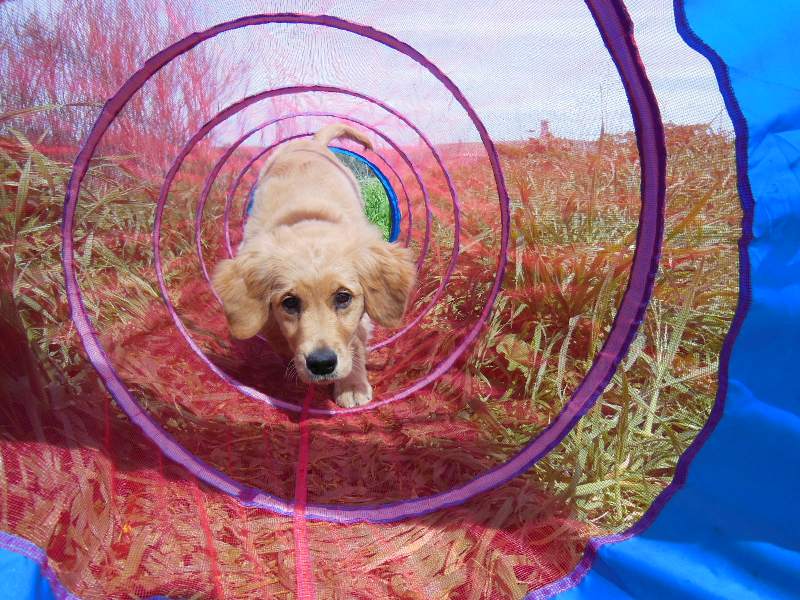
lost in the tunnelCali and Alberta started taking agility classes a few weeks ago. Watching Cali puzzle through things and figure out what we want has been fun. I can almost see the wheels turning in her little head.

Alberta is more experienced with dog sports and classes, having nearly completed her Rally Advanced Excellent title. She catches on very quickly, but knowing what we want her to do doesn’t keep Alberta from showing her silly side in class sometimes.

In the first couple of classes, we worked on targeting a small piece of foam on the floor. Both girls are proficient at hand targeting and were able to touch our hands, on cue, no matter whether we placed them high, low, on our backs, or anywhere else. Getting them to touch the foam mat was easy, too, but … both Cali and Alberta quickly went from simply touching it to retrieving it. Alberta, in particular, has a great working retrieve and has often been rewarded for bringing Deni items that Deni didn’t even know she had dropped.

I’ve been working on teaching Cali to bring my shoes, and, like Jana and Oriel before her, she has shown some entrepreneurial spirit, bringing things that I don’t even know that I need (or want) — in hopes of exchanging them for a small cookie.

So it’s not surprising that both Cali and Alberta think that we want them to retrieve the small mat, rather than simply touch it. Or perhaps they know that we want them to touch it but prefer to retrieve it.

They both are eager to jump onto the agility equipment, out of turn or when we’re waiting for our turn at a different piece of equipment. No fear from either of them; just eagerness to learn more and try out new challenges.

Practicing at home is also fun (and can become a three-dog circus pretty quickly). Jana wants in on the action, and when I was guiding Cali through some fake weave poles, Jana knocked one over with a swish of her tail — while grabbing another and running off with it in her mouth. Meanwhile, Alberta knocked over the other two! Poor Cali never had a chance. With more practice, though, we have managed to get all three girls to walk between the poles, though we still occasionally lose a pole or two to a swishing tail.

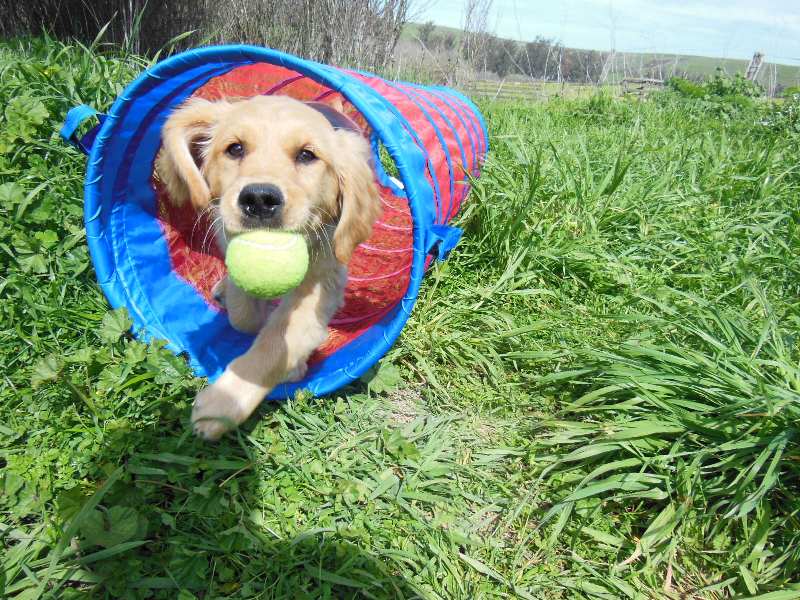
Out of the tunnelNone of our girls has any trouble with tunnels, though Cali did try to circumvent the tunnel once, taking a shortcut to where I was standing. She has always loved tunnels. Cali had a wonderful little play tunnel when she was a puppy, and Jana had plenty of exposure to tunnels before her first agility class. So neither of them hesitates, even when the tunnels are curved or have a piece of fabric covering one end, though many dogs resist entering a tunnel if they cannot see through to the end of it.

I thought about this last week as I was working with a neighbor’s dog, an adolescent golden retriever who is unwilling to use her dog door. The door flap makes her nervous. I rigged up a tunnel using a small table and a towel, and after a couple of sessions, she was willing (though still not exactly eager) to go through it for cookies. She’s uncomfortable with the small space, the towel brushing her back, and her inability to see what is coming. She’s improving, but she reminded me of how important it is to expose dogs to all sorts of tactile experiences, starting at a very young age.

Even that is not foolproof, though; this dog did use the door flap when she was younger, until she had a scary head-to-head confrontation with the cat as she went through the flap. My jerry-rigged tunnel will (I hope) help build her confidence in the same way that agility classes are boosting Cali’s confidence and awareness of where her body is. Classes in agility or other dog sports are a lot of fun — and they improve the dog’s focus on you and your communication with each other. Besides, they provide plenty of mental challenges to your thinking dog!

Her Very Own Key

Surveying her territory

Cali got her own key last night.

Readers of Merle’s Door — or Cali, the Ghost, and the Dog Door or A Doorway to Your Dog’s Independence — will understand the significance of this moment.

Deni’s house in Montana has an electronic dog door. The dogs each wear a magnet on their collars. The magnet opens the door, letting the dog go outside, into the fenced dog yard. It’s a nice dog yard with its own deck and a fabulous view of the mountains and valley. Lucky dogs.

Cali had learned about dog doors in our Florida house, but her key privileges were quickly rescinded when she spent her time chasing and eating lizards, digging, and going in and out and in and out and in and out … Our California apartment has no dog door, and Cali’s outdoor privileges are often suspended due to incessant digging and / or barking at the neighbors. If you can’t handle the freedom, I tell her, you have to stay with me.

Cali clearly treasures the privilege, as she showed us the first time she got a key and went in and out and in … She no longer does that, but she does relish opening her own door — often waiting for the dog door to open and using it even when we’re walking through the people door at the same time. Jana and Alberta, on the other paw, will stand by the people door and bark for their staff. When we fail to materialize and open the door promptly enough, they’ll disdainfully resort to using the dog door.

Cali convinced us of her increasing maturity, after spending most of an afternoon stretched out in her “bearskin rug” pose, watching the world go by. That world included a few deer, many squirrels, and an enormous truck that dumped four loads of dirt and gravel on the driveway. Nary a bark was heard nor a hole dug. Our baby is growing up!

Well … not so fast. Increased wildlife activity in the evening required closing the dog door. Barking at deer in the morning prompted a brief suspension of Cali’s privileges.

Even with these bumps in the road, it’s clear that Cali has turned a corner. She’s much more thoughtful and better able to rein in her abundant enthusiasm. She still gets excited (very excited) about meeting new people or heading out to play ball, but she can get a grip on her enthusiasm, sitting and trembling all over rather than jumping straight into a stranger’s arms, for example. As we walk to the play yard, she skips ahead, remembers, backs up, skips ahead, remembers, backs up … over and over. I don’t have to say a word. She rarely even gets to the point of pulling at the end of the leash anymore. And, last week, a friend asked whether 6-month-old Scarlett would “be as nice and calm as Cali when she grows up.” Granted, the friend hadn’t known Cali for very long …still, it was a nice compliment.

Scarlett, at 6 months, already shows her strong personality and intelligence. However, she’s heading full-speed-ahead into adolescence, and she lacks impulse control. Cali was similar at that age. Watching them together provides a nice reminder that, if you get through those crazy months, you just might end up with a wonderful adult dog at the other end of that long, dark, frustrating tunnel.

Montana Girl

We’re back in Lolo, Montana for a couple of months after three years’ absence. I knew that Jana would be happy to be back. She loves splashing in the river at Fort Fizzle, where she found her first heart-shaped rock several years ago, and barking at the abundant wildlife.

But it is Cali’s first trip to Montana, so I was really looking forward to her reactions. Turns out Cali is even more of a Montana girl than Jana! She loves the huge play yard outside Deni’s house — her own private dog park! — where she races over the ground, feet pounding the dry dirt, after her beloved tennis ball. The dry, stiff grass and stubble don’t seem to affect her at all, though poor Alberta winces with every step.

Cali is enthralled with the bunnies, chipmunks, and squirrels and fascinated by the deer. So far, we haven’t spotted anything bigger than a doe with twin fawns, but for Cali, that was a major life event. Every car ride is a source of great excitement and even greater smells, as sits up, looking out the window, not wanting to miss a thing. And if, oh joy!, the window is open, she glues her nose to the window and whuffs deeply, taking in the rich mix of scents.

The house has the most perfect windows, which are very tall and reach way down to golden-retriever-nose level, so Cali can watch the birds soaring as she looks out over the valley — or bark at the deer and squirrels who wander into the front yard.

Best of all is her new friend Scarlett’s house. Scarlett, aged six months, has a huge yard with the greenest, softest grass Cali has ever seen! And a play pool. And so many flower beds to dig in when Mom isn’t looking … If only she could get into that fenced veggie garden, she could help herself to more of those delicious peas and squashes. Cali thinks that Mom’s being awfully stingy with them. What kind of mom refuses to give her kid veggies?

For the first time ever, Cali has tried out Jana’s routine of stretching out on her back and exercising her abs. Sure feels great in that cool, soft grass. Jana’s enjoying the grass, too. Her new spa routine is a soak in the doggy pool, a luxuriant roll in the grass, then an abs workout. A short nap in the sun, then repeat. All day long.

When Cali is not working out, she’s happy to join a chase game that she, Alberta, and Scarlett have invented. They race in big circles around that garden (the one full of forbidden peas). Then one stops and the other two keep running. They switch out a few times, changing direction occasionally. Finally, they stop running, always ending up with Alberta in the middle as tug toy; Cali and Scarlett each attached to one ear. So far, the ears haven’t come off, but I watch nervously every day …

Cali hasn’t even experienced some of the best Montana treats, like dog cones at the Big Dipper ice cream store or the very cold stream at Packer Meadows or hiking… everywhere. Even so, she’s already sure that she was born to be a Montana girl!

Older, Wiser … and Far More Painful

Opening birthday presents helps keep Jana young and happy!

We celebrated Jana’s twelfth birthday recently. Her friend Leti (also a golden retriever) just turned 15.  These girls still walk to the park nearly every day and enjoy a vigorous roll in the grass. They make the rounds, saying hello to the other dogs’ people and trying to cadge a cookie or two from each human.

I do everything I can to see that Jana’s quality of life remains high. Despite their good health, both girls are showing signs of their age. Jana has severe arthritis and wakes up feeling stiff and painful many mornings. Though she’s usually very sharp mentally, I’ve noticed a few senior moments, when she seems to be a bit confused.

Hoping to deal with both those issues — without breaking the budget — I’ve put together a regime of supplements and exercises that help Jana a lot. If you have an aging dog, some of this might be helpful. I have no veterinary training, but I do check everything with my vet and vet techs before I try it on Jana, and I recommend that you do the same:

  • Even Cali, age 2, is taking a small amount of glucosamine each morning. It helps ease joint pain. Some people take it, too, particularly for knee pain.
  • New Zealand Green Lipped Mussel. Jana takes one green mussel capsule daily, emptied onto her breakfast. Like glucosamine, it can help people and dogs with joint pain. Jana behaves very differently when she’s talking it — asking to go on walks and soliciting tug games — so I am convinced that it helps.
  • Fish oil. Each girl gets two fish oil capsules a day. The omega-3 is as beneficial for them as it is for humans, and the dogs like the fishy taste. They get sardines once or twice a week as a treat for the same reason.
  • Coconut oil. A spoonful a day is great for their skin and coat. Coconut oil also might help with brain energy and metabolism (Thanks to Tom Morrare for sending me the link to this great article!), and it has anti-inflammatory properties (in lab rats, anyhow).
  • Turmeric, another anti-inflammatory. Jana likes spicy food; for some dogs, turmeric capsules or tablets might work better than the powder. Also, the bright orange powder stains everything it touches. If your dog is prone to tummy issues, you might want to use tablets.
  • Rimadyl or one of the generic equivalents. The active ingredient, carprofen, is an NSAID for dogs. It reduces inflammation and therefore pain. It also can cause liver damage if given in high dosages or for a very long time. Since I have started giving it to Jana regularly, I will make sure to get bloodwork done every six months.
  • Cold laser therapy. Jana goes about once a month. Some dogs get it more often; some less. Figuring out the frequency is a complex formula that factors in cost and distance and time. The treatment really seems to help keep Jana limber and, if not pain-free, certainly far less painful. It stimulates blood flow, healing the tissues and reducing inflammation, thereby reducing pain. I get Jana as many laser therapy sessions as I can so I can reduce the amount of Rimadyl she takes.
  • Jana does daily exercises on an inflated exercise disc, as recommended by her laser therapist. The idea is for Jana to strengthen the muscles that support her arthritic joints. She’s also working her core and having a great time. She’ll “dance” (prance, alternating paws) and turn around on the disc and balance with front or back feet. Cali usually joins in.
  • Treat toys. There are many. Jana’s favorites are Squirrel Dude and Nobbly Nubbly, both from PetSafe, and the Kyjen Cagey Cube. Other dogs will like different toys; these are the ones that hold Jana’s interest, even if I give them to her over and over again.

There are other options that we have not tried (or haven’t tried yet) or haven’t liked: Adequan injections, for example, which is used for arthritis pain; acupuncture, which Jana didn’t react well to; surgery; massages and body work; Chinese herbal treatments … the list is long. If you find something that works for you, let the Thinking Dog know at thinkingdogblog@gmail.com!

The important elements are to keep the dog moving and challenged — physically and mentally — and as pain-free as possible. Jana has jobs as well: She gets the morning paper, brings my shoes when we’re getting ready to go for a walk, and picks up the bowls after each (doggy) meal. She loves interactive toys where food or a tennis ball are hidden or trapped (her favorites are mentioned above); she’ll spend a long time trying to figure them out, whereas Cali gives up much more quickly.

It’s also important to make sure your older dog has a comfortable bed (in Jana’s case, so that she can sleep next to it) and is warm in cold and damp weather. I’ve put down rubber mats so she no longer slips on the bamboo and linoleum floors. I haven’t gotten her a ramp or stairs yet, but I do have to help her into the car.

My goals are to reduce Jana’s pain without heavy use of pharmaceuticals and maintain her quality of life. I started with the supplements and only added a small amount of Rimadyl when Jana was clearly painful. I want to accomplish all of this at what I consider a reasonable cost. Obviously, this means something different to everyone. And I understand that not everyone is willing to spend several minutes measuring out supplements at each meal or hours schlepping a dog to a laser appointment. Every individual dog and family needs to figure out what works best for them.