I Mean It!

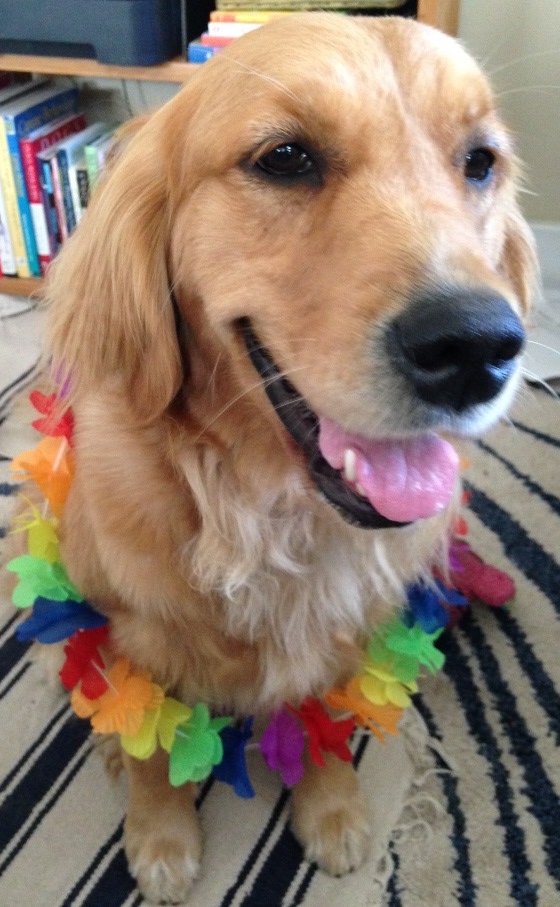
Cali looking2_side
Are you talking to me?

In my last blog post, Are You Talking to Me?, I said that dogs can tell when we are talking to them and when we really expect their response. They can tell when they can safely ignore us, even when they know that we are talking to them. They read our tone of voice, body language, and many other cues, most of which we are oblivious to.
So, how can we get those smart, calculating dogs to listen?
First, practice an “I mean it” tone. This can be a stern tone practiced in training class or at home; it can simply be a way of addressing your dog where you make it clear that you are completely focused on him — facing him, looking straight at him.
Fortunately, it can also be that note of fear or panic that creeps into your voice when your dog wanders too close to the street or shows too much curiosity about the ray hovering in the water just beyond her nose. In these instances, thankfully, even dogs with relatively poor recall skills will usually respond, coming to you and away from the danger.
Then, add an “emergency cue.” Practicing an “emergency recall” cue, as explained by a very dog-savvy friend, is a great way to build and maintain good listening skills in your dog: Choose a phrase, such as “right now,” and practice it with your recall cue (usually “come” or “come here”) and really, really excellent treats. Remember — your dog gets to decide what counts as a truly excellent treat.
Practice often. Use different tones of voice when you call. Surprise the dog, calling her when you are in some remote corner of the house or yard.
Soon, whenever your dog hears that cue — “Come here right now!” — regardless of tone of voice, she will know that top-quality treats are being dispensed, but only to the quickly responding dog! If you choose the right reward, you’ll see a blur of racing fur when you issue the cue. To get an even faster response, reward only the dog who arrives first, or, if you have only one dog, count to three (or five, or ten, if you have an old or slow dog), and only reward arrivals that beat the countdown clock.
I admit that I have been lazy about practicing this cue lately. Even so, when I add “right now” to a cue, any cue, I get a much-improved response. The association between “right now” and good treats is indelibly inked on Jana’s and Cali’s minds.
That’s partly due to lots of practice when Cali was little. It’s partly due to the fact that I have some really good treats hidden away. But it’s also due to the strength of our relationship — I spend a lot of time with Cali and Jana, and they can read me really well. They definitely know when they have to listen — and when they can push the boundaries a bit.

Are You Talking to Me?

Mom's not paying attention!
Mom’s not paying attention!

How does your dog know that you are talking to him rather than about him? At a friend’s recent presentation on service dogs, she was asked a great question by a member of the audience: How does your dog know when you are talking to him instead of using “command words” in a different context? For example, as both the speaker and I learned service dog training at the same University, our cue for urging a dog to toilet is “better hurry.” But this phrase, along with sit, stand, look, get it, and myriad others, are used while chatting with our friends, as well as being directives for our dogs.
My friend’s response is that not only do dogs know when we are talking directly to them. They also know when we really mean what we say. Several research teams have studied dogs’ ability to know when we are paying attention to them and whether they recognize when verbal communication is intended for them. Other studies have tested dogs’ ability to recognize non-verbal communication, such as pointing to something, or simply looking at something, that is intended for them. The results of many studies show that dogs do, indeed, know when we are talking to them.
None of this is news to a dog owner who has experienced the instant transformation of a peacefully napping dog into the canine equivalent of a hyperactive toddler who has consumed too much sugar — the instant that the owner picks up the phone.
How do our dogs know that we are talking to them rather than about them? Dogs pay attention to everything we do (I suspect that they pay attention even when we are sound asleep). They read our body language, watch our eyes, and recognize the difference between our use of “sit” as an instruction and our use of “sit” in conversation. They train every sense in our direction to see if we are seeking connection. They read our moods, anticipate our actions, and, yes, know whether we are paying attention to them or are distracted.
What does this mean for your relationship with your thinking dog? Well, think about a conversation you’ve had with someone about your latest personal crisis or sought a trusted friend’s advice, only to have her answer her cell phone while you are mid-sentence. Or you’re on the phone with your friend and you keep overhearing her conversation with someone else (or her dogs). You probably feel ignored or frustrated.
Our dogs, too, want connection. They deserve our attention and focus sometimes: Truly look at your dog, watch his body language. Try to understand what he is telling you. Our dogs spend much of their time giving us that kind of attention; they deserve a chunk of our time in return.
How? Make their walks or playtime all about them. No phones. No turning them loose at the dog park and turning your back to chat with another owner. Figure out how your dog likes to be petted, and give him the kind of attention he wants, not distracted stroking while you are focused on a book you are reading or a TV show.

Is Your Dog Smarter Than A …

Is your dog as smart as a human 2-year-old? A 5-year-old? A (gasp) teenager? Does it depend on what breed your dog is?
We can’t help it, we humans. We want to put everything into neat little human-constructed boxes. That is, I think, what is going on when people try to define dogs’ (or other non-humans’) intelligence in human terms. That and the common, if arrogant, human assumption that we are the smartest creatures, so everyone else — dolphins, dogs, starfish — can and should be evaluated, based in how they compare with us in human-like ways.
But really, how many human 2-year-olds would you trust to guide you across a busy street? Or turn loose in the wreckage of a natural disaster or terror site, with the expectation that the little tyke would let you know where the survivors are trapped? We use dogs to find lost 2-year-olds, don’t we? And protect them (and other humans) from diabetic coma or severe peanut allergies, warn of their impending seizures, coax those who have autism or have suffered trauma to connect — and so, so much more.
The basis for comparison is obviously flawed. Dogs are much like human toddlers in many ways, it’s true — their unbounded love of play; their sweet willingness to befriend just about anyone. Yet they are so much better at some things than any child could ever be — better at some things, such as anything based on scent, than any human of any age could ever be.
So, how should we measure, evaluate, understand canine intelligence?
We can start by acknowledging that intelligence is a complicated concept — there are many types of intelligence. Among people for example, there is social intelligence or emotional intelligence, there is numerical or problem-solving or analytical intelligence. Business acumen, logic, performing well under extreme stress — all of these might be considered different skill areas or types of intelligence. Intelligence is what helps you (or your dog) navigate life, with all the challenges and detours it throws in your path. We are all stronger in some areas, weak or ridiculously incompetent in others. The same is true of dogs.
We can also think about the skills that dogs have that have no parallel in human ability or intelligence — and the myriad ways we can help dogs develop and use those skills in partnerships that make life better for humans and dogs.
Some dogs excel at reading people’s body language. According to several prominent dog cognition researchers, among them superstars Brian Hare and Adam Miklosi, dogs — even very young puppies — excel at reading humans’ pointing gestures and where their humans gaze. This is a type of social intelligence. I am sure that many, many dogs excel at this. However, not all dogs do. I know. I live with one who fails miserably at reading gestures.
Other dogs (including the one who cannot follow a pointing finger to save her life), can intuit a person’s mood and provide exactly what is needed: comfort, humor, affection, appeasement, a favorite toy.
Still other dogs are great problem-solvers. They analyze each new situation and map out a solution.
Some dogs are born to … fill in the blank: Provide mobility assistance, search out bombs or drugs, find lost or hurt people, detect tumors, comfort lonely elderly people, make children laugh.
I don’t think it matters whether your dog is smarter than a toddler. I don’t think it is a fair or relevant comparison. What does matter is assessing each dog’s strengths and weaknesses, his or her specific areas of intelligence. Then, we can figure out how to stimulate and challenge each dog in the ways that will allow him or her to succeed, thrive, and enjoy life to the fullest.

Sisters at Play

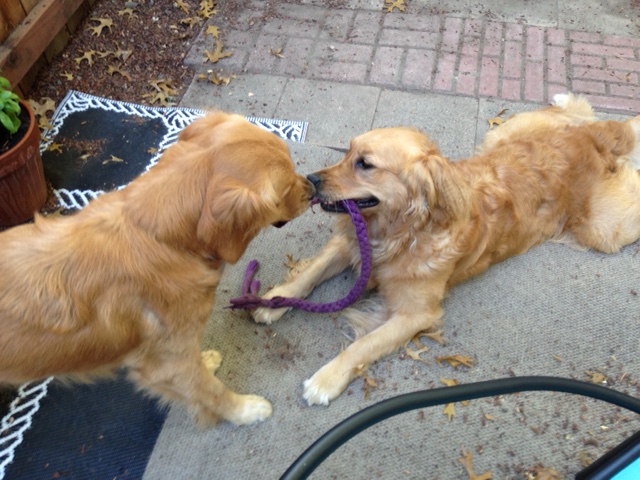
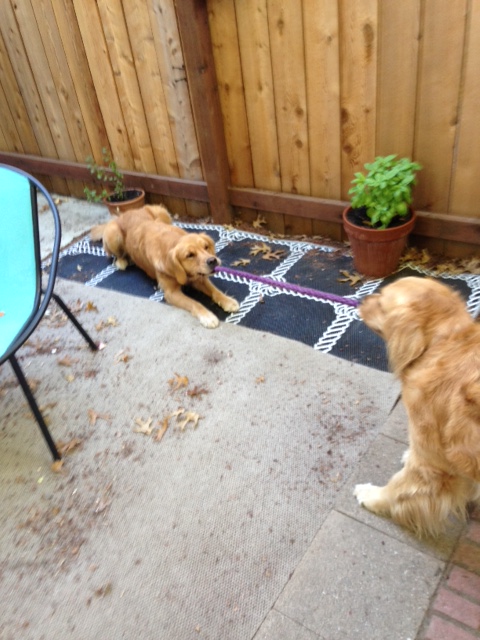
IMG_1137Cali’s sister Dora visited recently for the weekend, which meant nonstop action. Cali actually has lots of sisters. She lives with Big Sister Jana full time. Jana has been an excellent role model, teaching Cali necessary life skills, including barking at passersby and rolling in sand so joyously and thoroughly that, between them, they make sure to take the beach home with them. Then there is Alberta, the part-time sister and playmate. They are evenly matched in size and have similar energy levels. When they are together, everything becomes a tug toy.
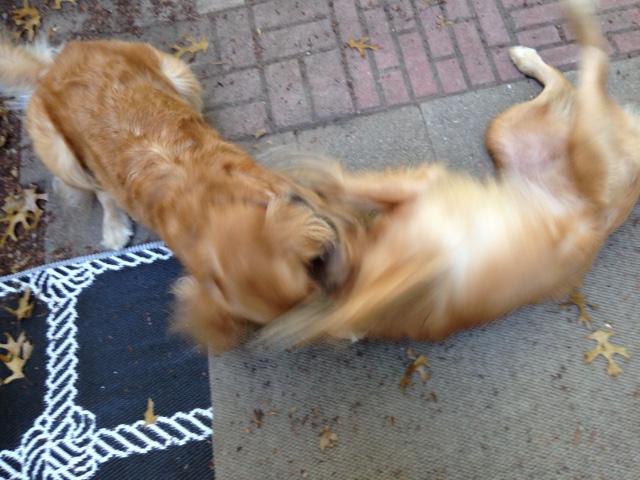
But DorIMG_1141a is special. Dora is Cali’s litter sister. They were plucked from their siblings on the same day (Cali by me and Dora by my close friends) and whisked away, first on a long car ride, then on an airplane where everyone made a huge fuss over them. They spent a scary first night away from Mom snuggled together in a crate. Since then (or maybe even before) they’ve shared a special bond. Whether it’s been days, weeks or even months since they last met, their greeting is rowdy, loud, and energetic. Their play is very physical and rough, but no one ever gets hurt. At rest, they often touch paws or sleep in a heap.
Play is often seen by researchers as practice for important life skills. One researcher, Dr. Marc Bekoff, suggests an additional crucial role for play: it is the basis for developing social ethics. In play, young dogs (or other social beings) learn not to hurt each other, to follow certain rules, to communicate their intentions honestly.
Both Dora and Cali have excellent social manners. When meeting new dogs, they exhibit all of the correct doggy signs for getting acquainted and inviting play. Both are wise enough to be deferential to larger dogs and to show respect for elderly dogs. They’ve internalized those ethical practices that they have learned through playing with a variety of dogs. But sister play is different.
InIMG_1134 their sister play, they also bow and use the full range of doggy play signals, but the signs are sometimes abbreviated or perfunctory. They feel safe enough to throw themselves into play without worrying about being misunderstood. There is lots of ear-pulling and gnashing of teeth. Their faces wear fierce expressions. They emerge panting and wet. And wearing huge smiles. There is a level of familiarity and trust between them that gives their connection a quality that Cali’s play with others — even Alberta and Jana — lacks. Social manners matter most when dogs assess the intent of strangers. Smart dogs know when they need to be polite. And when they don’t. And, for Cali and Dora, family is safe enough that politeness can take a backseat to full-on fun.

Amazing Restraint

In Alberta’s Marshmallow Test, I described Alberta’s admirable ability to resist temptation in the form of a bowl of dog biscuits sitting alongside a water bowl outside a Michigan store. While I know personally of the hard work Alberta (and Deni) have invested in honing Alberta’s ability to resist food temptations, I also know that all dogs (with the possible exception of Cali) really are capable of learning self-restraint.
This ability is, I believe, evidence of their ability to understand what is the “right” thing to do in particular circumstances. It is certainly evidence that not all dog behavior is hard-wired or instinctive.
Some examples include dogs who learn not to take food from counters, tabletops, and plates, even when those are tantalizingly within reach. I could leave a steak dinner on the coffee table (at Jana’s nose level) and go out for an hour. If she knew that was not her food, it would all still be sitting there when I got back. Leaving it alone with impulsive youngster Cali would be a different matter, however.
An even more important example, and something anyone who lives near a road with traffic or who takes the dog for car rides should work on, is waiting at doorways. When we drive to the dog beach or park, the dogs are very excited. But even Cali, who is probably wriggling with excitement, has learned not to exit the car without explicit permission. And Jana and Cali have both learned never to bolt out the front door, not matter how seductively the park across the street beckons, no matter how many cats, UPS delivery people and mail carriers are passing by … no matter what.
I argue that these are examples of dogs “doing the right thing” because I know that they are not afraid of being punished and that these efforts are rarely rewarded. Well, at the dog beach, they do get to go play — but even when someone slips up, the worst consequence is that she’s sternly instructed to get back in the car and wait, and then released a minute later to play. The girls are not following the rules because they think they will be horribly punished if they do not. They are not expecting any significant reward, especially for resisting the impulse to run out the front door. They are doing what they know is expected of them in these common situations for no reason other than they know that it is the rule.
In fact, we ask dogs to resist behavior that comes naturally to them all the time. We ask them not to chew and lick at their itchy spots. We ask them to resist humping other dogs. We ask them not to bark at the neighbors or the mail carrier, even when he is invading their turf. We ask them to ignore food (and things they consider food) on the ground, to not chase cats and squirrels encountered on walks, and to walk nicely on a leash.
We do ask a lot of them, don’t we? And most dogs, most of the time, live up to our very high expectations. Especially if we practice with them and do reward them sometimes.
I think that we humans take it for granted that dogs should follow our very human-centered rules. I am suggesting that we look at things from their point of view once in a while, recognize how truly counter-intuitive it is for a dog to resist food that is just sitting there or to abstain from chasing that cat out of the yard. We need to recognize that our dogs pass their own marshmallow tests, every day, many times a day — and reward their efforts with praise and pats and, at least occasionally, yummy treats to reward their restraint.

Alberta’s Marshmallow Test

This slideshow requires JavaScript.

In the 1970s, a psychologist tested the self-restraint of preschool children. Each child was offered a marshmallow. The children were told that they would get two marshmallows if they could delay eating the treat, and then left alone in a room for fifteen minutes. The researcher recorded what happened. The efforts of some children to stare down the treat or to distract themselves from it are both comical and painful to watch. Of course, some children inhaled the treat as soon as the researcher left the room. A recent book (The Marshmallow Test) describes this experiment and the follow-up studies of those children. The marshmallow test and other research on the ability to delay gratification shows that those who can exercise self-control in the face of temptation have better “life outcomes,” as measured by a variety of criteria, including SAT scores, social and cognitive functioning, long-term health, and retirement planning.

What does all of this have to do with thinking dogs?
Alberta experienced her own version of the marshmallow test recently. To say that Alberta loves treats is a bit like saying that I love chocolate. Alberta not only loves treats, she is not terribly fussy about which treats she gets. For sure, there are better treats, for example this bison and beef jerky concoction that I get at Costco and that, for some reason, Jana, Cali, and Alberta will do anything for. But ordinary, boring biscuits are fine too, and they are happily accepted as rewards for a job well done.

In her guide dog work, Alberta comes across many items that fit this dog’s definition of “treat,” and she works very hard to resist bits of food that just happen to be lying on the floor.
Alberta is justifiably proud of her hard-earned restraint, but more importantly, she wants Deni to know. So, in the course of a day’s work, if Alberta sees food on the floor and gives it a wide berth, she also nudges Deni to make sure that Deni knows just how good she is being. She pushes Deni hard with her nose, hoping that Deni will notice the ignored object. She often nudges Deni right near the pocket where Deni keeps the dog treats, just in case Deni might want to reward this extraordinary show of restraint. A girl can hope, can’t she?

Alberta knows the rule that she can’t grab food off the ground when she’s working. She wants to believe that that rule does not apply when she’s off-duty (her harness is off). She also knows that, even while working, she’s allowed to take treats that Deni hands her for particularly notable service. But she recently encountered a situation that blurred these lines a bit, a marshmallow test for dogs. Her reaction was remarkable.
Guiding Deni down a street in Saugatuck, Michigan, Alberta (along with her entourage of two other human family members) passed by a store that not only had a full doggy water bowl sitting by the sidewalk, but also a full bowl of doggy cookies. Just sitting there for the taking. An open invitation. Irresistible.
Or not.
Alberta headed for the water, took a drink, noticed the cookie bowl and … stopped dead. Confused. She looked at the biscuits. Looked at Deni. Furrowed her brow. Looked longingly at the treats. But she did not touch the treats.
We’d all stopped to watch the unfolding marshmallow-like drama. Alberta really wanted to gobble up as many of those dog cookies as she could. But she did not take one. She did, however, look at every one of us to make sure that we all knew how good she was being. Deni rewarded her by picking up a few biscuits from the bowl and handing them to Alberta.
Watching the interaction, I got to thinking. Most dogs who walk by this shop are not trained service dogs. Though many, like Jana and Cali, have had some training and certainly know that they are not supposed to just devour everything in sight, they don’t always have the restraint to follow through. Having more than once found myself alone with a new box of Trader Joe’s dark chocolate peanut butter cups, I can relate.
I wondered how often a doggy passerby just digs in and eats all the cookies in the bowl. How many battles between hungry hounds and their hapless handlers has the shop owner witnessed? Does the handler ever win? And really, what was that shop owner thinking?

But back to Alberta. In need of photos for this blog post, I asked Deni to re-create Alberta’s marshmallow test. The photo gallery (presented in order) at the top of this blog post shows that, like the successful children in the original marshmallow test, Alberta devised a series of ways to distract herself. Some of the children looked away, as Alberta did. Some sang songs or recited the alphabet. Alberta did neither of these. Some children closed their eyes. Upon realizing that, even after she had turned away, the bowl of biscuits was still there, Alberta closed her eyes.

Alberta has not only learned to resist random bits of food on cafeteria floors, sidewalks, and the like, but there she was, on that Michigan sidewalk and again in Deni’s office, passing up food that was obviously meant for dogs, placed there for her enjoyment. This shows us that dogs are able to do some high-level thinking and processing.

If Alberta were purely instinct-driven, that bowl would have been emptied in seconds flat. If she were operating only out of fear of punishment or hope of reward, she might have surreptitiously sneaked a mouthful of biscuits before Deni noticed, just to see if she could get away with it — and been rewarded by the treat, even if she got scolded after. But she went beyond a gut-instinct response and even beyond the basic (low) level of moral development that governs much of human and animal behavior. She paused, checked in with Deni, and did the right thing — even though she really wanted those cookies. We’re eagerly looking forward to seeing Alberta’s SAT scores and are consulting her for retirement advice. But in my next post, I will describe more practical ways we can apply the doggy marshmallow test to our relationships with our dogs.
Ready to Rally?

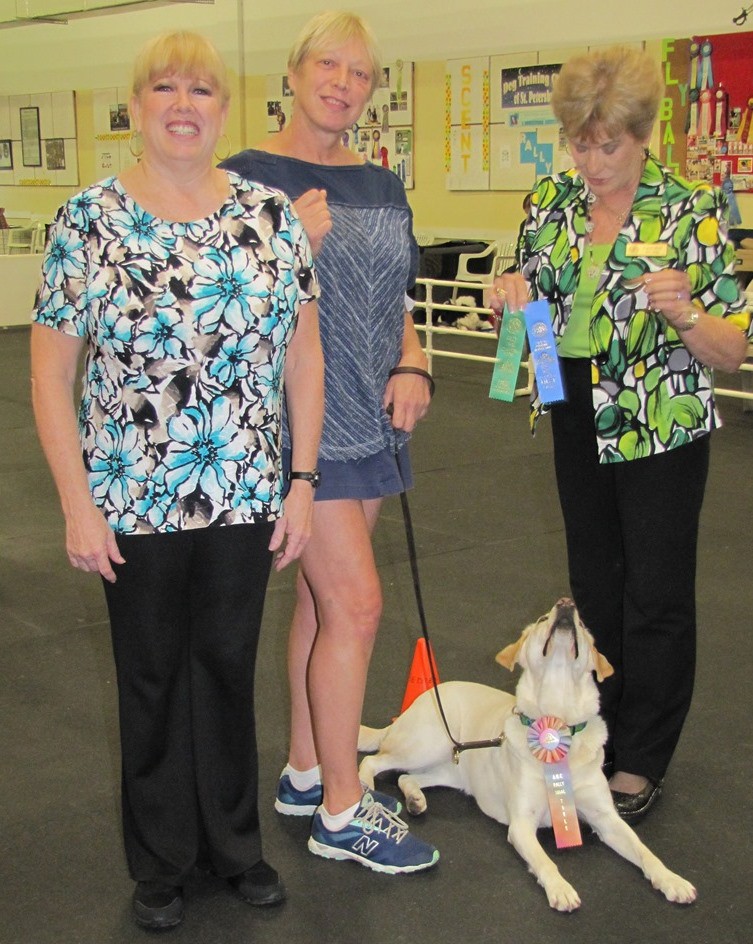
Alberta accepts her ribbons after earning her Rally Excellent title
Alberta accepts her ribbons after earning her Rally Excellent title. Deni and Alberta are the first guide dog team to earn an Excellent title. They have already two of ten needed “legs” toward their Rally Advanced Excellent title. 

I’ve watched both formal Obedience competitions and Rally-O (or Rally Obedience) competitions, and the difference is as stark as the difference between traditional training and cognitive education.
Both have the same goal: demonstrating a dog’s ability and willingness to follow specific commands when cued by the handler. They use similar sets of commands. Competitors are scored based on the preciseness of the dog’s response, the accuracy in completing the set of commands presented, and the time it takes to accomplish each task. Above the novice level, dogs compete off-lead. Dog-and-handler teams can earn titles in both kinds of competition.
That’s about where the similarity ends.
Rally is variable. The course is different in every round. The judge sets up the course within an hour of the competition; which exercises are included and in what order is a surprise for handlers and dogs. Formal obedience competitions, on the other hand, follow a set pattern of exercises at every level of competition. Experienced dogs and handlers could run the pattern in their sleep.
While competing, Rally handlers talk to, praise, and encourage their dogs. In the lower levels, the handler can use targeting and clapping or even touch the dog! Formal Obedience handlers cannot interact with their dogs other than to issue each cue, verbally or through hand signal, once.
To my (very biased) way of thinking, Obedience competition is all about showing the dog who’s boss (hint: it’s not the dog). Rally is about relationship and having fun. I strongly favor anything that builds relationship between dogs and their humans. Rally acknowledges the uniqueness of how each handler and dog interact as a team. Rally allows each team to excel in its own way.
The differences between Rally and Obedience underscore the differences in traditional vs. cognitive approaches to teaching dogs. If all you care about is getting an instant, precise response to a command, traditional obedience will do it for you. But that approach limits what you can accomplish with your dog and defines your relationship inside very narrow parameters.
Expecting precise, predetermined, responses to every cue essentially forbids your dog from thinking. There is a single correct response to each cue. Any other response results in punishment or lack of reward. The dog is not allowed to think about how to respond. Nor can the dog think of a better way to respond. When a dog schooled in this way confronts a situation that is slightly different from the training scenario, that dog will not know what to do. If the precise, rehearsed response is not possible or ineffective, the dog faces certain failure.
On the other hand, a dog who is taught with a cognitive approach will be able to figure out how to apply his or her learning in a variety of situations.
Here’s an example. Let’s say there are two dogs who have been taught to retrieve as part of their education. The obedience trainer, focused on the next competition, polishes his dog’s retrieve. The dog can flawlessly follow instructions to watch where the dumbbell was thrown over a jump, go out over the jump (even if a bad throw makes this the least efficient way of reaching the dumbbell), and bring it back, jumping over an obstacle on the way back. Perfect every time.
The cognitive trainer also teaches retrieve, but in a more jumbled way. Sometimes the dog retrieves a dumbbell. Sometimes it is the newspaper on the front porch. As training progresses, a set of keys, a cellphone, a pair of glasses, a spoon, a pen, a bottle of water are added. Sometimes the dog can see the item; sometimes the dog must search for it. Sometimes, it is an item that the handler has dropped. Sometimes it is the pair of slippers in the other room. The dog trained cognitively to retrieve has learned to follow her handler’s point, gaze or verbal cue for the item that needs to be retrieved.
Which of these dogs is more likely to fetch your keys if you drop them and they bounce, landing under your car? Which will find your cellphone when you fall and need help?
The dog who is trained only to produce a rote response will freeze when the dumbbell is not where he expects it to be or the judge produces a leather dumbbell when he has only practiced with a wooden one. This dog knows the retrieve as a patterned set of responses: sit, stay, go out, come back, sit in front holding the dumbbell, release, finish to a heel position.
This is different from understanding the reason behind a retrieve.
The dog who is trained to think about the retrieve as a practical skill, figure out the goal, and find a solution — the cognitive dog — will size up the situation and, chances are, do what needs to be done, even when it is not expected. I know more than one dog who has taught himself an “automatic retrieve,” picking up anything the handler drops, as a result of this style of retrieve training. Dogs who are allowed to freelance by adding variations to the task based on understanding the goal, will do so. This can come in handy when the handler unknowingly drops important material — like money.
Cognitive education enhances communication between dog and humans.

The Daily News

A very young Jana fetches The Jerusalem Post

Jana spends considerable time on every walk catching up on the local news. She sniffs out the usual trees and bushes on our daily route. When we take a different route or an extra walk, I know to leave extra sniff time.
But that’s not enough for my newshound. Jana does her best to ensure that I, too, have a steady stream of news and information. Knowing how sadly lacking my sense of smell is — and sensing my inability to understand the dog news, should I somehow manage to gather it — she wants me to read the daily paper.
Since our recent move, we’ve had Sunday-only delivery of The New York Times. But every morning, Jana has headed to the gate with an eager expression and a spring in her step. Bringing in the paper has been her job. Forever. She fetched The Jerusalem Post as a puppy. As a secular dog, she resented the lack of a Saturday edition.
As a young adult, she fetched the Boston Globe, carrying it the length of a very long driveway. (At one point, she suffered the humiliation of having to fetch it wearing a long leash, the result of an unfortunate decision one morning to take off after a jogger, rather than bring the paper home.)
She has fetched the Santa Rosa Press Democrat, the St. Petersburg Times (and, more recently, the Tampa Bay Times) and, last year, the San Francisco Chronicle. For the Chronicle, she was forced to fend off a job-stealing challenge from puppy Cali; having held on to her position, she proudly, carefully, carried her prize a great distance to our little rural cottage each morning.
So, when we moved to Petaluma, Jana simply could not understand — or accept — my decision to take Sunday-only delivery. Online news access, it seems, is an even more foreign concept to dogs than to us over-40 humans. I am fumbling along with it, but she refuses to accept this transformational technology and the havoc it wrought in her world.
I simply could not face the daily sad face, the disappointment. She’d head happily to the gate, and I would open it and show her: no paper. Her head would hang, and she’d slowly walk back to the house. Unemployment. Downsized. Made redundant by a computer. Unneeded. The worst fate for a smart, educated adult. Jana could relate. It was a terrible thing to watch.
So, I upgraded my newspaper subscription.
Now, our paper appears at the gate daily. Not rain, nor sleet, nor snow … even better than the mail, since we get seven-day-a-week service. Every morning, even before the sun comes up, Jana has a paper to retrieve. Full employment has returned. Jana’s sense of self-worth is restored.
Life is good for this thinking dog.

You Need a Large Toolbox

I met a wonderful family recently. They are puppy raisers for a guide dog school in the Northeast (one of the best assistance dog organizations that I am familiar with, Guiding Eyes for the Blind, in Yorktown Heights, NY). They told me a story that perfectly illustrates the importance of knowing and treating each dog as an individual.
The ability to lie still and just hang out is a crucial skill for service and guide dogs in particular, but, really, all dogs need to learn to do this. After all, we humans can rarely provide 24/7 entertainment and fun. Even if we could, this would be over-stimulating for the dog. Dogs need to learn how to calm themselves and just chill out.
These puppy raisers said that the way they had originally learned to teach dogs the importance of just being still (often using a cue like “settle”) was to give the dog food treats as rewards for lying quietly near them. For many dogs, this works well — the dog can initially be rewarded simply for lying down (when working on a strong “down”), and, very gradually, the rewards can be delayed until the dog has remained quiet for a few seconds, then 10 seconds, 15, etc. When the dog is able to relax in place for longer times, intermittent treats, with the interval getting longer, can reinforce this behavior and convince the dog that just lying there really isn’t so bad.
What was wrong with this approach? For many dogs, nothing. Then there were those extremely food-focused dogs. Funny how many of those are Labs and goldens — the very dogs that service and guide organizations use the most. Some of these dogs, it seems, would take to asking for food. The more independent ones would cut out the middleman entirely and start looking for dropped crumbs on the ground. These behaviors are annoying in any dog, but particularly unacceptable in a dog who works in public. These dogs need to learn to ignore tempting morsels in restaurants, supermarkets, and other places where there could be food on the floor.
So, the trainers came up with a solution: Reward the dog for lying quietly with a very gentle stroke along the dog’s back. Not active petting or interaction; simply a single, gentle, calming stroke. Again, for many dogs, this is indeed a desirable reward and something that will even deepen the calm, relaxed state the dog is in.
Then there are all of those other dogs. The ones that get wildly excited at the slightest stimulation. Even reaching toward these pups to stroke them is likely to be read as an invitation — and is more likely to elicit a play bow than a calm, relaxed dog. Or the dogs who regard touch as an invitation to cuddle or the ones who roll on their backs to solicit a belly-rub at the slightest hint that a hand is near. And don’t forget our analytical canines — the ones for whom touch is not rewarding, those whose social styles tend more toward more reserved contemplation of humans than actual up-close-and-physical contact.
You get the picture. This method of rewarding lying still is not going to work for all dogs — any more than food rewards would work for all dogs. That is exactly the point of using a cognitive approach to teaching dogs: Treat each dog as an individual. Starting with that essential principle, we can figure out which dogs to reward with food, which to reward with stroking — and which need something else entirely.
There is no one correct way to teach or reward any particular behavior, as my new friends learned. And individual dogs may respond to different rewards at different times. Applying this knowledge has made them better puppy raisers — and, I am sure, better people.
The methods and rewards are as varied as the dogs (and trainers) are. Be on the lookout for new ideas and ways of teaching or rewarding a dog. Every trainer needs a constantly expanding toolbox of techniques.

What Is Motivation?

When we are trying to understand why individuals — canine or human — behave in a certain way, we are trying to understand what motivates them. When trying to convince someone to do something he or she is not especially eager to do, we need to come up with a strong enough motivation to overcome that resistance.
For many dog trainers, food rewards are the only “motivator” they employ. Other trainers refuse to use food rewards in training, scornfully saying that dogs trained that way will work throughout their lives only for the food. In some cases, this might be true; skilled trainers, though, fade out the food rewards once a dog has learned a cue. Which leads to the interesting question of motivation: If the dogs are not working only for the food, what are they working for?
What do you work for? The satisfaction of a job well done? Money? The chance for a guilt-free rest or vacation? The admiration of your boss, colleagues, or friends? To impress your family? The pleasure you get from your work?
People work for many things. Some are tangible (money or food); some are external (popularity, praise, satisfaction) and some are internal (feeling proud of accomplishment, understanding the importance of the goal). The same is true of dogs (except maybe the money part).
What motivates you is as individual as you are. It is as variable as the situation or task at hand, your mood or energy level, where you are (in life or at a given moment), who’s nearby … any number of things can affect your motivation. What remains true is this: You decide what motivates you at any given moment or to perform any particular task. If you don’t care about money, no amount will drive you to do a task you loathe. If you are not hungry, the promise of a snack is unlikely to propel you to quickly complete your homework.
Next time you are having a hard time getting your dog to do something that you want her to do, think about motivation. Try a different motivator. Maybe you are asking her to do something that is very important to you but irrelevant or even unpleasant to her. Examples range from calling your dog to you when she is playing at the dog park or chasing a squirrel to asking her to pick up an object that is heavy, awkward, or just plain inconvenient to hold. In many cases, she’ll be willing to do as you ask — given the right motivation.
I know that it’s hard to be more interesting and appealing than a fleeing squirrel. But waiting a moment, until the squirrel reaches a nearby tree, perhaps, then calling the dog and offering a really tasty treat … well, now you might be getting somewhere. If your dog loves to play tug, use a few rounds as a reward when she does something that is really important to you — like picking up her heavy, awkward food bowl after dinner. Improve your tennis-ball-obsessed pup’s recall by rewarding her for a quick response with a few throws.
Finding the right motivation sometimes requires creative thinking on your part. It also requires looking at your dog as an individual. To figure out what motivates your dog, pay attention to what your dog pays attention to. What turns that light on in her eyes or gets her running over to you? Dogs whose owners say they are “not interested” in food might discover a culinary bent in their pooch when they offer freeze-dried liver or bison jerky or bits of roast beef. Maybe you haven’t hit on the right toy to turn on your dog’s inner retriever or you haven’t found the scratch spot that’ll have him not only picking up but washing and drying the dishes — just to get a little more of what you are offering.
We all will work for something. We will often do even unpleasant chores for the right reward. The trick, in every relationship, is figuring out which rewards work. You’ll know when you find the ones that work — but remember, make sure that the dog knows that it’s always her decision.