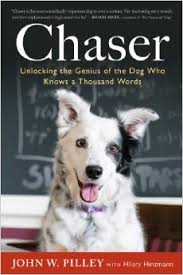
 Amazing dog. Amazing and super-friendly author. I got in touch w/Dr. Pilley after reading the book (and his research papers) and he did a Skype conversation with a class I was teaching on dog-human communication. He is one in a million, as is Chaser. He is such a great example of positive training that respects a dog and her abilities… and he is a fantastic teacher as well.
No one is surprised to hear that a border collie is intelligent and learns easily. But Chaser has gone far beyond what any other dog has been documented to learn in terms of human language comprehension. Dr. Pilley set out to teach her as many words as he could — names of objects — after reading the dismissive comments that greeted publications describing the accomplishments of Rico, a border collie in Germany who learned several hundred words. Dr. Pilley analyzed the linguists’ and other academics’ critiques of the training and testing of Rico — and set out to train his dog in a way that addressed all of their objections. And he accomplished his goal. (An interesting chapter in the book describes the resistance he faced when attempting to publish his initial results.) The opposition to admitting that any creature but humans can use language is still deeply entrenched.
But it’s also dead wrong. Chaser truly does understand human language. She learned and retains the names of more than a thousand items. She has demonstrated her ability to categorize them, grouping round bouncy things into the “ball” category and flat flying things into the “Frisbee” category, for example. And, like most dogs, she clearly distinguishes the category of “my toys” from “things in the house that I’d like to chew but am not allowed to chew.”
But Dr. Pilley realized that he had not pushed the boundaries of Chaser’s abilities. So, they tackled grammar next. Chaser understands the concepts of subject, verb, object — and indirect object. As an editor and college instructor, I have to point out that many writers and college students do not reach Chaser’s level of grammatical knowledge.
Toward the end of the book, Dr. Pilley describes his initial attempts to teach Chaser to imitate long, complex strings of behaviors. His description inspired me to try simple imitation games with my dogs, which have been fun and very funny.
The best part about this book though, is its constant message: Keep training fun and rewarding for the dog; make it a game; play to your dog’s strengths and preferences and, most important, make sure she has time do play and engage in her favorite activities. For Chaser, that means regular opportunities to herd sheep at a near
dog training
Turning Shoes into Treats
Since I share my home with two retrievers, I figure that they should help out a little around the house by, well, retrieving. I’ve written about how seriously Jana takes her newspaper delivery job. Cali has belatedly decided that she wants in on the treat action, so I thought about what a suitable job for her might be.
Cali lives for our daily walks (sometimes twice daily) to the nearby park where dogs can run free and she can avoid playing with the other dogs while holding onto her ball and occasionally actually retrieving it. I have a pair of shoes that I rarely put on for any purpose other than walking the girls. So I decided that bringing my walking shoes could be her new job. She has a passable retrieve, and, I figured, she’d be highly motivated — the reward, in addition to the requisite cookie-per-shoe going rate, would consistently be an immediate walk, often to her favorite park.
The training went pretty well, except for that incident where I got kicked in the face by my own dog wielding my own shoe, but we don’t need to dwell on that. Cali was very enthusiastic, if a little unclear on the concept at first. Jana helpfully showed her what to do, eagerly grabbing the nearest shoe and bringing it and even more eagerly accepting a cookie in exchange.
On day 1, Cali tried her first shortcut — offering a toy.
The next shortcut: stealing the shoe from Jana. Well, Jana was having none of that. I rescued my shoe from the tug of war and asked for the other shoe.
That was the next challenge. Incredibly, though, Cali seems to have picked up that concept with only a few days of repetition.
We also had to work on the delivery. From overly enthusiastic (see reference to being kicked in the face) to lackluster (dropping the shoe a couple of feet away), Cali’s finish needed polish. I’ve almost got her somewhat consistently putting the shoe into my hand not terribly roughly. Progress, right? Baby steps, baby steps …
But this is where it gets interesting. I know from reading about Chaser, one of my favorite dogs in the world, that dogs can learn to put items into categories. Cali and Jana bear this out, and throw in evidence of a sense of humor, too.
Clearly trying for additional treats, Jana gets this sly look as she sees Cali delivering the second and final walking shoe. She then runs into the bedroom and returns, tail held high and waving triumphantly, with a shoe, any shoe. Give me my treat, her bright eyes and wagging tail say. If I don’t seal off all other shoes behind a firmly closed door, I might get, in addition to my walking shoes, a slipper or two, a flip-flop, a sandal, a rain boot … They have definitely mastered the concept of “shoe.” They’ve even gone outside and brought in a Croc from the porch.
They also instantly made the transition from my laced walking shoes to Keen sandals when the weather warmed up a bit. I do keep the current walking shoes right next to the door, and I am sure that the context is a big help.
I did not try to teach them the category of “shoe.” I have, years ago, worked with Jana on categories and concepts: big and small, toy, ball, and, of course “other” to send her after an item similar to the one she’s just brought. Cali learned all of this on the fly — by watching Jana and by seeing what I did and did not reward.
I’m still in awe of what Dr. John Pilley has accomplished with Chaser and grateful to him for painstakingly documenting his teaching efforts and publishing solid scientific evidence of dogs’ abilities to map words to items, remember hundreds of item names, and group items into categories. I am also, though, delighted and surprised by the constant examples of dogs who learn some of those same things in less-than-ideal home-schooling environments with inconsistent teachers (such as myself).
What have your dogs learned that blows your mind?
Who’s a [Good, Bad, Anxious, Happy, Aggressive, Calm] Dog?
I recently attended a two-day workshop with TTouch practitioner Lori Stevens. Of the many tips and techniques that stuck with me, this stands out: We tend to label dogs’ behavior rather than describe it.
What is an anxious dog? What is an aggressive dog? A well-behaved dog? Turns out that each dog owner — and dog professional — means something different when she uses those terms.
 I sometimes describe Jana as “anxious” because, many evenings, she seems unsettled, distracted, and uncomfortable. She whines or paces, but I can usually settle her down in a few minutes. The technique I learned from Lori, using a body wrap, seems to help a little. Jana also shows what I call anxiety on walks if a vehicle (mostly loud, big trucks, though she seems to harbor a deep-seated hatred of minivans, too) approaches from behind us and startles us. I attribute some of this “anxiety” to the possibility that she’s not hearing things as well as she used to and she gets surprised more often — perhaps she’s also losing some vision. Whatever the cause, things seem to come out of nowhere and startle her more often. Fine, so, she’s a bit anxious and I deal with it.
But I have friends whose “anxious” dogs have done hundreds of dollars in damage to their possessions, their floors and walls, their furniture … other “anxious” dogs bark nonstop or are unable to sleep through the night (pacing, whining or barking, and ensuring that no one in the household gets any sleep. Ever.). Compared with that, Jana is calm and placid, well-adjusted even.
Then there’s the “aggressive” dog. I’ve seen dogs who have been labeled as aggressive who are the sweetest, friendliest dogs … but who really dislike cats and want to chase them (or worse). Or who have maybe bitten a person, once, under what turns out (if I get the whole story) to be extreme provocation. Or who are simply terrified, stressed by being put in a situation that they cannot handle. Not all of these dogs are aggressive; they are scared and overwhelmed.
Scared and overwhelmed can be fixed; prey drive can be managed. But some dyed-in-the-wool, born-with-it aggression is not fixable and can be very hard to manage. It is important to know the difference.
Being able to describe our dogs’ behavior accurately and in detail is important for so many reasons. We can do a better job of figuring out how to manage or change that behavior if we know what it is and why it’s happening. As dog professionals, or as dog owners who want to call in a professional, a clear, detailed description of behavior is an essential starting point — does this dog need training? Medication? Treatment for some underlying, painful condition that is causing her to snap at people? Sometimes the cause is simple, even if it’s not immediately obvious.
A couple of summers ago, one evening, Jana snapped at Cali for playing roughly near her. Jana is usually amazingly patient with Cali. I reprimanded Jana for her “aggressive” act. Fortunately, within a few days, Jana was scheduled to have her annual physical. At her vet exam, the doctor found that Jana had a very painful cracked molar. A long surgery and several hundred dollars later, Jana was no longer in pain. She has never snapped at Cali again.
So, trash the catch-all labels. Instead, look at the behavior. When does it happen? Is there a trigger? Did it just start? Has behavior changed recently? Has the dog’s environment changed? Is the dog getting enough exercise, a balanced diet, regular medical checkups? If you can’t figure out the cause, call in help: doggy friends, the vet, a trainer. Post a question on the Thinking Dog Blog!
It’s usually possible to figure out what’s going on — and lots of expert help is available!
Nice to Meet You
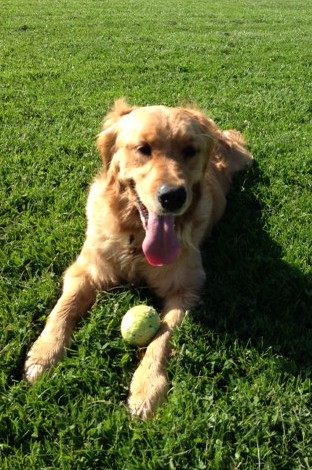
Dogs are as individual as people; therefore, getting to know them takes time and happens on different levels. There’s a big difference in “knowing” someone you’ve met at a party or been introduced to over coffee by a mutual friend, and “knowing” a friend who’s been part of your life for years, right? The same is true with dogs.
It takes time to get to know a dog and identify his or her personality and behavior patterns, just as it would with a person. But what about when you meet a dog briefly, say, walking down the street or hanging out at a coffee shop?
When you meet a person with a dog, greeting the dog probably won’t get much more intimate than saying hello and maybe giving the dog a pat or a hug. You might note the breed or notice whether the dog seems friendly — but even at this level, you can look for cues from the dog about his or her personality.
Cali and Jana perfectly illustrate the polar opposites in terms of their reaction to new people.
Cali was put on this planet to greet every single human being and become his or her new best friend. She rushes toward strangers with her whole rear half wagging and a huge smile on her face. If we’re on the way back from the park, she’s also got a slobbery tennis ball in her mouth, ropes of drool dangling, a wet “bib” (from the drool), muddy paws and legs, and she feels sweaty to the touch. On really energetic play days, she’s also given herself a good all-over shake and has, in the process, managed to drool on top of her own head. Never mind. She doesn’t notice any of that, and neither should you. She greets each and every person we meet with enthusiastic joy, secure in the certainty that every single human will love her back. Of course you can pet this girl, hug her, take her home and play ball with her. She’s your new best friend, after all.
Jana stands back and watches this all with horrified disapproval. Sometimes she barks. Usually she stands behind me, ensuring that there is a large, solid barrier between the stranger and the nut-job puppy greeting the stranger — and herself. This is not a dog who is inviting or would welcome a getting-to-know-you pat. This is the dog who invented “no-touch cuddling”: when she’s feeling affectionate, she will agree to lie upon a corner of my bed, so long as we’re not touching. After a few minutes, never more than five, she, with great dignity, descends from the bed and gets on with her life. This is what counts as “cuddling” in Jana’s world.
OK, so when you’re encountering a new dog, the first thing to notice is whether the dog is approaching you or standing back? That’s easy. But most dogs just kind of stand or sit next to their owners. They are not as clear about where they are on the Jana‒Cali continuum as, well, Jana and Cali are. What then?
Most dogs, even the friendly ones, dislike being patted on the head and being hugged. Sadly for them, most humans do one or both of those things when meeting a dog. According to Turid Rugaas, a dog communication expert who has identified what she calls “calming signals” — subtle body language cues dogs use with each other — the best way to introduce yourself to a dog is to approach slowly and from the side.
If the dog is sitting next to the person, you can just pet the dog on the side — stroke his shoulder, say — or reach around (not over the head) to scratch his ears. Making direct eye contact, leaning over a dog’s head, or reaching for the top of his head can be perceived as threatening by a dog, so it’s better to use the sideways approach. You can always crouch down to be more at the dog’s level; you’ll be less threatening and the dog will probably see it as a friendly gesture. If you are face to face, rather than reach for the top of the dog’s head, it’s better to scratch his chest. In any case, a slow approach lets the dog get your scent before you actually touch him.
Most people aren’t very observant around dogs, and dogs’ body language cues can be very subtle. A dog that is constantly looking back and forth, between the owner and you, for example, is showing nervousness, as is a dog who constantly licks her lips. A nervous dog might yawn or show a “stress smile.” (See “Communication Goes Two Ways” for examples.) These dogs will be happier if you don’t try to pat them when you first meet them.
If your dog is particularly sensitive or will meet a lot of people, it’s a good idea to play a pat-the-puppy game — pat the dog on the head, then immediately praise him and offer a treat. This can revise his thinking about this unpleasant encounter and may even turn it into something he likes. It’s also a good idea to teach your dog to look at you when people approach. You can reward this focus with a treat. The dog may develop better associations with meeting people. The dog will also be learning to look to you when she is stressed, which is a good “default” behavior. Because the bottom line is, whether your dog is Cali-style friendly, Jana-style reserved, or somewhere in between, your job is to keep him safe — and that means running interference with strangers, whether human or canine.
Hide and Seek
Every evening, as we get ready for bed, I call the dogs to brush their teeth. Jana runs right over, ever the good dog (and ever the dog who can sense a cookie opportunity). Cali used to run over. In fact, as a small puppy, she would often ask to have her teeth brushed, going over to the shelf where the dog toothbrush was kept and nosing it, touching my hand and then walking back over to it.
Those days are gone.
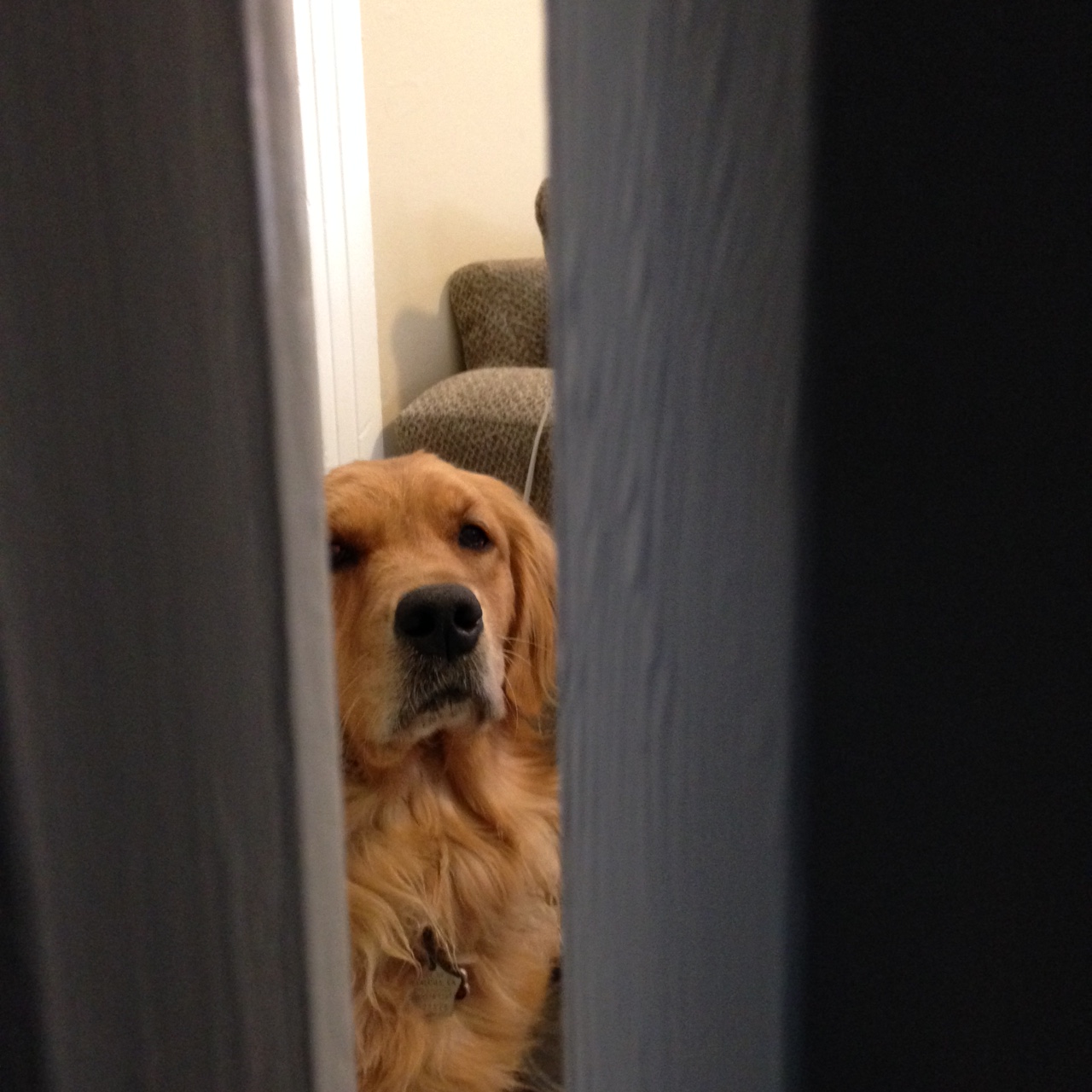
Now, her ritual is to hide. First, she heads into the bedroom. When I finish Jana’s teeth and call Cali, she walks toward me, but then she hides behind the bathroom door. She’s less than a foot away from me, and when I call her again, she comes over. But she always goes through this hiding routine. She does it when I need to clean her ears or trim her nails, too.
She could really hide. She could squeeze under the bed or hide in the closet. She doesn’t. She knows (I think) that I can see her. She’s not trying very hard to avoid the inevitable. She’s not refusing to cooperate. She’s simply registering her discontent. I don’t want to do this, she’s telling me, but I will, if I have to. And I will eagerly accept a cookie afterward.
What does all of this mean? I think it shows a pretty high level of communication. Cali is sure of what she wants, and does not want, to do. She knows, too, that we follow a routine and that she has to undergo some grooming, like it or not. She has figured out that hiding lets me know how she feels.
But it also shows her cognitive development in another way. Hiding, and understanding that she and I both know to look for something hidden (rather than assume it is gone forever) is part of understanding object permanence. It’s part of developing consciousness of the world around you and your place in it and in relation to others.
I have seen very young puppies show a grasp of object permanence: I once watched 8-week-old puppies playing with an agility tunnel. One ran in, and another ran to the other end of the tunnel to wait for her sister. That showed that the puppy knew that the “missing” puppy was simply temporarily out of sight and would reappear. She even knew where the puppy would reappear.
By the way, babies begin to grasp this concept at about 8 months, and, at about a year, can retrieve an item if they see it being hidden. Those 8-week-old puppies are leap years ahead of the typical baby.
So it’s no surprise that Cali understands object permanence. What I find fascinating, though, is how she uses it to communicate with me.
Growing Up

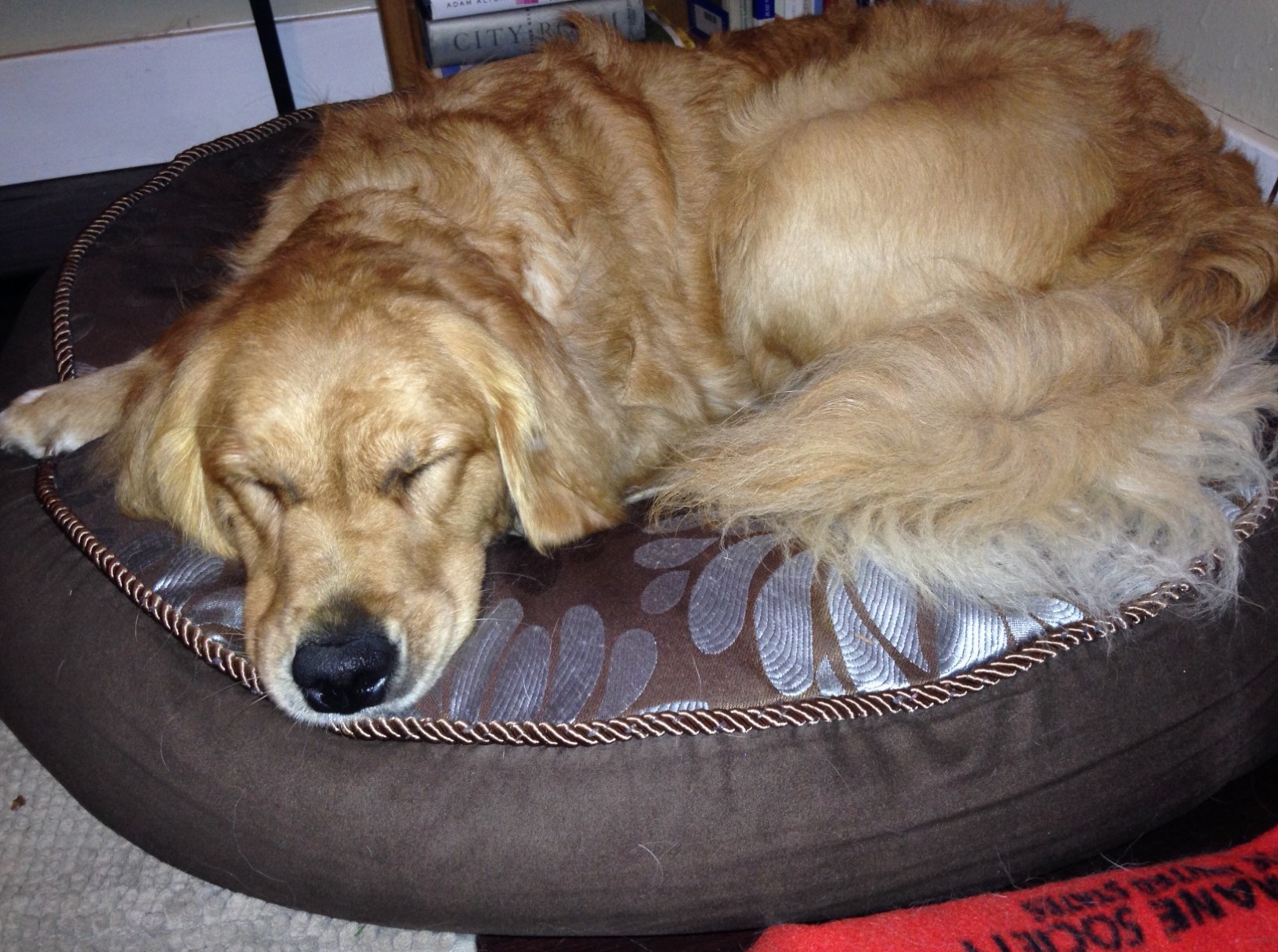
Cali turned two recently, so by some definitions, she is an adult. I had this fantasy that, at age two, she’d “click in,” showing maturity and leaving behind the seemingly endless adolescent phase.
Hasn’t happened.
But all is not lost. She is showing signs of growing up.
For a couple of weeks now, she’s been trying very hard not to pull on the leash when we are walking to the park where we play every morning. She has excellent leash manners on most regular walks, but she’s so excited about the park that our morning walk there has been a constant struggle.
I repeatedly stop and ask her to stop pulling. She bounces into position next to me, then, within a few seconds, is out in front, pulling hard. As we walked, my patience would wear thin and my requests would grow sharper.
Then, a couple of weeks ago, I noticed that she wasn’t pulling so much as … well, vibrating. When Deni was here for a Thanksgiving visit, she asked why Cali was” bouncing like that.” Cali now walks out in front of me, but the leash is a bit slack and she bounces and quivers, and, every so often, moves back and walks next to me for a few steps. She is trying so hard not to pull.
Another sign of impending adultness is that she actually tried on her own, without being asked, to pick up her bowl after dinner this week. I’ve been trying to get her to do this, as Jana does, for months. The best she’s managed is to sort of lift it by one edge and drag it to my waiting hand. And that only happens if I have a really good treat in the other hand. But there she was — and, because of raging hotspots, she was wearing her cone — trying mightily to lift her bowl.
Finally, the best sign yet of maturity came yesterday. For a few months, every time our neighbors walk their dog, Ernie, Cali has barked madly at him. She does not bark when the people go by without Ernie. She is fine meeting Ernie in the parking lot or at the play yard, where they occasionally show up when we are there. But they walk Ernie a lot. Several times a day. And Cali has always done her crazy dog impression, barking her loudest, fiercest bark.
Until yesterday. Earlier, the other neighbors had returned from a walk with their two dogs, and both Cali and Jana let them know whose territory this was. I let them know how unacceptable their barking was.
About 15 minutes later, I saw Ernie and his people walking by. Dead silence from both dogs. Until I threw them a party. Good GIRLS! Lots of cookies!! Woo-hoo! When the trio came back from their walk, again, silence. This morning, again. Can it be that she has finally learned??
It’s easy to get frustrated at our dogs. And to assume that they know what we want them to do (or not do) and are disobeying out of spite. Or general badness. How many times have I told Cali that she’s the “baddest dog in the whole #$&^ town”?
But she’s not. And chances are, your dog isn’t either. They are trying. But it takes a lot of maturity and self-restraint to follow human rules that make no sense in a doggy world.
I Mean It!
In my last blog post, Are You Talking to Me?, I said that dogs can tell when we are talking to them and when we really expect their response. They can tell when they can safely ignore us, even when they know that we are talking to them. They read our tone of voice, body language, and many other cues, most of which we are oblivious to.
So, how can we get those smart, calculating dogs to listen?
First, practice an “I mean it” tone. This can be a stern tone practiced in training class or at home; it can simply be a way of addressing your dog where you make it clear that you are completely focused on him — facing him, looking straight at him.
Fortunately, it can also be that note of fear or panic that creeps into your voice when your dog wanders too close to the street or shows too much curiosity about the ray hovering in the water just beyond her nose. In these instances, thankfully, even dogs with relatively poor recall skills will usually respond, coming to you and away from the danger.
Then, add an “emergency cue.” Practicing an “emergency recall” cue, as explained by a very dog-savvy friend, is a great way to build and maintain good listening skills in your dog: Choose a phrase, such as “right now,” and practice it with your recall cue (usually “come” or “come here”) and really, really excellent treats. Remember — your dog gets to decide what counts as a truly excellent treat.
Practice often. Use different tones of voice when you call. Surprise the dog, calling her when you are in some remote corner of the house or yard.
Soon, whenever your dog hears that cue — “Come here right now!” — regardless of tone of voice, she will know that top-quality treats are being dispensed, but only to the quickly responding dog! If you choose the right reward, you’ll see a blur of racing fur when you issue the cue. To get an even faster response, reward only the dog who arrives first, or, if you have only one dog, count to three (or five, or ten, if you have an old or slow dog), and only reward arrivals that beat the countdown clock.
I admit that I have been lazy about practicing this cue lately. Even so, when I add “right now” to a cue, any cue, I get a much-improved response. The association between “right now” and good treats is indelibly inked on Jana’s and Cali’s minds.
That’s partly due to lots of practice when Cali was little. It’s partly due to the fact that I have some really good treats hidden away. But it’s also due to the strength of our relationship — I spend a lot of time with Cali and Jana, and they can read me really well. They definitely know when they have to listen — and when they can push the boundaries a bit.
Are You Talking to Me?
How does your dog know that you are talking to him rather than about him? At a friend’s recent presentation on service dogs, she was asked a great question by a member of the audience: How does your dog know when you are talking to him instead of using “command words” in a different context? For example, as both the speaker and I learned service dog training at the same University, our cue for urging a dog to toilet is “better hurry.” But this phrase, along with sit, stand, look, get it, and myriad others, are used while chatting with our friends, as well as being directives for our dogs.
My friend’s response is that not only do dogs know when we are talking directly to them. They also know when we really mean what we say. Several research teams have studied dogs’ ability to know when we are paying attention to them and whether they recognize when verbal communication is intended for them. Other studies have tested dogs’ ability to recognize non-verbal communication, such as pointing to something, or simply looking at something, that is intended for them. The results of many studies show that dogs do, indeed, know when we are talking to them.
None of this is news to a dog owner who has experienced the instant transformation of a peacefully napping dog into the canine equivalent of a hyperactive toddler who has consumed too much sugar — the instant that the owner picks up the phone.
How do our dogs know that we are talking to them rather than about them? Dogs pay attention to everything we do (I suspect that they pay attention even when we are sound asleep). They read our body language, watch our eyes, and recognize the difference between our use of “sit” as an instruction and our use of “sit” in conversation. They train every sense in our direction to see if we are seeking connection. They read our moods, anticipate our actions, and, yes, know whether we are paying attention to them or are distracted.
What does this mean for your relationship with your thinking dog? Well, think about a conversation you’ve had with someone about your latest personal crisis or sought a trusted friend’s advice, only to have her answer her cell phone while you are mid-sentence. Or you’re on the phone with your friend and you keep overhearing her conversation with someone else (or her dogs). You probably feel ignored or frustrated.
Our dogs, too, want connection. They deserve our attention and focus sometimes: Truly look at your dog, watch his body language. Try to understand what he is telling you. Our dogs spend much of their time giving us that kind of attention; they deserve a chunk of our time in return.
How? Make their walks or playtime all about them. No phones. No turning them loose at the dog park and turning your back to chat with another owner. Figure out how your dog likes to be petted, and give him the kind of attention he wants, not distracted stroking while you are focused on a book you are reading or a TV show.
Is Your Dog Smarter Than A …
Is your dog as smart as a human 2-year-old? A 5-year-old? A (gasp) teenager? Does it depend on what breed your dog is?
We can’t help it, we humans. We want to put everything into neat little human-constructed boxes. That is, I think, what is going on when people try to define dogs’ (or other non-humans’) intelligence in human terms. That and the common, if arrogant, human assumption that we are the smartest creatures, so everyone else — dolphins, dogs, starfish — can and should be evaluated, based in how they compare with us in human-like ways.
But really, how many human 2-year-olds would you trust to guide you across a busy street? Or turn loose in the wreckage of a natural disaster or terror site, with the expectation that the little tyke would let you know where the survivors are trapped? We use dogs to find lost 2-year-olds, don’t we? And protect them (and other humans) from diabetic coma or severe peanut allergies, warn of their impending seizures, coax those who have autism or have suffered trauma to connect — and so, so much more.
The basis for comparison is obviously flawed. Dogs are much like human toddlers in many ways, it’s true — their unbounded love of play; their sweet willingness to befriend just about anyone. Yet they are so much better at some things than any child could ever be — better at some things, such as anything based on scent, than any human of any age could ever be.
So, how should we measure, evaluate, understand canine intelligence?
We can start by acknowledging that intelligence is a complicated concept — there are many types of intelligence. Among people for example, there is social intelligence or emotional intelligence, there is numerical or problem-solving or analytical intelligence. Business acumen, logic, performing well under extreme stress — all of these might be considered different skill areas or types of intelligence. Intelligence is what helps you (or your dog) navigate life, with all the challenges and detours it throws in your path. We are all stronger in some areas, weak or ridiculously incompetent in others. The same is true of dogs.
We can also think about the skills that dogs have that have no parallel in human ability or intelligence — and the myriad ways we can help dogs develop and use those skills in partnerships that make life better for humans and dogs.
Some dogs excel at reading people’s body language. According to several prominent dog cognition researchers, among them superstars Brian Hare and Adam Miklosi, dogs — even very young puppies — excel at reading humans’ pointing gestures and where their humans gaze. This is a type of social intelligence. I am sure that many, many dogs excel at this. However, not all dogs do. I know. I live with one who fails miserably at reading gestures.
Other dogs (including the one who cannot follow a pointing finger to save her life), can intuit a person’s mood and provide exactly what is needed: comfort, humor, affection, appeasement, a favorite toy.
Still other dogs are great problem-solvers. They analyze each new situation and map out a solution.
Some dogs are born to … fill in the blank: Provide mobility assistance, search out bombs or drugs, find lost or hurt people, detect tumors, comfort lonely elderly people, make children laugh.
I don’t think it matters whether your dog is smarter than a toddler. I don’t think it is a fair or relevant comparison. What does matter is assessing each dog’s strengths and weaknesses, his or her specific areas of intelligence. Then, we can figure out how to stimulate and challenge each dog in the ways that will allow him or her to succeed, thrive, and enjoy life to the fullest.
Amazing Restraint
In Alberta’s Marshmallow Test, I described Alberta’s admirable ability to resist temptation in the form of a bowl of dog biscuits sitting alongside a water bowl outside a Michigan store. While I know personally of the hard work Alberta (and Deni) have invested in honing Alberta’s ability to resist food temptations, I also know that all dogs (with the possible exception of Cali) really are capable of learning self-restraint.
This ability is, I believe, evidence of their ability to understand what is the “right” thing to do in particular circumstances. It is certainly evidence that not all dog behavior is hard-wired or instinctive.
Some examples include dogs who learn not to take food from counters, tabletops, and plates, even when those are tantalizingly within reach. I could leave a steak dinner on the coffee table (at Jana’s nose level) and go out for an hour. If she knew that was not her food, it would all still be sitting there when I got back. Leaving it alone with impulsive youngster Cali would be a different matter, however.
An even more important example, and something anyone who lives near a road with traffic or who takes the dog for car rides should work on, is waiting at doorways. When we drive to the dog beach or park, the dogs are very excited. But even Cali, who is probably wriggling with excitement, has learned not to exit the car without explicit permission. And Jana and Cali have both learned never to bolt out the front door, not matter how seductively the park across the street beckons, no matter how many cats, UPS delivery people and mail carriers are passing by … no matter what.
I argue that these are examples of dogs “doing the right thing” because I know that they are not afraid of being punished and that these efforts are rarely rewarded. Well, at the dog beach, they do get to go play — but even when someone slips up, the worst consequence is that she’s sternly instructed to get back in the car and wait, and then released a minute later to play. The girls are not following the rules because they think they will be horribly punished if they do not. They are not expecting any significant reward, especially for resisting the impulse to run out the front door. They are doing what they know is expected of them in these common situations for no reason other than they know that it is the rule.
In fact, we ask dogs to resist behavior that comes naturally to them all the time. We ask them not to chew and lick at their itchy spots. We ask them to resist humping other dogs. We ask them not to bark at the neighbors or the mail carrier, even when he is invading their turf. We ask them to ignore food (and things they consider food) on the ground, to not chase cats and squirrels encountered on walks, and to walk nicely on a leash.
We do ask a lot of them, don’t we? And most dogs, most of the time, live up to our very high expectations. Especially if we practice with them and do reward them sometimes.
I think that we humans take it for granted that dogs should follow our very human-centered rules. I am suggesting that we look at things from their point of view once in a while, recognize how truly counter-intuitive it is for a dog to resist food that is just sitting there or to abstain from chasing that cat out of the yard. We need to recognize that our dogs pass their own marshmallow tests, every day, many times a day — and reward their efforts with praise and pats and, at least occasionally, yummy treats to reward their restraint.
