Koala’s Marshmallow Test

This slideshow requires JavaScript.

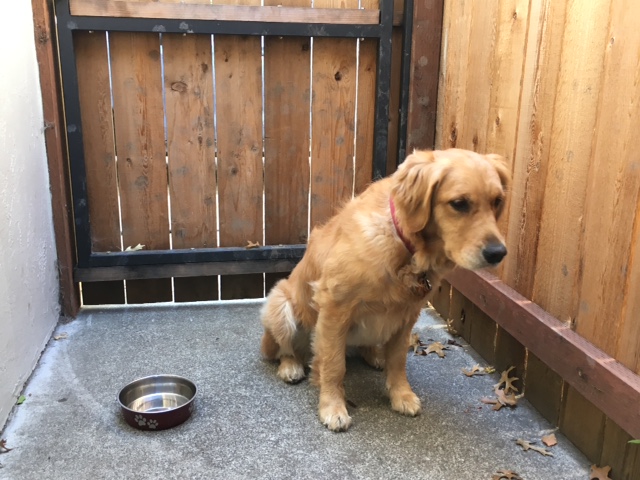
Koala, Deni’s current guide dog, is an exuberant dog; she has greeted me so enthusiastically that I emerge bruised. When she finds Deni a trash can to dump her poop, Koala leaps up and embraces the can, entire body wagging. So I was skeptical that she’d do well on the marshmallow test.

The marshmallow test is a test of self-restraint. The original test pitted preschoolers against marshmallows: If the child, unsupervised, could hold off on eating a marshmallow for 15 minutes, the researcher would reward the child with a second marshmallow. Children who waited, rather than eating the marshmallow with which they were left alone, were found, as adults, to have achieved greater success according to a variety of measures: higher SAT scores and greater academic achievement, more likely to have saved for retirement, etc.

Alberta, Deni’s previous guide dog, as you might recall, did very well on the marshmallow test. She clearly worked to distract herself from the treats, employing some of the methods the children did: she turned away, closed her eyes, raised her head and closed her eyes. Some of the kids sang or hummed; Alberta raising her head to smell something other than the treats is probably the doggie equivalent.

Alberta is, in many ways, a less exuberant and more restrained dog than Koala. So, I did not expect Koala to fare as well on this test of self-restraint.

Deni set up Koala’s test just has she had Alberta’s. A bowl of dog cookies was placed in the quiet hallway outside Deni’s office; Koala, dressed in her guide harness, sat in front of the bowl. Deni told her to “leave it,” then Deni went into the office and closed the door. Koala was alone in the hallway, but Deni, and a student photographer watched through the window blinds. Koala could not see Deni.

While Deni and the student were setting up the test, filling Koala’s bowl with treats, Koala — in harness — leapt and bounced around them in excitement. The student commented that she did not think the test would end well for Koala.

So, how did she do?

As Alberta had, Koala first leaned in and sniffed the cookies. She sat back up. And sat there. Unlike Alberta, she sat and stared at the bowl, salivating a bit. That’s it. She did not have to distract herself, she did not look away, close her eyes, or sing to herself. She aced the test.

I might need to point out: Both girls are Labradors who love their food and adore cookies.

Why was the test easier for Koala? Both girls were able to fight temptation and exercise self-restraint. What’s her secret? I’d love to say that her analytical nature is the key, but being very analytical myself has never helped much in the face of a chocolate-chip cookie.

Is Koala simply on a higher ethical plane than Alberta is (or I am)? That is the question that Deni is now asking: Is Alberta more ethical for having overcome a struggle to exercise restraint? Or is Koala more ethical for being easily able to do the right thing? Deni asks her philosophy students the same question about people.

We may never have an answer to that. What we do learn from this test, though, is that a dog’s behavior is not evidence that that dog can (or cannot) learn to “behave” —exercise self-restraint — in other circumstances. Koala, for example, plays tug to win, big time. She’d rip your arms out of their sockets if you let her. But her ability to “leave it” shows that, with practice and reinforcement, she could exercise that same restraint in other areas.

For other dogs and people, that translates to not giving up on a dog who has some uncontrolled behavior; it’s likely that, with some coaching, time, and practice, that dog, too, can pass his own marshmallow test. Now I am curious about Cali …
Don’t Let This Happen!

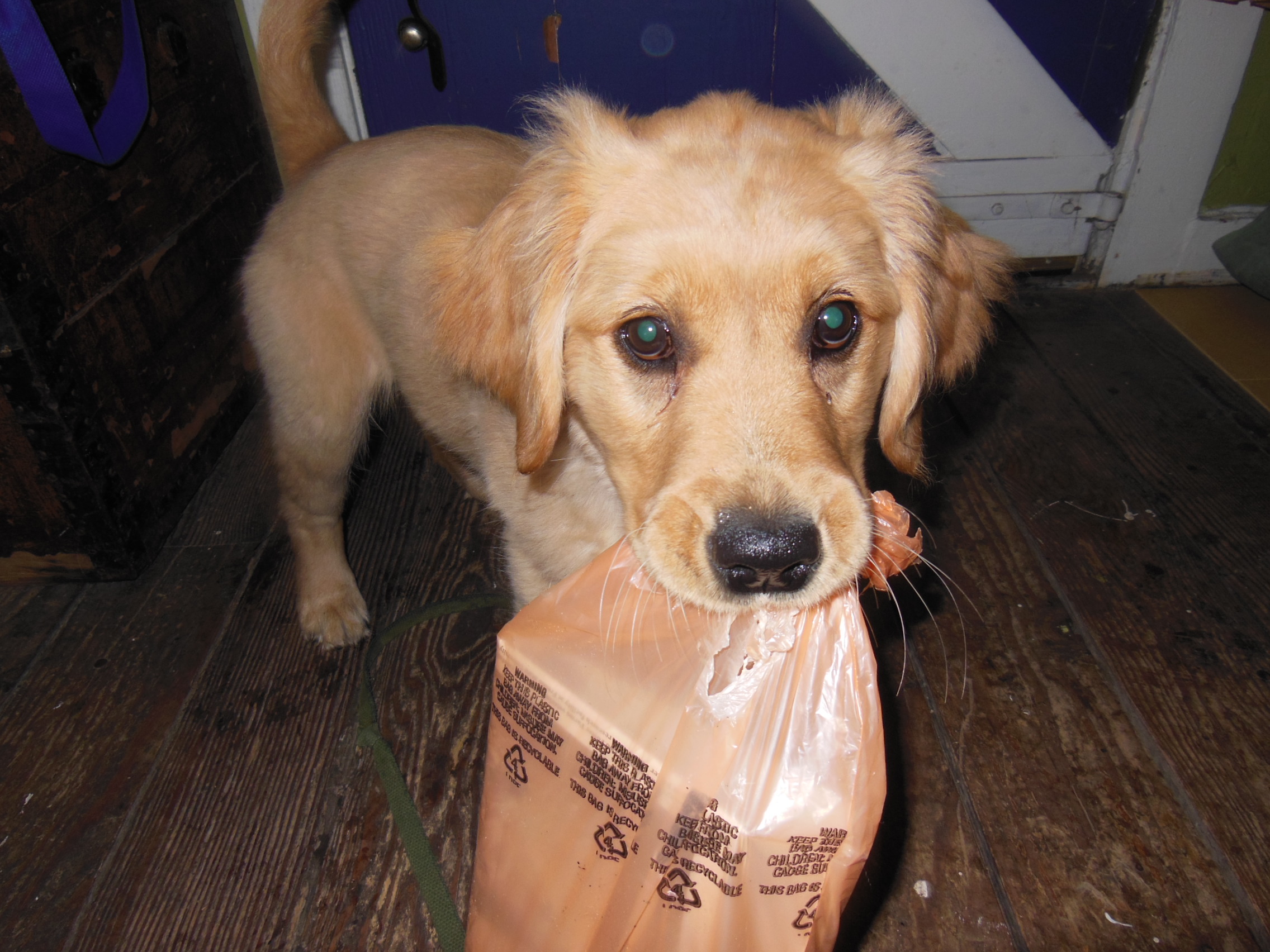
Cali carries a newspaper
It’s easier to teach a puppy to retrieve than to teach her to let you trim her nails.

A headline a few weeks ago caught my eye: “PetSmart, groomer are sued in death of dog.” Obviously, this should never happen. Reading the article just made me sad, and angry.

The dog, Henry, a year-old dachshund, went to the groomer to get his nails trimmed. He emerged, bloody, with two broken ribs and a punctured lung, struggling to breathe. He died soon after.

The owners’ lawsuit seeks more than damages for their suffering and Henry’s. They want change. They want the state (it happened in California) to license groomers. Grooming is not regulated. And this was not an isolated incident.

I want change, too, but I’m not convinced that state regulation is the only or best answer. States are not doing a great job of preventing or punishing a lot of other cruel and horrific treatment of animals, including pets.

So, how can you prevent this from happening to your dog?

Most pet parents struggle with nail trims. It’s a tough sell with most dogs. I did everything by the book with both Jana and Cali: lots of gradual exposure, a ton of treats, and they never once got nicked. It worked with Jana, but not Cali. She still hates having her nails done. She’ll let me do it, but she’s not happy about it. It’s a lot harder to teach a dog to accept nail trimming than to teach her to sit on cue or even to pick up a newspaper, both of which Cali does beautifully.

But here’s the thing. Even though Cali does not like it, she doesn’t struggle. I get down on the floor with her, hold her paw firmly, and she lets me do it — then collects a very yummy treat after each paw.

I know that many dog moms are going to have someone else do the nails, but that’s even more reason to work on it. If the dog is not terrified, she won’t struggle, and the groomer won’t do … whatever that horrible groomer did to poor Henry.

Puppy classes should all include some basic grooming and conditioning to a nail trimmer or dremel-type file. Adult classes, too. Nail trimming is scary, especially the noisy dremel. Most dogs dislike having their paws handled. But the classes usually don’t even mention it. That’s too bad. But pet parents can do this on their own. Slow, gradual, exposure. Lots of encouragement and treats. The Whole Dog Journal has articles explaining step-by-step what to do. Or ask a trainer for help. You can do it at any age, but the earlier you start, the better.

And, if you do take your dog to a groomer, ask lots of questions. Try to find a place where everything is out in the open and you can see what they are doing to restrain dogs. Ask them how they restrain dogs. Do it for Henry. No dog should have to go through what he experienced.


Mood Collars


Package for Mood Collar, which is not a real product. Shows cartoon dog with "mood ring" type stone in his collar.
The Mood Collar is no longer available from Moody Pets, but lots of cool toys are. Check them out.

I saw an article recently on a collar that lights up in different colors to reflect the emotion the dog is showing — a mood ring, or mood collar, for dogs.

The collar, called Inupathy, was developed by a Japanese biologist. The collar monitors the dog’s heartbeat and shows whether the dog is calm, excited, anxious, or angry. Co-creator Joji Yamaguchi told the BBC that he wanted to better understand his dog’s emotions. Fair enough.

But couldn’t he just pay closer attention to his dog?

It’s not always easy to tell distinguish an anxious or scared dog from an aggressive one, unless you get really good at reading the early signals of stress. By the time the dog is barking, the frightened, overwhelmed dog looks a lot like an aggressive terror.

If this collar had a sensor that was sensitive enough to pick up on early signs of anxiety, it could be a great training aid. I could see using it to figure out what the stress triggers were, then teaching the dog’s human to recognize and avoid or manage those situations. It would also make it easier for trainers to teach the dogs’ humans to recognize the early signs of stress — calming signals for example. If they saw the dog yawning or licking his lips a lot and the collar started showing anxiety, well, the owner could be trained to notice and respond to those signals.

I read somewhere else, a while ago, that someone was working on a collar that would translate barks into the language of the owner’s choice. That seems less useful (and less possible) to me. The mood collar, though, sounds groovy. And useful. I think it would be a great training aid!

A Conscious Struggle

This slideshow requires JavaScript.


Our dogs have jobs that they are expected to do, similar to assigning household chores to a child. Jana brings in the morning paper. Jana and Cali each bring me a shoe when we’re getting ready for a walk. And each dog is expected to bring me her food bowl when she’s done eating.

Jana learned this task very quickly. She does it eagerly, always happy to receive her dessert in exchange (a small cookie). Alberta is also an eager participant, usually the first to finish her meal and deliver her bowl. If I am not paying attention, she’ll push it into my leg, hard, in a not-at-all-subtle demand for her pay. Past dogs have learned the task too, though Wylie made it quite clear that he saw this task as beneath him — girls’ work — and he would immediately depart for more masculine pursuits upon finishing his meals. Jana was happy to pick up the slack (and the extra cookie).

Then there’s Cali. For months, she’d pretend to try, lifting the bowl by one edge before dropping it with a loud clang. Putting on her saddest golden retriever face, she look at me as if to say, “I tried, Mom, but I just can’t lift it. It’s a very large bowl, and I am a very small puppy.” As the very small puppy became 56 lbs. of solid muscle, this excuse held less and less water, but the sad eyes … well, let’s just say that she does a very good “sad golden” face.

Along came Deni. Not only did we switch Cali to a smaller bowl this summer, but Deni took over much of the feeding supervision. Deni wasn’t moved by the sad face. Weeks of cajoling and praise and cookies paid off. Cali started bringing her bowl, but reluctantly and only with much encouragement. Once we knew that Cali understood what was expected and that she was fully capable of doing it, the coddling was phased out.

Now, as Deni explains, Cali broods over the looming task or “stands there and glowers at her bowl.” She knows she’s supposed to pick it up; she simply does not want to. It’s similar to her reluctant acquiescence to brushing her teeth. But, more and more, Cali talks herself into bringing the bowl with no prompting from either of us. Deni reports that if Cali sees that extra-special treats are being offered for dessert, she is able to convince herself to pick up the bowl much more quickly, and she does so with far more energy and enthusiasm.

The battle of the bowl shows Cali’s increasing maturity and offers a window on her personality and intelligence. We all sometimes choose to do things that we do not want to do. Sometimes we do them for rewards (a paycheck, working extra hours to earn a vacation …) or to avoid worse consequences (dental checkups) or because we don’t want to disappoint someone we care about. Whatever the reason, we all face large and small decisions every day. Cali is no different.

Beyond WordsIn his wonderful book Beyond Words, which I have mentioned before, Dr. Carl Safina talks about sentience, cognition, and thought as the “overlapping processes of conscious minds.” He defines sentience as “the ability to feel sensations”; cognition as “the capacity to perceive and acquire knowledge and understanding”; and thought as “the process of considering something that has been perceived” (page 21).

We see all of these at work in Cali’s struggle. She understands what she needs to do and how to do it; she feels stress, anxiety or discomfort of some kind when she thinks about this expectation, and she considers how to resolve it. Sometimes the feeling of anticipation or desire for a treat wins; sometimes, probably, the desire not to disappoint Deni or me tips the balance; sometimes she needs some prodding. But she is very definitely making a choice. Whether she decides to go for the cookie or she’s concerned about our reaction or she walks away and lets Alberta or Jana pick up her bowl, she is in control; she weighs the options and makes her choice. She is not instinctively or automatically responding to a stimulus in a conditioned way, as some behaviorists would argue. Every day, every meal, Cali shows what it means to be a thinking dog.


Minding Their Manners

I recently read a study that compared wolves’ and dogs’ ability to solve a “puzzle” — opening a plastic box with a piece of sausage inside. The wolves did much better than the dogs, and, from the articles I read about the study, it seems that many researchers are interpreting that to mean that the dogs are dumber than the wolves, at least when it comes to problem-solving. The comments were rather unkind to dogs, and, I think, wrong.

One comment, in the New York Times, came closest to “getting it.” This person suggested that perhaps the dogs had been taught not to take human food or open food containers. Paired with the fact that most dogs’ food is handed to them by humans, while most wolves must find their own food, I’d say the dogs were set up to fail.

The study was published in a British journal by an Oregon State University researcher, Monique Udell. In her own analysis, she paid more attention to the fact that the dogs spent more time looking at the familiar human (who was present for some trials of the test and who provided encouragement in some trials) than at the box. Various commenters’ interpretations of the dogs’ looks ranged from “seeking assistance” to “slavish.”

Half the dogs tested were pets; the other half were shelter dogs, but no information was provided about how many of those had spent part or most of their lives in homes before landing at the shelter. The wolves had been socialized to humans, but even a tame wolf is still a wolf, not a domestic pet.

It makes sense that the dogs would have been taught not to take food or been punished for taking food. It also makes sense that, if a familiar human were present, they would seek help, information, or even permission before helping themselves. When I give my dogs a particularly spectacular treat (a 2-inch piece of sausage would certainly qualify), they often look at me, look at it, look at me — going back and forth a few times, seemingly questioning whether this bounty is truly meant for them. They are polite. They know the rules. They are also quite happy to indulge in exceptions to those rules, once they’re sure they won’t get reprimanded for doing so.

I would have been much more surprised if the dogs didn’t look to the human for permission or help. After all, thousands of years of living together has resulted in close partnerships and, at least on the dogs’ part, exquisite ability to read human’s communication. We humans are less successful at reading the dogs, sadly. Their survival depends on reading humans’ cues and behaving accordingly. Wolves have no such hangups (nor should they).

Some comments on the study went so far as to suggest that training dogs has made them dumber and less able to solve problems, that their social connection to humans puts them at a cognitive disadvantage. I disagree. While some training approaches do discourage dogs from thinking, modern approaches to training that use motivation and reward actually encourage problem-solving. Far from dumbing dogs down, their enhanced social sensitivity to humans enables them to thrive in our world and, in many cases, enjoy comfortable lives and strong connections with their adopted families.

And if those strong connections compel dogs to ask before eating your food, what’s wrong with that? Many people wish their roommates were as considerate.

For more about the study, see these articles:

OSU study: Have we made dogs lazier or dumber than their ancestor wolves?, the Register-Guard, Oct. 2, 2015

Why Is That Dog Looking at Me?, The New York Times, Sept. 15, 2015

The study, “When dogs look back: Inhibition of independent problem-solving behavior in domestic dogs,” by Monique Udell, was published in the British journal Biology Letters on Sept. 16, 2015.

See also my related post on the PPG Barks blog.

What the Dog Knows

what the dog knows

Cadaver dog training? Don’t make the same mistake I made — I was put off by the topic of this book and didn’t read it when it first came out (or even when I first got my copy). Once I started reading it, though, I was hooked. I breezed through it in a few days. Author Cat Warren does a wonderful job of weaving the history and technique of training scent dogs, and in particular cadaver dogs, into her story of training Solo, a German shepherd.

Like most of the books I love and recommend highly, this on puts heavy emphasis on the relationship between handler and dog. Warren is brave; she reveals her mistakes and failures as both the guardian of a high-energy puppy and as a novice trainer. She even admits to feeling overwhelmed by the intense, high-energy, demanding adolescent dog who shares her life, home, and hobby. We readers gain tremendously from her bravery, as these admissions both increase our understanding of how difficult cadaver training is and help us learn from someone else’s very understandable gaffes.

The book is rich with portraits of top cadaver dog trainers and handlers and with detailed descriptions of the training and the work. In her honesty and detail, Warren even mentions a great taboo among scent dog people: false alerts. They do happen. Her discussion of this raised a question in my mind about how deliberate the dogs are. I don’t know (yet) whether any formal studies have been done, but I am intrigued about whether the dogs are actually lying (intentionally alerting to get a reward) or whether they are simply unsure or scenting something that might be the target and responding because it seems to be what the handler wants or because they truly think they have identified the target scent. Look for more on this topic in an upcoming post .

Meanwhile, if you have any interest in scent dog training or cadaver dog training — or merely in a great dog-and-person story — read this book.


Some Like It Hot

This slideshow requires JavaScript.

When Jana was a young puppy, she had the strange and (I thought) disgusting habit of shredding, and sometimes eating, the trash. If I left her at home for too long — which, when she was a few months old meant “more than 10 minutes” — she’d empty one or more wastebaskets, usually leaving some of the shredded remains next to the wastebasket. Ick.

I knew that buying wastebaskets with lids or placing the wastebaskets out of reach would manage the problem, but I wanted to stop the behavior. A more-experienced trainer friend had a suggestion: douse the contents of the trash baskets with something very hot or spicy, something that would repel her with its scent or, if that failed, with the first bite. Tabasco sauce, perhaps.

Despite being a bit dubious, I decided to try it out.  The next time I was leaving Jana at home, I liberally sprinkled Tabasco over the crumpled tissues and bits of paper in the wastebaskets. I returned home to a floor clear of shreds … and to empty wastebaskets and a happy dog, wagging her thanks. “Great sauce, Mom, can I have some more?”

Hmmm. Not the reaction I had hoped for.

She’s consistent in her taste, though. Her dad, Moshe, used to give her bits of pita with hummus and schug, a very hot Yemenite condiment that makes smoke come out of my ears with the merest whiff. She now enjoys her breakfasts and dinner with a healthy spoonful of turmeric (a great anti-inflammatory).

I ascribed Jana’s odd penchant for spicy food to her Israeli heritage. Until last week.

We’ve been spending lots of time at the home of Gracie and Scarlett, two Montana goldens whose dad has a beautiful garden. The garden currently is bursting with an abundance of tomatoes, beans, squash and peppers (to Cali’s dismay, the peas are done for the season). Among the peppers that Deni harvested a few days ago were dozens of beautiful jalapeños.

As is her habit, Scarlett (now eight months old) watched like a hawk as Deni harvested and sorted vegetables, pouncing on any that fell to the ground and, when the opportunity presented itself, snatching veggies off the table. Green beans, squash, tomatoes … fine. Then she nabbed a large jalapeño and ran off to her “hiding” spot under the deck. As Deni watched in amazement, Scarlett took a bite, then another and another — until she had eaten the entire jalapeño, seeds, ribs, and all. As if to prove that she can take the heat, she nabbed another the next day and ate it, too. She has not shown any sign of ill effects or even indigestion. She didn’t even gulp down an entire bucketful of water afterward (as I would have).

While I certainly do not advocate feeding spicy foods to dogs, it seems that Jana is not the only girl who’s looking to spice up her kibble, fish, and peanut-butter cookie diet. Who knows? If your dog is turning her nose up at her ordinary meals, perhaps the problem isn’t that she doesn’t like the food — she might just be holding out for the right condiments.

(In case you’re wondering: Jana (mostly)outgrew her trashy habit; now she only shreds one tissue and leaves it for me, and only if she’s angry.)

Her Very Own Key

Surveying her territory

Cali got her own key last night.

Readers of Merle’s Door — or Cali, the Ghost, and the Dog Door or A Doorway to Your Dog’s Independence — will understand the significance of this moment.

Deni’s house in Montana has an electronic dog door. The dogs each wear a magnet on their collars. The magnet opens the door, letting the dog go outside, into the fenced dog yard. It’s a nice dog yard with its own deck and a fabulous view of the mountains and valley. Lucky dogs.

Cali had learned about dog doors in our Florida house, but her key privileges were quickly rescinded when she spent her time chasing and eating lizards, digging, and going in and out and in and out and in and out … Our California apartment has no dog door, and Cali’s outdoor privileges are often suspended due to incessant digging and / or barking at the neighbors. If you can’t handle the freedom, I tell her, you have to stay with me.

Cali clearly treasures the privilege, as she showed us the first time she got a key and went in and out and in … She no longer does that, but she does relish opening her own door — often waiting for the dog door to open and using it even when we’re walking through the people door at the same time. Jana and Alberta, on the other paw, will stand by the people door and bark for their staff. When we fail to materialize and open the door promptly enough, they’ll disdainfully resort to using the dog door.

Cali convinced us of her increasing maturity, after spending most of an afternoon stretched out in her “bearskin rug” pose, watching the world go by. That world included a few deer, many squirrels, and an enormous truck that dumped four loads of dirt and gravel on the driveway. Nary a bark was heard nor a hole dug. Our baby is growing up!

Well … not so fast. Increased wildlife activity in the evening required closing the dog door. Barking at deer in the morning prompted a brief suspension of Cali’s privileges.

Even with these bumps in the road, it’s clear that Cali has turned a corner. She’s much more thoughtful and better able to rein in her abundant enthusiasm. She still gets excited (very excited) about meeting new people or heading out to play ball, but she can get a grip on her enthusiasm, sitting and trembling all over rather than jumping straight into a stranger’s arms, for example. As we walk to the play yard, she skips ahead, remembers, backs up, skips ahead, remembers, backs up … over and over. I don’t have to say a word. She rarely even gets to the point of pulling at the end of the leash anymore. And, last week, a friend asked whether 6-month-old Scarlett would “be as nice and calm as Cali when she grows up.” Granted, the friend hadn’t known Cali for very long …still, it was a nice compliment.

Scarlett, at 6 months, already shows her strong personality and intelligence. However, she’s heading full-speed-ahead into adolescence, and she lacks impulse control. Cali was similar at that age. Watching them together provides a nice reminder that, if you get through those crazy months, you just might end up with a wonderful adult dog at the other end of that long, dark, frustrating tunnel.

Anticipation … Is Making Me Worry

Cali worries.

Many people worry. They dream up scenarios that could never happen. Then they worry that those unlikely events can and will happen. And they worry about what would follow … I don’t know if Cali does that, but she does worry about things that she knows are about to happen.

She worries about brushing her teeth. This is odd, because, when she was a puppy, she actually asked to have her teeth brushed, perhaps anticipating the treat to follow. She walked over to where the dog toothbrushes and toothpaste were kept and touched them with her nose. Looked at me. If I failed to notice, she nudged my hand, then walked over and touched the brush again.

Now, when it’s getting close to bedtime, she’ll go out for “last call,” then come in and immediately disappear when I say, “Time to brush your teeth,” or even move toward the bathroom. Disappearing a 60-lb dog is not an easy feat in a tiny one-bedroom apartment, yet Cali is gone. Jana comes right over to the sink, tail wagging, ready for the nightly tooth-brushing routine. I call Cali. She hides behind the bathroom door. Or I find her in the dog bed on the other side of my bed, pretending to be asleep. I’m willing to provide delivery service for the actual tooth-brushing but not for the cookie that follows. That’s only for dogs who line up to get their teeth brushed (she usually shows up for that part). Tooth-brushing doesn’t hurt. She’s never had a toothache or broken tooth or even an abscess. She likes the taste of the (chicken-flavored) toothpaste. But, somehow, when she knows that it is coming, she worries. The anticipation is much worse than the experience.

This is also the case for some other grooming tasks: Ear cleaning is admittedly as bad as she expects it to be, but getting the fur on her feet trimmed doesn’t hurt at all. It might tickle a bit, but then she’s amply rewarded with really special cookies. Nail trimming is even worse to anticipate: Both the Dremel that files her nails and that horrid clipper thingy are clearly medieval torture implements, in her view. In her entire 2 ½ years, no one has ever over-trimmed and cut the quick. Even so, no one can convince Cali that nail trimming is not worth every ounce of dread she can summon.

Cali worries about other things too. When I am working at my home computer, she catches sight of her ball and then looks worriedly at it, as if wondering whether anyone will ever throw it for her again. When we’re at the park and I do throw it, she catches it and then holds it between her paws, lying on the grass and looking worriedly around her at the other dogs who might come by and nab it. When she decides other dogs are too close, she picks up her ball and moves to a different part of the field. When no possible dog threats are near her in the park, she stretches her back legs out, ball loosely held between her teeth, and wags her tail at the activity happening at a safe distance. But she is reluctant to let the ball go for me to throw it — and start up the whole worry sequence again.

Her other big source of worry is the vacuum cleaner. It looks innocent, tucked into its little corner of the kitchen, but it sometimes roars to life. She avoids it, though she had no such fear as a puppy. When it comes out of its corner, Cali is nowhere to be found. What is her concern? She’s been around vacuums her whole life without ever suffering the smallest chance of being sucked up.

Cali’s worried anticipation, much like her eager expectation when we are driving toward a beloved location, dispels the myth that dogs are unable to think about future events. Dogs do appear to extrapolate from past experiences what the future might bring, good or bad. The best I can do when she’s nervous is acknowledge her concerns and insist that she face her fears and move on. While I hope that her anxiety is just a phase, I do wish that I were fluent enough in Dog to figure out why some future events seem so frightening to Cali.

Makes Scents

Follow your nose … wherever it takes you!

In a recent conversation, a friend described her memories of her grandparents’ house — each room had, obviously, a visual memory, but also a unique scent memory. Many people have experienced being transported back to a meaningful childhood moment upon smelling a familiar scent — Grandma’s perfume, cinnamon rolls, Thanksgiving turkey roasting … But until I read Dr. Gregory Berns’s study “Scent of the Familiar,” I hadn’t really thought of memories, scents, and dogs in the same context. This study, published in the journal Behavioural Processes in 2015, shows that dogs have a pleasurable association with some scents. Berns’s team analyzed MRI scans of several dogs, comparing their brain response to sniffing the scents of familiar and unfamiliar people and dogs. The dogs were all trained, using only positive methods, to lie still in MRI machines, as described in Berns’s book, How Dogs Love Us.

What the team found was that, while the scent-processing areas of the dogs’ brains responded similarly to all the scents, only the scent of a familiar human triggered a strong reaction in the “pleasure center” of their brains. The study was carefully controlled — the scents were from people in the dogs’ households but not the dogs’ primary caregivers and not individuals who were present in the lab for the testing.

Berns compares the dogs’ ability to recognize and happily respond to the scent of a loved but distant human to the response humans show when viewing photos of loved ones who are not present.
In simple English, this study confirms that dogs, like my friend, can experience pleasant memories via scent. It makes perfect sense, since dogs’ ability to detect and identify scents is so powerful. Humans tend to rely more on visual cues to identify and remember places, people and, maybe, dogs. But dogs are far less visually oriented, and their eyesight works differently from ours — fewer colors, more emphasis on shadows and movement, for example.

It also most likely explains how dogs remember people they have not seen in a very long time. As a student at Bergin University (then called the Assistance Dog Institute), I trained a young puppy, from her birth to about 13 weeks of age. Cassie was a brilliant puppy, and we spent time together every day. Then, the semester ended, and I left for my home. I did not visit the school again until a year and a half later. I knew that Cassie was still there, but there was no way that I could pick out this now-grown golden retriever from a sea of beautiful, but very similar-looking, goldens. I’m sure I looked different too, but she had no trouble recognizing me. I quickly guessed that the enthusiastic, whole-body-wagging-with-joy girl who was leaping into my arms was Cassie. The nose knows!