Play Ball!

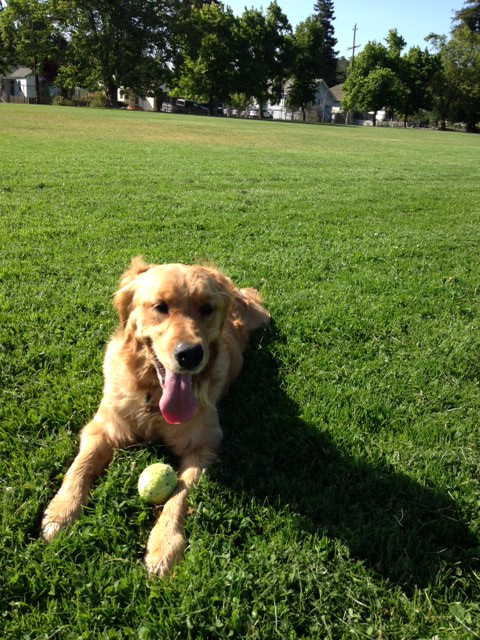
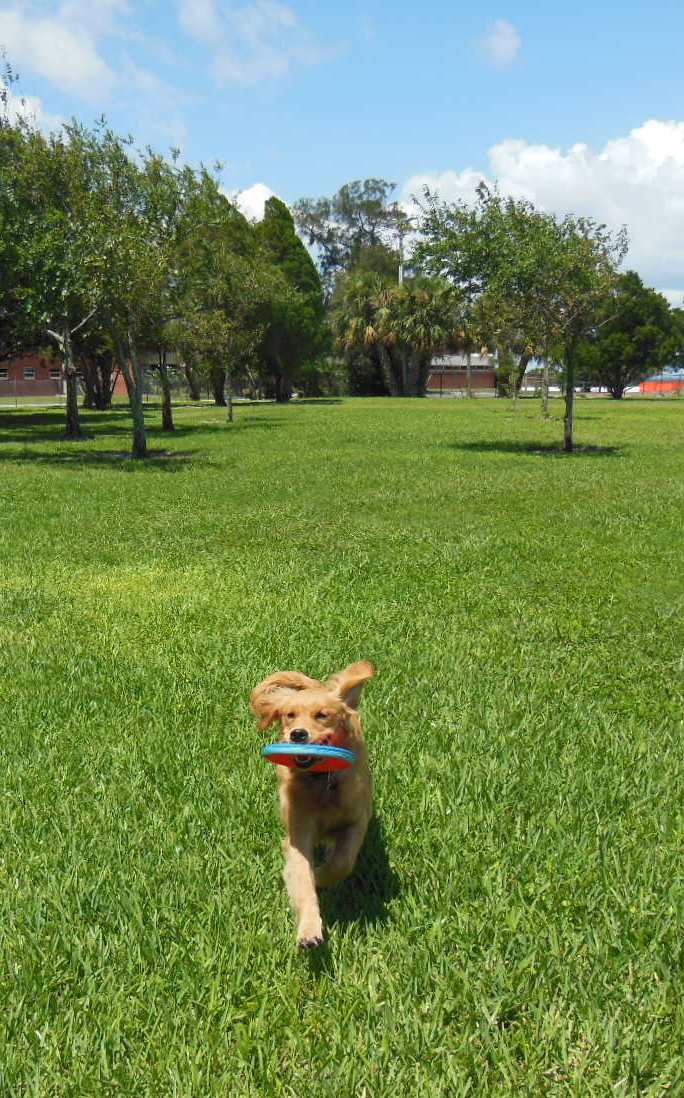
Wanna play?
Wanna play?

“She’s such a mama’s girl,” Deni said of Cali the other day. “If we get too far ahead, she looks back and wants to stop and wait for you.”

“Nah,” I said. “She knows that I have her precious tennis ball, and she’s worried that she won’t have it when she gets to the park.”

I may be a bit too cynical, and I do know that Cali and I have a close bond, but … when it comes to morning play, I really am just the tennis-ball carrier and tennis-ball thrower.

We tested our competing theories the next morning. As Deni, Cali and Alberta set off at a brisk pace, leaving Jana and me plodding at 12-year-old-golden speed, Cali glanced back once, then marched off, tail wagging. A key difference from the previous morning: Deni was wearing the all-important black backpack with Cali’s filthy, spit-coated, utterly disgusting tennis ball — the only one that Cali wants to play with.

Soon they were out of sight. When I got to the park with Jana, I asked Deni what had happened.

“Well,” she said. “Cali did look back twice, but she did not want to stop or even slow down.”

I knew it. Tennis-ball carrier status confirmed.

As I have mentioned before, play is very important to Cali and a huge part of our daily routine. She’s a very fair and friendly dog, and makes every effort to include all the humans present in whatever game is going on. When we’re not playing, she thinks that we should be.

In fact, Cali is my best balanced-life coach, nudging me at regular intervals to gently point out that it is time to take a break from this horrid computer, go outside, and play with her. And that darned tennis ball.

Cali knows what dogs have known for thousands of years and what has contributed significantly to the human-canine partnership: People and dogs play well together. Play makes all of our lives better. And playing with ours dogs makes our relationships with them better. According to a recent study by dog expert John Bradshaw, dogs who have frequent, positive play sessions with their owners (no scolding!) are more obedient and more engaged with their humans.

So, what are you waiting for? Get out there and throw that (disgusting) tennis ball!
Be Careful What You Teach Them …

When I was first learning to train service dogs, my instructor taught me that, once you put something on “cue control,” that is, teach the dog to do it when asked, the dog will no longer do it unasked.

Those of you with dogs and a little training experience, stop laughing.

This is one rationale behind teaching dogs to “speak” — bark on command.

Problem is, no one told the dogs about this bit of learning theory.

There is a key caveat to this piece of wisdom: The dog will no longer do it unasked unless he really, really wants to.

Bonnie Bergin (my teacher) discovered this one morning, when a particularly rambunctious group of adolescent Labrador service-dog trainees learned about tugging open a refrigerator door. One day, the ringleader of the litter, Xavier, let himself and some buddies into the training room (opening the door from the outside yard), tugged open the fridge, and helped himself to a large hambone.

The ensuing melee was quite dramatic. None of those Labs became service dogs.

I learned about the “unless they really want to” caveat to the lesson about dogs not volunteering named behaviors too late: I had already taught Jana to speak on cue. She uses her words. A lot. She’s quite opinionated, in fact.

Cookie, please

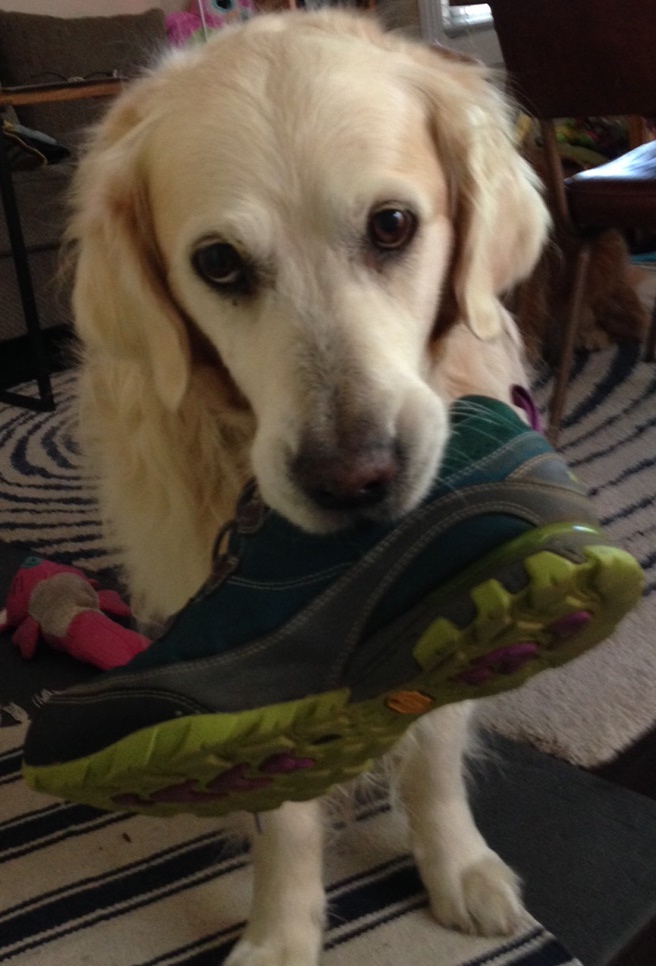
But I digress. The latest example of dogs doing unbidden that for which they have been amply rewarded in the past involves my shoes. I recently wrote about how eagerly Cali and Jana bring my shoes or sandals when it’s time for our morning walk.

Well, now they bring my shoes and my sandals. And a pair of slippers or flip-flops too. I reward the correct two shoes and wordlessly return the others to their proper place, hoping to extinguish this behavior. Not only is the flood of shoes not diminishing, it’s extending beyond walk time.

I occasionally turn around to find Jana, hopeful look on her face, shoe in mouth, standing behind me … at any hour of the day or evening. When I ask for anything — bowl, leash, collar, toy — Cali will often dash off enthusiastically … and return with a shoe.

On the bright side, they are both really good at “getting the other one,” so I never need to worry about being barefoot or mismatched.

So, be careful what you teach your dog; she might be smart enough to turn it into a game you never anticipated.

Dog Parks: The New Spectator Sport

Cali loves going to the park, just as many sports fans love going to the stadium. McNear Park, about eight blocks from our apartment, is an off-leash dog run for a few hours every morning. A group of very nice, well-mannered dogs are regulars, and I have only very rarely seen any inappropriate play. It’s a wonderful place for Cali to get some off-leash ball play, since our yard is very small.

Cali loves going to the park, just as many sports fans love going to the stadium. McNear Park, about eight blocks from our apartment, is an off-leash dog run for a few hours every morning. A group of very nice, well-mannered dogs are regulars, and I have only very rarely seen any inappropriate play. It’s a wonderful place for Cali to get some off-leash ball play, since our yard is very small.

Every morning, she bugs me to get going. Hurry up! She brings my shoes and nudges me to get out the door faster. She noses her favorite ball to remind me to take it along. When we get there, she demands that I throw the ball immediately. She eagerly chases it.

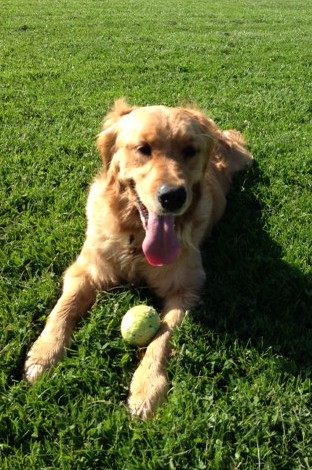
Then she lies down in the grass and surveys the park. She’ll occasionally bring the ball back and let me throw it again. Once. She moves from sunny patch to shade, carrying her ball with her and carefully placing it between her paws as she resumes her reclining position on the grass. Watching other dogs play.

A few dogs try to engage her, bowing and bouncing. Once in a great while, Cali will play for a couple of minutes, then, worry furrowing her brow, search out her ball, sigh in relief, and lie down, the precious ball resting safely between her paws once again.

Sometimes, I go over and get the ball to throw it for her. She’s happy to chase it, tail rotating like a helicopter blade … and then, again, lie down and watch the action. Or not, in which case, she’ll hold tightly onto the ball, not letting me take it and throw it.

Cali sees the park as a sports arena where she gets to watch other dogs play ball, Frisbee, and tag. She’d be happy to stay there all day, observing, but I usually get annoyed and threaten, “Play — or we’re going home.”

Meanwhile, Jana is doing her thing. She grazes a bit, then rolls in the grass. Stretches out, does a bit of yoga, sunbathes. The walk there and back is enough exercise for her. But Cali really needs to run and burn off energy.

When I finally give up and snap leashes back on, Cali usually digs in her heels, refusing to leave. She might, grudgingly, let me take the ball and throw it a few times then, before we leave.

When we get home, what does Cali want me to do? Throw the ball for her, of course.

Following Our Dogs’ Example

Jana does yoga. No, really.

I took a yoga workshop a couple of weeks ago that focused on stretches for the back, neck, and shoulders. The instructor showed us a couple of ways that she uses a tennis ball to apply pressure to tight muscles. Watching her, I got an immediate image of Jana, who does something very similar. You can watch her here: Jana Works Out. She has always done this. She wriggles so that the tennis ball moves down her back, massaging every inch.

We can learn a lot about how to live well and take care of ourselves by watching our dogs. Think about how consistently they demand exercise. And fun. Breaks. I can get sucked into work and sit in front of the computer for several hours. Except Cali won’t let me. Play time is supposed to happen at 3:30. Dinner must happen at 5. Breaks happen every couple of hours, tops. That is such a healthy, balanced approach to life — enforced by my dogs.

Also recently, I was talking to an acupuncturist. She was lecturing me on how important it is to take probiotics. I looked at her for a moment, then said. You know, I actually know that — I do it for my dogs. I just never applied that knowledge to my own diet.

IMG_1540How many of us worry more about what our pets eat than what we eat, and how many spend more time (and money) ensuring that their food is nutritious, balanced, tasty … while we eat junk food? Jana and Cali have no weight problem to contend with. They take their vitamins and supplements and exercise daily. They get better medical care than I do. And, once something becomes routine, even something like brushing their teeth, they expect it — and expect me to provide it. They remind me. (Though they have never asked me to clean their ears …)

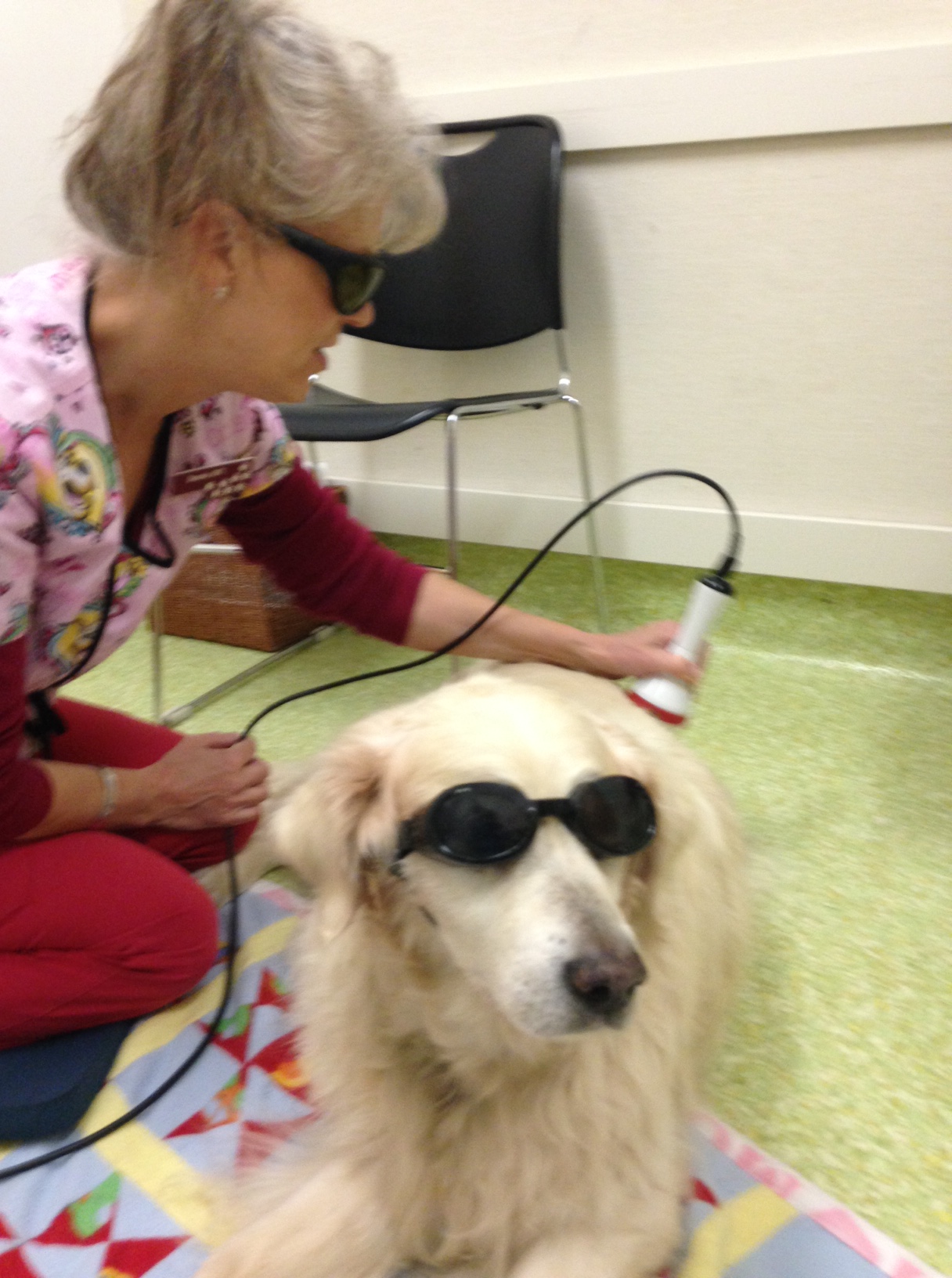
We do exercises daily to build up Jana’s shoulder muscles (which, incidentally, help me improve my balance), and Jana also gets regular laser therapy treatments for her arthritis (see photo). It keeps her (mostly) pain-free, so she can continue to wriggle and roll and do her yoga-tennis-ball exercises. For many more years, I hope!

What Is Dognition?

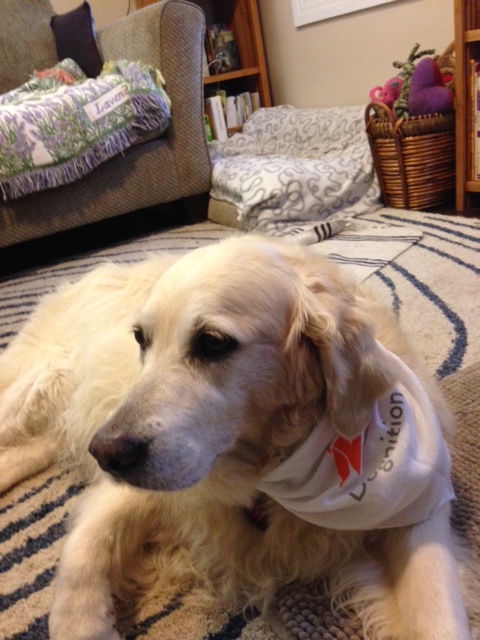
Jana dognition
In last week’s post, If Cali Were Brian Hare’s Dog…, I mentioned Dognition. What is it?
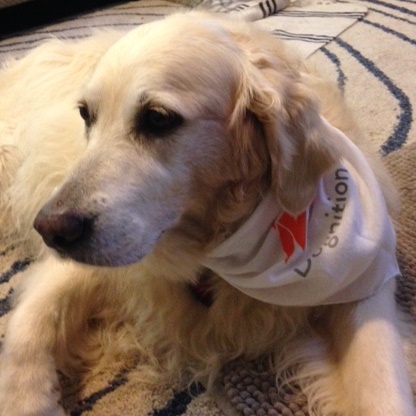
First: full disclosure. Jana and I were among the beta testers of the site, for which we received no pay, but Jana did receive the bandanna she’s shown wearing above. This is not a paid post or advertisement. It is my opinion, based on my experience with the site.
Brian Hare, whom I wrote about last week, is the co-founder and chief science officer. Dognition is a site that studies canine cognition through a series of games and experiments that site members do with their dogs, at home. The Dognition team includes some innovative canine cognition researchers. It is a clever way to gather a huge amount of information about a large variety of dogs. It’s also (usually) fun.
The initial set of games and exercises creates a “profile” of your dog. There are nine profile types, ranging from the “Ace,” a problem-solver with strong communication skills, to the “Protodog,” who, according to the brief description on the site, is “reminiscent of the first dogs that began their relationship with early mankind.” I am guessing that that’s a nice way of saying “can’t follow human gestures.” The writers on the site excel at couching bad news (“your dog flunked this test”) in very positive terms.
Renaissance DogJana is a Renaissance dog, good at a little bit of everything. I never finished the profile exercises for Cali, though.
The reasons are, I think, the site’s biggest drawback: Nearly all of the games require two people, and they are very hard to do alone. The site steps you through each set of exercises, and you have to enter information about your dog’s response before getting the next prompt. Another drawback (especially for multiple dog households) is that the exercises are repetitive.
I get it. They want data that they can use. They usually have a baseline exercise, which you do a few times, then the real one, which might have a few variations. For example, you might put a treat under a cup while showing the dog where it is. Then you might introduce a second cup, but still show the dog where the treat is. Then you might pretend to put treats under both cups but point to the right cup. Then you have someone hold the dog where she can’t see you and you hide the treat and point to the correct cup … you get the picture. You do each step three to five times. Jana can lose patience. When I am testing one dog, the other rapidly loses patience as she waits (and waits, and waits) for her turn. And I don’t have a second person here to cover Jana’s eyes or whatever else is needed.
So, those problems aside, I have learned a lot from Dognition. The site includes lots of articles and information on canine cognition. They do a good job of explaining the science behind the games and the profiles. And they send occasional tips, games, and suggestions that can be done by one person. I’ve gotten some great ideas for games to play with Jana and Cali and experiments to do with my students and their dogs. And I enjoyed finding watching Jana’s progress through the exercises. I’m curious about how much usable data the Dognition team has gathered and how they are using it.

If Cali Were Brian Hare’s Dog …

photo 4If Cali were Brian Hare’s dog, or rather, if she had been his dog years ago when he first started studying human-animal communication and animal cognition, there would likely be no Duke Canine Cognition Center, no Dognition …
I am not saying that Cali is not intelligent (far from it!). Before I get into that, though, some background:
In Brian Hare’s (wonderful) book The Genius of Dogs, he tells the story of how his interest in canine cognition came to be. Hare, now a leading researcher and innovator in canine cognition, was studying primates. As a college student, Hare participated in a study that investigated whether bonobos and chimpanzees understand the intention behind gestural communication. The chimps flunked the test. But, while conducting this research, Hare commented to his professor that his dog could do that. And history was made.
Hare and his professor found that dogs, even very young puppies, understand the communication intended by gestures such as pointing. Chimps must be taught, and, even then, rarely generalize. Wolves don’t do as well as dogs, even if they’ve been raised by humans.
In the first test that Hare did with his dog, Oreo, Hare threw three balls into a pond. After Oreo had found the first one, Hare pointed to the second, then the third. Oreo effortlessly located the balls by following the pointing.
Simple, right? Your dog can do that, I bet. Most dogs can. Jana can. Alberta can. Cali? Not so much.
Cali loves to play ball. She gets very excited when we’re playing, and often starts running out in anticipation of my next throw. She gets so excited that she neglects to keep her eye on the ball … and often ends up with no idea where the ball landed.
So, comfortable in the knowledge that dogs can do this, I point. And she invariably runs off … in a completely different direction. We play the “hot, cold” game. I pretend to throw the ball again, waving the Chuckit in the correct direction. To her credit — and showing considerable intelligence — Cali is never fooled by this gesture. I point some more. I walk in the right direction. I do everything except point a neon arrow at the ball.
Meanwhile, Cali continues running huge loops in completely wrong directions. Eventually, she ends up in the right section of the field and, using her excellent nose, locates the ball. She hardly ever loses her ball. But she just doesn’t get the pointing thing.
According to the studies I’ve read, Cali performs about as well as an unsocialized wolf. So what does this mean?
Aside from the obvious — that if Hare’s dog had performed as dismally as Cali, the science of canine cognition would have never been born — it means that Cali lacks this particular type of social intelligence.
She brims over with other types of social intelligence, though: She is extremely empathetic and affectionate; she is overwhelmingly friendly and nonjudgmental; and she is playful and happy. She also has a great memory and can use her nose to find hidden items in seconds flat (unless the item is a tennis ball nestled in the grass, of course).
The point is that dogs, like people, have different types of intelligence. Each individual excels at some things while faring more poorly at other skills. And that’s just fine.

Sisters at Play

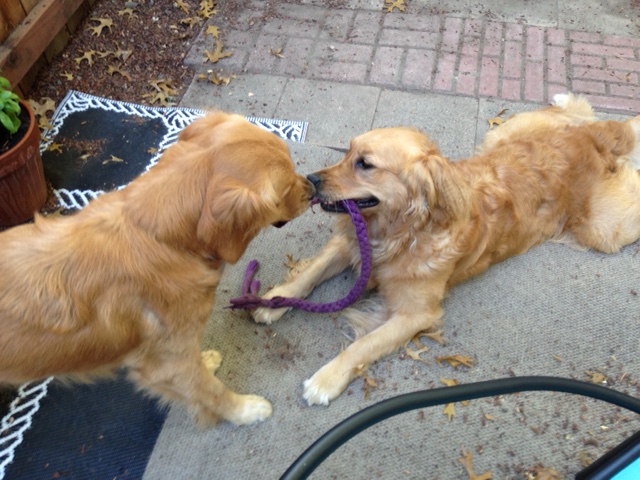
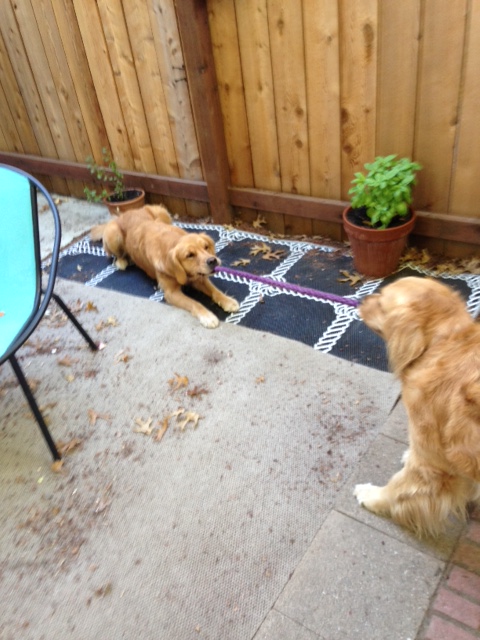
IMG_1137Cali’s sister Dora visited recently for the weekend, which meant nonstop action. Cali actually has lots of sisters. She lives with Big Sister Jana full time. Jana has been an excellent role model, teaching Cali necessary life skills, including barking at passersby and rolling in sand so joyously and thoroughly that, between them, they make sure to take the beach home with them. Then there is Alberta, the part-time sister and playmate. They are evenly matched in size and have similar energy levels. When they are together, everything becomes a tug toy.
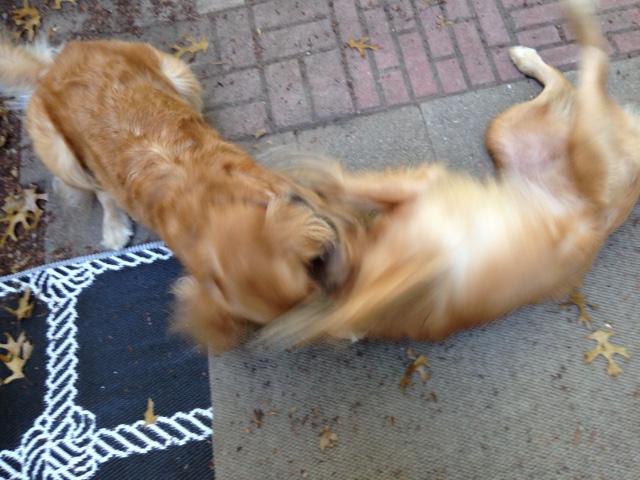
But DorIMG_1141a is special. Dora is Cali’s litter sister. They were plucked from their siblings on the same day (Cali by me and Dora by my close friends) and whisked away, first on a long car ride, then on an airplane where everyone made a huge fuss over them. They spent a scary first night away from Mom snuggled together in a crate. Since then (or maybe even before) they’ve shared a special bond. Whether it’s been days, weeks or even months since they last met, their greeting is rowdy, loud, and energetic. Their play is very physical and rough, but no one ever gets hurt. At rest, they often touch paws or sleep in a heap.
Play is often seen by researchers as practice for important life skills. One researcher, Dr. Marc Bekoff, suggests an additional crucial role for play: it is the basis for developing social ethics. In play, young dogs (or other social beings) learn not to hurt each other, to follow certain rules, to communicate their intentions honestly.
Both Dora and Cali have excellent social manners. When meeting new dogs, they exhibit all of the correct doggy signs for getting acquainted and inviting play. Both are wise enough to be deferential to larger dogs and to show respect for elderly dogs. They’ve internalized those ethical practices that they have learned through playing with a variety of dogs. But sister play is different.
InIMG_1134 their sister play, they also bow and use the full range of doggy play signals, but the signs are sometimes abbreviated or perfunctory. They feel safe enough to throw themselves into play without worrying about being misunderstood. There is lots of ear-pulling and gnashing of teeth. Their faces wear fierce expressions. They emerge panting and wet. And wearing huge smiles. There is a level of familiarity and trust between them that gives their connection a quality that Cali’s play with others — even Alberta and Jana — lacks. Social manners matter most when dogs assess the intent of strangers. Smart dogs know when they need to be polite. And when they don’t. And, for Cali and Dora, family is safe enough that politeness can take a backseat to full-on fun.

Cali, the Ghost, and the Dog Door

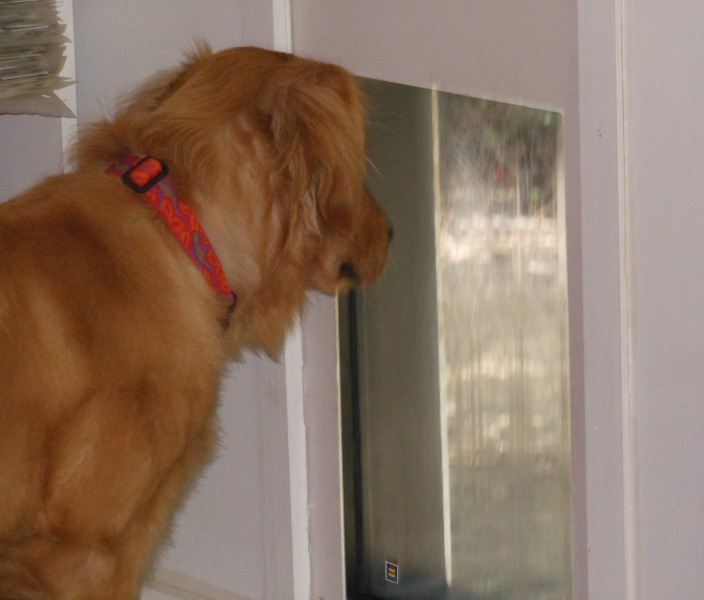
Cali ghost door3Our electronic dog door continues to be a wonderful window on the dogs’ personalities. The dog door is operated (ostensibly) by a magnet attached to each dog’s collar. The idea is that only animals with magnets can open the door, keeping out neighbor cats, possum, raccoons and the like.

Well, in one of Florida’s daily summer thunderstorms, the door suffered damage. The motor would hum but the door would not open. We summoned our electrician, ordered a part, summoned the electrician again, and, after a few dog-doorless weeks, were back in business. With a twist.

The door started opening and closing all on its own. We joked that not only had we acquired a resident ghost, but the ghost somehow had been given its own key and had learned to use the dog door. As I sit at my desk, not a dog in sight, the door will occasionally open and close. Then do it again a few minutes later. The ghost going out for a potty break and returning? Or the ghost entering for a brief reconnaissance and leaving? Hard to tell, since I can’t actually see the ghost.

Meanwhile, Cali, who learned to use the dog door in just seconds flat, has lost key privileges. She, it turns out, wants to spend all of her time outside chasing lizards. And occasionally catching them, with gruesome results for the lizard and anyone watching. She has recently taken up stalking those huge, bright yellow Florida grasshoppers that are apparently quite tasty. Her other hobby is digging small ditches all over the backyard. Some dogs, it seems, are too immature to handle the freedom a dog door brings. Unable to convince her to take up knitting, gnawing chew toys, or even sunbathing (with sunscreen!), I took her key away.

With no key, Cali has to ask permission to go out, and she now has supervised playtime. She hates that. She has figured out that she can sometimes follow her big sister Jana out. Occasionally, I think when Cali is being particularly, er, adolescent, I have seen Jana walk with her over to the door. Door opens; Cali runs out; big sis walks away with, I swear, a big smile on her face.

The next step was probably inevitable: Cali discovered the ghost. And decided to train it. She could get the ghost to let her out! Who needs a key when you have a trained ghost?

Now, when Cali wants to go out, she sits, patiently staring at the dog door. Eventually, usually within a couple of minutes, the ghost does, indeed, let her out.

Cali ghost door2Cali has had less success at training the ghost (or her big sisters) to let her back in, however. When she gives up on the ghost, she’ll sit, looking sadly at the back door and occasionally jumping on the glass, until I let her in. Twice I have come home from errands to find her outside, stretched out in the shade, waiting patiently.

I haven’t seen her sitting by the dog door on the outside, waiting for the ghost. But she has gotten back in without my help on occasion. So maybe the ghost training is going better than I think.

Sometimes, when Jana or Albee opens the door to go out, Cali seizes the moment and slips in very quickly. Jana isn’t quite as agile as she used to be, and the door only stays open for about 5 seconds. So when Cali does this, Jana is left inside. As Cali enters and the door closes, Jana gets a perplexed look. I am sure that, as she waits for the door to open again, she’s wondering why she wasn’t lucky enough to be an only dog.

The Inclusive Dog

Cali zipflight2Cali, Albee, and Deni are playing fetch with a Zipflight (a Frisbee-like toy for dogs that Cali is crazy about). I wander over with Jana. Deni throws the disc. Cali catches it. Cali then brings it over and offers it to me for a throw.

If more than one person is in the area where Cali is playing fetch, she always does this. I find it charming. She takes the toy to one person, and then to the other, as if to include everyone in the game. She’ll include people she doesn’t know well, too, if they happen to be standing near and watching.

Oriel did this too. Cali and Oriel are closely related, but since Albee occasionally does it too, I don’t think genetics fully explains this behavior.

A professor I had in graduate school, ethologist Marc Bekoff, has hypothesized that play behavior forms the foundation of social ethics for a species. That is, youngsters learn how to get along in the group — what is “good” and “bad” behavior in their society, what the rules are for acceptable social interactions — at least partly through their games. They learn to play by the rules, not hurt each other, not to cheat or deceive, and to self-handicap when playing with younger or smaller friends. We observe all of this as our well-bred and well-socialized canines play with one another and with other dog friends. This might be a partial explanation, but Cali’s behavior seems to go a step farther.

I’ve seen dogs take turns in other situations — at the school where I teach, it’s not unusual to see three or four dogs lined up, waiting for a turn at the water bowl! And of course, when we play with our three dogs they must take turns chasing the ball when we throw it. Our dogs wait their turn to get their treats, to get brushed, even to get their dinners. Taking turns is nothing new in multi-dog homes. But dogs ensuring that all of the people and dogs get to join the game is unusual and shows an even higher level of social awareness. Cali’s not waiting for her own turn to do something fun or trying to get extra turns. She’s going out of her way, sometimes across a large lawn, to invite someone else to take a turn, to join the game.

Cali zipflightIt’s impossible to know exactly what motivates her to offer me a chance to throw the ball when she’s playing with Deni, but it does bring the family together. She even takes the ball over to Jana to offer her oldest sister the chance to chase the ball!  Cali’s desire to include everyone reflects something that matters to her. Empathy, or possibly inclusiveness.

An inclusive organization is defined as one that values the contributions of all people (human and canine!); one that incorporates different members’ needs, assets, and perspectives. That sounds like the kind of dog-human family I want. And, from her actions, it appears to be the kind of dog-human family that Cali wants too.


Good Owners Make Good Dog Parks

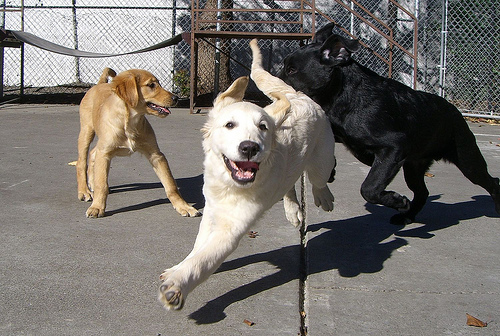
Happy dogs at play (photo by Sae Hokoyama)

In Take Me Out to the Dog Park, I described some features that contribute to a successful — fun, safe — dog park. But a perfectly designed and maintained park can be a nightmare if the dogs and humans who hang out there create a bad dog park culture. How can you tell?

Before letting your dog off leash in an unfamiliar dog park, check it out. If you can, observe the park during busy after-work or weekend hours. If not, observe for a few minutes before letting your darling out of the car.

Inattentive dog owners are a key contributor to unsafe and unpleasant dog park experiences. If the people are all clustered around the edge, chatting in small groups, or sitting on benches sipping coffee and ignoring the dogs, walk away. Some dog parks have a “let dogs be dogs” culture that encourages bullying. In Sue Sternberg’s excellent APDT Webinar[1], she showed video footage from a small urban dog park where dogs bullied and ganged up on other dogs while the oblivious humans sat on the sidelines.

You are your dog’s advocate and protector — if your dog is being bullied, get him out of there! You are also the responsible grown-up, frightening as that may be. If your dog is being a bully, get him out of there! Not all dog play is appropriate, and dog owners need to be aware of what’s happening so they can stop unsafe play.

What does dog bullying look like? If a dog keeps bugging another dog to play, even though the other dog has looked away, walked away, or barked, bared teeth, or otherwise told the first dog that he’s not interested, that dog is being a bully. If a dog pursues another dog, and nothing the other dog does can shake him, that dog is being a bully. If one dog body slams or plays roughly and the other dog is trying to get away or is not equally engaged in the roughhousing, it’s time to step in.

Watch those high-speed doggy chases, too. Sometimes it is all in good fun. The dogs chase each other, stop and restart, and look relaxed and happy, with tails up and ears back. But if the “chasee” has his ears forward and his tail tucked and looks scared, or if several dogs are chasing one dog, the dog being chased needs help. If a chase never changes directions — the same dog is always being chased — the chaser(s) might be bullying the other dog.

Entry gates at dog parks are prime spots for scary interactions. If several dogs are milling around the gate — or approach as you and your dog enter the double gate — be very careful. Walking into a mob of strange dogs is a stressful experience for your dog. The dogs might be friendly; they might also harass or attack an entering dog, especially if he seems nervous or defensive. Do your dog a favor and wait until the entryway is clear.

Not all dogs automatically learn the social graces. If your dog needs to learn some manners, try to set up one-on-one play dates with well-socialized dogs who can teach him the boundaries of appropriate dog play. And if you do take him to the dog park, remove him the instant you see him picking on another dog. He will learn that the fun stops when he acts like a bully, and the other dogs and people at the park will appreciate your conscientiousness.

Dog parks can be wonderful places for dogs to socialize and burn off energy. But some dogs are shy or timid; a dog park is too stressful for these dogs. And there are too many stories of dogs being injured or attacked to assume that all dog park experiences will be good ones. Think carefully about whether your dog will enjoy the rough-and-tumble of multi-dog play, and take the time to check out a dog park’s culture before you go.


[1] “A Look at Interactions Between Dogs in Public Dog Parks”