A Dog Can Help You With That …

Whatever you need help with, chances are, a dog can help out. Need help finding your way around? Easy-peasy. Need a guide who also lets you know about important sounds? Dog’s got that handled too.

Funny thing is, not too many humans believe that dogs can do all that (and more). Fortunately for some people, Guiding Eyes is an organization that takes chances on people — and dogs.

As someone who’s sure that we haven’t come close to tapping dogs’ full potential, I see this as a sign that Guiding Eyes (or GEB) really “gets” dogs in a way that few people, even dog professionals, do.  This understanding leads the organization and its trainers to willingly take on challenges that few people would even think possible: Tasks that require a belief in dogs’ ability to be adaptable and to become creative problem solvers, for example. GEB dogs do things that it’s really not possible to teach them without a shared understanding and buy-in to shared goals, so the trainers have to know that dogs are capable of higher-level thinking, problem solving, and working toward goals.

What do I mean? GEB places dogs with a tremendous variety of clients, including individuals who have both visual impairments and another disability, such as a mobility or hearing impairment. The clients whose dogs alert to sounds as well as guiding range from people who are legally blind and hard of hearing to individuals who are both blind and deaf. I could be wrong about this, but I believe that GEB is the only U.S. guide dog school that is willing to provide these clients with a guide dog. In any case, it was the first organization to do so.

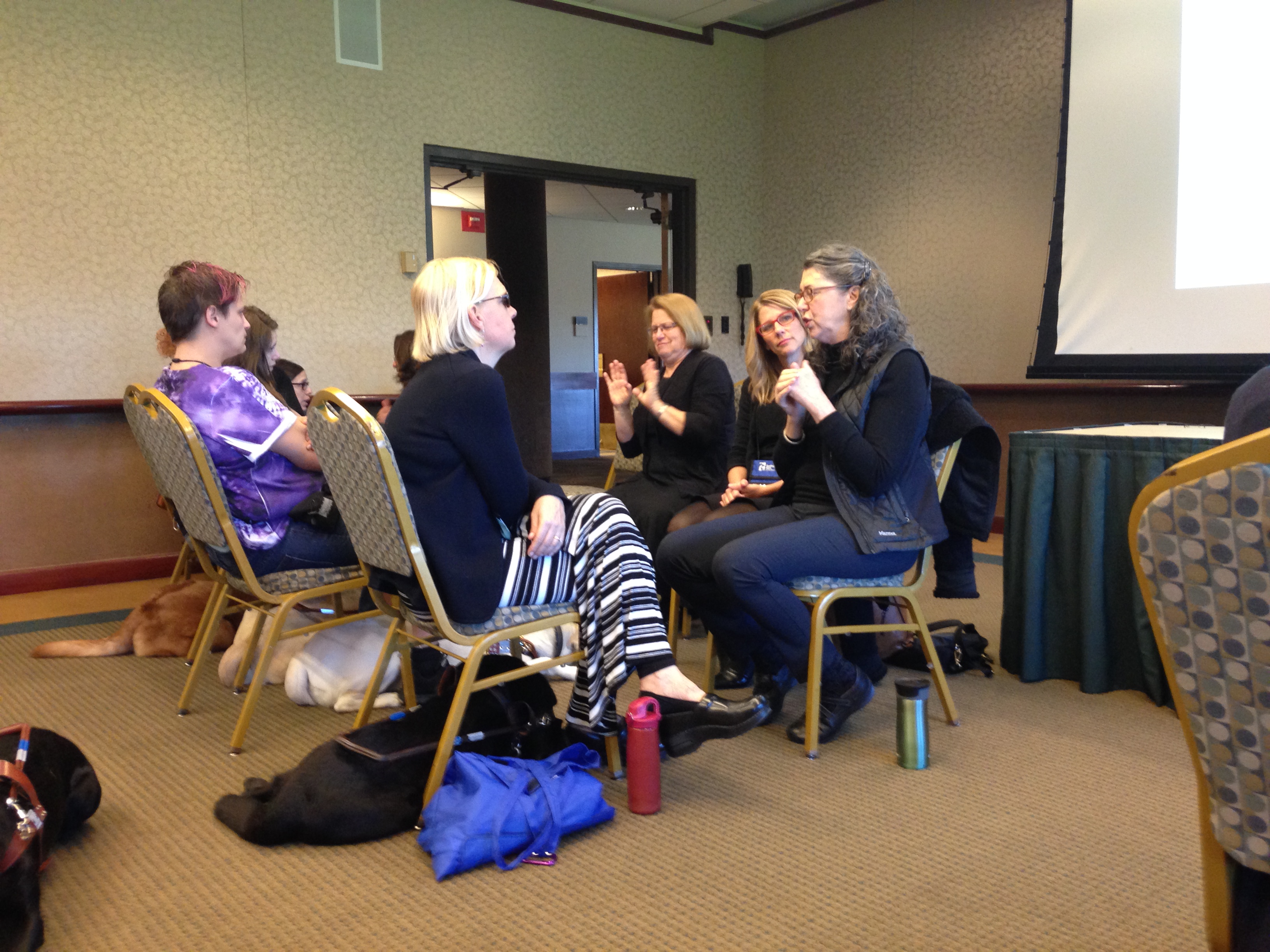
As registration opened for the Guiding Eyes continuing education weekend, a number of these grads registered. Planning committee member, grad, and GEB consumer outreach and graduate support manager Becky Barnes Davidson waved a magic wand and somehow found funding to bring a cadre of interpreters to the weekend, ensuring that all of the grads could participate fully in the events.
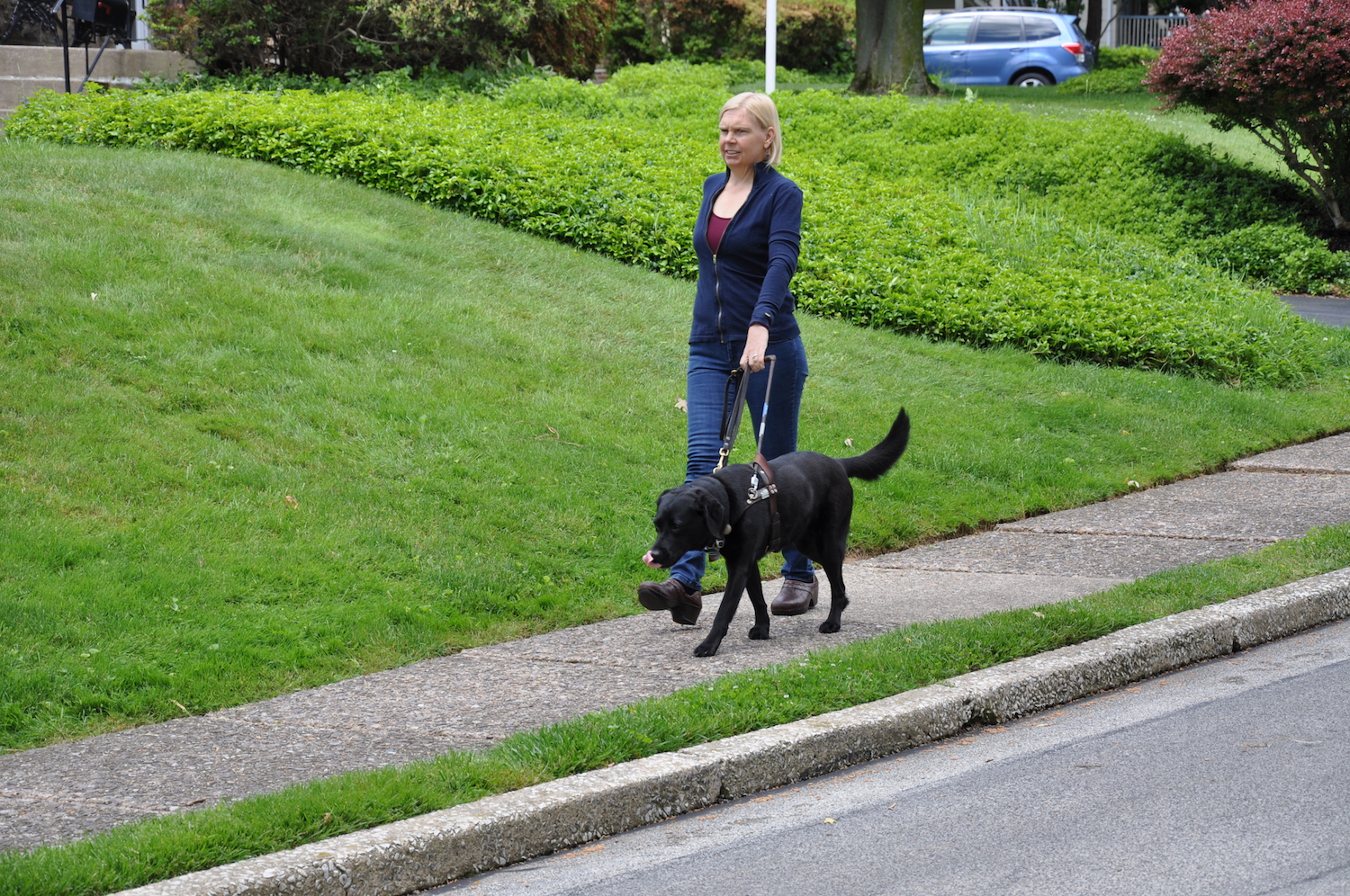
Deborah and Gypsy walk togetherI had the opportunity to chat with one of these grads, Deborah Groeber. She got her first Guiding Eyes dog in 1987. GEB didn’t yet have its “Special Needs” training program, which got off the ground in 1990, but, Deborah said, it was the only guide dog school willing to try training a guide for her.

Having guide dogs has, of course, made a tremendous difference for Deborah, especially in her frequent travels. She describes traveling with her dogs (current guide Gypsy is her fifth) as “phenomenally different” from traveling with a cane.

“I think Gypsy is a great match for me because she loves going from the suburbs into the city every day, loves taking trains, buses, escalators, stairs, revolving doors and working obstacles and construction sites. She is bright, confident and self-motivated, but she also loves praise and food rewards,” Deborah said.

Deborah is about to participate in another unique Guiding Eyes program. Gypsy is nearing retirement, and Deborah’s next guide will be a member of GEB’s new program, Running Guides.

Running Guides perform the usual guide dog work as well as guiding their partners while running. The first Running Guide team graduated in 2015. And Deborah’s dog will, as Gypsy has, learn to alert her to sounds, such as smoke alarms, phones, and doorbells. Deborah knows how to teach her additional alerts as needed. Sometimes Gypsy figures it out on her own, too.

Once, not long ago, Gypsy alerted her to a carbon monoxide alarm when Deborah’s husband was traveling for work. Gypsy is not allowed in the basement, Deborah explained, but she kept alerting to the basement door, because she heard the unexpected sound of the alarm. She’d not been trained to respond to that sound, but somehow understood that it was an urgent problem. Deborah got both the CO and smoke alarms, Gypsy told her which one was making noise, and she was able to respond and resolve the problem.

That story underscores the connection and communication that develop between members of a guide team. Many of us plain old pet-dog owners, who have the good fortune to be able to see our dogs’ body language and hear their vocalizations, are nonetheless unable to figure out what they are telling us. And I bet most of our dogs would react to an alarm and try really hard to get us to do something about it. That we’d all die of carbon monoxide poisoning anyhow would not be the dogs’ fault…

As someone who has tremendous faith in dogs’ abilities to figure things out, communicate, get what they need, figure out what their humans need, and so much more, I am not amazed that a single dog can perform both guide and hearing work, with a side gig as a personal fitness trainer. I am impressed that enough people at Guiding Eyes believed in dogs back in 1987 to give combined guiding and hearing dogs a try, and that the organization is continually coming up with new ways to stretch and grow the partnerships between their amazing dogs and clients.

In Her Own Time

Koala, a black Labrador, relaxes on a hammock-style dog bed

I wrote last week’s post on Koala and her reluctance to move to a big-girl bed a few weeks before it was published. Since then, she went on a long visit (with Deni of course) to Deni’s mom’s house. There, she did not have a crate. And, she decided, upon returning home, that she was ready for her grown-up bed. She wouldn’t even look at the crate. Crates are for babies, she said. Why would I want one?

The crate is gone.

I think it is more about choice than about where Koala sleeps. She wants to — and should be able to — make choices about things that affect her quality of life (to a reasonable extent, of course … Cali does not get to do the grocery shopping, for example, and neither does Koala).

I’ve had an interesting email conversation over the last couple of weeks with a reader who has taken her dogs’ communication and ability to make choices to an unusual level. She uses an approach similar to what I have seen a few other people do, which is to present two options and have the dog choose a hand. Left for yes, right for no, or left for “go for a walk” and right for “play ball.” Things like that.

I have not taught this to very many dogs, but Jana and Cali picked up the idea pretty quickly. Cali’s favorite daily choice is between two tennis balls (yes, she’s a bit obsessed). Our morning routine goes like this: Walk to the park. She skips and dances ahead and has to be reminded not to pull. As we get close to the gate she literally wriggles with joy and excitement. She gets to the gate first and stands at attention, touching the gate with her nose. I open the gate and reach down to unhook her leash. She bounds into the park, turns and sits, looking eager and expectant. I pull the Chuckit and two tennis balls out of the bag. I offer her both balls. She sniffs each one deeply, sometimes wavering, then makes a choice. She watches carefully to make sure I don’t pull a fast one, swapping the balls. I put the rejected ball away, slip the chosen ball into the Chuckit, and throw.

Occasionally we have a variation: She somehow gets hold of a ball at home and carries it to the park. I throw that one.

She always carries her ball home from the park.

The point is that, along with getting to play her favorite game, (which is not what you think) she gets some control over that game. The game, by the way, is not fetch or catch. It’s: Run after the ball, grab it, then keep it away from everyone else, human, canine, avian, or whatever, in the vicinity. Occasionally let a human get it and throw it again. Repeat for as long as you can get the humans to cooperate.

Anyhow, in addition to that, Cali gets to choose. She takes her choice very seriously. There are other choices in her day. She occasionally gets to choose between two treats or two games; she might get to choose whether to go for a walk or have a play session; she often gets to choose which direction we go on a walk. But really, she doesn’t have that many choices in her life. The few areas where she gets to exercise some control are important to her. I think that’s true for Koala as well. And for every other intelligent creature, canine or otherwise.


Missing Christine

I remember the day she was born, nearly fourteen years ago. I would be responsible for her sister, Cassie, but only for a few months. Christine’s human mom — we were all learning to train service dogs — held her when she was only moments old and became her trainer when Christine was seven months old. The two formed a solid bond and became a permanent family a few months later.

Christine was one of the last puppies in the litter. It was a dramatic birth. “My” puppy wouldn’t stop bleeding from the umbilical cord. One of the other students, an EMT, stopped the bleeding. Then one of the pups was not breathing. The same student tried to save the tiny puppy, but she didn’t make it. There was an orientation going on in the next room for volunteers who would help socialize the puppies. Each student had a part in the orientation, and we had to run back and forth between the whelping room and the room filled with people. Christine’s mom, Ideal, an special dog who raised many successful service dog puppies, stayed calm despite all the drama.

Christine was fine, though, wonderful even, right from the start. She had pretty much the perfect dog life. Her devoted mom took her to the beach pretty regularly, and they went on great hikes and walks in San Francisco every day. She had the best food and treats. Dozens of toys. When we all got together, Jana and Cali sure knew which mom to beg for treats. Not their mom.

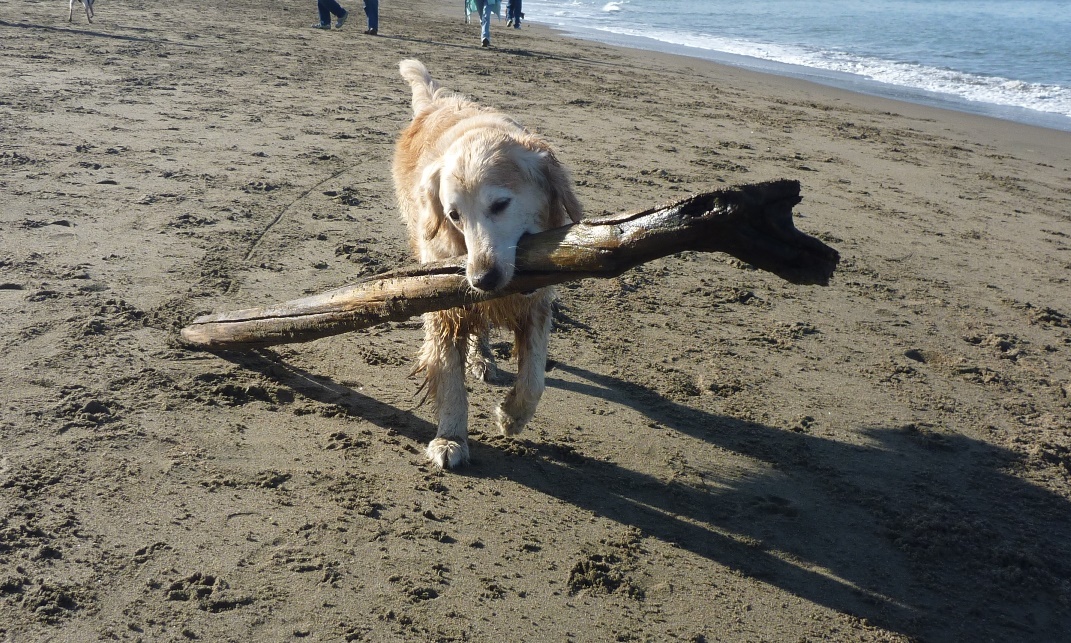
Christine carries a large tree branch on the beachChristine showed Jana the ropes at Fort Funston and at our favorite — Crissy beach. She liked to speak softly and carry a very big stick. She loved to play and sniff out gophers. Jana loves to roll in the sand. Lucky for her mom, Christine didn’t do that. She slowed down a bit as she hit her teens, but she was always a sweet, friendly, happy girl.

In the end, as it often is with golden retrievers, Christine was diagnosed with cancer. She carried on for six months, but eventually, she could go no farther. Wherever great dogs go, she’s in good company. I can’t even list all of the wonderful dogs my friends and family members have lost in the last year, let alone all the wonderful dogs who’ve touched our lives.

Sometimes, cancer takes a dog very suddenly. Christine, as our Oriel did, gave us time to prepare. But either way, no one’s ever ready, and there’s never enough time. Thirteen and a half years, a full life for a golden retriever, is far too little time to have with a beloved friend and companion. We miss you, Christine.

Trust Your Dog

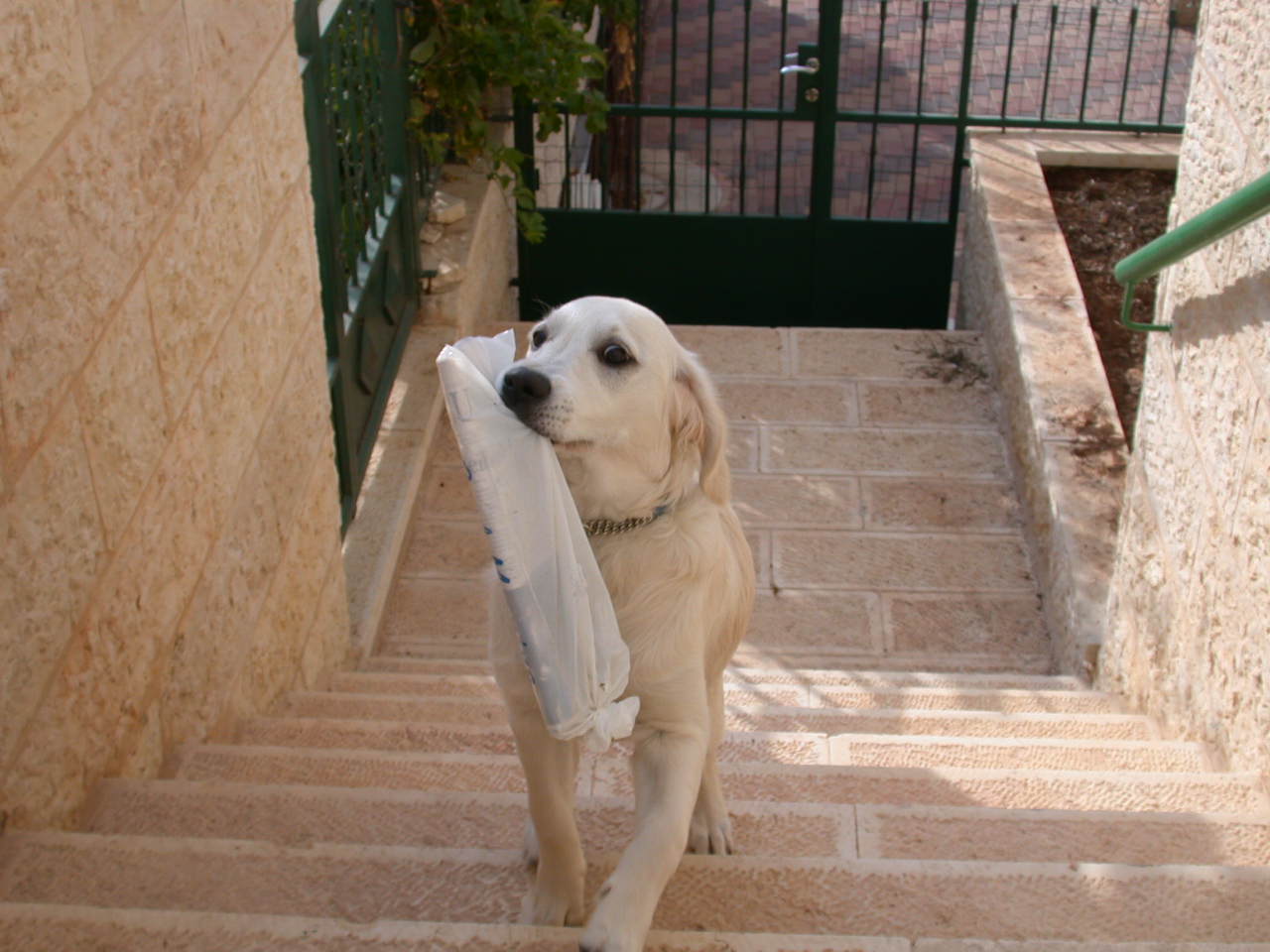
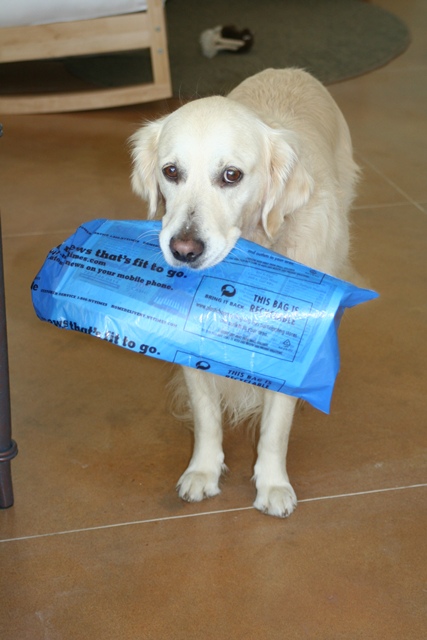
Jana, at 4 months old, gets the paper

Jana gets the paper every morning. She has had this job pretty much her entire life. She’s good at it. Really good. She is also very serious about it.

She has carried papers up stairs and the length of country driveways that you can’t even see the end of. For several months a few years ago, we actually had to walk out to the end of the road for the paper, maybe a quarter-mile. She carried the paper all the way home, no matter what essential business might need to take place on the way.

Now, living in Petaluma, she listens for the delivery person. We have a great delivery person at the moment. He or she comes at 4:30 every morning. Rain, shine, weekend. Doesn’t matter. Drives into our parking lot and tosses the paper in the general vicinity of my gate. How do I know this? Well, if I am not awake, Jana hears the paper arrive and lets me know that it is time to get the paper. She’s very polite about it, but quite insistent. She does have a snooze button, and I do use it. But still. Most mornings I am at least briefly awake at 4:30.

The paper subscription expired recently, and I actually considered letting it lapse. Then I felt guilty. I would deny Jana her greatest pleasure? Fire her from a job she has performed dutifully for more than 13 years? For no good reason??

So. This morning, a Sunday, we both heard the car and the thud of a paper. A while later, after a couple presses on Jana’s snooze button, Cali woke me up. Cali does not have a snooze button. She wakes me up by jumping onto the bed and shoving her nose in my face. GOOD MORNING she breathes into my face, wagging her tail furiously.

So, Cali got me out of bed, and Jana was eager to get the paper. Out we went. No paper.

Jana looked under the car and along the sidewalk and by the neighbors’ gates. No paper. She got very interested in the small bush by the gate and was quite sure the paper was in there. I looked under the bush. No paper. She kept looking at the bush and sniffing at it. I poked around some more. No paper. I convinced her to go inside.

Then, since she had been so sure there was a paper, I took the big flashlight and went back out for another look. No paper under Jana’s bush  But: The paper was, indeed, under a bush. Not the one Jana had fixated on, but one very close by. I pulled it out, and called for Jana. She was very excited about this development and practically danced outside. She grabbed the paper, the big, heavy Sunday paper, and held it up triumphantly. She carried it inside and traded it for a cookie. She wagged hard, still smiling.

She knew there was a paper, and she knew it had gone into a bush. You should always trust your dog, even if she’s sniffing at the wrong bush.

Scary Dog

Cali, puffed up and trying to be fierce
Cali tries to look fierce

A few weeks ago, while Jana was recovering from a vestibular incident and not joining Cali and me on the morning trek to the park, Cali found herself in a scary situation. On the way to the park, we pass a big, old corner house with two doggy residents. We see the younger one at the park pretty regularly. He’s a young husky mix, big and boyish. Cali doesn’t play with him; he’s too high-energy for her. But she’s not afraid of him, and he’s sweet. If he’s in the yard when we walk by, he doesn’t even bark.

His big sister, Diva, is a different story. She’s about Jana’s age, and she aggressively defends her territory. OK, that’s not fair; she barks aggressively, but doesn’t do anything more than bark. When Jana’s passing by, she anticipates Diva’s barking and tenses up. First of all, she just knows that she should be called Diva. Secondly, she envies Diva her large yard. But even beyond all my anthropomorphic projection, there is a bit of a grudge match between these two. Jana wants to preempt Diva’s barking by barking. They hurl insults at each other as I hustle Jana past the yard. Cali feels safely protected by her big sister.

That’s all fine when Jana is there. But on this morning: No Jana.

We were on our way home from the park, which means that Cali was carrying her tennis ball in her mouth. So, we were walking along, and I saw Diva a split second before Diva saw us and started barking. With no big sister there to protect her, and with mom woefully inept at the barking needed to address this dire threat, Cali stepped admirably up to the plate. She puffed up her hackles, making herself as fluffy … I mean, as big and scary … as she could. She barked her fiercest bark. However, that bark, filtered through the tennis ball in her mouth, sounded like a Chihuahua. A laughing, decidedly non-fierce Chihuahua.

Need I even say it: Diva was not impressed.

Not frightened at all by this fierce version of Cali. I wouldn’t have been frightened either; I just wanted to hug her since she was being so cute. I resisted; the humiliation might have done in poor Cali.

I feel for Cali. It must be terribly frustrating when you are trying your darndest to be strong and courageous and scary … and the people and dogs you’re trying to impress just want to hug you. Or laugh. A human teenager might respond by taking up weightlifting or trying out for the football team, but Cali seems OK. Maybe she’s emotionally healthy enough to shake it off. Or maybe she’s just really relieved that Jana’s recovered and back with us on morning walks.

Mind Your Manners

Wylie, a polite dog?Wylie hates peanut butter. It literally makes him gag. That’s why this story, from several years ago, is still one of my favorites: It tells me something really cool about dogs.

When Wylie was about to retire as a guide dog, his best friend t work brought him cookies. Very special gourmet dog cookies. One problem: They were peanut-butter cookies. Deni graciously thanked her colleague and said gently that she wasn’t sure Wylie would like them; he was fussy. The friend said, let’s see. He offered Wylie a cookie. Wylie accepted the cookie with appropriate doggy gratitude and ate it. The friend went happily on his way, feeling good that his gift had been accepted and enjoyed.

Surprised, Deni offered Wylie another cookie. He gave her what she can only describe as a disgusted “Are you nuts? I don’t eat that garbage” look, turned, and walked away. He never ate another one of those cookies.

Was Wylie “just being polite,” telling one of those little “white” lies we all tell when we want to avoid hurting someone’s feelings? Can a dog do that?

Here’s a different way to think about it, though, really, we’ll arrive at the same conclusion: Dogs are very empathetic. They excel at reading and responding to our emotions. Many dog people have stories of dogs offering comfort when they were sad; getting excited when were excited; responding in a way that many people regard as “guilty” when we are angry. In truth, the dogs are more likely to be trying to appease a person they perceive as angry, but they are accurately reading the person’s emotion.

If Wylie got excited about the cookies, he could be said to be mirroring the friend’s emotion: The guy was presenting a gift that he had selected with Wylie in mind, and he was happy to see Wylie get the gift and enjoy it. Or the friend was sad to be saying good-bye. But Wylie didn’t get excited or offer comfort. He offered a gracious and appropriate, but not overly happy, response. (I don’t think Wylie is capable of phoniness.) And he clearly rejected the gift as soon as his buddy left the room.

My explanation is that Wylie was reading the situation clearly and accurately. He’d been around lots of people in lots of social situations, and he knew these two people really well. He behaved as he’d learned was appropriate. He wasn’t, I don’t think, consciously deciding to lie — any more than we consciously decide to lie each and every time we say something that will make someone feel good — or, to more clearly match this situation, every time we say or do something that is nice and socially expected rather than blurt out our first or most honest thought.

Jana, who really has no use for children of any species, is perfectly gracious and polite when being “enthusiastically petted” (she’d say “mauled”) by a child, but she gives me that look that says loud and clear: “Get me out of here, now, please.” And Alberta would dutifully “say hello” to people she and Deni met, but she really didn’t want to; and she expected a cookie as a reward afterward.

So, I would argue, that dogs read social situations and respond appropriately. What is “appropriate” in a given situation varies widely, and it is learned, not instinctive. Some dogs, and some humans, learn better than others. Some dogs do this well with dogs and poorly with humans, or the reverse. Wylie’s social instincts with other dogs were often less astute than his social instincts in this particular human instance.

So, while I’m not arguing that dogs adopt human social manners, I would say that they learn, over time with the same people, what those people think is acceptable. Much about dog-human relationships entails dogs trying to do what they think their human wants; it’s not surprising that this can get nuanced or that Wylie and Jana are good at it.

Better and Better

Jana enjoys springThis will be a short post to update you on Jana. She’s doing a lot better.

In the weeks following her bout with vestibular disease, she visited a neurologist, an ophthalmologist, and an additional vet. The vet, someone whom we like and trust very much, was Cali’s pediatrician and Jana’s vet a few years ago. Her clinic is pretty far from where we live now, but I decided to check in with her anyhow. She offers fantastic Western veterinary care and also Eastern medicine.

Jana, it turns out, had an ear infection. She and Cali each had a foxtail in her right ear, which has nothing to do with the vestibular incident but was very uncomfortable. They were amazingly good and let the vet remove the foxtails; both girls are feeling much better now.

Jana is also taking Chinese herbal medicine, plus she just finished some pills that helped get her over the last of her dizziness. She’s still a little wobbly on her feet, but much, much better. She still tilts her head a little bit, too.

But she seems to be focusing better; and her selective hearing is excellent when she wants it to be. She was back on the job, retrieving the paper, in less than a week, and she demanded to rejoin the long morning walks to the park after about three and a half weeks of recovery. She does get tired easily, but, at her age (the rough equivalent of a 92-year-old human), that’s not surprising.

She seems to get stronger every day, and she’s her usual happy, bossy, food-focused self. At the park, she made the rounds, visiting with her many friends — and demanding cookies.

In short, Jana is back to normal.

How much is that in dog money?

This slideshow requires JavaScript.

I had house-guests recently, and the girls put their entrepreneurial spirits to work. As I have described in other posts, the girls bring me my shoes when it’s time for a walk. They also bring their bowls when they are done eating. For each of these, as well as for getting the paper and for other tasks, they are paid in cookies.

There’s a cookie hierarchy in dogdom and therefore in our home. When requiring the girls to do something they dislike, such as submit to ear-cleaning or nail-trimming, I reward them (some would say bribe, but it happens after the fact) with high-value treats — freeze-dried liver, perhaps, or the dried beef patties we discovered at Costco. When we are practicing recall (come here, right NOW!) they get very high-value treats. We have special tooth-brushing cookies, which are of medium value. Ordinary chores like bringing the paper, shoes, etc. get ordinary treats — a few Charlee Bears or a small biscuit. This, it seems, is the currency of the dog world. They expect to be paid, and, so far, they have been willing to accept the prices I am willing to pay.

They showed a basic understanding of economics when they started bringing things I hadn’t asked for and expecting payment. It reminded me a bit of those kids who used to come out of nowhere and wash your car windshield while you were sitting at a red light, then ask for money. But the girls are cuter and very earnest.

Then my guests came along. One was so enchanted by the dogs bringing shoes — random shoes, no less, maybe taking my shoes to her or a single sandal when she needed her boots — that she inflated the payout. At least once, but I suspect more, she gave Cali a beef patty — a whole one! — and Cali had not even brought her the right shoes! I don’t even want to know what she paid for the girls’ dinner bowls.

Well. Jana and Cali don’t have MBAs, but they don’t need them. The girls quickly understood inflation and supply-and-demand economics. And bargaining: I’ll give you this shoe — and a boot — for one of those beef patties. I’ll throw in a phone or a TV remote if you’ll give me two. What? A measly Charlee Bear? I am going to hang on to this slipper. When your foot is cold, you’ll pay more.

Just what I need. A looming winter of cold feet and fat dogs. I’d better go to Costco this week. We’re gonna need more beef patties.


Last Night Alone

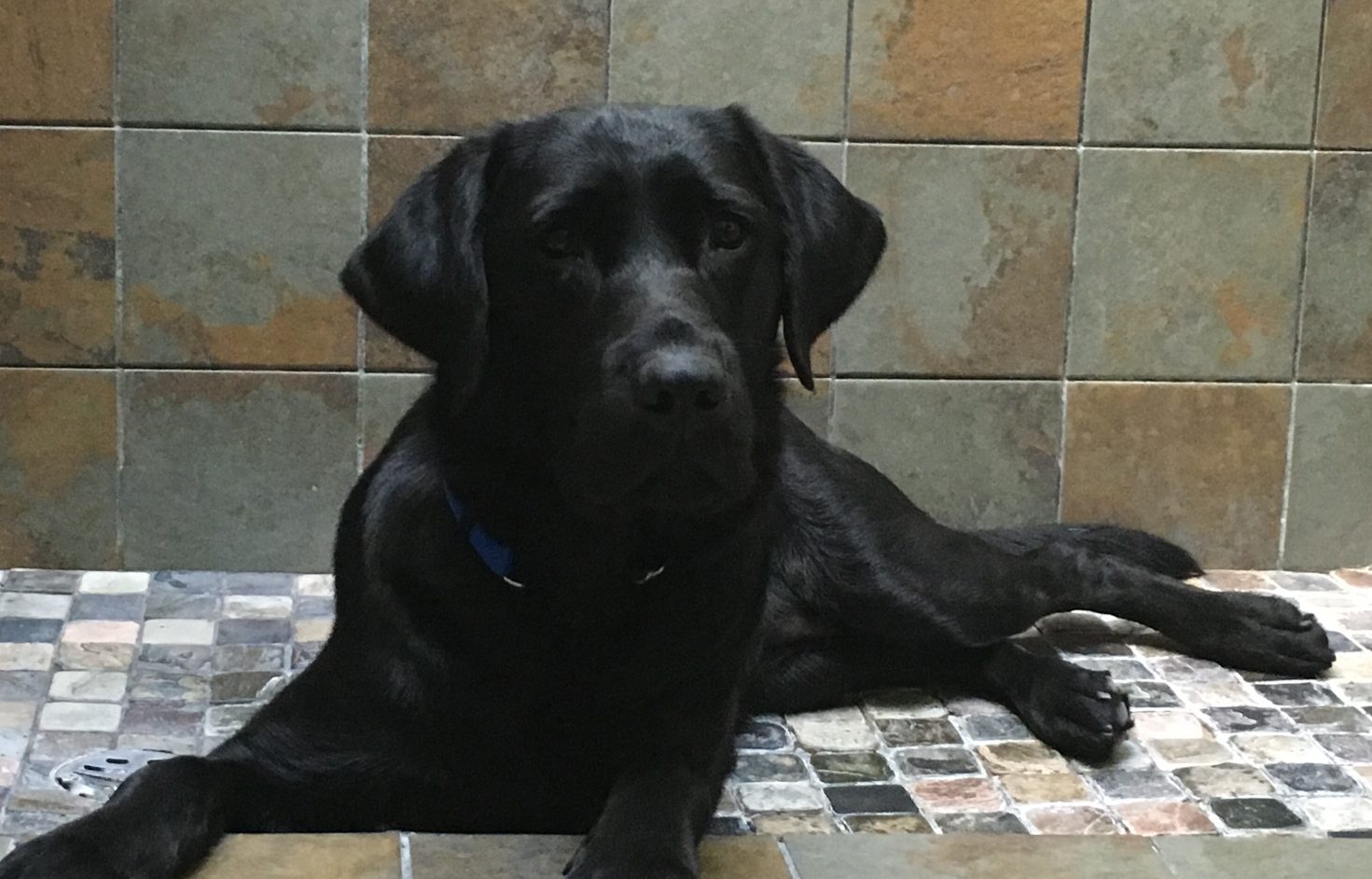
koala-in-showerA guest post by Deni Elliott

Tonight is my last night alone. After four months of crawling into bed without Guiding Eyes Alberta snorting and snoring a few feet away, tonight is my last night alone. Tomorrow I meet Guiding Eyes Koala. As hard as I’ve squinted at photos and video and as tightly as I have clutched each new piece of information, I find it odd how little I can imagine about our future together.

Koala’s passed all the tests and has exceeded expectations. I’ve heard that she leaps into her harness and back-channels routes after only one trip. She eagerly solves problems and pivots on a dime, ready for new adventure. A personality match for sure. But I remind myself that I need to go slow and not expect too much of this 2-year-old.

At the cusp of this unknown relationship curving to be real, my tummy flutters with butterflies of anxiety and anticipation. I can imagine the home trainer better than the dog he is bringing me.

Jim Gardner, GEB director of home training, will fly from New York to Tampa with Koala curled at his feet. I imagine Jim cheerfully answering the questions I am annoyed to be asked. “Are you training that dog?” someone will ask. “Yes,” he’ll smile, “This is a new, young guide dog. I am taking her to meet her blind partner.” When asked, I put on the same “please the public” smile, but say in a way that invites no further intrusion: “Every day is a training day, but I am blind, and she is my guide dog.”

I imagine Jim calmly replying, when asked the dog’s name, “We don’t tell people that because we don’t want them distracted.” Knowing that despite 16 years of guide dog use that I am still paralyzed by strangers asking my dog’s names, other trainers have had me practice giving a fake name. I don’t lie well. Saying, “I won’t tell you,” feels rude. “Leave us alone,” is definitely rude. Saying, “If I tell you the dog’s name, you will immediately say it and distract her and that is exactly what I don’t want you to do,” is too long and complicated. So, I quickly say, “This is the dog’s name, BUT DON’T SAY IT.” As those words come out of my mouth, I concurrently offer a treat so that the dog doesn’t pay attention to what the other person might say. We then hurry away.

I imagine Jim chaperoning Koala and me on our first neighborhood walk. “What can we do for our first outing?” I will ask. “Two miles? One mile? 250 steps?” I have three routes mapped out just in case.  For the months I’ve caned my way through twice-daily walks, I’ve imagined being guided by new dog instead. I whisper “Right-right,” and “To the curb please,” and “Good dog, good job.” I’ve counted the number of streets I cross on these daily laps so that I can help Koala learn streets where she needs to stop and driveways where she doesn’t. I imagine the neighbors that I pass daily expressing surprise and sending best wishes when they see me with Koala in harness instead of gripping a cane.

I cry when I imagine Jim and Koala arriving from the airport tomorrow night. I have joked about lighting candles and pouring wine for the new girl’s arrival. In truth, I have stocked the house with beds, toys, crate, food and treats. I ache with the knowledge that none of these will fill her heart tomorrow night. All I can do is make promises that she won’t understand.

She’ll wonder where her most recent caregivers, Graham and David, have gone. She’ll look for her special canine friend, Wrangler. Some visual or scent will call to mind her puppy raiser mom, Eileen, although it has been six months since they’ve seen one another. From Alberta, I know that well-raised guide dogs never forget previous family members and greet them with great joy. I suspect Koala would prefer we all live together in one pack. I can’t make that happen, but I will promise to keep her connected with the dogs and humans who matter to her most.

koala-and-deniI will promise to keep her safe. I hope that she never needs to know that I will instinctively fold her under my body for protection if anything threatens her just as I did when Alberta and I were attacked by a stray dog.

I will promise to trust her today and for all of the tomorrows we have together. When I am utterly confused, I will follow her lead, knowing that she’ll have better ideas that I about what to do next.

I can’t imagine Koala at my side because I don’t know yet the person she will turn out to be. But I can promise to show her day after day that I will love her for being her own best self and for who we can become together. Maybe that’s enough for the first day.

Postscript: Koala and Deni are off to a great start!

Dogs Understand Our Words — and Our Tone of Voice

janaNYT

This week, many media outlets have run stories on a recent Hungarian study that might show that dogs not only understand the words we say to them, they also understand the tone of voice. I haven’t yet read the full paper, but based on several articles, here’s the gist.

The 13 dogs, trained to lie still in an MRI machine (so already a select group of highly educated individuals …), were tested on four sets of cues: Praise words said in a “praising intonation,” described as a higher and more varying pitch than neutral speech; the same praise words in a neutral tone; neutral words in a praise tone; and neutral words in a neutral tone.

From interactions with dogs, most of us know that we can get dogs to respond to pretty much anything we say in an excited or happy tone. And we know that they respond to some words even if we barely whisper them. For instance, a whispered “c…o…o…o…o…k…i…e…e…e…” gets a reliable response even if the dog is 100 yards away, playing happily with her buddy. But this research study, like several other MRI studies by this team and an American team, looked at the response in specific areas of the dogs’ brains, not their actions.

Praise words, regardless of tone, caused reactions in the left hemisphere of the dogs’ brain; this is similar to what the researchers would see in a human brain that is processing speech. Neutral tones, regardless of words, produced a reaction in the right hemisphere; this is similar to what the researchers would see in a human brain that is processing generic acoustic information. And, when the praise words were spoken in the praising tone, the reward centers of the dogs’ brain lit up. This shows that the dogs were able to integrate the meaning of the words and the tone and deduce meaning from them.

This study seems to show that dog brains process speech similarly to the way human brains process speech, which is what this article on Smithsonian.com reports. Other media reports said that it also means that the dogs understand human language, like this one from NPR.

Some experts, like one of my all-time-favorite scientists, Dr. Gregory Berns, told Smithsonian.com that the paper has been “wildly overinterpreted,” partly due to its methods. He pointed out that responding to speech and tone is not the same as understanding it.

That may well be true. On the other hand, the NPR article warns of the perils of life with such smart dogs, particularly if — as I do — one leaves NPR on for them to listen to all day. My dogs are, indeed, both smarter and better-informed than I am, especially now that I work in an office and do not listen to NPR all day.

However, in all seriousness, I think the overinterpretation also may be oversimplification. Yes, our dogs learn that certain words, even sentences, have specific meanings. They learn our habits and routines, and through experience with us, they associate all kinds of things with words. In our household some examples are: Leashes and fun and ball-playing with, “Who wants to go to the park?”; bowls of yummy food with “How about some dinner?”; and a careful backing up so that just her large, furry front paws are over the threshold with “Out of the kitchen, Cali.” The front feet then scootch back almost imperceptibly in response to, “The entire dog, please.” So yes, my dogs understand and respond somewhat appropriately to several sentences; I suspect that each family’s dogs have a set of favorites.

But even armed with my years of knowledge of their intelligence, along with my new realization of their eruditeness (is there a dog-oriented radio station that I could leave on instead of NPR?), I do not think that they process and understand human language in the same way that a human adult does.

What I do think, based on a combination of experience and having read dozens of research papers on dog-human communication, is that they read us really, really well. They don’t respond only to the words we say or the words combined with the tone of voice. Humans don’t either; so much communication is based on body language and other cues, even between humans. But dogs really read our body language. They also read all the scents we are giving off, including pheromones that we are completely unaware of. They read our microexpressions and our posture and our facial expression and pay attention to what we are doing as we are talking to them. They can figure out our emotions from these cues. They know when we “mean it” and when they can push the boundaries just a bit further.

Cali is much quicker to listen to my “get out of the kitchen” phrases when I am fixing her dinner than when I am doing the dishes. She’s learned that I will stop fixing her dinner and wait for her to leave the kitchen. She doesn’t like that consequence. But she doesn’t much care if I get the dishes done and maybe even wants me to stop doing them so I can pay attention to her.

The point is, looking at dogs’ response to words and voice in isolation doesn’t make sense, because in their lives with us, that is not how they use language. Another important thing to remember about dogs, as opposed to any other nonhumans, is that so much of who they are has been shaped by the fact of their lives with us. The dog-human connection is unique; our communication with them is different from our communication with any other nonhumans (even cats).

The most important point, though, is that dogs pay close enough attention to us to learn the meanings of the different things we say to them. They care whether we’re happy with them — or just whether we’re happy. I’m excited about new discoveries about dogs’ intelligence and cognitive abilities. But I am even more excited about new reasons to cherish the relationship I have with my girls and that others have with their dogs.