Dog Food Update

At the end of June, the FDA released an update on its investigation into a spike in reported cases of Canine Dilated Cardiomyopathy, or DCM. This investigation and report have caused many pet owners to worry about whether the food their dogs are eating could cause heart disease.

The investigation is ongoing, and the results are not conclusive. But they do point to multiple factors, not a simple link between diet and heart disease or, more specifically, grain-free kibbles and heart disease.

The investigation was triggered by unusually high numbers of cases of DCM reported in 2018 and early 2019, a total of 320 reports in 2018 and 197 in January through April 2019. For comparison, from 2014 through 2017, the FDA received a total of 7 reports. These numbers include cats and dogs, though very, very few are cats. Since some of the reports concern multiple pets in a household, the total number of affected animals is 560 dogs and 14 cats. To provide context, it’s important to note that these 560 dogs are from a population of 77 million pet dogs in the U.S. It’s a very small number of cases, yet the spike was unusual, and I, for one, am glad to see researchers digging into this.

The most commonly affected breeds are golden retrievers (95), mixed-breed dogs (62), and Labradors (47).

The FDA report offers a lot of information, and here’s where it gets interesting. Most of the dogs affected are older, with a mean of 6.6 years; and since most are also larger (mean weight of 68 lbs.), many are considered “senior.”

The FDA report provides information about the dogs’ diet. Nearly all of the dogs ate an exclusively kibble diet (452 out of the 515 reports). The foods named, with Acana and Zignature topping the list, are all high-end foods with multiple grain-free formulas. Several of the brands named in the report are quality brands that appear on the Whole Dog Journal’s list of approved dog foods.

2019_WDJApprovedDryDogFoods

It’s unlikely that multiple high-end brands of dog food all developed the same nutritional deficiency, suddenly and simultaneously, in 2018. What’s more likely is that people started paying more attention to symptoms their dogs were exhibiting and, rather than simply attributing them to age, got them checked out. The interesting detail that many of the dogs are eating expensive dog food hints that these dogs might live with people who have the means and desire to pamper their pets a bit — just the sort of dog owners who are also more likely than the average to shell out for annual bloodwork and one- or twice-yearly senior pet exams.

A correlation the FDA is looking closely at is whether the high proportion of grain-free foods using large amounts of peas and/or lentils had anything to do with the DCM. The reported foods also contained a large variety of animal proteins, with chicken, lamb, and salmon topping the list. There are so many other variables, though, that drawing a connection between either the animal or vegetable protein sources and the heart disease is tough. For one, the millions of dogs eating those same foods who are not showing any signs of DCM. For another, it’s very rare that a dog eats one kibble and one kibble only — no treats, nothing scavenged on a walk, nothing slipped to him at the dinner table. The FDA is interviewing some owners to determine whether exposure to other things — plants, chemicals — could be a factor.

It’s possible that further study will find a connection. One area researchers are considering is whether large amounts of pea or lentil protein interferes with dogs’ ability to digest necessary minerals or amino acids, like taurine.

I don’t think panic is warranted. I also don’t think boycotting the named brands (or all grain-free foods) is justified. I do have some common-sense suggestions, though, for worried pet owners: Switch up your dog’s food.

Anyone who eats the same diet, day in, day out, for months or years is bound to have some nutritional deficiencies, especially a diet as highly processed as kibble. No one food can provide everything any dog needs. The old “advice” about not switching dog’s food and how anything new will upset their stomachs is bunk. Sure, if your dog has eaten the same kibble for 7 years and you suddenly switch to something radically different, your dog is likely to have digestive issues for a while. If your dog has a lot of food sensitivities, again, proceed cautiously. But most dogs can switch pretty easily. I usually mix the last couple pounds of a bag of an old food with the new food, giving the dog a week or more to transition.

Some manufacturers encourage switching among their formulas. I’d go a step farther and switch companies and formulas to ensure that over a year or so, your dog gets a few different proteins and formulas. They all add different mixes of vegetables, minerals, and other supplements. With Cali, I mix kibble with frozen raw food (one meal of each per day). She also gets salmon oil, a probiotic and digestive enzyme supplement, a joint support supplement, and lots of fresh fruit, vegetables, eggs, sardines … OK, so she’s a little spoiled. So?

Even if you don’t want to go that crazy, switching foods every couple of bags could give your dog some variety and a better mix of nutrients over time.

In addition, make sure your dog has regular exams and bloodwork. Raise your concerns with a vet you trust and, if your dog is showing signs of DCM, such as coughing, trouble breathing, or lethargy, get a checkup.




It’s That Time of Year …

Can I please have a cookie?

Cali knows the drill by now. No breakfast. People at the vet’s office making a big fuss over her but not offering cookies, no matter how many times she helpfully points out the cookie jar that is right there under their noses. And her own nose and rumbling tummy.

They poke and prod her, take about a gallon of blood, clip her nails, and try to make her pee into a cup. She sure shows them, though. They chase her around with that huge black stick with the cup for hours. She has to stay at the vet’s office nearly all day … oh, wait.

It’s her annual physical for the Morris Foundation’s Golden Retriever Lifetime Study.

Cali would rather be in this other study her mom just read about. The one testing a vaccine for cancer. It just started and the 800 dogs are getting shots. Half will get the experimental vaccine; half will get placebos.

This 5-year study is uses a vaccine developed at Arizona State University to target lymphoma, osteosarcoma, hemangiosarcoma,  mastocytomas — common canine cancers — and four other types of cancer. The idea is to inject abnormal proteins that occur on the surface of cancer cells, along with a substance to stimulate an immune response. If it works, “researchers believe the vaccine could serve as a universal defender against cancer by ‘turning on’ the immune system to recognize and defeat cancer,” according to a press release from ASU.

Those dogs only have to get four shots over a few weeks, then get regular checkups. They don’t have to pee in a stupid cup on a stick.

The Morris Study looks at dogs’ diet, exposures, lifestyle, and genetics to attempt to determine causes of cancer.

Both hope to find information that could reduce cancer in dogs, and, ultimately, other animals — including humans.

Cali doesn’t really understand the big picture. She knows the routine though. The day starts off pretty badly, but after the blood draw, she tends to get lots of treats. Who knows … she might even get some ice cream.

So Cute in that T-shirt

Cute in her post-op T-shirt

“Your dog looks cute in that T-shirt,” Cali’s little friend said. We walk past a school-bus stop every morning, and some days, we beat the bus there. Two young children, themselves owned by a handsome male golden retriever, often ask to pet Cali. “But why is she wearing it?”

The little girl who asks a lot of questions is probably around 7, her quieter brother even younger.

“She had a tiny lump on her side,” I said. “It was removed, and she has stitches, but she’s fine.”

“So the shirt protects it?”

“Yes, it keeps the stitches clean and keeps her from licking it.”

“Oh.” My questioner nodded knowingly. Her dog has had stitches too.

We chatted for another minute, until the bus pulled up.

Deni and I talk about Cali’s “quarterly de-lumping” in resigned tones. Lots of golden retrievers are little lump factories. So far, Cali’s have all been benign fatty cysts, but … she’s a golden. She’s over 6 years old. I know the statistics.

That’s why Cali is in the Morris Foundation’s Golden Retriever Lifetime Study. Cali’s personal physician, Dr. Jani Zirbel, also has a golden in the study. He’s about Cali’s age, a tall, gorgeous boy. She always says that I can leave the lumps and see if they grow, but I like to know that they’re benign.

I know it will only be a matter of weeks until I find the next little bump. But so far, Cali is fine.

She came home from her minor outpatient surgery a little groggy from the sedative and with a tummy ache. She had not fasted and did not have anesthesia, but after her procedure, the vet techs fed her. (Cali does a very convincing impersonation of a starving dog.) Whatever they fed her did not agree with her tummy …

Other than that, she recovered quickly and was delighted to run outside in her beloved yard the next day. And she does look cute in that T-shirt.


Can my dog be vegan?

Cali turns away from her food bowl and faces a fence
Cali doesn’t want to be vegan!

I’ve been asked several times whether I think it’s OK to feed a dog a vegan diet. The short answer is that dogs can survive and even thrive on a vegan diet, but it’s not easy and it’s not the optimal diet. Cats cannot be vegan, by the way.

A recent article in Wired addressed this question from the perspective of dog owners’ conflicting beliefs: They are vegan because they oppose using animals for human benefit but they also want to provide the best lives for their dogs (which means letting the dogs eat meat …). I understand the dilemma.

Premium pet food companies understand the dilemma, too. More and more, they are advertising the humane and sustainable nature of the ingredients they use. Is the advertising accurate? I don’t know; my hunch is that some companies are better than others, as with human food producers. Maybe the Whole Dog Journal will add sustainability to its list of criteria in future dog food evaluations (wouldn’t that be great?).

From a nutritional standpoint, I’d advise choosing this path very carefully. Consult with a canine nutritionist or a vet who has studied pet nutrition extensively. That is not a given; many vets take one or no courses on nutrition in vet school and many vet schools receive a lot of funding from large pet-food companies. That is to say, what many vets “know” about nutrition is heavily influenced by the makers of often not very good kibbles. I’ve gotten truly terrible nutritional advice from many otherwise excellent veterinarians.

If your vet is on board and knows a lot about canine nutrition, you can probably work out a vegan or mostly vegan diet that will work for your dog. But it’s not something to do casually; don’t just switch to a vegan food and forget about it. For example, your dog might need more frequent blood work done to test for key nutritional elements, as the recent scares over taurine levels illustrates.

One hypothesis with the many dogs showing low taurine levels is that foods with high levels of vegetable-based proteins and low or no carbohydrates made it harder for the dogs to get full nutritional benefit from the meat-based proteins in those foods. While I haven’t yet seen a definitive answer to that question, it suggests that boosting the amount of plant-based proteins in a dog’s diet has implications beyond whether she’s getting enough protein … which means going vegan or mostly vegan could have health effects that you’re not anticipating, and that even if the dog is a healthy weight and seems to be fine, serious problems could be developing.

So. The long and short answers get us to the same place, which is this: If you’re serious about moving your dog to a more vegan diet, proceed carefully and make sure you’ve got a knowledgeable vet’s supervision and guidance.


A Great Idea!

A screen shows the Tesla Dog MOde message, My owner will be back soon.

If only Cali could afford a Tesla …

Several weeks ago, Tesla rolled out a software update that introduces “Dog Mode.”

This is a feature that allows car-and-dog owners to set a cabin temperature for their dogs’ comfort while they go off and … do whatever it is people do while leaving their dogs in the car. The car’s heating or cooling system will maintain the appropriate temperature automatically. Here’s the cool part: The Tesla’s screen shows a message meant to reassure worried passers-by that the dogs are OK. It reads “My owner will be back soon” and displays the interior temperature in large numerals.

The main hitch I see is that the screen, which is usually used for the car to communicate with the driver, is positioned between the front seats. People passing by and noticing dogs in a closed car in extreme heat (or cold) may not peek in at the right angle to see the screen. They might still panic, break a window, call the cops, leave a nasty note for the owners, alert the security at the nearest store, etc.

However, this does raise a great possibility: An add-on product that could maintain a reasonable temperature in the car while displaying a prominent notice easily visible from the car’s driver and passenger windows. A solar-powered cooler that hangs inside the window perhaps? Any inventors out there? That’s a Kickstarter I could get on board with.

Seriously. Summer is coming. Don’t overheat your pups. Trade in for a Tesla today! (I wish …)

The Garden Is Going to the Dogs!

Cali, under the blossoming cherry trees, with her tennis ball.

It’s February in Montana, so reading an article about planning a “sensory garden” for dogs was a nice escape from the cold. Since Cali has staked her claim to the back yard of our house, though, and much landscaping is needed, it’s also great inspiration.

The first piece of advice is to watch how the dog uses the space — where she hangs out, where and what she sniffs. That’s easy. Cali’s favorite spot is under the cherry trees and next to the raspberries. In the summer, her favorite spot is in the raspberries, harvesting and eating as many berries as she can reach. But even in the winter, she’s most likely to be found in that corner of the garden.

Then, plan ways to enrich the garden for her enjoyment and mental stimulation. This means stimulating all of her senses.

Foremost for dogs is, of course, smell. Plant things that she enjoys sniffing. Ideally, plant several plants and flowers that will bloom and grow at different times of the year. Here in Montana, that’s a fairly small part of the year, so other senses will have to dominate in the winter.

For visual stimulation, the author of the article suggests rocks, logs, items of different heights to create variation.

To stimulate hearing, she suggests running water, wind chimes, or rustling plants. Those wouldn’t really work too well in a Montana winter either, but in our somewhat urban neighborhood, there is plenty of aural stimulation.

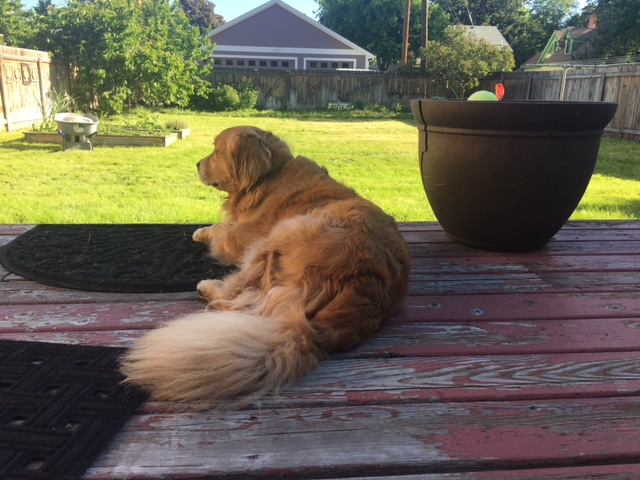
Cali surveys her yard from the deck
When not under the cherry trees, Cali enjoys her perch on the deck

Taste is a tough one. I have always discouraged my dogs from sampling the garden plants. Timo, my first dog, loved lemon verbena and once ate every single leaf from a small plant. The plant did not survive the assault, but Timo and the larger one coexisted happily for many years. As a puppy, Jana enjoyed harvesting strawberries and blackberries in our garden. Cali enjoys the cherries and raspberries in season, of course. But the suggestions of verbena, thyme, and other safe and appealing plants are worth considering.

Finally, tactile stimulation is essential. Cali loves to dig; I have thought about creating a digging spot for her in the garden. Another suggestion is using a variety of textures — grass, mulch (check and check) and paths made of stones or crushed granite, or even sand. We can definitely work more of that into our landscaping.

A final suggestion is creating opportunities for the dog to run around. When Cali has friends over, they do create a sort of circuit, looping into the cherry-tree corner and under the clotheslines.

Some other things to consider:

  • Know which plants are toxic to dogs and avoid these.
  • Use raised beds, pots, or plant borders to steer dogs away from no-go zones, like the vegetable patch. Interestingly, though Cali dug up all our baby tomato plants the day we planted them, she never bothered the vegetable gardens after that, even though she loves cucumbers, and the cukes were well within her reach. She quickly learned that the raised beds were my turf.
  • Consider your dog’s age and activity level. For some dogs, simple agility equipment or things they can climb or jump onto are a good addition.

The garden can be very appealing to humans, too. But too many yards are designed only for the people in the family. Since Cali spends exponentially more time in our yard than I do, it’s only fair to create a place she will enjoy fully!

Update: Is Grain-Free Dog Food Risky?

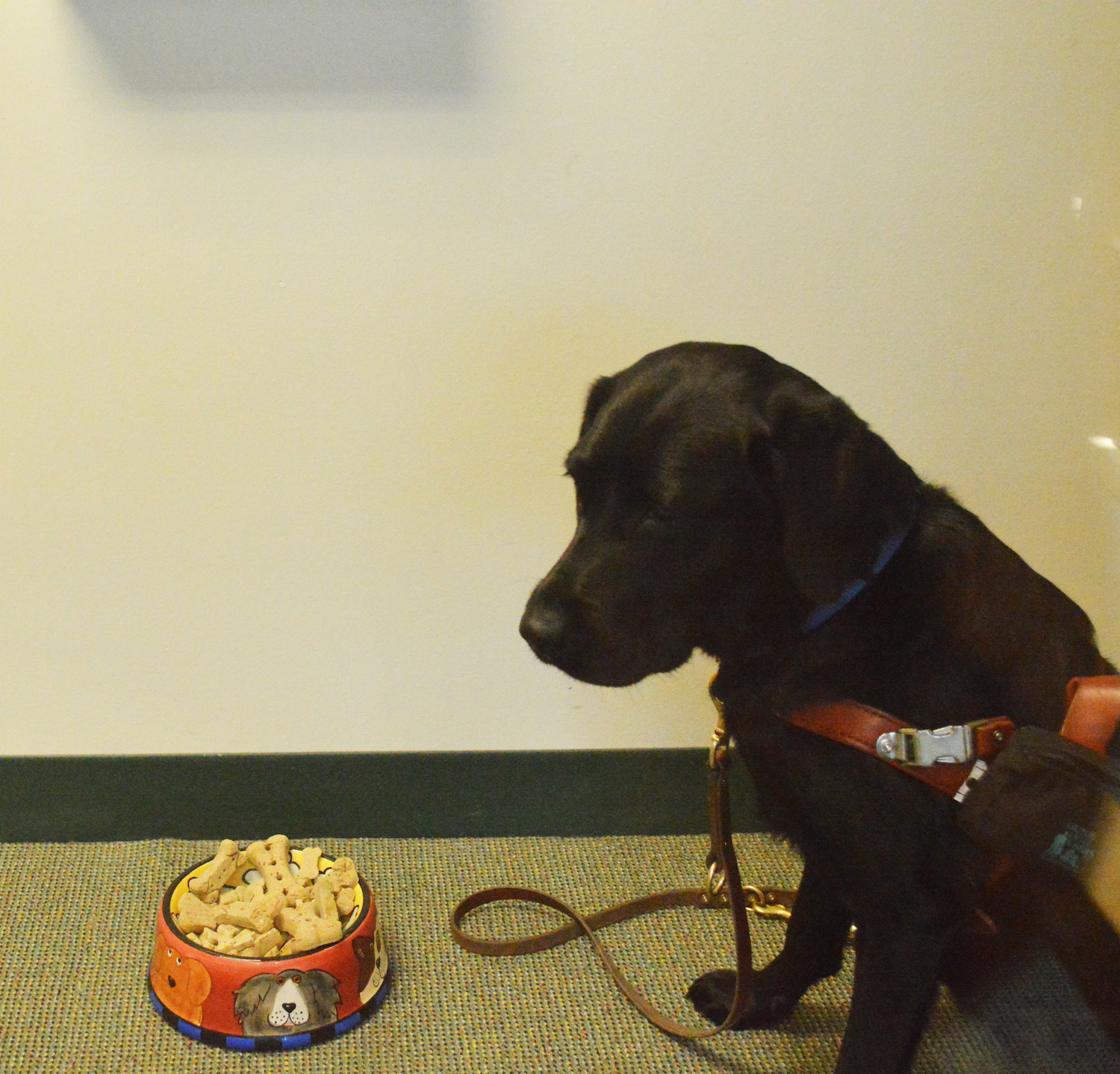
Koala, a black Lab, eyes a bowl of dog biscuits.
Despite what your dog might tell you, an all-cookie diet is not recommended.

A few months have passed since the FDA scared dog-owners who feed grain-free dog foods, so the I decided that Thinking Dog blog needed to run an update.

I am grateful to veterinarian and researcher Lisa Freeman, who has written extensively on this issue. Based on some of her work, including this Dec. 1 JAVMA article, “Diet-associated dilated cardiomyopathy in dogs: what do we know?” here is what I have learned:

  • Grain-free diets are not the problem. What Freeman calls “BEG” diets — foods from boutique producers that are based on exotic ingredients and are grain-free — appear to be a common factor in many of the cases of DCM. (DCM is dilated cardiomyopathy; see the earlier post, Should Your Dog Go Grain-Free? for more info.)
  • Most dogs do not need to eat boutique foods with exotic ingredients.
  • Some of the companies producing these foods have not done thorough nutritional research and testing, and the foods are not nutritionally sound. Or their quality control might not be as good as some more conventional dog food producers, so the foods may be less consistent.
  • The problem is not only about taurine levels, either. Freeman writes that most of the dogs she’s seen (in the practice at Tufts University) with DCM have normal taurine levels. Furthermore, many improve with a diet switch (away from a BEG food), even though their taurine levels were and remain normal.
  • Owners who have moved to home-prepared diets should be extremely cautious and consult with a veterinary nutritionist to ensure that the homemade diet meets the dog’s needs.

The problem does appear to be linked to nutritional deficiencies. Exactly what, though, is still unclear.

What should a concerned owner do?

  • Feed a high-quality food from a responsible manufacturer. You may be tired of hearing this, but: The best food for your dog is not necessarily the best food for my dog. Each dog’s needs are different. Your budget and what’s available in your area differs from what I can get easily. So, I am not going to recommend specific foods. I strongly urge you to choose a food from the Whole Dog Journal’s list. Their 2018 list is available; I will post a link to the 2019 list when they publish it.

Dry dog foods

Canned dog foods

  • For advice on raw foods, check out the Dog Food Advisor recommendations.
  • If your dog gets lots of ear infections, is itchy, or has hot spots or other issues that could indicate food sensitivities, consult with a vet and a nutritionist (some vets have lots of training and knowledge about canine nutrition but many do not; ask for credentials).
  • I do not recommend “prescription” diets. Many vets will recommend these. Why? They make a lot of money selling them. They tend to use low-quality ingredients and be very, very expensive. You can get a higher-quality commercial food for less money that addresses the same issue. Whether your dog needs a lower-fat or lower-protein diet, should avoid particular ingredients, whatever the issue, there are likely to be several foods in your (high quality) pet store that will work.

If You Use Oral Flea Control — Read This

Red circle with a slash through it over image of a flea and a tick, indicating No Fleas or Ticks.As many readers know, I trust the Whole Dog Journal as a key source of information on dog health and welfare. So when the WDJ issues a warning, I pay attention.

A few days ago, they published this: Hold Off on Those Oral Flea-Killing Medications. This came up just after Dora’s mom sent me a link to the FDA warning. Cali and Dora have both been taking Nexguard.

Cali is lucky to live in Montana, where she does not need heartworm preventive and only needs flea control a couple months of the year (we won’t get into the reasons for WHY that is true, but think cold weather …). That significantly reduces the amount of these nasty chemicals that I have administered to Cali over the year+ that we’ve been in Montana. But not everyone is lucky enough to live in a place that has winter for 8 months a year, so …

Flea control is important, and I am not recommending stopping it completely. I do not have an “answer” — a single recommendation for all dogs. I do have some suggestions, with emphasis on this: What you choose depends on the climate where you live, the prevalence of fleas and ticks, your dog’s reaction to both flea bites and to the different treatments and preventives, and on how much time and effort you are willing and able to invest in keeping your dogs and home flea-free. If your dog is extremely sensitive to flea bites and fleas are abundant where you live, you might opt for stronger methods than if you live in a climate where fleas are less of a problem, for example.

Newer oral flea control products like Nexguard, Bravecto, Credelio, and Simparica are the subjects of the warning. If you are using these, stop doing so until more is known. By “neurologic adverse events,” the warning mostly means seizures, but can also refer to tremors or loss of muscle control, which can mean stumbling or falling. These products are relatively new, and the FDA has received reports of such reactions. Most dogs do not have an adverse reaction, but … there are enough other options for parasite control that why risk it?

Other oral flea preventives, like Trifexis, have their own histories of causing seizures in some breeds of dogs or individuals with a history of epilepsy or other seizures. Comfortis, AcuGuard, and ComboGuard use the same medication as Trifexis. I’ve used Trifexis and Comfortis; I am not thrilled with using strong chemicals on my dogs, but for people who live in, say, Florida, where fleas are a huge problem and many remedies simply don’t work, these are an option.

Prescription topical preventives (Advantage, Advantix, FrontLine) are an option. In many parts of the world, mostly the warm, humid regions, the fleas are resistant to these and the topicals simply do not work. Where they are effective, and if you do not have to use them year-round, they might offer a solution. They have their own problems; they are potent neurotoxins, after all. You need to be careful when you apply them and when disposing of the containers. They are nasty, toxic chemicals. But if relatively easy, spring and summer flea or flea and tick control is needed, at least look into these. Some dogs react badly to these but, unlike with an oral medication, immediate and repeated bathing can reduce this reaction. I don’t recommend the over-the-counter topicals based on bad personal experience (severe reaction in a dog).

A more holistic approach is also a possibility, but this is far more labor-intensive and might not be sufficient in places where fleas and ticks are more prevalent and hardy. This includes regular (1-2 times a week) washing of rugs, pet beds, etc. as well as some combination of natural repellents. Dogs Naturally has some suggestions and warnings in this article: 9 Tips for Safe and Natural Flea Control. Comments at the bottom of the WDJ article mention Neem oil, beneficial nematodes, food-grade diatomaceous earth, and more. I have not tried these and cannot vouch for their effectiveness. Other comments mention amber collars, Only Natural Pet’s flea repellent tags, and Arava natural pet products. Again, no experience with these, though, having looked at the websites, I’d be most inclined to try the Arava products or the Only Natural Pet topical.

I wish there were an easy answer. Think carefully about your dog’s needs and the options for where you live. Please share your experience in comments, especially if you have tried any of the more natural approaches.


Are Doggy DNA Tests Worthwhile?

A Puli dog walks on a dirt road.
Is your dog part Puli? Probably not, no matter what the DNA panel says. Creative Commons photo by Rennender

DNA tests started out as a fun way to try to figure out a mixed-breed dog’s genetic makeup. Many people I know who’ve done them have gotten results that made me a little skeptical — high percentages of extremely rare breeds. I am not a geneticist, though, and it all seemed harmless enough.

But.

People are using — and the testing companies are marketing — these tests in two ways that could be very, very bad for dogs: to attempt to predict dogs’ future health problems and to “tailor” behavioral training. And, according to an excellent column in Nature, the tests are extremely inaccurate.

Let’s start with the problem of trying to tailor behavioral training to the supposed mix of breeds in your dog. Your dog is a unique individual. Whether purebred or mixed, each dog’s behavior is affected to some extent by genetic drives — some dogs want to herd everything; some want to chase whatever moves. It’s also enormously affected by personality and experience. Within a breed, within a litter, even, the personalities and drives can be very different.

A good trainer tailors her teaching to the individual dog, of course, but she bases her work on the dog in front of her — not on some possibly wildly inaccurate list of breed percentages. If a dog is half Lab and half German shepherd, do you reward with food half the time, since the shepherd half might not be food focused? Do you use harsher methods half the time if your dog’s ancestry might lie in a military dog line? It’s silly when you start to parse out what it might mean in day-to-day training and life. A smart dog owner will choose a trainer who uses motivational methods tailored to the dog based on her hands-on experience working with that dog.

But a far more dangerous use of these tests is in attempting to predict future illnesses. The Nature article, and these related articles in the Washington Post and the Undark website explain the problems with this in great detail. In sum:

  • The mapping of a single gene mutation to a specific disease is far from foolproof. Genes express themselves differently in different breeds, so a gene that is linked to a condition in one breed might not behave the same way in another breed. And no one really knows what happens in mixed-breed dogs.
  • Having a specific gene mutation might (or might not) increase the risk of a particular disease. Basing a decision to euthanize your dog on very imprecise data, rather than on the actual dog’s health and symptoms, is cruel.
  • People unnecessarily panic when they get the results that show gene mutations — which might be completely meaningless. They pay for — and subject their dogs to — unnecessary, stressful, and expensive tests, which generally don’t tell them anything conclusive anyhow.

The truth is, genetic testing in humans works much the same way … results are often highly inaccurate; they are not predictive; and they could cause people to panic and get unnecessary “treatment” for a disease they think they might get some day. But as an adult, you get to make that choice for yourself. Subjecting your dog to it — or killing him out of fear of what might happen — is horrible!

The testing companies are businesses. They make money by selling you the tests. They also make money by selling the huge amounts of data they collect on test subjects. Veterinary clinics are also businesses, which many people lose sight of. Some vets are ethical and don’t push expensive tests. Others … not so much. Vets can make money by suggesting further testing, special diets that they sell, treatment … there is a definite conflict of interest that can exploit loving pet owners’ worst fears.

So, if you’re curious about whether your pup has some Puli or Xoloitzcuintli in his past (unlikely), go ahead and do the test. Just don’t base decisions about his medical care on the results. Train, and care for, the dog in front of you — his behaviors, his quirks, and his medical symptoms.

Choosing a Dog Food

I’ve gotten some questions about choosing dog foods, particularly since this post was published: Should Your Dog Go Grain-Free? Here are some guidelines (and opinions) I recently provided to people who asked:

  • I’ve seen wonderful results with dogs eating mostly or entirely raw diets. These can be fresh, frozen, dehydrated, or homemade. I personally would not do homemade; it’s a lot of work, I don’t want all that meat in my vegetarian kitchen, and it’s challenging to ensure you are meeting all of the dog’s nutritional needs.
  • For dehydrated, Honest Kitchen is a good brand that is easy to find in good pet stores and online. If you buy directly from the company, you get free treats and other rewards (well, your dog does …).
  • For frozen, Primal and Instinct are nationally available; check in high-end pet stores for local or regional brands. Cali eats Steve’s Real Food, which is not available everywhere. Getting frozen food delivered is really expensive. Learn more here: Dog Food Advisor.
  • For kibble, I can’t say it enough: Choose a food from the Whole Dog Journal’s list. They look into ingredient quality and sourcing and manufacturing practices. They really do their homework.
  • Never buy dog food or treats at the supermarket. Health food stores and natural grocers are a possible exception. If you live in a less urban area, feed stores might stock a wide variety of pet foods and treats; watch quality and check ingredients, but these places might be less expensive than high-end pet stores.
  • That said, shop around. I’m considering switching Cali’s kibble to a brand that uses higher quality ingredients than her current Canidae. It actually costs less — and the real attraction is that I can get it at the high end store where I get her frozen food.
  • For dog treats, look for things that are simple: dried meat or fish, locally baked, few-ingredient biscuits. Avoid anything with artificial colors, preservatives, or ingredients you can’t pronounce. (That’s good advice for choosing your own treats, too!)
  • There’s no need to specifically seek grain-free foods, but many of the top brands have little or no grain. I do avoid wheat and especially corn, a common filler in cheap dog foods. Most of that filler ends up on your lawn. And, corn is a common allergen in dogs.
  • If your dog is gassy or has digestive issues, try a diet change. The protein could be wrong, or there might just be some ingredient or combination that doesn’t work well with your dog’s digestive system.
  • Food sensitivities are a common cause of itchy dogs. And ear problems. If your dog seems itchy and you don’t think it’s a seasonal allergy, take a look at her food. Eliminate corn and wheat. And chicken. If that doesn’t help, consult someone knowledgeable about canine nutrition (NOT necessarily your vet!).

Choosing a Protein

  • Some people prefer to feed a diet with multiple protein sources. When Cali had digestive issues as an adolescent, I decided that that made it too hard to know what was causing the problem.
  • I tend to avoid chicken-based kibbles, since many dogs are sensitive to it and since a lot of the larger dog food manufacturers aren’t using the highest quality chicken. I don’t want my dog eating meat from animals that were loaded with hormones and steroids, for example.
  • Very few dogs need exotic proteins. Don’t spend the money unless you know your dog is allergic to the more common, and more affordable, meats.
  • Pay attention to your dog. If she’s always hot, seeks the cool spot in the house, or gets hotspots or other inflammatory problems, avoid lamb and other “warm” proteins. Beef and turkey are neutral. Duck and most fish are “cool” proteins. On the other hand, if your dog loves the sun and wants to sleep under the covers and suffers even in a Florida winter, do look for lamb-based foods. You might think the idea of warming and cooling foods is mumbo-jumbo, but it has definitely helped both Cali and her sister Dora resolve recurrent hotspot issues. I’m a believer.