The Value of a Tennis Ball

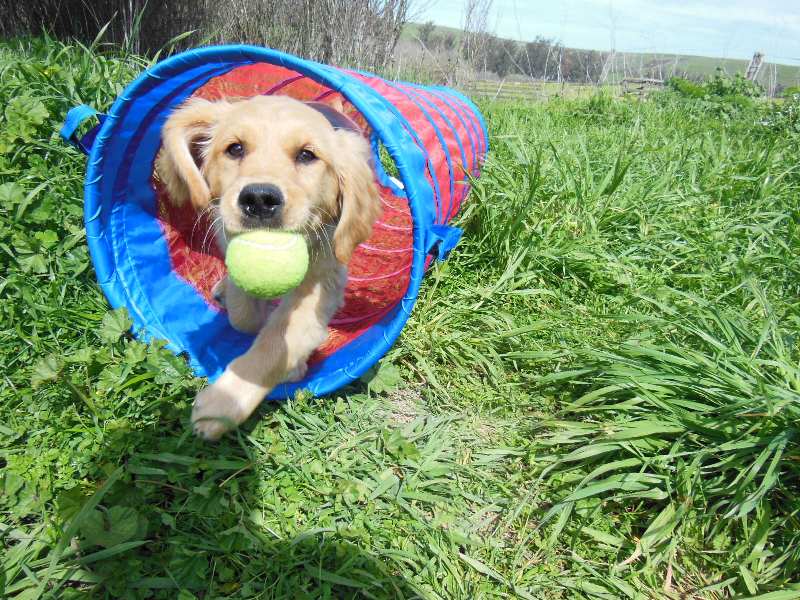
Cali, as a very young puppy, runs through a tunnel holding a tennis ball.
Cali was a young tennis ball addict

Cali showed her entrepreneurial spirit this week when she decided to buy a tennis ball. Cali adores tennis balls. She loves chasing them, holding them, drooling on them. She especially loves getting one really wet and drooly and then rolling it in the dirt she’s carefully prepared by digging a new hole in the yard. She then tries to sneak it into the living room. She’s not allowed to have tennis balls in the house.

I also like tennis balls. When my shoulders feel stiff and sore, I use a tennis ball to loosen the muscle cramp. I learned this trick from Jana, who loved to position a tennis ball under her shoulder and then roll it down the length of her spine while wriggling on her back. My yoga teacher advised using a tennis ball for this as well. There are two ways for people to do this: lying on your back on the floor, with the ball under your shoulder; or standing against a wall with the tennis ball pinned between your shoulder and the wall. Both work. The problem with the floor version, I have found, is that Cali cannot resist temptation, and she tries to steal the ball from under my shoulder. I end up with no tennis ball and a lot of drool on my neck. So I use the wall method.

The other day, there I was, leaning into the tennis ball. Cali was on her bed, watching intently.I think that part of the appeal for Cali is the “breaking the rules” aspect of getting her teeth on a tennis ball inside. She got up, rooted around in the blankets a bit, and found her Kong. Cali has two Kongs, and at the time I was working on the tennis ball, I knew that one was empty and one had a big chunk of a biscuit inside.

A very young Jana studies her Kong toy.
Jana was a young Kong addict

Now, Cali has only recently become a fan of Kongs. Jana was an early Kong addict, and by the time Jana was about 6 months old, there was nothing that I could pack into a Kong that she couldn’t devour in less than 30 seconds, leaving the Kong sparkling clean. But as long as Jana was on the scene, I could not give Cali a Kong. Cali is more leisurely in her approach to Kongs. She’ll work at it for a few minutes, get some of the food out, then abandon it. A few hours later, she’ll find it and work some more. It’s more of an all-day snack than a quick nosh. She’s also more likely to dribble bits of whatever is in the Kong onto the floor, the carpet, her bed … Jana would not let a drop or a crumb escape.

Cali picked up one of her Kongs, walked over to me, and sat. She looked at the shoulder where the tennis ball was, then looked me in the eyes. Back to the shoulder, back to the eyes. Then, still holding the Kong in her mouth, she poked her nose at me a few times, looking me right in the eyes. Oh, I said, are you offering me that Kong? I held out my hand. She placed the Kong in my hand and looked at the tennis ball shoulder again. I handed her the tennis ball. Purchase complete, Cali walked back to her bed, smiling.

I looked at my newly purchased Kong and discovered that it was the one with the biscuit. I pulled the biscuit out and called Cali back to me. She came, leaving her new purchase safely on her bed.

You’ve overpaid, sweetie, I told her. Here’s your change. She accepted her change, ate it, and returned to her tennis ball.

Dog trainers know that the dog gets to decide what a worthy reward is for any task. Cali is more obsessed with tennis balls (and less obsessed with food) than any other Lab or golden retriever that I’ve worked with. But she knows what she values and how to get it. She also knows that a Kong has value, and that one with food is worth more than one without. She doesn’t seem to understand scarcity and how it should affect value, though; we have lots and lots of tennis balls, but only two Kongs. To her, a tennis ball clearly has more value than even a Kong-with-snack, even though one is scarce and the other is common.

Or maybe the joke’s on me: She might also know that she’ll get the Kong back, filled with biscuits, each morning when I head out the door. So it’s not a scarce resource after all.

Now really, who’s the smart one here?

I Don’t WANT a Little Sister

This slideshow requires JavaScript.

I don’t want a little sister. Or do I? Cali wondered. 

Cali met Koala with great ambivalence. She loved Alberta, Deni’s previous guide. Alberta and Cali joined the family at the same time, though Alberta was older, and a career girl to boot. Cali looked up to her and admired her. And, after a week or so of struggling to understand each other, they worked out a play language of their own.

But then, Alberta retired and moved to Montana (lucky Alberta!).  And Koala waltzed into Cali’s living room, bounced off the walls a few times, then settled down on the Good Bed. You know, the one Cali was always stealing from Jana.

That look on Cali’s face stunned. Disbelieving. Outraged. It was priceless. Hmmm, Cali, paybacks are … tough to handle sometimes, aren’t they?

Cali and Koala I just call them Koali haven’t spent enough time together to have their own play language yet. And I think Cali is ambivalent, maybe confused about where Koala fits in. She’s younger and newer to the family. Little sister. But she works and travels and seems to get all sorts of special privileges. What’s up with that? She’s also a bit pushy and intense. But she is fun, and we spend a lot of time at the park when she’s around so … Cali just isn’t sure.

Koala’s Marshmallow Test

This slideshow requires JavaScript.

Koala, Deni’s current guide dog, is an exuberant dog; she has greeted me so enthusiastically that I emerge bruised. When she finds Deni a trash can to dump her poop, Koala leaps up and embraces the can, entire body wagging. So I was skeptical that she’d do well on the marshmallow test.

The marshmallow test is a test of self-restraint. The original test pitted preschoolers against marshmallows: If the child, unsupervised, could hold off on eating a marshmallow for 15 minutes, the researcher would reward the child with a second marshmallow. Children who waited, rather than eating the marshmallow with which they were left alone, were found, as adults, to have achieved greater success according to a variety of measures: higher SAT scores and greater academic achievement, more likely to have saved for retirement, etc.

Alberta, Deni’s previous guide dog, as you might recall, did very well on the marshmallow test. She clearly worked to distract herself from the treats, employing some of the methods the children did: she turned away, closed her eyes, raised her head and closed her eyes. Some of the kids sang or hummed; Alberta raising her head to smell something other than the treats is probably the doggie equivalent.

Alberta is, in many ways, a less exuberant and more restrained dog than Koala. So, I did not expect Koala to fare as well on this test of self-restraint.

Deni set up Koala’s test just has she had Alberta’s. A bowl of dog cookies was placed in the quiet hallway outside Deni’s office; Koala, dressed in her guide harness, sat in front of the bowl. Deni told her to “leave it,” then Deni went into the office and closed the door. Koala was alone in the hallway, but Deni, and a student photographer watched through the window blinds. Koala could not see Deni.

While Deni and the student were setting up the test, filling Koala’s bowl with treats, Koala — in harness — leapt and bounced around them in excitement. The student commented that she did not think the test would end well for Koala.

So, how did she do?

As Alberta had, Koala first leaned in and sniffed the cookies. She sat back up. And sat there. Unlike Alberta, she sat and stared at the bowl, salivating a bit. That’s it. She did not have to distract herself, she did not look away, close her eyes, or sing to herself. She aced the test.

I might need to point out: Both girls are Labradors who love their food and adore cookies.

Why was the test easier for Koala? Both girls were able to fight temptation and exercise self-restraint. What’s her secret? I’d love to say that her analytical nature is the key, but being very analytical myself has never helped much in the face of a chocolate-chip cookie.

Is Koala simply on a higher ethical plane than Alberta is (or I am)? That is the question that Deni is now asking: Is Alberta more ethical for having overcome a struggle to exercise restraint? Or is Koala more ethical for being easily able to do the right thing? Deni asks her philosophy students the same question about people.

We may never have an answer to that. What we do learn from this test, though, is that a dog’s behavior is not evidence that that dog can (or cannot) learn to “behave” —exercise self-restraint — in other circumstances. Koala, for example, plays tug to win, big time. She’d rip your arms out of their sockets if you let her. But her ability to “leave it” shows that, with practice and reinforcement, she could exercise that same restraint in other areas.

For other dogs and people, that translates to not giving up on a dog who has some uncontrolled behavior; it’s likely that, with some coaching, time, and practice, that dog, too, can pass his own marshmallow test. Now I am curious about Cali …
Trust Your Dog

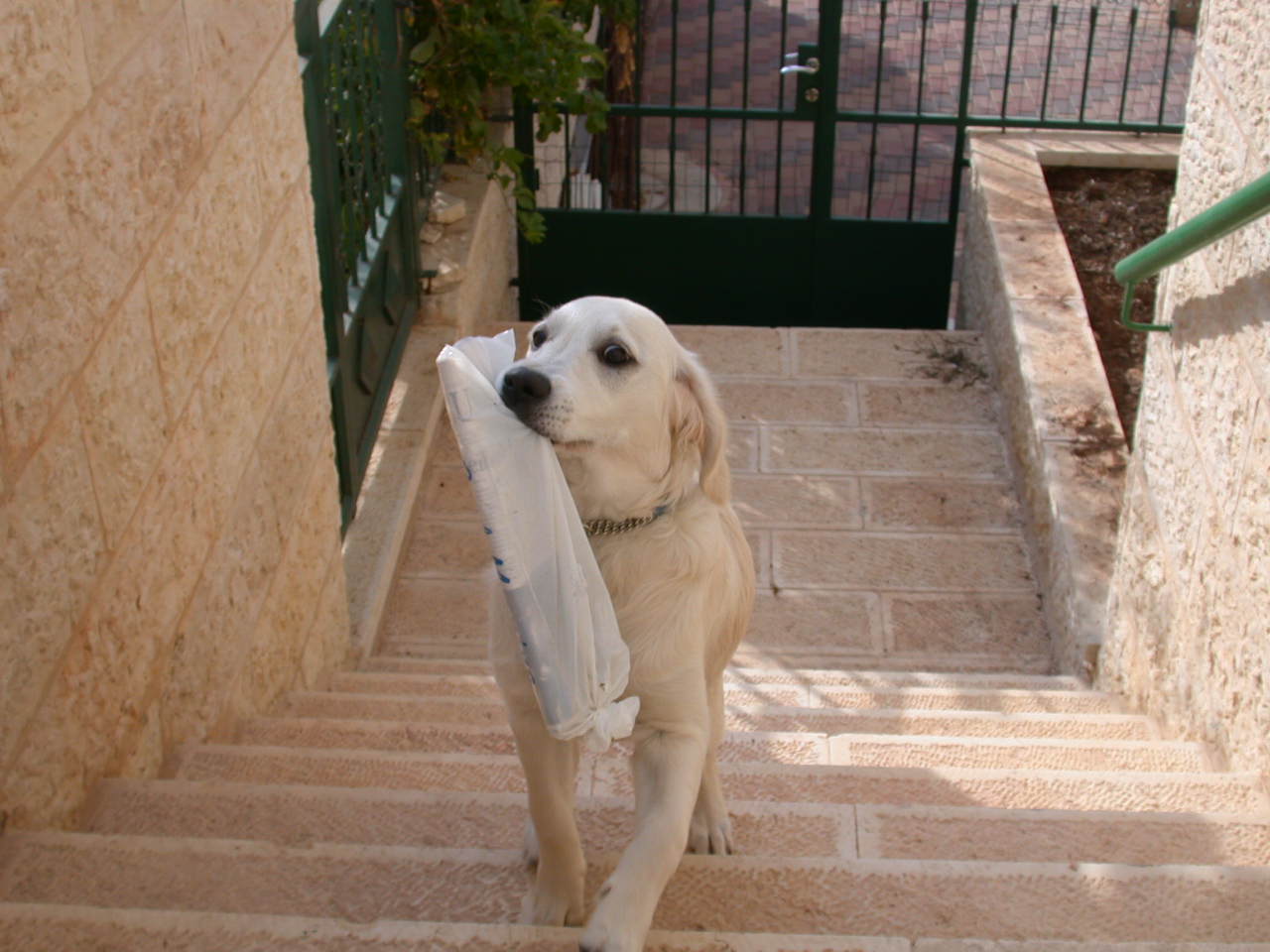
Jana, at 4 months old, gets the paper

Jana gets the paper every morning. She has had this job pretty much her entire life. She’s good at it. Really good. She is also very serious about it.

She has carried papers up stairs and the length of country driveways that you can’t even see the end of. For several months a few years ago, we actually had to walk out to the end of the road for the paper, maybe a quarter-mile. She carried the paper all the way home, no matter what essential business might need to take place on the way.

Now, living in Petaluma, she listens for the delivery person. We have a great delivery person at the moment. He or she comes at 4:30 every morning. Rain, shine, weekend. Doesn’t matter. Drives into our parking lot and tosses the paper in the general vicinity of my gate. How do I know this? Well, if I am not awake, Jana hears the paper arrive and lets me know that it is time to get the paper. She’s very polite about it, but quite insistent. She does have a snooze button, and I do use it. But still. Most mornings I am at least briefly awake at 4:30.

The paper subscription expired recently, and I actually considered letting it lapse. Then I felt guilty. I would deny Jana her greatest pleasure? Fire her from a job she has performed dutifully for more than 13 years? For no good reason??

So. This morning, a Sunday, we both heard the car and the thud of a paper. A while later, after a couple presses on Jana’s snooze button, Cali woke me up. Cali does not have a snooze button. She wakes me up by jumping onto the bed and shoving her nose in my face. GOOD MORNING she breathes into my face, wagging her tail furiously.

So, Cali got me out of bed, and Jana was eager to get the paper. Out we went. No paper.

Jana looked under the car and along the sidewalk and by the neighbors’ gates. No paper. She got very interested in the small bush by the gate and was quite sure the paper was in there. I looked under the bush. No paper. She kept looking at the bush and sniffing at it. I poked around some more. No paper. I convinced her to go inside.

Then, since she had been so sure there was a paper, I took the big flashlight and went back out for another look. No paper under Jana’s bush  But: The paper was, indeed, under a bush. Not the one Jana had fixated on, but one very close by. I pulled it out, and called for Jana. She was very excited about this development and practically danced outside. She grabbed the paper, the big, heavy Sunday paper, and held it up triumphantly. She carried it inside and traded it for a cookie. She wagged hard, still smiling.

She knew there was a paper, and she knew it had gone into a bush. You should always trust your dog, even if she’s sniffing at the wrong bush.

Scary Dog

Cali, puffed up and trying to be fierce
Cali tries to look fierce

A few weeks ago, while Jana was recovering from a vestibular incident and not joining Cali and me on the morning trek to the park, Cali found herself in a scary situation. On the way to the park, we pass a big, old corner house with two doggy residents. We see the younger one at the park pretty regularly. He’s a young husky mix, big and boyish. Cali doesn’t play with him; he’s too high-energy for her. But she’s not afraid of him, and he’s sweet. If he’s in the yard when we walk by, he doesn’t even bark.

His big sister, Diva, is a different story. She’s about Jana’s age, and she aggressively defends her territory. OK, that’s not fair; she barks aggressively, but doesn’t do anything more than bark. When Jana’s passing by, she anticipates Diva’s barking and tenses up. First of all, she just knows that she should be called Diva. Secondly, she envies Diva her large yard. But even beyond all my anthropomorphic projection, there is a bit of a grudge match between these two. Jana wants to preempt Diva’s barking by barking. They hurl insults at each other as I hustle Jana past the yard. Cali feels safely protected by her big sister.

That’s all fine when Jana is there. But on this morning: No Jana.

We were on our way home from the park, which means that Cali was carrying her tennis ball in her mouth. So, we were walking along, and I saw Diva a split second before Diva saw us and started barking. With no big sister there to protect her, and with mom woefully inept at the barking needed to address this dire threat, Cali stepped admirably up to the plate. She puffed up her hackles, making herself as fluffy … I mean, as big and scary … as she could. She barked her fiercest bark. However, that bark, filtered through the tennis ball in her mouth, sounded like a Chihuahua. A laughing, decidedly non-fierce Chihuahua.

Need I even say it: Diva was not impressed.

Not frightened at all by this fierce version of Cali. I wouldn’t have been frightened either; I just wanted to hug her since she was being so cute. I resisted; the humiliation might have done in poor Cali.

I feel for Cali. It must be terribly frustrating when you are trying your darndest to be strong and courageous and scary … and the people and dogs you’re trying to impress just want to hug you. Or laugh. A human teenager might respond by taking up weightlifting or trying out for the football team, but Cali seems OK. Maybe she’s emotionally healthy enough to shake it off. Or maybe she’s just really relieved that Jana’s recovered and back with us on morning walks.

Mind Your Manners

Wylie, a polite dog?Wylie hates peanut butter. It literally makes him gag. That’s why this story, from several years ago, is still one of my favorites: It tells me something really cool about dogs.

When Wylie was about to retire as a guide dog, his best friend t work brought him cookies. Very special gourmet dog cookies. One problem: They were peanut-butter cookies. Deni graciously thanked her colleague and said gently that she wasn’t sure Wylie would like them; he was fussy. The friend said, let’s see. He offered Wylie a cookie. Wylie accepted the cookie with appropriate doggy gratitude and ate it. The friend went happily on his way, feeling good that his gift had been accepted and enjoyed.

Surprised, Deni offered Wylie another cookie. He gave her what she can only describe as a disgusted “Are you nuts? I don’t eat that garbage” look, turned, and walked away. He never ate another one of those cookies.

Was Wylie “just being polite,” telling one of those little “white” lies we all tell when we want to avoid hurting someone’s feelings? Can a dog do that?

Here’s a different way to think about it, though, really, we’ll arrive at the same conclusion: Dogs are very empathetic. They excel at reading and responding to our emotions. Many dog people have stories of dogs offering comfort when they were sad; getting excited when were excited; responding in a way that many people regard as “guilty” when we are angry. In truth, the dogs are more likely to be trying to appease a person they perceive as angry, but they are accurately reading the person’s emotion.

If Wylie got excited about the cookies, he could be said to be mirroring the friend’s emotion: The guy was presenting a gift that he had selected with Wylie in mind, and he was happy to see Wylie get the gift and enjoy it. Or the friend was sad to be saying good-bye. But Wylie didn’t get excited or offer comfort. He offered a gracious and appropriate, but not overly happy, response. (I don’t think Wylie is capable of phoniness.) And he clearly rejected the gift as soon as his buddy left the room.

My explanation is that Wylie was reading the situation clearly and accurately. He’d been around lots of people in lots of social situations, and he knew these two people really well. He behaved as he’d learned was appropriate. He wasn’t, I don’t think, consciously deciding to lie — any more than we consciously decide to lie each and every time we say something that will make someone feel good — or, to more clearly match this situation, every time we say or do something that is nice and socially expected rather than blurt out our first or most honest thought.

Jana, who really has no use for children of any species, is perfectly gracious and polite when being “enthusiastically petted” (she’d say “mauled”) by a child, but she gives me that look that says loud and clear: “Get me out of here, now, please.” And Alberta would dutifully “say hello” to people she and Deni met, but she really didn’t want to; and she expected a cookie as a reward afterward.

So, I would argue, that dogs read social situations and respond appropriately. What is “appropriate” in a given situation varies widely, and it is learned, not instinctive. Some dogs, and some humans, learn better than others. Some dogs do this well with dogs and poorly with humans, or the reverse. Wylie’s social instincts with other dogs were often less astute than his social instincts in this particular human instance.

So, while I’m not arguing that dogs adopt human social manners, I would say that they learn, over time with the same people, what those people think is acceptable. Much about dog-human relationships entails dogs trying to do what they think their human wants; it’s not surprising that this can get nuanced or that Wylie and Jana are good at it.

How much is that in dog money?

This slideshow requires JavaScript.

I had house-guests recently, and the girls put their entrepreneurial spirits to work. As I have described in other posts, the girls bring me my shoes when it’s time for a walk. They also bring their bowls when they are done eating. For each of these, as well as for getting the paper and for other tasks, they are paid in cookies.

There’s a cookie hierarchy in dogdom and therefore in our home. When requiring the girls to do something they dislike, such as submit to ear-cleaning or nail-trimming, I reward them (some would say bribe, but it happens after the fact) with high-value treats — freeze-dried liver, perhaps, or the dried beef patties we discovered at Costco. When we are practicing recall (come here, right NOW!) they get very high-value treats. We have special tooth-brushing cookies, which are of medium value. Ordinary chores like bringing the paper, shoes, etc. get ordinary treats — a few Charlee Bears or a small biscuit. This, it seems, is the currency of the dog world. They expect to be paid, and, so far, they have been willing to accept the prices I am willing to pay.

They showed a basic understanding of economics when they started bringing things I hadn’t asked for and expecting payment. It reminded me a bit of those kids who used to come out of nowhere and wash your car windshield while you were sitting at a red light, then ask for money. But the girls are cuter and very earnest.

Then my guests came along. One was so enchanted by the dogs bringing shoes — random shoes, no less, maybe taking my shoes to her or a single sandal when she needed her boots — that she inflated the payout. At least once, but I suspect more, she gave Cali a beef patty — a whole one! — and Cali had not even brought her the right shoes! I don’t even want to know what she paid for the girls’ dinner bowls.

Well. Jana and Cali don’t have MBAs, but they don’t need them. The girls quickly understood inflation and supply-and-demand economics. And bargaining: I’ll give you this shoe — and a boot — for one of those beef patties. I’ll throw in a phone or a TV remote if you’ll give me two. What? A measly Charlee Bear? I am going to hang on to this slipper. When your foot is cold, you’ll pay more.

Just what I need. A looming winter of cold feet and fat dogs. I’d better go to Costco this week. We’re gonna need more beef patties.


Funny Girls

What's so funny, Cali?
What’s so funny, Cali?

Cali’s sister Dora recently spent several days with us, and I enjoyed watching them play, wrestle, and hang out together. It is fun and interesting to see how they are similar and how they are different. One similarity is that they both have a silly side and a goofy sense of humor.

All the dogs I’ve known, with the possible exception of a German shepherd, have had some concept of humor. They play tricks on each other and on us — keep away, hide and seek. They act silly. Cali lies on her back and wriggles around the living room, bicycling her legs. This never fails to get a laugh (and usually a belly rub and a play session). She especially likes to do this when I am on the phone.

Jana used to have a “geflite fish” stuffed toy that said, “Oy, vey …” and burbled when she squeezed it. This also was always good for a laugh. She’d dig it out and “oy vey” it whenever she thought I needed to lighten up. Sometimes, she’d stand and do it over and over, just to keep me laughing. She always watched me very carefully as she did this, as if gauging my reaction.

They don’t only enjoy getting me to laugh; they seem to like it even better when I do something silly and they get to laugh at me!

Jana LaughingCali and Dora lucked out. I had lunch with some friends while Dora was here, and we talked about different stretches and exercises we do at home. Someone talked about how important it is to do the “plank” pose from yoga, so I decided to try it. Well, that was about the funniest thing that Dora had ever seen. Cali wanted to play too, so she lay down and squeezed her head under one of my arms. Then she flipped over and wriggled until she was, belly-up, between my arms. Dora was — I swear — laughing. Literally ROTFL. I’ve never actually seen anyone do that!

The next trick was even better. I have a foam roller, and I use it to stretch my back. Fair enough. Hilarious, said Dora. She buried her head in my shoulder, laughing. I am sure she was laughing. Cali got in the act too, and within seconds, I had a fuzzy golden head peering at me from either side. Two big black noses in my face. Two girls nosing my shoulders, neck, face. Nudging. Occasionally, one or both could stand it no longer and buried her head in my shoulder. Laughing. Silly humans!

All those studies about how humans benefit from living with dogs? If laughter is the best medicine, I think it goes both ways.

Chow Hounds

How many of you have dogs who steal food from the table or countertop? How about dogs who beg? On the flip side, how many have to cajole and hand-feed dainty treats to a fussy dog?

Taking available food is a natural behavior for dogs, so puppies generally have to be taught to respect some boundaries and not “steal” human food. They don’t necessarily accept our characterization of “helping myself to a snack” as “stealing.” We also tend to disagree on what items belong in the “food” category, but that is a whole separate issue. Some trainers claim that dogs can’t be taught not to steal food, but that is absurd. Of course they can. But if they keep getting rewarded by tasty snacks left out on the counter, well, that’s not their fault, is it? If you have a food thief, management is necessary. Great temptation plus no chance of getting caught is a tough test for even well-trained dogs, especially once they’ve formed the habit.

I recently spent the weekend with family, including my “cousin” Beau, a boxer. He loves to do the dishes, and his humans allow him the pleasure of this “chore.” Despite knowing that he’ll get some, or maybe because he knows, he doesn’t beg. He’s totally chill while we’re eating, even when we eat sitting on the sofa, just inches from him (reclining on his dog bed).

Jana would never steal food from the table or counter. She generally respects boundaries. But, when she was a puppy, she was invited to a 2-year-old’s birthday party. She was unable to resist the temptation of dozen of cupcakes walking around at exactly her nose level. Never mind that each cupcake was being held by a toddler … She wasn’t invited to the 3-year-old party.

She did learn her manners, but, a girl has to give in to temptation once in a while. I came home with her once and my roommate was sitting on a low chair on the patio, eating a turkey sandwich. She leaned forward to get up, sandwich in hand … at nose level. Gone in one gulp. Well, Jana thought she was offering her the sandwich. An honest mistake. And the now-former roommate is still a good friend. Though I haven’t seen her eating a turkey sandwich when Jana’s been over, come to think of it.

Then there’s Cali. Cali begs. To be brutally honest, Jana sometimes begs. She does so by resting her chin on my lap while I am eating. Or staring me down. If I tell her to stop, though, she seems a bit embarrassed and stops. Not Cali. Shameless beggar. She’s never actually stolen anything, though I wouldn’t put it past her. Besides, she has a family history of food theft. Her great-aunt Oriel, an otherwise perfect dog, would steal food given the tiniest opening. Ory even stole sandwiches from picnic blankets in the park near our house.

Scarlett-Eating-Peas-07-01-16
Scarlett makes sure to eat several servings of veggies a day (Photo by James Cramer)

Cali feels entitled to some (all?) of whatever I am eating. She employs a combination of the stare-down, the nudge, the head on the knee, the LOOK … plus whatever pops into her head at the time. She’s relentless. And I have never fed her from the table, though I occasionally let her lick out a dish, it’s rare, and not at the table either. She will stop when I firmly tell her to settle and stop begging, but she never seems the least bit embarrassed. Hey, a girl’s got to try, she shrugs. She also checks out any snack I put on the little TV table. She’s never taken anything, and she leaves it when I tell her to, but she definitely pushes the boundaries. I wouldn’t trust her alone with a tasty dinner.

And then there’s Scarlett. She has Cali beat, paws down, for shameless begging and food theft. She steals vegetables right out of the garden! Her dad has to scheme and trick her just to get a few peaches off of his own tree!

IMG_2090But these dogs are all “normal” for retrievers. Retrievers are chow  hounds. You can’t leave food out when they’re around. I get that. What I don’t understand, what none of us understand is the fussy dogs. What kind of dog turns her nose up at chicken?

I’m not sure I’d know what to do with one. Deni hand-fed cheese and crackers to a fussy house guest last summer, who enjoyed her visit immensely and did not waste away from starvation while she was with us. But getting her to eat required some creative thinking.

It’s really a question of management: Managing expectations (ours and the dogs’) and managing opportunities, as in, not providing opportunities for the dogs to steal food.


She’ll Have It HER Way

Who else is old enough to remember the Burger King jingle about having it your way?

I’m sure Jana’s never heard it, but she’s completely on board with the idea. Jana is very particular about how she wants things done.

The other day, we set out for our usual morning walk. Except that she did not want to walk a block up Petaluma Blvd. to the crosswalk. Or a block the other way to the light and crosswalk. Nope. She wanted to cross on the corner of our street and head right to the little park a block in on the other side of the street. I could not convince her to walk to the crosswalk.

When she digs her heels in, nothing I can do will budge her. And I am not about to drag 61 pounds of elderly golden retriever down the street.

So we did it her way. She got to the park, rolled in the grass, smiled broadly, sniffed and rolled some more. Happy Jana. Then we went on our usual route to the big park.

On a Saturday morning, early, there’s not much traffic on Petaluma Blvd. so it doesn’t matter if we cross at our corner or at a crosswalk. On a weekday morning, I wouldn’t chance it. Other than traffic, does it really matter which way we go? Of course not. But to Jana, being able to express a preference and make a choice, even a trivial one, matters.

To Cali, too. When we play ball, if I take the “wrong” ball from the basket, she won’t return it to me. She’ll run over, sniff it, then give me a  reproachful look. That’s not my ball. I’ve learned. I pick two balls from the basket, any two, and let her choose. Then she plays happily with her ball.

Some afternoons, if Jana seems tired, I let her choose between a walk (I offer the leash) and her favorite toy (I also offer Squirrel Dude). Contrary to my expectation, she does not always choose Squirrel Dude, who comes with a bellyful of Charlee Bear treats. She often wants a walk. She always appreciates having the choice.

The choices are not monumental. It’s probably similar to letting your two-year-old child choose between two T-shirts when getting dressed. I’m not letting the dogs take over (I keep telling myself that, but even I don’t really believe it …); I’m just letting them have some control over their environment. There’s so much that I can’t give them a choice about that I am always happy to find things that they can decide for themselves.