Cali’s Quiet Competence

This slideshow requires JavaScript.

I was in charge of puppy lunch the other day.

Puppy lunch is Deni and Koala’s name for the midday treat ball break that Koala has trained Deni to give her. The time keeps moving up; it would be more aptly named Puppy brunch, since Koala starts asking for it around 10 am, but that is a different story. Deni and I call it PL, as if Koala, and now Cali, won’t know what we’re talking about. Right.

But I digress.

Koala gets about a quarter-cup of kibble in her large orange treat ball. Cali now gets a smaller amount of kibble in a smaller yellow treat ball. Before anyone howls about unfairness, keep in mind that most dogs stop getting puppy lunch at about 4 months of age. Koala is over 4 years old and Cali is 6. Neither needs puppy lunch, but Koala has everyone convinced that she must eat multiple small meals a day to survive.

Also, Cali doesn’t seem to care. When I gave her a larger treat ball, she lost interest in it well before it was empty. Her lack of fanatical, desperate obsession with food is the least golden-ey thing about her.

They get PL in the downstairs TV / dog play area.

I’ve written in the past about how good Koala is at avoiding obstacles and keeping her treat ball from rolling under things. This large open area is easy for her. She rolls and chases the ball the full length and width of the room, vacuuming up the kibble as it falls out.

Cali has a different strategy. She takes her ball to the dog bed that is in a corner. It’s got walls on two sides and the sofa on the third. She stands in the open end, and gently bats her ball around the small, contained space. It can’t roll under the sofa because the dog bed blocks the bottom opening. This gives her a very easy way to keep track of the ball, get all of the kibble, and stay out of Koala’s zooming, looping path.

This simple strategy shows Cali’s characteristic calm, almost offhand, intelligence. She figures things out and makes the world work for her, in a quiet, unassuming way. She’s fine letting Koala’s exuberance claim the spotlight, and she doesn’t seem to mind that Koala’s treat ball fun lasts a bit longer.

It’s similar when the girls are picking up their toys (which does not happen often enough). Koala leaps and runs and bounces around, flinging toys toward the basket. One occasionally lands inside; others land nearby. She’ll toss the same toy at the basket 3 or 4 times, growing increasingly agitated — at the lack of praise and cookies from Deni. Cali, meanwhile, slowly gets a toy and thrusts it into my hand. (She and I have not worked much on putting things into the basket, for which I take full responsibility.)

Cali’s not always quiet and calm; she’s true to her golden heritage when visitors come or we meet a human, any human, walking down the street. She’s as wriggly and excited to meet a new friend as to greet an old friend. But I really do enjoy her thoughtful approach to problem solving.

The Making of a Cherry Monster

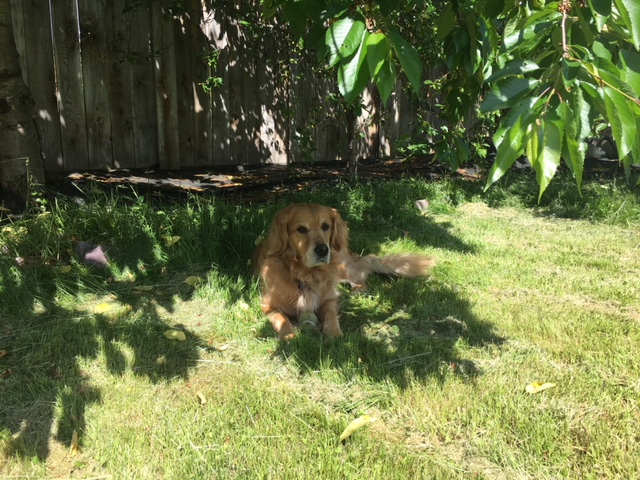
Cali with her tennis ball, in the shade of a cherry tree
Cali discovered delicious snacks under the cherry trees.

It started out innocently enough. Cali wandered over to that nice shady corner of her yard by the cherry trees. One day, she found something red that smelled delicious. She ate it. She found more of those delicious red balls and ate them, too.

I noticed and told her to cut it out. She carefully spit out the cherry pit that was in her mouth and wandered away.

If only it were that simple.

Soon Koala discovered cherries. She taught Cali that if you swallowed the pits, you could eat a whole lot more cherries, faster, even after one of the mean policemoms caught you and told you to stop.

We went from a pit spitter and a pit pooper to … well, you know.

Then Koala packed up and went back home to Florida. Cali had to figure out stealth cherry chomping on her own. She’d keep an eye on me to see if I was watching. If I was talking on the phone or (!) went inside, she’d steal over to the cherry patch and grab a few cherries. She’d still spit the pits if she felt as if she had time to dine more leisurely. But, if she saw that I’d looked her way or — worse — was walking over to ruin her snack — the gobble rate would speed up.

I chased her away from the cherries. She went back. I threatened to make her go inside. She stayed away for a few minutes but was always drawn back. I cleaned up the dropped cherries. She found more. The call of the cherries was irresistible.

She got very sneaky. She’d wander around the yard feigning nonchalance. If I didn’t react, her loops would take her closer and closer to the cherries … Or she’d head that way and glance casually over her shoulder. If I wasn’t paying attention (or she thought I wasn’t), she’d pick up the pace and head right there. If I was watching, she’d change direction, look again, react appropriately … this meandering ultimately always ended at the cherry feast.

Finally, nearly all the cherries were ripe. I picked several million one Sunday morning. A friend helped me pick most of the remaining billions of cherries one evening after work. We cleaned up the dropped cherries pretty well. Cali went into deep depression.

Now, the only cherries left are too high for me to reach, even with a ladder.  The birds and squirrels help Cali out by dropping and knocking them down.

But Cali has pretty much moved on.

She discovered the raspberries this week.

She picks the low-down ones, being careful to avoid the spiky branches. When I am out there picking, she’ll stick her nose into the bowl and try to steal the fruits of my labor. I tell her to go get her own raspberries. She does, even burrowing into the bushes to go after a particularly juicy berry.

There aren’t as many raspberries, and they have no pits, so I don’t worry as much about her eating those. But somehow, Raspberry Monster doesn’t have the same ring.

Cali and the Magic Box


This slideshow requires JavaScript.


Cali’s head whips around. Her body follows her nose. She’s on the scent.

She started doing this at her second or third “nosework” class — as she ambled around, haphazardly looking for the target. Suddenly, she’d catch the scent and be off, following that now-beloved birch scent to the magic box. All she had to do was touch this box and her devoted servant (me) would start showering her with praise and treats. Really good treats. Yum.

Cali “got it” very quickly. When practicing, I have to put her in the bedroom and close the door so I can hide the magic box. She trots out eagerly, nose in the air. Within seconds, that nose whips around and she’s dancing beside the box.

The road to nosework expertise is not without bumps. At one point, Cali started bashing the box with a large, soft paw. When we switched to cardboard boxes, she thought they might make a nice snack.

Despite the minor hiccups, Cali continues to progress in her scent-detection abilities. She’s putting them to work daily. Though Jana enjoyed the concept of smell walks throughout her life, Cali had never been interested in sniffing her way through town. Now she thoroughly investigates the many (many, many, many …) places along our daily walks that other dogs have marked. I never knew it could take so long to walk around a parking lot!

She’s suddenly developed a deep interest in squirrels, too. Montana squirrels are a lot more interesting than California squirrels, apparently. Especially the one that hangs out near the veterans’ apartment building next to our apartment complex. Oh, and the one that raids our bird feeder any chance it gets, whom Cali seems to enjoy watching.

Back in “nosework” class, we’ve moved from hiding the scent in boxes to moving it around. Cali quickly grasps each new step — at least, in class. Watching her try to understand the new “rules” at home is interesting. She is a living illustration that content and context both affect learning. In plain English — don’t change everything at once. She did find the scent hidden in a plastic container this morning, as well as under the sofa and on a shelf. She’s is following her nose for sure; she can’t see where I have hidden the tin with the scent stick. She’s not very methodical in her search, but she is thorough. And she gets very excited when she finds it.

What’s great about the scent game is that we can play it all winter, indoors, with little changes, and – so far — Cali’s enthusiasm hasn’t faded a bit.


Freedom!

Cali lost her head over Thanksgiving. We spent the week at her Favorite Place in the World, also known as Deni’s Lolo, Mont., house. We were sharing the holiday with Alberta and Mack, two lovely dogs who live there.

Well, the most important thing to know about Deni’s Lolo house is that it has a lot of land and is surrounded by even more open, unfenced land and national forest.

The first day, we set out for a walk around the property and, well, Cali lost her head. She took off running and she ran and ran in giant loops around the meadow, up and down hills, in and out between trees, around and around and around, for several minutes.

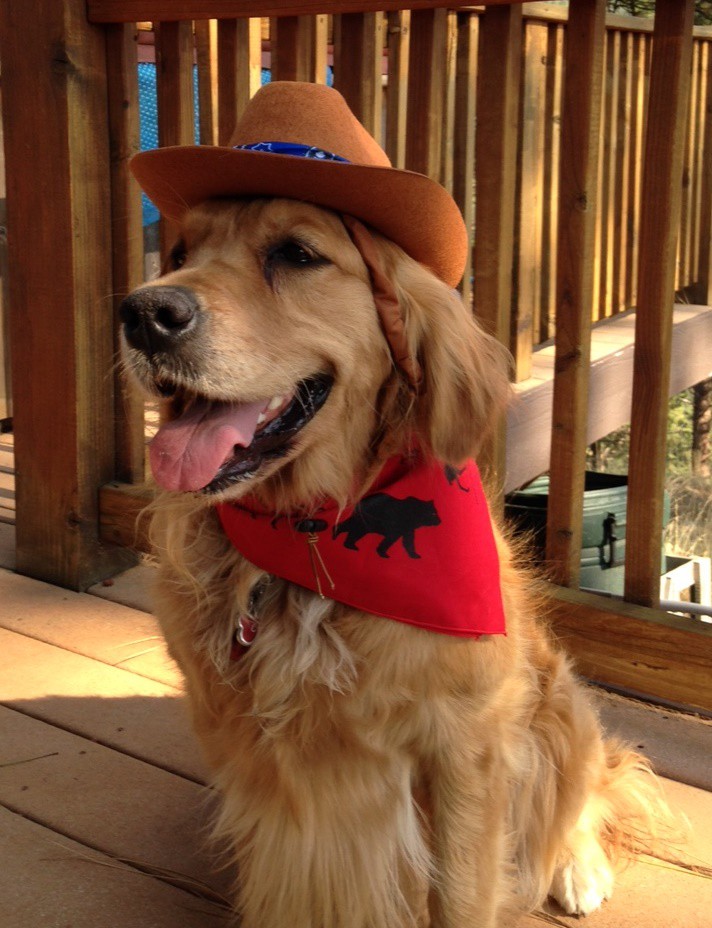
Cali, wearing a cowboy hat, smiles broadlyThe first time Cali spent a summer in Montana, I decided that “Don’t Fence Me In” should be her theme song. When we returned last summer, we stopped at Packer Meadow, which is at Lolo Pass, right on the Idaho — Montana border, about a 30-minute drive from Lolo. Koala was with us, and the two dogs did the same sort of “lost-our-heads, can’t-stop-running” exuberant celebration (see the video for a tiny sliver of their romp).

There is nothing more joyful than watching a dog run free. And dogs seem to know when they are truly free, versus in a large, open, off-leash, but fenced area.

Cali has a good life. Every day, wherever we’ve lived, I’ve taken her someplace that she can play ball and run around off leash. But it’s nearly always a yard or park that is a contained, fenced play area. She loves it, but she knows the difference.

Acing the Physics Final, but …


What is it with dogs and physics?

Many dogs, including Cali, can calculate the exact place to jump into a river to intersect the tennis ball or stick that is floating along with the current. They do this while racing at top speed along the riverbank. Those same dogs can perform gorgeous acrobatics as they run and leap high into the air to catch a flying Frisbee. Cali executes stunning leaps over hills and turns gracefully in the air to catch her beloved tennis ball. Most dogs can catch a tiny piece of popcorn as it sails through the air, artfully dodging the other dog or dogs angling to snatch the same treat.

These calculations require a complex combination of skills that I, personally, have never mastered. They need to understand geometry, trigonometry, calculus, and, yes, physics. They can perform these feats while running at top speed and rarely, if ever, crashing into anything. Miraculous. They are better multitaskers than any human. These dogs could easily ace a college physics final exam.

Why, then, is gravity so hard for those same dogs to comprehend?

I play ball with Cali on the grass outside our apartment. There’s a fairly steep hill, and I often throw the ball up the hill. Cali races after it, catches it or picks it up, and sometimes, brings it back to me.

This is where we run into the gravity problem. She often drops the ball next to me, on the hill. The ball rolls down the hill. Cali gives it a perplexed look … and sits there, waiting for me to throw the ball again.

But I don’t have the ball. It’s several feet away, at the foot of the hill.

No matter how often this happens, Cali just doesn’t seem to understand.

I ask her to put the ball in my hand. She drops it. It rolls. I ask her to get it again. She looks at me as if I am crazy. I get the ball and throw it.

We repeat this cycle several times a day.

How is it that she understands calculus and trajectories but not gravity? Did she skip the first weeks of class, snooze through the midterm — and only show up for the more advanced stuff?

There is, of course, another possible explanation.

It could be that Cali finds it more entertaining to watch me fetch the ball than to get it herself. Nah, that couldn’t be it …

Koala Cleans Up

Photo by Deni Elliott

Koala is learning a skill that all dogs need: She’s learning to pick up her toys before she goes to bed.

Wow, you might be thinking, that’s amazing.

It’s really pretty simple, once you get over the ridiculous human notions that dogs “can’t” do … whatever. Frankly, I believe that the only limitation on what dogs can learn is the imagination of the humans teaching them.

So, back to Koala. Koala is the smartest dog I know. She is also an excellent people-trainer. She’s got Deni really, really well trained. For instance, even though Koala celebrated her third birthday a few weeks ago (mazal tov Koala!), she has Deni convinced that she will not be able to work, and may well keel over and die, if she does not get puppy lunch every single day. Most Labs and goldens give up their puppy lunch at around 6 months of age. It was the single most terrible experience in Jana’s long and otherwise happy life.

The next thing that Koala trained Deni to do was provide a bedtime snack, just before the nightly cuddle. This actually was fortuitous, because it made teaching Koala to clean up very easy. While possibly not as smart as Koala, Deni is no slouch. She put one and one together and got a perfect back-chaining opportunity: Deni simply had to remember to ask that Koala clean up before she would get her bedtime snack.

OK, there is another step of course. Koala had to know to get her toys and to drop them in the toy basket. Koala is a very well-educated guide dog, but for some reason, a working retrieve was not part of her university curriculum. No matter. Deni easily taught her to bring toys to her. Koala did already know to drop items on cue, so getting her to drop them into a basket was also pretty easy.

With these essential pieces in place, and the very strong motivation of her snack, it took Koala only a few days to get into the routine. The biggest obstacle, to be honest, was Deni remembering to ask Koala to clean up before providing the snack. It’s nearly always the humans who hold dogs, back, not any lack of ability on the dog’s part.

A bonus: Koala, like most smart dogs, excels at finding shortcuts. She seems to have figured out the concept and, in the interest of making snack delivery speedier, she leaves fewer toys lying around. The other day, she had only two to pick up. Chores done, on to snacks and cuddles. Seems like an all-around win!

Cali and the Singing Bowls

A couple weeks ago, a friend came to visit. She brought her Himalayan singing bowls and showed us what she was learning about playing them.

Cali was enchanted; Koala was indifferent.

Cali’s reaction was curiosity, and she investigated the bowls (and our friend) very thoroughly. This short video shows some of what Cali.

She approached, sniffed the bowls, sniffed our friend, sniffed the various implements used to strike the bowls; she stuck her head into the bowls; she walked around the room, listening from different angles.

Most of the time, Cali wagged her tail enthusiastically. But at one point, when the sound was high-pitched, she slowed the wags and walked away. But within minutes, she was back at her investigation.

Cali’s curious, but she’s also cautious around new things, so I was a little surprised by how nosy she was being. She also tends to quickly lose interest in anything that’s not a tennis ball, but she remained engaged throughout the “concert,” which was about 20 minutes, maybe more.

Meanwhile, Koala lay next to Deni and pretty much ignored the whole show: the bowls, our friend, Cali.

I’d love to know what was going on inside their minds!


Where’s Cali?

Cali hides in tall grass

Cali has started a new game. When she doesn’t want to leave someplace (Jacob’s Island Bark Park in Missoula, for example), she hides. She’s really good at hiding, too. See if you can spot her in the photos.

I could get angry with her, say she’s misbehaving, that she’s a willful adolescent. I could also admire her intelligence, strategizing, and ability to read my intentions.

It takes a lot of thought and awareness to hide. Her ability to do so shows that she can think about what I can see and figure out where she can go that I won’t be able to see her. She can anticipate going home, decide that that’s not what she wants, and come up with a way to foil my intentions. She can plan and decide not to respond when I call her, and she understands that she has to be very still so I don’t see or hear her moving.
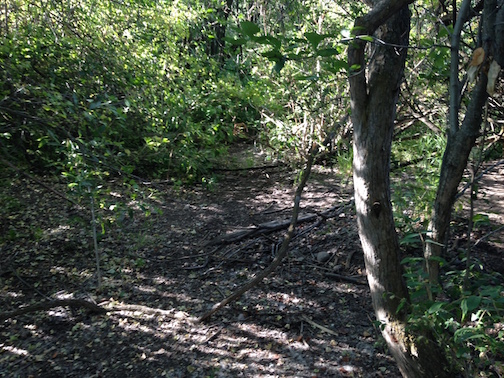
Cali hides deep in some thick bushes

She has to get the timing right, too. She wants to avoid going home, but it would be self-defeating to hide while I was still willing to play ball with her. So she has to read my body language carefully, in addition to parsing the verbal cues I give her. Finally, she also has to know when to resurface so as not to be abandoned (this would not happen, but how can she be sure of that?) or really get me angry.

A few days ago, she hid at the dog park. I might’ve very foolishly muttered something like “we need to get going” before throwing her ball. She took the ball, ducked under a branch, and disappeared. I called her. Nothing. I waited for about 10 minutes, then called some more. Nothing. I was pissed off. I had seen where she entered the bushes, and I went in after her. She was happy as can be, under some bushes with her ball. I grabbed the ball. That got her attention. We walked back to the car with me giving her an earful about what a terrible dog she was, bad to the bone. She laughed.

Then, the next day, she hid in a friend’s garden. I left her there (with the friend) and figured she’d have a nice afternoon in the grass, playing with dog and human friends. She did, but my friend reported that Cali cried when she realized that I had left. She recovered pretty quickly, though, and had fun; my friend also reported that Cali had a fence-fight with the next-door-neighbor-dog — which Cali instigated. But that’s a problem for another blog post.

I’m not really sure what to do about this new trick. I could just not take her to the dog park, but that’s a terrible solution. I don’t think that telling her to “come out right now or we won’t come back tomorrow” would work. She’s smart, but that is probably too abstract and verbose for her. I could punish her when I find her, but that would only motivate her to do a better job of hiding. I could keep her on a long leash, and risk getting it tangled in trees, picnic tables, other dogs …

She hides with her beloved tennis ball, and when she has her ball, she’s not interested in treats, so stooping to bribery is out. I could just wait her out, but I am not sure that my laptop battery would outlast her, and I do need to work.

Deni suggested letting Cali keep her tennis ball with her when we leave the park so that she’s not worried about losing it. In the apartment, all the time. Ick. Cali loves her tennis ball so much. She is happiest when it is really dirty, so she gets is all drooly and wet, then rolls it in dirt. Sometimes she digs a special pit just to make sure it gets totally covered in really fresh, dirty dirt. I’ve generally not allowed her to have the ball inside. If I get desperate enough, maybe …

Anyone have a better idea?
It’s All About Strategy

I recently wrote about how Koala uses tools, using a round chew toy as a base and holder to position a more desirable chew (an antler) for better chewing. But there’s more to her entertainment strategy than tool use.

Although she is a two-and-a-half-year-old working adult, Koala still gets puppy lunch. This is a point of contention in the family, because Jana thought she should get puppy lunch forever (but I did not agree), and Cali thinks, not unreasonably, that if Koala gets puppy lunch, she, too, should get puppy lunch.

What is puppy lunch, you ask. Large-breed puppies, because they are growing quickly, get three meals a day. Adult dogs, who only grow wider, get two (and in some cases, one!) meal a day. Puppy lunch is the mid-day meal that goes away when a dog is about a year old. Unless she’s Koala.

The first puppy-lunchless day is a day of infamy and trauma in the lives of goldens and Labs everywhere. Jana never really recovered.

Koala’s puppy lunch is a portion of kibble, served in a treat ball. The ball gets rolled and batted around, dribbling bits of food for Koala to munch. It’s fun. I have several treat balls, and sometimes give Cali food in one. She gets bored with it far more quickly than Koala, partly because she’s less food-focused. But Koala really enjoys her mid-day snack-and-play breaks.

All of that background offers the context for Koala’s strategic play approach. I was watching her eat her puppy lunch not long ago and I saw her using a fairly sophisticated tactic. We were at a hotel (at the Guiding Eyes weekend, actually) and the room had a dresser, sofa, bench, bed, etc. Lots of places a ball could roll out of reach. Koala is an exuberant dog, never more so than when playing, so the ball was getting batted around at a good clip. But it was not uncontrolled ball batting. She’d pounce, roll the ball, whap it with a paw … but always, always keeping track of the many sand-trap equivalents. Never once did she let the ball roll under or behind something. She’d pounce on it or bat it just in time, sending it in a different direction. She almost seemed to be gauging how close it could get to the edge of the bed, say, before she’d lose the ability to steer it out of danger. She’d watch, position herself, and, bam, send it careening away toward the next potential obstacle. It only takes her about 10 minutes to empty the treat ball, so this high-stakes bowling / golf game took place at an impressive level of intensity and speed. She’s really good at this entirely made-up game.

This is certainly not the first time that I’ve seen a dog play a game that she has created. What held me spellbound was both the intensity and the advanced strategy. She had an intuitive understanding of a fluid situation. Much as dogs do when they catch a Frisbee or dive into a river at the precise moment needed to grab the ball or stick as it floats by, she showed a far better grasp of physics than I ever could.

The geneticist at Guiding Eyes says that each generation of their dogs is “better” — smarter, more suited to guide work, healthier — than earlier generations. If the dogs get any smarter than Koala, we won’t need to worry about robots taking over our jobs; the dogs will beat them to it.


Not Quite Ready

Koala, a black Labrador, lies down in a stone-tiled shower
Koala is always in search of a cozy place to rest.

Koala loves her crate. Deni thought that she might be ready to move to the big-girl bed, which is a really nice hammock bed with a cozy blanket on it. Deni put the hammock bed next to her own bed, and she moved Koala’s crate way far away. Koala likes to be near Deni, so, Deni hoped, the position of the beds would be an incentive for Koala to try the grown-up bed.

No dice. Koala slept in her crate.

Oh, sure, she tried out the bed. She spent part of the night there. She lay down on it when Deni told her to. But first chance she got, she crept into her crate. She likes her crate.

She even started stealing off during the day for little naps in her crate, which she never used to do.

“What’s the big deal?” I asked Deni. “Why can’t she have her crate?”

“It takes up too much space” was the response. “It’s ugly.”

Well. Dora, Cali’s sister, loves her crate too. She still sleeps in it most nights. She loves her nice dog bed in the living room, and she enjoys cuddling with Mom and Dad on the bed, but she loves her crate. Some dogs just love the feeling of having a private room.

Cali might still love her crate, too, if she had one. But her puppy crate was borrowed and went back to the dog school when Cali, Jana, and I moved out of Cali’s puppy home four years ago. Cali has moved a lot, and the crate was a casualty of that first move. She’s never seemed to mind, but if she’d had the choice, who knows?

Koala is adjusting to the hammock bed. She does seem to like it. But she also likes her crate. I think she should have the choice. But I am a big believer in giving dogs choices. And, of course, I don’t have to trip over a huge crate every time I want to get clothes out of my closet, so I do understand Deni’s desire to get rid of it.

It’s too soon to know who will win this battle of wills. My money’s on Koala though.