Duck-Induced Deafness

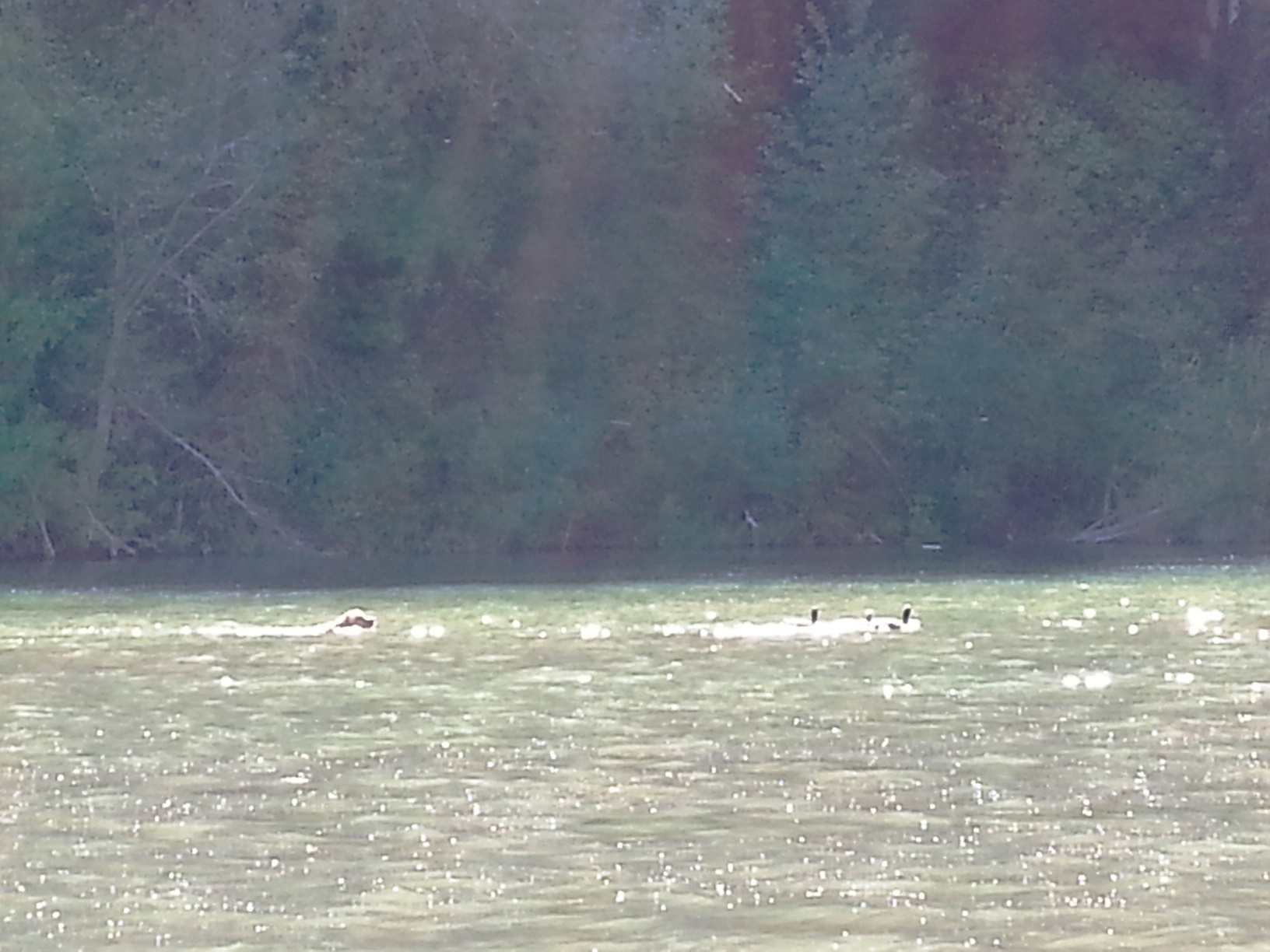
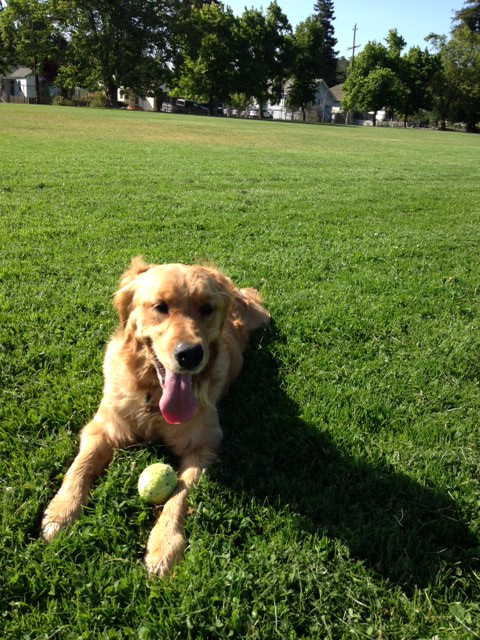
cali and ducksI’m a whole lot less interesting than three mallards. I’m trying not to take it personally.
I took the girls swimming the other day at the Russian River. We were having a nice time splashing around, and Cali was happily swimming after a ball. Jana was searching for rocks. Russian RIver April 2015She likes to find heart-shaped rocks, as I have described in an earlier post. She added this one (right) to our collection on this particular river excursion. In short, all was well.
Until those darn ducks swam by. There were about 10 ducks, enjoying a sunny day. Jana noticed them first. She’d swim in their general direction, and they’d fly up a few feet into the air, and she’d lose interest.

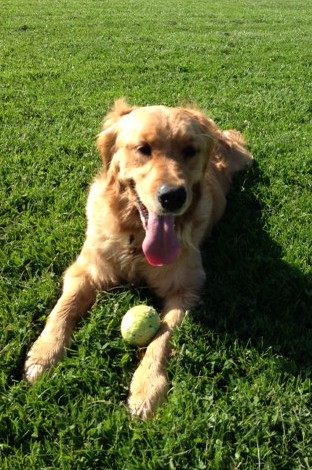
Then Cali got in on the game. She just followed them around, never getting too close. She was no threat. She was holding a tennis ball in her mouth the whole time, and she never got closer than about 10 feet. Three of the ducks decided to play a little game with her. They did not fly away. They stayed just far enough in front of her that they (apparently) felt safe but close enough that she stayed interested. And they swam around in big circles. They swam across the river, around a big island, back to our side. Upriver. Downriver. Big circles.

Cali paddled doggedly after them.

At first, it was funny. She never let go of her tennis ball. She’s a strong swimmer, but after a few minutes, I started worrying that she’d get tired. My friend and I waded farther into the river, determined to head them off if they headed downriver. They didn’t.

We called Cali and waved. But she was suffering a bout of duck-induced deafness and never heard a thing. Jana had long since given up on following the ducks and was nosing around for sticks on the beach. The other golden in our group had gone back to tennis balls. But not Cali. Back and forth, around and around. Finally, my friend couldn’t stand it any longer. She crossed the river and grabbed Cali, getting soaked in the process. Cali still had her tennis ball. She was not even winded.

Jana used to do the same thing. She once followed a leaping fish pretty far out into the Gulf at a Florida dog beach. But Jana has more sense than Cali. After a while, she looked back, saw how far she was, got a very worried look on her face — and turned and paddled for shore as quickly as she could. I don’t worry about Jana disappearing into the wild. She never wants to lose sight of me.

But Cali is more impulsive and less aware of her surroundings. Was Cali even a tiny bit aware that she had worried us? Nothing doing. Within minutes, she was bugging us to throw the ball some more.

Does this mean that Cali has a poor recall? Not necessarily; even the best-trained dog is likely to go temporarily deaf when confronted with a really interesting distraction. It does teach me to keep a closer eye (and shorter leash) on Cali when I see ducks on future water adventures, though. And it’s a good reminder that I need to practice recalls with Cali in more places with lots of interesting things going on. I may never be able to cure duck-induced deafness, but I can probably relieve some of the symptoms.

Turning Shoes into Treats

This slideshow requires JavaScript.


Since I share my home with two retrievers, I figure that they should help out a little around the house by, well, retrieving. I’ve written about how seriously Jana takes her newspaper delivery job. Cali has belatedly decided that she wants in on the treat action, so I thought about what a suitable job for her might be.

Cali lives for our daily walks (sometimes twice daily) to the nearby park where dogs can run free and she can avoid playing with the other dogs while holding onto her ball and occasionally actually retrieving it. I have a pair of shoes that I rarely put on for any purpose other than walking the girls. So I decided that bringing my walking shoes could be her new job. She has a passable retrieve, and, I figured, she’d be highly motivated — the reward, in addition to the requisite cookie-per-shoe going rate, would consistently be an immediate walk, often to her favorite park.

The training went pretty well, except for that incident where I got kicked in the face by my own dog wielding my own shoe, but we don’t need to dwell on that. Cali was very enthusiastic, if a little unclear on the concept at first. Jana helpfully showed her what to do, eagerly grabbing the nearest shoe and bringing it and even more eagerly accepting a cookie in exchange.

On day 1, Cali tried her first shortcut — offering a toy.

The next shortcut: stealing the shoe from Jana. Well, Jana was having none of that. I rescued my shoe from the tug of war and asked for the other shoe.

That was the next challenge. Incredibly, though, Cali seems to have picked up that concept with only a few days of repetition.

We also had to work on the delivery. From overly enthusiastic (see reference to being kicked in the face) to lackluster (dropping the shoe a couple of feet away), Cali’s finish needed polish. I’ve almost got her somewhat consistently putting the shoe into my hand not terribly roughly. Progress, right? Baby steps, baby steps …

But this is where it gets interesting. I know from reading about Chaser, one of my favorite dogs in the world, that dogs can learn to put items into categories. Cali and Jana bear this out, and throw in evidence of a sense of humor, too.

Clearly trying for additional treats, Jana gets this sly look as she sees Cali delivering the second and final walking shoe. She then runs into the bedroom and returns, tail held high and waving triumphantly, with a shoe, any shoe. Give me my treat, her bright eyes and wagging tail say. If I don’t seal off all other shoes behind a firmly closed door, I might get, in addition to my walking shoes, a slipper or two, a flip-flop, a sandal, a rain boot … They have definitely mastered the concept of “shoe.” They’ve even gone outside and brought in a Croc from the porch.

They also instantly made the transition from my laced walking shoes to Keen sandals when the weather warmed up a bit. I do keep the current walking shoes right next to the door, and I am sure that the context is a big help.

I did not try to teach them the category of “shoe.” I have, years ago, worked with Jana on categories and concepts: big and small, toy, ball, and, of course “other” to send her after an item similar to the one she’s just brought. Cali learned all of this on the fly — by watching Jana and by seeing what I did and did not reward.

I’m still in awe of what Dr. John Pilley has accomplished with Chaser and grateful to him for painstakingly documenting his teaching efforts and publishing solid scientific evidence of dogs’ abilities to map words to items, remember hundreds of item names, and group items into categories. I am also, though, delighted and surprised by the constant examples of dogs who learn some of those same things in less-than-ideal home-schooling environments with inconsistent teachers (such as myself).

What have your dogs learned that blows your mind?

“I’m So Angry I Could Eat a Tissue”

Jana01
Photo by Cathy Condon

When Jana gets angry at me, she takes one thing (usually a tissue) out of the wastebasket, shreds it, and leaves the pieces next to the wastebasket.

A quick Google search will turn up dozens of articles on why dogs eat trash or how to get them to stop, and many will suggest that they’re attracted to the food or your scent on items, or that they are obeying an irresistible impulse. Some will suggest that training can solve the problem; some will suggest management (trash cans with lids). Many dogs get into the trash; why do I think it is a reflection of her anger with me? I know my dog.

When Jana was a puppy, she nearly always shredded the trash when I left her home. As a dog newbie, I once followed the advice of a trainer to put hot sauce on the trash to discourage this behavior. Instead, I discovered that Jana loves spicy food. And spicy “food.” (Her definition of food is much, much broader and more inclusive than mine.) After she had enthusiastically thanked me for adding condiments to her snack, I asked her to help me pick up the remnants and put them (back) in the trash can. She did. I never put sauce on her snack again.

As Jana matured, she became a responsible dog who follows the rules and respects boundaries. She’s very helpful and thoughtful. I could leave a steak dinner on the counter and go out for the day (unlikely; I keep a vegetarian home) and it would still be there when I got home. She is 100 percent trustworthy around guests and snacks, even if the snacks smell really good and are at dog-nose level on a coffee table. She has mostly stopped the trash-shredding behavior.

But.

When I leave her at home at a time that is just wrong — it’s close to mealtime, or I have already been gone much of the day and I come in and leave again soon after, or it looks like I am going to do something fun that should include dogs — I will come home to a single shredded tissue on the floor next to the trash can.

I know that serious dog scientists (most of whom seem to never have actually lived with a real dog) will howl over my interpretation of this behavior, but here it is anyhow. I think that Jana is expressing her hurt feelings and anger in a way that is uniquely her own. She could be very destructive; thankfully, she’s not that kind of girl. She could ignore me when I returned, but she’s not the type to hold grudges, either. I believe that she has thought this through and decided that shredding one piece of trash makes a statement.

As Cali does with hiding before brushing her teeth, Jana is telling me how she feels. Both girls do this articulately and in their own way — and then move on. Wouldn’t it be nice if everyone were so mature and as effective and clear in their communications?

Hide and (Don’t) Seek

Albee sleeps_small
Alberta sleeps — or pretends to?

My last post, Hide and Seek, talked about how Cali hides when she is avoiding something, such as having her teeth brushed. This week, I encountered an example of hiding that has a different purpose — and shows some high-level, and rather devious, thinking.
We were visiting at a home where there is a resident cat. Early one morning, the cat’s mom got up, gave the cat his breakfast in a plastic bowl, placed on the floor. Cat and mom then wandered away. Alberta, who had been sleeping on blankets next to the bed, noticed the cat and mom as they passed by into another room and closed the door. Very quietly, which took some effort, as she had several jangly tags on her collar, Alberta slipped out of the bedroom. Minutes later, without waking Deni, she slipped back in and either went back to sleep or did a stellar job of faking it. None of the three people in the house had any idea that she had slipped out of the bedroom or back in.
Later that morning, cat-mom asked us whether we’d seen the cat’s food bowl, which she had last seen at 5:30 a.m., still filled with kibble. Nope. We looked high and low. We looked in closets, cupboards, even the refrigerator, the bathrooms, and the garage. Nope, nope, and nope. Cat-mom wondered whether she really had fed the cat. Was she losing her marbles? Regardless, the bowl itself had disappeared.
Several hours later, walking through the bedroom, I noticed the edge of a plastic bowl under the bed, right near Alberta’s dog bed. Hmmm. Bending over, I reached waaayyy under the bed … and pulled out the cat’s (now empty) bowl.
Our best guess is that Alberta snuck out to eat the cat’s food and then, as is her habit, picked up the bowl and headed toward Deni to hand it over for an after-meal treat. Somewhere along the way, she must have remembered that she wasn’t supposed to let anyone know that she’d stolen the cat’s breakfast. Was she deliberately hiding the bowl? Had that been her plan all along? Or did she only think of it once she got back and saw Deni sleeping? At what point did she realize her error?
Her extreme stealth tells us that she knew she was doing something wrong; the distance the bowl was shoved under the bed indicates the same. If Alberta needs to go outside or decides that breakfast is long overdue before Deni wakes up, she noses Deni and whines until Deni responds. When Alberta picks up her bowl after a legitimate meal, she usually dances around, makes noise, doing whatever it takes to get Deni’s attention — because she is eager to collect her dessert (a cookie for returning the bowl). That she did not do this, and did not leave the bowl where anyone could see it, indicates deliberate hiding.
There’s a whole lot of higher-level thinking going on in her mind — all put to work for devious purposes. Alberta is showing multilayered understanding of a situation: knowledge that she can work a situation to her advantage (steal the food while cat and humans are sleeping or otherwise occupied) and hide the evidence where humans can’t see it.
Despite her impeccable breeding and fancy education, and regardless of her usual angelic behavior, what we learn here is that Alberta is also still a true Labrador — primarily a food-seeking missile. We also see that, whatever we teach our dogs and however we nurture their intelligence and try to shape it in ways that we want, each dog is still an individual who can put that intelligence to work in the ways that best serve her own interests.

Hide and Seek

hiding

Every evening, as we get ready for bed, I call the dogs to brush their teeth. Jana runs right over, ever the good dog (and ever the dog who can sense a cookie opportunity). Cali used to run over. In fact, as a small puppy, she would often ask to have her teeth brushed, going over to the shelf where the dog toothbrush was kept and nosing it, touching my hand and then walking back over to it.
Those days are gone.
Now, her ritual is to hide. First, she heads into the bedroom. When I finish Jana’s teeth and call Cali, she walks toward me, but then she hides behind the bathroom door. She’s less than a foot away from me, and when I call her again, she comes over. But she always goes through this hiding routine. She does it when I need to clean her ears or trim her nails, too.
She could really hide. She could squeeze under the bed or hide in the closet. She doesn’t. She knows (I think) that I can see her. She’s not trying very hard to avoid the inevitable. She’s not refusing to cooperate. She’s simply registering her discontent. I don’t want to do this, she’s telling me, but I will, if I have to. And I will eagerly accept a cookie afterward.
What does all of this mean? I think it shows a pretty high level of communication. Cali is sure of what she wants, and does not want, to do. She knows, too, that we follow a routine and that she has to undergo some grooming, like it or not. She has figured out that hiding lets me know how she feels.
But it also shows her cognitive development in another way. Hiding, and understanding that she and I both know to look for something hidden (rather than assume it is gone forever) is part of understanding object permanence. It’s part of developing consciousness of the world around you and your place in it and in relation to others.
I have seen very young puppies show a grasp of object permanence: I once watched 8-week-old puppies playing with an agility tunnel. One ran in, and another ran to the other end of the tunnel to wait for her sister. That showed that the puppy knew that the “missing” puppy was simply temporarily out of sight and would reappear. She even knew where the puppy would reappear.
By the way, babies begin to grasp this concept at about 8 months, and, at about a year, can retrieve an item if they see it being hidden. Those 8-week-old puppies are leap years ahead of the typical baby.
So it’s no surprise that Cali understands object permanence. What I find fascinating, though, is how she uses it to communicate with me.

Growing Up

9 Weeks

Janas Bed age 2


Cali turned two recently, so by some definitions, she is an adult. I had this fantasy that, at age two, she’d “click in,” showing maturity and leaving behind the seemingly endless adolescent phase.
Hasn’t happened.
But all is not lost. She is showing signs of growing up.
For a couple of weeks now, she’s been trying very hard not to pull on the leash when we are walking to the park where we play every morning. She has excellent leash manners on most regular walks, but she’s so excited about the park that our morning walk there has been a constant struggle.
I repeatedly stop and ask her to stop pulling. She bounces into position next to me, then, within a few seconds, is out in front, pulling hard. As we walked, my patience would wear thin and my requests would grow sharper.
Then, a couple of weeks ago, I noticed that she wasn’t pulling so much as … well, vibrating. When Deni was here for a Thanksgiving visit, she asked why Cali was” bouncing like that.” Cali now walks out in front of me, but the leash is a bit slack and she bounces and quivers, and, every so often, moves back and walks next to me for a few steps. She is trying so hard not to pull.
Another sign of impending adultness is that she actually tried on her own, without being asked, to pick up her bowl after dinner this week. I’ve been trying to get her to do this, as Jana does, for months. The best she’s managed is to sort of lift it by one edge and drag it to my waiting hand. And that only happens if I have a really good treat in the other hand. But there she was — and, because of raging hotspots, she was wearing her cone — trying mightily to lift her bowl.
Finally, the best sign yet of maturity came yesterday. For a few months, every time our neighbors walk their dog, Ernie, Cali has barked madly at him. She does not bark when the people go by without Ernie. She is fine meeting Ernie in the parking lot or at the play yard, where they occasionally show up when we are there. But they walk Ernie a lot. Several times a day. And Cali has always done her crazy dog impression, barking her loudest, fiercest bark.
Until yesterday. Earlier, the other neighbors had returned from a walk with their two dogs, and both Cali and Jana let them know whose territory this was. I let them know how unacceptable their barking was.
About 15 minutes later, I saw Ernie and his people walking by. Dead silence from both dogs. Until I threw them a party. Good GIRLS! Lots of cookies!! Woo-hoo! When the trio came back from their walk, again, silence. This morning, again. Can it be that she has finally learned??
It’s easy to get frustrated at our dogs. And to assume that they know what we want them to do (or not do) and are disobeying out of spite. Or general badness. How many times have I told Cali that she’s the “baddest dog in the whole #$&^ town”?
But she’s not. And chances are, your dog isn’t either. They are trying. But it takes a lot of maturity and self-restraint to follow human rules that make no sense in a doggy world.

If Cali Were Brian Hare’s Dog …

photo 4If Cali were Brian Hare’s dog, or rather, if she had been his dog years ago when he first started studying human-animal communication and animal cognition, there would likely be no Duke Canine Cognition Center, no Dognition …
I am not saying that Cali is not intelligent (far from it!). Before I get into that, though, some background:
In Brian Hare’s (wonderful) book The Genius of Dogs, he tells the story of how his interest in canine cognition came to be. Hare, now a leading researcher and innovator in canine cognition, was studying primates. As a college student, Hare participated in a study that investigated whether bonobos and chimpanzees understand the intention behind gestural communication. The chimps flunked the test. But, while conducting this research, Hare commented to his professor that his dog could do that. And history was made.
Hare and his professor found that dogs, even very young puppies, understand the communication intended by gestures such as pointing. Chimps must be taught, and, even then, rarely generalize. Wolves don’t do as well as dogs, even if they’ve been raised by humans.
In the first test that Hare did with his dog, Oreo, Hare threw three balls into a pond. After Oreo had found the first one, Hare pointed to the second, then the third. Oreo effortlessly located the balls by following the pointing.
Simple, right? Your dog can do that, I bet. Most dogs can. Jana can. Alberta can. Cali? Not so much.
Cali loves to play ball. She gets very excited when we’re playing, and often starts running out in anticipation of my next throw. She gets so excited that she neglects to keep her eye on the ball … and often ends up with no idea where the ball landed.
So, comfortable in the knowledge that dogs can do this, I point. And she invariably runs off … in a completely different direction. We play the “hot, cold” game. I pretend to throw the ball again, waving the Chuckit in the correct direction. To her credit — and showing considerable intelligence — Cali is never fooled by this gesture. I point some more. I walk in the right direction. I do everything except point a neon arrow at the ball.
Meanwhile, Cali continues running huge loops in completely wrong directions. Eventually, she ends up in the right section of the field and, using her excellent nose, locates the ball. She hardly ever loses her ball. But she just doesn’t get the pointing thing.
According to the studies I’ve read, Cali performs about as well as an unsocialized wolf. So what does this mean?
Aside from the obvious — that if Hare’s dog had performed as dismally as Cali, the science of canine cognition would have never been born — it means that Cali lacks this particular type of social intelligence.
She brims over with other types of social intelligence, though: She is extremely empathetic and affectionate; she is overwhelmingly friendly and nonjudgmental; and she is playful and happy. She also has a great memory and can use her nose to find hidden items in seconds flat (unless the item is a tennis ball nestled in the grass, of course).
The point is that dogs, like people, have different types of intelligence. Each individual excels at some things while faring more poorly at other skills. And that’s just fine.

Sisters at Play

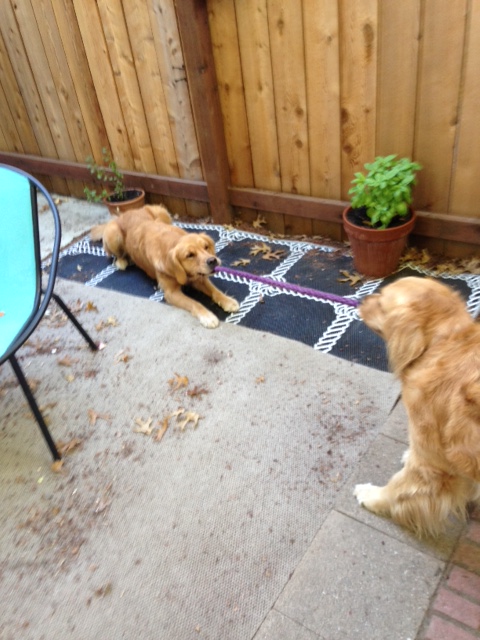
IMG_1137Cali’s sister Dora visited recently for the weekend, which meant nonstop action. Cali actually has lots of sisters. She lives with Big Sister Jana full time. Jana has been an excellent role model, teaching Cali necessary life skills, including barking at passersby and rolling in sand so joyously and thoroughly that, between them, they make sure to take the beach home with them. Then there is Alberta, the part-time sister and playmate. They are evenly matched in size and have similar energy levels. When they are together, everything becomes a tug toy.
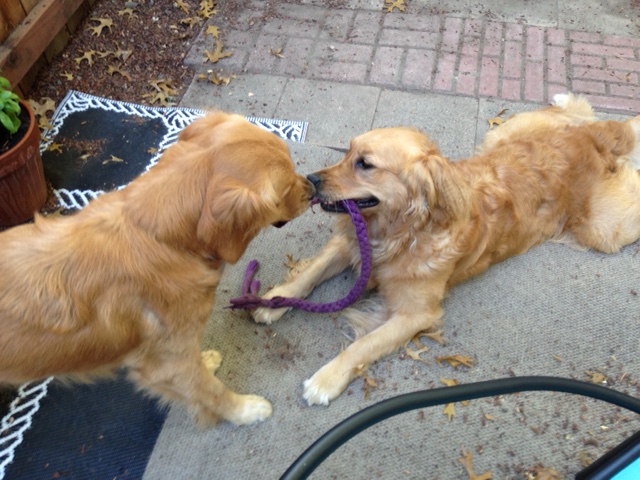
But DorIMG_1141a is special. Dora is Cali’s litter sister. They were plucked from their siblings on the same day (Cali by me and Dora by my close friends) and whisked away, first on a long car ride, then on an airplane where everyone made a huge fuss over them. They spent a scary first night away from Mom snuggled together in a crate. Since then (or maybe even before) they’ve shared a special bond. Whether it’s been days, weeks or even months since they last met, their greeting is rowdy, loud, and energetic. Their play is very physical and rough, but no one ever gets hurt. At rest, they often touch paws or sleep in a heap.
Play is often seen by researchers as practice for important life skills. One researcher, Dr. Marc Bekoff, suggests an additional crucial role for play: it is the basis for developing social ethics. In play, young dogs (or other social beings) learn not to hurt each other, to follow certain rules, to communicate their intentions honestly.
Both Dora and Cali have excellent social manners. When meeting new dogs, they exhibit all of the correct doggy signs for getting acquainted and inviting play. Both are wise enough to be deferential to larger dogs and to show respect for elderly dogs. They’ve internalized those ethical practices that they have learned through playing with a variety of dogs. But sister play is different.
InIMG_1134 their sister play, they also bow and use the full range of doggy play signals, but the signs are sometimes abbreviated or perfunctory. They feel safe enough to throw themselves into play without worrying about being misunderstood. There is lots of ear-pulling and gnashing of teeth. Their faces wear fierce expressions. They emerge panting and wet. And wearing huge smiles. There is a level of familiarity and trust between them that gives their connection a quality that Cali’s play with others — even Alberta and Jana — lacks. Social manners matter most when dogs assess the intent of strangers. Smart dogs know when they need to be polite. And when they don’t. And, for Cali and Dora, family is safe enough that politeness can take a backseat to full-on fun.

Alberta’s Marshmallow Test

This slideshow requires JavaScript.

In the 1970s, a psychologist tested the self-restraint of preschool children. Each child was offered a marshmallow. The children were told that they would get two marshmallows if they could delay eating the treat, and then left alone in a room for fifteen minutes. The researcher recorded what happened. The efforts of some children to stare down the treat or to distract themselves from it are both comical and painful to watch. Of course, some children inhaled the treat as soon as the researcher left the room. A recent book (The Marshmallow Test) describes this experiment and the follow-up studies of those children. The marshmallow test and other research on the ability to delay gratification shows that those who can exercise self-control in the face of temptation have better “life outcomes,” as measured by a variety of criteria, including SAT scores, social and cognitive functioning, long-term health, and retirement planning.

What does all of this have to do with thinking dogs?
Alberta experienced her own version of the marshmallow test recently. To say that Alberta loves treats is a bit like saying that I love chocolate. Alberta not only loves treats, she is not terribly fussy about which treats she gets. For sure, there are better treats, for example this bison and beef jerky concoction that I get at Costco and that, for some reason, Jana, Cali, and Alberta will do anything for. But ordinary, boring biscuits are fine too, and they are happily accepted as rewards for a job well done.

In her guide dog work, Alberta comes across many items that fit this dog’s definition of “treat,” and she works very hard to resist bits of food that just happen to be lying on the floor.
Alberta is justifiably proud of her hard-earned restraint, but more importantly, she wants Deni to know. So, in the course of a day’s work, if Alberta sees food on the floor and gives it a wide berth, she also nudges Deni to make sure that Deni knows just how good she is being. She pushes Deni hard with her nose, hoping that Deni will notice the ignored object. She often nudges Deni right near the pocket where Deni keeps the dog treats, just in case Deni might want to reward this extraordinary show of restraint. A girl can hope, can’t she?

Alberta knows the rule that she can’t grab food off the ground when she’s working. She wants to believe that that rule does not apply when she’s off-duty (her harness is off). She also knows that, even while working, she’s allowed to take treats that Deni hands her for particularly notable service. But she recently encountered a situation that blurred these lines a bit, a marshmallow test for dogs. Her reaction was remarkable.
Guiding Deni down a street in Saugatuck, Michigan, Alberta (along with her entourage of two other human family members) passed by a store that not only had a full doggy water bowl sitting by the sidewalk, but also a full bowl of doggy cookies. Just sitting there for the taking. An open invitation. Irresistible.
Or not.
Alberta headed for the water, took a drink, noticed the cookie bowl and … stopped dead. Confused. She looked at the biscuits. Looked at Deni. Furrowed her brow. Looked longingly at the treats. But she did not touch the treats.
We’d all stopped to watch the unfolding marshmallow-like drama. Alberta really wanted to gobble up as many of those dog cookies as she could. But she did not take one. She did, however, look at every one of us to make sure that we all knew how good she was being. Deni rewarded her by picking up a few biscuits from the bowl and handing them to Alberta.
Watching the interaction, I got to thinking. Most dogs who walk by this shop are not trained service dogs. Though many, like Jana and Cali, have had some training and certainly know that they are not supposed to just devour everything in sight, they don’t always have the restraint to follow through. Having more than once found myself alone with a new box of Trader Joe’s dark chocolate peanut butter cups, I can relate.
I wondered how often a doggy passerby just digs in and eats all the cookies in the bowl. How many battles between hungry hounds and their hapless handlers has the shop owner witnessed? Does the handler ever win? And really, what was that shop owner thinking?

But back to Alberta. In need of photos for this blog post, I asked Deni to re-create Alberta’s marshmallow test. The photo gallery (presented in order) at the top of this blog post shows that, like the successful children in the original marshmallow test, Alberta devised a series of ways to distract herself. Some of the children looked away, as Alberta did. Some sang songs or recited the alphabet. Alberta did neither of these. Some children closed their eyes. Upon realizing that, even after she had turned away, the bowl of biscuits was still there, Alberta closed her eyes.

Alberta has not only learned to resist random bits of food on cafeteria floors, sidewalks, and the like, but there she was, on that Michigan sidewalk and again in Deni’s office, passing up food that was obviously meant for dogs, placed there for her enjoyment. This shows us that dogs are able to do some high-level thinking and processing.

If Alberta were purely instinct-driven, that bowl would have been emptied in seconds flat. If she were operating only out of fear of punishment or hope of reward, she might have surreptitiously sneaked a mouthful of biscuits before Deni noticed, just to see if she could get away with it — and been rewarded by the treat, even if she got scolded after. But she went beyond a gut-instinct response and even beyond the basic (low) level of moral development that governs much of human and animal behavior. She paused, checked in with Deni, and did the right thing — even though she really wanted those cookies. We’re eagerly looking forward to seeing Alberta’s SAT scores and are consulting her for retirement advice. But in my next post, I will describe more practical ways we can apply the doggy marshmallow test to our relationships with our dogs.

The Daily News

A very young Jana fetches The Jerusalem Post

Jana spends considerable time on every walk catching up on the local news. She sniffs out the usual trees and bushes on our daily route. When we take a different route or an extra walk, I know to leave extra sniff time.
But that’s not enough for my newshound. Jana does her best to ensure that I, too, have a steady stream of news and information. Knowing how sadly lacking my sense of smell is — and sensing my inability to understand the dog news, should I somehow manage to gather it — she wants me to read the daily paper.
Since our recent move, we’ve had Sunday-only delivery of The New York Times. But every morning, Jana has headed to the gate with an eager expression and a spring in her step. Bringing in the paper has been her job. Forever. She fetched The Jerusalem Post as a puppy. As a secular dog, she resented the lack of a Saturday edition.
As a young adult, she fetched the Boston Globe, carrying it the length of a very long driveway. (At one point, she suffered the humiliation of having to fetch it wearing a long leash, the result of an unfortunate decision one morning to take off after a jogger, rather than bring the paper home.)
She has fetched the Santa Rosa Press Democrat, the St. Petersburg Times (and, more recently, the Tampa Bay Times) and, last year, the San Francisco Chronicle. For the Chronicle, she was forced to fend off a job-stealing challenge from puppy Cali; having held on to her position, she proudly, carefully, carried her prize a great distance to our little rural cottage each morning.
So, when we moved to Petaluma, Jana simply could not understand — or accept — my decision to take Sunday-only delivery. Online news access, it seems, is an even more foreign concept to dogs than to us over-40 humans. I am fumbling along with it, but she refuses to accept this transformational technology and the havoc it wrought in her world.
I simply could not face the daily sad face, the disappointment. She’d head happily to the gate, and I would open it and show her: no paper. Her head would hang, and she’d slowly walk back to the house. Unemployment. Downsized. Made redundant by a computer. Unneeded. The worst fate for a smart, educated adult. Jana could relate. It was a terrible thing to watch.
So, I upgraded my newspaper subscription.
Now, our paper appears at the gate daily. Not rain, nor sleet, nor snow … even better than the mail, since we get seven-day-a-week service. Every morning, even before the sun comes up, Jana has a paper to retrieve. Full employment has returned. Jana’s sense of self-worth is restored.
Life is good for this thinking dog.