Be Careful What You Teach Them …

When I was first learning to train service dogs, my instructor taught me that, once you put something on “cue control,” that is, teach the dog to do it when asked, the dog will no longer do it unasked.

Those of you with dogs and a little training experience, stop laughing.

This is one rationale behind teaching dogs to “speak” — bark on command.

Problem is, no one told the dogs about this bit of learning theory.

There is a key caveat to this piece of wisdom: The dog will no longer do it unasked unless he really, really wants to.

Bonnie Bergin (my teacher) discovered this one morning, when a particularly rambunctious group of adolescent Labrador service-dog trainees learned about tugging open a refrigerator door. One day, the ringleader of the litter, Xavier, let himself and some buddies into the training room (opening the door from the outside yard), tugged open the fridge, and helped himself to a large hambone.

The ensuing melee was quite dramatic. None of those Labs became service dogs.

I learned about the “unless they really want to” caveat to the lesson about dogs not volunteering named behaviors too late: I had already taught Jana to speak on cue. She uses her words. A lot. She’s quite opinionated, in fact.

Cookie, please

But I digress. The latest example of dogs doing unbidden that for which they have been amply rewarded in the past involves my shoes. I recently wrote about how eagerly Cali and Jana bring my shoes or sandals when it’s time for our morning walk.

Well, now they bring my shoes and my sandals. And a pair of slippers or flip-flops too. I reward the correct two shoes and wordlessly return the others to their proper place, hoping to extinguish this behavior. Not only is the flood of shoes not diminishing, it’s extending beyond walk time.

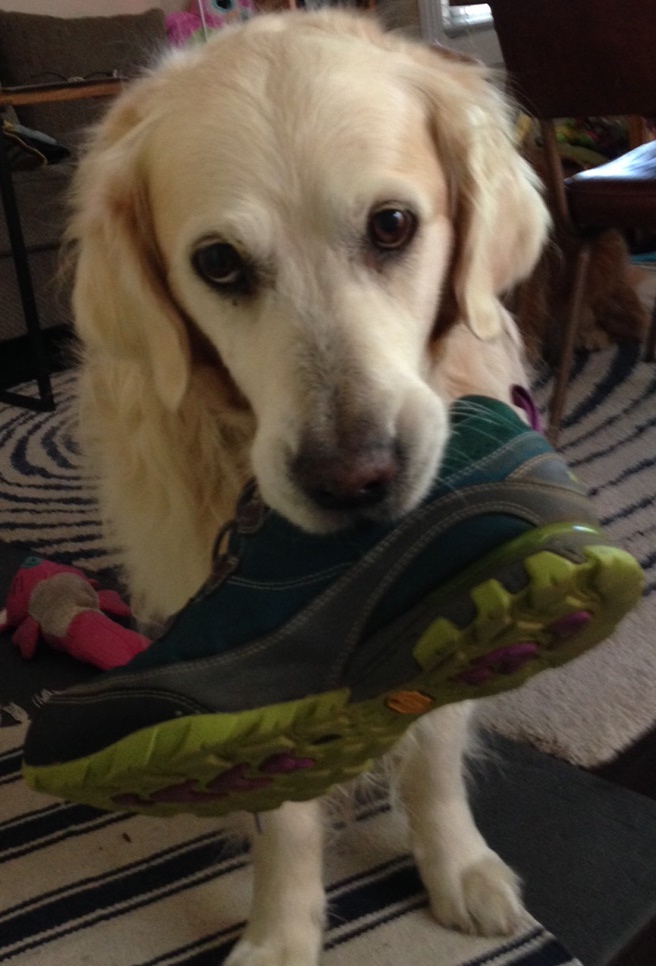
I occasionally turn around to find Jana, hopeful look on her face, shoe in mouth, standing behind me … at any hour of the day or evening. When I ask for anything — bowl, leash, collar, toy — Cali will often dash off enthusiastically … and return with a shoe.

On the bright side, they are both really good at “getting the other one,” so I never need to worry about being barefoot or mismatched.

So, be careful what you teach your dog; she might be smart enough to turn it into a game you never anticipated.

Dog Parks: The New Spectator Sport

Cali loves going to the park, just as many sports fans love going to the stadium. McNear Park, about eight blocks from our apartment, is an off-leash dog run for a few hours every morning. A group of very nice, well-mannered dogs are regulars, and I have only very rarely seen any inappropriate play. It’s a wonderful place for Cali to get some off-leash ball play, since our yard is very small.

Cali loves going to the park, just as many sports fans love going to the stadium. McNear Park, about eight blocks from our apartment, is an off-leash dog run for a few hours every morning. A group of very nice, well-mannered dogs are regulars, and I have only very rarely seen any inappropriate play. It’s a wonderful place for Cali to get some off-leash ball play, since our yard is very small.

Every morning, she bugs me to get going. Hurry up! She brings my shoes and nudges me to get out the door faster. She noses her favorite ball to remind me to take it along. When we get there, she demands that I throw the ball immediately. She eagerly chases it.

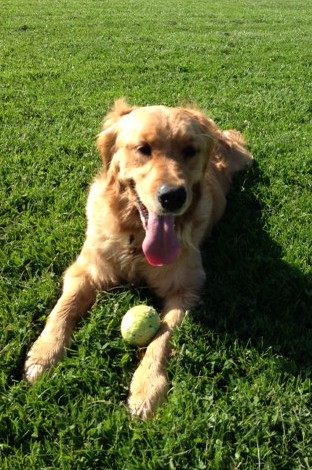
Then she lies down in the grass and surveys the park. She’ll occasionally bring the ball back and let me throw it again. Once. She moves from sunny patch to shade, carrying her ball with her and carefully placing it between her paws as she resumes her reclining position on the grass. Watching other dogs play.

A few dogs try to engage her, bowing and bouncing. Once in a great while, Cali will play for a couple of minutes, then, worry furrowing her brow, search out her ball, sigh in relief, and lie down, the precious ball resting safely between her paws once again.

Sometimes, I go over and get the ball to throw it for her. She’s happy to chase it, tail rotating like a helicopter blade … and then, again, lie down and watch the action. Or not, in which case, she’ll hold tightly onto the ball, not letting me take it and throw it.

Cali sees the park as a sports arena where she gets to watch other dogs play ball, Frisbee, and tag. She’d be happy to stay there all day, observing, but I usually get annoyed and threaten, “Play — or we’re going home.”

Meanwhile, Jana is doing her thing. She grazes a bit, then rolls in the grass. Stretches out, does a bit of yoga, sunbathes. The walk there and back is enough exercise for her. But Cali really needs to run and burn off energy.

When I finally give up and snap leashes back on, Cali usually digs in her heels, refusing to leave. She might, grudgingly, let me take the ball and throw it a few times then, before we leave.

When we get home, what does Cali want me to do? Throw the ball for her, of course.

Duck-Induced Deafness

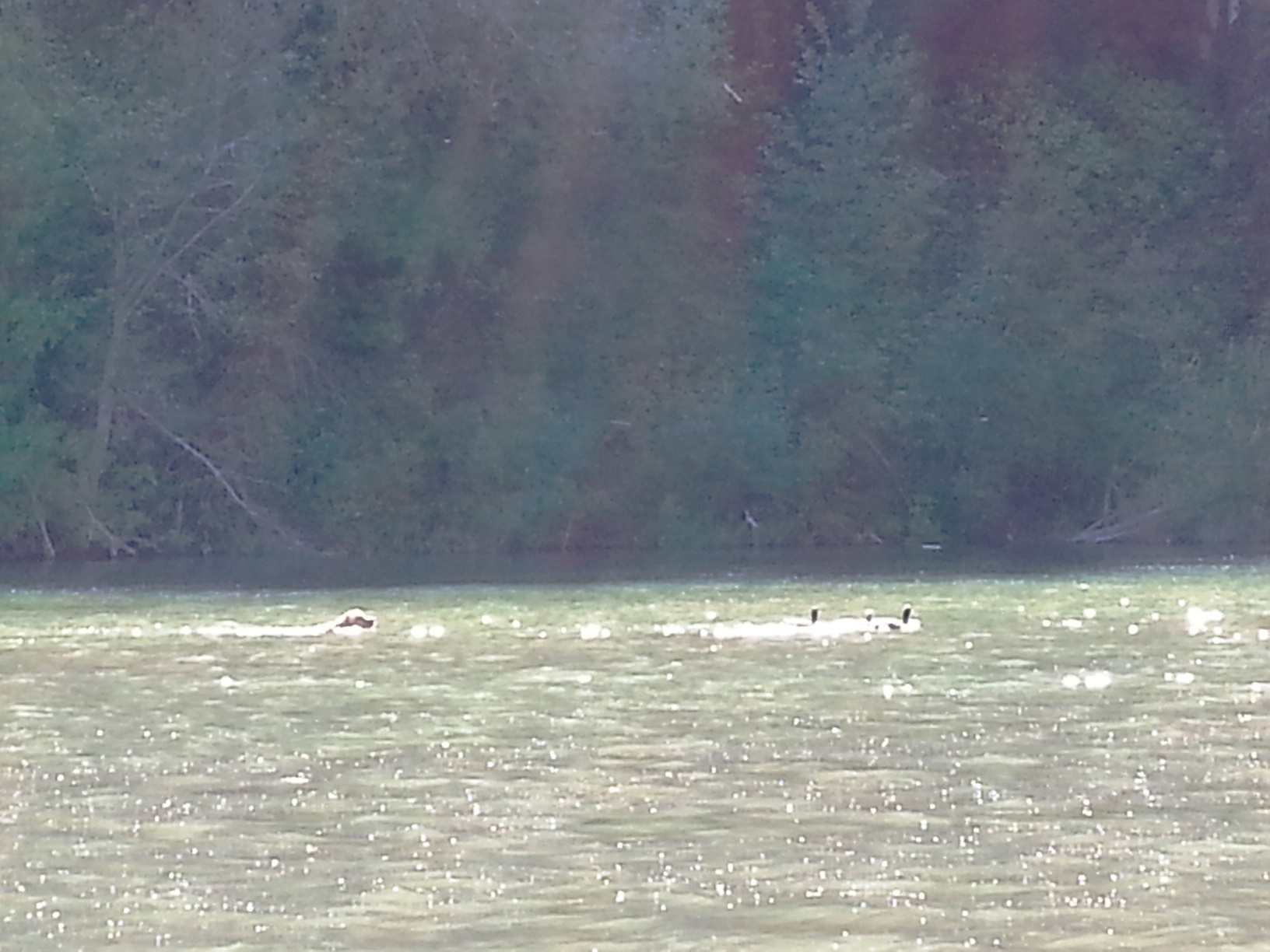
cali and ducksI’m a whole lot less interesting than three mallards. I’m trying not to take it personally.
I took the girls swimming the other day at the Russian River. We were having a nice time splashing around, and Cali was happily swimming after a ball. Jana was searching for rocks. Russian RIver April 2015She likes to find heart-shaped rocks, as I have described in an earlier post. She added this one (right) to our collection on this particular river excursion. In short, all was well.
Until those darn ducks swam by. There were about 10 ducks, enjoying a sunny day. Jana noticed them first. She’d swim in their general direction, and they’d fly up a few feet into the air, and she’d lose interest.

Then Cali got in on the game. She just followed them around, never getting too close. She was no threat. She was holding a tennis ball in her mouth the whole time, and she never got closer than about 10 feet. Three of the ducks decided to play a little game with her. They did not fly away. They stayed just far enough in front of her that they (apparently) felt safe but close enough that she stayed interested. And they swam around in big circles. They swam across the river, around a big island, back to our side. Upriver. Downriver. Big circles.

Cali paddled doggedly after them.

At first, it was funny. She never let go of her tennis ball. She’s a strong swimmer, but after a few minutes, I started worrying that she’d get tired. My friend and I waded farther into the river, determined to head them off if they headed downriver. They didn’t.

We called Cali and waved. But she was suffering a bout of duck-induced deafness and never heard a thing. Jana had long since given up on following the ducks and was nosing around for sticks on the beach. The other golden in our group had gone back to tennis balls. But not Cali. Back and forth, around and around. Finally, my friend couldn’t stand it any longer. She crossed the river and grabbed Cali, getting soaked in the process. Cali still had her tennis ball. She was not even winded.

Jana used to do the same thing. She once followed a leaping fish pretty far out into the Gulf at a Florida dog beach. But Jana has more sense than Cali. After a while, she looked back, saw how far she was, got a very worried look on her face — and turned and paddled for shore as quickly as she could. I don’t worry about Jana disappearing into the wild. She never wants to lose sight of me.

But Cali is more impulsive and less aware of her surroundings. Was Cali even a tiny bit aware that she had worried us? Nothing doing. Within minutes, she was bugging us to throw the ball some more.

Does this mean that Cali has a poor recall? Not necessarily; even the best-trained dog is likely to go temporarily deaf when confronted with a really interesting distraction. It does teach me to keep a closer eye (and shorter leash) on Cali when I see ducks on future water adventures, though. And it’s a good reminder that I need to practice recalls with Cali in more places with lots of interesting things going on. I may never be able to cure duck-induced deafness, but I can probably relieve some of the symptoms.

Chaser: Unlocking the Genius of the Dog Who Knows a Thousand Words

CHaserAmazing dog. Amazing and super-friendly author. I got in touch w/Dr. Pilley after reading the book (and his research papers) and he did a Skype conversation with a class I was teaching on dog-human communication. He is one in a million, as is Chaser. He is such a great example of positive training that respects a dog and her abilities… and he is a fantastic teacher as well.
No one is surprised to hear that a border collie is intelligent and learns easily. But Chaser has gone far beyond what any other dog has been documented to learn in terms of human language comprehension. Dr. Pilley set out to teach her as many words as he could — names of objects — after reading the dismissive comments that greeted publications describing the accomplishments of Rico, a border collie in Germany who learned several hundred words. Dr. Pilley analyzed the linguists’ and other academics’ critiques of the training and testing of Rico — and set out to train his dog in a way that addressed all of their objections. And he accomplished his goal. (An interesting chapter in the book describes the resistance he faced when attempting to publish his initial results.) The opposition to admitting that any creature but humans can use language is still deeply entrenched.
But it’s also dead wrong. Chaser truly does understand human language. She learned and retains the names of more than a thousand items. She has demonstrated her ability to categorize them, grouping round bouncy things into the “ball” category and flat flying things into the “Frisbee” category, for example. And, like most dogs, she clearly distinguishes the category of “my toys” from “things in the house that I’d like to chew but am not allowed to chew.”
But Dr. Pilley realized that he had not pushed the boundaries of Chaser’s abilities. So, they tackled grammar next. Chaser understands the concepts of subject, verb, object — and indirect object. As an editor and college instructor, I have to point out that many writers and college students do not reach Chaser’s level of grammatical knowledge.
Toward the end of the book, Dr. Pilley describes his initial attempts to teach Chaser to imitate long, complex strings of behaviors. His description inspired me to try simple imitation games with my dogs, which have been fun and very funny.
The best part about this book though, is its constant message: Keep training fun and rewarding for the dog; make it a game; play to your dog’s strengths and preferences and, most important, make sure she has time do play and engage in her favorite activities. For Chaser, that means regular opportunities to herd sheep at a near

Canine Couch Potatoes

TV dogA recent post on the Whole Dog Journal blog about dogs who watch TV got me thinking about this topic. When the DogTV channel launched, I thought it was a silly gimmick that would appeal to indulgent pet parents but leave the dogs indifferent. I tried out the sample videos on Jana, who had never shown any interest in TV, and felt vindicated when she barely glanced at the screen.
But …
I remembered one evening when I came home to find my dog Timo and my mom’s dogs Buddy and Daisy all sitting on the sofa watching Animal Planet. We had not left the TV on. Hmmm…
And then there was Oriel, who perked up and watched any time a TV show featured a dog. And, of course, Cali. Cali, who is Oriel’s great niece, loves to watch TV. She got hooked, I am a bit embarrassed to admit, a year or so ago when PBS had a short series about different animals’ uh, love lives. Cali was only a year and a half old, and maybe I should have been more careful about monitoring her viewing. She seemed to like the kangaroos the most.
In any case, she’s a real fan of animal shows on TV. Recently, I was flipping through channels and paused on a PBS show about cats. Cali was riveted. I had to stay up just so she could keep watching. And she likes ads. Hulu has one that shows lots of inter-species animal friendships — she loves that one.
I read in a Popular Science article that newer TVs have a higher refresh rate for the images, so they will appear more lifelike to dogs; images on older TVs have a noticeable flicker for dogs since their eyes are sharper than ours. So maybe the TV-watching dogs of old simply had poorer eyesight than the dogs who ignored TVs, and more dogs are paying attention now that TV technology has caught up with their visual ability.
Regardless of why dogs are more interested in TV, the pertinent question is, if we ask the dog to bring us the remote, will we have to negotiate for it? Will the dog demand an equal say in choosing what we watch? I’m all for the occasional PBS nature show, but I’m not about to let Cali nix my “Grey’s Anatomy” fix.

Citizen Canine

Citizen Canine
Should dogs have legal rights?
The question is not as crazy as it might sound. In Citizen Canine, author David Grimm explores this and many other questions about the rights, responsibilities, and roles of pets in contemporary life. He examines the history of pet life in American society as well as the legal status of dogs, cats, and other nonhumans. Along the way, he introduces readers to some interesting and influential people in the areas of animal welfare, animal law, animal rescue, and more.
Grimm is clearly an advocate for better treatment of dogs and cats and is very open to new possibilities — from laws that better protect pets and the people who love them to a radically new status for dogs and cats. But the book presents a mix of viewpoints and does an excellent job of presenting the very real questions posed by granting “legal personhood” to animals. Who would represent the interests of dogs and cats without families? Could a pet owner be jailed for failing to provide medical care to a standard determined by … whom? Could dogs sue people? Could they have their own money? How would we contend with the likelihood that veterinary malpractice insurance and lawsuits would dramatically increase the cost of vet care? Who would have legal standing to represent a pet? How would we handle getting dogs’ and cats’ consent before breeding (or neutering) them?
His discussion with a leader of the American Veterinary Medical Association reveals the fierce opposition among vets to any change in dogs’ legal status — and the hypocrisy of vets who appeal to pet owners by acknowledging the role of their pets as family members, and who offer, even encourage those owners to purchase vet care that costs thousands of dollars — then insist that a dog’s or cat’s value cannot exceed replacement cost. Like a toaster.
What I like best about this book is the many possibilities and viewpoints it presents. Some of the people Grimm interviews present the “personhood” question as black and white: Dogs must either remain with their current status, as property, with no more rights or protections than a toaster; or they must be elevated to a status equivalent to that of humans. As with most issues presented as a stark choice between two equally poor options, though, the reality is much more complex. Many of the objections raised, for example, can be resolved by looking for parallels in the way that we protect children’s rights or the rights of adult humans who cannot make their own legal decisions.
The final chapter introduces an idea that merits a lot of thought and that could provide pets with a status that more closely reflects their true position in our society. For details, you’ll have to read the book.

Turning Shoes into Treats

This slideshow requires JavaScript.


Since I share my home with two retrievers, I figure that they should help out a little around the house by, well, retrieving. I’ve written about how seriously Jana takes her newspaper delivery job. Cali has belatedly decided that she wants in on the treat action, so I thought about what a suitable job for her might be.

Cali lives for our daily walks (sometimes twice daily) to the nearby park where dogs can run free and she can avoid playing with the other dogs while holding onto her ball and occasionally actually retrieving it. I have a pair of shoes that I rarely put on for any purpose other than walking the girls. So I decided that bringing my walking shoes could be her new job. She has a passable retrieve, and, I figured, she’d be highly motivated — the reward, in addition to the requisite cookie-per-shoe going rate, would consistently be an immediate walk, often to her favorite park.

The training went pretty well, except for that incident where I got kicked in the face by my own dog wielding my own shoe, but we don’t need to dwell on that. Cali was very enthusiastic, if a little unclear on the concept at first. Jana helpfully showed her what to do, eagerly grabbing the nearest shoe and bringing it and even more eagerly accepting a cookie in exchange.

On day 1, Cali tried her first shortcut — offering a toy.

The next shortcut: stealing the shoe from Jana. Well, Jana was having none of that. I rescued my shoe from the tug of war and asked for the other shoe.

That was the next challenge. Incredibly, though, Cali seems to have picked up that concept with only a few days of repetition.

We also had to work on the delivery. From overly enthusiastic (see reference to being kicked in the face) to lackluster (dropping the shoe a couple of feet away), Cali’s finish needed polish. I’ve almost got her somewhat consistently putting the shoe into my hand not terribly roughly. Progress, right? Baby steps, baby steps …

But this is where it gets interesting. I know from reading about Chaser, one of my favorite dogs in the world, that dogs can learn to put items into categories. Cali and Jana bear this out, and throw in evidence of a sense of humor, too.

Clearly trying for additional treats, Jana gets this sly look as she sees Cali delivering the second and final walking shoe. She then runs into the bedroom and returns, tail held high and waving triumphantly, with a shoe, any shoe. Give me my treat, her bright eyes and wagging tail say. If I don’t seal off all other shoes behind a firmly closed door, I might get, in addition to my walking shoes, a slipper or two, a flip-flop, a sandal, a rain boot … They have definitely mastered the concept of “shoe.” They’ve even gone outside and brought in a Croc from the porch.

They also instantly made the transition from my laced walking shoes to Keen sandals when the weather warmed up a bit. I do keep the current walking shoes right next to the door, and I am sure that the context is a big help.

I did not try to teach them the category of “shoe.” I have, years ago, worked with Jana on categories and concepts: big and small, toy, ball, and, of course “other” to send her after an item similar to the one she’s just brought. Cali learned all of this on the fly — by watching Jana and by seeing what I did and did not reward.

I’m still in awe of what Dr. John Pilley has accomplished with Chaser and grateful to him for painstakingly documenting his teaching efforts and publishing solid scientific evidence of dogs’ abilities to map words to items, remember hundreds of item names, and group items into categories. I am also, though, delighted and surprised by the constant examples of dogs who learn some of those same things in less-than-ideal home-schooling environments with inconsistent teachers (such as myself).

What have your dogs learned that blows your mind?

Who’s a [Good, Bad, Anxious, Happy, Aggressive, Calm] Dog?

I recently attended a two-day workshop with TTouch practitioner Lori Stevens. Of the many tips and techniques that stuck with me, this stands out: We tend to label dogs’ behavior rather than describe it.

What is an anxious dog? What is an aggressive dog? A well-behaved dog? Turns out that each dog owner — and dog professional — means something different when she uses those terms.

WrapI sometimes describe Jana as “anxious” because, many evenings, she seems unsettled, distracted, and uncomfortable. She whines or paces, but I can usually settle her down in a few minutes. The technique I learned from Lori, using a body wrap, seems to help a little. Jana also shows what I call anxiety on walks if a vehicle (mostly loud, big trucks, though she seems to harbor a deep-seated hatred of minivans, too) approaches from behind us and startles us. I attribute some of this “anxiety” to the possibility that she’s not hearing things as well as she used to and she gets surprised more often — perhaps she’s also losing some vision. Whatever the cause, things seem to come out of nowhere and startle her more often. Fine, so, she’s a bit anxious and I deal with it.

But I have friends whose “anxious” dogs have done hundreds of dollars in damage to their possessions, their floors and walls, their furniture … other “anxious” dogs bark nonstop or are unable to sleep through the night (pacing, whining or barking, and ensuring that no one in the household gets any sleep. Ever.). Compared with that, Jana is calm and placid, well-adjusted even.

Then there’s the “aggressive” dog. I’ve seen dogs who have been labeled as aggressive who are the sweetest, friendliest dogs … but who really dislike cats and want to chase them (or worse). Or who have maybe bitten a person, once, under what turns out (if I get the whole story) to be extreme provocation. Or who are simply terrified, stressed by being put in a situation that they cannot handle. Not all of these dogs are aggressive; they are scared and overwhelmed.

Scared and overwhelmed can be fixed; prey drive can be managed. But some dyed-in-the-wool, born-with-it aggression is not fixable and can be very hard to manage. It is important to know the difference.
Being able to describe our dogs’ behavior accurately and in detail is important for so many reasons. We can do a better job of figuring out how to manage or change that behavior if we know what it is and why it’s happening. As dog professionals, or as dog owners who want to call in a professional, a clear, detailed description of behavior is an essential starting point — does this dog need training? Medication? Treatment for some underlying, painful condition that is causing her to snap at people? Sometimes the cause is simple, even if it’s not immediately obvious.

A couple of summers ago, one evening, Jana snapped at Cali for playing roughly near her. Jana is usually amazingly patient with Cali. I reprimanded Jana for her “aggressive” act. Fortunately, within a few days, Jana was scheduled to have her annual physical. At her vet exam, the doctor found that Jana had a very painful cracked molar. A long surgery and several hundred dollars later, Jana was no longer in pain. She has never snapped at Cali again.

So, trash the catch-all labels. Instead, look at the behavior. When does it happen? Is there a trigger? Did it just start? Has behavior changed recently? Has the dog’s environment changed? Is the dog getting enough exercise, a balanced diet, regular medical checkups? If you can’t figure out the cause, call in help: doggy friends, the vet, a trainer. Post a question on the Thinking Dog Blog!

It’s usually possible to figure out what’s going on — and lots of expert help is available!

Good Mom, Bad Mom?

got cookies_sae hokoyamaA reader writes: My spouse, the “good” parent, gives our dog lots of treats. Now the dog has become a tyrant, especially when I’m trying to make dinner. Other than saying NO when she has maxed out her quota and then having to deal with nagging, or else yelling at this sensitive dog and becoming even more of the “bad” parent, what might you suggest?

This is a tough one, as is any instance where spouses’ parenting styles clash.

A couple of hints in your question suggest an area where I think you can make changes, though. One is your characterization of yourself as the “bad” mom, simply because you are a tiny bit more strict. And what, exactly, is her “quota”? Together, these tell me that you and your spouse, like many dog parents, equate giving treats with giving (or, perhaps, getting) love. And a nice mom (or dad) gives lots of treats while a mean mom stints on the cookies. That’s simply not true, regardless of what the dog says or how sadly she looks at you.

One place to start might be to not give any treats without a reason. That’s not as mean or as hard as it sounds. And even if you can’t get your spouse on board, you can convince the dog that making sad puppy eyes at you will not get her anywhere (and neither will “nagging,” whatever form it takes).

Come up with your own criteria. I ask that my dogs do something, bring me something, or submit to something they dislike in order to earn treats. This translates to cookies for bringing me the paper or my shoes or for picking up their bowls after eating; treats for coming in, sitting nicely, and stopping their insane barking when the neighbors walk by with their dog; and high-value treats for allowing me to do their nails and other hated grooming chores.

Some people set the bar lower, giving the dog a treat each time she comes in from going out to pee, for example. While I see no reason to do that, it does, at least, set a criterion. You do X, you get a cookie. That sets up a different expectation than: I am (or I am cute); therefore I deserve a cookie.

If all that seems too complicated, any time she bugs you for a treat, ask her to do something she already knows: sit and shake hands; roll over; high five. She will still be exchanging something for the treat, not just walking by and expecting rewards simply for existing.

Of course, she is not going to accept this new regimen without protest. You’ll need to hold firm for a few days or a week or so, ignoring her nagging, and she will ultimately resign herself to having to earn or pay for her rewards, just like the rest of us. She might still get freebies from your spouse — you probably can’t change that. But I seriously doubt that your dog measures her love for each of you by the number of free treats you hand out. A lot more goes into building a relationship than that!

Thinking Dogs

A young Jana thinks about how to get the peanut butter out of her Kong
Do dogs think?

Many of you are thinking, Of course they do!

So, why am I even asking that question?

I recently taught a class on dog intelligence where we tried to decide what and how dogs think and how to define dog intelligence. I had just seen the movie The Imitation Game, and I mentioned the scene where the police investigator asks Alan Turing whether machines think. Turing’s response (paraphrased considerably) is that, if someone we know has different taste than we do — likes a book we hated or loves a food we don’t care for — we wouldn’t say that the person is not thinking, but that his or her thinking is different from ours. In the same vein, machines do not think as humans do, but they can follow a process that approximates human thinking, according to Turing.

Human thinking is conscious and active — that is, we are aware that we are doing it and do it intentionally. It is an attempt to understand something, solve a problem, answer a question, create connections or meaning. Human thinking is mostly done in words, though, as Temple Grandin points out in many of her books, people with autism do not always think in words but often in pictures or even video.

Dogs don’t necessarily think in the same ways as humans — or agree on everything or reach the same conclusions — but I would argue that dogs’ thinking is more similar to humans’ thinking than a computer’s is, if only because dogs are conscious and machines are not.

So, the simple answer is: Dogs do think, but they do it differently from the way humans think. They probably do not spend a lot of time planning for retirement or worrying about the bills or speculating about which stocks to invest in, for example. They do not appear to worry about things that they cannot control (unless it seems that dinner might be late …). They might think about their next meal or the dog beach or the cute shepherd down the block — not so different from some of what people think about.

All grown up and still thinking about how to get food out of her toys ...
All grown up and still thinking about how to get food out of her toys …
But even where their thoughts might meander to some of the same topics we’d think about, I bet that dogs do it very differently. While dogs are often taught to understand many, many words, I doubt that dogs actually think in words. Alexandra Horowitz, in Inside of a Dog, suggests that dogs think in smells and maybe in pictures. That makes sense when you consider how powerful their experience of scent is.

Another wonderful dog book, How Dogs Love Us by Gregory Berns opens the door a little bit toward understanding how thinking in smells might work. Berns trained his own dog, and then several other dogs, to lie still in an MRI so that he could get images of their brains — while they were awake. He did several experiments, including one where he mapped dogs’ reactions to the scent of a human from their own family and the scent of a different person. He also mapped their responses to a familiar and an unfamiliar dog. These tests, and others that measured response to cues indicating a desirable reward (bits of hot dog, I think) and cues indicating no reward, showed that dogs brains look very much like human brains. Dogs scenting their own humans showed similar responses to humans viewing photos of their loved ones, for example.

Regardless of how they do it, evidence that dogs think is all around us. When they bring a toy and ask us to play, beg for a bite of our sandwich, or stand by the door asking to go out, they are thinking and planning. The dog who creates a diversion so he can steal a coveted bone from his sibling dog is thinking and planning. The ability to anticipate where the Frisbee will come down and then to jump in a graceful arc to meet it reflects thinking (and a far better grasp of physics than I ever had). Service dogs show their thinking skills constantly in their ability to intuit what their partners need and offer it. The examples are endless; share yours in the comments!