Welcome to the Family, Koala

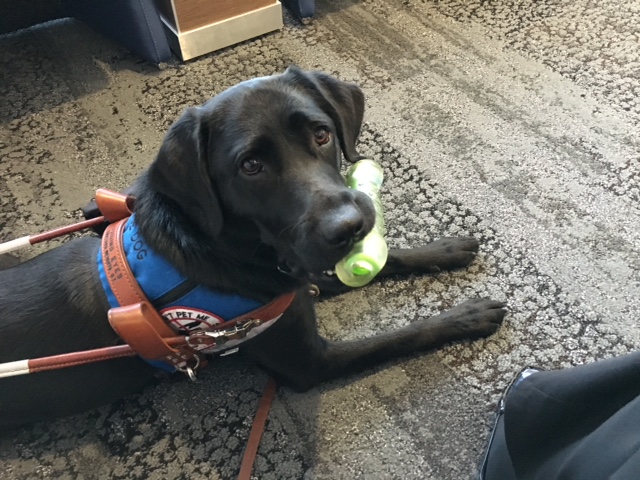
Koala, in harness, waits at the airportShe’s here! And I finally met her!

Deni’s new guide dog, Guiding Eyes Koala, is a 2-year-old, high-energy black Lab with a dazzling smile. She’s very smart and she learns new skills very quickly. For example, she knew where “home” was and could accurately turn in to the right house after one trial. She quickly learned to “find the trash” — anywhere — and she is so pleased with herself that she leaps up and embraces the trash can, with her tail wagging, and wearing a huge smile. I saw her do it several times in places none of us had ever visited before.

She’s very playful and can be quite silly, when she’s not working. She completed her first airplane travel with the grace of a pro, and seems up for any new adventure. She was “just amazing” on a recent visit to Guiding Eyes; she even agreed to use the indoor service dog “relief” area. These tend to be more “desperation” areas, with fake grass rinsed by pop-up sprinklers or pee pads on the floor in some out-of-the-way corner of the airport. She’s definitely a good sport.

Cali is going to just love having a playful, high-energy little sister to boss around. Jana is looking for an invitation for Thanksgiving week. If she stays home, she’s likely to never speak to me or Deni again after spending several days in a tiny apartment with the two “puppies.”


Mind Your Manners

Wylie, a polite dog?Wylie hates peanut butter. It literally makes him gag. That’s why this story, from several years ago, is still one of my favorites: It tells me something really cool about dogs.

When Wylie was about to retire as a guide dog, his best friend t work brought him cookies. Very special gourmet dog cookies. One problem: They were peanut-butter cookies. Deni graciously thanked her colleague and said gently that she wasn’t sure Wylie would like them; he was fussy. The friend said, let’s see. He offered Wylie a cookie. Wylie accepted the cookie with appropriate doggy gratitude and ate it. The friend went happily on his way, feeling good that his gift had been accepted and enjoyed.

Surprised, Deni offered Wylie another cookie. He gave her what she can only describe as a disgusted “Are you nuts? I don’t eat that garbage” look, turned, and walked away. He never ate another one of those cookies.

Was Wylie “just being polite,” telling one of those little “white” lies we all tell when we want to avoid hurting someone’s feelings? Can a dog do that?

Here’s a different way to think about it, though, really, we’ll arrive at the same conclusion: Dogs are very empathetic. They excel at reading and responding to our emotions. Many dog people have stories of dogs offering comfort when they were sad; getting excited when were excited; responding in a way that many people regard as “guilty” when we are angry. In truth, the dogs are more likely to be trying to appease a person they perceive as angry, but they are accurately reading the person’s emotion.

If Wylie got excited about the cookies, he could be said to be mirroring the friend’s emotion: The guy was presenting a gift that he had selected with Wylie in mind, and he was happy to see Wylie get the gift and enjoy it. Or the friend was sad to be saying good-bye. But Wylie didn’t get excited or offer comfort. He offered a gracious and appropriate, but not overly happy, response. (I don’t think Wylie is capable of phoniness.) And he clearly rejected the gift as soon as his buddy left the room.

My explanation is that Wylie was reading the situation clearly and accurately. He’d been around lots of people in lots of social situations, and he knew these two people really well. He behaved as he’d learned was appropriate. He wasn’t, I don’t think, consciously deciding to lie — any more than we consciously decide to lie each and every time we say something that will make someone feel good — or, to more clearly match this situation, every time we say or do something that is nice and socially expected rather than blurt out our first or most honest thought.

Jana, who really has no use for children of any species, is perfectly gracious and polite when being “enthusiastically petted” (she’d say “mauled”) by a child, but she gives me that look that says loud and clear: “Get me out of here, now, please.” And Alberta would dutifully “say hello” to people she and Deni met, but she really didn’t want to; and she expected a cookie as a reward afterward.

So, I would argue, that dogs read social situations and respond appropriately. What is “appropriate” in a given situation varies widely, and it is learned, not instinctive. Some dogs, and some humans, learn better than others. Some dogs do this well with dogs and poorly with humans, or the reverse. Wylie’s social instincts with other dogs were often less astute than his social instincts in this particular human instance.

So, while I’m not arguing that dogs adopt human social manners, I would say that they learn, over time with the same people, what those people think is acceptable. Much about dog-human relationships entails dogs trying to do what they think their human wants; it’s not surprising that this can get nuanced or that Wylie and Jana are good at it.

An Idea Whose Time Is Up

A recent Freakonomics podcast featured various politicians talking about one idea about elections that they wish would die, go away, never be mentioned again. I like that idea because I have a long list of absurd ideas about dogs and other nonhumans that I wish would go away and die a miserable, lonely death.

High up on that list is one that is getting a lot of attention these days, due to the unfortunate publication of a new book by novelist Tom Wolfe: the idea that only humans use language. Though I am one of the few people I know who disliked Bonfire of the Vanities, I had some professional respect for Wolfe as a writer until I heard his interview on NPR about his new book.

Wolfe essentially suggests that if evolution occurs, it only happens to nonhumans. That’s bad enough. But what really got my blood boiling were his comments on language. In the interview, Wolfe made the absurd claim that no evidence of anything resembling a language has ever been seen in a nonhuman. Wow. He really should have done some very basic research, like a cursory Google search, before deciding that. There’s a lot of research out there on animals and language.

Wolfe uses “speech” and “language” interchangeably, which is already a clear indication he doesn’t know what he’s talking about. Many languages exist that are not based on speech, the most obvious being American (or any other) Sign Language. Thousands of nonverbal people understand and use language; some even write beautifully. Many actual scientists, even some who believe that only humans use language, have published extensive research on language and how it is separate from and does not require speech.

Wolfe also claimed that speech / language is necessary for any sort of memory or planning. Hmm, how does he explain insects, birds, mammals who store food for the winter (and remember where they put it); any critter who finds his way home once he leaves the den, ever, or who leads his pack back to the marvelous carcass or other food source he’s discovered? Even bees remember and guide others to food sources they’ve found. Memory. Memory, communication, teaching … And wouldn’t pack hunting, as wolves do, require planning? Building a nest or den requires both planning and memory. There’s a lot of research on these topics, too.But t

But really. Let’s focus on dogs for a moment. To establish that these nonhumans use language, remember, and plan, all you really need to do is spend a few days with a dog. Watch a dog come up with really clever plans for appropriating a coveted bone or toy from his sibling, or walk a dog who remembers where that lovely dead thing she rolled in last week was, or see how excited the dog gets when she recognizes the drive to the dog beach?

I could list, literally, thousands of examples from my own experience, reading, research, and students’ and friends’ stories. So could anyone who has ever paid much attention to dogs, elephants, chimps, whales, prairie dogs, birds, or any of the many other nonhumans who use language. Memory is essential to learning anything; and it is clear that millions of critters, but especially, and most near and dear to my heart, dogs, learn, remember, plan, use tools, problem-solve, and manipulate humans.

book cover of Beyond Words by Carl Safina My favorite comment on the interview came from an NPR listener who wrote that “It was the equivalent of interviewing an expert on evolutionary biology who never reads novels to get his opinions about how novelists can write better stories.” Yup. Stick to what you know: make-believe. Another good response is this column about why it matters when a famous writer dismisses evolution.

If you want to learn about language, read Chasing Doctor Doolittle or Beyond Words, both beautiful books about what language is and how various nonhumans use it. I’ve written several posts on this blog that address human communication with dogs and dogs’ ability to learn to understand human language. (I’ve never claimed that dogs have speech, and I do know the difference.) You can find those by searching this blog site.


Better and Better

Jana enjoys springThis will be a short post to update you on Jana. She’s doing a lot better.

In the weeks following her bout with vestibular disease, she visited a neurologist, an ophthalmologist, and an additional vet. The vet, someone whom we like and trust very much, was Cali’s pediatrician and Jana’s vet a few years ago. Her clinic is pretty far from where we live now, but I decided to check in with her anyhow. She offers fantastic Western veterinary care and also Eastern medicine.

Jana, it turns out, had an ear infection. She and Cali each had a foxtail in her right ear, which has nothing to do with the vestibular incident but was very uncomfortable. They were amazingly good and let the vet remove the foxtails; both girls are feeling much better now.

Jana is also taking Chinese herbal medicine, plus she just finished some pills that helped get her over the last of her dizziness. She’s still a little wobbly on her feet, but much, much better. She still tilts her head a little bit, too.

But she seems to be focusing better; and her selective hearing is excellent when she wants it to be. She was back on the job, retrieving the paper, in less than a week, and she demanded to rejoin the long morning walks to the park after about three and a half weeks of recovery. She does get tired easily, but, at her age (the rough equivalent of a 92-year-old human), that’s not surprising.

She seems to get stronger every day, and she’s her usual happy, bossy, food-focused self. At the park, she made the rounds, visiting with her many friends — and demanding cookies.

In short, Jana is back to normal.

How much is that in dog money?

This slideshow requires JavaScript.

I had house-guests recently, and the girls put their entrepreneurial spirits to work. As I have described in other posts, the girls bring me my shoes when it’s time for a walk. They also bring their bowls when they are done eating. For each of these, as well as for getting the paper and for other tasks, they are paid in cookies.

There’s a cookie hierarchy in dogdom and therefore in our home. When requiring the girls to do something they dislike, such as submit to ear-cleaning or nail-trimming, I reward them (some would say bribe, but it happens after the fact) with high-value treats — freeze-dried liver, perhaps, or the dried beef patties we discovered at Costco. When we are practicing recall (come here, right NOW!) they get very high-value treats. We have special tooth-brushing cookies, which are of medium value. Ordinary chores like bringing the paper, shoes, etc. get ordinary treats — a few Charlee Bears or a small biscuit. This, it seems, is the currency of the dog world. They expect to be paid, and, so far, they have been willing to accept the prices I am willing to pay.

They showed a basic understanding of economics when they started bringing things I hadn’t asked for and expecting payment. It reminded me a bit of those kids who used to come out of nowhere and wash your car windshield while you were sitting at a red light, then ask for money. But the girls are cuter and very earnest.

Then my guests came along. One was so enchanted by the dogs bringing shoes — random shoes, no less, maybe taking my shoes to her or a single sandal when she needed her boots — that she inflated the payout. At least once, but I suspect more, she gave Cali a beef patty — a whole one! — and Cali had not even brought her the right shoes! I don’t even want to know what she paid for the girls’ dinner bowls.

Well. Jana and Cali don’t have MBAs, but they don’t need them. The girls quickly understood inflation and supply-and-demand economics. And bargaining: I’ll give you this shoe — and a boot — for one of those beef patties. I’ll throw in a phone or a TV remote if you’ll give me two. What? A measly Charlee Bear? I am going to hang on to this slipper. When your foot is cold, you’ll pay more.

Just what I need. A looming winter of cold feet and fat dogs. I’d better go to Costco this week. We’re gonna need more beef patties.


Last Night Alone

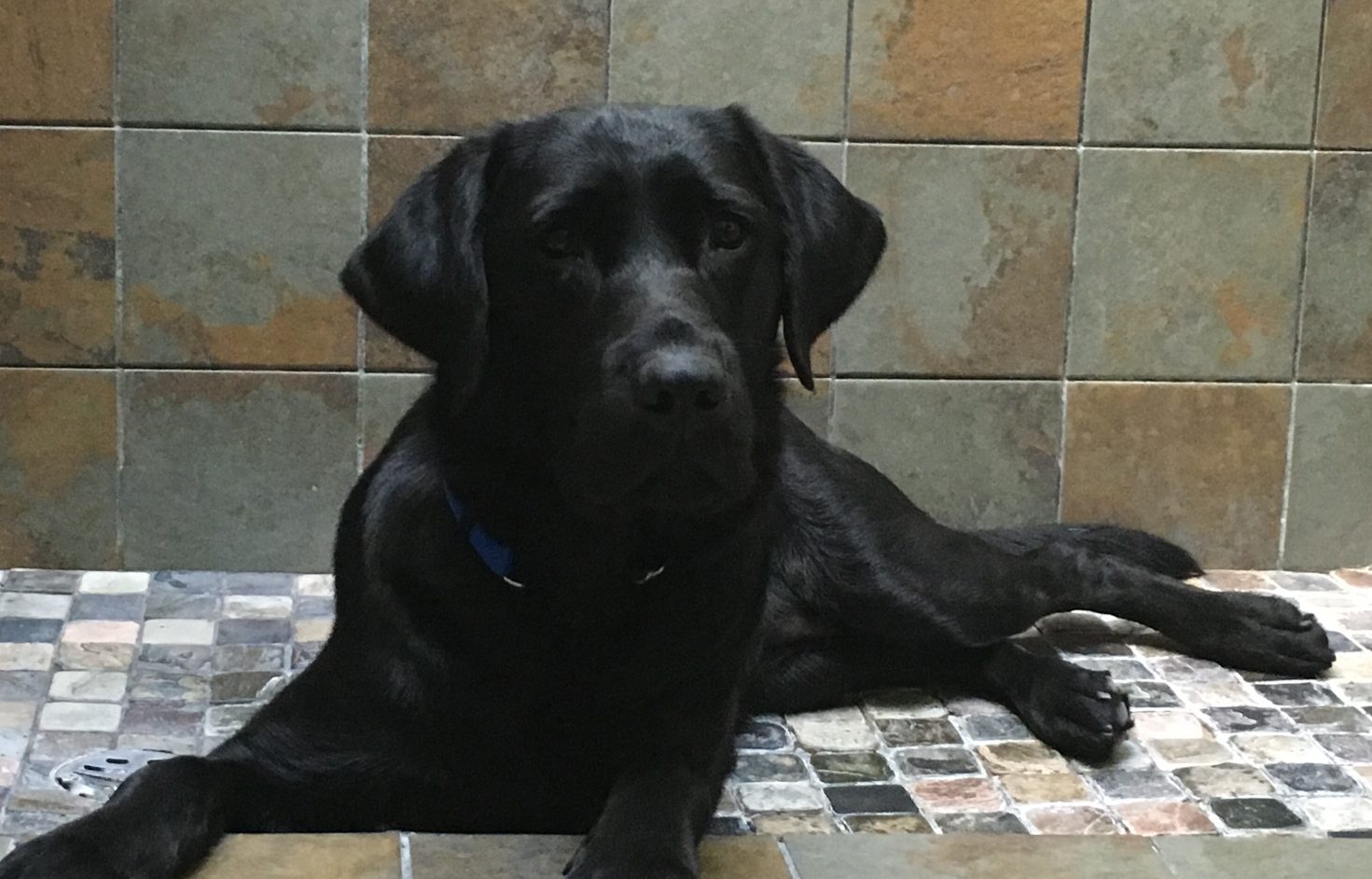
koala-in-showerA guest post by Deni Elliott

Tonight is my last night alone. After four months of crawling into bed without Guiding Eyes Alberta snorting and snoring a few feet away, tonight is my last night alone. Tomorrow I meet Guiding Eyes Koala. As hard as I’ve squinted at photos and video and as tightly as I have clutched each new piece of information, I find it odd how little I can imagine about our future together.

Koala’s passed all the tests and has exceeded expectations. I’ve heard that she leaps into her harness and back-channels routes after only one trip. She eagerly solves problems and pivots on a dime, ready for new adventure. A personality match for sure. But I remind myself that I need to go slow and not expect too much of this 2-year-old.

At the cusp of this unknown relationship curving to be real, my tummy flutters with butterflies of anxiety and anticipation. I can imagine the home trainer better than the dog he is bringing me.

Jim Gardner, GEB director of home training, will fly from New York to Tampa with Koala curled at his feet. I imagine Jim cheerfully answering the questions I am annoyed to be asked. “Are you training that dog?” someone will ask. “Yes,” he’ll smile, “This is a new, young guide dog. I am taking her to meet her blind partner.” When asked, I put on the same “please the public” smile, but say in a way that invites no further intrusion: “Every day is a training day, but I am blind, and she is my guide dog.”

I imagine Jim calmly replying, when asked the dog’s name, “We don’t tell people that because we don’t want them distracted.” Knowing that despite 16 years of guide dog use that I am still paralyzed by strangers asking my dog’s names, other trainers have had me practice giving a fake name. I don’t lie well. Saying, “I won’t tell you,” feels rude. “Leave us alone,” is definitely rude. Saying, “If I tell you the dog’s name, you will immediately say it and distract her and that is exactly what I don’t want you to do,” is too long and complicated. So, I quickly say, “This is the dog’s name, BUT DON’T SAY IT.” As those words come out of my mouth, I concurrently offer a treat so that the dog doesn’t pay attention to what the other person might say. We then hurry away.

I imagine Jim chaperoning Koala and me on our first neighborhood walk. “What can we do for our first outing?” I will ask. “Two miles? One mile? 250 steps?” I have three routes mapped out just in case.  For the months I’ve caned my way through twice-daily walks, I’ve imagined being guided by new dog instead. I whisper “Right-right,” and “To the curb please,” and “Good dog, good job.” I’ve counted the number of streets I cross on these daily laps so that I can help Koala learn streets where she needs to stop and driveways where she doesn’t. I imagine the neighbors that I pass daily expressing surprise and sending best wishes when they see me with Koala in harness instead of gripping a cane.

I cry when I imagine Jim and Koala arriving from the airport tomorrow night. I have joked about lighting candles and pouring wine for the new girl’s arrival. In truth, I have stocked the house with beds, toys, crate, food and treats. I ache with the knowledge that none of these will fill her heart tomorrow night. All I can do is make promises that she won’t understand.

She’ll wonder where her most recent caregivers, Graham and David, have gone. She’ll look for her special canine friend, Wrangler. Some visual or scent will call to mind her puppy raiser mom, Eileen, although it has been six months since they’ve seen one another. From Alberta, I know that well-raised guide dogs never forget previous family members and greet them with great joy. I suspect Koala would prefer we all live together in one pack. I can’t make that happen, but I will promise to keep her connected with the dogs and humans who matter to her most.

koala-and-deniI will promise to keep her safe. I hope that she never needs to know that I will instinctively fold her under my body for protection if anything threatens her just as I did when Alberta and I were attacked by a stray dog.

I will promise to trust her today and for all of the tomorrows we have together. When I am utterly confused, I will follow her lead, knowing that she’ll have better ideas that I about what to do next.

I can’t imagine Koala at my side because I don’t know yet the person she will turn out to be. But I can promise to show her day after day that I will love her for being her own best self and for who we can become together. Maybe that’s enough for the first day.

Postscript: Koala and Deni are off to a great start!

Dogs Understand Our Words — and Our Tone of Voice

janaNYT

This week, many media outlets have run stories on a recent Hungarian study that might show that dogs not only understand the words we say to them, they also understand the tone of voice. I haven’t yet read the full paper, but based on several articles, here’s the gist.

The 13 dogs, trained to lie still in an MRI machine (so already a select group of highly educated individuals …), were tested on four sets of cues: Praise words said in a “praising intonation,” described as a higher and more varying pitch than neutral speech; the same praise words in a neutral tone; neutral words in a praise tone; and neutral words in a neutral tone.

From interactions with dogs, most of us know that we can get dogs to respond to pretty much anything we say in an excited or happy tone. And we know that they respond to some words even if we barely whisper them. For instance, a whispered “c…o…o…o…o…k…i…e…e…e…” gets a reliable response even if the dog is 100 yards away, playing happily with her buddy. But this research study, like several other MRI studies by this team and an American team, looked at the response in specific areas of the dogs’ brains, not their actions.

Praise words, regardless of tone, caused reactions in the left hemisphere of the dogs’ brain; this is similar to what the researchers would see in a human brain that is processing speech. Neutral tones, regardless of words, produced a reaction in the right hemisphere; this is similar to what the researchers would see in a human brain that is processing generic acoustic information. And, when the praise words were spoken in the praising tone, the reward centers of the dogs’ brain lit up. This shows that the dogs were able to integrate the meaning of the words and the tone and deduce meaning from them.

This study seems to show that dog brains process speech similarly to the way human brains process speech, which is what this article on Smithsonian.com reports. Other media reports said that it also means that the dogs understand human language, like this one from NPR.

Some experts, like one of my all-time-favorite scientists, Dr. Gregory Berns, told Smithsonian.com that the paper has been “wildly overinterpreted,” partly due to its methods. He pointed out that responding to speech and tone is not the same as understanding it.

That may well be true. On the other hand, the NPR article warns of the perils of life with such smart dogs, particularly if — as I do — one leaves NPR on for them to listen to all day. My dogs are, indeed, both smarter and better-informed than I am, especially now that I work in an office and do not listen to NPR all day.

However, in all seriousness, I think the overinterpretation also may be oversimplification. Yes, our dogs learn that certain words, even sentences, have specific meanings. They learn our habits and routines, and through experience with us, they associate all kinds of things with words. In our household some examples are: Leashes and fun and ball-playing with, “Who wants to go to the park?”; bowls of yummy food with “How about some dinner?”; and a careful backing up so that just her large, furry front paws are over the threshold with “Out of the kitchen, Cali.” The front feet then scootch back almost imperceptibly in response to, “The entire dog, please.” So yes, my dogs understand and respond somewhat appropriately to several sentences; I suspect that each family’s dogs have a set of favorites.

But even armed with my years of knowledge of their intelligence, along with my new realization of their eruditeness (is there a dog-oriented radio station that I could leave on instead of NPR?), I do not think that they process and understand human language in the same way that a human adult does.

What I do think, based on a combination of experience and having read dozens of research papers on dog-human communication, is that they read us really, really well. They don’t respond only to the words we say or the words combined with the tone of voice. Humans don’t either; so much communication is based on body language and other cues, even between humans. But dogs really read our body language. They also read all the scents we are giving off, including pheromones that we are completely unaware of. They read our microexpressions and our posture and our facial expression and pay attention to what we are doing as we are talking to them. They can figure out our emotions from these cues. They know when we “mean it” and when they can push the boundaries just a bit further.

Cali is much quicker to listen to my “get out of the kitchen” phrases when I am fixing her dinner than when I am doing the dishes. She’s learned that I will stop fixing her dinner and wait for her to leave the kitchen. She doesn’t like that consequence. But she doesn’t much care if I get the dishes done and maybe even wants me to stop doing them so I can pay attention to her.

The point is, looking at dogs’ response to words and voice in isolation doesn’t make sense, because in their lives with us, that is not how they use language. Another important thing to remember about dogs, as opposed to any other nonhumans, is that so much of who they are has been shaped by the fact of their lives with us. The dog-human connection is unique; our communication with them is different from our communication with any other nonhumans (even cats).

The most important point, though, is that dogs pay close enough attention to us to learn the meanings of the different things we say to them. They care whether we’re happy with them — or just whether we’re happy. I’m excited about new discoveries about dogs’ intelligence and cognitive abilities. But I am even more excited about new reasons to cherish the relationship I have with my girls and that others have with their dogs.

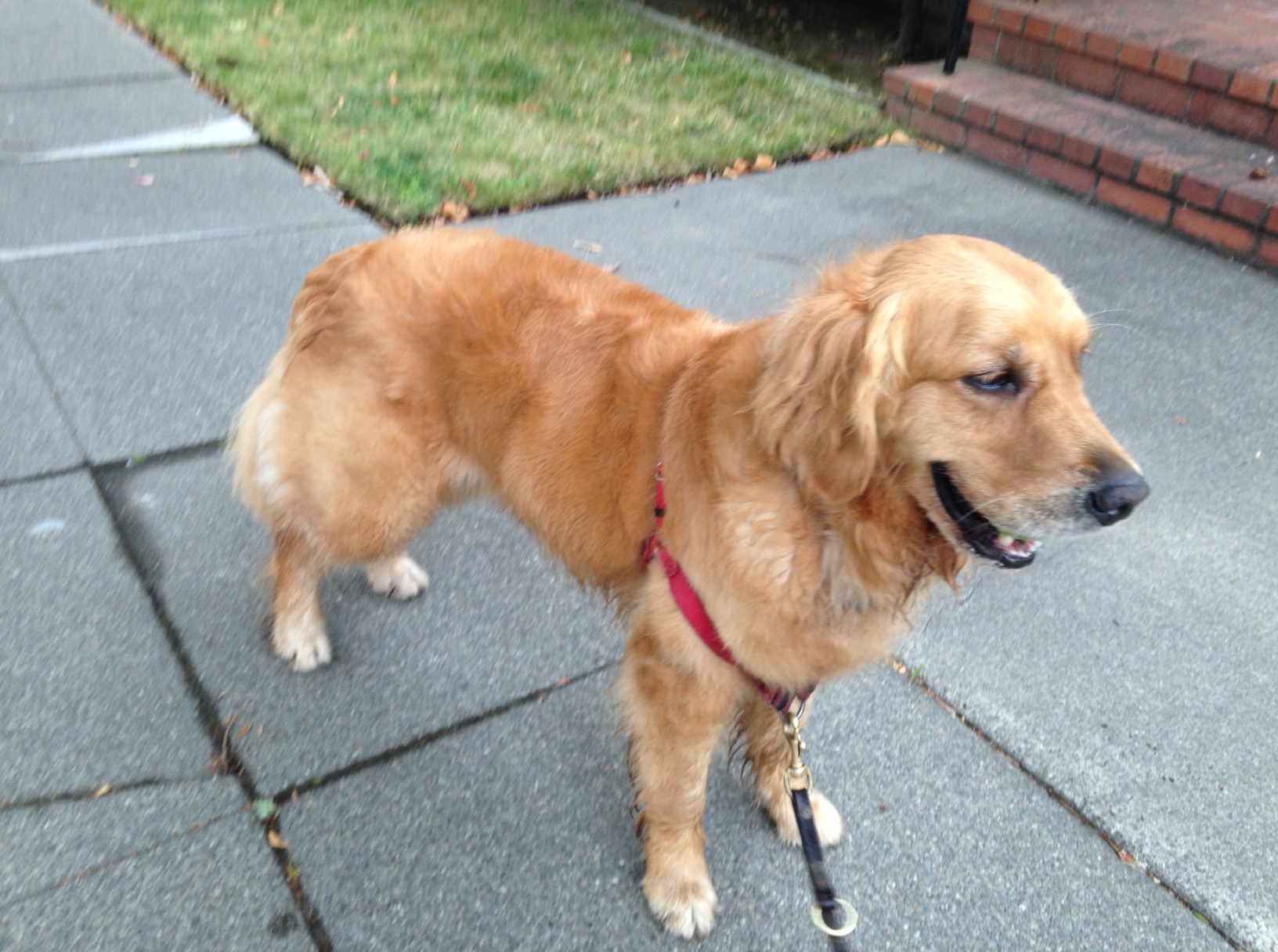
 

A Scary Incident (That Ended Well)

Jana and Cali_post vestibular_crop

Jana’s had a rough week.

She’s dealing with something that is fairly common, but a lot of her friends and family weren’t familiar with it: vestibular disease. It’s also called “old dog vestibular disease,” since it is especially common among older dogs. But Jana regards herself as neither a dog nor old, so we’re just calling it vestibular disease.

It shows up suddenly and looks for all the world like your dog has had a stroke. She might have. She also might have an inner ear infection, a brain bleed, a brain tumor — or none of these. Most vestibular incidents are idiopathic. A fancy way of saying the vet has no idea why your dog cannot stand up or staggers around like she’s drunk. Very drunk.

In Jana’s case, she woke up in the middle of the night and struggled to stand up. I know this because what woke me up was the sound of her flailing and falling. I calmed her down and we went back to sleep. In the morning, she could not walk. I got her outside to toilet and then into the car. Her vet offered the suggestions of vestibular disease, inner ear infection, or tumor. The tumor idea arose primarily because Jana’s left eye looked much larger than her right and was bulging a little.

I got her home and settled her in the yard. She spent the weekend struggling to stand and unable to walk without a lot of help. But by Sunday afternoon, she was noticeably better. I made arrangements with two wonderful individuals, our longtime friend Sally and our new dog walker, Stephanie, to care for Jana on Monday and Tuesday, as I had work meetings that I could not miss.

By Monday afternoon, Jana was taking herself outside. She was very unsteady and fell a lot but did not want help.

Since she’s a golden retriever, it might be unnecessary to mention that her appetite did not suffer a bit during any of this, but she needed help eating.

The vestibular system is what helps you balance and orient your body. Hers was way out of whack. This was not paralysis or muscle weakness. It was extreme dizziness and disorientation. She got meds for the supposed nausea (though she never seemed nauseated) and for the possible inner ear infection. She slowly recovered, walking a bit better each day, all week, and we went for a neurological consult at the end of the week. The neurologist said that her excellent progress, along with the improvement in her eye, indicated that a tumor is not likely. The only way to know for sure whether she has (or does not have) a tumor and to figure out (maybe) why this happened is an MRI and spinal tap. I’m not doing that for a number of reasons.  If Jana stops improving or gets worse, I will have to figure out next steps. But right now, she’s doing well.

It’s important to know several things about vestibular disease.

One is that it’s not painful. It is probably scary and miserable, though. I had an inner ear infection once and was horrifically dizzy. If Jana was experiencing anything like that, she has my sympathy. She was also much more of a trouper than I was; I couldn’t even keep water down. She scarfed down cookies, water, meals … a true golden.

Another is that most dogs recover — and quickly. The most significant recovery happens in the first two or three days. Many dogs have a wobbly gait and maybe a head tilt for a week or two. The head tilt might never go away. Jana’s head tilts noticeably to the right when she’s standing up. When she’s lying down, I don’t see it. And it too is a little better every day.

Many dogs recover and continue living perfectly normal lives, though some have additional episodes. Some have permanent effects — a limp, unsteadiness, the head tilt.

Finally, it’s important to emphasize that Jana had no personality changes, no cognitive damage — she’s still very much herself. As soon as she could stand, she was asking to go out on her own, did not want help, and did not want me or anyone else hovering over her. She was back on the job, demanding that I let her out to get the paper, by Tuesday morning.

It’s scary to wake up to a dog who cannot stand up. It is also scary to have to figure out how to get a 60-lb. dog outside to pee or into the car when she cannot support her own weight. We really need 30-lb goldens. If she had not recovered quickly, I would have had to make some hard decisions. I was very relieved to see Jana trying to stand, and, slowly, getting her bearings back.

A vet tech who takes care of Jana said that lots of owners panic when they see their dogs’ initial symptoms, and many make the difficult choice to euthanize. So I want to emphasize again that dramatic improvement in the first two-three days is the norm. If that is not what happens, then the dog might have something other than vestibular disease.

Cali was concerned and attentive throughout all of this — to me and to Jana — but also worried about missing her ball time and park visits. She bumped into Jana a few times before understanding that she needed to be more gentle. She’s been remarkably patient overall, though, and very good company.

Jana is still unsteady, but she doesn’t fall every time she shakes off or turns a corner. She’s cautious on steps, but we only have a couple of small ones. She wants to go for walks and visit her friend in the neighborhood. She wants to sniff and check out the news and get to her favorite grassy patch. I’m looking forward to the day that she’s stable enough to head out to the coast for a beach day. We all deserve one.

That Soulful (and Loving) Gaze

Oxytocin is a hormone that plays a role in social bonding, as implied by some of its nicknames: the love hormone, cuddle chemical, or bliss hormone. It’s also something that dogs and humans share.

Studies published in 2009 found that, when dogs gazed at their owners — you know, that adoring gaze that says, “feed me; I’m yours,” owners had more oxytocin in their urine. This correlates with feeling affection and social connection.

You can see where this is going, right? They gaze at us, we interpret it as adoration, we respond by feeling loved and happy. This works well for the dog. For us, too; real or not, we have that great “someone loves me” feeling.

But there’s more to this story. A later study looked at more variables. For example, the oxytocin in dogs’ urine. Did they get the same emotional lift out of the exchange of adoring gazes? Also whether interaction with the humans affected oxytocin in either humans or dogs.

This is where things get interesting.

A note: In both studies, dogs and wolves were used, as a way to determine whether this was just a canine thing, or whether it really has to do with the dog-human relationship.

First, the study looked at the effects if the person and dog exchanged gazes only, versus when the person also interacted with the dog, talking to her or petting her. No one was given oxytocin in this study; dogs’ and humans’ levels were measured before and after. The dogs and owners who spent the longest time gazing and interacting with each other had significant increases in their oxytocin levels — the dogs’ levels as well as the people’s. The dogs like the attention — even you, Jana! The gaze-only dogs and the shorter-gazing couples had small or no increases. Neither did the wolves.

A variation of the study had researchers administer oxytocin to some of the dogs to see whether the amount of oxytocin in their bodies made a difference. Then, the dogs and humans were allowed to gaze at each other, but the humans were not allowed to intentionally interact. If the dogs touched the humans, it was noted, but the humans were not allowed to respond by petting or talking to the dog.

So, was there a change in the dogs’ behavior if they had higher (administered) oxytocin? There was — but only for female dogs. With more oxytocin, they gazed at their humans for a significantly longer time; the length of their gaze at a stranger wasn’t affected. Male dogs actually gazed at their owners longer if they had not received oxytocin. The wolves didn’t really gaze at the people.

Not to knock boy dogs, but … maybe they’re just not that into you.

Seriously, what this all means — according to the researchers, anyhow — is that a mutually reinforcing loop occurs (particularly with girl dogs). They gaze at us, we look back, babble nonsense at them, rub their bellies … Hmmm, how do they gaze at us while we’re rubbing their bellies? OK, we stroke their long, soft ears and gaze back into their eyes. And everyone feels all warm and mushy and loved, so the girls keep staring at us, to keep this good thing going. More gazing, more oxytocin, so more and longer gazing, and the cycle continues.

Gazing is important in human social bonding and communication, starting when babies nurse. Lots of research shows that dogs use humans’ gaze as communication — and use their own gaze to communicate with us. And, as I wrote a couple of weeks ago, dogs choose to hang out with us. All that, to me, adds up to a mutual bond that is very rewarding to all of us, including the dogs. That, and they need someone with working thumbs around to get access to their dinner.

Racial Profiling

A new dog shows up at our park play group. Is Cali interested in meeting or playing with this newcomer? Is she curious? Is she hesitant, cautious? Or does she simply head for the other side of the park and ignore the new pup? And what about Jana?

That depends on several things.

When the newcomer is a puppy, I can be absolutely certain that Jana wants nothing to do with him or her. Cali might, but she tends to watch new pup interact with some other dogs first.

What about adolescent and adult dogs? Large dogs get a wide berth. Small dogs get more interest. But the one time I can be certain that Cali will go right over and say hello to a new dog is when that dog is a golden retriever.

Cali’s very wary of shepherds and huskies. She’s open to small poodles and terriers. A little nervous around very high-energy dogs. Very leery of big dogs, though once she gets to know them, she’s fine. She finds boy Labradors overwhelming, but has had a few Labby girlfriends. Cali’s the most relaxed with her sister Dora and a couple of other dogs she knows well, all Labs or goldens. Anyone who shows any interest in her ball is definitely off the potential friends list. Unless it’s a golden; then they can talk.

Cali is racially profiling dogs. Jana does it too. When Jana was a puppy, if we saw another dog up ahead on a walk (we didn’t have a great neighborhood park with a play group), she’d react completely differently, depending on the breed. Jana is a little broader-minded than Cali; she loved Labradors and goldens equally from early puppyhood. A Lab or golden up ahead would mean eager dancing at the end of the leash and maybe even pulling toward the potential pal. Any other dog, big or small, and Jana would slow down and walk very close to me, a bit nervous and unsure. She’d be fine once she met and got to know a dog of any breed, as long as the dog had good manners. But retrievers, dogs who looked like her — they were OK from the get-go.

It’s not just based on experience. One of the first nonfamily goldens Cali met at the park was an unusually bad-tempered young man who snarled and lunged at her. That did not make her wary the next time she saw an unfamiliar golden.

It’s not only a golden thing, either. A smooth-coated collie puppy I was working with, the lone collie in a sea of Lab puppies at a service dog training school, literally danced with joy the first time a staffer brought her smooth collie service dog to visit. I’d never seen him so happy, and he was generally a pretty cheerful guy. Then there are the German shepherds at the park. The young girl likes to play with Cali. Cali has, on a couple of occasions, accepted the play invitations. Sometimes, while she’s thinking about it, another shepherd, either a young male or an older, long-haired shepherd, will show up. Young girl is immediately off to play with the other shepherd. During breaks in that play, though, she tries again and again to invite Cali to play. She strongly prefers shepherds, but young golden girls are second.

We can’t really hold it against them; people racially profile dogs all the time. What else would you call legal restrictions on owning dogs of certain breeds or apartment rental policies or insurance policies that exclude specific breeds, without any attention to an individual dog’s personality and behavior? But I don’t think dogs learned it from us; I think they are hardwired to recognize — and feel more comfortable with — dogs of their own breed.