Still a Hero

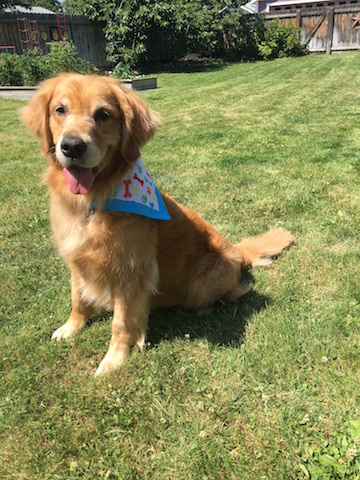
Cali, a golden retriever, smiles happily and wears a colorful bandanna after her grooming.

Cali’s annual exam takes place in late June every year, but she’s only recently completed this year’s visit. Cali is a “hero,” one of 3,000 golden retrievers in the Morris Animal Foundation’s Golden Retriever Lifetime Study.

Cali’s Montana doc is not part of the study, but, fortuitously, we were in California in late June. Her beloved Sonoma vet did the exam. Everything seemed to be fine. Cali’s nails were long, for a change. She also needed to have a large section of her dewclaw removed, which provided an additional large sample. Cali obligingly provided more than enough hair and other biological specimens.

Then the study people lost her samples. Not all of them, but the packet that included the nail clippings, those precious and rare clippings.

They told me that I had to send more samples within four weeks.

I told them that there were no toenails to be clipped.

They granted me two additional weeks.

We drove back to Montana. I got the sample collection kit in the mail. It said I needed to have my vet do the collection. Seriously? I pick up poop several times a day. I can’t be trusted to collect that, trim some fur … and clip nonexistent nails?

They agreed to let me do the collection.

The stern letter threatened to kick Cali out of the study if we missed the deadline. This was serious. Cali’s life’s work was hanging, literally, by a toenail.

I checked her nails daily, deadline looming ever closer.

With about a week to go, I walked Cali around the corner to meet the groomer in our new neighborhood. She got lots of cookies and attention. The groomer thought she could get some clippings. We made an appointment.

Cali wasn’t too sure about this, but the cookies helped.

The nice groomer agreed to save the nail clippings. I left Cali in her capable (I hoped) hands.

A couple of hours later, I retrieved Cali, freshly washed, trimmed, and bandannaed — and that all-important baggie of nail clippings.

I collected the remaining samples and dropped it all off at FedEx.

A couple of days later, I got confirmation. We’d made it. Cali is still a hero.

Just Stop It.

Cali, a golden retriever, licks her lips in anticipation of a treat.
No robot could replace this face

Stop. Just stop saying that soon ____ will replace dogs. Nothing and I mean nothing will replace dogs.

Here’s the latest, a “robot bloodhound.”

I have no idea how much money is poured into efforts to replace dog noses with machines that detect:

  • Cancer (multiple kinds)
  • Low blood sugar
  • Other medical conditions
  • Narcotics
  • Bombs
  • Contraband, including veggies in a traveler’s suitcase
  • Contraband, including smuggled animals, plants, or anything else in shipping containers
  • Scent trails on land
  • Scent trails on water
  • Cadavers (on land or under water)
  • Identify human cremains
  • Endangered / rare wildlife
  • Endangered / rare plants
  • Insects
  • Rats
  • Other pests and parasites
  • Truffles

I could literally list millions of things that dogs can be taught to identify and find by scent. Sometimes, humans don’t even know what the dog is scenting. But dogs are so smart and capable that we can teach them to reliably find it anyhow.

To replace the dogs, a machine would need to be able to identify the exact chemical combination that creates the scent. The machines, so far, are less accurate than dogs. This might be because identifying a scent is not a cut-and-dried, easily reproduced, often repeated set of identical steps.

It’s a process that requires thinking and intuition and understanding of the goal. Dogs can do all of that. They do it all the time, every, in their interactions with us — even without training. The machine does exactly what the human programmed it to do. It might be able to “get better” with practice, but only within parameters determined by the humans who programmed the algorithm. Regardless of what you might hear about how smart computers are, they are not thinking on their own.

Dogs are.

And, dogs can go into all kinds of situations, flexibly adjust to different working conditions, offer feedback on what’s happening, and learn from their successes and their failures. They can work in any kind of terrain and in weather that would defeat many mechanical imposters, uh, substitutes.

Additional dog teams can be trained far less expensively than fancy schmancy robots can be built and moved around to world to anyplace they might be needed. Dogs can hop onto a plane with their handlers and go help — at a disaster site, in a large-scale search-and-rescue operation, at a field hospital.

Remember, scenting is only one of dozens, maybe hundreds of ways dogs assist people. Or make our lives better without a specific task — just by being dogs.

So just stop it. Stop pouring millions of dollars into machines to “replace” dogs. Focus that money and effort on training dog-and-handler teams. That could prevent things like what I heard on the radio this morning: In a story on the return of remains from North Korea, which are likely to include the remains of many American servicemen who died there more than 60 years ago, a comment was made about how difficult it is to find human remains because there’s no technology that can detect them. Maybe there’s no technology, but trained cadaver dog teams could certainly find them. They wouldn’t falsely alert on bones from nonhuman mammals, either, preventing the “return” of nonhuman remains (which has happened).

And remember, each of those expensive robots does only one task. A different robot is needed for each task. The dog team? That dog can be trained to do multiple related (or unrelated) tasks. Besides, who wants to cuddle up with the robot bloodhound at the end of a tiring day of searching?


The Making of a Cherry Monster

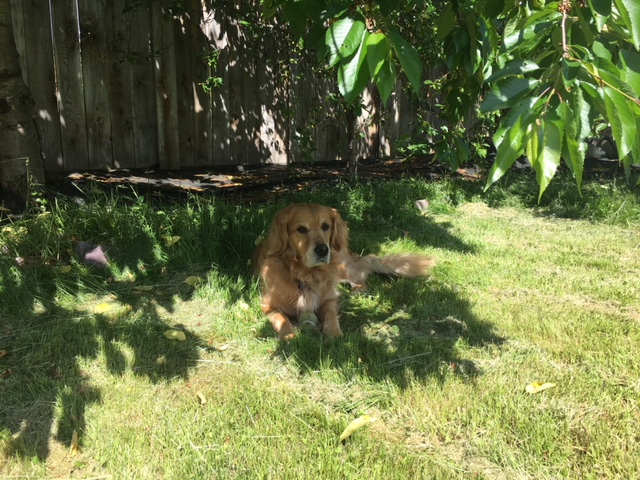
Cali with her tennis ball, in the shade of a cherry tree
Cali discovered delicious snacks under the cherry trees.

It started out innocently enough. Cali wandered over to that nice shady corner of her yard by the cherry trees. One day, she found something red that smelled delicious. She ate it. She found more of those delicious red balls and ate them, too.

I noticed and told her to cut it out. She carefully spit out the cherry pit that was in her mouth and wandered away.

If only it were that simple.

Soon Koala discovered cherries. She taught Cali that if you swallowed the pits, you could eat a whole lot more cherries, faster, even after one of the mean policemoms caught you and told you to stop.

We went from a pit spitter and a pit pooper to … well, you know.

Then Koala packed up and went back home to Florida. Cali had to figure out stealth cherry chomping on her own. She’d keep an eye on me to see if I was watching. If I was talking on the phone or (!) went inside, she’d steal over to the cherry patch and grab a few cherries. She’d still spit the pits if she felt as if she had time to dine more leisurely. But, if she saw that I’d looked her way or — worse — was walking over to ruin her snack — the gobble rate would speed up.

I chased her away from the cherries. She went back. I threatened to make her go inside. She stayed away for a few minutes but was always drawn back. I cleaned up the dropped cherries. She found more. The call of the cherries was irresistible.

She got very sneaky. She’d wander around the yard feigning nonchalance. If I didn’t react, her loops would take her closer and closer to the cherries … Or she’d head that way and glance casually over her shoulder. If I wasn’t paying attention (or she thought I wasn’t), she’d pick up the pace and head right there. If I was watching, she’d change direction, look again, react appropriately … this meandering ultimately always ended at the cherry feast.

Finally, nearly all the cherries were ripe. I picked several million one Sunday morning. A friend helped me pick most of the remaining billions of cherries one evening after work. We cleaned up the dropped cherries pretty well. Cali went into deep depression.

Now, the only cherries left are too high for me to reach, even with a ladder.  The birds and squirrels help Cali out by dropping and knocking them down.

But Cali has pretty much moved on.

She discovered the raspberries this week.

She picks the low-down ones, being careful to avoid the spiky branches. When I am out there picking, she’ll stick her nose into the bowl and try to steal the fruits of my labor. I tell her to go get her own raspberries. She does, even burrowing into the bushes to go after a particularly juicy berry.

There aren’t as many raspberries, and they have no pits, so I don’t worry as much about her eating those. But somehow, Raspberry Monster doesn’t have the same ring.

Over the Top

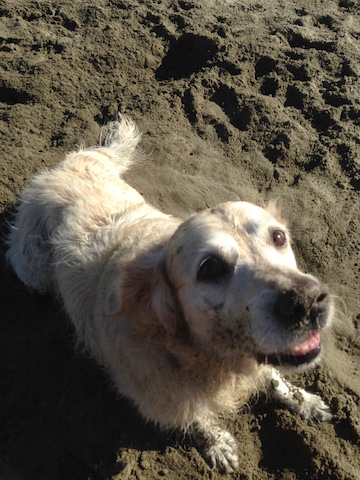
Jana, a white golden retriever, smile happily as she shows off the sand coating her entire body.
Jana was happiest at the beach, covered in as much sand as she could rub into her fur.

Two people sent me this article for the July 4 New York Times on the absurd lengths that people go to to “pamper” their pets. I am skeptical that it is truly pampering for many (most?) pets. It’s really what the human owners think of as pampering or as necessary; I do not think that the pets themselves would choose … OK, where do I start:

Neuticals? Too easy. These fake manly bits exist exclusively for the humans who cannot get past the horror of neutering … a human. Dogs don’t care. In fact, dogs who suffer miserably when forced to live in a human world following human rules are generally far less frustrated, less anxious, and possibly less aggressive post-alteration. Many more of them actually get to remain in their comfy homes, too.

Gender non-conforming pets? Since the reasons given for what is termed “gender reassignment surgery” in pets sound plausibly medically justified, I am not too upset about the examples given. But the discussion of gender-(non)conformity and pets is … absurd. The ideas of gender come from the humans. The dogs go about their doggy lives peeing in whatever position  works best for them and don’t give each other any grief about how (or where) they do it. We could learn from them. And, yes, they mount one another, even if they are female. It’s not all about sex; sometimes it’s about status or control. It’s a very doggy thing to do, even if it is rude.

The idiotic haircuts and styling are a step too far. Even dogs who enjoy going to the groomer — and most dogs don’t — don’t need all that fuss and oh-so-human bother. Let dogs be dogs.

Which brings us to the worst offense: Cosmetic surgery. I cannot believe there are vets who would do this, but I guess in any profession, there are some who are just in it for the money. “Popular procedures include tummy tucks, nose jobs and eyebrow and chin lifts,” according to the NYT article. Seriously? Isn’t there a veterinary code of ethics? In what universe is forcing unnecessary surgery on a sentient, sensitive, loving being who cannot (and would not) consent even close to ethical?

Again: Let dogs be dogs. Want to pamper your dog? Forget the spa and the glitter. Head for the dog beach or a nice creek. Spend a couple of hours walking in a forest, preferably where the dog can safely be off leash. Heck, stay home, toss a ball for a few hours (“Heaven …” Cali murmurs), and fire up the grill. Throw an extra burger or steak on for your best buddy. (“Is that even possible …?” Cali wonders. “Does it have to be a tofu hot dog?”). Wrap up with a long belly rub (for the dog) while you watch TV together (DOGTV is not necessary or even very interesting to many dogs) or sit outside and stargaze.

Dogs love to be pampered, sure. But their idea of pampering is not the same as ours. If the spa really wanted to appeal to the dogs, they’d replace the oatmeal soak and blueberry facial with a “rotten fish roll” — and I don’t mean bread. Or, they’d swap out the mud “mask” for a (post-shampoo) chance to wallow in a mud bath — then shake off in an all-white room provisioned with a freshly laundered white bedspread and pristine rug to roll on. That’s the ticket!

Are Mixed-Breed Dogs Healthier?

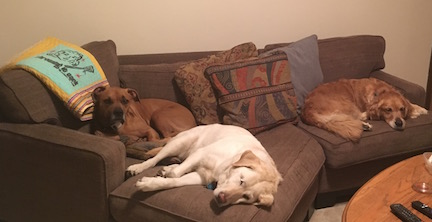
A mixed breed dog relaxes with a Labrador and a golden retriever on a sofa.
Who’s healthier?

A recent blog post by Dr. Stanley Coren mused about “hybrid vigor” or the notion that mixed-breed dogs are healthier — or, at least, less prone to genetic diseases — than purebred dogs. I decided to read the full study he referenced to learn more.

A large group of researchers, mostly Finnish, studied a huge sample of dogs: more than 83,000 mixed-breed and more than 18,000 purebred dogs of 330 different breeds. They analyzed the dogs’ genotypes, looking for 152 different genetic markers that underlie hereditary diseases.

They quickly narrowed down the study: Of the dogs with a faulty gene, 96 percent had one (or more) of a group of 30 genetic markers or “disease alleles.” They narrowed further, selecting the nine most common markers, which all appeared in multiple purebred breeds as well as in mixed-breed dogs in the sample.

Several findings might be interesting to dog owners:

  • Mixed-breed dogs are as likely or more likely to carry some genetic variations linked to diseases than purebred dogs.
  • But purebred dogs are more than twice as likely to actually have a genetic disease.
    That makes sense; the number of purebred dogs who are actually bred is quite small, and many are bred to dogs from the “same lines” — relatives, even very close relatives. Within a closely related population, the likelihood of dogs sharing a recessive gene is much higher than in the broad population of mixed-breed dogs.
  • Deeper study of individual mixed-breed dogs who carried rare genetic variations found that, even when the dogs exhibited symptoms of a genetic disease, these individual dogs were only diagnosed after the owners had the results of the genotyping.
    That also (sadly) makes sense: The vets didn’t suspect that the mixed-breed dogs had rare, usually breed-linked, genetic diseases.

The question of “hybrid vigor” is nuanced, since the dogs are likely to be carriers but less likely to suffer the diseases, but I’d argue that mixed-breeds are healthier.

In his post, Coren also points out that another common belief — that breeders frequently breed dogs known to be carriers or even sufferers of a disease — is unfounded. Many breed-specific genetic diseases have become extremely rare or have been eradicated — due to careful breeding. Some breed clubs forbid breeding of carriers of known genetic diseases.

The researchers are sharing their data; they’ve created the free My Breed Data database, where anyone can search for information on genetically linked diseases.


Time to Weigh In on Flying Dogs (Hurry!)

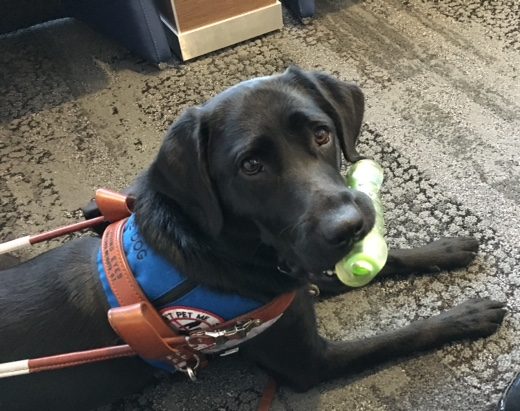
Koala, a black Labrador, rests. She's wearing her guide harness.
Koala is an excellent traveler.

The peacocks, the pets trying to travel as service or emotional support dogs, the misbehavior — from pooping pigs to biting dogs — and the “service dog” whelping her litter near gate F81 … it’s all too much.

Not only are airlines tightening up their rules on which of our furred, feathered, and scaled friends may board, the Department of Transportation is considering changing sections of the Air Carrier Access Act (ACAA), the law governing air travel with service and emotional support animals.

The root of the problem is that federal laws governing access for assistance animals are vague, different laws allow for different things in different spaces (public businesses, housing, and air travel), and it’s easy to exploit loopholes or deliberate omissions in these laws. The result, as far as air travel is concerned, is a mess.

In a nutshell, the ACAA allows people to travel with service animals or with emotional support animals (ESAs). The ACAA definition of a service animal is different from the more familiar ADA (Americans with Disabilities Act) definition; the ACAA definition of ESA is loose indeed. For one thing, no training is required; for another, passengers are not required to crate or otherwise contain the animals during the flight.

Problems include threats to (and harm to) the safety of other passengers, interference with legitimate service animals working with their partners, and undue stress on the animals themselves, who generally have had no public access training and should not have to endure a strange, noisy, smelly, stressful, cramped, terrifying experience (air travel is all of that and more for me, and I am used to it!).

The DOT is soliciting comments by July 9, 2018 specifically in these areas:

  1. Psychiatric service animals; ADA treats (some) PSAs as any other service animal, while the current ACAA groups them together with ESAs
  2. Whether to maintain the distinction between ESAs and service animals
  3. Whether ESAs should be crated or otherwise confined / restrained throughout the flight; similarly, they are soliciting comments on whether service / ESAs should be required to be leashed or tethered
  4. Whether to limit what species of animals would be permitted to fly as service and/or ESAs; ADA allows only service dogs and a limited number of miniature horses
  5. Whether and how to limit the number of service / ESAs a passenger may travel with; currently neither the ACAA nor the ADA limits the number of animals
  6. Whether to require that passengers with a service or ESA should be required to attest (sign a statement declaring) that the animal has been trained  for public access
  7. Safety concerns regarding travel with “large” (undefined) service animals and suggestions for addressing those concerns
  8. Whether airlines should be allowed to require a veterinary health form or immunization record from any or all service animal users
  9. Issues with airlines denying / allowing passengers to board with ESAs / service animals on foreign airlines’ code-share flights

For more details, read the full notice. Post a comment here. Read others’ comments here.

Post your comment by July 9!

Tales Tails Tell

Everyone knows that a wagging tail means a happy dog, right?

Nope. What “everyone knows” is not always true. Dog say a lot with their tails. Sometimes, they are showing happiness, playfulness, and friendliness. Sometimes the tail wag means the exact opposite. How can you tell?

Koala is wagging her entire tail in the video above. She’s excited about something (Deni is probably fixing her dinner!). If she were standing, the tail would flow down from her back and the wag would extend widely to both sides of her body. This is a happy, friendly, excited tail wag.

A tail held level with the body or a little lower, wagging quickly, usually means good things. The dog is happy or excited. When a dog is really happy, she might wag her whole body. This is known as the tail wagging the dog.

When Cali is greeting someone she adores (by which I mean “someone she has met before”), her entire body wags and wriggles with joy. Not all dogs are that exuberant, but it’s usually possible to see signs of happiness other than the waggy tail: soft, open facial expression, bright eyes, a smile, that wriggly body. In Cali’s case, this can be challenging to distinguish from her whole-tail happy wag when she spies someone she hasn’t yet become best friends with. The chance to meet someone new is almost as great as seeing someone adored, so she wags high and fast then too. But maybe a little less of the body wag …

The tail gets higher as the dog becomes more aroused … or more assertive. A tail held high radiates confidence but could also indicate aggression. If you’re approached by a dog you don’t know with tail straight up, be cautious, especially if the tail is doing more of a vibration than a wag.

An exception is the “helicopter tail,” a maneuver sometimes performed by Labs and Goldens when they are playing ball. I am sure there are other times (and other dogs) where the helicopter move shows up. It’s a high tail that make complete circles over the dog’s back, like a helicopter rotor.

A slow thump often indicates a happy, relaxed dog. But a slow wag with the tail low, when the dog is standing, could mean the dog is checking out something that makes her feel anxious or unsure. The narrower the sweep of the wag, the more nervous the dog. People often mistake a slow, conservative wag for a welcome and move in to pet the dog. This can be a mistake; an anxious dog who feels crowded or threatened could respond badly. I’d let a dog showing this nervousness have her space, and I wouldn’t make direct eye contact. If, after sniffing me, she wanted to approach, great! But I wouldn’t push the issue. A tail held very low or even tucked signifies submission or nervousness; it might move a bit but, this is not really a tail wag, even if the tail is moving.

As it dawns on a dog that the anticipated good thing is not going to happen or will be delayed, the excited, happy wag could slow into the uncertain or anxious wag; this is one of many ways that dogs converse with us using their tails.

There’s more to a tail wag than tail height and width of the wag. A study done in Italy a few years ago found that dogs wag more to the right when they see someone they know and more to the left if they are nervous. The study also determined that dogs can read that nervousness in other dogs’ tail wags and are likely to respond by becoming anxious when they saw left-wagging dogs.

These whole-tail wags are easy enough to read once you practice a bit. But sometimes dogs say much more with their tails. Let’s look at Koala’s unique tail-speak:

I’ve never seen another dog do this exactly, but the partial tail wag is great communication. Koala’s thinking about something: she might be listening hard to what Deni is saying and trying to understand; she might be hoping that Deni is about to give her a wonderful treat and watching closely to see if she can tell. This tail-tip wag means that Koala is thinking about something, solving a problem. But it’s a good problem; she’s tentatively, hopefully, anticipating something good.

So, pay attention to what your dog’s tail is telling you. It’s a great way to read her mood and improve your two-way conversation.


Still Life: Girl with Tennis Ball

Cali and I recently moved to a new home. It has a yard. I’m not sure whether Cali has actually noticed anything but the yard. She wants to spend all of her waking hours in the yard. And with close to 16 hours of daylight these days, that’s a lot of hours. She’d sleep out there too, if I’d let her. What does she do out there? I’ll let you see for yourselves in a series of still life photos:

This slideshow requires JavaScript.

Aromatherapy for Dogs

Cali’s favorite way to relax is curling up with her beloved tennis ball.

Aromatherapy for dogs seems like an obvious idea, but it’s only recently been formally studied as a way to calm dogs in  a stressful environment.

A small study looked at the effects of four scents: Coconut, vanilla, valerian, and ginger, on dogs in a shelter / kennel environment, a noisy and stressful environment. All four scents were found to reduce activity and vocalization; coconut and ginger also increased the amount of time dogs spent sleeping.

It was a single, small study, and I hope that more research is done on whether scents can calm dogs and which scents are most effective. I have some products that are intended to calm anxious dogs, but I don’t know that they’ve been particularly effective with my own dogs. One is lavender and chamomile. I’ve used T-Away, an essential oil blend, with Cali, and it sometimes calms her right down, but other times doesn’t seem to have an effect. I think the difference is whether she’s excited (no effect) versus anxious (seems to help a lot), but I have not done careful enough study to be sure. A DAP diffuser seemed to help with Jana’s anxiety, but again, my study of one dog doesn’t really say much about whether this is an effective treatment.

But, given the way most humans respond to scents — some are calming, others are irritating — along with dogs’  sensitivity to scent, it seems likely that aromatherapy could work for many dogs. I’d love to see something as easy to implement as infusions of relaxing scents become a standard protocol at kennels and shelters, maybe vet clinics — anywhere that stressed-out, anxious dogs are likely to be found.

Aromatherapy might also be a nice, easy way to help dogs with noise and thunderstorm anxiety. That would be a great direction for some additional research. I have a growing personal interest in this topic, as Cali has recently shown some anxiety during severe thunderstorms. I don’t think she’s reacting to noise, but rather to changes in air pressure or something else that started quite a while before the actual rain, thunder, and lightning. Melatonin helps, but it would be nice to have some other ways to ease her anxiety.

A caveat: The scents that tend to be soothing to humans might not have the same effect on dogs, and scents that they find calming might be unpleasant to us. Even if that turned out to be the case, it would be interesting to know more about how scent affects dogs’ moods and energy or activity levels.

In addition to calming them, scents could probably be used in other ways to work with dogs or influence their moods and behavior. I learned a lot about dogs’ sense of smell from Being a Dog by Alexandra Horowitz, but I don’t remember any mention of scent as a way to calm (or energize) dogs.


Perfect (Selective) Hearing

A partially peeled banana

There’s something about the sound of a banana being separated from the bunch. That little snapping sound. For dogs who love bananas, like Cali and my first dog, Timo, that sound is magic.

Timo could be outside, busy with doggy things, but if I touched the bananas, he’d be there in a flash. Cali currently can’t get too far from me; we live in an apartment with no yard. And her sensitive ears never miss that sound. Or the sound of a knife cutting into a cucumber. She does love cucumbers …

Cali, a golden retriever, licks her lips in anticipation of a treat.
Did someone mention cucumbers?

Her hearing excels in other ways too. If I rustle a treat bag or the bag her food comes in … touch my keys … move a tennis ball while looking through the closet. Certain key sounds carry extremely well. Jana could hear a whispered, “Cooookieeee” from a mile away.

On the other hand, other sounds never seem to penetrate the fog of a Cali daydream. Her name, for example. Or a “let’s go,” when she’s perfectly happy where she is.

Dog enthusiasts make much of dogs’ keen sense of smell. Rightfully so; it is amazing. But their hearing is no less fascinating.