Cali went to the groomer a few weeks ago. Our groomer, conveniently located around the corner, has a nice antique brass coal hod in the entryway, usually filled with dog biscuits. And cleverly located at golden-retriever-nose height.
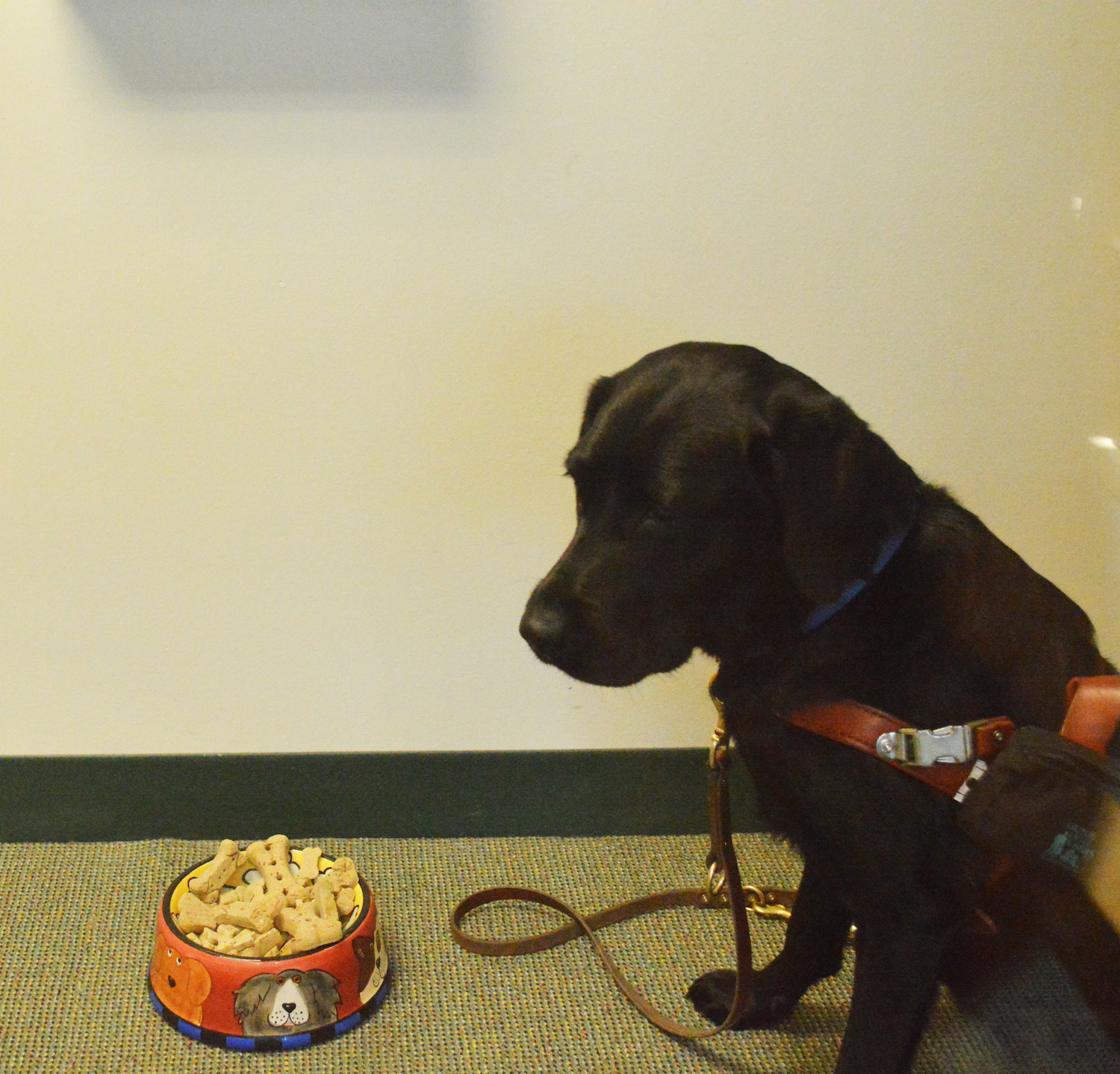
Cali beelined for the cookie basket, which had only three biscuits. She looked at them, at me, at them, etc. I gave her one, then handed her leash over to the groomer.
A couple of hours later, I returned to pick Cali up. She came out from the back and headed straight to the basket. I gave her one of the remaining cookies, and stood chatting with the groomer and paying the bill for a few minutes.
When we looked back at Cali, she was standing at full attention, chin resting on the edge of the basket, staring at the one remaining biscuit. She could easily have taken it; we hadn’t been paying close attention. The groomer even said that most dogs do, indeed, help themselves. She was impressed with Cali’s manners.
I saw that as Cali’s version of the marshmallow test, and I was pleased that she showed self-restraint and good manners. She’s not always so disciplined, but she has never taken food that wasn’t hers, and she’s generally a very Good Dog.
Puppy lunch is Deni and Koala’s name for the midday treat ball break that Koala has trained Deni to give her. The time keeps moving up; it would be more aptly named Puppy brunch, since Koala starts asking for it around 10 am, but that is a different story. Deni and I call it PL, as if Koala, and now Cali, won’t know what we’re talking about. Right.
But I digress.
Koala gets about a quarter-cup of kibble in her large orange treat ball. Cali now gets a smaller amount of kibble in a smaller yellow treat ball. Before anyone howls about unfairness, keep in mind that most dogs stop getting puppy lunch at about 4 months of age. Koala is over 4 years old and Cali is 6. Neither needs puppy lunch, but Koala has everyone convinced that she must eat multiple small meals a day to survive.
Also, Cali doesn’t seem to care. When I gave her a larger treat ball, she lost interest in it well before it was empty. Her lack of fanatical, desperate obsession with food is the least golden-ey thing about her.
They get PL in the downstairs TV / dog play area.
I’ve written in the past about how good Koala is at avoiding obstacles and keeping her treat ball from rolling under things. This large open area is easy for her. She rolls and chases the ball the full length and width of the room, vacuuming up the kibble as it falls out.
Cali has a different strategy. She takes her ball to the dog bed that is in a corner. It’s got walls on two sides and the sofa on the third. She stands in the open end, and gently bats her ball around the small, contained space. It can’t roll under the sofa because the dog bed blocks the bottom opening. This gives her a very easy way to keep track of the ball, get all of the kibble, and stay out of Koala’s zooming, looping path.
This simple strategy shows Cali’s characteristic calm, almost offhand, intelligence. She figures things out and makes the world work for her, in a quiet, unassuming way. She’s fine letting Koala’s exuberance claim the spotlight, and she doesn’t seem to mind that Koala’s treat ball fun lasts a bit longer.
It’s similar when the girls are picking up their toys (which does not happen often enough). Koala leaps and runs and bounces around, flinging toys toward the basket. One occasionally lands inside; others land nearby. She’ll toss the same toy at the basket 3 or 4 times, growing increasingly agitated — at the lack of praise and cookies from Deni. Cali, meanwhile, slowly gets a toy and thrusts it into my hand. (She and I have not worked much on putting things into the basket, for which I take full responsibility.)
Cali’s not always quiet and calm; she’s true to her golden heritage when visitors come or we meet a human, any human, walking down the street. She’s as wriggly and excited to meet a new friend as to greet an old friend. But I really do enjoy her thoughtful approach to problem solving.
The latest pet-food scare (as if the concern over grain-free foods isn’t enough) is that several brands of dry dog food have been recalled for toxic levels of vitamin D.
The FDA first alerted dog owners in early December, and it recently updated the list of recalled foods. You know what I am going to say next: If you’ve chosen your dog’s food from the Whole Dog Journal’s list of approved dog foods, you have nothing to worry about. They do the legwork, checking out the companies’ manufacturing process, documentation of the nutritional completeness of the food, quality control, and ingredient sourcing so you can confidently purchase any food on the list. The list includes foods in a huge range of prices and formulas, and many are very easy to find at pet supply stores, feed stores, Ace-hardware-type stores, and the like. You do not have to spend a fortune at an exclusive pet boutique to get quality dog food; in fact, many of the exotic boutique foods are of poor nutritional quality.
Vitamin D is a vital nutrient for dogs (and humans). It helps maintain the proper level of calcium and the balance of calcium and phosphorus, according to PetMD. (Read the full PetMD article, Vitamin D Poisoning in Dogs, for more details.) Too much vitamin D, though can cause vomiting, weakness, lethargy, excessive thirst, urination, and drooling — and kidney failure and death.
A Whole Dog Journal article (available only to subscribers) says that in most commercial dog foods, the problem is likely to be too little vitamin D, not too much. In addition, dogs in the same household eating the same diet can have very different levels, due to differences in how their bodies absorb the vitamin. Over time, a vitamin D deficiency can cause bone disorders, gastrointestinal issues, and some researchers are studying a possible link to immune system disorders. A blood test can measure your dog’s vitamin D levels.
The best approach is to feed a high-quality meat-based food. Suggestions from the Whole Dog Journal article include adding probiotics or apple cider vinegar to the dog’s meals; avoiding alkalizing foods like corn, wheat, soy, rice, white potatoes, tapioca, and peas; and supplementing with coconut oil. It’s hard to recommend a specific combination of supplements, though, because each dog’s diet and needs are different.
The key takeaway is that what you feed your dog matters.
It matters what you feed yourself and your family, too. But each member of the family makes dozens of choices daily about what to eat and, one hopes, over the course of a day or a week, eats a range of foods that cover her or his nutritional needs. The dog does not get to make those choices, though. He eats what you give him. The dog also probably eats the same thing every day. Some dogs eat the same food for weeks, months, even years. If that food doesn’t have what the dog needs to be healthy, there’s not much chance he’ll get it some other way. So choose your dog’s food carefully — and give him some variety by changing it up every so often.
Is your dog an internet star? Does she want to be?
Perhaps she needs to sign on with The Dog Agency (home to the most influential animals in the world).
It seems that dogs can no longer become viral sensations without an agent. Loni Edwards, the founder and CEO, is quoted in Fast Company as saying, “We help them think about how to grow their brands.” I think she means the humans who are associated with the celebrity pooches.
She’ll advise clients (and their humans) on how to get ads, book personal (or doginal) appearances, get book deals … all the elements in becoming and remaining a pet influencer.
Not just any dog can sign on, though. She’ll only take clients who already have at least 50,000 followers on Instagram. The human also has to have what it takes.
The top influencers bring in thousands of dollars per post — not to mention the income from all those other deals.
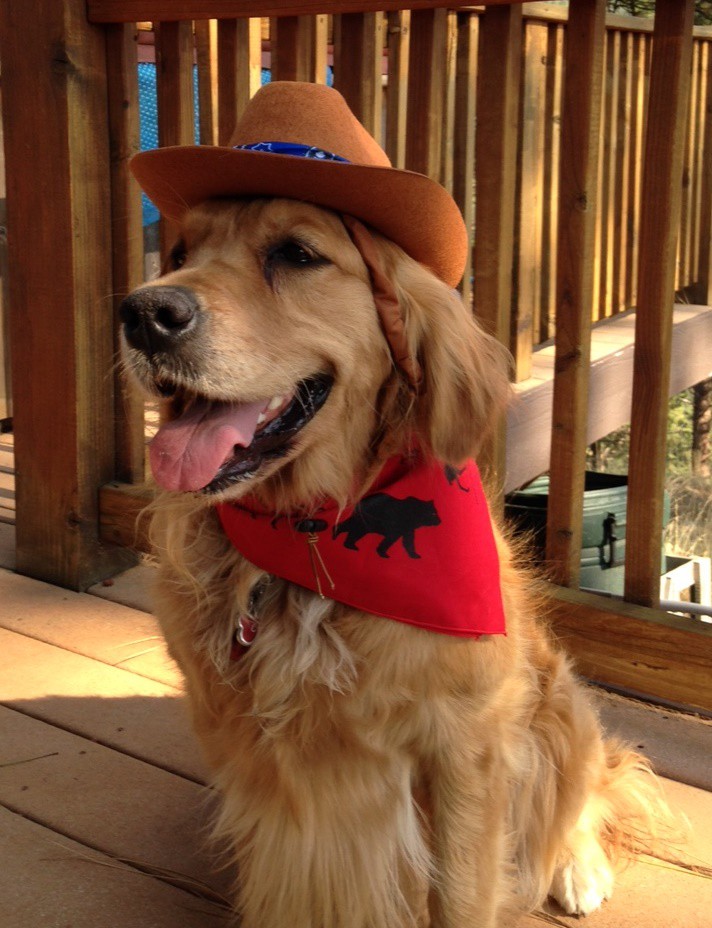
Cali’s out of luck. I don’t even have an Instagram account (though who knows; Cali might …). Maybe we should check it out. Rugged, athletic cowdog types might be in demand. Being supported by my dog would be a nice change …
Despite what your dog might tell you, an all-cookie diet is not recommended.
A few months have passed since the FDA scared dog-owners who feed grain-free dog foods, so the I decided that Thinking Dog blog needed to run an update.
I am grateful to veterinarian and researcher Lisa Freeman, who has written extensively on this issue. Based on some of her work, including this Dec. 1 JAVMA article, “Diet-associated dilated cardiomyopathy in dogs: what do we know?” here is what I have learned:
Grain-free diets are not the problem. What Freeman calls “BEG” diets — foods from boutique producers that are based on exotic ingredients and are grain-free — appear to be a common factor in many of the cases of DCM. (DCM is dilated cardiomyopathy; see the earlier post, Should Your Dog Go Grain-Free? for more info.)
Most dogs do not need to eat boutique foods with exotic ingredients.
Some of the companies producing these foods have not done thorough nutritional research and testing, and the foods are not nutritionally sound. Or their quality control might not be as good as some more conventional dog food producers, so the foods may be less consistent.
The problem is not only about taurine levels, either. Freeman writes that most of the dogs she’s seen (in the practice at Tufts University) with DCM have normal taurine levels. Furthermore, many improve with a diet switch (away from a BEG food), even though their taurine levels were and remain normal.
Owners who have moved to home-prepared diets should be extremely cautious and consult with a veterinary nutritionist to ensure that the homemade diet meets the dog’s needs.
The problem does appear to be linked to nutritional deficiencies. Exactly what, though, is still unclear.
What should a concerned owner do?
Feed a high-quality food from a responsible manufacturer. You may be tired of hearing this, but: The best food for your dog is not necessarily the best food for my dog. Each dog’s needs are different. Your budget and what’s available in your area differs from what I can get easily. So, I am not going to recommend specific foods. I strongly urge you to choose a food from the Whole Dog Journal’s list. Their 2018 list is available; I will post a link to the 2019 list when they publish it.
For advice on raw foods, check out the Dog Food Advisor recommendations.
If your dog gets lots of ear infections, is itchy, or has hot spots or other issues that could indicate food sensitivities, consult with a vet and a nutritionist (some vets have lots of training and knowledge about canine nutrition but many do not; ask for credentials).
I do not recommend “prescription” diets. Many vets will recommend these. Why? They make a lot of money selling them. They tend to use low-quality ingredients and be very, very expensive. You can get a higher-quality commercial food for less money that addresses the same issue. Whether your dog needs a lower-fat or lower-protein diet, should avoid particular ingredients, whatever the issue, there are likely to be several foods in your (high quality) pet store that will work.
Cali got her first Sense-ation harness when she was only a few months old.
Lots of dogs have poor leash manners. This is partly the fault of their humans (not enough training or the wrong kind of training). But it’s also partly just how dogs are.
They are eager to explore. To check out interesting smells. To meet fascinating people. To chase smaller animals. Also they lead pretty dull lives, mostly inside, often alone. Going for a walk is stimulating and fun. So they pull.
There are a couple of problems with this. One is that it’s annoying for the human and makes walks with the dog a chore, rather than a pleasure. If you don’t think that walking your dog is one of life’s greatest pleasures, a) I feel very sorry for you and b) please read Dog Walks Man.
The other problem is that, since most dogs’ leashes are attached to a collar, when the dog pulls, she puts a lot of pressure on her throat. Some dogs have thick, muscular necks and don’t really feel it. But for many dogs, the pressure could cause damage.
Luckily, there is an easy solution. It’s not 100 percent guaranteed to work, but with many dogs, the results are close to miraculous.
What is this magical cure? A chest-fastening harness.
A standard harness with the leash hooking into a ring on the dog’s back will not help. It will actually enable the dog to pull harder (no throat pressure).
But something about a chest-fastening harness inhibits most dogs from pulling. I tried it with a friend’s 6-month-old puppy just this week, and the change was instantaneous.
Several brands are available, and they all fit a little differently. Some are a little complicated to put on, at least initially. The best thing to do is go to a large pet store and try a few on the dog.
Note: Don’t confuse chest-fastening harnesses with the halter-type deals that go over a dog’s nose. Dogs hate those. And if either the dog or the human pulls or jerks too hard, the dog can seriously injure her back or neck. I do not recommend those at all.
That’s not always possible. I’ve had great luck with the Balance harness (also rated #1 by the Whole Dog Journal) and the Sense-ation harness, which is easier to find. I dislike the Easy Walk because even if I’ve adjusted it correctly, it loosens up and slips around on the dog. I either haven’t tried or I’m neutral on several other brands.
What are you waiting for? You could be enjoying a walk with your dog!
Be careful what you say; little ears are listening. And I don’t mean your children. It turns out that dogs do listen to what we say, as well as our tone of voice And they can often tell when we’re talking to them — or about something that matters to them.
A recent study, ‘Who’s a good boy?!’ Dogs prefer naturalistic dog‑directed speech looked at what they called “dog-directed speech,” which resembles baby talk. Their canine test subjects were all adult dog guests of a boarding kennel whose humans gave permission for their participation.
An earlier study on this topic had played recorded voices to dogs who were alone in a room. The dogs didn’t pay much attention. To me, that shows their intelligence. Would you respond to a disembodied voice telling you that you were a “good boy” or to “come here”? I hope not!
The newer study is far more respectful of canine intelligence. They also used recorded speech, but an actual human, matching the gender of the voice, was in the room.
Dogs were more likely to look at, approach, and interact with the researcher who was present when dog-directed speech — high-pitched dog talk — than boring human talk in a normal pitch and register.
The researchers also investigated whether dogs had a preference for content of speech.
The dogs showed the most interest in high-pitched, emotional speech directed to them, with relevant content. Dull content in an interesting tone was no more appealing to them than interesting content said in a dull tone.
What does this tell us? Perhaps that:
Dogs learn to associate meanings with particular words and phrases, as well as a particular tone of voice.
People tend to use a higher-pitched, more excited tone when talking to dogs, so dogs learn that what is said in these exaggerated tones is meaningful.
Dogs learn that people might say interesting things in a dull tone and then nothing fun for dogs happens, so they learn to ignore even favored words (“walk” or “cookie”) when it’s clear that the human isn’t addressing them.
Additional layers develop as a specific human builds a relationship with a specific dog.
I’ve always talked fairly conversationally to my dogs, and they do respond to relevant phrases and questions, even when I say them in a “normal” tone. I believe that dogs learn to read their humans and are able to tell — with a familiar person, though not necessarily with a researcher — which speech is relevant to them, regardless of tone.
I also think that it’s about time more people studied communication with dogs!
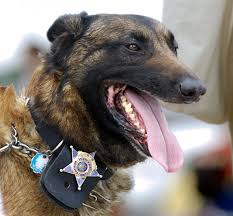
Hundreds of drug-detection dogs are taking early retirement, their jobs disappearing as marijuana legalization makes their skill set obsolete. It’s not the dogs’ fault; the blame lies with human myopia.
Dogs can be taught to identify pretty much any scent, even scents that humans cannot detect. The dogs who sniff out cancer or flag diabetics whose blood sugar is dropping, for example, are responding to scents that humans cannot smell.
Dogs can also be taught to reliably distinguish scents and alert to more than one scent. And they can of course be taught to respond to each scent with a unique behavior — a bark, sitting, lying down, spinning in a circle. It really doesn’t matter what; the dog can learn it.
But the humans. Oh, the humans.
There are the trainers who take the “easy” path of teaching their canine pupils to give the same alert to any contraband. Easier to teach. Easier for the handler to remember. But it makes the dog’s skills useless when you no longer want her to alert to marijuana.
There are the humans — trainers, handlers, lawyers, judges — who do not believe that dogs can discriminate the scent of meth from the scent of marijuana. Or who do not believe that dogs can reliably signal which one they’ve detected.
Many detection-dog trainers are have already stated training dogs on other forms of contraband but not marijuana. And new recruits, who’ve graduated with this newfangled curriculum, are stepping up to take the retiring dogs’ jobs. Even so, there are sure to be younger dogs caught unprepared as the job market shifts, new grads whose skills are outdated before they’ve had a chance to shine. The thousands of humans forced to adjust when their jobs vanished will understand how tough this can be.
The retirees’ future is not bleak, however. Most of these dogs are headed into a cushier retirement than many people can look forward to. Many of them have years of experience under their vests and deserve to enjoy their golden years. And who knows? Some may pivot to new careers. I hear there’s growing demand for conservation dogs…
A puppy I know has trouble with greetings. She’s so excited to meet people that she bounds to the door and, essentially, assaults them. That is pretty normal puppy behavior; they’re not born with perfect manners (who knew?). And people usually mean play, treats, toys … all kinds of good things. So of course puppies get excited.
There are a few possible responses to this assault. Most people do the natural (but also among the worst) thing: They exclaim at the puppy’s cuteness and pet the puppy. Hm, thinks the puppy, people love being jumped on and even gnawed on at the door.
But … most people don’t love being jumped on and gnawed on by puppies. And puppies have a tendency to grow. Larger-breed puppies might be cute when they jump on visitors as 8- or 10-week old balls of fluff, but even the people who think that is cute are less amused a few weeks later, when the 4- or 6-month old adolescent, or even the 60-lb adult engages in the same greeting.
“Managing” the situation by removing the puppy before answering the door is also a common response, though this does not teach the puppy manners and therefore requires a lifetime commitment from the humans. It’s also not great for times that people show up at the door unannounced, as delivery people, mail carriers, and relatives tend to do.
So, the puppy must learn some manners.
One slow option, with great long-term payoff, is teaching the puppy to do something else: Get a toy. Sit. Sit and offer a paw (charming!). Go to her bed or crate.
A supposedly easier option is “correcting” the puppy. Unfortunately, there are still many old-school trainers out there who use physical “corrections” (a euphemism for physical punishment), for all manner of infractions where punishment is really inappropriate. Even more horrifying, many of them apply these techniques to puppies.
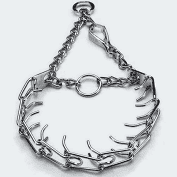
So, this pushy puppy’s trainer suggested using a prong collar. She gave the whole speech about how it doesn’t hurt and is better than a choke chain. I know the speech because I used to believe it. But, a prong collar is a choke chain. Even worse, it’s a choke chain with dozens of pointy spikes designed to dig into your puppy’s neck when you pull on the leash, tightening the … choke chain. Technically, it’s a “limited-slip” collar; the chain only tightens so much, so you won’t choke the puppy to death. How comforting.
Its sole purpose is to hurt the dog (to “get her attention,” the trainer will say. Yep, if someone jerked a pointy chain tightly around my throat, that would surely get my attention …). So, yes, it hurts, unless your puppy is a thick-necked muscular breed, but even then … is that really how you want to get your best friend’s attention?
And, more to the point, it doesn’t work.
OK, yes, if you set the puppy up, have the puppy dressed in prong collar and leash when someone comes to the door (as you’ve prearranged), and the puppy jumps, and you give a perfectly timed correction, the puppy most likely won’t succeed in jumping on that visitor. If you consider that “working,” your bar for success is pretty low.
Will you keep the puppy on leash and in full prong at all times? Will you be holding the leash at all times? If so, then you are a monster and do not deserve a puppy. If not, then it’s quite likely that the puppy will still succeed in jumping on people. Often.
So, what the puppy will learn, very quickly, is that she can get away with jumping when she’s not leashed and pronged. She’ll also learn that being leashed leads to being hurt and that being near you leads to being hurt. Those are not things you want your puppy to learn, are they? I mean, you do want to be able to hang out go for walks together that the puppy does not regard as torture. At least, I hope you do.
It also fails because it doesn’t teach her anything positive. It doesn’t teach her what you want her to do, for example (sit, get toy, etc.). It doesn’t even really teach her what you don’t want her to do because there’s too much going on for her to understand that the fact that she might jump is what triggers the “correction.” And few dog owners, especially when frazzled and dealing with puppy and visitor and who knows what else, have great timing; there’s no way you will always deliver the “correction” right at the moment she’s jumping. So the puppy might think it’s the doorbell or her barking or people reaching to pet her or any number of things that are causing the painful jerk on her neck.
What this painful “correction” might teach her is that people at the door are scary because they cause her to get hurt. She might even figure out that people at the door cause her humans to go crazy and attack her.
In either case, since the puppy cannot prevent people from coming to the door (or avoid them, if you’ve got her on a leash), she’ll do what every scared canine is hardwired to do: defend herself. That’s right. “Correcting” the puppy by hurting her — and failing to teach her what she should do — can make her behavior at the door far worse by convincing her that it’s a threat. She might growl, lunge, bark, even try to bite people once she connects their arrival with the painful leash jerk and pronged choke.
I had a trainer tell me that I had to use a prong collar on Cali to teach her to heel and not get excited about the other dogs in class. Cali was an older puppy at that point, maybe 7 or 8 months, and in full-fledged obnoxious adolescence. Even so, she was a puppy. A golden retriever puppy, for goodness’ sake! If an adult human cannot teach a puppy to behave without resorting to brute force, she shouldn’t have a puppy. (Same goes for a toddler!)
I didn’t use it. I decided that I wanted a relationship with my dog that was not based on scaring her or hurting her, but on teaching her. Granted, her leash manners are not perfect, and she still gets really excited about meeting people when we’re on walks. But visitors? She runs to get a toy and prances around with the toy. No jumping, no barking.
Fortunately for my puppy friend, her parents won’t be using a prong collar either. But the prong collar solution appeals to many puppy owners (and sadly, trainers) because it seems to have an immediate effect and it’s “easy.”
Yes, actual teaching takes longer. It also offers a real solution to the problem: You end up with a dog who greets people politely, offers a toy, or goes off to her own space. Isn’t that who you want to spend the next 12 or 14 years sharing your home with?
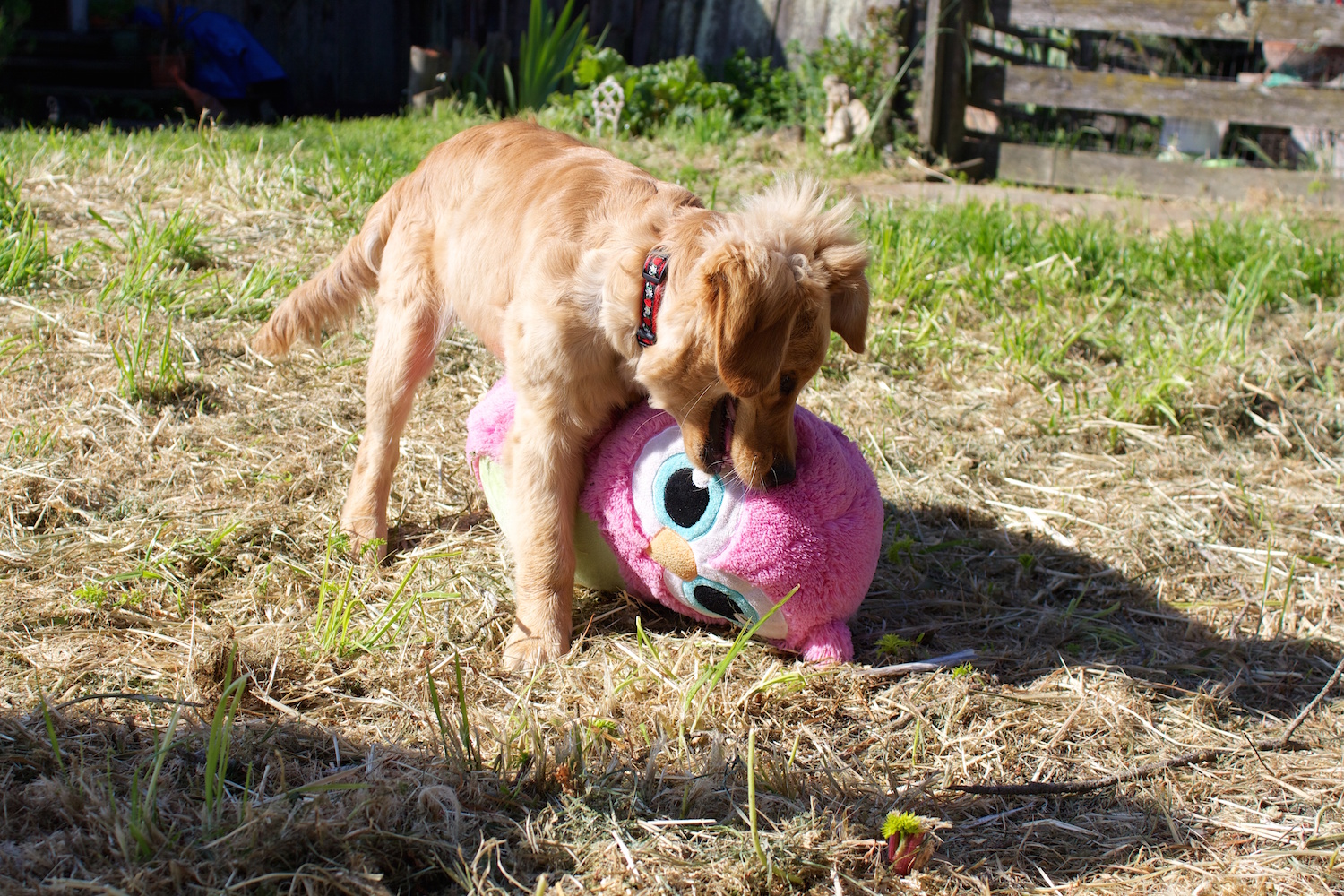
When Cali was a very small puppy, she tried to move in on Jana’s turf, to steal her job! Young Cali had her heart set on delivering the paper, but that didn’t go so well. Cali decided that she was just going to be a puppy of leisure.
But every so often, she’d check out what was out there.
She usually wasn’t interested in the jobs that were available. Picking up her dish doesn’t pay well enough. Putting her toys away is boring. And besides, she’s just going to get them out again in the morning.
She’s willing to work as a dishwasher pretty often, despite the dull vegetarian menu, but the hours are irregular and the pay is inconsistent.
She does like her gig work as a greeter, but again, it’s unpredictable and the pay is inconsistent. Some visitors play with her; others ignore her. Some don’t even come inside to admire the toy she has brought to show them. The really mean ones just ring the bell and disappear. Who does that?
Yes, for many years, the job market was tight. But things are looking up.
Finally, Cali has a new job that she loves. It’s predictable, the hours are the same every day, and the pay is great. Thanks to the new fence that nice man from Western Montana Patio built for her, she can safely get the paper.
Yep, back to her first job. Or attempt at a job. Jana had that one locked up for a while, then Cali was too depressed to work … then there was no paper for about a year.
When she first moved to her new yard, she immediately saw a problem: There was a house blocking the paper delivery area, and the front yard opened right onto a busy street. She wasn’t going to risk her life for a job!
At last, the stars have aligned: There’s a paper to get and it’s safe for her to work.
With the new fence, all is well. She goes out into the back yard first thing to take care of business, then she’s ready for work. She bounds through the house and out the front door, tracks down that paper (the weekend carrier doesn’t have the best aim …), wrestles with it a bit, and delivers a slightly damaged plastic-wrapped bundle. With a little encouragement, she’ll even place it in the bossy human’s hand, but she really thinks that dropping it on the living room rug should be sufficient. Lazy human!
Still, the human comes through with decent pay. A liver treat! Best of all, her workday is done with plenty of day left to play, roll in the grass, and sleep on the human’s bed.