Resources for Finding a Dog Trainer

In last week’s post, I described some things to consider when choosing a dog trainer for your puppy or adult dog. Here, I’ll provide a few resources to help you locate a suitable trainer.

Professional organization listings

Two professional dog training organizations that I have been involved with have directories of positive trainers. These are a great place to start your search — or continue it if efforts to get recommendations from dog-obsessed friends have failed:

Pet Professionals Guild — This is a 100 percent positive trainer group that is very serious about continuing education. They publish a journal and a blog; have regular webinars, workshops, and conferences, and are a truly dedicated group of professionals.

Their mission statement: The Pet Professional Guild is a membership organization representing pet industry professionals who are committed to results based, science based force-free training and pet care.

APDT (Association of Professional Dog Trainers) — The APDT is dedicated to “least intrusive, minimally aversive” training approach. This is a mostly positive approach that emphasizes humane and effective strategies to change behavior. They offer a ton of resources, have huge (really fun) conferences, and are also very dedicated professionals.

Dog training clubs

Many cities and counties have dog training clubs. These vary widely in their size, philosophy, and what they offer. St. Petersburg, Florida, has a very active club where you can find puppy classes, obedience, Rally, agility, other dog sports, and much more. Google, ask fellow-dog owners, and dig around to see what your city offers.

Shelters

Many shelters offer classes, especially to people who’ve adopted their dogs. But most are open to the community, reasonably priced, and focused on basic manners or obedience.

Ask lots of questions

Whichever path leads you to a potential trainer or class, ask about the approach used and what equipment is recommended. If anyone says to bring a choke or prong collar to your first class, run! If you’re advised to do something that seems off, ask for an explanation. Follow your instincts; your role is to teach and protect your dog. You do not have to hurt him to get him to behave!

Most trainers love to talk dogs. If you have questions about (mis)behavior, problems, or simply are new to dog-parenting, ask, ask, and ask more questions.

Don’t be put off if the trainer suggests more classes. Building a relationship takes work and time. Training classes are a good place to learn what to do. And, realistically, most people don’t practice much between classes, so continuing to attend ensures that you continue to work on behavior problems in a calm place where you have help — which beats yelling at your dog in frustration whenever she does something “bad.” Even “frivolous” classes like trick training and scent work are great for building your relationship, improving communication with your dog, and just having fun together.

How do you choose the “right” trainer?

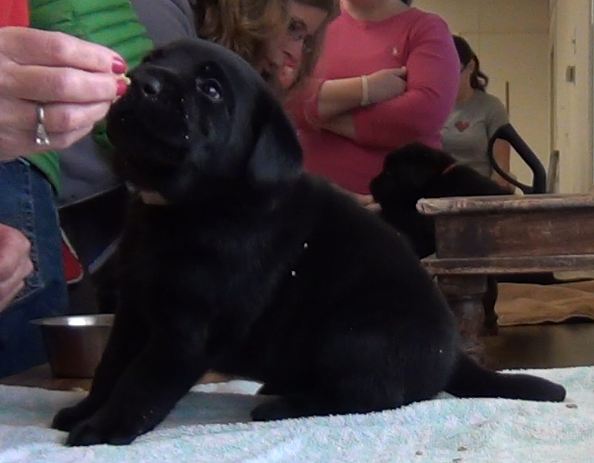
A tiny black lab puppy learns to sit on cue
Even very young puppies love to learn

So, you’ve got a new puppy, or a newly adopted dog — or you just want to work on some behavior or other things with your dog. How do you find the “right” or “best” trainer?

Get recommendations … but use caution. Ask a lot of questions. Ask both the person recommending the trainer and the trainer:

What approach does the trainer use?

Is it a clicker trainer, a mostly dog sports or competition oriented trainer, an obedience trainer, a trainer who works with all kinds of dog/human teams from pets to service dogs to dog sports nuts?

Trainers who use mostly or entirely positive methods are the best choice for most dogs — certainly for puppies — and for most people. A trainer who is expert in a specific type of training is a good choice for advanced training.

When you are just getting to know your dog, the focus should be on building a connection and communicating. A positive trainer will help you develop skills in communicating to the dog what you want her to do and also in understanding your dog’s communication with you. That is the best foundation for your relationship.

A more “traditional” or obedience focused trainer might introduce punishments for “bad” behavior — things the dog does that you don’t like. At any point in your relationship, but especially at the beginning, this has the effect of cutting off communication with the dog. The dog begins to worry about what might trigger the next punishment. Often, you’ve given the dog little or no (or very unclear) information about what you do want her to do. On the other hand, when she does perfectly normal doggy things, like having accidents, if she’s a young puppy, or eating some interesting smelling thing, unpleasant and scary things happen. This does not build trust.

Red flags to look out for: Trainers who advocate using harsh tools, like prong collars, on puppies or very early in training; trainers who routinely use shock collars or who expect you to use them for an extended period of time (more than 1-2 uses); trainers who emphasize the need to “be the alpha.”

Does the person do classes, private training, or board-and-train? A combination?

You may have preferences for a class vs. private; board-and-train might sound tempting. Think through the options.

For a puppy, a great combination is a puppy play with short training classes. The opportunity to play with other puppies in a supervised, appropriate (size, age, play style) group is essential to developing good doggy social skills.

If you have an older dog, classes and private training are good options. Private training is ideal for focused work on a specific problem. Classes that focus on reactive dogs or trick training or scent training or some other fun or serious topic can also be helpful. It’s good to see how other dogs and their humans do things, it’s fun to meet the other people and make connections. General manners or basic obedience classes, Canine Good Citizen training, or classes geared toward teaching manners for dogs who are out and about with their humans are all fun and helpful. They tend to focus on things that every dog needs to learn: walking nicely on leash, staying calm around other dogs and people, not jumping, settling quietly. Your options may be limited, depending on where you live, but I hope you can find something that works.

Board-and-train might be a good choice for some adult dogs for some types of training. I do not recommend it with puppies because the puppy should be forming her primary bond with you / your family — not with a trainer. Obviously it can work; many service and guide dogs spend their puppyhoods with families and then transfer their bond to their new partner. But given the choice, I think your new puppy belongs with you.

Choosing board-and-train to work on a specific problem or if you need to leave your dog for a time period anyhow (maybe during a 2-week no-dog vacation) could work out well — if you are realistic in your expectations.

The trainer, likely an experienced professional (choose carefully), will probably make a lot of progress with the dog during the training weeks. But when you get back, you and the dog have made no progress at all. That is, the dog has no reason to behave any differently with you in your home environment than she did before you left.

Many dog owners mistakenly assume that the trainer imparts knowledge to the dog and the dog then knows exactly what to do in similar situations from that time forward.

For example, your dog goes nuts when she sees another dog, a squirrel, or a cat when you’re out for walks. The trainer spends 2 weeks working on this, and is able to walk the dog calmly through a park filled with squirrels, cats, and other dogs out for walks or even playing off leash. So you’ll have no more problems, right?

Wrong.

Your dog is going to go just as nuts with you as she did before the training, unless and until you work with her to change that.

The trainer has taught your dog an alternative behavior, but the dog still needs to learn that she has to use that behavior with  you. That requires undoing an established pattern (the dog going nuts, you freaking out …) and learning a new one. This will be much easier since the dog has already learned the new pattern, but…

Board and train is not a replacement for work, lots of hard work, with your dog.

I’ll cover more trainer-selection criteria in another post.


Farewell to Chaser, a Dog Who Changed the (Dog) World

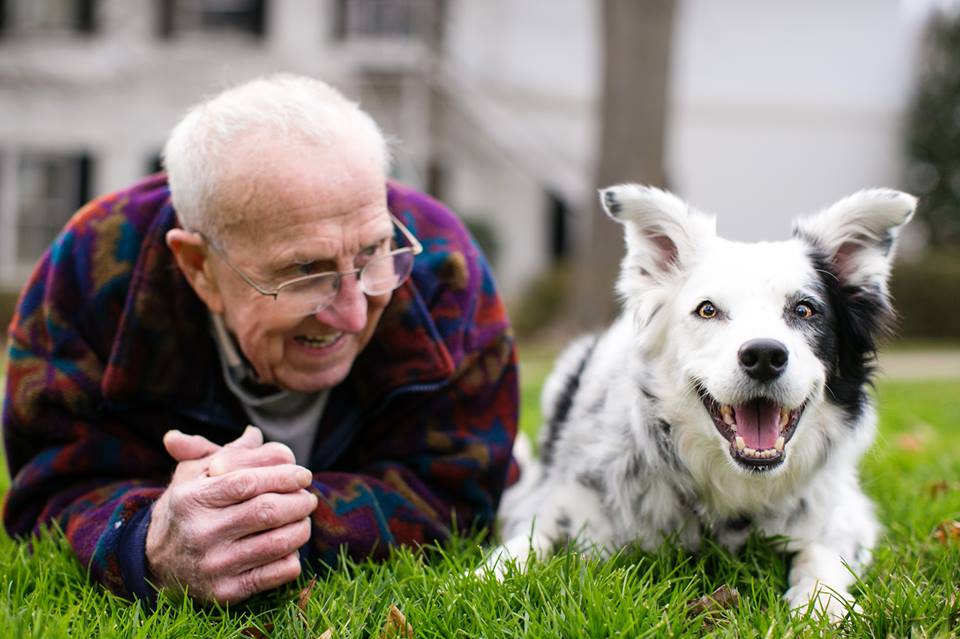
Photo of Chaser & Dr. Pilley, from Chaser’s Facebook page

How many dogs get a New York Times obituary?

I have to admit to a stab of apprehension every time I saw a post on Chaser the border collie‘s Facebook page since she turned 15. But in the end, I saw the news in the NYT: Chaser passed away last week peacefully, of natural causes. Her dad and trainer, John Pilley, passed away last year. Together, the two of them changed the way millions of people think about and understand dogs and the dog-human relationship.

Anyone who has spent significant time with a dog and really paid attention to that dog knows that dogs can pick up some human language. After all, the entire notion of dog training is based on teaching them to associate our words and gestures with specific actions. But Chaser took understanding of language far, far beyond simple cues and responses.

Chaser understood grammar. In fact, Chaser’s knowledge of grammar often surpassed that of my students. I had to teach them about subjects, objects, and indirect objects before they could understand exactly what she had learned to do …

Chaser hit the TV talk show circuit when she had learned to identify more than 1,000 items by name and category. She knew the unique names of 1,022 toys. More than that, though she could put each of her dozens of balls into the “ball” category while also recognizing each by its own name. Same with Frisbee-type disc toys.

OK, I’m pretty average as a dog trainer, and even I have taught dogs the names of toys and categories. Not as many as Chaser, but I knew it was possible.

But the grammar bit: She learned to understand requests that entailed taking toy1 to toy 2, which required her to distinguish both toys by name and understand which was the direct object (toy1) and which the indirect object (toy2).

It’s so much more than the grammar though. It’s the idea of that complex level of thought, understanding — and communication — occurring between a dog and a human. Chaser made it clear to anyone willing to see that dogs really can learn so much and that their limitations are more in humans’ inability to conceive of how to teach them than in their capacity to learn.

Which brings us to Dr. Pilley. Chaser was a brilliant dog. But many other brilliant and capable dogs have lived and died with no fame or recognition; without learning or reaching their potential. Dr. John Pilley showed the world what was possible. He pushed back against the doubt, the disdain, the dismissive derision of his colleagues and of the journals that demanded extraordinary testing and re-testing before publishing his research.

He was one of a very few dedicated individuals who believed in dogs’ abilities and who put in the hours and years of effort to make the world see what’s possible. Thanks to him and a few others, centers to study dog cognition are popping up at universities around the world and we’re learning more and more about how dogs think and learn and understand.

Very few animals are memorialized in the New York Times. But if ever a dog deserved such an honor, it was Chaser.

A Perfect Day (for Cali)

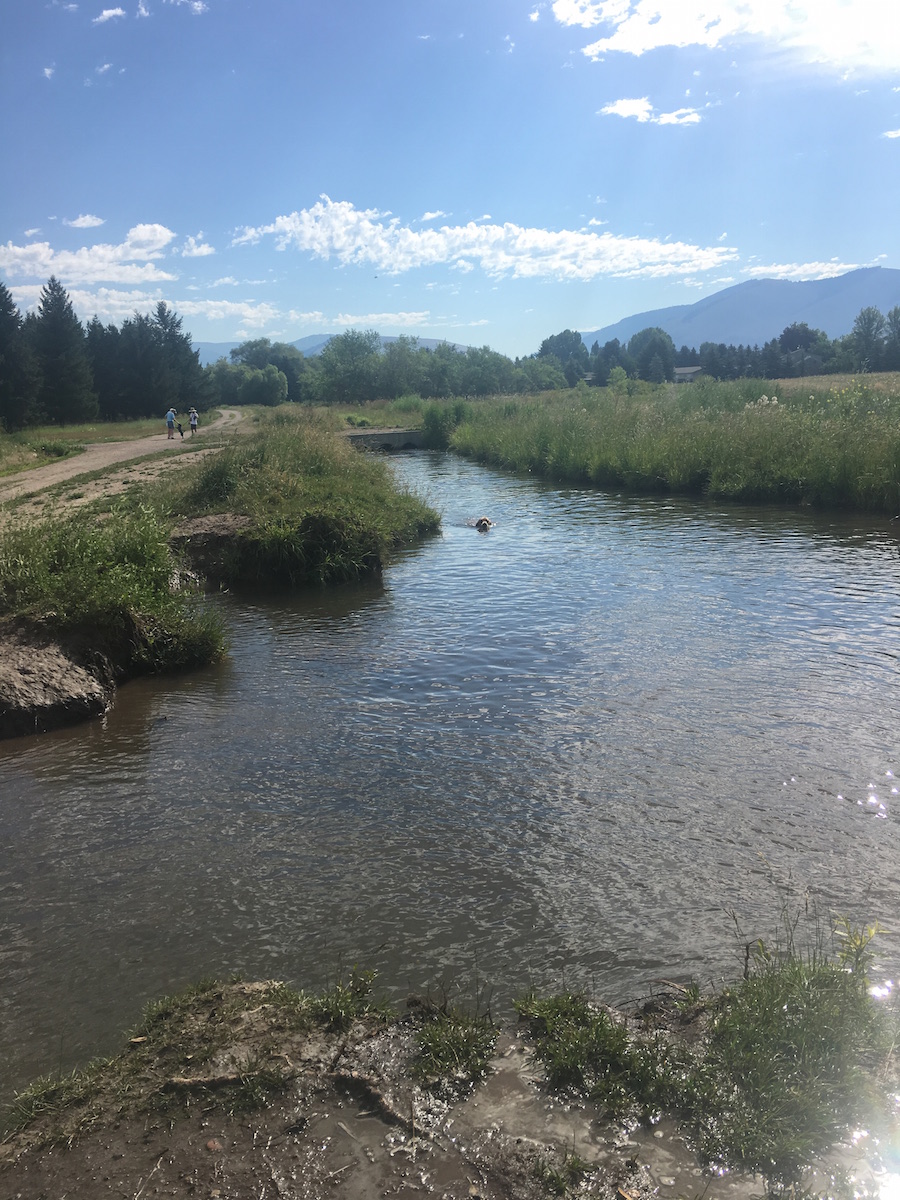
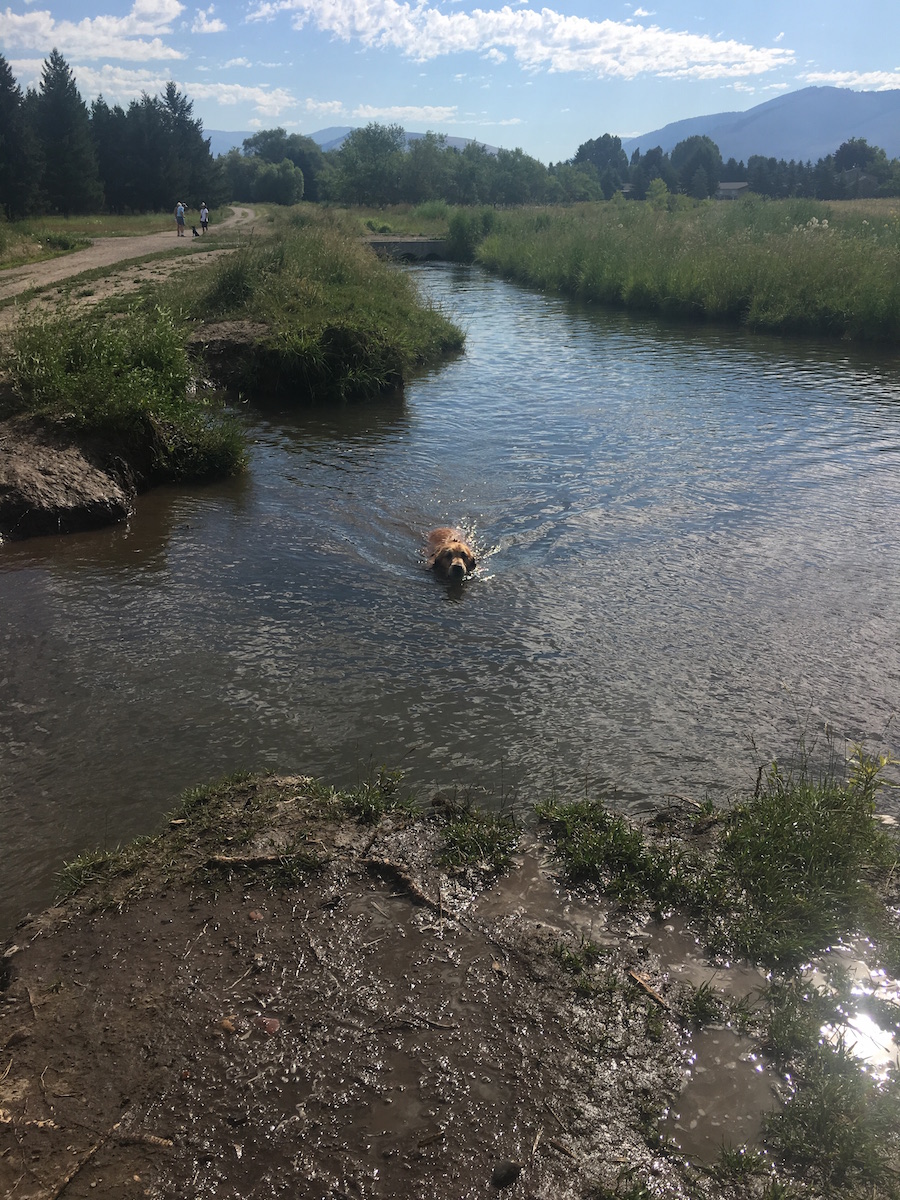
Cali, a golden retriever, swims in a riverI’d like to get out and hike more. It’s summer in Missoula. I’m an outdoor novice; I don’t go camping (which means I have Missoula all to myself on summer weekends) and I can really only do easy hikes. Even so, I like to get outside in our short, but stunning, summers.

But Cali’s not great off leash. She gets engrossed in something and next thing she knows, she’s miles away and 20 minutes have passed.

There are many wonderful trails where I can’t or wouldn’t let her off leash even if she were more reliable. They’re at the edge of vast wilderness, have too many tempting smells and critters to follow, and I’m not willing to risk losing her. Every weekend in the summer, the Missoula NPR station reads our lost dog reports, and sometimes there are pictures at the trail heads … it’s sad and scary.

So, when I have a little time and it’s a nice day, I face a dilemma. Do I pack Cali into the car and go off somewhere to satisfy my desire to hike? Or do I choose an option that will be more fun for her?

Hiking is fun for her, but still, it’s usually a long walk on a short leash in a pretty place that she’d love to explore, if only her mean mom would let her.

Compared with one of our standbys, a large open area inside Missoula where she can run off leash, and where I usually throw a ball for her to chase … well, no contest. Especially in the summer when there’s water to play in!

I feel a little bad each time I decide to head there rather than gear up for a more adventurous outing, but then, as I make the turn off of Reserve St., and Cali knows for sure where we’re going, her excitement reassures me. This is what she’d choose. This or a trip to Big Dipper ice cream (or both).

She dances with excitement as we get out of the car and I dig out her ball; she squeals with joy as I release the leash. Then she’s off, running, the instant I throw the ball. She doesn’t bring it back, of course, so I walk to her, she lets me take it, and I throw it again. And again.

We walk along the irrigation ditch, currently full of cool water. We walk through a wooded area. When we get to each of the two little pools, I throw the ball into the water for her to swim after. Now she does bring it back, over and over, so I will keep throwing it upstream. Her favorite thing is to get out of the water and drop the ball at my feet. Then, just as I bend to pick it up, she shakes off, sharing the cool water. We both get back to the car dirty, tired, and happy.

I think that she has more fun doing this, even if it’s the same outing two or three times a week (or daily) than she would if we went to new and interesting places … where she had to stay on leash. It’s not that dire; there are a few other places where she can be off leash. But in the summer, this spot, with the trees, water, and open space, is pretty hard to beat. Instead of worrying about taking her more places, maybe I need to focus on taking her more often for perfect Cali days … a swim, some mud, maybe a little ice cream!

Those Puppy Eyes …

Cali looks up, licking her lips
Who can say ‘no’ to these eyes?

That sad puppy look your dog gives you… that look that Cali uses every time we’re within a block of her favorite ice cream stand … that look has been perfected by dogs over millennia. It’s no wonder we’re helpless to resist it!

It turns out that dogs’ “expressive eyebrows” enable them to raise their inner eyebrows in a way that makes their eyes look larger and, to humans, sadder. A study found “compelling” evidence “that dogs developed a muscle to raise the inner eyebrow after they were domesticated from wolves.”

What’s more, it’s mostly our own fault for breeding these manipulators: A Science Daily report on the study suggests that this eyebrow muscle, which wolves lack, “may be a result of humans unconscious preferences that influenced selection during domestication.”

It’s working out well for the dogs. The expression elicits a strong response from most humans who feel protective toward the “sad” or “worried” dogs. Dogs who use this eye movement get adopted faster from shelters, according to the study.

The muscle difference evolved very quickly, according to researchers, and seems to have had an outsize impact on human-dog relationships. Eye contact plays a huge role in dog-human communication, and the dogs have clearly learned to use their anatomical gift to full advantage.

Humans pay close attention to eyebrow movement, even if we aren’t really aware of it. “In humans, eyebrow movements seem to be particularly relevant to boost the perceived prominence of words and act as focus markers in speech,” the study points out. It hypothesizes that we’re especially tuned in to eyebrow movement because it “is a uniquely human feature.”

Or was. Until the dogs figured out how to hijack it.

Dog Food Update

At the end of June, the FDA released an update on its investigation into a spike in reported cases of Canine Dilated Cardiomyopathy, or DCM. This investigation and report have caused many pet owners to worry about whether the food their dogs are eating could cause heart disease.

The investigation is ongoing, and the results are not conclusive. But they do point to multiple factors, not a simple link between diet and heart disease or, more specifically, grain-free kibbles and heart disease.

The investigation was triggered by unusually high numbers of cases of DCM reported in 2018 and early 2019, a total of 320 reports in 2018 and 197 in January through April 2019. For comparison, from 2014 through 2017, the FDA received a total of 7 reports. These numbers include cats and dogs, though very, very few are cats. Since some of the reports concern multiple pets in a household, the total number of affected animals is 560 dogs and 14 cats. To provide context, it’s important to note that these 560 dogs are from a population of 77 million pet dogs in the U.S. It’s a very small number of cases, yet the spike was unusual, and I, for one, am glad to see researchers digging into this.

The most commonly affected breeds are golden retrievers (95), mixed-breed dogs (62), and Labradors (47).

The FDA report offers a lot of information, and here’s where it gets interesting. Most of the dogs affected are older, with a mean of 6.6 years; and since most are also larger (mean weight of 68 lbs.), many are considered “senior.”

The FDA report provides information about the dogs’ diet. Nearly all of the dogs ate an exclusively kibble diet (452 out of the 515 reports). The foods named, with Acana and Zignature topping the list, are all high-end foods with multiple grain-free formulas. Several of the brands named in the report are quality brands that appear on the Whole Dog Journal’s list of approved dog foods.

2019_WDJApprovedDryDogFoods

It’s unlikely that multiple high-end brands of dog food all developed the same nutritional deficiency, suddenly and simultaneously, in 2018. What’s more likely is that people started paying more attention to symptoms their dogs were exhibiting and, rather than simply attributing them to age, got them checked out. The interesting detail that many of the dogs are eating expensive dog food hints that these dogs might live with people who have the means and desire to pamper their pets a bit — just the sort of dog owners who are also more likely than the average to shell out for annual bloodwork and one- or twice-yearly senior pet exams.

A correlation the FDA is looking closely at is whether the high proportion of grain-free foods using large amounts of peas and/or lentils had anything to do with the DCM. The reported foods also contained a large variety of animal proteins, with chicken, lamb, and salmon topping the list. There are so many other variables, though, that drawing a connection between either the animal or vegetable protein sources and the heart disease is tough. For one, the millions of dogs eating those same foods who are not showing any signs of DCM. For another, it’s very rare that a dog eats one kibble and one kibble only — no treats, nothing scavenged on a walk, nothing slipped to him at the dinner table. The FDA is interviewing some owners to determine whether exposure to other things — plants, chemicals — could be a factor.

It’s possible that further study will find a connection. One area researchers are considering is whether large amounts of pea or lentil protein interferes with dogs’ ability to digest necessary minerals or amino acids, like taurine.

I don’t think panic is warranted. I also don’t think boycotting the named brands (or all grain-free foods) is justified. I do have some common-sense suggestions, though, for worried pet owners: Switch up your dog’s food.

Anyone who eats the same diet, day in, day out, for months or years is bound to have some nutritional deficiencies, especially a diet as highly processed as kibble. No one food can provide everything any dog needs. The old “advice” about not switching dog’s food and how anything new will upset their stomachs is bunk. Sure, if your dog has eaten the same kibble for 7 years and you suddenly switch to something radically different, your dog is likely to have digestive issues for a while. If your dog has a lot of food sensitivities, again, proceed cautiously. But most dogs can switch pretty easily. I usually mix the last couple pounds of a bag of an old food with the new food, giving the dog a week or more to transition.

Some manufacturers encourage switching among their formulas. I’d go a step farther and switch companies and formulas to ensure that over a year or so, your dog gets a few different proteins and formulas. They all add different mixes of vegetables, minerals, and other supplements. With Cali, I mix kibble with frozen raw food (one meal of each per day). She also gets salmon oil, a probiotic and digestive enzyme supplement, a joint support supplement, and lots of fresh fruit, vegetables, eggs, sardines … OK, so she’s a little spoiled. So?

Even if you don’t want to go that crazy, switching foods every couple of bags could give your dog some variety and a better mix of nutrients over time.

In addition, make sure your dog has regular exams and bloodwork. Raise your concerns with a vet you trust and, if your dog is showing signs of DCM, such as coughing, trouble breathing, or lethargy, get a checkup.


Dogs and Deer

The house where we are dog-sitting is above the Bitterroot Valley

We’ve been hanging out in the Montana wilderness, dog sitting. Well, the edge of the wilderness, anyhow. And it’s fawn season.

We were out in the play yard with a motley collection of tennis balls, most of which were cleverly camouflaged in the grass. We do this three or four times a day — take three balls and three dogs. Play for a while. Return to the house with one or, if we’re lucky two balls …

I hadn’t seen many deer around the house at all, and none in this fenced play area, and I hadn’t seen a single fawn yet this year. So I wasn’t thinking about deer as I walked around looking for lost tennis balls. We were down to one, which Cali was carefully hoarding.

Suddenly, I saw a flash of brown and white. A tiny fawn nestled in the grass. I’d startled her (or him). The fawn ran. The dogs, being dogs, noticed and ran after. I yelled, dogs chased, things got scary and noisy. The fawn got to the fence … and tried to get out. Non-trigger warning: No one gets physically hurt.

This part, though terrifying, was also very interesting. Cali got to the fawn first. Tail at half mast, wagging, she sniffed. She did that “hold back and stretch forward at the same time” thing she does when she’s nervous but her curiosity mostly overcomes her apprehension. I yelled at her to get away. She did.

Then Mack got there.

She looked more serious, and I screamed at her to get away. She’s very obedient, so she did. But … the fawn was scared and couldn’t get through the fence and started bleating. With every bleat, Mack returned in a flash. I’d yell. She’d leave.The cycle would repeat.

By this time, Cali had gone back for another sniff. I also kept telling Cali, “NO!” and she’d look at me, then sniff and wag some more.

I finally got there (this all happened in about 15 or 20 seconds …) and grabbed both dogs’ collars. I dragged them away and … Alberta sauntered over to see what was happening. I called her, too, and she came right away. Good girl!

After dragging the dogs into the house, I went back to see if the fawn was stuck. She was gone. I really hope her mom came and got her, but I can’t really know whether she’s OK. It’s been about a half hour, and I am just now starting to breathe normally again. My heart is still pounding, though not quite as fast. The adrenaline is subsiding, I guess.

The dogs were doing what dogs do. Which is a problem where deer are also doing what deer do.

I was happy to see how gentle Cali was, but the fawn didn’t really see that and was justifiably terrified. I’m less thrilled that Cali did not come when I called her.

I’m not as confident about the beneficence of Mack’s motives, but I am grateful that she listened to me (multiple times) though less happy that she kept going back into the fray.

I’ll go out to the play yard and make sure it’s deerless before taking the girls there again but … I’ll also be happy to be back home, where the neighborhood deer respect our 6-foot fence and stay out of Cali’s yard.

It’s That Time of Year …

Can I please have a cookie?

Cali knows the drill by now. No breakfast. People at the vet’s office making a big fuss over her but not offering cookies, no matter how many times she helpfully points out the cookie jar that is right there under their noses. And her own nose and rumbling tummy.

They poke and prod her, take about a gallon of blood, clip her nails, and try to make her pee into a cup. She sure shows them, though. They chase her around with that huge black stick with the cup for hours. She has to stay at the vet’s office nearly all day … oh, wait.

It’s her annual physical for the Morris Foundation’s Golden Retriever Lifetime Study.

Cali would rather be in this other study her mom just read about. The one testing a vaccine for cancer. It just started and the 800 dogs are getting shots. Half will get the experimental vaccine; half will get placebos.

This 5-year study is uses a vaccine developed at Arizona State University to target lymphoma, osteosarcoma, hemangiosarcoma,  mastocytomas — common canine cancers — and four other types of cancer. The idea is to inject abnormal proteins that occur on the surface of cancer cells, along with a substance to stimulate an immune response. If it works, “researchers believe the vaccine could serve as a universal defender against cancer by ‘turning on’ the immune system to recognize and defeat cancer,” according to a press release from ASU.

Those dogs only have to get four shots over a few weeks, then get regular checkups. They don’t have to pee in a stupid cup on a stick.

The Morris Study looks at dogs’ diet, exposures, lifestyle, and genetics to attempt to determine causes of cancer.

Both hope to find information that could reduce cancer in dogs, and, ultimately, other animals — including humans.

Cali doesn’t really understand the big picture. She knows the routine though. The day starts off pretty badly, but after the blood draw, she tends to get lots of treats. Who knows … she might even get some ice cream.

How do you choose a boarding facility?

A white golden retriever, Jana, reclines on a sofa
Leave your dog in the lap of luxury when you travel

You’re going on a trip. Hooray!
Your dog isn’t. Now what?

First, consider your options.

You could have a sitter stay at your house. Advantages include less disruption of the dog’s routine — this was my go-to when Jana was elderly and anxious — and it’s convenient. No drop-off or pick-up. But you do need to prepare the house, maybe make up a guest bed, and be prepared for a relative stranger to live in your space. You have to really trust the person.

You could leave the dog at a sitter’s home. This is easy, and often less expensive than a boarding kennel. The dog is likely to get lots of attention (if you’ve chosen your sitter well). You also need to really trust the person.

Some sitters take only one or two dogs at a time, while others board multiple families’ dogs. Find out how many other dogs will be there, and decide whether that will work for your dog. Clarify what exercise and play opportunities the dog will have. Ask about sleeping arrangements, and ask how much time the dog(s) are left home without human supervision.

If these options don’t work for you, you might look at boarding kennels. These range from a few cages at the back of a vet hospital to luxurious pet ranches. The price and the amenities do not always correlate, so visit any place you are considering and ask a lot of questions. Basic, essential questions include:

  • How many dogs are boarded at a time, and how many staffers are on each shift?
  • Is someone on site overnight? If not, what time do they leave? What time do they come in? Does someone come in in the late evening to let the dogs out? Or do the dogs have access to a potty area? Your goal is to find out how many hours the dogs are in their kennels or crates. In some places, it’s 12+ hours!
  • Where do the dogs sleep?
  • What exercise and play opportunities are included? What costs extra?
  • How many hours a day is the dog kenneled / crated?
  • Where do the dogs sleep? Do they have blankets / beds or are they in bare runs?
  • Are they fed their own food or does the kennel feed everyone an in-house food (should be dog’s own diet)?
  • What vet do they call if there’s a problem (should be your own vet)?
  • How are dogs grouped for play? How are they supervised?
  • How do they handle special diets / medication and avoid mistakes?
  • Do they send you updates or photos?

Look at the kennels and play areas. Do they look secure? Kennels should have solid walls and, ideally, be separated. Long rows of mesh fences are a bad sign. Being kenneled right next to other dogs, with no way to “den” or get away from the other dogs’ gaze is very stressful for most dogs.

A kennel I used a long time ago had several small garden sheds set up for the dogs’ sleeping accommodations. Each had its own dog door to its own potty yard, available all night. The dogs were “tucked in” at night by a staffer, who stayed on site overnight. That’s a great setup.

Another kennel I used had regular wire-fenced kennels (not for my dog!) and a few separate rooms. With actual walls. Our dogs could share a room (with no non-family dogs), and have their own bedding. They were away from the chaos and stress of the kennel area. It was still stressful and not ideal, but it was an acceptable solution.

Finding the right place requires doing your homework. You might visit several kennels or interview a half-dozen sitters before choosing. Get recommendations from picky friends if you can. Once you’ve been to a kennel or sitter, pay close attention to your dog’s reaction. Is she dragging you out of there or happily interacting with the staffers while you settle your bill?

Oh, and have a great trip!


Freedom!

Cali, a golden retriever, jumps out of a freezing cold stream
Photo by Christina Phelps

An out-of-town friend came to visit Cali this weekend, and we all went to our favorite place, Packer Meadow. We were a little early for the gorgeous wildflowers, but Cali enjoyed being out in nature and off her leash.

The first time she ever visited Packer Meadow, Cali was with Jana and Alberta, and they all went crazy, running in circles and splashing in the creek.

Cali did a similar run-and-splash today, but she had barely dipped her paws into the icy snowmelt water before bounding back onto land and running some more.

She did not want to go home and ran off when called back to the car. She made sure to stay close enough that she could see us but stubbornly refused to come to the car. We’ve got to work on that if Cali wants to enjoy any more Montana hiking!

I corralled her and we got into the car … where Cali was soon sound asleep.