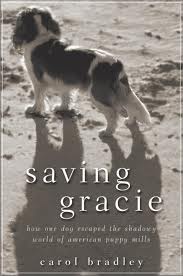
Saving Gracie

The tiny Cavalier King Charles Spaniel puppy with the checkmark “swoosh” on her leg started life like any other puppy — blind, deaf, seeking the warmth and nourishment her mother offered. Like too many other puppies, though, she was born in a puppy mill and was chosen for the worst possible fate — rather than being sold to a puppy broker or a family, she was chosen to be a breeder.

Gracie, as she eventually was named, spent about five years inside of a metal-grate cage, never feeling grass or even a regular floor. She was filthy, constantly hungry, and in pain from an eye problem that would plague her throughout her life.

Author Carol Bradley, an award-winning journalist, weaves Gracie’s story into her thorough and informative tale of American puppy mills. Packed with information, Saving Gracie chronicles the 2006 raid on a large Pennsylvania puppy mill where Gracie was one of 337 dogs removed to new lives. Bradley describes other puppy mill raids, tells the stories of heroic individuals who made these raids possible, and describes the scope of the problem and some of the ways dog lovers in Pennsylvania and nationwide are fighting the large-scale breeders who commit almost unimaginable cruelty in their greedy exploitation of dogs and pet-loving Americans.

Saving Gracie could be a difficult read; Bradley does not sugarcoat anything and the conditions that puppy mill dogs endure are as heart wrenching as they are stomach-turning. Yet, somehow, the book seems hopeful. Gracie finds a home with a loving and incredibly patient single mom, Linda. Once Gracie becomes indisputably Linda’s dog, the family adds two more retired breeding dogs. As awareness of puppy mills grows, the HSUS, ASPCA, and lawmakers in several states are beginning to take action. So much more is needed, but Bradley ends the book with a hopeful epilogue that lists some early successes.

Through her telling of Gracie’s story, and glimpses into the lives of other puppy mill rescues, Bradley explains the problems of puppy mill dogs, which begin with health problems but include lack of socialization, mistrust of humans, difficulty housebreaking, and a slew of behavioral problems that stem from the neglect and abuse the dogs suffered. While young puppies that are removed from the puppy mill escape the worst conditions early in their lives, they, too, suffer from health problems due to the filthy environment and congenital defects due to irresponsible breeding, and they are often poorly socialized.

Bradley does not paint all large-scale breeders as evil, carefully distinguishing between responsible breeders and puppy mills, and explaining the differences. She exposes other horrors, such as puppy auctions, that many readers might not know about. Without being pedantic or preachy, Bradley tells readers how to find puppies from responsible sources and what to look for in deciding where to purchase a dog. One by one, dog lovers can make a difference by refusing to buy puppy mill dogs and by supporting efforts to eradicate puppy mills. Saving Gracie is a heartwarming story of one dog’s rescue and a call to action for all readers.

Do Over Dogs

For a relatively compact book (under 200 pages), Do Over Dogs: Giving Your Dog a Second Chance for a First Class Life packs in a wealth of information. Renowned positive trainer and author Pat Miller targets a broad audience of dog parents — and manages to hit the target dead on.

A Do Over Dog is any dog who has had “issues.” This can be a dog adopted from a shelter, whether the dog was surrendered due to behavior issues or turned in by a family facing financial hardship or by an owner who was relocating and “unable” to take the dog along (Miller points out that many of these owners choose not to take the dog because of a behavior problem). A Do Over Dog can also be a puppy mill rescue or a puppy bred in a puppy mill or elsewhere and simply not socialized adequately. The do-over can even be the dog you have lovingly raised from puppyhood but who has developed a problem behavior.

The dog’s issue might be a major problem, such as dog aggression, that demands years of work and constant management, or it might be something that was a deal-breaker to the dog’s former humans but that doesn’t bother you very much.

In short, since there are no perfect dogs (or owners) out there, whatever your dog’s background and behavior issue — and no matter how much or how little dog experience you have — you are sure to find valuable hints and advice in this book.

Miller does not promise quick or easy solutions to problems. Her emphasis on managing problems while working on resolving them, as well as her sober admission that some problems require lifelong management are strong indicators of her knowledge, experience — and commitment to the dogs. After all, if all she wanted to do was convince readers to adopt dogs, she’d make it all sound easy.

Instead, Miller emphasizes the need for consistency and points out many situations where the only way to address a problem is for the humans to change their behavior. She recommends enlisting a positive trainer for assistance with difficult issues and for some problems, suggests consulting with a behaviorist.

Miller provides clear explanations and training instructions for addressing several common problem behaviors, such as digging and property destruction, offers advice on reducing stress (the dog’s!) and anxiety, and offers her thoughts on medicating dogs to modify their behavior. She effectively explains why positive training methods, besides being the humane choice, are more effective in the long run in teaching dogs the behaviors we want and discouraging the ones we do not want. She presents the science behind different approaches to dog training in easy-to-understand language with examples all readers will relate to. Despite being jam-packed with information and advice, the book is not overwhelming, nor does it drown readers in jargon.

Do Over Dogs succeeds at what many dog books attempt —  presenting advice and information that is helpful and relevant to humans while respecting and explaining the dogs’ viewpoint.

Published by Dogwise Publishing, Wenatchee, Wash., 2010

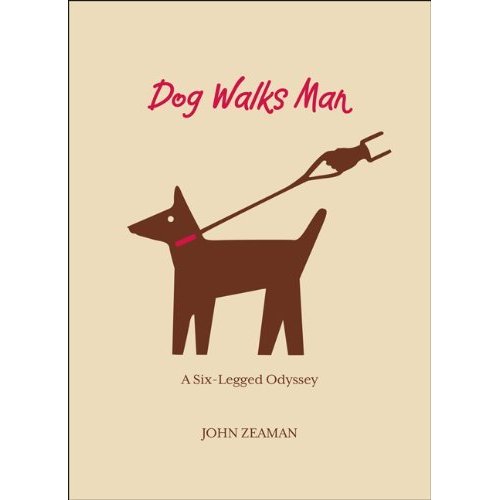
Dog Walks Man: A Six-Legged Odyssey

At first glance, a book about walking the dog might not sound very exciting. But, as a person who has written about dogs extensively and who has blogged about dog walking, I was intrigued. I picked up a copy, started reading, and was entranced.

Dog Walks Man: A Six-Legged Odyssey, by John Zeaman, is delightful! A collection of essays that is part memoir, part philosophy, and part social commentary, it has something to appeal to everyone. Zeaman, an art critic, has a warm writing style and a wry humor that makes a topic as ordinary as dog-walking almost poetic. I found myself nodding in agreement frequently and laughing out loud more than once.

Though he initially regarded the daily walks with his young standard poodle, Pete, as a chore, Zeaman describes the evolution of his attitude toward their nightly outings. I am sure that many dog owners can identify with his descriptions, and, I hope, with his ultimate realization that dog-walking provides access to pleasures that the dog-deprived miss. While there are certainly times that “having to” walk the dog feels burdensome, I find Jana’s and my morning walk-and-greet (I live in a neighborhood with many regular morning walkers, some accompanied by dogs, others there to admire my dog — that’s her take on it, anyhow) a genuine pleasure.

The fact that I agree with Zeaman’s view that dog-walkers should be in the moment, focused on the dog and the walk — not talking on their cell phones, shepherding children, and doing their errands at the same time — naturally added to my enjoyment of the book. But Zeaman’s philosophizing extends beyond a description of the ways that a daily walk enhances his relationship with his dog — he touches on people’s connections with nature, community relations, solitude and friendship, family dynamics, and the joys and responsibilities of dog ownership.

Anyone who has ever walked a dog will find something in this book that evokes a smile and a warm memory. And for readers who don’t have dogs? You’ll find out what you’re missing!