Why Is My Dog’s Eye Red?

A reader asks: My dog’s eye is red and bloodshot. I know that she has seasonal allergies; is that all it is? How do I know whether it is something serious?

While itchy, red, and irritated eyes can definitely be a symptom of seasonal allergies in our dogs (as well as in ourselves!), the key that something more is going on is that only one eye is affected. This is a good reason to get it checked out by a vet.

Eyes are delicate — and very important — so don’t take chances here. It can be allergies, a cold, or a minor irritation, but it could be something much more serious.

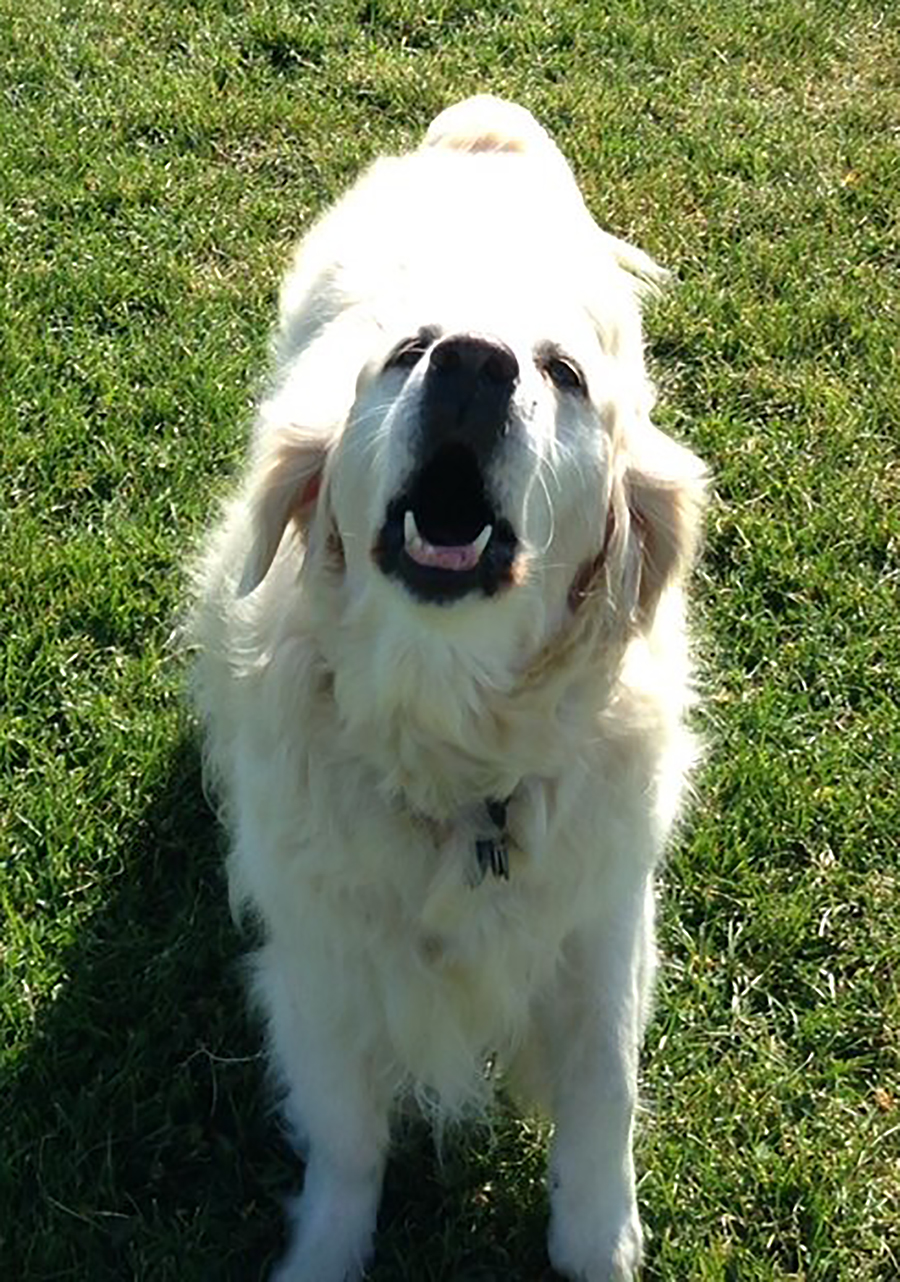
In this case, the dog, Hannah, had scratched her cornea badly. The vet put in some drops that showed the scratch in vivid green. Hannah went home with eye drops. She was an amazingly cooperative patient (I’ve had otherwise sweet-tempered, you-can-do-anything-to-them dogs threaten to rip my arm off if I came near them with that eyedropper again). Medication seemed to help at first, but ultimately, Hannah needed surgery, but she’s recovering. It’s a good thing she’s nice about the eye drops, though, because she needs several types of drops and ointments during her long, uncomfortable recovery.

A scratched cornea is not the only thing that can cause a single red eye. The most common cause is an irritant — a piece of dirt, dust, or plant matter or a spray, such as a skunk’s spray or a household aerosol. But bleeding in the eye or clear discomfort (the dog is pawing at her eyes) can signal a serious health problem like glaucoma or a tumor. These are rare, but the only way to be sure is to get the eye examined.

Play Ball!

Wanna play?
Wanna play?

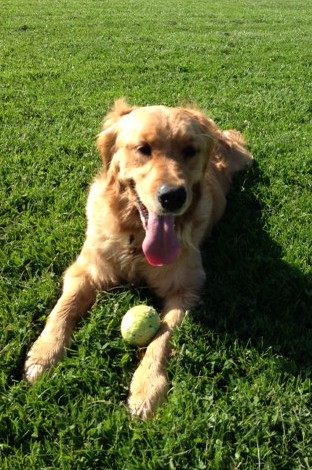
“She’s such a mama’s girl,” Deni said of Cali the other day. “If we get too far ahead, she looks back and wants to stop and wait for you.”

“Nah,” I said. “She knows that I have her precious tennis ball, and she’s worried that she won’t have it when she gets to the park.”

I may be a bit too cynical, and I do know that Cali and I have a close bond, but … when it comes to morning play, I really am just the tennis-ball carrier and tennis-ball thrower.

We tested our competing theories the next morning. As Deni, Cali and Alberta set off at a brisk pace, leaving Jana and me plodding at 12-year-old-golden speed, Cali glanced back once, then marched off, tail wagging. A key difference from the previous morning: Deni was wearing the all-important black backpack with Cali’s filthy, spit-coated, utterly disgusting tennis ball — the only one that Cali wants to play with.

Soon they were out of sight. When I got to the park with Jana, I asked Deni what had happened.

“Well,” she said. “Cali did look back twice, but she did not want to stop or even slow down.”

I knew it. Tennis-ball carrier status confirmed.

As I have mentioned before, play is very important to Cali and a huge part of our daily routine. She’s a very fair and friendly dog, and makes every effort to include all the humans present in whatever game is going on. When we’re not playing, she thinks that we should be.

In fact, Cali is my best balanced-life coach, nudging me at regular intervals to gently point out that it is time to take a break from this horrid computer, go outside, and play with her. And that darned tennis ball.

Cali knows what dogs have known for thousands of years and what has contributed significantly to the human-canine partnership: People and dogs play well together. Play makes all of our lives better. And playing with ours dogs makes our relationships with them better. According to a recent study by dog expert John Bradshaw, dogs who have frequent, positive play sessions with their owners (no scolding!) are more obedient and more engaged with their humans.

So, what are you waiting for? Get out there and throw that (disgusting) tennis ball!

Thunderboy!


Poor Ziggy. Summer in Kansas is a never-ending cycle of thunderstorms and frenetic lawn-mowing. To make matters worse, his neighbors seem to tag-team each other. No sooner does one mower stop its terrifying buzz than another starts up. When all the lawns are neatly groomed … the thunder clouds roll in.

Ziggy cannot click his heels together, murmur “there’s no place like home,” and wind up back in thundercloud-free Southern California, where he grew up. He wouldn’t even need to worry about lawnmowers there; lawns are practically illegal in California these days. There’s no place like home indeed.

So what’s a poor thunder- and mower-phobic dog to do?

Rescue Remedy did not live up to its name; hiding under the sofa failed to quell his fears, and even the trusty closet let him down, seeing as it has an external wall. His mom’s planning to turn his kennel into a man-cave in the hall, the only place without windows or outside walls, but meanwhile, well, it’s raining. Again. And rain means thunder. When the rain stops, the neighbors fire up their mowers. Again. The cycle continues.

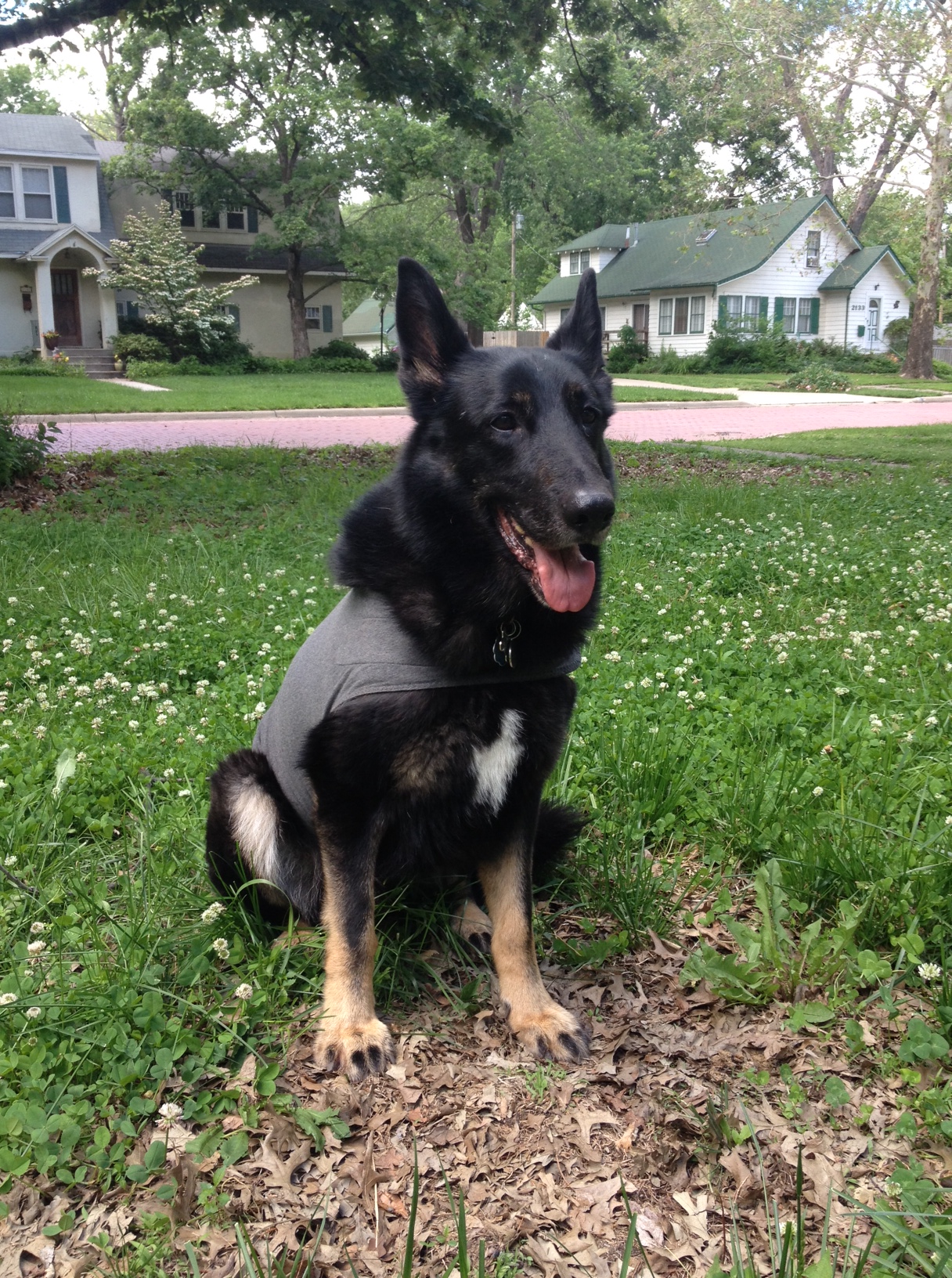
In Ziggy’s case, the ThunderShirt™ does the trick. Donning his trusty gray garment, Ziggy, a.k.a. Thunderboy®, acquires the superpower he needs to survive the back-to-back threats of local lawnmowers and ubiquitous thunderstorms.

Ziggy’s hardly alone in his quandary. And thunder and lawnmowers are not the only anxiety triggers of summer. The suggestions here can help dogs deal with Fourth of July fireworks as well.

WrapNot all dogs are lucky enough to gain superpowers by putting on a ThunderShirt. Other forms of wraps work for some anxious dogs — Jana favors hot pink elastic bandages, for example, when her nerves are on edge. Some dogs opt for a ThunderCap™, but Ziggy prefers to confront his fears with eyes wide open.

Some dogs just need a cuddle. Or a lot of cuddles. In the bed with you. Or on top of you. Others dogs are happier in their own secure fortresses — under or behind furniture or in a secure crate. Closed-sided crates or wire crates draped with towels or blankets work best. Pheromone sprays, collars, and plug-in diffusers work for some anxious dogs, while others can be distracted by music (or TV, for the couch potatoes) or games. A food toy (who doesn’t feel better with a nosh at hand — er, paw?), such as a stuffed Kong, inside the crate could work wonders for your pup’s nerves, if not his waistline.

A warning — dogs with extreme noise phobias might bolt during especially loud thunderstorms or fireworks. Make sure your dog is secured inside your home; a dog who escapes could cover a large distance trying to outrun his fear.

For many dogs, the issues is not the noise, it’s the air pressure and other changes they can feel when a thunderstorm is approaching. Some dogs’ anxiety can kick into high gear well before the first raindrops fall or thunder rumbles. If there’s no escape and no distracting him, medication might be necessary. In extreme cases, a Valium can pacify your perturbed pooch.

If even that fails? Dip into his Valium yourself … one little tablet (or a nice glass of Cabernet) and those anxieties will soon slide into the background.

Potty Parity for Pets, Pros

A new era for traveling dogs

Jet-setting working dogs, along with small traveling pets, have reason to rejoice! They are on their way to potty parity.

A recent trip took me through several large airports, and I noticed something new in Detroit: A service dog and traveling pet relief area inside the secure area. Update: A new relief area was opened at O’Hare airport in October! From the pictures, it looks a lot like the Detroit one.

Now, according to the law, this should not be a novel find. Air carriers are required to ensure that all traveling service dogs, whether departing, arriving or connecting, have access to appropriate facilities. The relevant law, 14 CFR Part 382 (Nondiscrimination on the Basis of Disability in Air Travel) Subpart D, 382.51(a)(5) states: “In cooperation with the airport operator and in consultation with local service animal training organization(s), [air carriers] must provide animal relief areas for service animals that accompany passengers departing, connecting, or arriving at an airport on your flights.”

Sadly for all those dogs running between flights with their legs tightly crossed, if these facilities exist at all, they are most often outside the terminal — meaning that they are on the wrong side of security if you are transferring to a connecting flight. Solutions have included teaching dogs to use pee pads, then taking them into the family restrooms that are commonly found in airports to squat alongside their human partners; running them outside — then trekking back through security; or asking airline personnel for an escort to the tarmac, where many a service dog is too distracted by the unusual scents and sounds to, uh, deliver the goods. A tight connection can make either of the last two options impractical. The outdoor pet relief area might be at the very far end of a terminal — or even a few terminals away, making for a very long trek.

The situation is finally improving, though, with a few airports now providing potty facilities inside the terminal.

Unacceptable!
Unacceptable!

The first one I discovered was in Seattle; I found it — and I am being very generous — rather disappointing. When I was there, a few years ago, it offered essentially a large litter box, some pee pads, a dirty concrete floor and a trash can. A dog I was traveling with turned up his nose and decided to hold on until we reached our destination where, he hoped, some grass — or even a patch of dirt — might be available.

Detroit’s offering elevates indoor canine commodes to a new level. I hadn’t been through the Detroit airport in a while, and the new facilities, in the center of the main Delta concourse, were quite a pleasant surprise.

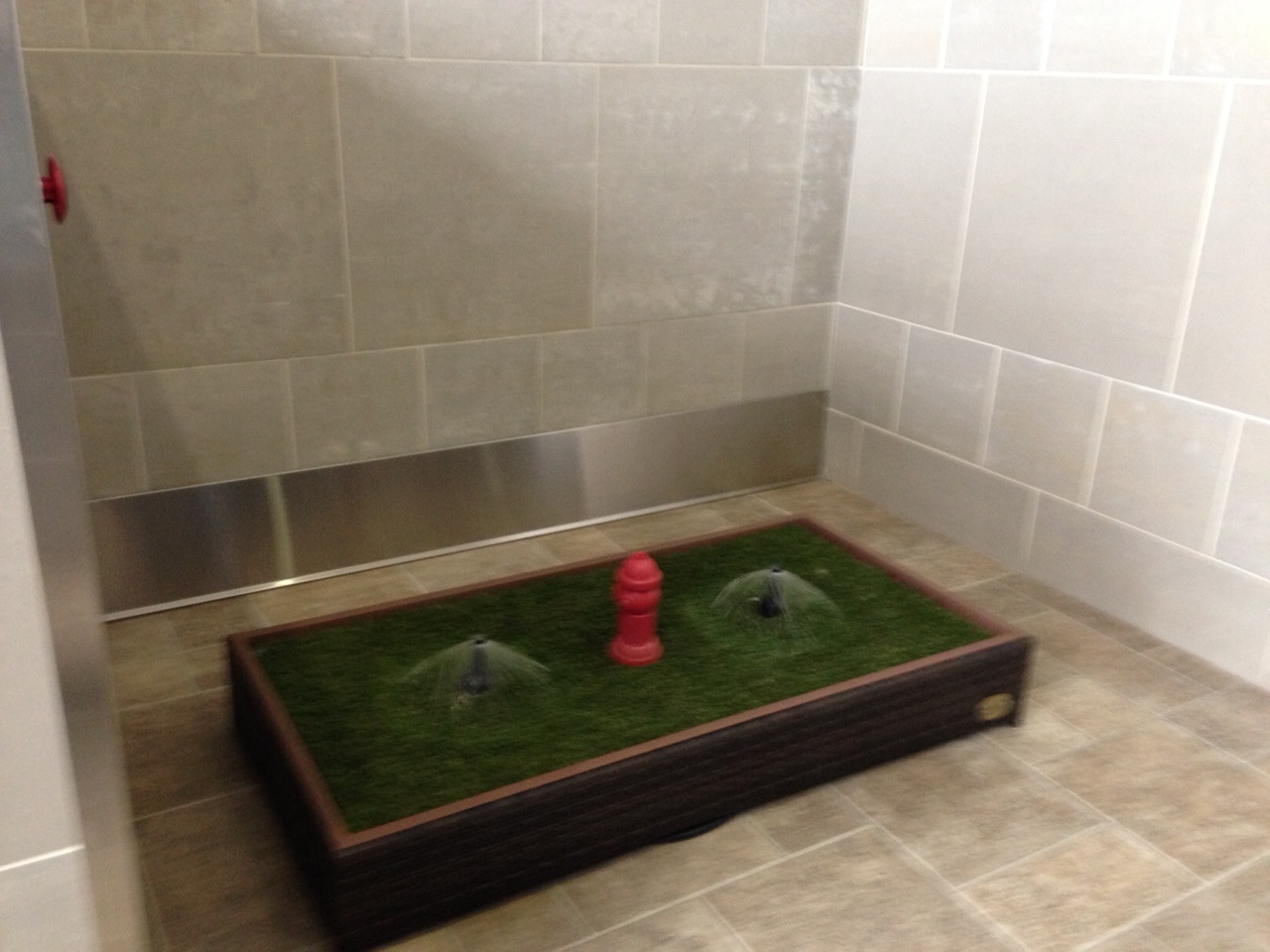
IMG_1815First of all, the service dog relief area contains two stalls, each offering the dignified or shy dog a reasonable degree of privacy. A shared hand-washing area, presumably for the humans’ use, divides the stalls. Each stall offers a small fire-hydrant-shaped urinal (female dogs might find these distasteful, but we must all adjust to this dawning era of non-gendered relief facilities, mustn’t we?). The hydrant occupies the center of a smallish patch of fake, very green, grass. Bags and trash cans are also provided. The nicest touch, however, was the built-in sprinkler system. With the push of a button, cleanup is accomplished, leaving the stall fresh and green for the next working dog in need of a restroom.

Let’s hope this becomes the new standard for powder rooms for peripatetic pooches.

Animal Wise

Animal WiseI got a copy of Virginia Morell’s Animal Wise soon after it came out in paperback … then let it sit on my shelf for ages. I finally picked it up after hearing an NPR broadcast of a talk she gave in March 2015. She was wonderful! And so were her animal stories!

Animal Wise talks about many species of animals. She does save the best for last, though. The final chapter, on dogs and wolves, includes interviews with and visits to the labs of nearly all of my dog-cognition-research heroes (Adam Miklosi, Vilmos Csanyi, Jozsef TopolPeter Pongracz … she reveals why Hungary is the center of the dog cognition universe, too … but Juliane Kaminski, Julia Fischer and Brian Hare also get their due).

Morell does a fantastic job of grabbing readers’ interest with great storytelling. Who can resist reading about rats who laugh or ants who teach — and evaluate their students? I sure couldn’t.

She then describes the science behind these discoveries in laymen’s terms and explains why these discoveries matter. And best of all, her discussion of the research is not All About How Great It Is for Humans. In fact, her epilogue eloquently puts to rest (thank goodness) the idea that the only reason to study animal minds is to compare them unfavorably with humans’ minds and to keep on isolating the qualities that make humans superior. “Instead,” she writes, “given that we now know that we live in a world of sentient beings, not one of stimulus-response machines, we need to ask, how should we treat these other emotional, thinking creatures?”

While this is not light reading — heavy on the science — it’s well worth the effort and is, actually, a very friendly way to learn a lot about animal cognition science.

Makes Scents

Follow your nose … wherever it takes you!

In a recent conversation, a friend described her memories of her grandparents’ house — each room had, obviously, a visual memory, but also a unique scent memory. Many people have experienced being transported back to a meaningful childhood moment upon smelling a familiar scent — Grandma’s perfume, cinnamon rolls, Thanksgiving turkey roasting … But until I read Dr. Gregory Berns’s study “Scent of the Familiar,” I hadn’t really thought of memories, scents, and dogs in the same context. This study, published in the journal Behavioural Processes in 2015, shows that dogs have a pleasurable association with some scents. Berns’s team analyzed MRI scans of several dogs, comparing their brain response to sniffing the scents of familiar and unfamiliar people and dogs. The dogs were all trained, using only positive methods, to lie still in MRI machines, as described in Berns’s book, How Dogs Love Us.

What the team found was that, while the scent-processing areas of the dogs’ brains responded similarly to all the scents, only the scent of a familiar human triggered a strong reaction in the “pleasure center” of their brains. The study was carefully controlled — the scents were from people in the dogs’ households but not the dogs’ primary caregivers and not individuals who were present in the lab for the testing.

Berns compares the dogs’ ability to recognize and happily respond to the scent of a loved but distant human to the response humans show when viewing photos of loved ones who are not present.
In simple English, this study confirms that dogs, like my friend, can experience pleasant memories via scent. It makes perfect sense, since dogs’ ability to detect and identify scents is so powerful. Humans tend to rely more on visual cues to identify and remember places, people and, maybe, dogs. But dogs are far less visually oriented, and their eyesight works differently from ours — fewer colors, more emphasis on shadows and movement, for example.

It also most likely explains how dogs remember people they have not seen in a very long time. As a student at Bergin University (then called the Assistance Dog Institute), I trained a young puppy, from her birth to about 13 weeks of age. Cassie was a brilliant puppy, and we spent time together every day. Then, the semester ended, and I left for my home. I did not visit the school again until a year and a half later. I knew that Cassie was still there, but there was no way that I could pick out this now-grown golden retriever from a sea of beautiful, but very similar-looking, goldens. I’m sure I looked different too, but she had no trouble recognizing me. I quickly guessed that the enthusiastic, whole-body-wagging-with-joy girl who was leaping into my arms was Cassie. The nose knows!

Be Careful What You Teach Them …

When I was first learning to train service dogs, my instructor taught me that, once you put something on “cue control,” that is, teach the dog to do it when asked, the dog will no longer do it unasked.

Those of you with dogs and a little training experience, stop laughing.

This is one rationale behind teaching dogs to “speak” — bark on command.

Problem is, no one told the dogs about this bit of learning theory.

There is a key caveat to this piece of wisdom: The dog will no longer do it unasked unless he really, really wants to.

Bonnie Bergin (my teacher) discovered this one morning, when a particularly rambunctious group of adolescent Labrador service-dog trainees learned about tugging open a refrigerator door. One day, the ringleader of the litter, Xavier, let himself and some buddies into the training room (opening the door from the outside yard), tugged open the fridge, and helped himself to a large hambone.

The ensuing melee was quite dramatic. None of those Labs became service dogs.

I learned about the “unless they really want to” caveat to the lesson about dogs not volunteering named behaviors too late: I had already taught Jana to speak on cue. She uses her words. A lot. She’s quite opinionated, in fact.

Cookie, please

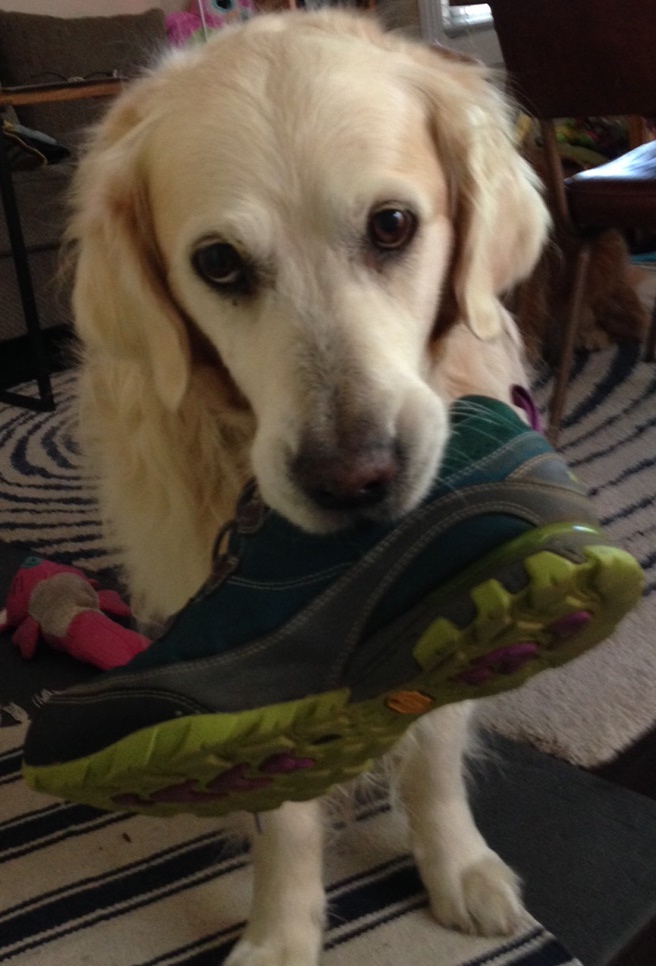
But I digress. The latest example of dogs doing unbidden that for which they have been amply rewarded in the past involves my shoes. I recently wrote about how eagerly Cali and Jana bring my shoes or sandals when it’s time for our morning walk.

Well, now they bring my shoes and my sandals. And a pair of slippers or flip-flops too. I reward the correct two shoes and wordlessly return the others to their proper place, hoping to extinguish this behavior. Not only is the flood of shoes not diminishing, it’s extending beyond walk time.

I occasionally turn around to find Jana, hopeful look on her face, shoe in mouth, standing behind me … at any hour of the day or evening. When I ask for anything — bowl, leash, collar, toy — Cali will often dash off enthusiastically … and return with a shoe.

On the bright side, they are both really good at “getting the other one,” so I never need to worry about being barefoot or mismatched.

So, be careful what you teach your dog; she might be smart enough to turn it into a game you never anticipated.

Dog Parks: The New Spectator Sport

Cali loves going to the park, just as many sports fans love going to the stadium. McNear Park, about eight blocks from our apartment, is an off-leash dog run for a few hours every morning. A group of very nice, well-mannered dogs are regulars, and I have only very rarely seen any inappropriate play. It’s a wonderful place for Cali to get some off-leash ball play, since our yard is very small.

Cali loves going to the park, just as many sports fans love going to the stadium. McNear Park, about eight blocks from our apartment, is an off-leash dog run for a few hours every morning. A group of very nice, well-mannered dogs are regulars, and I have only very rarely seen any inappropriate play. It’s a wonderful place for Cali to get some off-leash ball play, since our yard is very small.

Every morning, she bugs me to get going. Hurry up! She brings my shoes and nudges me to get out the door faster. She noses her favorite ball to remind me to take it along. When we get there, she demands that I throw the ball immediately. She eagerly chases it.

Then she lies down in the grass and surveys the park. She’ll occasionally bring the ball back and let me throw it again. Once. She moves from sunny patch to shade, carrying her ball with her and carefully placing it between her paws as she resumes her reclining position on the grass. Watching other dogs play.

A few dogs try to engage her, bowing and bouncing. Once in a great while, Cali will play for a couple of minutes, then, worry furrowing her brow, search out her ball, sigh in relief, and lie down, the precious ball resting safely between her paws once again.

Sometimes, I go over and get the ball to throw it for her. She’s happy to chase it, tail rotating like a helicopter blade … and then, again, lie down and watch the action. Or not, in which case, she’ll hold tightly onto the ball, not letting me take it and throw it.

Cali sees the park as a sports arena where she gets to watch other dogs play ball, Frisbee, and tag. She’d be happy to stay there all day, observing, but I usually get annoyed and threaten, “Play — or we’re going home.”

Meanwhile, Jana is doing her thing. She grazes a bit, then rolls in the grass. Stretches out, does a bit of yoga, sunbathes. The walk there and back is enough exercise for her. But Cali really needs to run and burn off energy.

When I finally give up and snap leashes back on, Cali usually digs in her heels, refusing to leave. She might, grudgingly, let me take the ball and throw it a few times then, before we leave.

When we get home, what does Cali want me to do? Throw the ball for her, of course.

Duck-Induced Deafness

cali and ducksI’m a whole lot less interesting than three mallards. I’m trying not to take it personally.
I took the girls swimming the other day at the Russian River. We were having a nice time splashing around, and Cali was happily swimming after a ball. Jana was searching for rocks. Russian RIver April 2015She likes to find heart-shaped rocks, as I have described in an earlier post. She added this one (right) to our collection on this particular river excursion. In short, all was well.
Until those darn ducks swam by. There were about 10 ducks, enjoying a sunny day. Jana noticed them first. She’d swim in their general direction, and they’d fly up a few feet into the air, and she’d lose interest.

Then Cali got in on the game. She just followed them around, never getting too close. She was no threat. She was holding a tennis ball in her mouth the whole time, and she never got closer than about 10 feet. Three of the ducks decided to play a little game with her. They did not fly away. They stayed just far enough in front of her that they (apparently) felt safe but close enough that she stayed interested. And they swam around in big circles. They swam across the river, around a big island, back to our side. Upriver. Downriver. Big circles.

Cali paddled doggedly after them.

At first, it was funny. She never let go of her tennis ball. She’s a strong swimmer, but after a few minutes, I started worrying that she’d get tired. My friend and I waded farther into the river, determined to head them off if they headed downriver. They didn’t.

We called Cali and waved. But she was suffering a bout of duck-induced deafness and never heard a thing. Jana had long since given up on following the ducks and was nosing around for sticks on the beach. The other golden in our group had gone back to tennis balls. But not Cali. Back and forth, around and around. Finally, my friend couldn’t stand it any longer. She crossed the river and grabbed Cali, getting soaked in the process. Cali still had her tennis ball. She was not even winded.

Jana used to do the same thing. She once followed a leaping fish pretty far out into the Gulf at a Florida dog beach. But Jana has more sense than Cali. After a while, she looked back, saw how far she was, got a very worried look on her face — and turned and paddled for shore as quickly as she could. I don’t worry about Jana disappearing into the wild. She never wants to lose sight of me.

But Cali is more impulsive and less aware of her surroundings. Was Cali even a tiny bit aware that she had worried us? Nothing doing. Within minutes, she was bugging us to throw the ball some more.

Does this mean that Cali has a poor recall? Not necessarily; even the best-trained dog is likely to go temporarily deaf when confronted with a really interesting distraction. It does teach me to keep a closer eye (and shorter leash) on Cali when I see ducks on future water adventures, though. And it’s a good reminder that I need to practice recalls with Cali in more places with lots of interesting things going on. I may never be able to cure duck-induced deafness, but I can probably relieve some of the symptoms.

Chaser: Unlocking the Genius of the Dog Who Knows a Thousand Words

CHaserAmazing dog. Amazing and super-friendly author. I got in touch w/Dr. Pilley after reading the book (and his research papers) and he did a Skype conversation with a class I was teaching on dog-human communication. He is one in a million, as is Chaser. He is such a great example of positive training that respects a dog and her abilities… and he is a fantastic teacher as well.
No one is surprised to hear that a border collie is intelligent and learns easily. But Chaser has gone far beyond what any other dog has been documented to learn in terms of human language comprehension. Dr. Pilley set out to teach her as many words as he could — names of objects — after reading the dismissive comments that greeted publications describing the accomplishments of Rico, a border collie in Germany who learned several hundred words. Dr. Pilley analyzed the linguists’ and other academics’ critiques of the training and testing of Rico — and set out to train his dog in a way that addressed all of their objections. And he accomplished his goal. (An interesting chapter in the book describes the resistance he faced when attempting to publish his initial results.) The opposition to admitting that any creature but humans can use language is still deeply entrenched.
But it’s also dead wrong. Chaser truly does understand human language. She learned and retains the names of more than a thousand items. She has demonstrated her ability to categorize them, grouping round bouncy things into the “ball” category and flat flying things into the “Frisbee” category, for example. And, like most dogs, she clearly distinguishes the category of “my toys” from “things in the house that I’d like to chew but am not allowed to chew.”
But Dr. Pilley realized that he had not pushed the boundaries of Chaser’s abilities. So, they tackled grammar next. Chaser understands the concepts of subject, verb, object — and indirect object. As an editor and college instructor, I have to point out that many writers and college students do not reach Chaser’s level of grammatical knowledge.
Toward the end of the book, Dr. Pilley describes his initial attempts to teach Chaser to imitate long, complex strings of behaviors. His description inspired me to try simple imitation games with my dogs, which have been fun and very funny.
The best part about this book though, is its constant message: Keep training fun and rewarding for the dog; make it a game; play to your dog’s strengths and preferences and, most important, make sure she has time do play and engage in her favorite activities. For Chaser, that means regular opportunities to herd sheep at a near