Some Like It Hot

This slideshow requires JavaScript.

When Jana was a young puppy, she had the strange and (I thought) disgusting habit of shredding, and sometimes eating, the trash. If I left her at home for too long — which, when she was a few months old meant “more than 10 minutes” — she’d empty one or more wastebaskets, usually leaving some of the shredded remains next to the wastebasket. Ick.

I knew that buying wastebaskets with lids or placing the wastebaskets out of reach would manage the problem, but I wanted to stop the behavior. A more-experienced trainer friend had a suggestion: douse the contents of the trash baskets with something very hot or spicy, something that would repel her with its scent or, if that failed, with the first bite. Tabasco sauce, perhaps.

Despite being a bit dubious, I decided to try it out.  The next time I was leaving Jana at home, I liberally sprinkled Tabasco over the crumpled tissues and bits of paper in the wastebaskets. I returned home to a floor clear of shreds … and to empty wastebaskets and a happy dog, wagging her thanks. “Great sauce, Mom, can I have some more?”

Hmmm. Not the reaction I had hoped for.

She’s consistent in her taste, though. Her dad, Moshe, used to give her bits of pita with hummus and schug, a very hot Yemenite condiment that makes smoke come out of my ears with the merest whiff. She now enjoys her breakfasts and dinner with a healthy spoonful of turmeric (a great anti-inflammatory).

I ascribed Jana’s odd penchant for spicy food to her Israeli heritage. Until last week.

We’ve been spending lots of time at the home of Gracie and Scarlett, two Montana goldens whose dad has a beautiful garden. The garden currently is bursting with an abundance of tomatoes, beans, squash and peppers (to Cali’s dismay, the peas are done for the season). Among the peppers that Deni harvested a few days ago were dozens of beautiful jalapeños.

As is her habit, Scarlett (now eight months old) watched like a hawk as Deni harvested and sorted vegetables, pouncing on any that fell to the ground and, when the opportunity presented itself, snatching veggies off the table. Green beans, squash, tomatoes … fine. Then she nabbed a large jalapeño and ran off to her “hiding” spot under the deck. As Deni watched in amazement, Scarlett took a bite, then another and another — until she had eaten the entire jalapeño, seeds, ribs, and all. As if to prove that she can take the heat, she nabbed another the next day and ate it, too. She has not shown any sign of ill effects or even indigestion. She didn’t even gulp down an entire bucketful of water afterward (as I would have).

While I certainly do not advocate feeding spicy foods to dogs, it seems that Jana is not the only girl who’s looking to spice up her kibble, fish, and peanut-butter cookie diet. Who knows? If your dog is turning her nose up at her ordinary meals, perhaps the problem isn’t that she doesn’t like the food — she might just be holding out for the right condiments.

(In case you’re wondering: Jana (mostly)outgrew her trashy habit; now she only shreds one tissue and leaves it for me, and only if she’s angry.)

Agility Offers Fun for Thinking Dogs

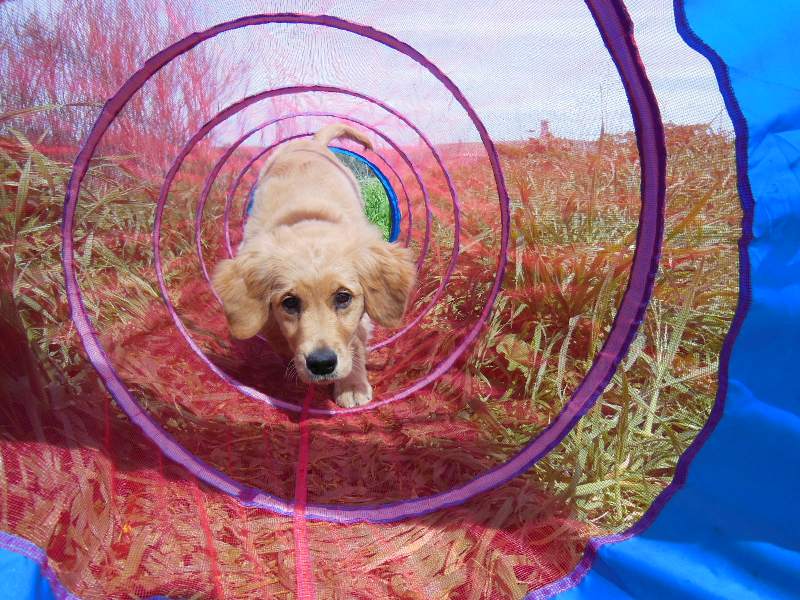
lost in the tunnelCali and Alberta started taking agility classes a few weeks ago. Watching Cali puzzle through things and figure out what we want has been fun. I can almost see the wheels turning in her little head.

Alberta is more experienced with dog sports and classes, having nearly completed her Rally Advanced Excellent title. She catches on very quickly, but knowing what we want her to do doesn’t keep Alberta from showing her silly side in class sometimes.

In the first couple of classes, we worked on targeting a small piece of foam on the floor. Both girls are proficient at hand targeting and were able to touch our hands, on cue, no matter whether we placed them high, low, on our backs, or anywhere else. Getting them to touch the foam mat was easy, too, but … both Cali and Alberta quickly went from simply touching it to retrieving it. Alberta, in particular, has a great working retrieve and has often been rewarded for bringing Deni items that Deni didn’t even know she had dropped.

I’ve been working on teaching Cali to bring my shoes, and, like Jana and Oriel before her, she has shown some entrepreneurial spirit, bringing things that I don’t even know that I need (or want) — in hopes of exchanging them for a small cookie.

So it’s not surprising that both Cali and Alberta think that we want them to retrieve the small mat, rather than simply touch it. Or perhaps they know that we want them to touch it but prefer to retrieve it.

They both are eager to jump onto the agility equipment, out of turn or when we’re waiting for our turn at a different piece of equipment. No fear from either of them; just eagerness to learn more and try out new challenges.

Practicing at home is also fun (and can become a three-dog circus pretty quickly). Jana wants in on the action, and when I was guiding Cali through some fake weave poles, Jana knocked one over with a swish of her tail — while grabbing another and running off with it in her mouth. Meanwhile, Alberta knocked over the other two! Poor Cali never had a chance. With more practice, though, we have managed to get all three girls to walk between the poles, though we still occasionally lose a pole or two to a swishing tail.

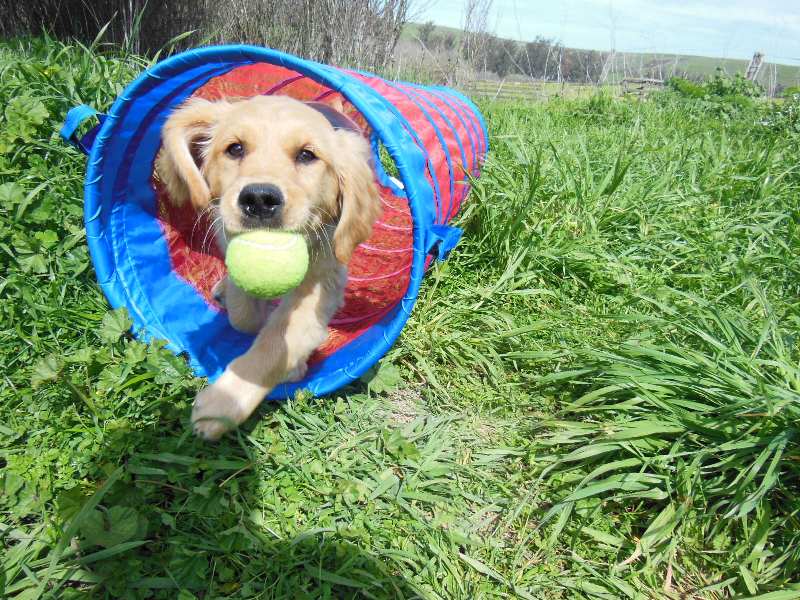
Out of the tunnelNone of our girls has any trouble with tunnels, though Cali did try to circumvent the tunnel once, taking a shortcut to where I was standing. She has always loved tunnels. Cali had a wonderful little play tunnel when she was a puppy, and Jana had plenty of exposure to tunnels before her first agility class. So neither of them hesitates, even when the tunnels are curved or have a piece of fabric covering one end, though many dogs resist entering a tunnel if they cannot see through to the end of it.

I thought about this last week as I was working with a neighbor’s dog, an adolescent golden retriever who is unwilling to use her dog door. The door flap makes her nervous. I rigged up a tunnel using a small table and a towel, and after a couple of sessions, she was willing (though still not exactly eager) to go through it for cookies. She’s uncomfortable with the small space, the towel brushing her back, and her inability to see what is coming. She’s improving, but she reminded me of how important it is to expose dogs to all sorts of tactile experiences, starting at a very young age.

Even that is not foolproof, though; this dog did use the door flap when she was younger, until she had a scary head-to-head confrontation with the cat as she went through the flap. My jerry-rigged tunnel will (I hope) help build her confidence in the same way that agility classes are boosting Cali’s confidence and awareness of where her body is. Classes in agility or other dog sports are a lot of fun — and they improve the dog’s focus on you and your communication with each other. Besides, they provide plenty of mental challenges to your thinking dog!

Her Very Own Key

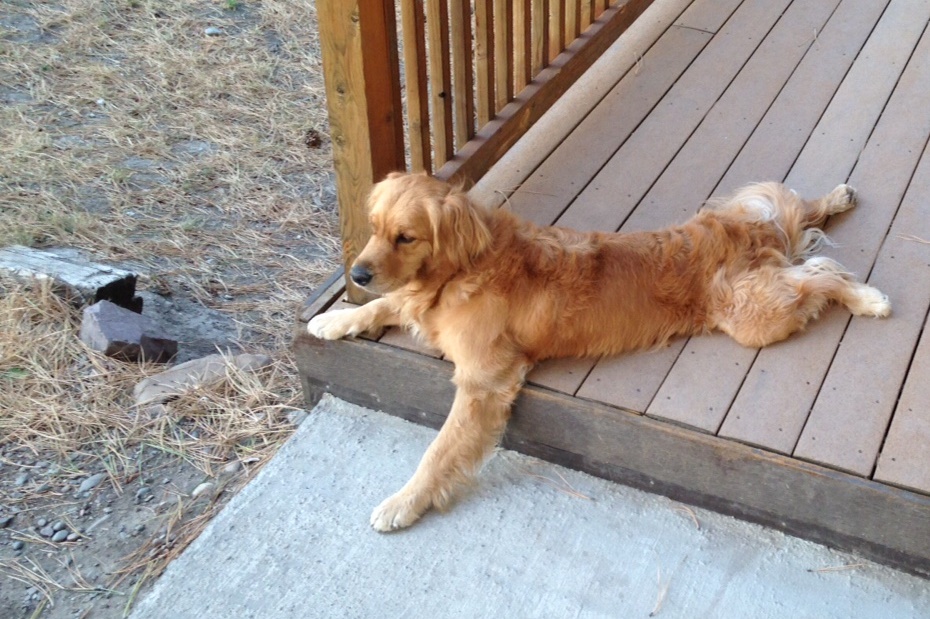
Surveying her territory

Cali got her own key last night.

Readers of Merle’s Door — or Cali, the Ghost, and the Dog Door or A Doorway to Your Dog’s Independence — will understand the significance of this moment.

Deni’s house in Montana has an electronic dog door. The dogs each wear a magnet on their collars. The magnet opens the door, letting the dog go outside, into the fenced dog yard. It’s a nice dog yard with its own deck and a fabulous view of the mountains and valley. Lucky dogs.

Cali had learned about dog doors in our Florida house, but her key privileges were quickly rescinded when she spent her time chasing and eating lizards, digging, and going in and out and in and out and in and out … Our California apartment has no dog door, and Cali’s outdoor privileges are often suspended due to incessant digging and / or barking at the neighbors. If you can’t handle the freedom, I tell her, you have to stay with me.

Cali clearly treasures the privilege, as she showed us the first time she got a key and went in and out and in … She no longer does that, but she does relish opening her own door — often waiting for the dog door to open and using it even when we’re walking through the people door at the same time. Jana and Alberta, on the other paw, will stand by the people door and bark for their staff. When we fail to materialize and open the door promptly enough, they’ll disdainfully resort to using the dog door.

Cali convinced us of her increasing maturity, after spending most of an afternoon stretched out in her “bearskin rug” pose, watching the world go by. That world included a few deer, many squirrels, and an enormous truck that dumped four loads of dirt and gravel on the driveway. Nary a bark was heard nor a hole dug. Our baby is growing up!

Well … not so fast. Increased wildlife activity in the evening required closing the dog door. Barking at deer in the morning prompted a brief suspension of Cali’s privileges.

Even with these bumps in the road, it’s clear that Cali has turned a corner. She’s much more thoughtful and better able to rein in her abundant enthusiasm. She still gets excited (very excited) about meeting new people or heading out to play ball, but she can get a grip on her enthusiasm, sitting and trembling all over rather than jumping straight into a stranger’s arms, for example. As we walk to the play yard, she skips ahead, remembers, backs up, skips ahead, remembers, backs up … over and over. I don’t have to say a word. She rarely even gets to the point of pulling at the end of the leash anymore. And, last week, a friend asked whether 6-month-old Scarlett would “be as nice and calm as Cali when she grows up.” Granted, the friend hadn’t known Cali for very long …still, it was a nice compliment.

Scarlett, at 6 months, already shows her strong personality and intelligence. However, she’s heading full-speed-ahead into adolescence, and she lacks impulse control. Cali was similar at that age. Watching them together provides a nice reminder that, if you get through those crazy months, you just might end up with a wonderful adult dog at the other end of that long, dark, frustrating tunnel.

Montana Girl

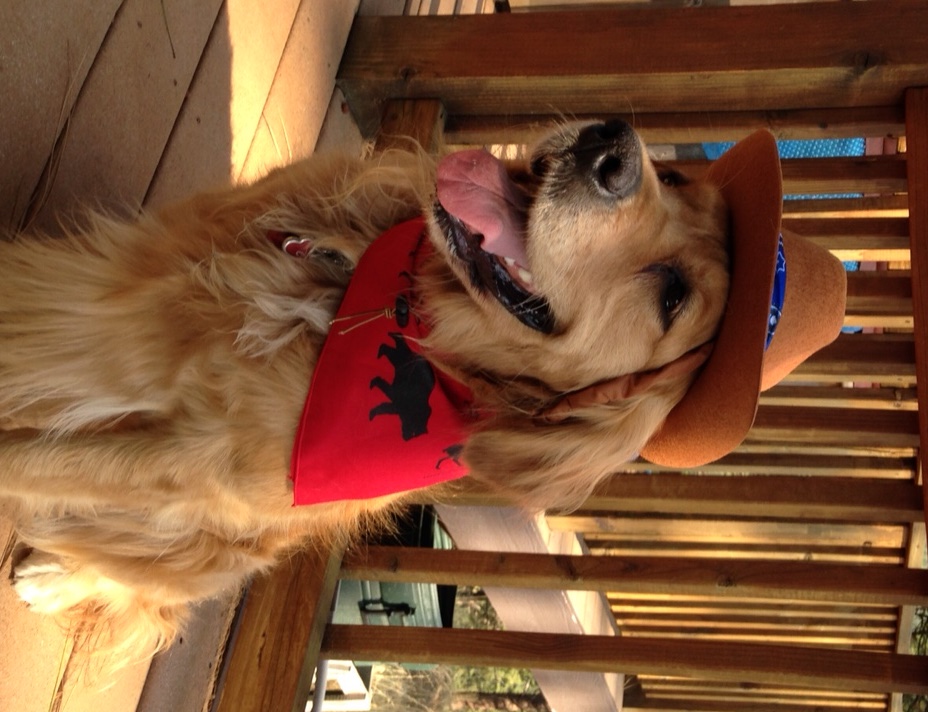
We’re back in Lolo, Montana for a couple of months after three years’ absence. I knew that Jana would be happy to be back. She loves splashing in the river at Fort Fizzle, where she found her first heart-shaped rock several years ago, and barking at the abundant wildlife.

But it is Cali’s first trip to Montana, so I was really looking forward to her reactions. Turns out Cali is even more of a Montana girl than Jana! She loves the huge play yard outside Deni’s house — her own private dog park! — where she races over the ground, feet pounding the dry dirt, after her beloved tennis ball. The dry, stiff grass and stubble don’t seem to affect her at all, though poor Alberta winces with every step.

Cali is enthralled with the bunnies, chipmunks, and squirrels and fascinated by the deer. So far, we haven’t spotted anything bigger than a doe with twin fawns, but for Cali, that was a major life event. Every car ride is a source of great excitement and even greater smells, as sits up, looking out the window, not wanting to miss a thing. And if, oh joy!, the window is open, she glues her nose to the window and whuffs deeply, taking in the rich mix of scents.

The house has the most perfect windows, which are very tall and reach way down to golden-retriever-nose level, so Cali can watch the birds soaring as she looks out over the valley — or bark at the deer and squirrels who wander into the front yard.

Best of all is her new friend Scarlett’s house. Scarlett, aged six months, has a huge yard with the greenest, softest grass Cali has ever seen! And a play pool. And so many flower beds to dig in when Mom isn’t looking … If only she could get into that fenced veggie garden, she could help herself to more of those delicious peas and squashes. Cali thinks that Mom’s being awfully stingy with them. What kind of mom refuses to give her kid veggies?

For the first time ever, Cali has tried out Jana’s routine of stretching out on her back and exercising her abs. Sure feels great in that cool, soft grass. Jana’s enjoying the grass, too. Her new spa routine is a soak in the doggy pool, a luxuriant roll in the grass, then an abs workout. A short nap in the sun, then repeat. All day long.

When Cali is not working out, she’s happy to join a chase game that she, Alberta, and Scarlett have invented. They race in big circles around that garden (the one full of forbidden peas). Then one stops and the other two keep running. They switch out a few times, changing direction occasionally. Finally, they stop running, always ending up with Alberta in the middle as tug toy; Cali and Scarlett each attached to one ear. So far, the ears haven’t come off, but I watch nervously every day …

Cali hasn’t even experienced some of the best Montana treats, like dog cones at the Big Dipper ice cream store or the very cold stream at Packer Meadows or hiking… everywhere. Even so, she’s already sure that she was born to be a Montana girl!

Older, Wiser … and Far More Painful

Opening birthday presents helps keep Jana young and happy!

We celebrated Jana’s twelfth birthday recently. Her friend Leti (also a golden retriever) just turned 15.  These girls still walk to the park nearly every day and enjoy a vigorous roll in the grass. They make the rounds, saying hello to the other dogs’ people and trying to cadge a cookie or two from each human.

I do everything I can to see that Jana’s quality of life remains high. Despite their good health, both girls are showing signs of their age. Jana has severe arthritis and wakes up feeling stiff and painful many mornings. Though she’s usually very sharp mentally, I’ve noticed a few senior moments, when she seems to be a bit confused.

Hoping to deal with both those issues — without breaking the budget — I’ve put together a regime of supplements and exercises that help Jana a lot. If you have an aging dog, some of this might be helpful. I have no veterinary training, but I do check everything with my vet and vet techs before I try it on Jana, and I recommend that you do the same:

  • Even Cali, age 2, is taking a small amount of glucosamine each morning. It helps ease joint pain. Some people take it, too, particularly for knee pain.
  • New Zealand Green Lipped Mussel. Jana takes one green mussel capsule daily, emptied onto her breakfast. Like glucosamine, it can help people and dogs with joint pain. Jana behaves very differently when she’s talking it — asking to go on walks and soliciting tug games — so I am convinced that it helps.
  • Fish oil. Each girl gets two fish oil capsules a day. The omega-3 is as beneficial for them as it is for humans, and the dogs like the fishy taste. They get sardines once or twice a week as a treat for the same reason.
  • Coconut oil. A spoonful a day is great for their skin and coat. Coconut oil also might help with brain energy and metabolism (Thanks to Tom Morrare for sending me the link to this great article!), and it has anti-inflammatory properties (in lab rats, anyhow).
  • Turmeric, another anti-inflammatory. Jana likes spicy food; for some dogs, turmeric capsules or tablets might work better than the powder. Also, the bright orange powder stains everything it touches. If your dog is prone to tummy issues, you might want to use tablets.
  • Rimadyl or one of the generic equivalents. The active ingredient, carprofen, is an NSAID for dogs. It reduces inflammation and therefore pain. It also can cause liver damage if given in high dosages or for a very long time. Since I have started giving it to Jana regularly, I will make sure to get bloodwork done every six months.
  • Cold laser therapy. Jana goes about once a month. Some dogs get it more often; some less. Figuring out the frequency is a complex formula that factors in cost and distance and time. The treatment really seems to help keep Jana limber and, if not pain-free, certainly far less painful. It stimulates blood flow, healing the tissues and reducing inflammation, thereby reducing pain. I get Jana as many laser therapy sessions as I can so I can reduce the amount of Rimadyl she takes.
  • Jana does daily exercises on an inflated exercise disc, as recommended by her laser therapist. The idea is for Jana to strengthen the muscles that support her arthritic joints. She’s also working her core and having a great time. She’ll “dance” (prance, alternating paws) and turn around on the disc and balance with front or back feet. Cali usually joins in.
  • Treat toys. There are many. Jana’s favorites are Squirrel Dude and Nobbly Nubbly, both from PetSafe, and the Kyjen Cagey Cube. Other dogs will like different toys; these are the ones that hold Jana’s interest, even if I give them to her over and over again.

There are other options that we have not tried (or haven’t tried yet) or haven’t liked: Adequan injections, for example, which is used for arthritis pain; acupuncture, which Jana didn’t react well to; surgery; massages and body work; Chinese herbal treatments … the list is long. If you find something that works for you, let the Thinking Dog know at thinkingdogblog@gmail.com!

The important elements are to keep the dog moving and challenged — physically and mentally — and as pain-free as possible. Jana has jobs as well: She gets the morning paper, brings my shoes when we’re getting ready to go for a walk, and picks up the bowls after each (doggy) meal. She loves interactive toys where food or a tennis ball are hidden or trapped (her favorites are mentioned above); she’ll spend a long time trying to figure them out, whereas Cali gives up much more quickly.

It’s also important to make sure your older dog has a comfortable bed (in Jana’s case, so that she can sleep next to it) and is warm in cold and damp weather. I’ve put down rubber mats so she no longer slips on the bamboo and linoleum floors. I haven’t gotten her a ramp or stairs yet, but I do have to help her into the car.

My goals are to reduce Jana’s pain without heavy use of pharmaceuticals and maintain her quality of life. I started with the supplements and only added a small amount of Rimadyl when Jana was clearly painful. I want to accomplish all of this at what I consider a reasonable cost. Obviously, this means something different to everyone. And I understand that not everyone is willing to spend several minutes measuring out supplements at each meal or hours schlepping a dog to a laser appointment. Every individual dog and family needs to figure out what works best for them.


Get Healthy, Get a Dog

I was excited when I read about Get Healthy, Get a Dog, a new report from the Harvard Medical School that describes the connections between life with a dog (or dogs) and better health. The article I read in Bark magazine was very enthusiastic, and I immediately purchased a copy of the report, a collaboration between Harvard Medical School and Angell Animal Medical Center (in Boston). A few days later, I settled in to read the whole 50-page document … and was deeply disappointed .

It’s not that the report contains anything negative. In fact, the first section is an excellent review of the many studies that have shown physical and emotional benefits of sharing life with a dog. It offers scientific support for what we all know: Dogs are great company, get people to exercise and take better care of themselves, and help people connect socially and feel less isolated. Great!

There’s a big problem with this part of the report, though: It lacks proper citation of the studies, and there is no list of references. The report does not offer enough information for readers to find the original studies. I expected more professional work from Harvard.

As a person with considerable expertise and experience in working with service dogs, I was especially disgusted by the section on service dogs. The definition provided for service dogs is wrong and misleading, and the authors confuse therapy dogs with service dogs, a common, but inexcusable, error.

I was especially looking forward to the section mentioned in the Bark article where dogs get their turn: Half the report is dedicated to describing what responsible dog ownership entails. Sadly, this portion of the report is very superficial. It reads more like the pet column of a newspaper than a carefully researched report. An example: After a thorough description of canine obesity (complete with the ubiquitous diagram), the authors suggest “limiting” treats to 10 percent of food intake, or “about seven medium-size dog biscuits” for a 70-lb. Labrador. Seven biscuits a day? Just for existing? Not in my house!! (To be fair, they do mention the possibility of using carrots or apple slices as treats and suggest putting the treats into a Kong so the dog has to “work” for them.)

There’s a lengthy section on exercising with your dog with heavy emphasis on exercising safely. As many dog owners do, I live in a moderate climate, so I found the inclusion of skijoring on the list of suggested activities a bit odd and the absence of activities like Rally, flyball, dock diving — and other dog sports that people have actually heard of — unfortunate.

The paper concludes with a short and not comprehensive list of dog resources, primarily a disjointed collection of dog-related organizations, and a brief glossary (which defines skijoring but not service dog). While such a list can never be exhaustive, it would be easy to prepare a better, more coherent list, as well as a list of the studies and books cited.

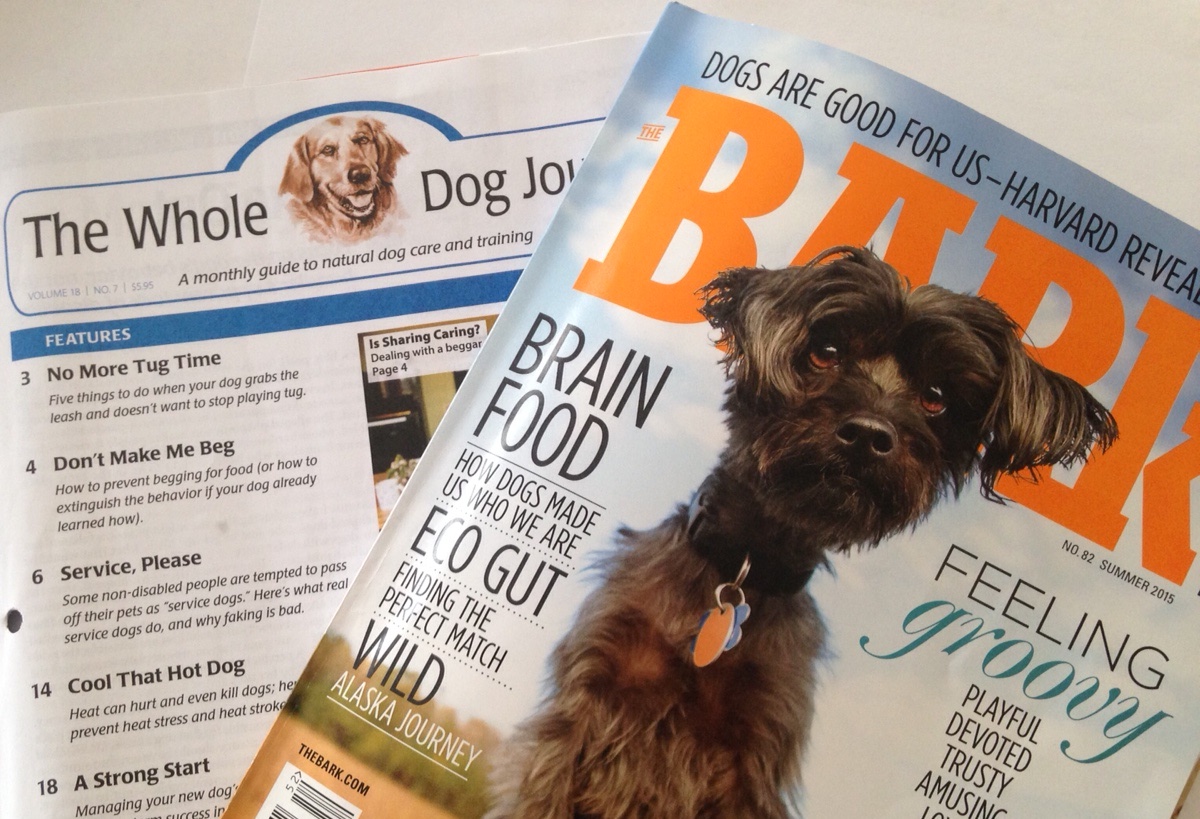
Save your $18 ($20 for a print copy); better yet, spend it on a subscription to Whole Dog Journal  or Bark. One issue of either of these outstanding dog magazines offers more, and more current, information than this second-rate report.

Note: A longer version of this blog post is published on Barks from the Guildthe blog of the Pet Professional Guild, where I am a monthly contributor. 


The Price of Being a Hero

Cali had a terrible, horrible, no-good, very bad day.

It all started in the evening, when, as Cali sees it, her mom attacked her with a machete, leaving her paw a bloody stump. It’s true that, for the first time in her life, I nicked a nail, clipping a bit too short. I saw a total of three drops of blood. Cali ran outside and sulked, then came back in and put herself to bed. She soon fell asleep, holding paws with her now disarmed, and very sorry, mom.

Then, in the morning, I faced down the stares of two disbelieving goldens as I failed to serve breakfast on time. Unable to take the pressure, I fled to the relative safety of the gym. On the way home, I got confirmation that Cali’s annual appointment for the Morris Animal Foundation’s Golden Retriever Lifetime Study would take place as scheduled.

Cali’s day was going downhill, fast.

Cali was initially delighted by the impromptu ball game when I got home … until she realized that she was being played (with). While big-sis Jana was getting breakfast.

Then, in Cali’s mind, her mom truly went nuts. She started chasing poor, hungry Cali around the yard wielding a paper plate. Every time Cali squatted, Mom shoved that darn plate in places that really shouldn’t be mentioned in a family-friendly blog. No way was Cali going to pee on that thing! They then walked up and down the street, with Mom still carrying the plate, and Cali thoroughly sniffed everything. She even faked Mom out a few times. Cali sure showed Mom, though: No pee.

Finally, things started looking up. Cali was excited that she got to go in the car with me, and Jana had to stay home with her super-duper treat toy. Hey, wait a minute …

At the vet’s office, Cali danced in, eager to see all those nice people who would ply her with cookies and tell her what a good girl she is. She got her wish: lots of attention, but … no cookies. Instead, they stuck her with needles and drained some of her blood. They cut some of her hair. And they tried to suck out some pee with a syringe, but she fixed them, too. No pee. Then she got some cookies. Finally!

Next, we got to go out for lunch. At last; something fun for Cali! Cali finally got her breakfast and a big bowl of water, and she got to say HI! to about 20 people on that patio. They all told Cali that she was a good girl. Except the one lady who said she was a good boy. A boy? With those long blonde eyelashes?

Then … oh, no! Back to the vet! Poor Cali got poked and prodded some more; the vet techs scraped off the edges of her toenails (no blood this time), gave her a shot, and finally got some pee, and the vet looked into her eyes with a very uncomfortable bright light, examined her teeth and her ears, took her temperature (she didn’t like that part at all), filled out an endless questionnaire … and pronounced her perfect. And they all gave her cookies, of course. Lots of cookies. She didn’t plan to tell Jana that part.

When we left, we took two huge packages — which smelled very much like Cali — and raced to the FedEx dropoff. Just in time. Off the samples went, to join those of 2,999 other golden retrievers who go through this exhaustive exam every year as part of the study.

Cali, along with two of her brothers, is one of the Morris Foundation’s golden retriever “heroes,” hero #608, to be exact. They’ll each give up a day every year, throughout their entire lives, as well as copious amounts of samples, so that the study researchers can try to figure out what causes cancer in golden retrievers. And other dogs. And what can be done to prevent it. From there, who knows who else Cali and the other heroes will help.

Best of all, we got home in time for dinner (and a trip to the park)!

Anticipation … Is Making Me Worry

Cali worries.

Many people worry. They dream up scenarios that could never happen. Then they worry that those unlikely events can and will happen. And they worry about what would follow … I don’t know if Cali does that, but she does worry about things that she knows are about to happen.

She worries about brushing her teeth. This is odd, because, when she was a puppy, she actually asked to have her teeth brushed, perhaps anticipating the treat to follow. She walked over to where the dog toothbrushes and toothpaste were kept and touched them with her nose. Looked at me. If I failed to notice, she nudged my hand, then walked over and touched the brush again.

Now, when it’s getting close to bedtime, she’ll go out for “last call,” then come in and immediately disappear when I say, “Time to brush your teeth,” or even move toward the bathroom. Disappearing a 60-lb dog is not an easy feat in a tiny one-bedroom apartment, yet Cali is gone. Jana comes right over to the sink, tail wagging, ready for the nightly tooth-brushing routine. I call Cali. She hides behind the bathroom door. Or I find her in the dog bed on the other side of my bed, pretending to be asleep. I’m willing to provide delivery service for the actual tooth-brushing but not for the cookie that follows. That’s only for dogs who line up to get their teeth brushed (she usually shows up for that part). Tooth-brushing doesn’t hurt. She’s never had a toothache or broken tooth or even an abscess. She likes the taste of the (chicken-flavored) toothpaste. But, somehow, when she knows that it is coming, she worries. The anticipation is much worse than the experience.

This is also the case for some other grooming tasks: Ear cleaning is admittedly as bad as she expects it to be, but getting the fur on her feet trimmed doesn’t hurt at all. It might tickle a bit, but then she’s amply rewarded with really special cookies. Nail trimming is even worse to anticipate: Both the Dremel that files her nails and that horrid clipper thingy are clearly medieval torture implements, in her view. In her entire 2 ½ years, no one has ever over-trimmed and cut the quick. Even so, no one can convince Cali that nail trimming is not worth every ounce of dread she can summon.

Cali worries about other things too. When I am working at my home computer, she catches sight of her ball and then looks worriedly at it, as if wondering whether anyone will ever throw it for her again. When we’re at the park and I do throw it, she catches it and then holds it between her paws, lying on the grass and looking worriedly around her at the other dogs who might come by and nab it. When she decides other dogs are too close, she picks up her ball and moves to a different part of the field. When no possible dog threats are near her in the park, she stretches her back legs out, ball loosely held between her teeth, and wags her tail at the activity happening at a safe distance. But she is reluctant to let the ball go for me to throw it — and start up the whole worry sequence again.

Her other big source of worry is the vacuum cleaner. It looks innocent, tucked into its little corner of the kitchen, but it sometimes roars to life. She avoids it, though she had no such fear as a puppy. When it comes out of its corner, Cali is nowhere to be found. What is her concern? She’s been around vacuums her whole life without ever suffering the smallest chance of being sucked up.

Cali’s worried anticipation, much like her eager expectation when we are driving toward a beloved location, dispels the myth that dogs are unable to think about future events. Dogs do appear to extrapolate from past experiences what the future might bring, good or bad. The best I can do when she’s nervous is acknowledge her concerns and insist that she face her fears and move on. While I hope that her anxiety is just a phase, I do wish that I were fluent enough in Dog to figure out why some future events seem so frightening to Cali.

Play By the Rules

Dogs just seem to know how to play by the rules. Ethologist Marc Bekoff makes this argument based on years of observing dogs and their wild relatives — at play. In a 2010 article in Scientific American, “The Ethical Dog,” Bekoff describes four rules that dogs use to govern their social relations: Communicate clearly; mind your manners; admit when you are wrong; be honest.

Social play helps dogs (and humans and other social beings) manage and maintain social connections. Individuals who do not play well with others often suffer in other areas of their lives. Coyotes who don’t play fairly and are ostracized when young tend to leave their family packs more than better-socialized coyotes — and they have a significantly shorter life span.

While the stakes for domestic dogs are lower — they can survive nicely in one-dog homes — there are still consequences, as anyone who has lived with a poorly socialized dog knows well. Some people cannot board their dogs or must avoid any outing where another dog is likely to appear. Some walk their dogs very early in the morning to avoid other dog-walkers.

Some people, unaware or uncaring that their dogs lack social skills, go to the park anyhow. Fortunately for Cali and Alberta, they have a big sister who’s willing to enforce the rules.

Not long ago, Alberta was happily playing with another Lab at our neighborhood park. The Lab was excited and got overly rough. Alberta, in her sweet, polite way, told him that he was being too rough. That didn’t work. She tried to avoid him, but he still didn’t get the hint. Jana had had enough. She got up and, with all of her senior-dog-dignity, approached the other dog — and gave him an earful.

After being told off by his elder, the Lab finally got the message. He apologized, and play continued at a more appropriate energy level. All was immediately forgiven.

A dog I lived with many years ago even applied the principles of fair play to human-human interactions. We were on a walk once when we came upon a group of young boys, around 8 or 9 years old. Two or three of the boys were hassling a smaller boy. Timo, all 12 pounds of him, was incensed. Though leashed, he lunged, barked, and snarled at them. Startled, the bullies ran away. Timo shook himself off and strutted home.

Most dogs learn the “rules” from their littermates, which is one key reason that puppies should stay with their siblings until they are eight weeks old. Good puppy classes are another place for puppies to acquire these all-important social skills.

Wherever your pup learns, make sure to play, and play often with him. As I’ve written, it is the best way to maintain a close bond.

Hoping for a Doggy Sequel

I’ll admit it up front: I might be just a bit obsessed with figuring out what goes on inside a dog’s mind. But many of you more “normal” dog lovers might appreciate a movie that helps by way of metaphor.

If you haven’t seen it yet, get yourself to the next showing of “Inside Out.” Stay for the credits. “Inside Out,” a summer blockbuster, is an animated movie that takes viewers inside the head of 11-year-old Riley Anderson. The main characters are her five primary emotions: Joy, Sadness, Anger, Fear and Disgust.

The metaphor should be obvious: Of course dogs experience these emotions. The real question is: How is their experience similar to (and different from) ours?

I’ve always been sure that dogs experience their own versions of joy, sadness, anger, and fear. I was on the fence about dogs and disgust for a long time, though. I’ve seen dogs eat and/or roll in many, many things that certainly trigger my disgust. Their concept of disgust, if it existed, was a mystery.

Then we offered Wylie, a fussy German shepherd, a peanut butter treat. The expression on his face: Pure disgust. He actually flinched. Then he wrinkled his nose, curled his lips, and backed away. That, and the accompanying reflexive gag, couldn’t be anything else. Peanut butter was clearly a human attempt to poison him.

Then there’s Jana’s priceless, very teenagery, eye-roll when Cali and Dora get too wild. Yep. Pure disgust: Puppies. Ick.

“Inside Out,” which I personally think is meant for adults — the best stuff goes right over the kids’ heads! — explains the necessity for and connections among all of those complicated emotions. Fear makes you pay attention: It can literally wake you up. Joy helps create the core elements of your personality. Sadness makes happy memories more precious. It can also influence your choices, pushing you to make decisions that allow you to hold onto memories — or connections — that once were joyful. Anger can make you notice injustice, or even speak out against it.

Which brings us back to disgust. A key role of Disgust, according to the movie is keeping us from being poisoned; toddler Riley is sure that broccoli will kill her. Disgust doesn’t seem to play the same role for Jana, who happens to love broccoli. She also wolfs down acorns every chance she gets, despite the cramps and upset tummy that inevitably follow. She is among the many dogs who eagerly lap up things that could (and do) poison them, ranging from antifreeze to raisins or chocolate. So I am still puzzling out what the emotion of disgust does for dogs — other than convince them that their own humans are trying to poison them.

A key lesson in the film that applies equally to dogs is the link between emotions and memory. Memories without a strong emotional component fade away, turn a dull gray, and are swept into a dump by an army of technicians in Riley’s brain. (The same guys periodically send up an annoying jingle from a gum commercial to bounce around in her head all day for no particular reason. I wonder if that happens to dogs.)

One of the ways that the other emotions kept Fear under control was by creating frequent associations with Joy. This is an essential fact for anyone with a dog, particularly a puppy, to understand. To forestall fears, dogs need frequent association of positive, joyful emotions with things that could be scary — people in hats, loud noises, balloons … Ideally, this happens in early puppyhood, before the dog hits adolescence.

But even fearful adult dogs can be helped. As “Inside Out” shows, recalling a memory while in a different emotional state can alter the emotion associated with the memory. In the movie, this is dramatically illustrated when every joyful memory that Sadness touches takes on her hue of blue … but it can work the other way, too. As trainers who advocate counter-conditioning and desensitization know, we can sometimes change fearful associations to joyful ones with careful, controlled exposure and appropriate positive reinforcement.

OK, so, why should you stay for the credits? I don’t want to give too much away, but the glimpse inside the dog’s mind is enough for me to want a canine sequel. The cat might even be better …