It’s Genetic

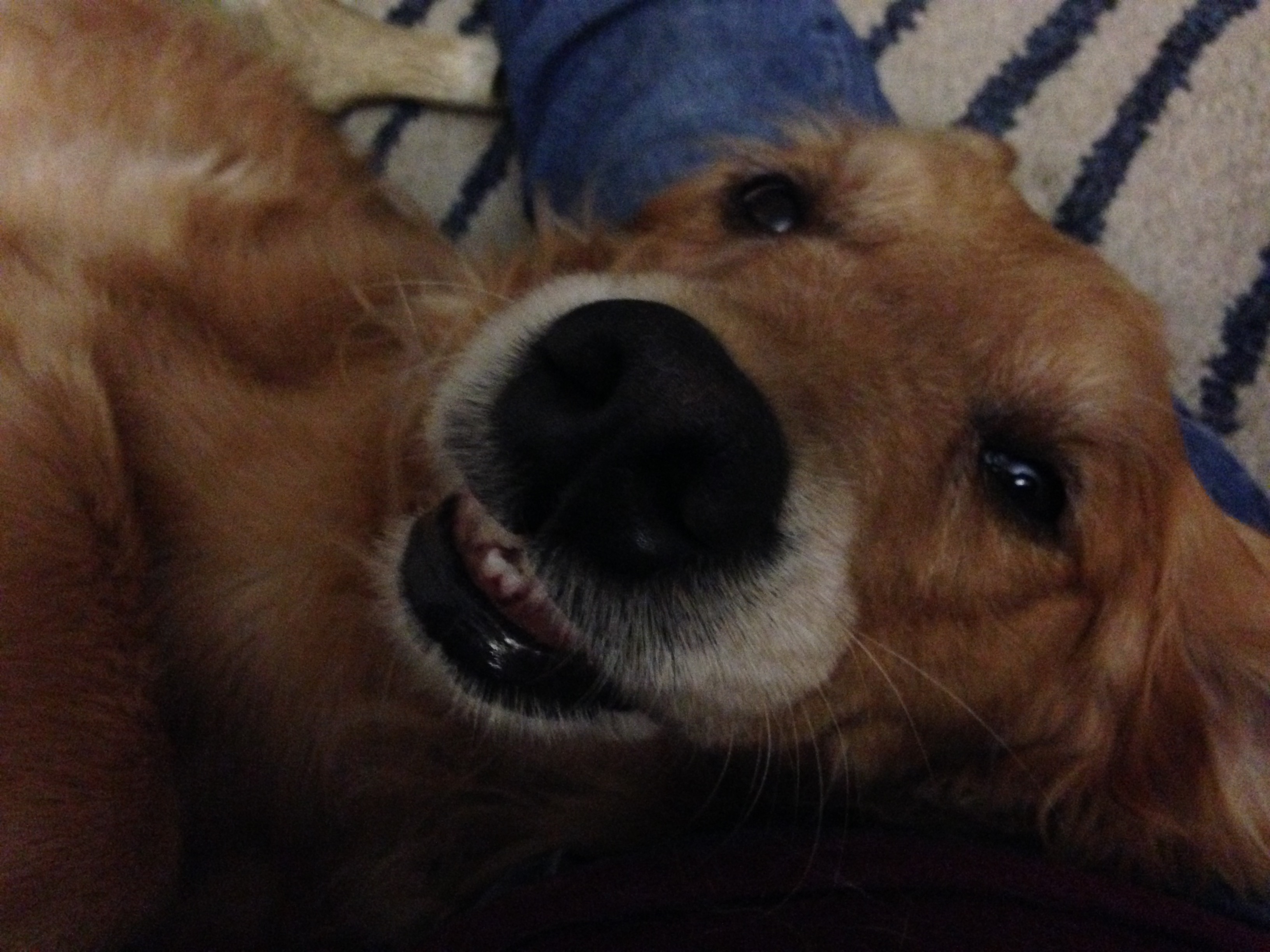
Cali relaxes on her dog bed.

People love to speculate on when, how, and why dogs and people became friends. A study published on July 19 shows that it might just be genetic.

Here’s the story. A condition in humans, Williams-Beuren Syndrome, is the result of a missing section of genetic material, a section of DNA that contains about 27 genes, according to an article in Inside Science. The syndrome affects about 1 in 10,000 people, the article says; these individuals are “hypersocial,” with bubbly, extroverted personalities, as well as some other traits.

It seems that someone else’s bubbly, extroverted personality (I’m looking at you, Cali) might be related to a similar genetic hiccup.

In the course of studies of domestication and how it has caused doggy genetics to differ from wolf genetics, Bridgett vonHoldt, the lead author of the study, tested the friendliness of dogs and 10 hand-raised, tamed wolves. They measured how much time the dogs and wolves chose to spend in close proximity to humans and whether they worked at a challenge or sought human assistance. Predictably, the dogs both spent more time with the people and sought their help in solving the puzzle. Dogs do enjoy having staff.

However, the results had some variation, and in looking for reasons that some wolves were more sociable than others, the researchers found a clue: The genetic area that showed differences in the more- and less-social wolves corresponded to the genetic area that is missing in people with Williams-Beuren Syndrome. Friendly dogs and wolves had similar genetic variants; unfriendly wolves had genetic variants similar to each other and different from the dogs and the friendly wolves.

The researchers looked deeper. They examined the corresponding genes in dogs from 13 breeds. Breeds known to be friendly had profiles similar to the friendly members of the initial research group, while breeds known to be more standoffish had profiles that looked more like the unfriendly wolves. The study says that this genetic region is “known to be under positive selection in the domestic dog genome” — over generations of breeding, people have selected for the “friendly” genetic variation; these mutations are rare in wolves and even rarer in coyotes, which tend to be far less social than dogs and wolves. The same genes had been linked to friendliness in mice in earlier research.

Of course, a small segment of genetic material is not the only thing that influences social behavior. And theories about the domestication of wolves abound. But evidence is accumulating for a theory that basically says that that wolves chose to hang out with early humans. The friendlier, or less timid, wolves started scavenging near human camps and trash heaps. Over time, young pups and friendly adults inched closer to actual contact, until a great partnership was formed.

I have always been skeptical of the various human-centered narratives that had humans capturing and holding captive and bending to their will fierce wolves, all thousands of years before humans had metalworking abilities and tools that would make it possible to hold onto a wolf who didn’t want to stick around. I doubt that those unfriendly wolves, even the hand-reared ones, would stay put if tied to a tree with a leather strap. There had to be something else going on.

That the roots of friendship could center on food makes sense (again, looking at you, Cali). But even that explanation is not enough. While dogs and wolves are opportunistic — which means they will eagerly take advantage of opportunities to help themselves to a snack — early  humans were unlikely to have huge quantities of extra food available to just hand out to large-toothed scavengers skulking on the periphery of camp. On the other hand, if the scavengers were friendly and potentially useful …

An explanation that includes a choice on the part of the wolves, or at least some wolves makes more sense than the whole deal being human-instigated and controlled. And, as more people study the human-canine connection, more bits of information point to dogs playing an active role in establishing a mutually beneficial relationship with people, like this suggestion that some wolves were genetically inclined to be friendly and seek human company.

An additional reason that this study could be important is that researchers have long sought genetic explanations for complex behavior; this could be an important first step.

None of that really makes a genetic mutation a truly satisfying explanation for that waggy tail, wriggly, “let me show you my toy” greeting I get at the door … but the bottom line is, the dog-human friendship is pretty wonderful. If that’s where it started, well, I’ll take it.
 

Bit by Bit

Her motto is “don’t fence me in”; she needs a reliable recall!

For a little over a year, I have been writing for an online “magazine” that covers online learning. Some of my articles touch on various learning theories and how these might be applied in “eLearning” or online training and performance support. Every so often, a source talks about “spaced learning” or “spaced repetition.” It’s funny to me that many of them think they’ve stumbled on a new secret weapon.

Spaced practice is simply practicing a skill or recalling information, maybe by taking a quiz or using flash cards, at short intervals over a period of time. It’s long been known to be effective both in the education of children (and adults) and in the education of dogs.

I first learned about spaced repetition in my first dog training classes. Particularly when working with very young puppies, we paired very short training sessions with spaced practice on the same set of skills. Hmmm, did we also discover microlearning, another current hot topic in eLearning? Maybe so.

Microlearning — very short lessons — certainly worked with our 4-week-old puppies. Two five-minute sessions a day (even one, if we got busy) were enough to teach one puppy I worked with about 15 cues by the time she was 10 weeks old. I’ve used the approach, with great success, with dozens of other puppies and adolescent dogs, but my training skills are becoming rusty from disuse.

I’ve been thinking about both microlearning and spaced learning for two different reasons this week.

One is a conversation I had about a friend of hers who wants to train her dog to help her with some aspects of her MS. The dog already has some foundational skills. The friend, due to her MS, has limited stamina and would only likely have enough energy to work with her dog for a few minutes a day. I found myself telling my friend that that was not an insurmountable obstacle. If she were able to spend a few minutes a day practicing a skill, the dog could learn it very well.

The second reason is my own lapse in spaced practice. When Cali was a puppy, I was very diligent about practicing her recall and working on her willingness to accept grooming, especially handling of her feet and nails. I did everything by the book, practiced almost every day, sometimes two or three short sessions. Cali was a great student. Then life got in the way and I stopped practicing. She now has a mediocre recall and hates having her feet handled. Great.

I know that I can find five minutes a day to work with Cali, and I know that, with the right treats, her recall could again become speedy and eager. That matters here in Montana, where there are many places that Cali could run off-leash.

I’m less sure about the feet, but I could probably get her to be a little less skittish and a little more cooperative. It’s certainly worth a few minutes a day to try. I have a new bag of very desirable treats; maybe I will use them for some remedial training. Wish us luck!


It’s Teaching, Not Training


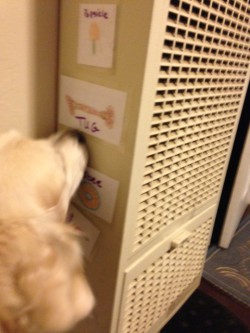
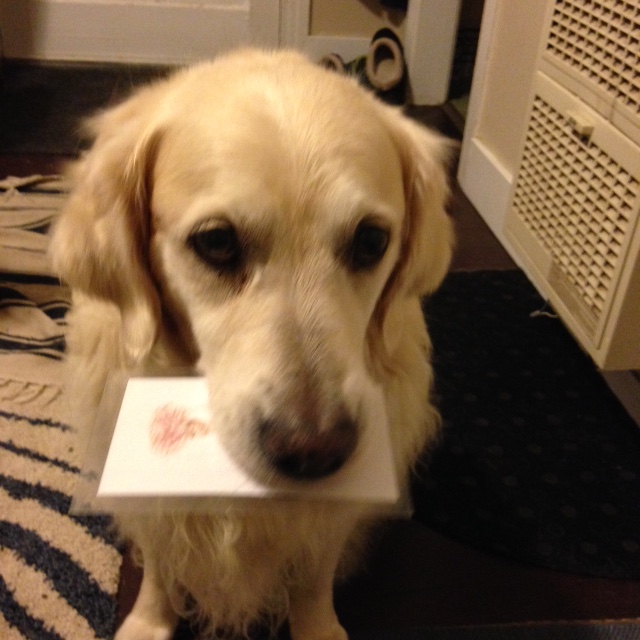
Jana peruses several cards, then chooses "tug," asking to play tug.

Someone whom I admire greatly, though I have never met her, wrote a wonderful column a while back. It was emailed to me recently, and I’d like to bring it to readers’ attention. She describes an approach to educating dogs that she calls “Non-Training.” I’ve called this “Cognitive” dog training.

Whatever you call it, the idea is the same: Treat the dog as a partner and student, not as a robot who must obey.

It is a positive, motivation-based approach to teaching dogs that relies on their intelligence and problem-solving ability — not rote memorization of specific, inflexible responses to commands barked at them by an “alpha” human.

It starts with giving dogs choices. Teaching dogs a simple “yes” or “no” response is pretty easy. You can use your hands or ask the dog to do a different response, such as raise a paw or nose your knee. It’s up to you (and your dog) what response works. But once the dog gets the concept of a choice, the sky is the limit.

You can ask your dog whether she wants to go out, wants water, is hungry (use caution if you have a Lab or a golden!), wants the ball or the tug toy, wants a walk or a ball game, wants to rest, is hurting somewhere … Really, as in so many areas of our relationships with dogs, the limitations are imposed by our lack of imagination, not the dogs’ lack of ability or willingness.

Cognitive training goes beyond simple choices, though. It is about teaching dogs to think and solve problems, rather than waiting for us to tell them what to do. It is about shared goals, rather than humans ordering dogs around. It is a dramatic re-imagining of the human-dog partnership. It requires letting go, once and for all, of the idea that dogs “have to” obey humans, just because we have thumbs, or that they do stuff for us out of unconditional love.

A relationship with a dog is just that: A relationship. It takes work, mutual respect, a two-way avenue of communication that acknowledges what each contributes and what each needs from the other.

I won’t go so far as to say that it is or should be a completely equal relationship. Sometimes — often — the human gets to make the decisions. Much as some people loathe the comparison, it is like parenting in that way. The adult human is in charge, but that doesn’t mean there’s no room to respect and encourage the dog’s (child’s) individuality, allow for expression of preferences, and allow the dog to make choices when appropriate.

I encourage you to read the column, “Teaching Your Dog to Say Yes or No: The Art of Non-Training.”


Where’s Cali?

Cali hides in tall grass

Cali has started a new game. When she doesn’t want to leave someplace (Jacob’s Island Bark Park in Missoula, for example), she hides. She’s really good at hiding, too. See if you can spot her in the photos.

I could get angry with her, say she’s misbehaving, that she’s a willful adolescent. I could also admire her intelligence, strategizing, and ability to read my intentions.

It takes a lot of thought and awareness to hide. Her ability to do so shows that she can think about what I can see and figure out where she can go that I won’t be able to see her. She can anticipate going home, decide that that’s not what she wants, and come up with a way to foil my intentions. She can plan and decide not to respond when I call her, and she understands that she has to be very still so I don’t see or hear her moving.

Cali hides deep in some thick bushes

She has to get the timing right, too. She wants to avoid going home, but it would be self-defeating to hide while I was still willing to play ball with her. So she has to read my body language carefully, in addition to parsing the verbal cues I give her. Finally, she also has to know when to resurface so as not to be abandoned (this would not happen, but how can she be sure of that?) or really get me angry.

A few days ago, she hid at the dog park. I might’ve very foolishly muttered something like “we need to get going” before throwing her ball. She took the ball, ducked under a branch, and disappeared. I called her. Nothing. I waited for about 10 minutes, then called some more. Nothing. I was pissed off. I had seen where she entered the bushes, and I went in after her. She was happy as can be, under some bushes with her ball. I grabbed the ball. That got her attention. We walked back to the car with me giving her an earful about what a terrible dog she was, bad to the bone. She laughed.

Then, the next day, she hid in a friend’s garden. I left her there (with the friend) and figured she’d have a nice afternoon in the grass, playing with dog and human friends. She did, but my friend reported that Cali cried when she realized that I had left. She recovered pretty quickly, though, and had fun; my friend also reported that Cali had a fence-fight with the next-door-neighbor-dog — which Cali instigated. But that’s a problem for another blog post.

I’m not really sure what to do about this new trick. I could just not take her to the dog park, but that’s a terrible solution. I don’t think that telling her to “come out right now or we won’t come back tomorrow” would work. She’s smart, but that is probably too abstract and verbose for her. I could punish her when I find her, but that would only motivate her to do a better job of hiding. I could keep her on a long leash, and risk getting it tangled in trees, picnic tables, other dogs …

She hides with her beloved tennis ball, and when she has her ball, she’s not interested in treats, so stooping to bribery is out. I could just wait her out, but I am not sure that my laptop battery would outlast her, and I do need to work.

Deni suggested letting Cali keep her tennis ball with her when we leave the park so that she’s not worried about losing it. In the apartment, all the time. Ick. Cali loves her tennis ball so much. She is happiest when it is really dirty, so she gets is all drooly and wet, then rolls it in dirt. Sometimes she digs a special pit just to make sure it gets totally covered in really fresh, dirty dirt. I’ve generally not allowed her to have the ball inside. If I get desperate enough, maybe …

Anyone have a better idea?

Too Hot for Dogs!

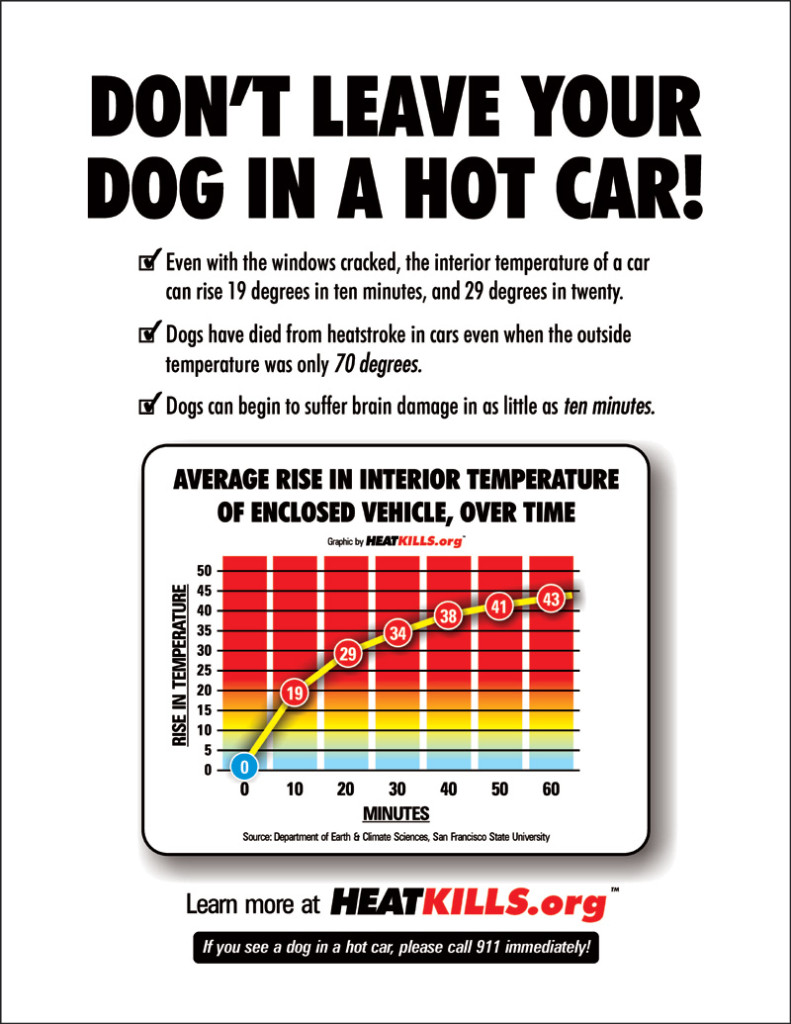
Graphic image showing how quickly a car can heat up on a hot day from heatkills.org
Downloaded from Heatkills.org

It has been in the 90s pretty much every day since we got to Missoula, Montana, our new home. If it’s this hot here … well. Dogs everywhere are suffering.

I know I don’t have to remind readers not to leave a dog in the car for even a minute in this heat. No way, no how, it is too hot for that.

But what about walking them?

Hot pavement can burn pads and paws. Sand, dry stiff grass, seeds, etc. can poke and scratch. Hazards are everywhere.

When the temperatures are in the upper-80s and above, the sidewalk can get very hot. You might not notice it through your shoe soles, but think carefully about where you ask your dog to walk. This is a huge concern for service dogs, since they are more likely to be out an about in any weather than pets. What to do?

First, avoid blacktop. Let the dog walk on grass or dirt wherever possible. Gravel gets hot, too. Light-colored sidewalks are better than asphalt, but in this heat, they will be hot too. If it feels hot to your feet or the palm of you hand, it’s uncomfortable for the dog. Let the dog stay home if possible. Or walk early in the day, before the sidewalk gets hot.

A recent discussion on a service dog email list settled on two possible solutions for dogs who must go out on hot days: booties and paw-protecting cream.

The best booties, the consensus is, are these: Ruff-Wear Grip Trex. Guiding Eyes for the Blind recommends them, too. These are more suitable than regular dog boots because they have a breathable mesh top. Even so, booties are not an ideal solution. They can be hard to put on and take off, which is an issue for many service dog partners. In addition, and possibly more critical in this heat, is that dogs need to sweat through their paw pads to cool off. These booties let some sweat evaporate, because they have that mesh top, but I still worry that the rubber sole will interfere with the dog’s ability to cool off. If you use them for short outdoor walks and remove them as soon as you get indoors, they are probably a great solution. If your dog tolerates them … and that is the final objection: Most dogs hate booties. Some people begin conditioning very young puppies to wear socks or booties, and they might have some success. Some dogs are just OK with stuff on their feet. But most dogs? Not happening.

So option two, which is also an option for winter, might be a better choice: Musher’s Secret. I just got some. It’s easy to apply, and seemed to absorb very quickly. Cali didn’t object at all, and she really isn’t crazy about having her feet handled. One review I saw online said Musher’s Secret helps dry, cracked noses heal, too. I have noticed that Cali’s nose and feet are dry and rough; I hope this helps get them back to a healthier state. Many online reviewers love Musher’s Secret; a small minority hate it. Stay tuned for a report on the state of Cali’s nose and toes.

Other ways we’ve dealt with the heat? I got out the wading pool for Cali, Mack, and Alberta the other day … and they all ignore the cool water and wondered why I had dunked their favorite toys. Silly girls. Yesterday, Cali finally got to explore Jacob’s Island, a dog park in the middle of the Clark Fork River in downtown Missoula! How great is that? A sandy-legged, smiling Cali was led reluctantly from the park after a spirited splash in the river with a young Lab mix. We’ll need to do that more often!

Lessons from the Original Thinking Dog

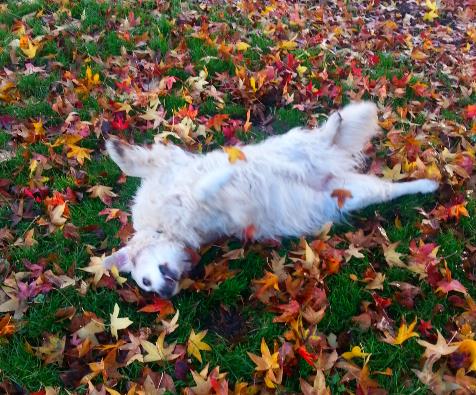
A happy Jana rolls in leaves on a lush lawnI had hoped to be celebrating Jana’s 14th birthday today, July 2. Instead, Cali and I have moved to Montana without her; we marked her birthday with a walk to a place she loved, Mormon Creek. We were with Koala, Storm, Ki, and Django. Quite a few dogs are missing from this group.

Rather than dwelling on the sadness of missing Jana, Ory, Weizer, Gus, Cedar … I am thinking about some of the most important things I learned from Jana during our years together.

Before I met Jana, I knew that dogs were smart and could start learning just about as soon as they opened their eyes. Even so, Jana astonished me.

A very young Jana studies her Kong toy.
Jana was a young Kong addict

I met Jana when she was only about 4 weeks old — not long after she opened her eyes. She came home at 7 weeks and started learning things immediately. First, of course, she learned about treats; that took about 2 seconds. She never met a treat toy that could keep her from her food for more than a few minutes.

As a puppy, and even an adolescent, Jana was an easy dog to live with. For instance, though she was the first puppy I housetrained, Jana learned to toilet outside almost immediately — she was a very clean dog in that way — and she quickly developed a strong preference for grass. She was never destructive as a puppy, though she was always vocal when displeased, starting with my initial (failed) attempt to crate train her.

Very quickly, Jana learned about stairs — mastering them when I left her downstairs and ran up to grab something. Not 2 minutes later, I walked down the stairs to find my tiny puppy hoisting herself up the huge staircase. Though she ultimately learned to accept boundaries and would respect even so flimsy a barrier as a partially closed door, she also wanted to be with me. As a young puppy, this manifested first with the stairs and later, with her flying leaps over the baby gate that was meant to keep her safely enclosed.

And Jana quickly learned to respond to verbal cues — so many that I can’t list them here. She picked up new skills so fast that I had to work hard to come up with new challenges. She would do anything, figure out anything, solve any problem for the chance to earn a cookie. Watching her was amazing. I could see the gears turning as she tackled problems and figured out the names of items she was asked to retrieve, what the laser pointer was indicating for her to do, how to brace herself on a door jamb to pull open a door, how to extract treats from the very small hole on her treat toy …

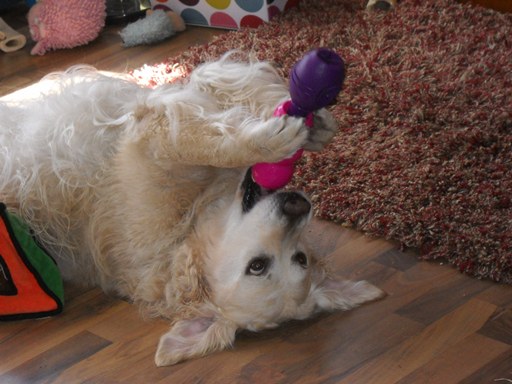
Jana lies on her back to squeeze treats from a toy into her mouth

Jana’s intelligence accompanied her fierce independence. Thus, I also learned from Jana that her agenda and priorities might often be misaligned with mine, and having opposable thumbs did not mean that I always got my way. We learned to negotiate, compromise, and respect each other’s differing perspectives. For instance, I was forced to accept her definition of cuddling: Sharing space, perhaps on the same bed, more likely in the same room. Limited physical contact on her terms only. Jana was not like the typical golden; she needed few friends, but if you were a person she’d decided she liked, you had a friend for life. Her chosen people got very warm greetings, and Jana actually chose to spend time with them, even seeking them out. The best compliment was being invited to play a game of tug.

The truth is, Jana and I shared a lot, and I could fill books with what I learned from her. I know that she had a great life, and I am grateful that she had a dignified, relatively quick and pain-free death, but I still miss my princess every day. Happy birthday, Jana.

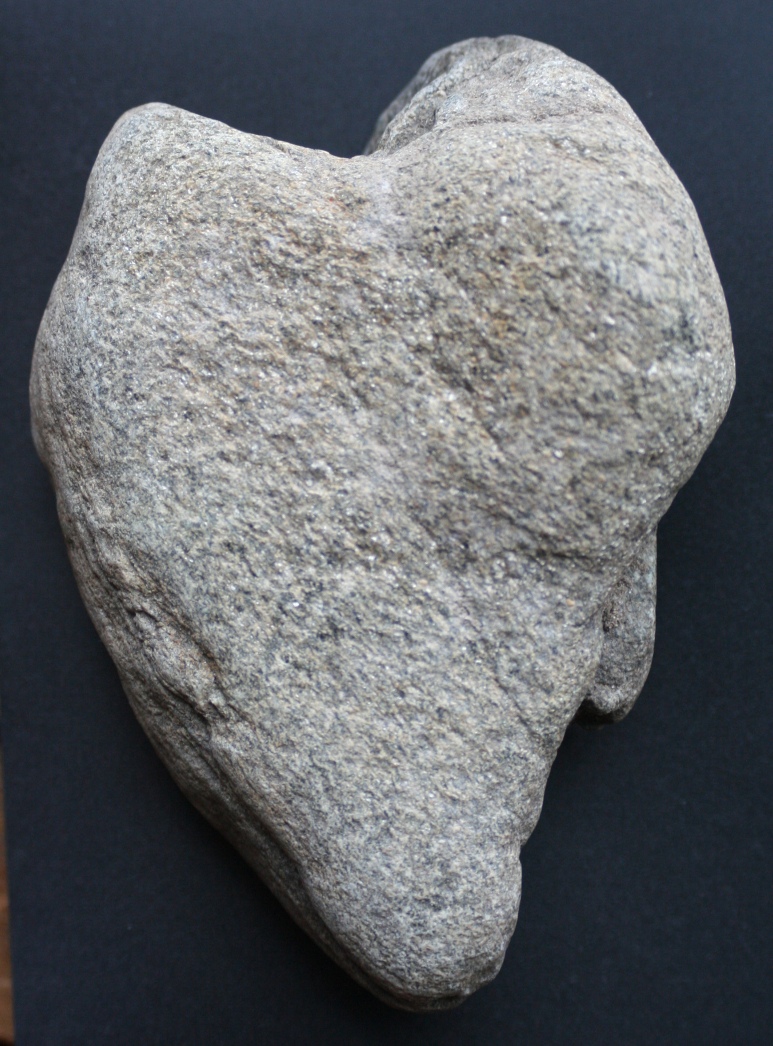
Jana had a knack for finding large heart-shaped rocks; here is one from her collection


Martin Speaks for “Everydog”

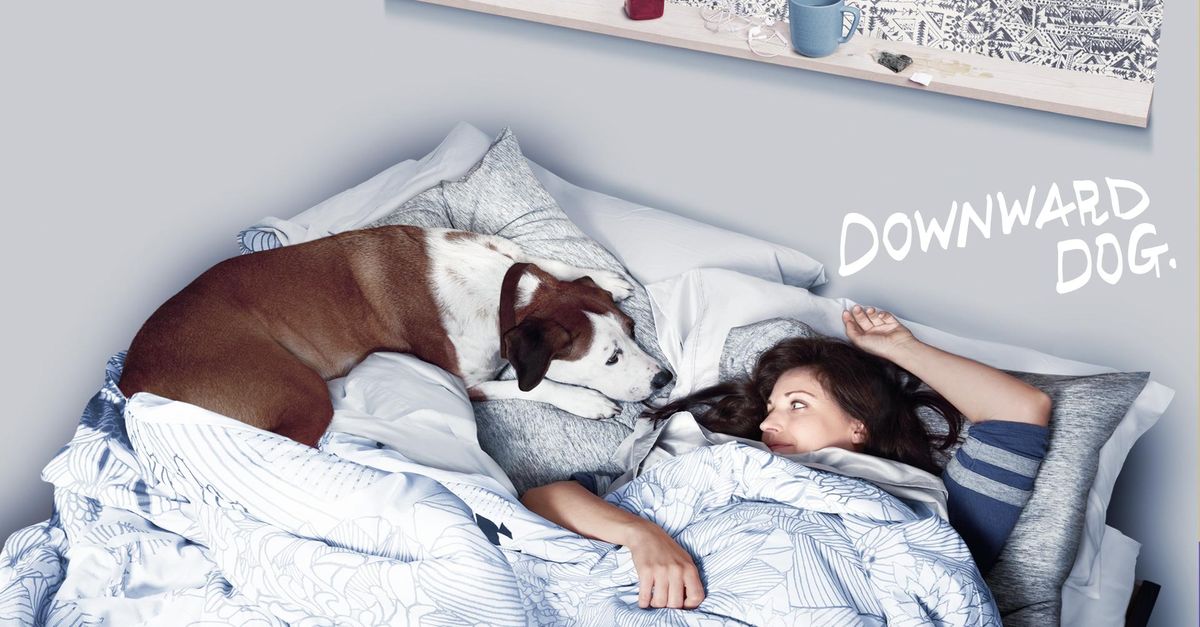
An ABC promotional image for “Downward Dog”

If you’re not watching ABC’s “Downward Dog,” you should check it out before it disappears. (ABC just announced that the show will be canceled after its seventh and eighth episodes air this week.) Martin, the narrator, does a pretty good job of capturing the cynomorphic take on the human-dog relationship. That’s the dog’s point of view.

Martin, a medium-sized mixed-breed dog, shares a home with Nan, a single woman with a demanding advertising career, an unreasonable boss, and a frustratingly immature and undependable on-again, off-again boyfriend. Martin chronicles the ups and downs of their relationship and his days.

While he might not speak for every dog in every instance, a lot of what he says rings awfully true: His assumption that Nan drives around all day in her car and his inability to understand why she’d want to do that without him; his hurt when he finds out the truth. His certainty that he has super powers when he can make the automatic dog door open (one of our dogs seemed to have the same take on it; the others either thought it was magic or just another way the lazy human staff tried to get out of doing their jobs; Cali thought a trainable ghost ran things). His conviction that he makes the rules in the relationship and sometimes has to show Nan who’s boss — by chewing up an Ugg boot.

One of my favorite parts so far is Martin’s soliloquy on why he is compelled to eat trash. I could just see Jana, my ultrafeminine princess who loved to roll in dead things, nodding in agreement. Sometimes, a dog’s gotta do what a dog’s gotta do.

The show doesn’t get everything right. For instance it leans too heavily on the assumption that, in a dog-human relationship, someone has to be “dominant.” And Nana’s character embodies way too many clichés about single women. But, though Martin is self-involved — like many dogs — he’s a lovable guide to the dog’s world.

I’ve spent years trying to understand how dogs see our relationships with them; I’ve tried with mixed success to teach students to consider the many angles and nuances of life with dogs from the dogs’ point of view. If I were teaching those students now, I’d use the eight episodes of “Downward Dog” as an imperfect but enjoyable presentation of one dog’s unique perspective.

Two Rude Jerks Go Out For a Walk

As Cali and I were walking to the park, we saw a woman with a small terrier-looking dog. I said hello and she did too. Cali was taking a long sniff of the grass near some trash bins, so I moved aside to let them pass.

As we walked behind them, I noticed that the little dog kept picking up his rear right paw. He had impeccable leash manners, which means that the woman wouldn’t be able to see his back paws, since he was walking right next to her (paying attention, Cali?). Also, despite a lot of rain this winter, dry season has arrived. Stiff grass stubble is everywhere, as are foxtails. Cali comes home from walks full of tiny burrs. In other words, prickly things that could easily get embedded in a paw are everywhere.

So I said to the woman, “Your dog is picking up his paw; he might have something stuck in it.”

Her reply: “I’m a good pet owner.”

Is it me or was that an oddly hostile and/or defensive response? Quashing the impulse to say something defensive in return, I said, “I thought he might have a thorn or something in it. That happens to my dog a lot around here.”

She softened a little, I think, and told me that her dog has a congenital knee problem and that’s why he does that.

But, really, is the assumption that I am criticizing your parenting the go-to response for most people? That’s a sad comment on society.

Or maybe it is me. Because, a few blocks later, we encountered another dog walker. As I tend to, I detoured into the street to avoid passing close to an unfamiliar dog on a narrow stretch of the sidewalk. The other walker said, two or three times, “He’s friendly.”

When we were closer, I said, “My dog is nervous around unfamiliar dogs.”

All perfectly normal … except the implication that I was assuming negative things about her dog. Do I radiate an air of disapproval and judgment? (Please do not answer that question.)

The last encounter in this bizarrely social morning was at the park. This time, Cali was the jerk, running off an overly friendly poodle who showed too much interest in her ball. The joke was on Cali, though, because, while she was running him off and then I was reprimanding her, Maui, a dog Cali used to consider a friend, actually stole her ball. We beat an embarrassed retreat before she could challenge Maui to a duel.

I am going back to 7 a.m. walks; the park is empty and the other dog walkers are also trying to avoid dog encounters. That all makes it easier to avoid offending the entire dog and dog-owning population of Petaluma.

Hero for a Day

No breakfast is always a bad sign.

Cali pokes me hopefully with her nose. Remember me? I’m hungry. I hug her and apologize. It’s your Morris Study Day, I tell her. I promise her a really good breakfast after the exam.

We head to the vet. For once, everything goes smoothly. No traffic (!). They take Cali immediately. No emergency comes in to delay taking the endless samples — the usual stuff, plus blood, fur, toenails. I assure the vet that I have not touched Cali’s nails since her March grooming. Her nails are always so short that it’s hard to get a sample. This year, at least her dewclaws are long.

As we’re talking, I realize that I completely forgot to collect samples on our morning walk. Not a problem, the tech reassures me. We’ll get them. I tell Cali she’d better poop for them. You can’t get out of here until you do, I tell her. That means no breakfast until you poop. She poops. She eats lots of treats. In fact, she’s done in an hour. Hooray!

Cali has breakfast. We play ball for a few minutes. She’s fully recovered. She also gets a special treat at dinner (sardines). Definitely recovered.

But every year, I wonder: Is this process OK with her? She’s happy but also a little nervous at the vet clinic. She’s been clingy since Jana died several months ago, and at the vet’s office, she “ups” on my lap and snuggles in. Sweet, but also a sign that she’s not comfortable, mildly stressed. At this vet office, the techs collect samples “in the back,” — away from my sight. I trust them; I know they are not hurting Cali any more than necessary to get a blood sample or clip her nails. But she’s nervous; she hesitates for a second before running after the tech who’s leading her away.

Every year I go over and over this in my head. It’s not that different from a regular exam, which I would do every year even if Cali were not in the study. The study is collecting a huge amount of data that might point to ways to reduce canine cancer. That is a big deal. I believe in what they are doing. I trust the vet and techs at this clinic. Is all of that enough? I decide it is.

But what does Cali think? She’s so easygoing and forgiving that she seems to just shake it off. She enjoys the extra attention and treats both at the clinic and once we get home. But her nervousness haunts me.

The Morris Animal Foundation Golden Retriever Lifetime Study started enrolling dogs shortly before Cali was born (she’s four and a half). The oldest dogs who were eligible were two. That means that none of the 3,000 “heroes” are older than seven. Some have already had cancer; some have already died. This study matters. I know too many golden retrievers and other dogs who have had cancer, including some very young dogs. The study looks at genetics, exposure, diet, lifestyle. We (the human participants) fill out a very detailed questionnaire every year. What we feed our dogs, including occasional treats and supplements. How much exercise they get. What they’re exposed to: Pesticide? Secondhand smoke? It’s all in there.

The research team will have an enormous amount of data. I am looking forward to seeing what they find. I hope they look at other things besides cancer and that they release information about what they’re seeing already, about five years in.

But so far, after Cali’s fourth visit, I find myself wondering more than ever what she thinks of it all.

It’s All About Strategy

I recently wrote about how Koala uses tools, using a round chew toy as a base and holder to position a more desirable chew (an antler) for better chewing. But there’s more to her entertainment strategy than tool use.

Although she is a two-and-a-half-year-old working adult, Koala still gets puppy lunch. This is a point of contention in the family, because Jana thought she should get puppy lunch forever (but I did not agree), and Cali thinks, not unreasonably, that if Koala gets puppy lunch, she, too, should get puppy lunch.

What is puppy lunch, you ask. Large-breed puppies, because they are growing quickly, get three meals a day. Adult dogs, who only grow wider, get two (and in some cases, one!) meal a day. Puppy lunch is the mid-day meal that goes away when a dog is about a year old. Unless she’s Koala.

The first puppy-lunchless day is a day of infamy and trauma in the lives of goldens and Labs everywhere. Jana never really recovered.

Koala’s puppy lunch is a portion of kibble, served in a treat ball. The ball gets rolled and batted around, dribbling bits of food for Koala to munch. It’s fun. I have several treat balls, and sometimes give Cali food in one. She gets bored with it far more quickly than Koala, partly because she’s less food-focused. But Koala really enjoys her mid-day snack-and-play breaks.

All of that background offers the context for Koala’s strategic play approach. I was watching her eat her puppy lunch not long ago and I saw her using a fairly sophisticated tactic. We were at a hotel (at the Guiding Eyes weekend, actually) and the room had a dresser, sofa, bench, bed, etc. Lots of places a ball could roll out of reach. Koala is an exuberant dog, never more so than when playing, so the ball was getting batted around at a good clip. But it was not uncontrolled ball batting. She’d pounce, roll the ball, whap it with a paw … but always, always keeping track of the many sand-trap equivalents. Never once did she let the ball roll under or behind something. She’d pounce on it or bat it just in time, sending it in a different direction. She almost seemed to be gauging how close it could get to the edge of the bed, say, before she’d lose the ability to steer it out of danger. She’d watch, position herself, and, bam, send it careening away toward the next potential obstacle. It only takes her about 10 minutes to empty the treat ball, so this high-stakes bowling / golf game took place at an impressive level of intensity and speed. She’s really good at this entirely made-up game.

This is certainly not the first time that I’ve seen a dog play a game that she has created. What held me spellbound was both the intensity and the advanced strategy. She had an intuitive understanding of a fluid situation. Much as dogs do when they catch a Frisbee or dive into a river at the precise moment needed to grab the ball or stick as it floats by, she showed a far better grasp of physics than I ever could.

The geneticist at Guiding Eyes says that each generation of their dogs is “better” — smarter, more suited to guide work, healthier — than earlier generations. If the dogs get any smarter than Koala, we won’t need to worry about robots taking over our jobs; the dogs will beat them to it.