What’s OK When Puppies Play?

I’ve accompanied friends with young puppies to puppy play sessions several times over the past few months. (Playing with puppies and then sending them home with someone else is the best …)

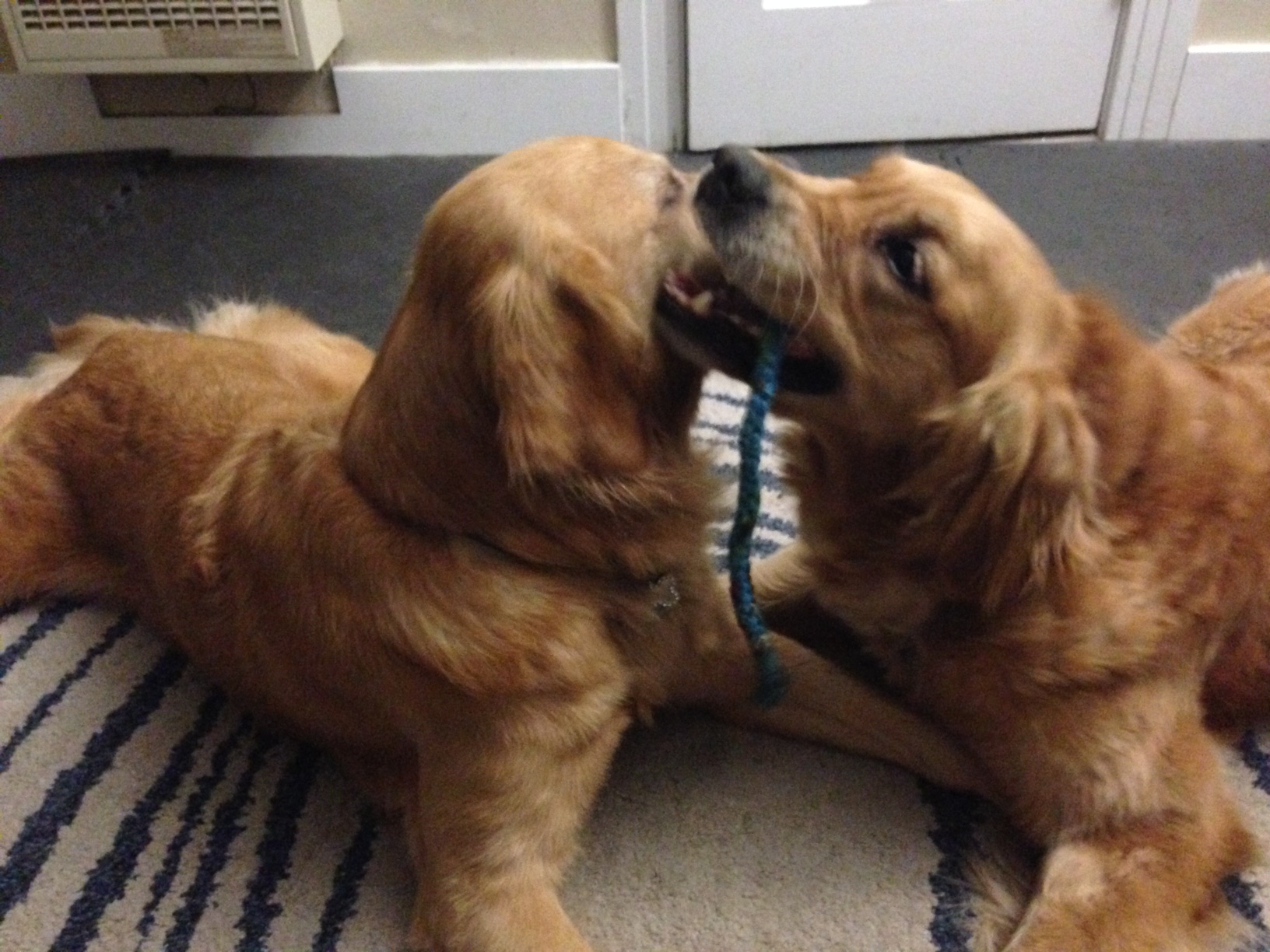
Puppies often play in ways that seem rough and scary to their doting parents. Those other puppies might hurt Precious, the new owners fret.

Relax. Puppies are pretty sturdy. They also tend to be quite vocal if another puppy is too rough.

Great puppy play includes:

  • Lots of chasing. One puppy leads off and others chase her. Within a few seconds, the pair or group change direction and another puppy is in front. When to worry? If only one puppy is chased (same for adult dogs) or if the chasee seems to want to end the chase and the other dogs ignore the signals. If too many puppies or dogs are chasing a single dog and seem intently focused on that dog. Good chase is fluid, not targeted at a single puppy.
  • Lots of wrestling, mouthing, and tugging. Yes, puppies have nasty, needle-sharp teeth. All the more reason to let them practice biting — and inhibiting their bite — on each other, not on our arms and hands. They let each other know what hurts and when to back off. This is one of the primary reasons why new puppy owners should insist that their puppy stay with his litter until he’s 8 weeks old. Sure, they’re weaned and yeah, the breeder might be pressuring you to take your puppy home. But those few weeks (with teeth) of play with littermates are essential to teaching initial social skills and bite inhibition. Single puppies and those taken from their litters at 6 or 7 weeks, which is way too common, are at a serious disadvantage.
  • Frequent pauses where puppies check in with their people, get a drink, pee, rest under a bench … puppies who know when they need a break are smart and self-protective. Puppy owners might need to enforce breaks, though, because the little ones don’t always make good choices. Call your puppy over, give him a treat, and send him back to re-engage.

What crosses a line?

  • Watch puppies for signs of stress. A puppy that is scratching a lot is stressed, as is one who’s constantly seeking to avoid other dogs, clings to a person’s legs, hides under a bench for long periods of time.
  • Yelps signal distress. Some puppies do vocalize while happily playing, but a distressed-sounding yelp is a call for human intervention. De-escalate the play, let the yelping puppy catch her breath, then let them all play again. Puppies usually recover quickly from a minor scrape and don’t hold grudges.
  • Too much mounting and other pushy behavior. This is a fine line. Puppies do wrestle and climb on each other, and that’s fine. Puppies of vastly different sizes can play happily together. But if a puppy seems interested only in humping or pinning other puppies and is doing it over and over, or constantly seeks out a specific puppy to mount, that puppy needs a break. And possibly larger, older playmates who will teach and enforce more acceptable play rules.

Puppy play groups are a great way for puppies to work on their social skills while working off a fraction of that endless puppy energy. Don’t avoid them because you are worried that your delicate baby might get hurt — but do pay attention and intervene when needed. In fact, that guidance serves beyond puppyhood and in any situation where dogs of any age are playing together.

The Garden Is Going to the Dogs!

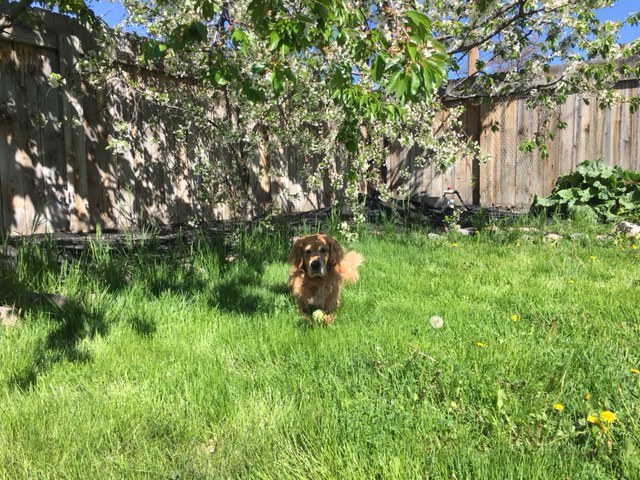
Cali, under the blossoming cherry trees, with her tennis ball.

It’s February in Montana, so reading an article about planning a “sensory garden” for dogs was a nice escape from the cold. Since Cali has staked her claim to the back yard of our house, though, and much landscaping is needed, it’s also great inspiration.

The first piece of advice is to watch how the dog uses the space — where she hangs out, where and what she sniffs. That’s easy. Cali’s favorite spot is under the cherry trees and next to the raspberries. In the summer, her favorite spot is in the raspberries, harvesting and eating as many berries as she can reach. But even in the winter, she’s most likely to be found in that corner of the garden.

Then, plan ways to enrich the garden for her enjoyment and mental stimulation. This means stimulating all of her senses.

Foremost for dogs is, of course, smell. Plant things that she enjoys sniffing. Ideally, plant several plants and flowers that will bloom and grow at different times of the year. Here in Montana, that’s a fairly small part of the year, so other senses will have to dominate in the winter.

For visual stimulation, the author of the article suggests rocks, logs, items of different heights to create variation.

To stimulate hearing, she suggests running water, wind chimes, or rustling plants. Those wouldn’t really work too well in a Montana winter either, but in our somewhat urban neighborhood, there is plenty of aural stimulation.

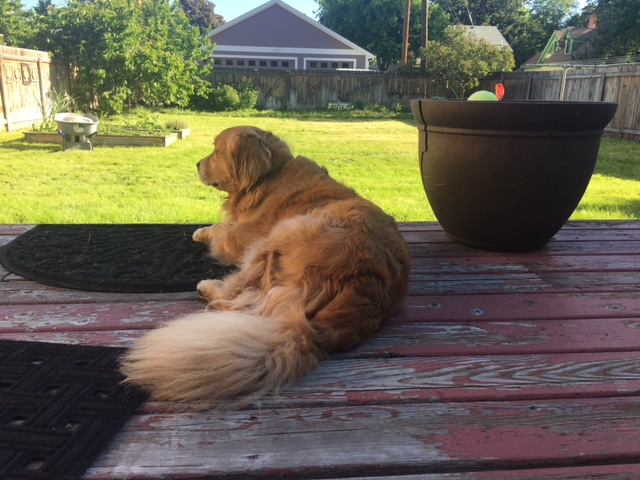
Cali surveys her yard from the deck
When not under the cherry trees, Cali enjoys her perch on the deck

Taste is a tough one. I have always discouraged my dogs from sampling the garden plants. Timo, my first dog, loved lemon verbena and once ate every single leaf from a small plant. The plant did not survive the assault, but Timo and the larger one coexisted happily for many years. As a puppy, Jana enjoyed harvesting strawberries and blackberries in our garden. Cali enjoys the cherries and raspberries in season, of course. But the suggestions of verbena, thyme, and other safe and appealing plants are worth considering.

Finally, tactile stimulation is essential. Cali loves to dig; I have thought about creating a digging spot for her in the garden. Another suggestion is using a variety of textures — grass, mulch (check and check) and paths made of stones or crushed granite, or even sand. We can definitely work more of that into our landscaping.

A final suggestion is creating opportunities for the dog to run around. When Cali has friends over, they do create a sort of circuit, looping into the cherry-tree corner and under the clotheslines.

Some other things to consider:

  • Know which plants are toxic to dogs and avoid these.
  • Use raised beds, pots, or plant borders to steer dogs away from no-go zones, like the vegetable patch. Interestingly, though Cali dug up all our baby tomato plants the day we planted them, she never bothered the vegetable gardens after that, even though she loves cucumbers, and the cukes were well within her reach. She quickly learned that the raised beds were my turf.
  • Consider your dog’s age and activity level. For some dogs, simple agility equipment or things they can climb or jump onto are a good addition.

The garden can be very appealing to humans, too. But too many yards are designed only for the people in the family. Since Cali spends exponentially more time in our yard than I do, it’s only fair to create a place she will enjoy fully!

The Marshmallow Fallacy

Deni and I were delighted that both Alberta and Koala did well on our cleverly designed doggy version of the marshmallow test — a well-known study of self-control and ability to delay gratification.

Based on hundreds of pages of research papers, magazine and newspaper articles, and books, I was convinced that the test indicated sterling character and hinted at characteristics that led to success in life; after all, follow-up studies showed that the kids in the early marshmallow tests who had showed self-restraint did have better outcomes in life in many areas.

Turns out that’s not what the marshmallow test shows at all. A much larger study, released last spring (an article about it has been buried since then among other things I need to read) shows more nuanced and interesting results. But the bottom line is, Alberta and Koala aced the marshmallow test because they had privileged puppyhoods and superior educations. (Cali’s self-restraint is, of course, due to her excellent breeding and sterling character; she grew up in a converted barn in western Sonoma County and was home-schooled.)

The new study, “Revisiting the Marshmallow Test: A Conceptual Replication Investigating Links Between Early Delay of Gratification and Later Outcomes,” as well as several other recent studies, points to socioeconomic background as a key influence on both ability to delay gratification and successful long-term outcomes like job security and ability to save for retirement. The mom’s education level was a fairly reliable predictor of the kids’ outcomes; kids whose moms had college degrees fared better throughout childhood and beyond, regardless of their marshmallow test results.

Basically, kids from better-off homes have more food security; they know that if they miss out on the marshmallow now, there will be more marshmallows or other treats later, whereas kids from lower-income homes might not get treats — or even meals — as reliably.

Since Guiding Eyes for the Blind has a wonderful puppy raising program, as well as enrichment that begins pretty much at the moment of whelping, neither Alberta nor Koala ever had to worry about a lack of meals and treats. Both of them had excellent educations, as did their parents. They were set up for success.

A dog doesn’t need to be from the elite 1 percent to succeed in life, though. As puppy parents, we ordinary dog-owning humans can set our dogs up for success, too, by offering them a predictable routine and nutritious meals on a regular schedule, training them (with lots of treats), and meeting their needs. Cali aced her pseudo-marshmallow test; your dog could ace the marshmallow test too!


Cali’s Pseudo-Marshmallow Test

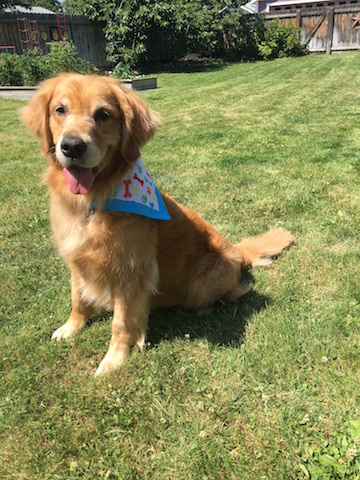
Cali, a golden retriever, smiles happily and wears a colorful bandanna after her grooming.

Cali went to the groomer a few weeks ago. Our groomer, conveniently located around the corner, has a nice antique brass coal hod in the entryway, usually filled with dog biscuits. And cleverly located at golden-retriever-nose height.

Cali beelined for the cookie basket, which had only three biscuits. She looked at them, at me, at them, etc. I gave her one, then handed her leash over to the groomer.

A couple of hours later, I returned to pick Cali up. She came out from the back and headed straight to the basket. I gave her one of the remaining cookies, and stood chatting with the groomer and paying the bill for a few minutes.

When we looked back at Cali, she was standing at full attention, chin resting on the edge of the basket, staring at the one remaining biscuit. She could easily have taken it; we hadn’t been paying close attention. The groomer even said that most dogs do, indeed, help themselves. She was impressed with Cali’s manners.

I saw that as Cali’s version of the marshmallow test, and I was pleased that she showed self-restraint and good manners. She’s not always so disciplined, but she has never taken food that wasn’t hers, and she’s generally a very Good Dog.

Cali’s Quiet Competence

This slideshow requires JavaScript.

I was in charge of puppy lunch the other day.

Puppy lunch is Deni and Koala’s name for the midday treat ball break that Koala has trained Deni to give her. The time keeps moving up; it would be more aptly named Puppy brunch, since Koala starts asking for it around 10 am, but that is a different story. Deni and I call it PL, as if Koala, and now Cali, won’t know what we’re talking about. Right.

But I digress.

Koala gets about a quarter-cup of kibble in her large orange treat ball. Cali now gets a smaller amount of kibble in a smaller yellow treat ball. Before anyone howls about unfairness, keep in mind that most dogs stop getting puppy lunch at about 4 months of age. Koala is over 4 years old and Cali is 6. Neither needs puppy lunch, but Koala has everyone convinced that she must eat multiple small meals a day to survive.

Also, Cali doesn’t seem to care. When I gave her a larger treat ball, she lost interest in it well before it was empty. Her lack of fanatical, desperate obsession with food is the least golden-ey thing about her.

They get PL in the downstairs TV / dog play area.

I’ve written in the past about how good Koala is at avoiding obstacles and keeping her treat ball from rolling under things. This large open area is easy for her. She rolls and chases the ball the full length and width of the room, vacuuming up the kibble as it falls out.

Cali has a different strategy. She takes her ball to the dog bed that is in a corner. It’s got walls on two sides and the sofa on the third. She stands in the open end, and gently bats her ball around the small, contained space. It can’t roll under the sofa because the dog bed blocks the bottom opening. This gives her a very easy way to keep track of the ball, get all of the kibble, and stay out of Koala’s zooming, looping path.

This simple strategy shows Cali’s characteristic calm, almost offhand, intelligence. She figures things out and makes the world work for her, in a quiet, unassuming way. She’s fine letting Koala’s exuberance claim the spotlight, and she doesn’t seem to mind that Koala’s treat ball fun lasts a bit longer.

It’s similar when the girls are picking up their toys (which does not happen often enough). Koala leaps and runs and bounces around, flinging toys toward the basket. One occasionally lands inside; others land nearby. She’ll toss the same toy at the basket 3 or 4 times, growing increasingly agitated — at the lack of praise and cookies from Deni. Cali, meanwhile, slowly gets a toy and thrusts it into my hand. (She and I have not worked much on putting things into the basket, for which I take full responsibility.)

Cali’s not always quiet and calm; she’s true to her golden heritage when visitors come or we meet a human, any human, walking down the street. She’s as wriggly and excited to meet a new friend as to greet an old friend. But I really do enjoy her thoughtful approach to problem solving.

You Are What You Eat

Cali, a golden retriever, licks her lips in anticipation of a treat.
Feed me!

The latest pet-food scare (as if the concern over grain-free foods isn’t enough) is that several brands of dry dog food have been recalled for toxic levels of vitamin D.

The FDA first alerted dog owners in early December, and it recently updated the list of recalled foods. You know what I am going to say next: If you’ve chosen your dog’s food from the Whole Dog Journal’s list of approved dog foods, you have nothing to worry about. They do the legwork, checking out the companies’ manufacturing process, documentation of the nutritional completeness of the food, quality control, and ingredient sourcing so you can confidently purchase any food on the list. The list includes foods in a huge range of prices and formulas, and many are very easy to find at pet supply stores, feed stores, Ace-hardware-type stores, and the like. You do not have to spend a fortune at an exclusive pet boutique to get quality dog food; in fact, many of the exotic boutique foods are of poor nutritional quality.

Vitamin D is a vital nutrient for dogs (and humans). It helps maintain the proper level of calcium and the balance of calcium and phosphorus, according to PetMD. (Read the full PetMD article, Vitamin D Poisoning in Dogs, for more details.) Too much vitamin D, though can cause vomiting, weakness, lethargy, excessive thirst, urination, and drooling — and kidney failure and death.

A Whole Dog Journal article (available only to subscribers) says that in most commercial dog foods, the problem is likely to be too little vitamin D, not too much. In addition, dogs in the same household eating the same diet can have very different levels, due to differences in how their bodies absorb the vitamin. Over time, a vitamin D deficiency can cause bone disorders, gastrointestinal issues, and some researchers are studying a possible link to immune system disorders. A blood test can measure your dog’s vitamin D levels.

The best approach is to feed a high-quality meat-based food. Suggestions from the Whole Dog Journal article include adding probiotics or apple cider vinegar to the dog’s meals; avoiding alkalizing foods like corn, wheat, soy, rice, white potatoes, tapioca, and peas; and supplementing with coconut oil. It’s hard to recommend a specific combination of supplements, though, because each dog’s diet and needs are different.

The key takeaway is that what you feed your dog matters.

It matters what you feed yourself and your family, too. But each member of the family makes dozens of choices daily about what to eat and, one hopes, over the course of a day or a week, eats a range of foods that cover her or his nutritional needs. The dog does not get to make those choices, though. He eats what you give him. The dog also probably eats the same thing every day. Some dogs eat the same food for weeks, months, even years. If that food doesn’t have what the dog needs to be healthy, there’s not much chance he’ll get it some other way. So choose your dog’s food carefully — and give him some variety by changing it up every so often.


Is Your Dog Famous?

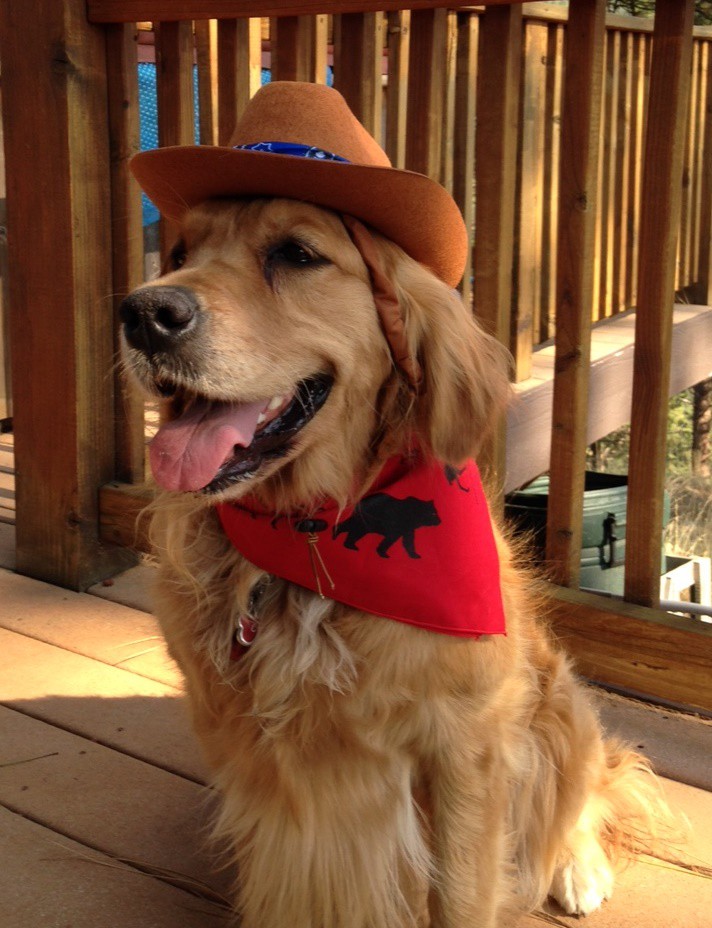
Cali, wearing a cowboy hat, smiles broadly

Is your dog an internet star? Does she want to be?

Perhaps she needs to sign on with The Dog Agency (home to the most influential animals in the world).

It seems that dogs can no longer become viral sensations without an agent. Loni Edwards, the founder and CEO, is quoted in Fast Company as saying, “We help them think about how to grow their brands.” I think she means the humans who are associated with the celebrity pooches.

She’ll advise clients (and their humans) on how to get ads, book personal (or doginal) appearances, get book deals … all the elements in becoming and remaining a pet influencer.

Not just any dog can sign on, though. She’ll only take clients who already have at least 50,000 followers on Instagram. The human also has to have what it takes.

The top influencers bring in thousands of dollars per post — not to mention the income from all those other deals.

Cali’s out of luck. I don’t even have an Instagram account (though who knows; Cali might …). Maybe we should check it out. Rugged, athletic cowdog types might be in demand. Being supported by my dog would be a nice change …

Update: Is Grain-Free Dog Food Risky?

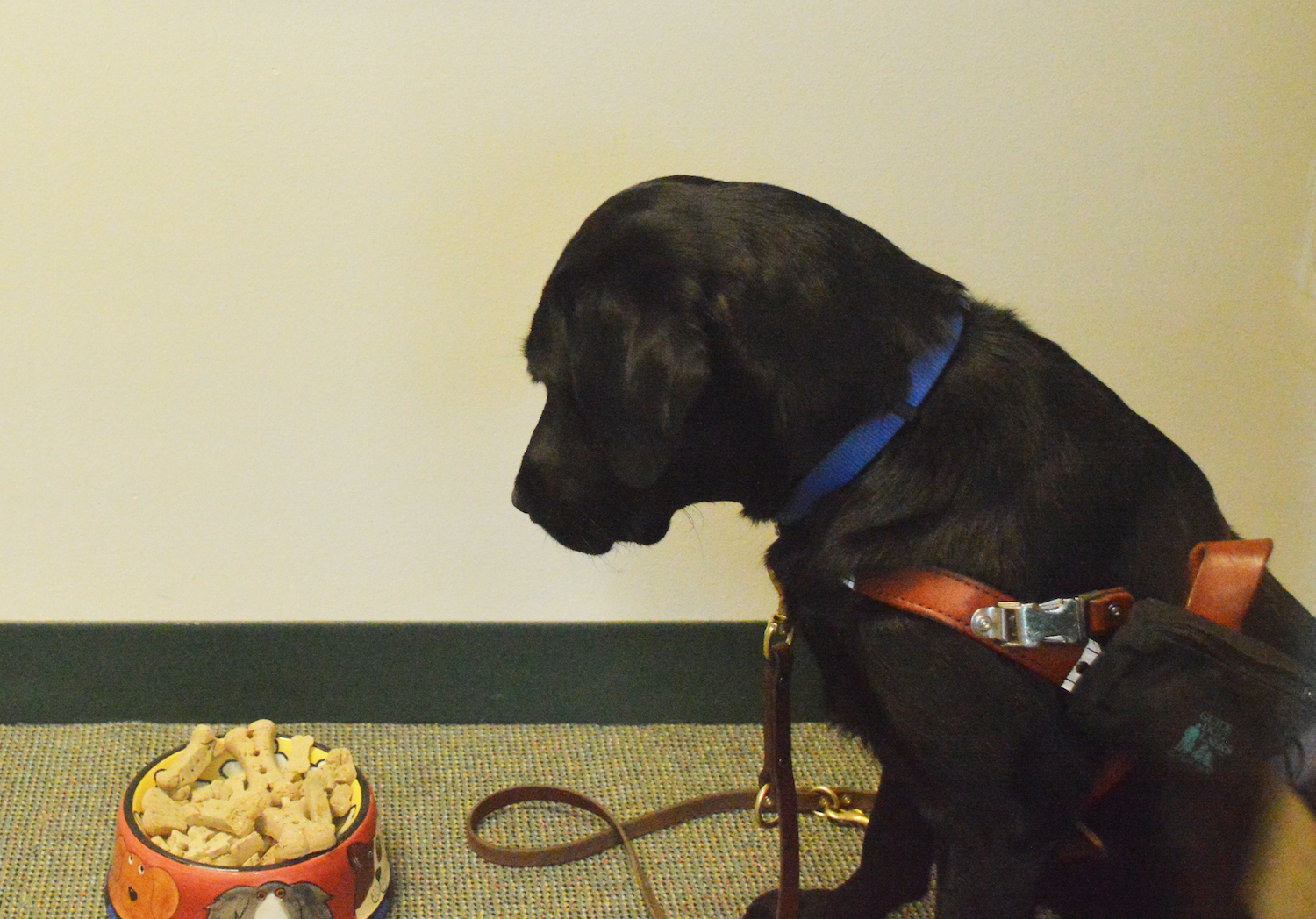
Koala, a black Lab, eyes a bowl of dog biscuits.
Despite what your dog might tell you, an all-cookie diet is not recommended.

A few months have passed since the FDA scared dog-owners who feed grain-free dog foods, so the I decided that Thinking Dog blog needed to run an update.

I am grateful to veterinarian and researcher Lisa Freeman, who has written extensively on this issue. Based on some of her work, including this Dec. 1 JAVMA article, “Diet-associated dilated cardiomyopathy in dogs: what do we know?” here is what I have learned:

  • Grain-free diets are not the problem. What Freeman calls “BEG” diets — foods from boutique producers that are based on exotic ingredients and are grain-free — appear to be a common factor in many of the cases of DCM. (DCM is dilated cardiomyopathy; see the earlier post, Should Your Dog Go Grain-Free? for more info.)
  • Most dogs do not need to eat boutique foods with exotic ingredients.
  • Some of the companies producing these foods have not done thorough nutritional research and testing, and the foods are not nutritionally sound. Or their quality control might not be as good as some more conventional dog food producers, so the foods may be less consistent.
  • The problem is not only about taurine levels, either. Freeman writes that most of the dogs she’s seen (in the practice at Tufts University) with DCM have normal taurine levels. Furthermore, many improve with a diet switch (away from a BEG food), even though their taurine levels were and remain normal.
  • Owners who have moved to home-prepared diets should be extremely cautious and consult with a veterinary nutritionist to ensure that the homemade diet meets the dog’s needs.

The problem does appear to be linked to nutritional deficiencies. Exactly what, though, is still unclear.

What should a concerned owner do?

  • Feed a high-quality food from a responsible manufacturer. You may be tired of hearing this, but: The best food for your dog is not necessarily the best food for my dog. Each dog’s needs are different. Your budget and what’s available in your area differs from what I can get easily. So, I am not going to recommend specific foods. I strongly urge you to choose a food from the Whole Dog Journal’s list. Their 2018 list is available; I will post a link to the 2019 list when they publish it.

Dry dog foods

Canned dog foods

  • For advice on raw foods, check out the Dog Food Advisor recommendations.
  • If your dog gets lots of ear infections, is itchy, or has hot spots or other issues that could indicate food sensitivities, consult with a vet and a nutritionist (some vets have lots of training and knowledge about canine nutrition but many do not; ask for credentials).
  • I do not recommend “prescription” diets. Many vets will recommend these. Why? They make a lot of money selling them. They tend to use low-quality ingredients and be very, very expensive. You can get a higher-quality commercial food for less money that addresses the same issue. Whether your dog needs a lower-fat or lower-protein diet, should avoid particular ingredients, whatever the issue, there are likely to be several foods in your (high quality) pet store that will work.

Fifteen Dogs

Fifteen Dogs, by Andre Alexis, is an interesting read for philosophically inclined readers or people who think about what separates humans from animals. But it’s a terrible book. I do not recommend it.

Even so, it’s worth a blog post. It is a story of, you guessed it, fifteen dogs. These dogs are given “human consciousness,” as part of a bet between Hermes and Apollo. Well, they’re given human consciousness if by that you mean human language. I view consciousness differently from the author. I also believe that dogs have many of the elements of consciousness already, with no need for intervention by mythical gods.

The dogs are boarders at a kennel when they are given these abilities; they form a pack and escape.

One troubling aspect of the book is how rapidly most of the 15 dogs are dispatched to pretty unpleasant deaths. Several are killed by their packmates, which raises another philosophical question: Why is it that at the center of the human-like dogs’ behavior is cruelty, cliquishness, and a propensity to murder their friends? The situations and means of the dogs’ deaths at their colleagues’ paws are easily imaginable among humans, but are very undoglike behavior.

The other aspect of “human consciousness” that the author obsesses over is language. All of the dogs develop an uncanny (!) ability to understand some phrases and words in English after repeated exposure, much like, oh, every other dog in the world. They also develop their own language, with elements of English and elements of Dog. One becomes a poet (in the new language), which really annoys several of the others. A couple learn to speak weirdly accented English that some humans can understand.

The focus on language reinforces a conceit that is common among people who study animals with the goal of proving how and why humans are superior. Many argue that only humans have language. Only humans have human language, but many species use language: A communication system with rules (“grammar” or rules of syntax) that is widely understood by members of the speakers’ culture. Some nonhuman species go one better: Their language is understood by all members of the species, regardless of culture or geography. Humans aren’t there yet.

The crux of the bet is that if even one of these human-like dogs dies happy, Hermes wins the bet; if they are as miserable as humans, Apollo wins. Since most of the dogs die in terrible ways, Apollo takes an early lead. But even that is absurd: Anyone can live a mostly happy life but at the moment of her death be scared or sad or surprised or in terrible pain — and not necessarily happy. Does that cancel out her entire life?

I’m not sure that the ability to speak English would make most dogs happier. Or more miserable. And I am not sure that dog happiness is much like human happiness. But above all, I really don’t think dogs need divine intervention to either understand humans or be happy.  Cali has done both quite well since the day we met.

Cali races across a lawn with a frisbee
Dog joy


The Magic Harness

Cali, aged about 4 months, shows off her new red Sense-ation harness.
Cali got her first Sense-ation harness when she was only a few months old.

Lots of dogs have poor leash manners. This is partly the fault of their humans (not enough training or the wrong kind of training). But it’s also partly just how dogs are.

They are eager to explore. To check out interesting smells. To meet fascinating people. To chase smaller animals. Also they lead pretty dull lives, mostly inside, often alone. Going for a walk is stimulating and fun. So they pull.

There are a couple of problems with this. One is that it’s annoying for the human and makes walks with the dog a chore, rather than a pleasure. If you don’t think that walking your dog is one of life’s greatest pleasures, a) I feel very sorry for you and b) please read Dog Walks Man.

The other problem is that, since most dogs’ leashes are attached to a collar, when the dog pulls, she puts a lot of pressure on her throat. Some dogs have thick, muscular necks and don’t really feel it. But for many dogs, the pressure could cause damage.

Luckily, there is an easy solution. It’s not 100 percent guaranteed to work, but with many dogs, the results are close to miraculous.

What is this magical cure? A chest-fastening harness.

A standard harness with the leash hooking into a ring on the dog’s back will not help. It will actually enable the dog to pull harder (no throat pressure).

But something about a chest-fastening harness inhibits most dogs from pulling. I tried it with a friend’s 6-month-old puppy just this week, and the change was instantaneous.

Several brands are available, and they all fit a little differently. Some are a little complicated to put on, at least initially. The best thing to do is go to a large pet store and try a few on the dog.

Note: Don’t confuse chest-fastening harnesses with the halter-type deals that go over a dog’s nose. Dogs hate those. And if either the dog or the human pulls or jerks too hard, the dog can seriously injure her back or neck. I do not recommend those at all.

That’s not always possible. I’ve had great luck with the Balance harness (also rated #1 by the Whole Dog Journal) and the Sense-ation harness, which is easier to find. I dislike the Easy Walk because even if I’ve adjusted it correctly, it loosens up and slips around on the dog. I either haven’t tried or I’m neutral on several other brands.

What are you waiting for? You could be enjoying a walk with your dog!