Welcome to the Family, Koala

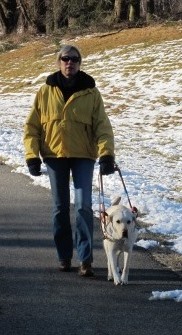
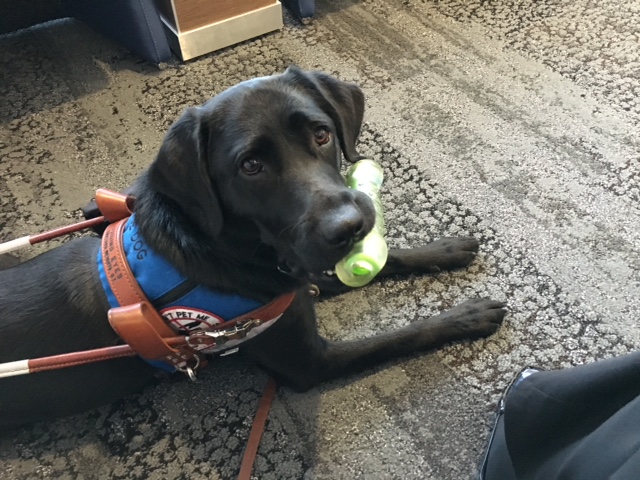
Koala, in harness, waits at the airportShe’s here! And I finally met her!

Deni’s new guide dog, Guiding Eyes Koala, is a 2-year-old, high-energy black Lab with a dazzling smile. She’s very smart and she learns new skills very quickly. For example, she knew where “home” was and could accurately turn in to the right house after one trial. She quickly learned to “find the trash” — anywhere — and she is so pleased with herself that she leaps up and embraces the trash can, with her tail wagging, and wearing a huge smile. I saw her do it several times in places none of us had ever visited before.

She’s very playful and can be quite silly, when she’s not working. She completed her first airplane travel with the grace of a pro, and seems up for any new adventure. She was “just amazing” on a recent visit to Guiding Eyes; she even agreed to use the indoor service dog “relief” area. These tend to be more “desperation” areas, with fake grass rinsed by pop-up sprinklers or pee pads on the floor in some out-of-the-way corner of the airport. She’s definitely a good sport.

Cali is going to just love having a playful, high-energy little sister to boss around. Jana is looking for an invitation for Thanksgiving week. If she stays home, she’s likely to never speak to me or Deni again after spending several days in a tiny apartment with the two “puppies.”


Thinking Dogs ♥ New York

Alberta and Deni trainingService dogs in New York got a great Christmas present from Governor Andrew Cuomo: official recognition as the state dog.

While some states choose a breed as the official state dog, and many states (gasp!) have no official dog, New York took a novel and wonderful approach. This article from Syracuse.com points out that breed doesn’t matter; only education and ability.

The original legislation designated service dogs as the official state dog. The governor expanded the law to include working dogs like police K9s and search-and-rescue dogs, and the lawmakers have agreed to officially expand the definition.

Four paws up to New York legislators for recognizing the contributions of service dogs. Other working dogs are also heroic and deserving of recognition, but a tiny, possibly very cynical, part of me wishes the honor had been kept, as originally intended, for service dogs only.

Unlike this recognition, the “me too”-ism that wants to lump a whole bunch of dogs in with service dogs for special attention or privileges usually is negative, as described in this New York Times column: When Dog Owners Are Off the Leash.

Maybe my grumpiness stems from having read the two stories only moments apart.

While the writer of the Times column admits to schadenfreude at the news of a celebrity couple getting caught and penalized for smuggling their two dogs into Australia, breaking several laws, including avoiding the required quarantine — he also freely and unabashedly admits to committing similar misdeeds. Stating that “half the people” he knows do it, he relates stories of many other people smuggling dogs into no-pets venues, lying to get them on airplanes, and smuggling pets across borders. He even acknowledges having a fake letter attesting to his dog’s status as an emotional support dog, commenting that the law is so vague that it’s easy to cheat. The motivation ranges from simply wanting to avoid paying pet fees on airlines to feeling entitled to have your pet with you wherever you want. Even if that requires that you lie about having a disability and pretend that an untrained pet is a trained service dog.

While the author of the column briefly mentions that this fakery “makes life difficult for those who really need” service dogs, he seems not to care. He sounds much more irate about the high fees that airlines charge to transport small dogs, and approvingly cites a few recent changes, including posh hotels that now allow dogs and the news that Amtrak has started allowing small pets to ride on some trains.

The thing is, though, that faking it is not OK — and is not trivial. So many people are doing it that it really does interfere with legitimate working dogs’ ability to do their jobs. And their safety. I’ve seen so-called service dogs come tearing out of airport shops, snarling and dragging their people, reacting to people or working service dogs.

And, as my students who train service dogs have pointed out, allowing untrained pets into more and more public spaces might not be the best solution. As a pet owner, I love discovering new places that I can take my dogs. But as a person who understands the ins and outs of training and working with service dogs, I also understand the problem.

If pet dogs are very well trained and socialized and the owners are skilled handlers who are aware of what’s going on around them, then no harm is likely to be caused; unfortunately, that’s rarely the case. Most dogs are poorly prepared for the stresses of public spaces, and many dog owners are poorly equipped to handle their dogs safely and appropriately — or they are simply oblivious. As is often the case, a good remedy is more education. Education of dog owners — and of business owners, about how to spot and deal with fakers.

Kudos to New York for recognizing and increasing awareness of the incredible work that service dogs do. Let’s hope it will help more people understand how vital service dogs are to people who truly need them — and how harmful it is to fake it.


Amazing Restraint

In Alberta’s Marshmallow Test, I described Alberta’s admirable ability to resist temptation in the form of a bowl of dog biscuits sitting alongside a water bowl outside a Michigan store. While I know personally of the hard work Alberta (and Deni) have invested in honing Alberta’s ability to resist food temptations, I also know that all dogs (with the possible exception of Cali) really are capable of learning self-restraint.
This ability is, I believe, evidence of their ability to understand what is the “right” thing to do in particular circumstances. It is certainly evidence that not all dog behavior is hard-wired or instinctive.
Some examples include dogs who learn not to take food from counters, tabletops, and plates, even when those are tantalizingly within reach. I could leave a steak dinner on the coffee table (at Jana’s nose level) and go out for an hour. If she knew that was not her food, it would all still be sitting there when I got back. Leaving it alone with impulsive youngster Cali would be a different matter, however.
An even more important example, and something anyone who lives near a road with traffic or who takes the dog for car rides should work on, is waiting at doorways. When we drive to the dog beach or park, the dogs are very excited. But even Cali, who is probably wriggling with excitement, has learned not to exit the car without explicit permission. And Jana and Cali have both learned never to bolt out the front door, not matter how seductively the park across the street beckons, no matter how many cats, UPS delivery people and mail carriers are passing by … no matter what.
I argue that these are examples of dogs “doing the right thing” because I know that they are not afraid of being punished and that these efforts are rarely rewarded. Well, at the dog beach, they do get to go play — but even when someone slips up, the worst consequence is that she’s sternly instructed to get back in the car and wait, and then released a minute later to play. The girls are not following the rules because they think they will be horribly punished if they do not. They are not expecting any significant reward, especially for resisting the impulse to run out the front door. They are doing what they know is expected of them in these common situations for no reason other than they know that it is the rule.
In fact, we ask dogs to resist behavior that comes naturally to them all the time. We ask them not to chew and lick at their itchy spots. We ask them to resist humping other dogs. We ask them not to bark at the neighbors or the mail carrier, even when he is invading their turf. We ask them to ignore food (and things they consider food) on the ground, to not chase cats and squirrels encountered on walks, and to walk nicely on a leash.
We do ask a lot of them, don’t we? And most dogs, most of the time, live up to our very high expectations. Especially if we practice with them and do reward them sometimes.
I think that we humans take it for granted that dogs should follow our very human-centered rules. I am suggesting that we look at things from their point of view once in a while, recognize how truly counter-intuitive it is for a dog to resist food that is just sitting there or to abstain from chasing that cat out of the yard. We need to recognize that our dogs pass their own marshmallow tests, every day, many times a day — and reward their efforts with praise and pats and, at least occasionally, yummy treats to reward their restraint.

Service Dog Appreciation Week!

service dog week

As National Service Dog Appreciation Week draws to a close, I want to draw your attention to an article I co-authored with Deni Elliott. It is a discussion of the current and growing problem of fake service dogs and “inappropriate” service dogs, that is, dogs who may be trained to assist a person with a disability but who are not trained for public access and/or have a temperament that makes them unsafe in public spaces. Unfortunately, Deni and other service dog partners are encountering more and more dog-reactive dogs, which makes it challenging and unsafe for their dogs to work.

Our proposal, which might be controversial, suggests a solution. We hope this article will be part of a larger debate in the service dog community as well as among policy makers and will ultimately help find a solution. You may download the article from Deni’s website or from the portfolio page of this website.

Puppy Tries to Downsize Older Dog, Steal Her Job

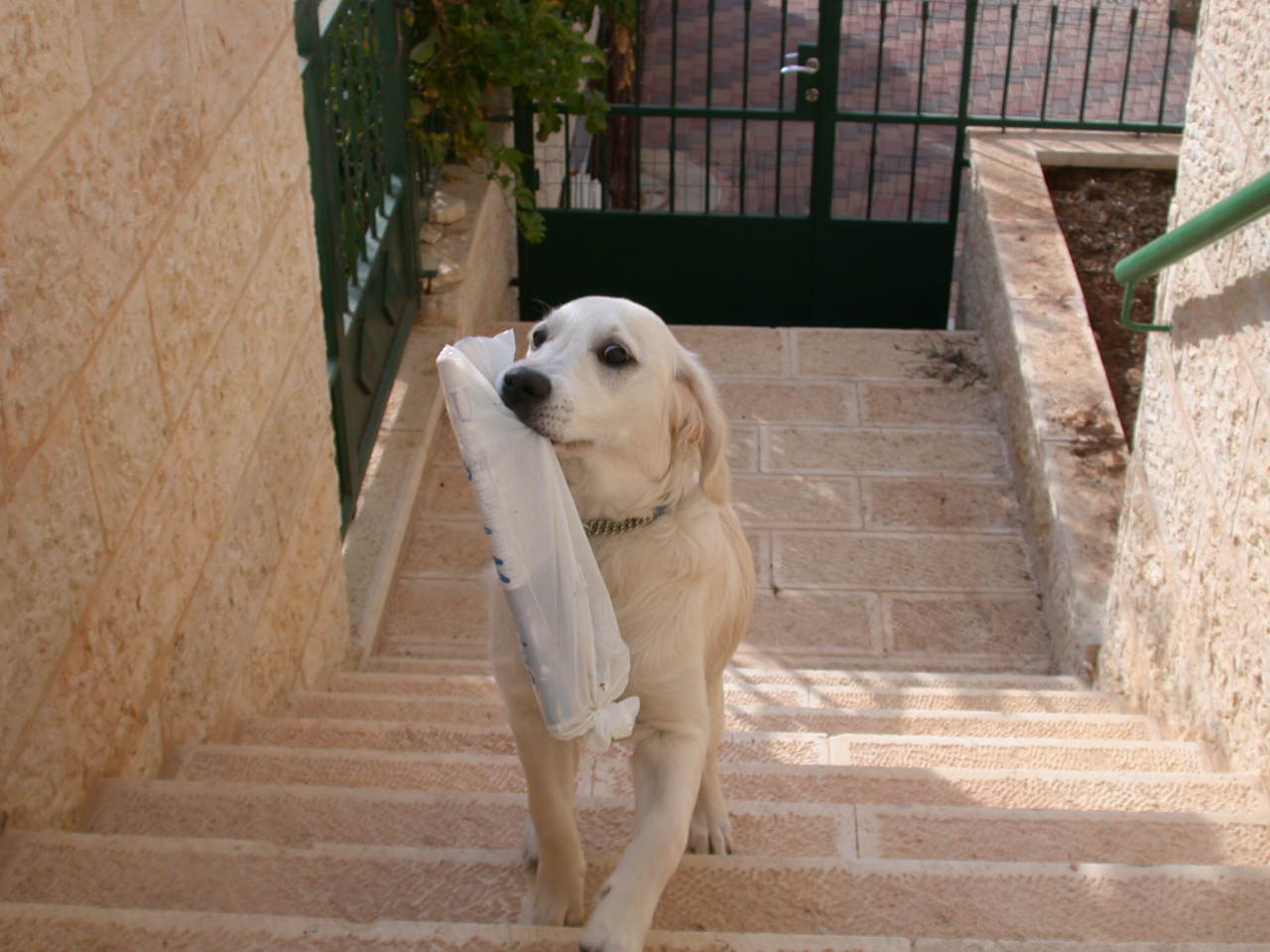
At the ripe old age of not-quite-three-months, Cali made her first play for Jana’s job. She liked the idea of a paycheck, in the form of some treats, delivered as soon as the work was complete.

The newspaper was still bigger than Cali the first time she grabbed it and dashed off ahead of Jana. Reined in by a too-short leash, Cali was soon overtaken by Jana. Jana looked at her in annoyance, then reached over and snatched “her” newspaper back.

Jana’s held this job since she was a tiny pup, and she is not ready to retire.

get the paper

Since that day, I try to get the girls to take turns, and I give each one a reward, but Cali still wants that job. And Jana is not giving up without a fight. Sometimes the paper bears the brunt of this literal tug-of-war.

Cali and the Sunday Paper

Dogs need jobs. Ever more, dogs need opportunities to earn rewards. But I think what is really at play here is that Cali looks up to — worships — Jana and wants to do everything that Jana does. Cali learns new skills very quickly and I am sure it is partly because she is watching what her adored big sister does and copying every move, albeit in her clumsy puppy way.

Still, I think the best solution might be a second newspaper subscription.

Bidding Farewell to Wylie

Cool

Wylie is heading off to learn his new career this week. Deni’s difficult decision to let him go and to seek a professionally trained guide dog, whom we hope will be a better fit for both her personality and her needs, is described in Loving and Letting Go, an earlier post on the Thinking Dog Blog. But Wylie was part of my pack, family, life too — and saying good-bye brings up some tough issues.

I think of dogs as family members. Taking a dog into your life, I believe, is a lifetime commitment — you take it upon yourself to care for the dog for the rest of his life (or the rest of yours). Yet I believe that letting Wylie move on to a new life is the best choice for him as well as for the rest of his pack/family. I’ve been struggling to reconcile these conflicting views.

Wylie wasn’t a pet; he was a guide dog. But he wasn’t a good fit for the job Deni had assigned to him. We’re both confident that his new job, working with a veteran, will be a better match for Wylie’s personality and needs. He’ll revel in the intense companionship and enjoy his new responsibilities. He might be matched with a young, athletic guy who can give him the exercise he craves, too.

None of that makes it easy to say good-bye. What makes it hard, I think, is that for all that I try to study human-dog communication and improve my ability to communicate with dogs, I am still human — with that human tendency to be overly reliant on words. For all his intelligence and perceptiveness, Wylie is a dog who doesn’t use language the way we do. That gap is sometimes tough to bridge.

So we can’t prepare Wylie for what is happening, can’t help him understand that we love him and want him to be happy, can’t call him on the phone to find out how his training is going. He’ll be confused and sad when Deni leaves him with Jennifer, his new trainer. There’s no way to explain to him that, after some training, he’ll get to go live with a guy who will be his best friend and constant companion. While he senses that something is up, Deni says, he doesn’t understand what.

I also know that dogs are more “now” focused than most people are, which means that Wylie will quickly adapt to his new routines. He makes new friends easily. I am sure that he’ll be the star of the training class before long. Even knowing all of that, and feeling sure that it’s the best choice for him, it still feels strange and sad to say good-bye.


Loving and Letting Go

A Guest Blog by Deni Elliott

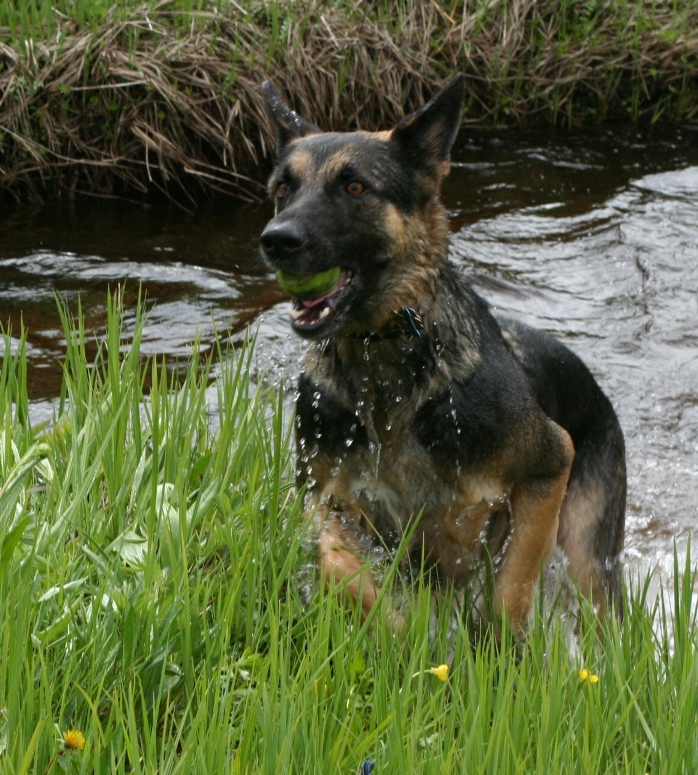
wylie ballSometimes things just don’t work out. He is intensely athletic; I’m a stroll-on-the-beach kind of gal. He always wants to be in charge; I think that responsibility should be shared. He likes hanging out with the guys, and he unabashedly flirts with the girls; I crave a less-social life and want him to have eyes only for me. But when we are alone, I need some private time; he dogs my every move.

After four years of trying to make our partnership work and then carefully planning for our separation, I’m ready to announce this to the world: I love Wylie more than I can say. He’s smarter than I am, good-hearted, and generally well-intentioned. But Wylie and I are breaking up.

My guide dog’s career change feels a lot like ending a human relationship. As with intimacy between humans, the partnership of human and guide dog is a dance of inter-dependency and cooperation. Compatibility is required.

Wylie counts on me to give him everything that he needs to be a well-adjusted German shepherd, and he is not shy about communicating his demands to me.

I put my life in his paws every time that I slide the harness over his shoulders and say, “Forward.” I trust Wylie to choose the path as he guides me under low-hanging branches, steers me around obstacles, and takes us across streets, avoiding the traffic that I can hear but cannot see.

We communicate moods and expectations up and down the harness as we let each other know what is next in our progression from Point A to Point B. If we’re out of sync with one another, we both get frustrated. And while our ability to read one another has astounded others observing us, the frustration has become more than either of us can handle.
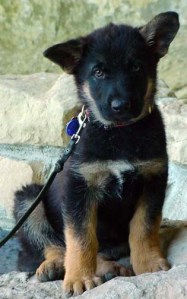
8 wks Wylie (2)Wylie is the second guide dog that I have raised from young puppyhood, enlisting the expertise of professionals to accomplish training that I couldn’t do on my own. I’ve owned and trained dogs since I was a child. My visual loss was progressive, but slow. I thought that I was better able than a guide dog school to prepare a dog to meet my special needs.

As a puppy, Wylie showed strong potential to become a guide. My successful partnership with my first guide dog, a golden retriever named Oriel, made me unrealistically confident. Oriel was, in the words of many who knew her, “the perfect dog.” When she retired, I assumed that I could make the guide relationship with young Wylie work just as well. I struggled through the first year and thought that he would mature and grow into his job. I was wrong. Wylie’s basic personality did not change; nor did mine. When I finally realized that I couldn’t make things better, I knew that I owed Wylie the chance for a better life.

On January 23, Wylie will start training to be a service dog for a veteran with Post-Traumatic Stress Disorder (PTSD). For the first time in more than 12 years, I will depend solely on my white cane to pick my way through my travels. Wylie and I will both be in transition and will grieve the loss of one another.

But not for long.
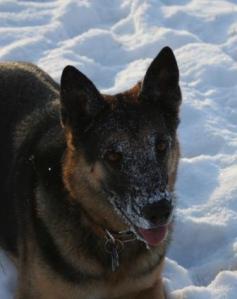
Wylie (2)Wylie will have new challenges from the start. He will live first with Jennifer Rogers, director of PAALS, a service-dog training school that is affiliated with Fort Jackson, the U.S. Army base in Columbia, South Carolina. Wylie and other dogs-in-training will spend one evening each week on the base with active-duty service members and veterans who are coping with combat-related anxiety. Under Jennifer’s supervision, the dogs will learn to help people with PTSD; the soldiers and veterans will teach the dogs how to assist others like themselves. Dogs and humans will learn to support one another.

When the time and match is right, Wylie will become an “intensive companion” dog for a veteran who is not yet ready for the challenge of working with a service dog out in the community. Dog and veteran will be encircled by a team of mental health and service dog professionals who will support their journey together.

I will be supported in a new journey as well. On March 4, I will join a training class at Guiding Eyes for the Blind in Yorktown Heights, New York. After intensive training there, I expect to return home with a 2-year-old mellow yellow Labrador retriever at my side. I’ll have a guide dog bred and trained by experts who create and maintain ethical working dog relationships. After many hours of application to, evaluation by, and conversation with Guiding Eyes personnel, I trust that they know better than I how to find me the best guide dog match.

Wylie’s new life will be very different from guiding me around obstacles that I cannot see. Crucially, it will be a life that is more in tune with his nature. The behaviors that he will be trained to do on cue include leaning against his partner, resting his head on his partner’s knee, lying on his partner’s feet, and providing a friendly-but-safe barrier between his partner and others. With me, Wylie got to connect like this only after his harness came off and he was done guiding for the day. Providing a partner such physical support 24/7 is Wylie’s dream job.

Wylie has always wanted more physical connection than I could handle. When I was done working for the day, I wanted some time free of my canine umbilical cord; Wylie wanted the intense physical contact that he lacked when he was walking two steps ahead of me, in harness.

The behaviors that have been problematic for me will be just what Wylie’s new partner needs. Wylie will bond with a veteran who needs a canine companion to guide him out of a darker place than I have ever experienced. It is likely that Wylie’s new partner — a veteran with deployments in Iraq, Afghanistan or both — will be no more than 30 years old. Wylie will finally have a young partner who is able to provide the daily intensive exercise that he craves.

Wylie will no longer endure long hours lying under a desk while I work in the office or teach my classes. He will no longer sigh and resign himself to STILL being on duty when I sternly command him to turn left to guide me to the Dean’s office when he wants to turn right to walk home and be done for the day. And, most importantly, Wylie will no longer have to pant and tremble as he struggles to guide me through airports and onto airplanes, a task that he finds increasingly stressful.
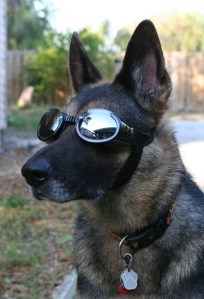
CoolSome people will criticize me for not letting Wylie retire and spend the rest of his days lounging at home. But, all dogs need stimulation; a young, intelligent dog like Wylie, who is accustomed to life out in the world, needs it more than most. Long days spent alone and doing nothing would be unbearable for him. Others will say that it is cruel for me to give him away, suggesting that I don’t love my dog as they love theirs. But I know that Wylie would not be happy watching me leave home with another dog doing “his” job, even if it is a job that he sometimes hates. I love Wylie enough to recognize that he’ll be happier moving on.

I will get over losing the goofy frat-boy who has been part of my life for 6 years. I will have learned yet one more lesson in loving and letting go. I’ll get past the guilty feeling that I failed this dog. From this perspective, it seems to me that I’ve been helping Wylie get ready to be the helper dog that he was really meant to be. I appreciate his true nature enough to let him go forward and be that dog.


Clothes Make the Dog

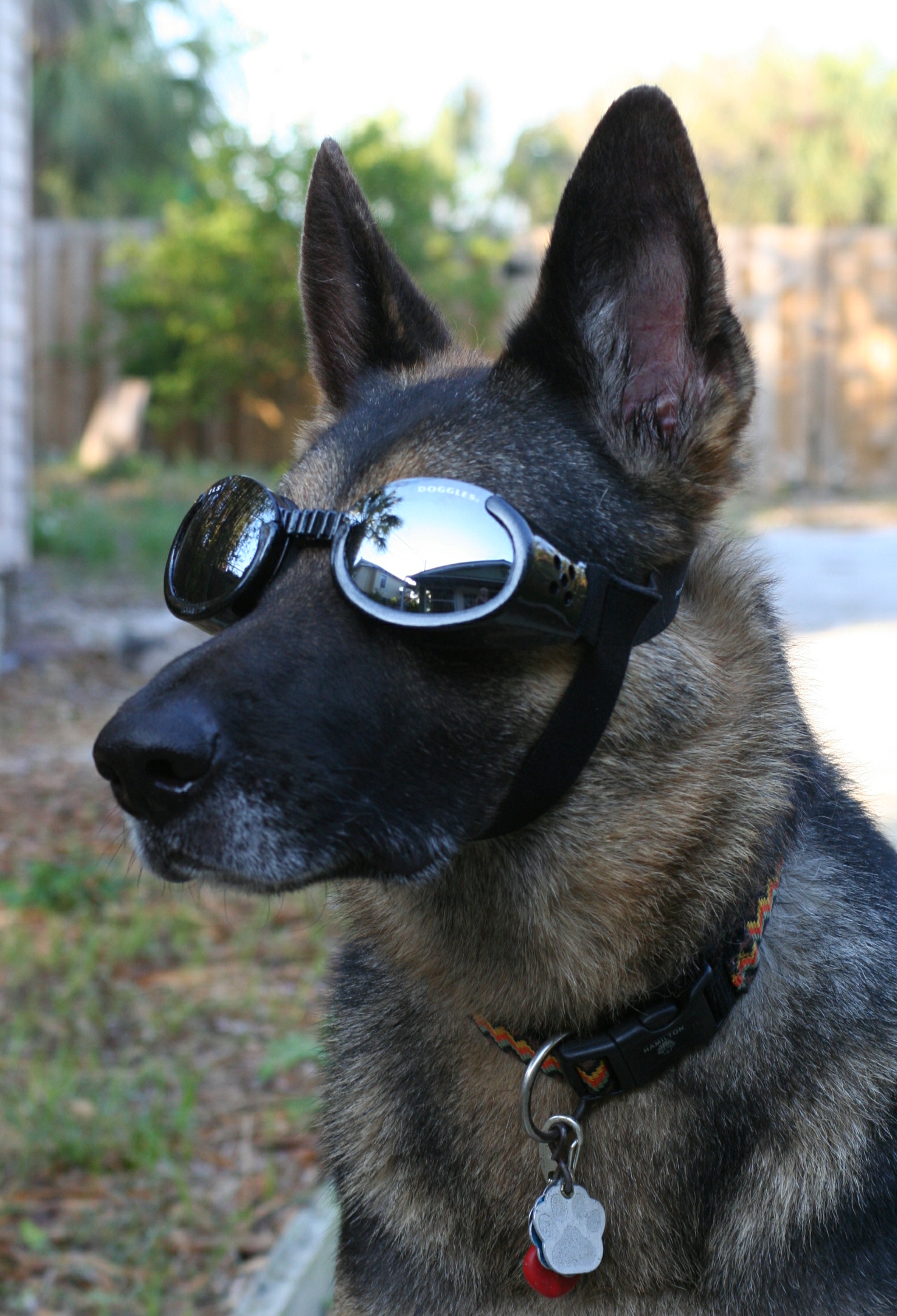
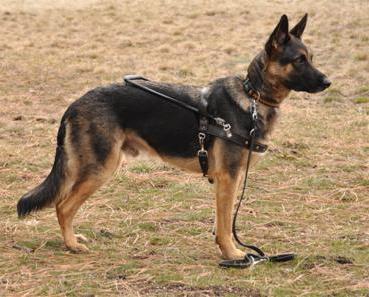
For as long as I have worked with service dogs in training, I have known that putting a service dog cape or harness on a dog sends a clear signal: “ Now, you are working!” With many dogs, the working dog and the off-duty dog behave so differently they could be two different dogs. Wylie is an extreme example — on harness, he will work past distractions. He still notices cats, for example, but his strong work ethic keeps him focused on the job at paw. But take off his harness and he is all-dog — party dog. We call him the frat boy. All he wants to do is play. And, maybe, if we’d let him, drink beer.

Wearing his harness, Wylie is all business

Last week, The New York Times gave me an explanation for this phenomenon: enclothed cognition. The study’s authors say that we think not only with our brains but also with our bodies. It’s long been known that our clothing affects other people’s perceptions of us; now researchers are learning that how people dress affects the way that they see themselves and the way that they think and behave.

The study cited by the NYT found that people who put on a “doctor’s” lab coat were better able to notice subtle incongruities or differences in images they saw. For example, they noticed that the word “red” was colored green, or they found more differences in very similar photos. Those wearing the “doctor’s” coat did better than test subjects who merely saw the coat, better than subjects who wore the coat but were told it belonged to an artist, and better than a control group who had no white coat presented in any way.

“Enclothed” cognition is an extension of embodied cognition. Just as washing hands has been shown to be associated with ideas of moral purity and people who carry large clipboards feel important, dressing in certain clothing awakens specific associations in our minds — and these associations affect our behavior.

It’s not much of a leap to recognize that dogs are affected in a similar way.

Off duty and ready to party

Putting on a cape signals to a Pet Partner dog that it’s time to go on a therapy dog visit, and putting a cape on a service dog says that playtime is over. Some dogs even have better leash manners with their capes on. When two working service dogs, who also happen to be pals, meet while on duty, they might greet each other warmly and with a wag of the tail, but they will quickly settle back into their calm, unobtrusive working roles. Take those same two dogs on a walk together, or watch them at one of their homes when neither is on duty, and you will see very different dogs and a much higher level of energy!

Just as some people quickly exchange work clothes — and professional persona — for comfy yoga pants and an informal attitude as soon as they get home, some dogs, like Wylie, demonstrate a wide gap between “all business” and “let’s get this party started.” And there are dogs (and people) who clearly know that something special is expected of them when they are dressed for work but who maintain a consistent personality, on duty or off. Each dog’s different degree of “enclothed” cognition helps us respect the truth that all who live with and love working dogs quickly learn: a service dog partner is not a robot, but an individual who makes voluntary choices to do her job. The study’s authors wonder whether the effects of a person’s daily work uniform eventually wear off — or become habit. Do the clothes, in the end, define the dog?