Drug Dogs Forced into Early Retirement

Hundreds of drug-detection dogs are taking early retirement, their jobs disappearing as marijuana legalization makes their skill set obsolete. It’s not the dogs’ fault; the blame lies with human myopia.

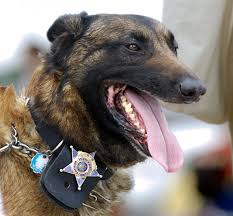
A police dog wears a star-shaped badge.

Dogs can be taught to identify pretty much any scent, even scents that humans cannot detect. The dogs who sniff out cancer or flag diabetics whose blood sugar is dropping, for example, are responding to scents that humans cannot smell.

Dogs can also be taught to reliably distinguish scents and alert to more than one scent. And they can of course be taught to respond to each scent with a unique behavior — a bark, sitting, lying down, spinning in a circle. It really doesn’t matter what; the dog can learn it.

But the humans. Oh, the humans.

There are the trainers who take the “easy” path of teaching their canine pupils to give the same alert to any contraband. Easier to teach. Easier for the handler to remember. But it makes the dog’s skills useless when you no longer want her to alert to marijuana.

There are the humans — trainers, handlers, lawyers, judges — who do not believe that dogs can discriminate the scent of meth from the scent of marijuana. Or who do not believe that dogs can reliably signal which one they’ve detected.

For these reasons, many drug-detection dogs who’ve served faithfully and honorably are being pushed out of their jobs. In places where marijuana is now legal, basing an arrest on the dog’s say-so is too risky. Defendants can argue that the dog alerted to a legal substance.

Many detection-dog trainers are have already stated training dogs on other forms of contraband but not marijuana. And new recruits,  who’ve graduated with this newfangled curriculum, are stepping up to take the retiring dogs’ jobs. Even so, there are sure to be younger dogs caught unprepared as the job market shifts, new grads whose skills are outdated before they’ve had a chance to shine. The thousands of humans forced to adjust when their jobs vanished will understand how tough this can be.

The retirees’ future is not bleak, however. Most of these dogs are headed into a cushier retirement than many people can look forward to. Many of them have years of experience under their vests and deserve to enjoy their golden years. And who knows? Some may pivot to new careers. I hear there’s growing demand for conservation dogs


Just Stop It.

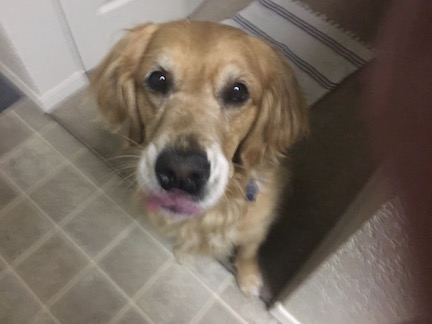
Cali, a golden retriever, licks her lips in anticipation of a treat.
No robot could replace this face

Stop. Just stop saying that soon ____ will replace dogs. Nothing and I mean nothing will replace dogs.

Here’s the latest, a “robot bloodhound.”

I have no idea how much money is poured into efforts to replace dog noses with machines that detect:

  • Cancer (multiple kinds)
  • Low blood sugar
  • Other medical conditions
  • Narcotics
  • Bombs
  • Contraband, including veggies in a traveler’s suitcase
  • Contraband, including smuggled animals, plants, or anything else in shipping containers
  • Scent trails on land
  • Scent trails on water
  • Cadavers (on land or under water)
  • Identify human cremains
  • Endangered / rare wildlife
  • Endangered / rare plants
  • Insects
  • Rats
  • Other pests and parasites
  • Truffles

I could literally list millions of things that dogs can be taught to identify and find by scent. Sometimes, humans don’t even know what the dog is scenting. But dogs are so smart and capable that we can teach them to reliably find it anyhow.

To replace the dogs, a machine would need to be able to identify the exact chemical combination that creates the scent. The machines, so far, are less accurate than dogs. This might be because identifying a scent is not a cut-and-dried, easily reproduced, often repeated set of identical steps.

It’s a process that requires thinking and intuition and understanding of the goal. Dogs can do all of that. They do it all the time, every, in their interactions with us — even without training. The machine does exactly what the human programmed it to do. It might be able to “get better” with practice, but only within parameters determined by the humans who programmed the algorithm. Regardless of what you might hear about how smart computers are, they are not thinking on their own.

Dogs are.

And, dogs can go into all kinds of situations, flexibly adjust to different working conditions, offer feedback on what’s happening, and learn from their successes and their failures. They can work in any kind of terrain and in weather that would defeat many mechanical imposters, uh, substitutes.

Additional dog teams can be trained far less expensively than fancy schmancy robots can be built and moved around to world to anyplace they might be needed. Dogs can hop onto a plane with their handlers and go help — at a disaster site, in a large-scale search-and-rescue operation, at a field hospital.

Remember, scenting is only one of dozens, maybe hundreds of ways dogs assist people. Or make our lives better without a specific task — just by being dogs.

So just stop it. Stop pouring millions of dollars into machines to “replace” dogs. Focus that money and effort on training dog-and-handler teams. That could prevent things like what I heard on the radio this morning: In a story on the return of remains from North Korea, which are likely to include the remains of many American servicemen who died there more than 60 years ago, a comment was made about how difficult it is to find human remains because there’s no technology that can detect them. Maybe there’s no technology, but trained cadaver dog teams could certainly find them. They wouldn’t falsely alert on bones from nonhuman mammals, either, preventing the “return” of nonhuman remains (which has happened).

And remember, each of those expensive robots does only one task. A different robot is needed for each task. The dog team? That dog can be trained to do multiple related (or unrelated) tasks. Besides, who wants to cuddle up with the robot bloodhound at the end of a tiring day of searching?


Guide Dog Haiku

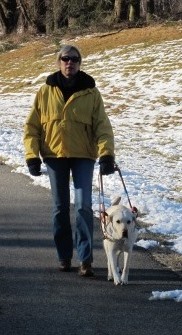
Deni Elliott learns to work with Guiding Eyes Alberta, who is now retired.

Several Guiding Eyes dogs’ human partners recently posted haiku and other poetry to a graduates’ email list. The poems show their appreciation and love for their guides. A member of the list asked (and received) permission to share some of the poems, which appear below. Feel free to add, in the comments section, your own service- guide- or pet-dog haikus, odes, ballads … or tributes in any literary form.

Naughty puppy face
Harness on, working face on!
What to do without?

Night comes, harness off
Naughty puppy face once more
We dream together.


The trees and sky breathe
My golden girl goes forward
Our hearts together


My vision as wide
As a dog can see, hear, smell
Guiding Eyes radar


Walking by my side
You safely show me the way
Teamwork every day


Our talks as we walk
Open volumes clearly spoken
Unheard by strangers


They don’t know our language
We speak silently yet so loudly
RIGHT!  LEFT!  STOP!  I LOVE YOU!

A movement, a language, a laugh
in voices so clear to us
So invisible, so silent to strangers
Roxanne, I hear you

You speak more loudly
“You do, too, when you smile at me.”
I smile back
A wag of  tail
A snort and shake of collar
A lean against your leg
A huff, a snort.
I smile back

Strangers never know
We laugh out loud at them
Out loud but silently
Our talks when we travel
Volumes never heard so clearly spoken
So secret, so open


The partnership and communication between guides and their humans is unusual, but service-dog partners and working-dog partners often experience  a comparable connection. True communication develops best in relationships where both partners’ roles are recognized and each acknowledges the necessity and the significance of the other’s contribution. This idea goes to the heart of the Thinking Dog Blog and my reasons for writing it, which is why I wanted to share these heartfelt tributes to guide dogs, both working and retired.

A Task Only a Dog Could Do

Is Cali a budding search dog?

I heard a great story on NPR recently about dogs helping people. OK, so stories about dogs helping people are nothing new, but this one is different.

I’ve spent a lot of time in Northern California, mostly in Sonoma County not far from where the horrific wildfires burned 5,000 homes and businesses a few months ago. The story was about — stay with me here — trained cadaver dogs helping people whose houses had burned. The dogs were assisting people who had had cremains of family members in their homes.

The dogs are actually able to distinguish the ashes of human cremains from the massive amounts of ash on the home sites.

The forensics expert said that the texture and appearance is different, so, once the dogs alerted to the presence of cremains, the human team was able to separate out the cremains and return them to the families.

A woman interviewed on the show said that her mom had passed away not long before the fires and she’d been planning a memorial service and burial … when the fires intervened. Having lost everything, she was devastated to lose her mom’s remains as well.

Cadaver dog teams came in and the searchers had two dogs, separately, search and alert. If they alerted to the same spot, the humans got busy.

I’m not at all surprised that dogs can do this; I think that dogs can identify and seek out any unique scent, no matter how many other scents are mingled with and surrounding it. I love that people are creative enough — and trust their dogs enough — to come up with an endless variety of ways dogs can help humans do things that, let’s face it, there’s no way humans could do without dogs.

A great book that tells more than you’ve ever wanted to know about training and working cadaver dogs is What the Dog Knows. But it’s not only cadavers … dogs sniff out rare and endangered wildlife (or their scat); living humans; drugs; disease; explosives … anything you can imagine, someone has (or could) trained a dog to find it.

When Cali’s complaining about being bored, I know the problem isn’t with her; it’s my lack of imagination in finding new challenges and games for her. The problem’s hardly ever the dog; it’s the human.

Lulu Gets a Golden Handshake

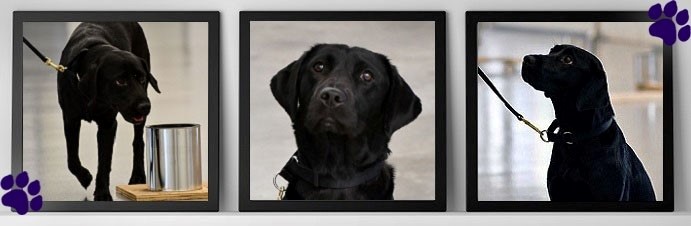
three photos of Lulu, a young black Labrador who chose not to become an explosives detection dog.
Photos from the CIA Pupdate: A Pup Leaves the Class.

Have you ever started a job and realized, during new hire training, that you’d made a terrible mistake? Who hasn’t decided that a job just isn’t the way they want to spend the majority of their waking hours.

Well, Lulu, a year-and-a-half-old Labrador, gave up on what many dogs might consider a highly desirable career; she quit her gig as an explosives detection dog during training. Lulu was recruited from a service dog school at a young age, apparently having decided that a life of service was also not her calling. (Often, service dog puppies with exceptionally high energy or drive are released to a career like explosives detection or search and rescue, if their energy level is not suitable for work as mobility assistance dogs.)

Lulu, according to tweets from the CIA K9 training program and articles in the New York Times and Washington Post, gave up the opportunity to work 60-hour weeks with handlers from the Fairfax County (Virginia) police department. Her new life entails playing with her former handler’s children and protecting the family home from squirrels and rabbits.

Not all dogs are cut out to be working dogs. Service dog and guide dog schools that breed are doing well if more than half the carefully bred and socialized puppies actually end up working as service dogs. Some are released for health reasons, but a large number choose, as Lulu did, to just be dogs. I’ve trained lots of Lab puppies: If food and play weren’t enough of a reward to get Lulu to love the training, she really wasn’t cut out for the work. It’s to the CIA program’s credit that they let Lulu go.

“For our K9 trainers, it’s imperative that the dogs enjoy the job they’re doing,” states the “Pupdate” announcing Lulu’s retirement.

That’s a far cry (and very welcome evolution) from the “bad old days” of training, where lackluster performance was punished. Mistakes were also punished. Insufficiently speedy correct responses might also have been punished. Dogs were compelled to do the job. I am happy that more and more organizations, from service and guide dog schools to military and police dog trainers, are learning that punishment is the wrong approach.

Think about it. If compelled, the dog might do the work, but probably not put her heart into it. If your child is lost in the woods, or your city is hosting a large public event, or your city’s buses are plagued by the threat of terrorist bombings, do you want a dog who’s just doing what he has to to avoid punishment to be the search or sniffer dog on duty? Or do you want an eager dog who loves the work, buys into the goal, and puts heart and soul into the search?

It’s also cool to note that the trainer who wrote the Pupdate talked about working through a slump, figuring out what’s bothering the dog, and motivating the pups with toys and food. That sounds like they treat the dogs as individuals with preferences and feelings, not like robots who are just expected to do as they’re told. This is how it should be; dogs are individuals and should be given opportunities to make choices and express preferences.

It also raises an important point that dog trainers and owners do well to remember: The trainee, in this case, Lulu, determines what is motivating. And what is not. Most Labs love food and will do anything for a food reward. Many dogs are delighted to earn a play reward. A dog who doesn’t want to work for these rewards either needs a creative trainer to find what motivates that dog — or she needs a different goal.

Lulu made her preference clear, and I’m pleased that she got her wish. I’m betting that the handler’s children are equally delighted with her choice.

Too Hot for Dogs!

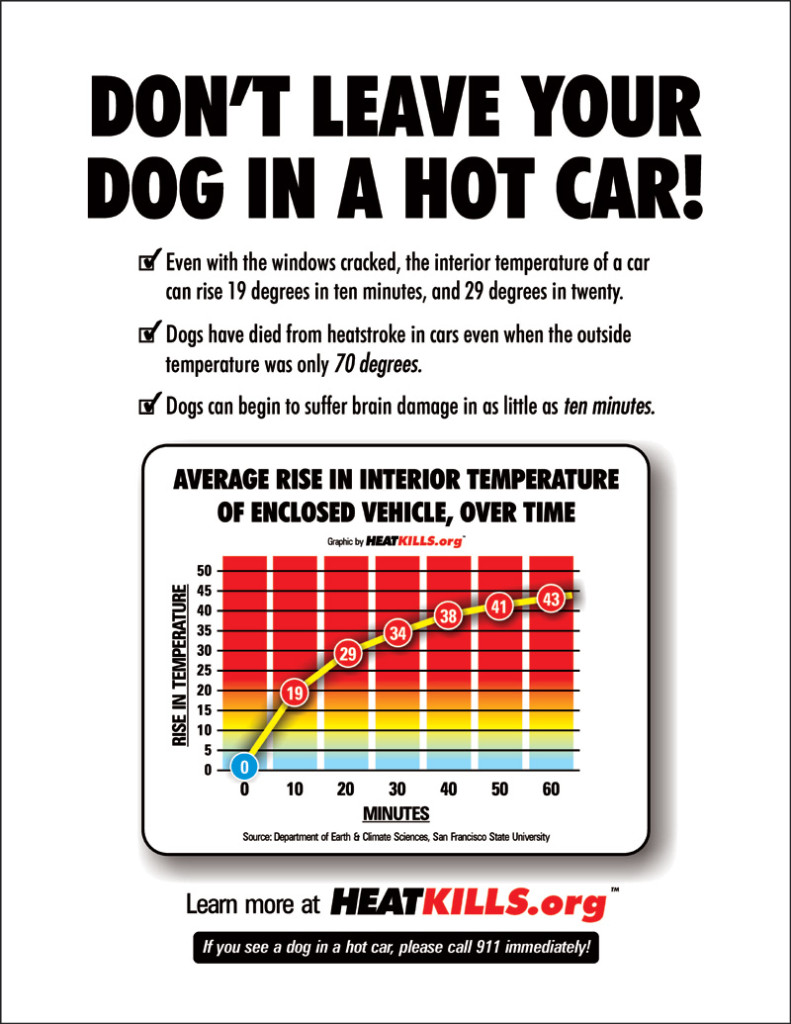
Graphic image showing how quickly a car can heat up on a hot day from heatkills.org
Downloaded from Heatkills.org

It has been in the 90s pretty much every day since we got to Missoula, Montana, our new home. If it’s this hot here … well. Dogs everywhere are suffering.

I know I don’t have to remind readers not to leave a dog in the car for even a minute in this heat. No way, no how, it is too hot for that.

But what about walking them?

Hot pavement can burn pads and paws. Sand, dry stiff grass, seeds, etc. can poke and scratch. Hazards are everywhere.

When the temperatures are in the upper-80s and above, the sidewalk can get very hot. You might not notice it through your shoe soles, but think carefully about where you ask your dog to walk. This is a huge concern for service dogs, since they are more likely to be out an about in any weather than pets. What to do?

First, avoid blacktop. Let the dog walk on grass or dirt wherever possible. Gravel gets hot, too. Light-colored sidewalks are better than asphalt, but in this heat, they will be hot too. If it feels hot to your feet or the palm of you hand, it’s uncomfortable for the dog. Let the dog stay home if possible. Or walk early in the day, before the sidewalk gets hot.

A recent discussion on a service dog email list settled on two possible solutions for dogs who must go out on hot days: booties and paw-protecting cream.

The best booties, the consensus is, are these: Ruff-Wear Grip Trex. Guiding Eyes for the Blind recommends them, too. These are more suitable than regular dog boots because they have a breathable mesh top. Even so, booties are not an ideal solution. They can be hard to put on and take off, which is an issue for many service dog partners. In addition, and possibly more critical in this heat, is that dogs need to sweat through their paw pads to cool off. These booties let some sweat evaporate, because they have that mesh top, but I still worry that the rubber sole will interfere with the dog’s ability to cool off. If you use them for short outdoor walks and remove them as soon as you get indoors, they are probably a great solution. If your dog tolerates them … and that is the final objection: Most dogs hate booties. Some people begin conditioning very young puppies to wear socks or booties, and they might have some success. Some dogs are just OK with stuff on their feet. But most dogs? Not happening.

So option two, which is also an option for winter, might be a better choice: Musher’s Secret. I just got some. It’s easy to apply, and seemed to absorb very quickly. Cali didn’t object at all, and she really isn’t crazy about having her feet handled. One review I saw online said Musher’s Secret helps dry, cracked noses heal, too. I have noticed that Cali’s nose and feet are dry and rough; I hope this helps get them back to a healthier state. Many online reviewers love Musher’s Secret; a small minority hate it. Stay tuned for a report on the state of Cali’s nose and toes.

Other ways we’ve dealt with the heat? I got out the wading pool for Cali, Mack, and Alberta the other day … and they all ignore the cool water and wondered why I had dunked their favorite toys. Silly girls. Yesterday, Cali finally got to explore Jacob’s Island, a dog park in the middle of the Clark Fork River in downtown Missoula! How great is that? A sandy-legged, smiling Cali was led reluctantly from the park after a spirited splash in the river with a young Lab mix. We’ll need to do that more often!

A Dog Can Help You With That …

Whatever you need help with, chances are, a dog can help out. Need help finding your way around? Easy-peasy. Need a guide who also lets you know about important sounds? Dog’s got that handled too.

Funny thing is, not too many humans believe that dogs can do all that (and more). Fortunately for some people, Guiding Eyes is an organization that takes chances on people — and dogs.

As someone who’s sure that we haven’t come close to tapping dogs’ full potential, I see this as a sign that Guiding Eyes (or GEB) really “gets” dogs in a way that few people, even dog professionals, do.  This understanding leads the organization and its trainers to willingly take on challenges that few people would even think possible: Tasks that require a belief in dogs’ ability to be adaptable and to become creative problem solvers, for example. GEB dogs do things that it’s really not possible to teach them without a shared understanding and buy-in to shared goals, so the trainers have to know that dogs are capable of higher-level thinking, problem solving, and working toward goals.

What do I mean? GEB places dogs with a tremendous variety of clients, including individuals who have both visual impairments and another disability, such as a mobility or hearing impairment. The clients whose dogs alert to sounds as well as guiding range from people who are legally blind and hard of hearing to individuals who are both blind and deaf. I could be wrong about this, but I believe that GEB is the only U.S. guide dog school that is willing to provide these clients with a guide dog. In any case, it was the first organization to do so.

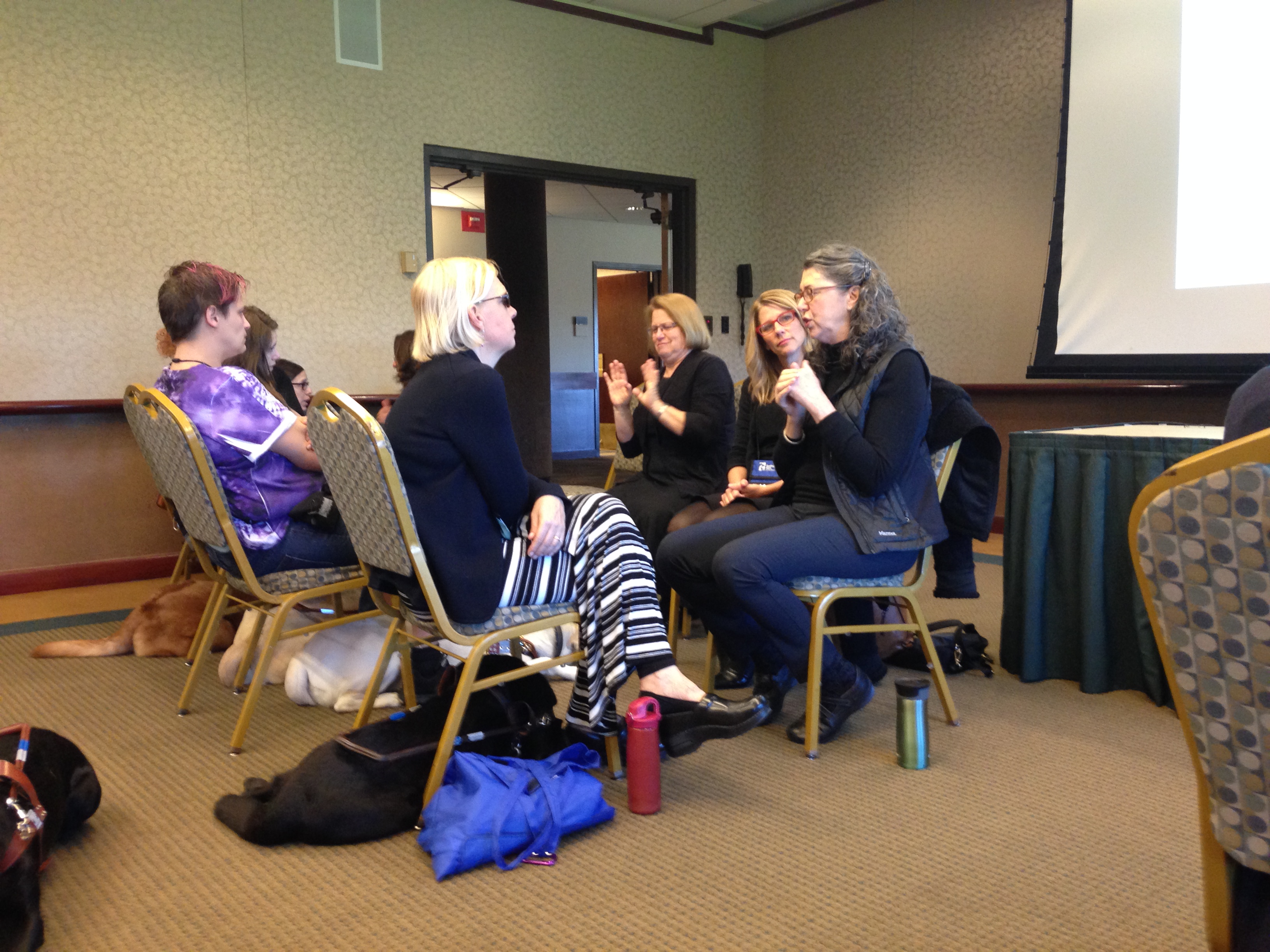
As registration opened for the Guiding Eyes continuing education weekend, a number of these grads registered. Planning committee member, grad, and GEB consumer outreach and graduate support manager Becky Barnes Davidson waved a magic wand and somehow found funding to bring a cadre of interpreters to the weekend, ensuring that all of the grads could participate fully in the events.
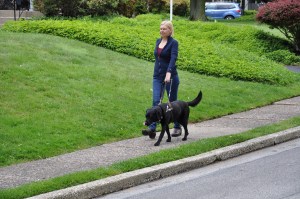
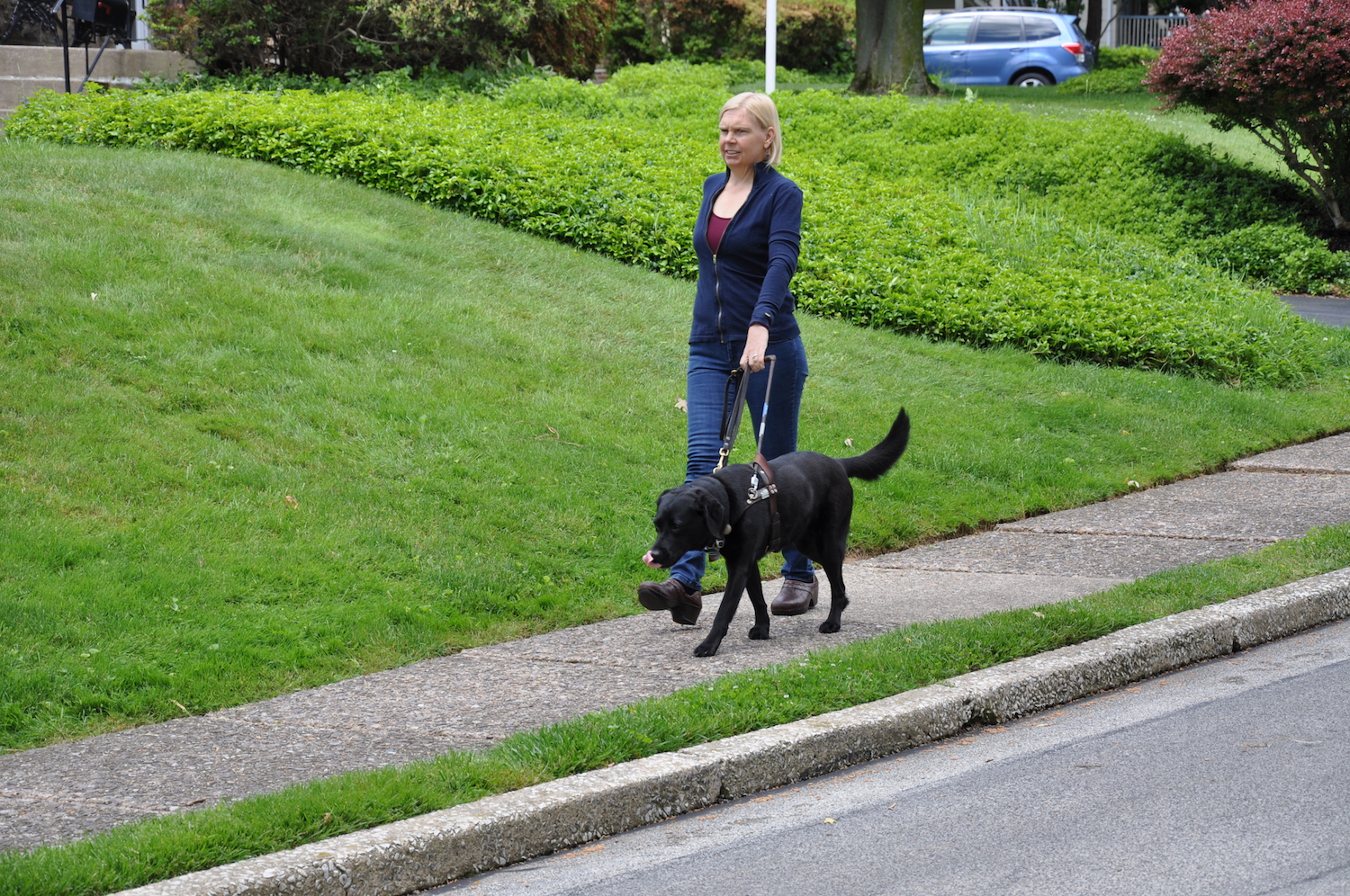
Deborah and Gypsy walk togetherI had the opportunity to chat with one of these grads, Deborah Groeber. She got her first Guiding Eyes dog in 1987. GEB didn’t yet have its “Special Needs” training program, which got off the ground in 1990, but, Deborah said, it was the only guide dog school willing to try training a guide for her.

Having guide dogs has, of course, made a tremendous difference for Deborah, especially in her frequent travels. She describes traveling with her dogs (current guide Gypsy is her fifth) as “phenomenally different” from traveling with a cane.

“I think Gypsy is a great match for me because she loves going from the suburbs into the city every day, loves taking trains, buses, escalators, stairs, revolving doors and working obstacles and construction sites. She is bright, confident and self-motivated, but she also loves praise and food rewards,” Deborah said.

Deborah is about to participate in another unique Guiding Eyes program. Gypsy is nearing retirement, and Deborah’s next guide will be a member of GEB’s new program, Running Guides.

Running Guides perform the usual guide dog work as well as guiding their partners while running. The first Running Guide team graduated in 2015. And Deborah’s dog will, as Gypsy has, learn to alert her to sounds, such as smoke alarms, phones, and doorbells. Deborah knows how to teach her additional alerts as needed. Sometimes Gypsy figures it out on her own, too.

Once, not long ago, Gypsy alerted her to a carbon monoxide alarm when Deborah’s husband was traveling for work. Gypsy is not allowed in the basement, Deborah explained, but she kept alerting to the basement door, because she heard the unexpected sound of the alarm. She’d not been trained to respond to that sound, but somehow understood that it was an urgent problem. Deborah got both the CO and smoke alarms, Gypsy told her which one was making noise, and she was able to respond and resolve the problem.

That story underscores the connection and communication that develop between members of a guide team. Many of us plain old pet-dog owners, who have the good fortune to be able to see our dogs’ body language and hear their vocalizations, are nonetheless unable to figure out what they are telling us. And I bet most of our dogs would react to an alarm and try really hard to get us to do something about it. That we’d all die of carbon monoxide poisoning anyhow would not be the dogs’ fault…

As someone who has tremendous faith in dogs’ abilities to figure things out, communicate, get what they need, figure out what their humans need, and so much more, I am not amazed that a single dog can perform both guide and hearing work, with a side gig as a personal fitness trainer. I am impressed that enough people at Guiding Eyes believed in dogs back in 1987 to give combined guiding and hearing dogs a try, and that the organization is continually coming up with new ways to stretch and grow the partnerships between their amazing dogs and clients.
Amazing

This slideshow requires JavaScript.

I spent a recent weekend at an event that brought together guide dog teams, puppy raisers, and trainers, all from Guiding Eyes for the Blind, a New York-based organization. It was a “continuing education” weekend, offering training and coaching for teams, education on dog related topics ranging from breeding for success to technology that eases travel for guide dog teams, and opportunities for people who work with guide dogs to meet the people who raised and trained them. Nothing like it had ever happened before at any guide dog school.

The weekend was three years in the making. The idea was initially met with skepticism from the training staff, though it was immediately embraced by the grad teams and puppy raisers. As teams arrived at the hotel, those of us who had planned the event and were checking them in began to have doubts. 80 guide dog teams in one hotel? What were we thinking? Arriving dogs, on recognizing kennel buddies, puppy pals, trainers, or, best of all, their puppy raisers — their first families — momentarily forgot their manners and bounced, danced, and wagged with joy. Grads, meeting familiar friends and encountering new ones, were equally emotional. The dogs, at least, quickly remembered their excellent breeding and top-notch training and focused on getting their partners to their rooms. Which was no small challenge in the most confusing hotel I’ve ever seen.

Over the weekend, humans and dogs continued to amaze. An army of volunteers, primarily puppy raisers, escorted blind attendees to tables in the dining room and helped them navigate the extensive buffet meals. In sessions, anywhere from a dozen to eighty calm dogs relaxed under tables and at handlers’ feet, oblivious to distractions. They worked through bustling hallways and deftly steered around other teams, running children, concrete pillars, and tempting indoor gardens of lush vegetation.

The weekend was important for so many reasons. Puppy raisers, including some who have been raising and socializing puppies for more than twenty years, got to see living, breathing examples of how their hard work and devotion improves lives. Graduates got to meet the wonderful people who raise the puppies who become their partners. All of us met new friends (or finally met in person people we’d been communicating with for years!). Everyone got a better understanding of what it takes to turn a tiny puppy into a working guide.

This special event provided enough information and stories for several blog posts, which I’ll write and post over the next weeks. Most of all, it was an outstanding example of how capable, creative, and flexible dogs — and their human partners — truly are.

Koala’s Marshmallow Test

This slideshow requires JavaScript.

Koala, Deni’s current guide dog, is an exuberant dog; she has greeted me so enthusiastically that I emerge bruised. When she finds Deni a trash can to dump her poop, Koala leaps up and embraces the can, entire body wagging. So I was skeptical that she’d do well on the marshmallow test.

The marshmallow test is a test of self-restraint. The original test pitted preschoolers against marshmallows: If the child, unsupervised, could hold off on eating a marshmallow for 15 minutes, the researcher would reward the child with a second marshmallow. Children who waited, rather than eating the marshmallow with which they were left alone, were found, as adults, to have achieved greater success according to a variety of measures: higher SAT scores and greater academic achievement, more likely to have saved for retirement, etc.

Alberta, Deni’s previous guide dog, as you might recall, did very well on the marshmallow test. She clearly worked to distract herself from the treats, employing some of the methods the children did: she turned away, closed her eyes, raised her head and closed her eyes. Some of the kids sang or hummed; Alberta raising her head to smell something other than the treats is probably the doggie equivalent.

Alberta is, in many ways, a less exuberant and more restrained dog than Koala. So, I did not expect Koala to fare as well on this test of self-restraint.

Deni set up Koala’s test just has she had Alberta’s. A bowl of dog cookies was placed in the quiet hallway outside Deni’s office; Koala, dressed in her guide harness, sat in front of the bowl. Deni told her to “leave it,” then Deni went into the office and closed the door. Koala was alone in the hallway, but Deni, and a student photographer watched through the window blinds. Koala could not see Deni.

While Deni and the student were setting up the test, filling Koala’s bowl with treats, Koala — in harness — leapt and bounced around them in excitement. The student commented that she did not think the test would end well for Koala.

So, how did she do?

As Alberta had, Koala first leaned in and sniffed the cookies. She sat back up. And sat there. Unlike Alberta, she sat and stared at the bowl, salivating a bit. That’s it. She did not have to distract herself, she did not look away, close her eyes, or sing to herself. She aced the test.

I might need to point out: Both girls are Labradors who love their food and adore cookies.

Why was the test easier for Koala? Both girls were able to fight temptation and exercise self-restraint. What’s her secret? I’d love to say that her analytical nature is the key, but being very analytical myself has never helped much in the face of a chocolate-chip cookie.

Is Koala simply on a higher ethical plane than Alberta is (or I am)? That is the question that Deni is now asking: Is Alberta more ethical for having overcome a struggle to exercise restraint? Or is Koala more ethical for being easily able to do the right thing? Deni asks her philosophy students the same question about people.

We may never have an answer to that. What we do learn from this test, though, is that a dog’s behavior is not evidence that that dog can (or cannot) learn to “behave” —exercise self-restraint — in other circumstances. Koala, for example, plays tug to win, big time. She’d rip your arms out of their sockets if you let her. But her ability to “leave it” shows that, with practice and reinforcement, she could exercise that same restraint in other areas.

For other dogs and people, that translates to not giving up on a dog who has some uncontrolled behavior; it’s likely that, with some coaching, time, and practice, that dog, too, can pass his own marshmallow test. Now I am curious about Cali …

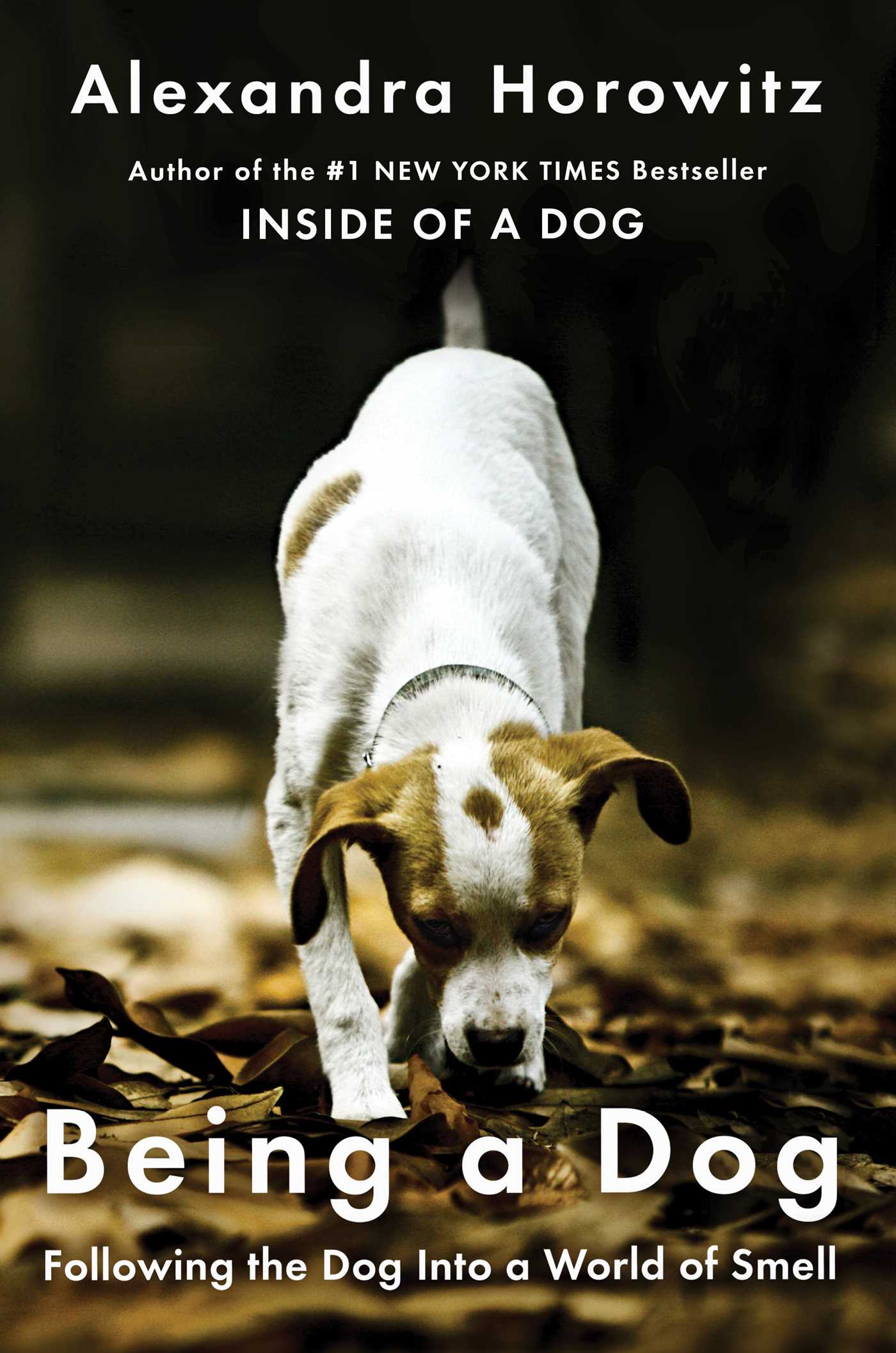
Being a Dog

Alexandra Horowitz’s new book, Being a Dog, is as much about being — and sniffing as — a human as it is about dogs and their world of smells. Horowitz does a great job breaking down the science of how dogs smell and how humans do (or, rather, fail to). I finally understand how different the dog’ s sense of the world is, in a way that superficial comparisons of the number of smell receptor cells dogs and humans have never could convey.

Dogs process and understand smell in a completely different way from humans. Smell is an entire language. Sniffing stuff on a walk is like reading an entire encyclopedia. Horowitz says that dogs don’t judge smells the way we do either. Smells are information; neither good nor bad. That explains a lot!

A couple of weeks ago, I described “smell walks” but I wasn’t sure exactly how these were supposed to work. Jana will be devastated to learn that not all walks need to be smell walks, but she will be delighted with the news that she deserves frequent smell walks. She sort of gets them already: The rules are that the dog gets to decide what direction to head, when to change direction, when to stop, and when to continue moving. If you and the dog never make it down the front steps, so be it. Luckily, we don’t have front steps.

I’d guess that it’s best to smell-walk one dog at a time, though Cali seems pretty happy with letting Jana choose smell sites. One must not head out on a smell walk when one is pressed for time. Especially if one is walking Jana; her smell walks could easily last from breakfast until dinner, especially if one remembered to bring refreshments for along the way.

There’s a lot more to the book than smell walks, though. There’s a lot of science, much of it having nothing to do with dogs but lots to do with smells. There are some great chapters on working dogs that barely scratch the surface of what career options are out there for dogs with working noses. There’s also a description of Horowitz’s experience taking her dog to a nosework class. He, like Jana, was a natural. But her descriptions of some of the other class members, nose-impaired and inhibited, were very sad.

Nosework classes are a dog’s idea of heaven on earth. The dog is in charge. The human cannot tell her “no” or hold her back. She gets to climb on things and under things and stick her nose anywhere she wants to. She can bark as much as she wants. And the reward for finding something smelly is a ton of treats. Not hard to figure out why Jana loved it. Cali would, too. She deserves a smell class of her own, come to think of it.

The book is definitely worth a read. Horowitz’s last book, Inside of a Dog, was billed as offering insight into how dogs experience the world. But I think that Being a Dog does a much better job of that. Scent is what defines the dog’s world; as much as most humans rely on what they see to understand the world, dogs turn to scent. Gaining a better understanding of what that means is the best way to try to understand dogs. When you’re done, sign your dog up for a nosework class. Maybe Cali and I will see you there!