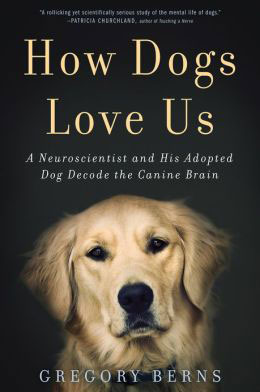
 Gregory Berns got the crazy idea of training his dog to lie still in an MRI machine, in the hope it would provide some insight into dogs’ thinking. What he found brings scientific proof to something every dog person knows — that dogs read us, anticipate our behavior, and act on that knowledge. Dogs, in short, have theory of mind. Berns rightly argues that this scientific evidence must change the way we think of and treat dogs.
What’s especially wonderful about this story is that, at least at the beginning, Berns is not an especially savvy dog person. He loves his dogs, treats them extremely well, but hasn’t spent a lot of time trying to communicate effectively with them or train them. By the end of the book — or maybe by a few months into the research — he’s become convinced that dogs communicate and function on a very high level and that “the key to improving dog-human relationships is through social cognition, not behaviorism.” Quite a journey … in fact, it’s the same journey that I hope to push my students along in Bergin U classes on dog training, canine-human communication and understanding the dog’s perspective. (Any current Bergin U students reading this might as well order their copies now … this book is destined to become required reading in all my classes.)
The book is filled with fairly complex scientific concepts, but it is written beautifully and clearly. It is very easy to understand and, like a good adventure novel, pulls readers along with foreshadowing and suspense. I especially love the long discussion of the ethical issues Berns and his team faced in setting up the research and the insistence of all the human researchers that the dogs would always be free to opt out, at any time. I also love the dog-centric approach the research takes (read the book to find out what I mean!). This book — this whole research study —is a testament to the amazing possibilities that exist when humans acknowledge their dogs’ abilities, treat them as partners (rather than as property or as slaves), and engage with them in a respectful, positive manner.
Because I am nut for precise language, I do have to quibble with the title. Berns does not actually show HOW dogs love us. He does show, I believe, that they DO love their human family members. While he can’t really show us what dogs are thinking, though, he has shown a way to understand their likes and dislikes — and perhaps opened the door to a better ability to read in dogs other emotions that humans and dogs share.