 “The walls and grids that restrain your animals restrain also your own knowledge.”
— Vicki Hearne
What I call “old-school” dog trainers — those who operate from the assumption that the human has “to be the alpha” in his or her relationship with a dog — don’t, in my opinion, credit dogs with much in the way of cognitive ability.
Some, like the 1920-era European trainer Konrad Most, bluntly state an approach to education that many of us would recoil from today: “In the absence of compulsion, neither human education nor canine training is possible.” Others, like William Koehler (circa 1960s), give rational-sounding advice: “Lay down a set of rules, and see that your dog lives by them.” But the means used to accomplish that goal are harsh and authoritarian.
What these trainers share is an emphasis on punishment over motivation or reward and an expectation that a dog should offer instant, precise obedience to any command given by a human. The expected response is almost robotic in its uniformity and immediacy.
Trainers with these expectations do not believe that dogs can — or should — think or be part of a decision-making process. No, the dog should know who’s boss and, according to Most, “do what we find convenient or useful and refrain from doing what is inconvenient or harmful to us.”
While both Most and Koehler were both enormously influential in the development of dog training, much about their approach is antithetical to the goal of raising a thinking dog.
Demanding instant, precise obedience to all commands in all situations does not allow for the dog to think or process the command in any way. When you expect instant, unquestioning obedience from your dog, you are essentially prohibiting him from thinking. In human relationships, we talk about such expectations this way: “When I say jump; you may ask only, ‘how high?’ ”
To raise a thinking dog, that is, to use a cognitive approach to your dog’s education, you must have expectations that not only allow for but encourage the dog to think and solve problems. The cognitive dog needs to learn, understand, and, ultimately, buy into a shared goal. Expecting unquestioning obedience at every request, mapping out not only the end result but every step the dog must perform to get there does not — cannot — allow dogs to think conceptually about what you are trying to accomplish, learn to solve problems, or offer a different (maybe better!) solution.
Granted, there are situations where an instant response is necessary — if your dog is unthinkingly following a bouncing tennis ball into a street, for example. But developing your dog’s cognitive abilities does not prevent you from also teaching your dog a strong recall and an “emergency recall” cue that, when taught and practiced with the highest-value treats possible, will ensure an automatic response in a true emergency.
There are many ways to lead or manage (or parent). Those of us who want to share our lives with thinking dogs should be wary of dog professionals who talk a lot about alpha roles and hierarchical relationships. Instead, we should look for ways to develop our dogs’ considerable cognitive abilities. Start by figuring out what motivates your dog. Read future blogs for tips on how to do that and more.
thinking dog
Teaching or Training?

Puppies, like babies, are born with the potential to learn and problem solve and think. They are innately curious and begin investigating their world even before they open their eyes.
Our job is to develop these skills in our puppies and dogs by providing opportunities for them to learn and develop their conceptual thinking abilities. We can expose them to lots of novel items and situations and provide encouragement and motivation. We can also be on the lookout — especially with puppies — for opportunities to turn potential problem behaviors into desirable, adorable, and even helpful skills!
Dogs who are taught, especially by handlers who use methods that encourage problem-solving, become better problem-solvers. A study called “Does training make you smarter?” compared dogs who had received training with dogs who had not. Dogs who had received training solved a problem — opening a box that had a pad that could be pressed by the dog’s paw — spent more time trying to open the box (and were less likely to seek help from their owners) than dogs who had no formal education. The study’s authors speculate that trained dogs have “learned to learn” in a way that unschooled dogs have not.
But, and this is a big but — not all education is equal. There are many approaches to teaching or training, and the methods you choose will affect more than just how fast your dog learns — it can affect the bond between you and your dog, and it can shape or reflect your attitudes toward dogs. And it’s not just the method. The words matter, too.
I make a distinction between training dogs and teaching them because I think the word choice reflects a difference in attitude and goals.
Training dogs is what I call educational approaches that are narrowly focused on eliciting specific reactions to cues or commands. The trainer has a clear end result in mind for each command. The trainer says, “sit;” the dog sits. Practice emphasizes precision of the dog’s response, speed of the response, and the dog’s ability to respond quickly and precisely even when distractions are present.
When I refer to teaching, on the other hand, I am referring to a process that develops the dog’s thinking and problem-solving abilities. The teacher’s goal is to give his or her students the tools and the confidence to figure out what to do in a variety of situations. Sometimes, a teacher might seek a precise response, like the sit; other times, the teacher makes a request that requires the dog to figure out what to do. “Find a pen” gives the dog a goal but no precise instructions for reaching that goal.
Teaching brings the dog to a level of independent thought and problem solving that enables him to respond to a command or cue that is as vaguely defined as “find a pen;” training does not.
Any approach to training or teaching is based on an underlying mindset or set of assumptions: assumptions about what dogs are capable of learning; assumptions about how dogs learn and how much of what we say and do they actually understand; and assumptions about what the dog-person relationship should be.
Trainers who do not believe that dogs are capable or reasoning or problem-solving are unlikely to put any effort into developing these skills in the dogs they train. Trainers or handlers who believe the dog’s “job” is to be obedient and submissive are unlikely to tolerate a free-thinking dog. Some trainers talk about “getting dominance” or “being the alpha” as ways to ensure that dogs remain obedient and submissive.
Methods of dog “training” or education can be placed on a continuum that ranges from those that do not encourage the dog to think at all to those that practically make the dog do all of the thinking. The Thinking Dog blog will teach you to recognize various approaches and their goals — and encourage and equip you to explore methods that help your dog become the best thinking dog he or she can be.
Cali, the Ghost, and the Dog Door
 Our electronic dog door continues to be a wonderful window on the dogs’ personalities. The dog door is operated (ostensibly) by a magnet attached to each dog’s collar. The idea is that only animals with magnets can open the door, keeping out neighbor cats, possum, raccoons and the like.
Well, in one of Florida’s daily summer thunderstorms, the door suffered damage. The motor would hum but the door would not open. We summoned our electrician, ordered a part, summoned the electrician again, and, after a few dog-doorless weeks, were back in business. With a twist.
The door started opening and closing all on its own. We joked that not only had we acquired a resident ghost, but the ghost somehow had been given its own key and had learned to use the dog door. As I sit at my desk, not a dog in sight, the door will occasionally open and close. Then do it again a few minutes later. The ghost going out for a potty break and returning? Or the ghost entering for a brief reconnaissance and leaving? Hard to tell, since I can’t actually see the ghost.
Meanwhile, Cali, who learned to use the dog door in just seconds flat, has lost key privileges. She, it turns out, wants to spend all of her time outside chasing lizards. And occasionally catching them, with gruesome results for the lizard and anyone watching. She has recently taken up stalking those huge, bright yellow Florida grasshoppers that are apparently quite tasty. Her other hobby is digging small ditches all over the backyard. Some dogs, it seems, are too immature to handle the freedom a dog door brings. Unable to convince her to take up knitting, gnawing chew toys, or even sunbathing (with sunscreen!), I took her key away.
With no key, Cali has to ask permission to go out, and she now has supervised playtime. She hates that. She has figured out that she can sometimes follow her big sister Jana out. Occasionally, I think when Cali is being particularly, er, adolescent, I have seen Jana walk with her over to the door. Door opens; Cali runs out; big sis walks away with, I swear, a big smile on her face.
The next step was probably inevitable: Cali discovered the ghost. And decided to train it. She could get the ghost to let her out! Who needs a key when you have a trained ghost?
Now, when Cali wants to go out, she sits, patiently staring at the dog door. Eventually, usually within a couple of minutes, the ghost does, indeed, let her out.
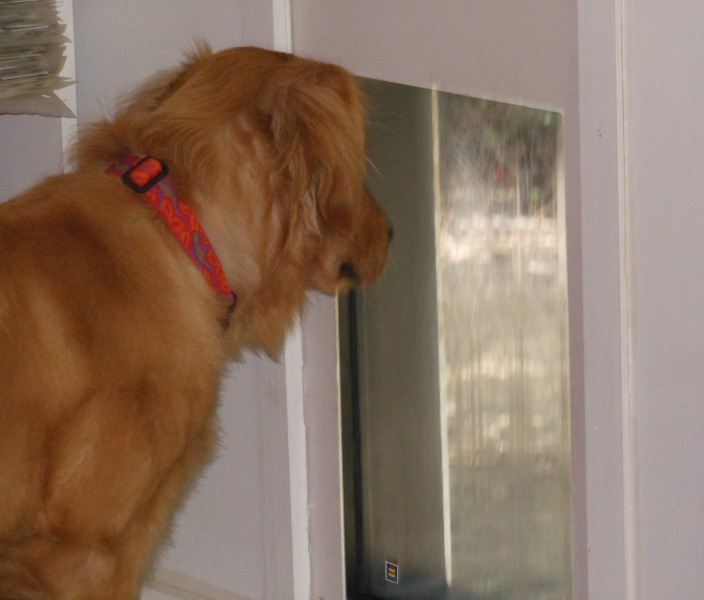 Cali has had less success at training the ghost (or her big sisters) to let her back in, however. When she gives up on the ghost, she’ll sit, looking sadly at the back door and occasionally jumping on the glass, until I let her in. Twice I have come home from errands to find her outside, stretched out in the shade, waiting patiently.
I haven’t seen her sitting by the dog door on the outside, waiting for the ghost. But she has gotten back in without my help on occasion. So maybe the ghost training is going better than I think.
Sometimes, when Jana or Albee opens the door to go out, Cali seizes the moment and slips in very quickly. Jana isn’t quite as agile as she used to be, and the door only stays open for about 5 seconds. So when Cali does this, Jana is left inside. As Cali enters and the door closes, Jana gets a perplexed look. I am sure that, as she waits for the door to open again, she’s wondering why she wasn’t lucky enough to be an only dog.
The Inclusive Dog
 Cali, Albee, and Deni are playing fetch with a Zipflight (a Frisbee-like toy for dogs that Cali is crazy about). I wander over with Jana. Deni throws the disc. Cali catches it. Cali then brings it over and offers it to me for a throw.
If more than one person is in the area where Cali is playing fetch, she always does this. I find it charming. She takes the toy to one person, and then to the other, as if to include everyone in the game. She’ll include people she doesn’t know well, too, if they happen to be standing near and watching.
Oriel did this too. Cali and Oriel are closely related, but since Albee occasionally does it too, I don’t think genetics fully explains this behavior.
A professor I had in graduate school, ethologist Marc Bekoff, has hypothesized that play behavior forms the foundation of social ethics for a species. That is, youngsters learn how to get along in the group — what is “good” and “bad” behavior in their society, what the rules are for acceptable social interactions — at least partly through their games. They learn to play by the rules, not hurt each other, not to cheat or deceive, and to self-handicap when playing with younger or smaller friends. We observe all of this as our well-bred and well-socialized canines play with one another and with other dog friends. This might be a partial explanation, but Cali’s behavior seems to go a step farther.
I’ve seen dogs take turns in other situations — at the school where I teach, it’s not unusual to see three or four dogs lined up, waiting for a turn at the water bowl! And of course, when we play with our three dogs they must take turns chasing the ball when we throw it. Our dogs wait their turn to get their treats, to get brushed, even to get their dinners. Taking turns is nothing new in multi-dog homes. But dogs ensuring that all of the people and dogs get to join the game is unusual and shows an even higher level of social awareness. Cali’s not waiting for her own turn to do something fun or trying to get extra turns. She’s going out of her way, sometimes across a large lawn, to invite someone else to take a turn, to join the game.
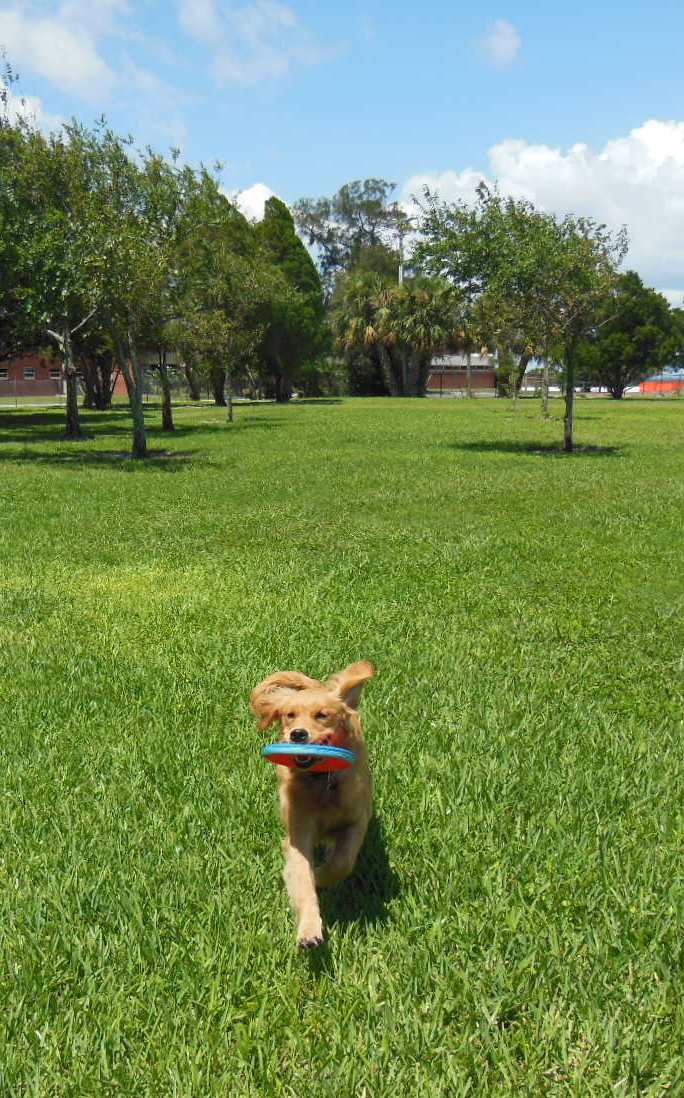 It’s impossible to know exactly what motivates her to offer me a chance to throw the ball when she’s playing with Deni, but it does bring the family together. She even takes the ball over to Jana to offer her oldest sister the chance to chase the ball! Cali’s desire to include everyone reflects something that matters to her. Empathy, or possibly inclusiveness.
An inclusive organization is defined as one that values the contributions of all people (human and canine!); one that incorporates different members’ needs, assets, and perspectives. That sounds like the kind of dog-human family I want. And, from her actions, it appears to be the kind of dog-human family that Cali wants too.
Special Delivery
 A story Deni told me about Jana has been going through my mind for several weeks now. I haven’t figured out the answer; maybe the students in my spring-semester class on the dog’s perspective will help me figure it out.
We have had a lot of work done on the house lately, and somehow, the gate to the backyard got left open. I was away.
Deni reports that the dogs woke up and took themselves out the electronic dog door as usual. Then, suddenly Wylie was back at the bed, barking at her, quite insistent that she get up. Not fully awake, Deni complied (Wylie rarely takes “no” for an answer). She noticed that Jana had not come back inside. Wylie was frantically urging Deni to the back of the house, where she noticed the open gate. And no Jana.
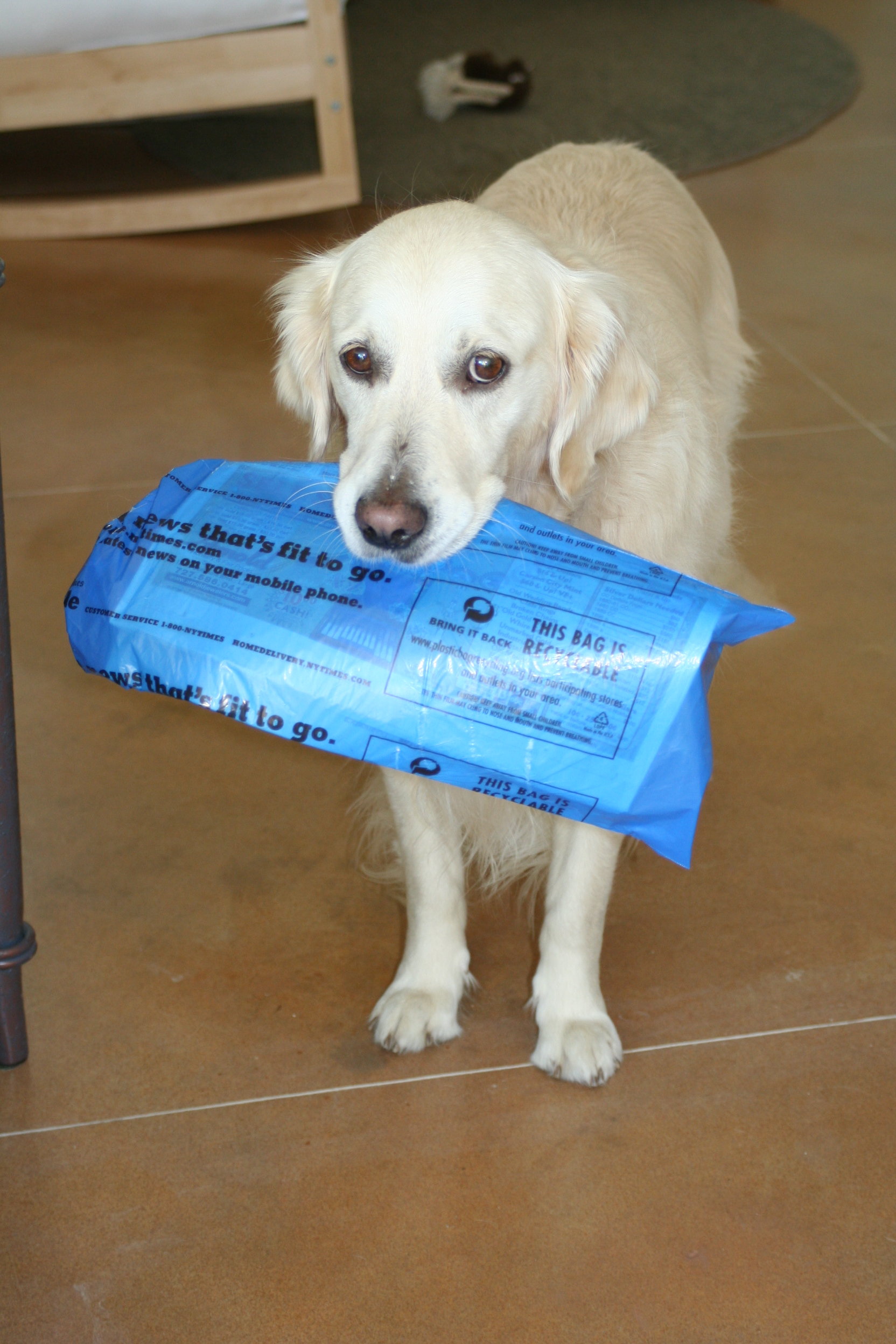
Now fully awake and worried, Deni quickly pulled on some clothes. Again, Wylie alerted her. This time, she followed him to the front of the house … where Jana was standing at the front door. Not only that, Jana was holding the morning newspaper (hmmm, too bad she didn’t nip out for fresh bagels while she was at it).
Relieved, Deni let Jana in and lavishly praised and rewarded her. But for what?
While Deni was delighted that Jana had stayed home, she and I both wonder how Jana understood the event.
Did Jana think she was being praised for simply doing her usual morning job of getting the paper? Or had she made a conscious decision to not seize the unexpected freedom and go for a swim or chase the cats next door? Did she understand that Deni was grateful for her restraint?
Maybe Jana finds too much freedom frightening and chose to return to safety.
Maybe she was afraid she’d get in trouble for being out and hoped that the paper would mollify Deni and mitigate punishment.
These are plausible explanations.
But Jana has had other opportunities to run through open gates, and she’s never passed one up. Just this week, when the roofers were packing up, I inadvertently let her out the back door before the back gate was closed behind the roofer’s truck. Within seconds, she was in the back alley. She did return immediately when I called her, though. And she’s often wandered off on her own during walks or hikes, farther than the front porch (but never so far that she could not see me or Deni).
She’s never gotten more than a scolding (and a leash) when she’s wandered too far afield in the past, so fear of punishment is unlikely.
She may have simply made the choice to stay close to home because she knew that that was the “right” thing to do. Could she have understood that Deni could not easily pursue her?
Which begs another question: Why did Wylie go to alert Deni rather than seize the moment, as it were, and go for a run? He has done so in the past. Was he worried about Jana or about keeping his pack intact? Was he delighted at the role reversal — that he got to be the good dog (and the tattletale) this time?
Though many people do not believe that dogs are capable of such deep, conceptual thinking, I do believe that Jana and Wylie are capable of making the judgment to do the “right” or the expected thing, even in the face of temptation. I have seen it many times in working dogs (including Wylie) — as well as in Jana and other pet dogs. I’ve also seen both Jana and Wylie give in to temptation and follow their impulses or their instincts. Just as we humans sometimes “do the right thing” and sometimes do what’s fun or feels good, so do dogs.
All things considered, my best guess about that morning is that she didn’t want to miss breakfast. Your thoughts are welcome.
Teach “Incompatible” Behaviors for a Well-Mannered Pup
New puppy parents are often advised to keep a supply of puppy chew toys handy in every room. If the puppy starts to chew on something inappropriate, such as the sofa leg or a shoe, the humans can easily reach for a puppy toy and offer a trade. This is good advice and a good introduction to teaching an “incompatible behavior” to replace an undesired behavior: If the puppy is chewing on her own teething bone, she’s not destroying the furniture.
In my last blog post, The Best Alarm Clocks Ever, I mentioned procedural memory in a description of how and why dogs remind us that it is time to get up, feed them, or even take our medication. Procedural memory is even more significant in the way it affects other routines and behaviors.
Some psychologists say that procedural memories form aspects of character or habits. That means that a behavioral or emotional response to a particular situation could become an automatic or ingrained response. This is a valuable piece of knowledge in educating dogs (or humans). Old habits are hard to break, but understanding where a behavior comes from might mean that you can work to change it — replacing the “bad” habit with an incompatible good habit. An incompatible behavior is simply any different behavior that cannot be done at the same time as the undesired behavior. Learning the new “routine” will replace the old, undesired one.
A common example is doggy greetings. Jumping up to greet people (or adult dogs) is a very common puppy behavior. This probably hearkens back to dogs’ wolf ancestors. When young wolf pups jump up and lick adults’ muzzles, it stimulates regurgitation feeding. Ick. (It’s also a submissive behavior.) When our cute puppies jump on us to greet us, we might not feed them in the style of wolves, but we do tend to reach down and pet and cuddle them. We might laugh and tell them how wonderful they are. This is fun and rewarding for puppies, and it encourages puppies to continue to jump on returning human family members and guests. Many small puppies grow, though, and become large, gangly adolescents, then 60- or 100-pound adult dogs. Jumping is not cute anymore, but the puppy has never learned not to do it; in fact, the puppy has been rewarded for jumping.
Some old-fashioned trainers might suggest stepping on the dog’s toes or kneeing the dog in the chest to stop the jumping behavior. This is cruel and does not teach the dog anything other than that his human can’t be trusted. From the dog’s perspective, his human has suddenly started hurting him for no reason. After all, the human allowed and even encouraged the jumping when the puppy was small.
A more fair and humane approach is to teach an incompatible behavior, for example teaching the puppy or dog to sit to greet people. If the puppy is sitting, she can’t jump, right? (Another option for overly enthusiastic canine greeters is to teach the puppy to fetch a toy and bring it to the visitor.)
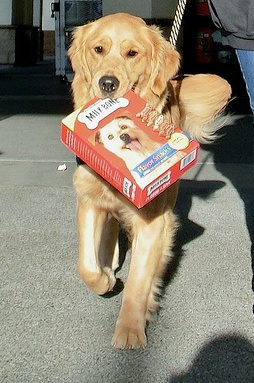
When Jana was a puppy, I wanted to teach her to sit to greet visitors. I put the “incompatible behaviors” principle to work successfully — both on puppy Jana and on our guests. First, I taught Jana to sit when I crossed my arms over my chest. Then I asked entering guests to cross their arms. This action was “incompatible” with petting the jumping puppy. It also gave Jana the cue to sit (incompatible with jumping). Viola! Jana sat and was rewarded with praise, petting, and, often, treats; I could happily greet visitors without fretting that they were teaching Jana bad habits.
In The Best Alarm Clocks Ever, I also mentioned Jana’s propensity to remind me of mealtimes — well ahead of time. Doggy dinner is at 6 p.m., but Jana often starts hinting, nudging, trying to lead me to the kitchen, pointing out her empty bowl, etc. long before 5 p.m. Do you suppose that, if I taught Jana to make cocktails at 5 p.m., she would stop bugging me for her dinner? It’s worth a try …
Wily Wylie
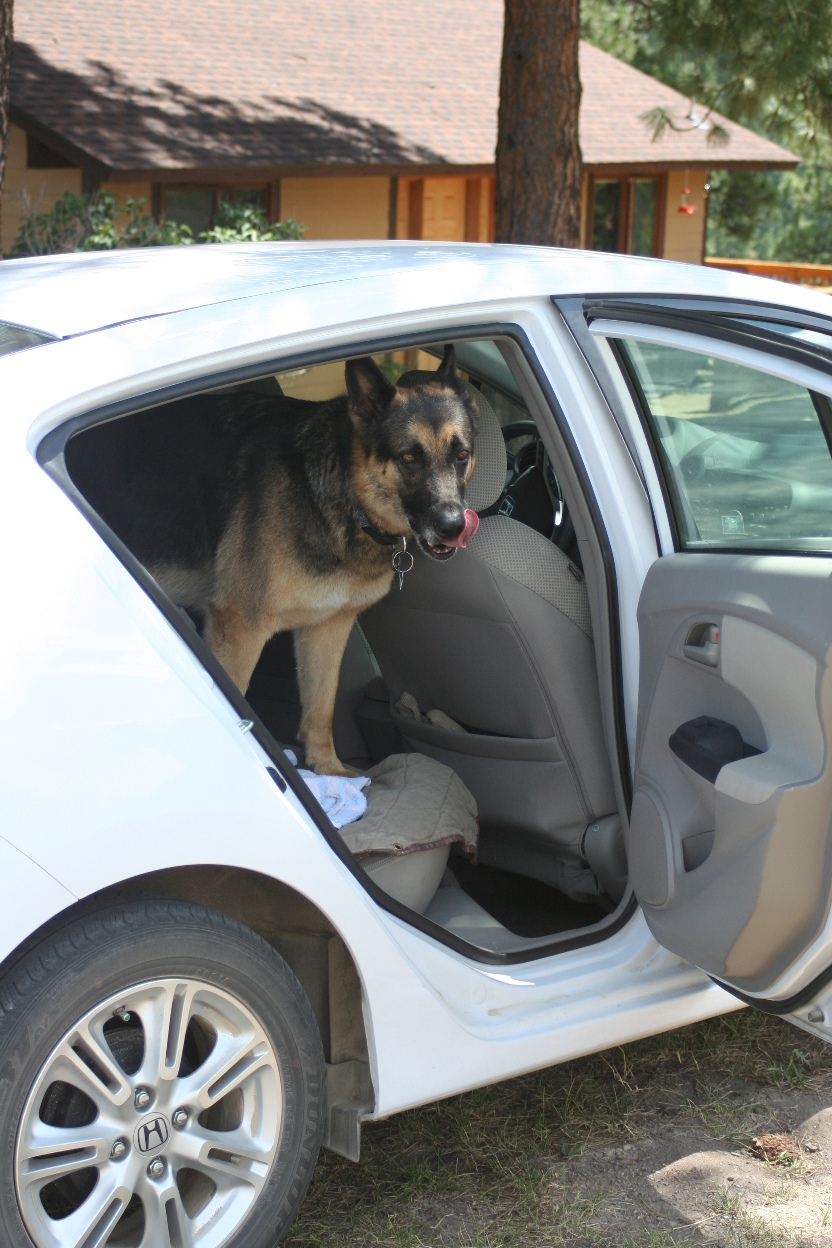
The chipmunk was driving Wylie crazy while Deni put the car’s backseats down in preparation for transporting some boxes. Taunting him, chattering nonstop, and darting around the yard. It ran under the car. Wylie ran around and around the car, fixated on the annoying rodent. Deni stepped around the dog, adjusting the seats through the car’s open doors. The crafty chipmunk stayed under the car, just out of paw’s reach. Then Wylie had an idea. Jumping into the backseat of the car, Wylie paced, peering intently out each door. He had figured out that, if that darned racing-striped rat didn’t see him, it would feel safe enough to leave the shelter of the car — and Wylie would be ready when it did!
Wylie’s idea of outsmarting the chipmunk (foiled only when Deni called Wylie back to the house and closed the car doors) shows his ability to strategize. Wylie uses his canine wiliness and planning skills in other ways as well. He’s not the only one.
Anyone who lives in multi-dog families has surely seen a gambit popular with Jana, Wylie’s doggy sister. Noticing that Wylie has a bed, bone, or toy that she might like, she suddenly looks intently out the sliding glass door or runs to the dog door, madly barking her “Look! What’s that in our yard?!” bark. Ever the dutiful watchdog, Wylie immediately goes to investigate and use his authoritarian German Shepherd voice to scare off any dangerous intruder. While Wylie’s scanning the horizon, hackles raised, Jana saunters over to the bed, bone, or toy he had been enjoying … and takes possession.
These stories and many more indicate that dogs have what is called “theory of mind.” Theory of mind means that they are aware of points of view other than their own and use that awareness to guess what another creature might do in a particular situation. It’s a necessary element for empathy and plays a role in much higher-level thought and social interaction.
For many scientists, though, theory of mind is a crucial component of what makes humans, well, human — and unique. As in, smarter-more sophisticated-better than non-human animals. Human children begin to demonstrate theory of mind by about age four. So attributing theory of mind to dogs can be controversial. Some psychologists and dog researchers who are reluctant to attribute theory of mind to dogs ascribe dogs’ ability to “read” us humans to group consciousness or instinct.
Increasingly, though, some are willing to at least take a tentative step out on that limb.
Psychologist and dog cognition researcher Alexandra Horowitz, for example, proposes what she calls a “rudimentary theory of mind” that might exist in dogs. She defines this as “more than acting instinctively, or as a behaviorist, but less than acting with the theoretical understanding characteristic of humans.”
I’ll take that; I am not (yet) ready to argue that dogs’ cognitive abilities are on a par with those of the average human. But there are too many examples of dogs anticipating and manipulating others’ behavior and empathizing with others’ emotions to ignore the evidence that suggests that dogs show theory of mind. And it is important to consider that we, with our human limitations, are measuring dogs’ theory of mind based on how it works for humans. It’s a good bet that we haven’t come up with a relevant-to-dogs way of testing it yet.
It’s cool enough that dogs show theory of mind about their own species, even if they tend to use it, as Jana does, for nefarious purposes. But it’s even more amazing that dogs use theory of mind in their interactions with humans, often anticipating what we’ll do — and coming up with endless ways of manipulating us to walk, play with, and feed them. Any dog who has ever brought his or her human a leash, an empty bowl, or a ball is showing theory of mind (as well as creative communications skills and great optimism!). Wylie was even using theory of mind to try to imagine how the chipmunk might change its behavior if the dog was out of sight. Better luck next time, Wylie!
Never Too Young to Learn
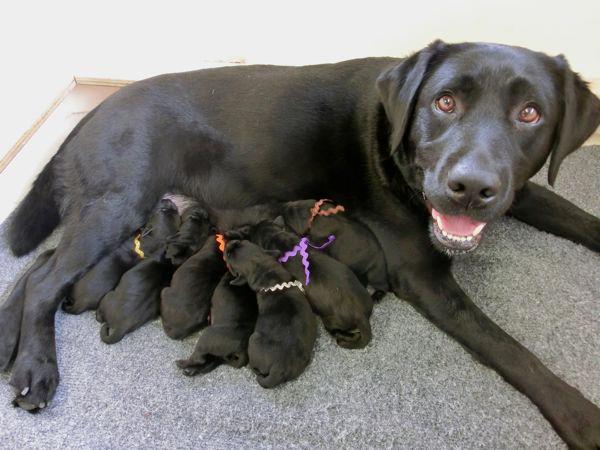 Bergin University has a litter of adorable black Lab puppies. (I know, puppies are all adorable, but I’ve always been a sucker for black Lab puppies.) The puppies started school last week. The puppies also turned four weeks old last week. That’s right. Four weeks. They’d had their eyes open for a full week before training started, so, honestly, I don’t know why the student trainers waited so long.
Sadly, there are still people who think that you can’t start formal training until a dog is a year old. Some more liberal people say that puppies can start training at six months. Then there are those smart puppy owners who get their pups into puppy kindergarten as soon as they can — usually once the pups are vaccinated. But even that is late. Puppies start learning the day they are born, if not before.
So why do people traditionally wait so long to begin teaching their puppies? In the history of dog training class that I am teaching this semester, the students have finally emerged from the cruel, punishment-focused training years of the early to mid-1900s. By the ’50s, people were starting to understand that so much emphasis on punishment actually got in the way of learning. A few trainers — Blanche Saunders, Winifred Strickland, and others — began incorporating praise and even rewards into their training! But the prevailing methods, up until the 1970s, were pretty harsh. Only older, stronger dogs could stand up to the punishment and the trainer’s lack of communication — and actually “learn” anything. Lots of dogs were deemed untrainable because they shut down or defended themselves by snarling or biting when treated harshly.
Fortunately for puppies and people who love them, trainers like Milo Pearsall and Ian Dunbar began teaching that, like young children, puppies are eager and quick learners. Furthermore, the younger they start learning how to learn, the better they get at it. In a sense, your puppy will be “smarter” if you train her early. These trainers introduced a now-popular and ubiquitous concept: puppy classes.

Human parents of a new puppy can reduce the number of bad habits and undesirable behaviors the puppy learns by enrolling the youngster in puppy kindergarten. Here puppies learn what to do — and what not to do — and develop good manners early on, all without harsh punishment. Good puppy classes emphasize socialization — ensuring that puppies are exposed to lots of different kinds of dogs, people, sounds, sights, smells, and experiences — all in a controlled, positive way. This helps puppies learn that new things are not always scary, that their human families will keep them safe, and that the world is an interesting and fun place to explore.
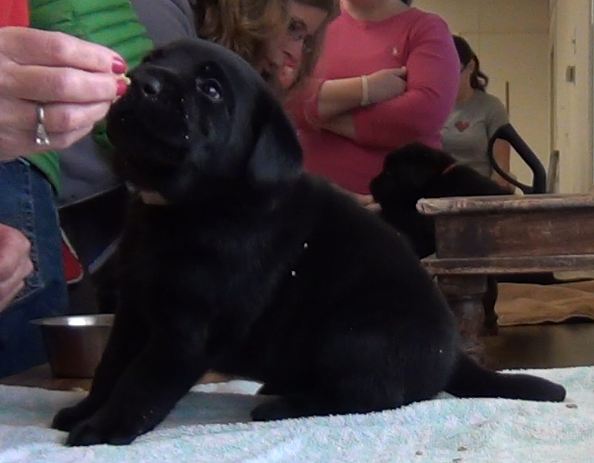
So, back to my students. These special Lab puppies are future service dogs. Thanks to Bonnie Bergin’s enlightened early training, fewer puppies need to be “released” from the program, and more will become grown-up dogs capable of doing the work needed by their owners, who have disabilities. What these puppies are learning now will pay off: The tiny bits of mushy puppy food offered as a reward for sitting or coming when called are helping the puppies build two-way communication with humans. The puppies are learning to think and problem solve, which will enable them to become full partners to the people who will rely on their assistance. Training sessions are short — only a few minutes at a time for the little pups — and fun.
The good news is that, nowadays, training that is fun is not just for puppies. Family dogs of any age can benefit from modern training approaches that emphasize positive reinforcement, rewards, and keeping training fun. Breeders can start working with puppies at four weeks; those “adopting” a new puppy at the ripe old age of eight weeks — or an older dog — can start as soon as the dog comes home. Your dog can start today. What are you waiting for?
Special thanks to Dearing English for the puppy training photos captured from her video of the first day of training. Puppies were four weeks and one day old.
Give That Dog a Job!
Getting the paper each morning is the classic dog’s job. My friend Sally continued her newspaper subscription long after she’d lost interest in reading it — just because it gave Mav, her Lab, such pleasure to get the paper. Jana started fetching the Jerusalem Post each morning when she was just a few months old. She’s graduated to the New York Times, which is considerably weightier, especially on Sundays. Every so often, Wylie tries to nose in on her morning chore, but she’s not giving up easily.
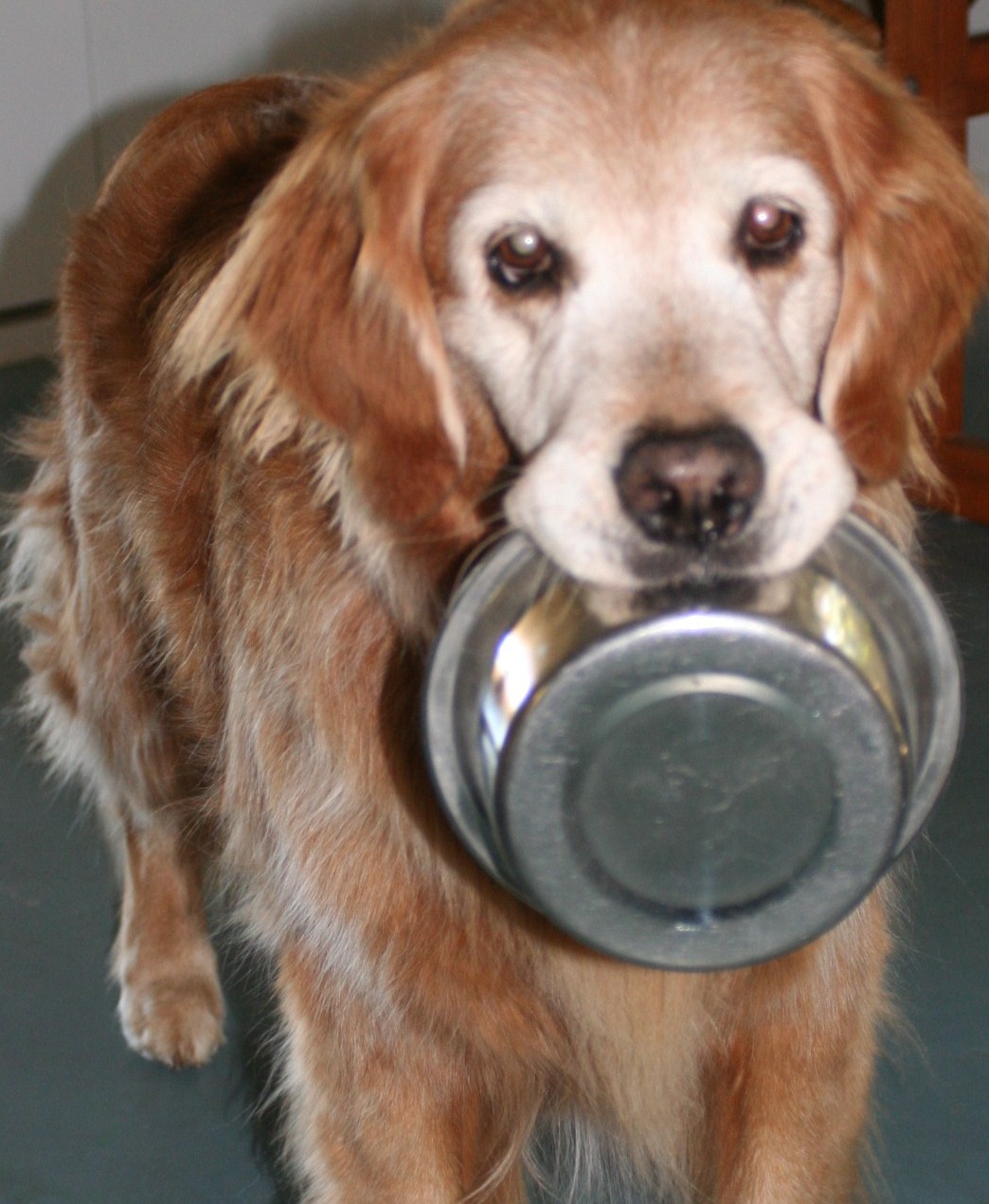
Our dogs have also learned to pick up their bowls after they eat. Some people have expressed surprise at this, understanding why a dog might bring an empty bowl in hopes that we’ll fill it but not why a full dog would bring an empty bowl. We explain that we try to encourage our dogs to behave responsibly. The dogs give us their empty bowls rather than actually washing them, but it’s a start. Jana can be persuaded to put her toys in the toy basket as well.
Dogs like to have jobs. This is a frequent topic of discussion with my dog-training students. These students are training future service dogs, but they are also preparing to train pet dogs — and their owners. We’ve talked about the many roles and careers available to dogs these days, and the consensus among my students is that, even if the job is a dangerous one (think military and police dogs), most dogs seem happier when they have work to do.
Most pet dogs are bored most of the time. Giving underemployed dogs some small tasks to do throughout the day can relieve that boredom and challenge them a bit.
Most people’s lives are filled with tasks that dogs can learn to handle, if only given the chance. When we miss the recycle box when tossing balled-up paper from our desks, a dog (or two) is always ready to bring the trash back or put it in the box for us. Fetching slippers or shoes is a natural. Dogs who learn to fetch the leash or their owners’ walking shoes when it is time for an outing might take the initiative and bring the items when they figure that they’ve waited long enough. Our beloved Oriel decided on her own to bring the water dish to one of us for a refill when it was empty, and she often brought discarded papers from the recycle box in hopes of exchanging the trash for a cookie.
If you can’t think of tasks, challenge your dog’s mind with games or a treat toy; dogs don’t seem to differentiate between thinking tasks that are just for fun and those that are dog jobs. Interactive dog games abound these days — these ask dogs to use their noses, paws, and sometimes teeth to open compartments, slide little doors, and nudge puzzle pieces aside to reveal hidden treats. Playing “tug” can lay the foundation for teaching dogs to open doors, cabinets, and drawers. Hiding a favorite toy or treat (or person) somewhere in the house encourages the dog to think, problem solve, and use her nose to find it. Some dogs’ desire to talk can be channeled into for alerting the humans to mail and package deliveries with just one bark. Other dogs, who like to carry things, can be taught to place plastic bottles in the recycle bin or clothes in the laundry basket.
The possibilities are endless. What are you waiting for? Give your dog a job!
Looking into the Future
Can dogs anticipate? Can they visualize a future event or state?
Certainly, our dogs learn our routines and recognize the signs that, say, we’re getting ready to take them for a walk or go to work. They might try to guess whether they get to come along on an outing. Wylie, our resident super-optimist, seems to anticipate doggy fun any time we get on a highway that has, once, led to a dog park. Then there’s mealtime. Jana gets agitated if we go out anywhere near (defined as “within a few hours”) a mealtime.
That’s all pretty typical stuff reported by many dog owners.
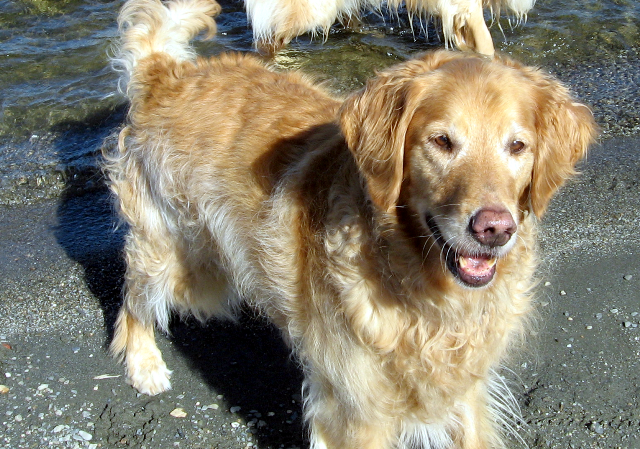 But Daisy, a very intelligent thinking dog who lives in Massachusetts with my friend Nancy, does something exceptional. She’s 13, and it’s possible that regular access to the “little dogs’ room” is more important to her than, say, to little brother Brandon (age 5). But she’s normally on a pretty regular going-out schedule, and is reputed to have enormous staying power. Nevertheless, she has recently started to pay close attention to Mom’s “leaving” cues. If Nancy is indicating that the outing is by car, Daisy will request an unscheduled pee break. Is she anticipating needing to go and not knowing when Mom will be home?
A similar question arises when I consider Jana’s habit of not drinking water when I am not home. I first noticed this when we lived in an apartment, and I was often gone for a few hours at a time. This was a new predicament for Jana, who has been an extremely lucky dog in mostly having a stay-at-home mom, or being able to accompany me to work, or having access to her yard via dog door. But things had changed.
I first noticed that the water bowl would be untouched while I was out. I also noticed that, the minute I came home, she’d say hello and then head straight for her bowl. The odd thing is, the not-drinking behavior persisted, even after we moved into a house with a dog door.
So, can dogs anticipate needing to go out when their human servants are not around to open the door? What else can they anticipate? How far ahead can they look forward? Is anticipation part of what dogs are doing when they warn people of impending seizures?
We’ll probably never know the answers to these questions (though I’d love to hear your thoughts!). But it seems yet another way that dogs constantly surprise and amaze us with their abilities.
