Too Much Nurturing?

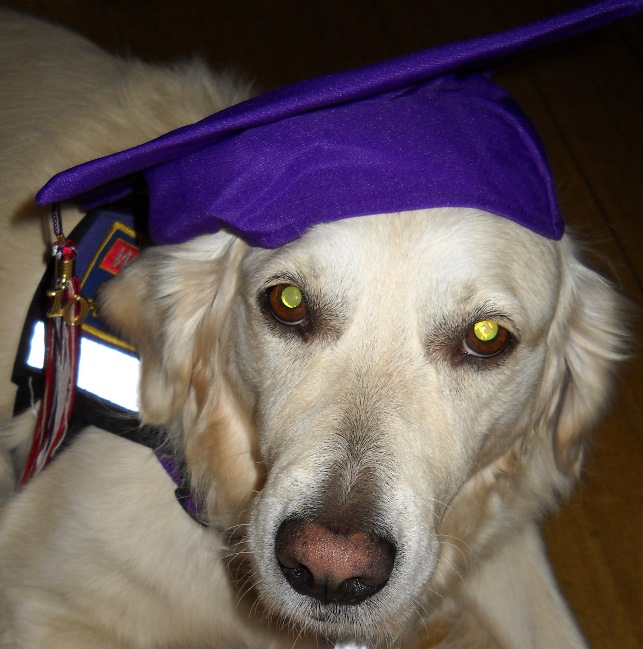
Jana, a white golden retriever, wears a mortarboardReading about this study will make you want to go back to college.  A team of undergrad researchers had the best job ever: Watching hundreds of hours of puppy videos.

They were looking at the differences in how moms at The Seeing Eye, a guide dog school in New Jersey, treated their pups. Some were very attentive, constantly licking and cuddling their newborn pups. Others spent as much time as they could out of the whelping box, away from the babies. Some lay down to nurse, making it easy for the pups to gorge themselves. Others stood, perhaps longingly eyeing the happy hour menu just out of reach. The researchers not only studied the moms’ behavior, they also measured their levels of cortisol, a hormone that indicates stress. Moms with higher anxiety tended to spend more time with their pups and coddle them more.

Guide dog puppies are set up to succeed. They have great genetics and prenatal health care, as well as top-notch vet care throughout their lives. They get early enrichment and socialization, lots of training. Even so, many don’t make it. A dog who is nervous or fearful makes a poor guide, as does one who can’t think independently and solve problems. Puppies who learn faster, solve puzzles faster, or figure out how to contend with obstacles naturally make better guide dogs. So do puppies who are confident and unafraid of new or potentially scary objects or situations. Temperament tests for puppies abound, but it’s still hard to reliably predict adult temperament or success.

It might seem that pups with attentive moms would be more confident and therefore more likely to succeed. But that’s not what the research indicated. The pups who had to work a little harder to eat and those who were less coddled by their moms turned out to be more independent and better problem solvers — scrappy, tough little dogs who had higher success rates in guide dog school. The coddled pups showed higher anxiety and less problem-solving ability. Even these pups are far ahead of the average pet dog in terms of temperament, ability to cope with the everyday stresses of life, and general health, though. But helicopter moms seemed to put their pups at a disadvantage.

It’s hard to determine just how much of the pups’ success or failure is linked to maternal behavior and how much is genetic, so more study is needed. But the attention to maternal behavior could help shape early training and enrichment. It could also point to ways that we could more successfully help our older puppies and adult dogs cope with anxiety (less coddling?).

Anyhow, doing more research is so appealing. Sign me up to watch those puppy cams!

The early study on maternal behavior is available online: Characterizing Early Maternal Style in a Population of Guide Dogs.

The abstract of the later study is available here: Effects of maternal investment, temperament, and cognition on guide dog success.

A Dog Can Help You With That …

Whatever you need help with, chances are, a dog can help out. Need help finding your way around? Easy-peasy. Need a guide who also lets you know about important sounds? Dog’s got that handled too.

Funny thing is, not too many humans believe that dogs can do all that (and more). Fortunately for some people, Guiding Eyes is an organization that takes chances on people — and dogs.

As someone who’s sure that we haven’t come close to tapping dogs’ full potential, I see this as a sign that Guiding Eyes (or GEB) really “gets” dogs in a way that few people, even dog professionals, do.  This understanding leads the organization and its trainers to willingly take on challenges that few people would even think possible: Tasks that require a belief in dogs’ ability to be adaptable and to become creative problem solvers, for example. GEB dogs do things that it’s really not possible to teach them without a shared understanding and buy-in to shared goals, so the trainers have to know that dogs are capable of higher-level thinking, problem solving, and working toward goals.

What do I mean? GEB places dogs with a tremendous variety of clients, including individuals who have both visual impairments and another disability, such as a mobility or hearing impairment. The clients whose dogs alert to sounds as well as guiding range from people who are legally blind and hard of hearing to individuals who are both blind and deaf. I could be wrong about this, but I believe that GEB is the only U.S. guide dog school that is willing to provide these clients with a guide dog. In any case, it was the first organization to do so.

As registration opened for the Guiding Eyes continuing education weekend, a number of these grads registered. Planning committee member, grad, and GEB consumer outreach and graduate support manager Becky Barnes Davidson waved a magic wand and somehow found funding to bring a cadre of interpreters to the weekend, ensuring that all of the grads could participate fully in the events.

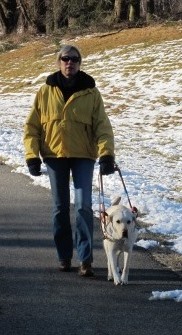
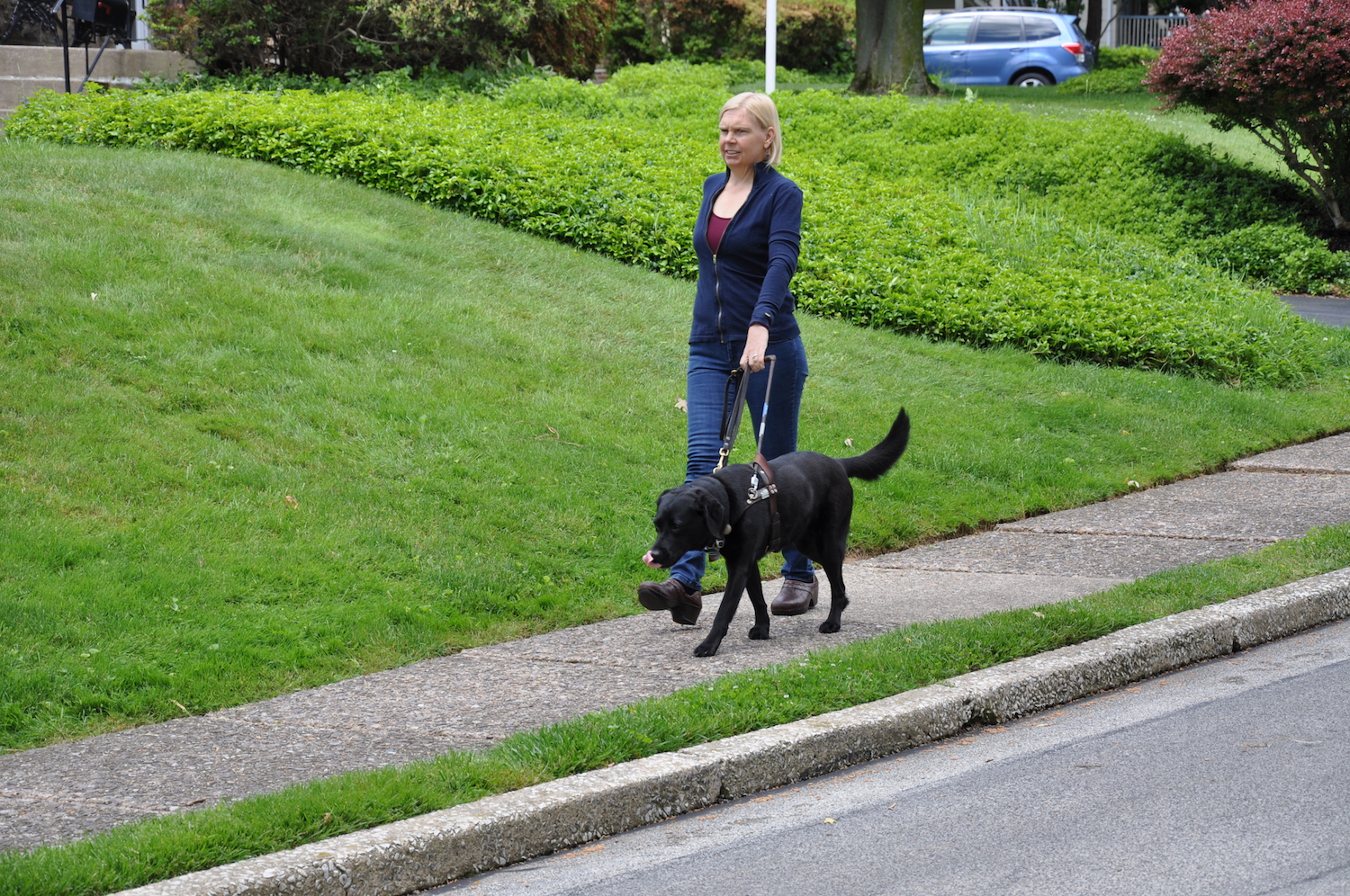
Deborah and Gypsy walk togetherI had the opportunity to chat with one of these grads, Deborah Groeber. She got her first Guiding Eyes dog in 1987. GEB didn’t yet have its “Special Needs” training program, which got off the ground in 1990, but, Deborah said, it was the only guide dog school willing to try training a guide for her.

Having guide dogs has, of course, made a tremendous difference for Deborah, especially in her frequent travels. She describes traveling with her dogs (current guide Gypsy is her fifth) as “phenomenally different” from traveling with a cane.

“I think Gypsy is a great match for me because she loves going from the suburbs into the city every day, loves taking trains, buses, escalators, stairs, revolving doors and working obstacles and construction sites. She is bright, confident and self-motivated, but she also loves praise and food rewards,” Deborah said.

Deborah is about to participate in another unique Guiding Eyes program. Gypsy is nearing retirement, and Deborah’s next guide will be a member of GEB’s new program, Running Guides.

Running Guides perform the usual guide dog work as well as guiding their partners while running. The first Running Guide team graduated in 2015. And Deborah’s dog will, as Gypsy has, learn to alert her to sounds, such as smoke alarms, phones, and doorbells. Deborah knows how to teach her additional alerts as needed. Sometimes Gypsy figures it out on her own, too.

Once, not long ago, Gypsy alerted her to a carbon monoxide alarm when Deborah’s husband was traveling for work. Gypsy is not allowed in the basement, Deborah explained, but she kept alerting to the basement door, because she heard the unexpected sound of the alarm. She’d not been trained to respond to that sound, but somehow understood that it was an urgent problem. Deborah got both the CO and smoke alarms, Gypsy told her which one was making noise, and she was able to respond and resolve the problem.

That story underscores the connection and communication that develop between members of a guide team. Many of us plain old pet-dog owners, who have the good fortune to be able to see our dogs’ body language and hear their vocalizations, are nonetheless unable to figure out what they are telling us. And I bet most of our dogs would react to an alarm and try really hard to get us to do something about it. That we’d all die of carbon monoxide poisoning anyhow would not be the dogs’ fault…

As someone who has tremendous faith in dogs’ abilities to figure things out, communicate, get what they need, figure out what their humans need, and so much more, I am not amazed that a single dog can perform both guide and hearing work, with a side gig as a personal fitness trainer. I am impressed that enough people at Guiding Eyes believed in dogs back in 1987 to give combined guiding and hearing dogs a try, and that the organization is continually coming up with new ways to stretch and grow the partnerships between their amazing dogs and clients.

Welcome to the Family, Koala

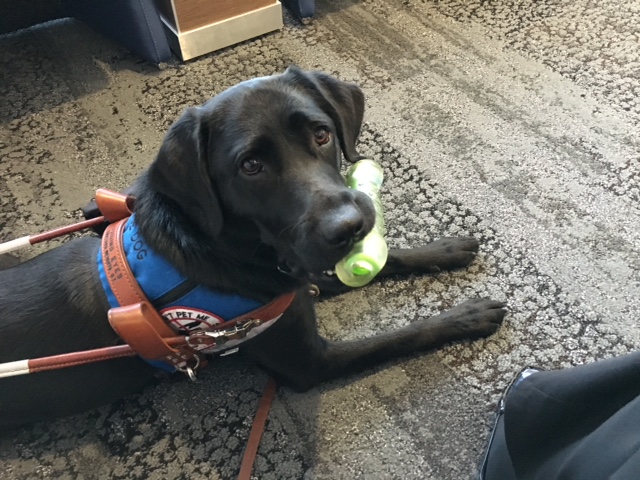
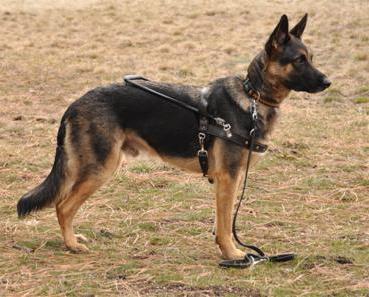
Koala, in harness, waits at the airportShe’s here! And I finally met her!

Deni’s new guide dog, Guiding Eyes Koala, is a 2-year-old, high-energy black Lab with a dazzling smile. She’s very smart and she learns new skills very quickly. For example, she knew where “home” was and could accurately turn in to the right house after one trial. She quickly learned to “find the trash” — anywhere — and she is so pleased with herself that she leaps up and embraces the trash can, with her tail wagging, and wearing a huge smile. I saw her do it several times in places none of us had ever visited before.

She’s very playful and can be quite silly, when she’s not working. She completed her first airplane travel with the grace of a pro, and seems up for any new adventure. She was “just amazing” on a recent visit to Guiding Eyes; she even agreed to use the indoor service dog “relief” area. These tend to be more “desperation” areas, with fake grass rinsed by pop-up sprinklers or pee pads on the floor in some out-of-the-way corner of the airport. She’s definitely a good sport.

Cali is going to just love having a playful, high-energy little sister to boss around. Jana is looking for an invitation for Thanksgiving week. If she stays home, she’s likely to never speak to me or Deni again after spending several days in a tiny apartment with the two “puppies.”


Last Night Alone

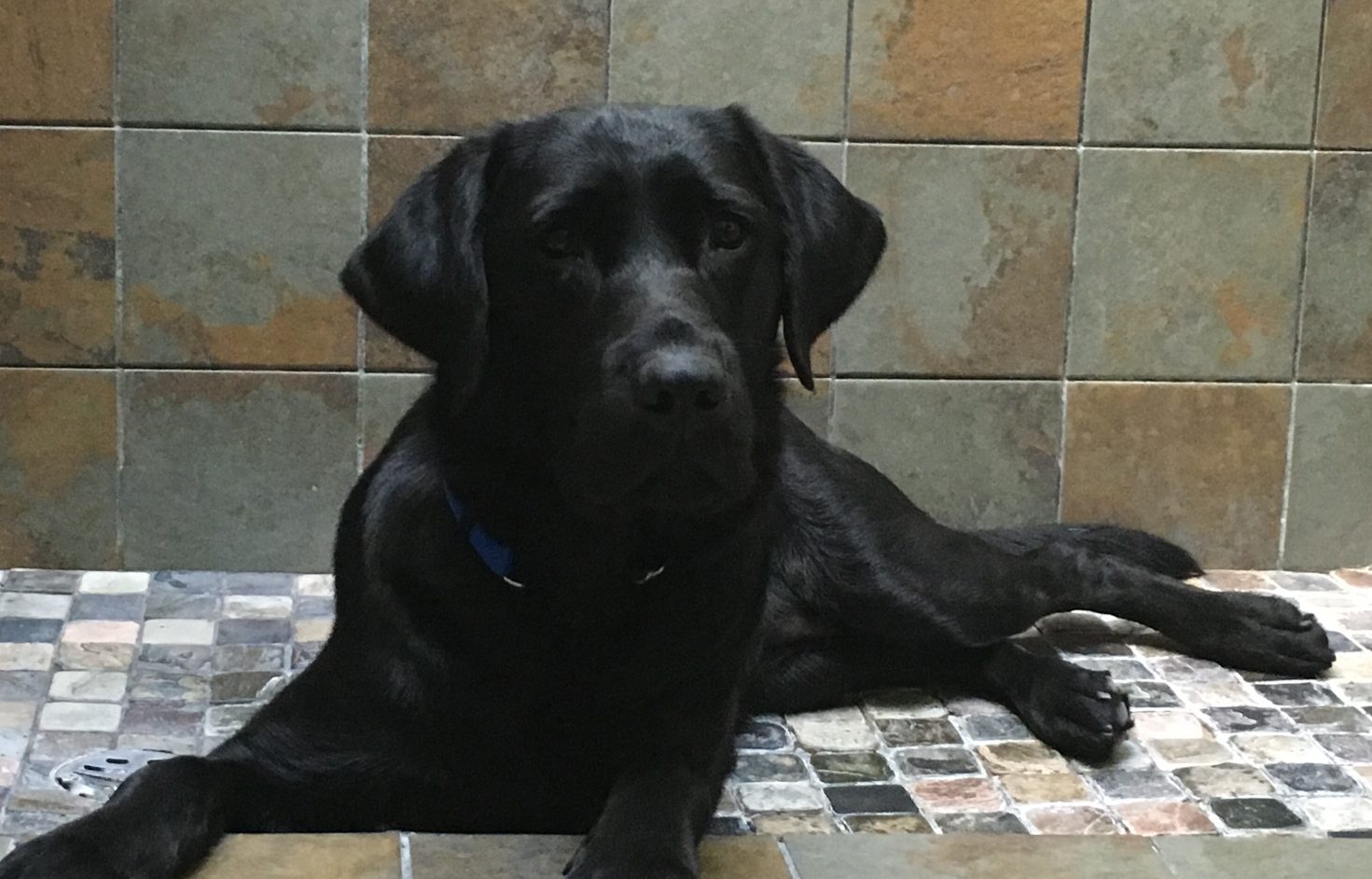
koala-in-showerA guest post by Deni Elliott

Tonight is my last night alone. After four months of crawling into bed without Guiding Eyes Alberta snorting and snoring a few feet away, tonight is my last night alone. Tomorrow I meet Guiding Eyes Koala. As hard as I’ve squinted at photos and video and as tightly as I have clutched each new piece of information, I find it odd how little I can imagine about our future together.

Koala’s passed all the tests and has exceeded expectations. I’ve heard that she leaps into her harness and back-channels routes after only one trip. She eagerly solves problems and pivots on a dime, ready for new adventure. A personality match for sure. But I remind myself that I need to go slow and not expect too much of this 2-year-old.

At the cusp of this unknown relationship curving to be real, my tummy flutters with butterflies of anxiety and anticipation. I can imagine the home trainer better than the dog he is bringing me.

Jim Gardner, GEB director of home training, will fly from New York to Tampa with Koala curled at his feet. I imagine Jim cheerfully answering the questions I am annoyed to be asked. “Are you training that dog?” someone will ask. “Yes,” he’ll smile, “This is a new, young guide dog. I am taking her to meet her blind partner.” When asked, I put on the same “please the public” smile, but say in a way that invites no further intrusion: “Every day is a training day, but I am blind, and she is my guide dog.”

I imagine Jim calmly replying, when asked the dog’s name, “We don’t tell people that because we don’t want them distracted.” Knowing that despite 16 years of guide dog use that I am still paralyzed by strangers asking my dog’s names, other trainers have had me practice giving a fake name. I don’t lie well. Saying, “I won’t tell you,” feels rude. “Leave us alone,” is definitely rude. Saying, “If I tell you the dog’s name, you will immediately say it and distract her and that is exactly what I don’t want you to do,” is too long and complicated. So, I quickly say, “This is the dog’s name, BUT DON’T SAY IT.” As those words come out of my mouth, I concurrently offer a treat so that the dog doesn’t pay attention to what the other person might say. We then hurry away.

I imagine Jim chaperoning Koala and me on our first neighborhood walk. “What can we do for our first outing?” I will ask. “Two miles? One mile? 250 steps?” I have three routes mapped out just in case.  For the months I’ve caned my way through twice-daily walks, I’ve imagined being guided by new dog instead. I whisper “Right-right,” and “To the curb please,” and “Good dog, good job.” I’ve counted the number of streets I cross on these daily laps so that I can help Koala learn streets where she needs to stop and driveways where she doesn’t. I imagine the neighbors that I pass daily expressing surprise and sending best wishes when they see me with Koala in harness instead of gripping a cane.

I cry when I imagine Jim and Koala arriving from the airport tomorrow night. I have joked about lighting candles and pouring wine for the new girl’s arrival. In truth, I have stocked the house with beds, toys, crate, food and treats. I ache with the knowledge that none of these will fill her heart tomorrow night. All I can do is make promises that she won’t understand.

She’ll wonder where her most recent caregivers, Graham and David, have gone. She’ll look for her special canine friend, Wrangler. Some visual or scent will call to mind her puppy raiser mom, Eileen, although it has been six months since they’ve seen one another. From Alberta, I know that well-raised guide dogs never forget previous family members and greet them with great joy. I suspect Koala would prefer we all live together in one pack. I can’t make that happen, but I will promise to keep her connected with the dogs and humans who matter to her most.

koala-and-deniI will promise to keep her safe. I hope that she never needs to know that I will instinctively fold her under my body for protection if anything threatens her just as I did when Alberta and I were attacked by a stray dog.

I will promise to trust her today and for all of the tomorrows we have together. When I am utterly confused, I will follow her lead, knowing that she’ll have better ideas that I about what to do next.

I can’t imagine Koala at my side because I don’t know yet the person she will turn out to be. But I can promise to show her day after day that I will love her for being her own best self and for who we can become together. Maybe that’s enough for the first day.

Postscript: Koala and Deni are off to a great start!

Don’t Fake It …

I spent much of the day prepping for two short classes I am teaching on service dog access law. I’ve done this before, but most recently, I had an entire semester to teach students about access law and other dog-related laws. We spent seven weeks on the crazy quilt of federal laws that govern public access for people who have service dogs. Paring the vast amount of information down to two one-hour presentations is tough.

I decided that the most important things that the students, future service dog trainers need to know are:

  • The ADA might be the most important law to study, but it is far from the only law that touches on people with disabilities and service dog access
  • The right to be accompanied by a service dog is far from absolute
  • Not all dogs can be or should be service dogs

Beyond that, I hope to give this group of students an overview of the applicable laws and plenty of info on where to get more in-depth information.

The biggest problem with the number of laws and variations in how and where they apply is how easy it is for people to break the law — sometimes intentionally, sometimes not.

What do I mean?

People often confuse service dogs, therapy dogs, and emotional support animals.

Service dogs, individually trained to assist a specific person by performing tasks that mitigate that person’s disability, are often seen in malls, restaurants, supermarkets — almost anywhere that members of the public can go. The ADA, the Americans with Disabilities Act, gives people with an ADA-recognized disability the right to take their service dogs into these places. But dogs that merely provide comfort or “emotional support” are not considered service dogs. Animals other than dogs (with limited exceptions for miniature horses) are not covered by the ADA.

However, people can get permission to live with an emotional support dog or other animal in housing that doesn’t allow pets. Other people get their dogs certified as “therapy dogs” and visit hospitals, schools, and other places that normally do not allow pets. What gives?

Different laws govern access to housing, air travel, Veterans Administration facilities … the laws are confusing. There is no requirement for any kind of public access test or identification. Emotional support animals that accompany people in no-pets housing or on airplanes are not required to have any training.

Many people honestly believe that they have the right to take their pet along to the coffee shop because they have a letter, a “prescription” that turns their pet into a service animal, or because they’ve passed a test given by Pet Partners or another therapeutic pet organization. Other people know that they are breaking the law when they purchase a vest online and head off to the coffee shop with Fido in tow; they just don’t care.

They also might not think they are harming anyone, but that’s often untrue. Most pets are not temperamentally suited for the stress of being in public. Stressed-out dogs might pant, drool, pull toward an exit, hide behind the handler  — or become aggressive. It’s not fair to subject a pet to this level of stress. A dog that is reactive to other dogs, has high prey drive, or any tendency at all to behave aggressively should not be in public. These dogs pose a threat to other people and to people with legitimate, well-trained service dogs.

What’s important for everyone to know, whether members of the public, pet owners, or managers and employees of businesses, is that the right to access is not an absolute right. A person can be asked to remove a dog who is misbehaving, is showing aggression, or is not under the handler’s control — even if the person does have a disability and even if the dog is a trained service dog. Asking a person to remove a dog under those circumstances is not a violation of access laws.

Ethical service dog trainers are careful about which dogs they place as service dogs, both to ensure that the person’s needs are met and to ensure that the dogs they place are comfortable and safe working in the public eye. Service dogs get lots of attention, including petting and hugging from random children (and adults) who run up to them out of nowhere. They endure a barrage of noises, smells, and sights that most pets cannot even imagine. Not all dogs can (or want to) do this work. It’s unfair to expect an unprepared, untrained dog (or other animal) to behave perfectly and calmly in public, even if he is wearing a really nice vest. And it is unfair and unethical to endanger properly trained working dogs and members of the public by taking a poorly prepared, frightened dog into situations that he or she cannot handle.


Thinking Dogs ♥ New York

Alberta and Deni trainingService dogs in New York got a great Christmas present from Governor Andrew Cuomo: official recognition as the state dog.

While some states choose a breed as the official state dog, and many states (gasp!) have no official dog, New York took a novel and wonderful approach. This article from Syracuse.com points out that breed doesn’t matter; only education and ability.

The original legislation designated service dogs as the official state dog. The governor expanded the law to include working dogs like police K9s and search-and-rescue dogs, and the lawmakers have agreed to officially expand the definition.

Four paws up to New York legislators for recognizing the contributions of service dogs. Other working dogs are also heroic and deserving of recognition, but a tiny, possibly very cynical, part of me wishes the honor had been kept, as originally intended, for service dogs only.

Unlike this recognition, the “me too”-ism that wants to lump a whole bunch of dogs in with service dogs for special attention or privileges usually is negative, as described in this New York Times column: When Dog Owners Are Off the Leash.

Maybe my grumpiness stems from having read the two stories only moments apart.

While the writer of the Times column admits to schadenfreude at the news of a celebrity couple getting caught and penalized for smuggling their two dogs into Australia, breaking several laws, including avoiding the required quarantine — he also freely and unabashedly admits to committing similar misdeeds. Stating that “half the people” he knows do it, he relates stories of many other people smuggling dogs into no-pets venues, lying to get them on airplanes, and smuggling pets across borders. He even acknowledges having a fake letter attesting to his dog’s status as an emotional support dog, commenting that the law is so vague that it’s easy to cheat. The motivation ranges from simply wanting to avoid paying pet fees on airlines to feeling entitled to have your pet with you wherever you want. Even if that requires that you lie about having a disability and pretend that an untrained pet is a trained service dog.

While the author of the column briefly mentions that this fakery “makes life difficult for those who really need” service dogs, he seems not to care. He sounds much more irate about the high fees that airlines charge to transport small dogs, and approvingly cites a few recent changes, including posh hotels that now allow dogs and the news that Amtrak has started allowing small pets to ride on some trains.

The thing is, though, that faking it is not OK — and is not trivial. So many people are doing it that it really does interfere with legitimate working dogs’ ability to do their jobs. And their safety. I’ve seen so-called service dogs come tearing out of airport shops, snarling and dragging their people, reacting to people or working service dogs.

And, as my students who train service dogs have pointed out, allowing untrained pets into more and more public spaces might not be the best solution. As a pet owner, I love discovering new places that I can take my dogs. But as a person who understands the ins and outs of training and working with service dogs, I also understand the problem.

If pet dogs are very well trained and socialized and the owners are skilled handlers who are aware of what’s going on around them, then no harm is likely to be caused; unfortunately, that’s rarely the case. Most dogs are poorly prepared for the stresses of public spaces, and many dog owners are poorly equipped to handle their dogs safely and appropriately — or they are simply oblivious. As is often the case, a good remedy is more education. Education of dog owners — and of business owners, about how to spot and deal with fakers.

Kudos to New York for recognizing and increasing awareness of the incredible work that service dogs do. Let’s hope it will help more people understand how vital service dogs are to people who truly need them — and how harmful it is to fake it.


Potty Parity for Pets, Pros

A new era for traveling dogs

Jet-setting working dogs, along with small traveling pets, have reason to rejoice! They are on their way to potty parity.

A recent trip took me through several large airports, and I noticed something new in Detroit: A service dog and traveling pet relief area inside the secure area. Update: A new relief area was opened at O’Hare airport in October! From the pictures, it looks a lot like the Detroit one.

Now, according to the law, this should not be a novel find. Air carriers are required to ensure that all traveling service dogs, whether departing, arriving or connecting, have access to appropriate facilities. The relevant law, 14 CFR Part 382 (Nondiscrimination on the Basis of Disability in Air Travel) Subpart D, 382.51(a)(5) states: “In cooperation with the airport operator and in consultation with local service animal training organization(s), [air carriers] must provide animal relief areas for service animals that accompany passengers departing, connecting, or arriving at an airport on your flights.”

Sadly for all those dogs running between flights with their legs tightly crossed, if these facilities exist at all, they are most often outside the terminal — meaning that they are on the wrong side of security if you are transferring to a connecting flight. Solutions have included teaching dogs to use pee pads, then taking them into the family restrooms that are commonly found in airports to squat alongside their human partners; running them outside — then trekking back through security; or asking airline personnel for an escort to the tarmac, where many a service dog is too distracted by the unusual scents and sounds to, uh, deliver the goods. A tight connection can make either of the last two options impractical. The outdoor pet relief area might be at the very far end of a terminal — or even a few terminals away, making for a very long trek.

The situation is finally improving, though, with a few airports now providing potty facilities inside the terminal.

Unacceptable!
Unacceptable!

The first one I discovered was in Seattle; I found it — and I am being very generous — rather disappointing. When I was there, a few years ago, it offered essentially a large litter box, some pee pads, a dirty concrete floor and a trash can. A dog I was traveling with turned up his nose and decided to hold on until we reached our destination where, he hoped, some grass — or even a patch of dirt — might be available.

Detroit’s offering elevates indoor canine commodes to a new level. I hadn’t been through the Detroit airport in a while, and the new facilities, in the center of the main Delta concourse, were quite a pleasant surprise.

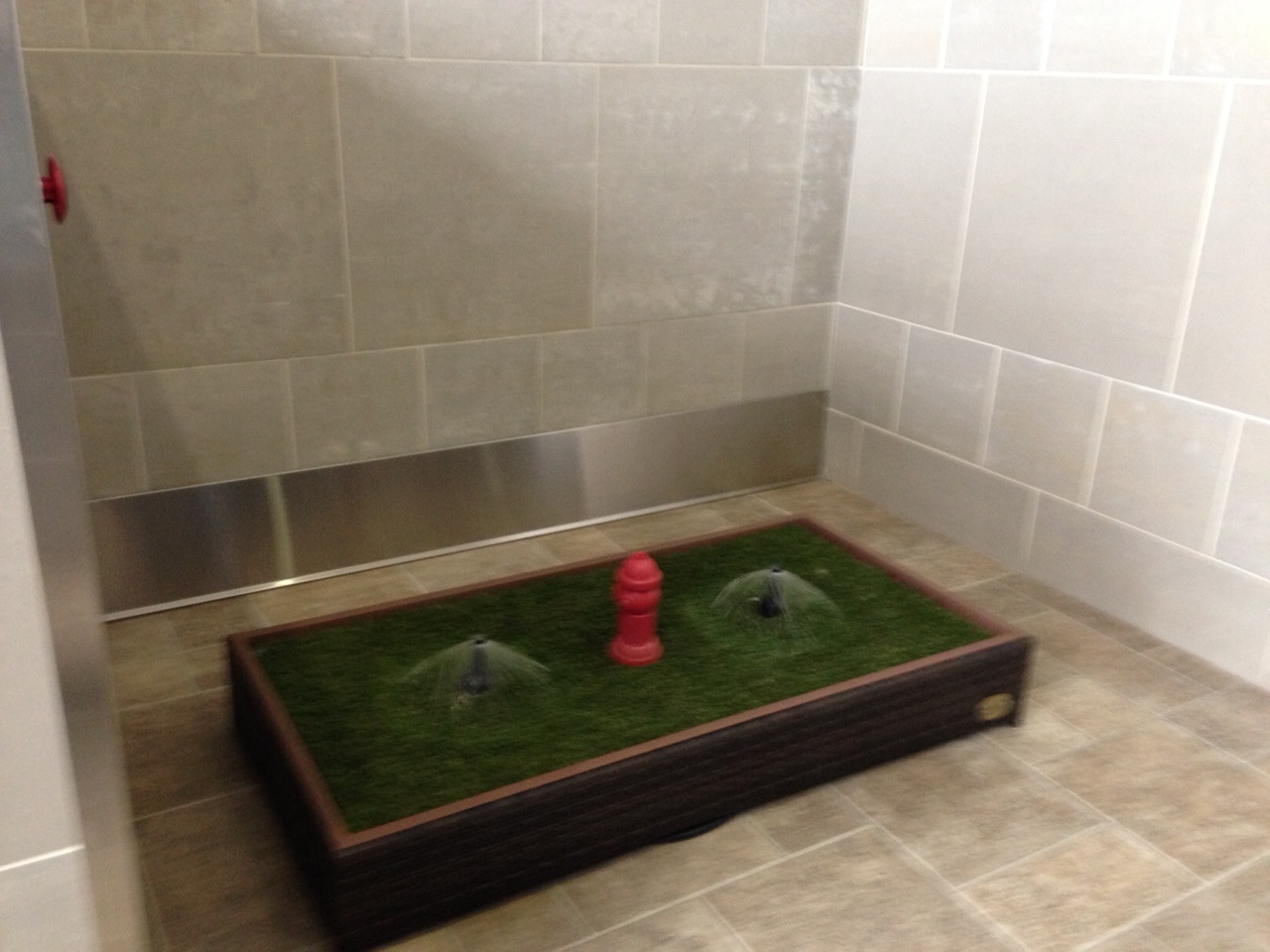
IMG_1815First of all, the service dog relief area contains two stalls, each offering the dignified or shy dog a reasonable degree of privacy. A shared hand-washing area, presumably for the humans’ use, divides the stalls. Each stall offers a small fire-hydrant-shaped urinal (female dogs might find these distasteful, but we must all adjust to this dawning era of non-gendered relief facilities, mustn’t we?). The hydrant occupies the center of a smallish patch of fake, very green, grass. Bags and trash cans are also provided. The nicest touch, however, was the built-in sprinkler system. With the push of a button, cleanup is accomplished, leaving the stall fresh and green for the next working dog in need of a restroom.

Let’s hope this becomes the new standard for powder rooms for peripatetic pooches.

Thinking Dogs

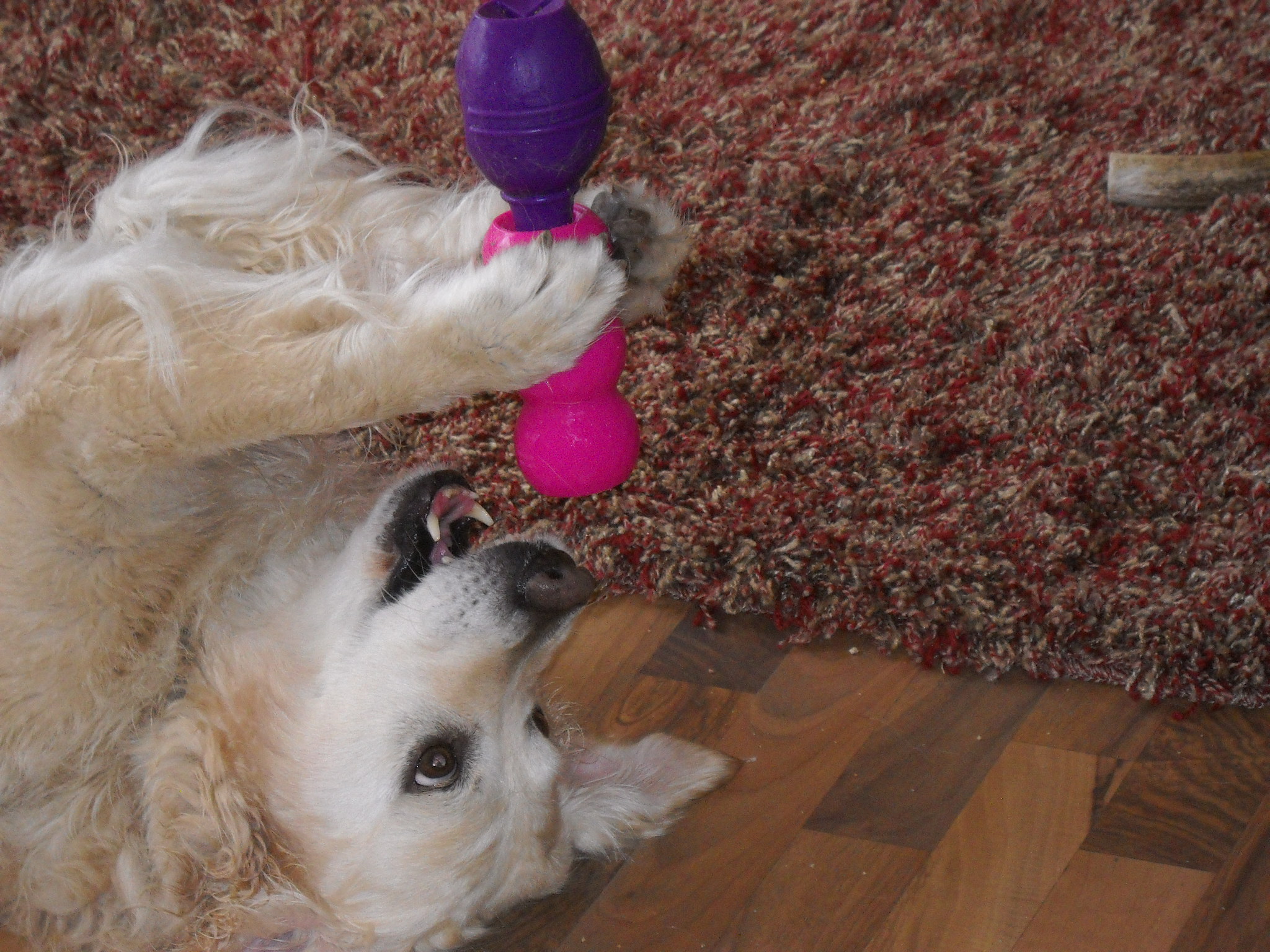
A young Jana thinks about how to get the peanut butter out of her Kong
Do dogs think?

Many of you are thinking, Of course they do!

So, why am I even asking that question?

I recently taught a class on dog intelligence where we tried to decide what and how dogs think and how to define dog intelligence. I had just seen the movie The Imitation Game, and I mentioned the scene where the police investigator asks Alan Turing whether machines think. Turing’s response (paraphrased considerably) is that, if someone we know has different taste than we do — likes a book we hated or loves a food we don’t care for — we wouldn’t say that the person is not thinking, but that his or her thinking is different from ours. In the same vein, machines do not think as humans do, but they can follow a process that approximates human thinking, according to Turing.

Human thinking is conscious and active — that is, we are aware that we are doing it and do it intentionally. It is an attempt to understand something, solve a problem, answer a question, create connections or meaning. Human thinking is mostly done in words, though, as Temple Grandin points out in many of her books, people with autism do not always think in words but often in pictures or even video.

Dogs don’t necessarily think in the same ways as humans — or agree on everything or reach the same conclusions — but I would argue that dogs’ thinking is more similar to humans’ thinking than a computer’s is, if only because dogs are conscious and machines are not.

So, the simple answer is: Dogs do think, but they do it differently from the way humans think. They probably do not spend a lot of time planning for retirement or worrying about the bills or speculating about which stocks to invest in, for example. They do not appear to worry about things that they cannot control (unless it seems that dinner might be late …). They might think about their next meal or the dog beach or the cute shepherd down the block — not so different from some of what people think about.

All grown up and still thinking about how to get food out of her toys ...
All grown up and still thinking about how to get food out of her toys …
But even where their thoughts might meander to some of the same topics we’d think about, I bet that dogs do it very differently. While dogs are often taught to understand many, many words, I doubt that dogs actually think in words. Alexandra Horowitz, in Inside of a Dog, suggests that dogs think in smells and maybe in pictures. That makes sense when you consider how powerful their experience of scent is.

Another wonderful dog book, How Dogs Love Us by Gregory Berns opens the door a little bit toward understanding how thinking in smells might work. Berns trained his own dog, and then several other dogs, to lie still in an MRI so that he could get images of their brains — while they were awake. He did several experiments, including one where he mapped dogs’ reactions to the scent of a human from their own family and the scent of a different person. He also mapped their responses to a familiar and an unfamiliar dog. These tests, and others that measured response to cues indicating a desirable reward (bits of hot dog, I think) and cues indicating no reward, showed that dogs brains look very much like human brains. Dogs scenting their own humans showed similar responses to humans viewing photos of their loved ones, for example.

Regardless of how they do it, evidence that dogs think is all around us. When they bring a toy and ask us to play, beg for a bite of our sandwich, or stand by the door asking to go out, they are thinking and planning. The dog who creates a diversion so he can steal a coveted bone from his sibling dog is thinking and planning. The ability to anticipate where the Frisbee will come down and then to jump in a graceful arc to meet it reflects thinking (and a far better grasp of physics than I ever had). Service dogs show their thinking skills constantly in their ability to intuit what their partners need and offer it. The examples are endless; share yours in the comments!

Service Dog Appreciation Week!

service dog week

As National Service Dog Appreciation Week draws to a close, I want to draw your attention to an article I co-authored with Deni Elliott. It is a discussion of the current and growing problem of fake service dogs and “inappropriate” service dogs, that is, dogs who may be trained to assist a person with a disability but who are not trained for public access and/or have a temperament that makes them unsafe in public spaces. Unfortunately, Deni and other service dog partners are encountering more and more dog-reactive dogs, which makes it challenging and unsafe for their dogs to work.

Our proposal, which might be controversial, suggests a solution. We hope this article will be part of a larger debate in the service dog community as well as among policy makers and will ultimately help find a solution. You may download the article from Deni’s website or from the portfolio page of this website.

Clothes Make the Dog

For as long as I have worked with service dogs in training, I have known that putting a service dog cape or harness on a dog sends a clear signal: “ Now, you are working!” With many dogs, the working dog and the off-duty dog behave so differently they could be two different dogs. Wylie is an extreme example — on harness, he will work past distractions. He still notices cats, for example, but his strong work ethic keeps him focused on the job at paw. But take off his harness and he is all-dog — party dog. We call him the frat boy. All he wants to do is play. And, maybe, if we’d let him, drink beer.

Wearing his harness, Wylie is all business

Last week, The New York Times gave me an explanation for this phenomenon: enclothed cognition. The study’s authors say that we think not only with our brains but also with our bodies. It’s long been known that our clothing affects other people’s perceptions of us; now researchers are learning that how people dress affects the way that they see themselves and the way that they think and behave.

The study cited by the NYT found that people who put on a “doctor’s” lab coat were better able to notice subtle incongruities or differences in images they saw. For example, they noticed that the word “red” was colored green, or they found more differences in very similar photos. Those wearing the “doctor’s” coat did better than test subjects who merely saw the coat, better than subjects who wore the coat but were told it belonged to an artist, and better than a control group who had no white coat presented in any way.

“Enclothed” cognition is an extension of embodied cognition. Just as washing hands has been shown to be associated with ideas of moral purity and people who carry large clipboards feel important, dressing in certain clothing awakens specific associations in our minds — and these associations affect our behavior.

It’s not much of a leap to recognize that dogs are affected in a similar way.

Off duty and ready to party

Putting on a cape signals to a Pet Partner dog that it’s time to go on a therapy dog visit, and putting a cape on a service dog says that playtime is over. Some dogs even have better leash manners with their capes on. When two working service dogs, who also happen to be pals, meet while on duty, they might greet each other warmly and with a wag of the tail, but they will quickly settle back into their calm, unobtrusive working roles. Take those same two dogs on a walk together, or watch them at one of their homes when neither is on duty, and you will see very different dogs and a much higher level of energy!

Just as some people quickly exchange work clothes — and professional persona — for comfy yoga pants and an informal attitude as soon as they get home, some dogs, like Wylie, demonstrate a wide gap between “all business” and “let’s get this party started.” And there are dogs (and people) who clearly know that something special is expected of them when they are dressed for work but who maintain a consistent personality, on duty or off. Each dog’s different degree of “enclothed” cognition helps us respect the truth that all who live with and love working dogs quickly learn: a service dog partner is not a robot, but an individual who makes voluntary choices to do her job. The study’s authors wonder whether the effects of a person’s daily work uniform eventually wear off — or become habit. Do the clothes, in the end, define the dog?