Family Reunion

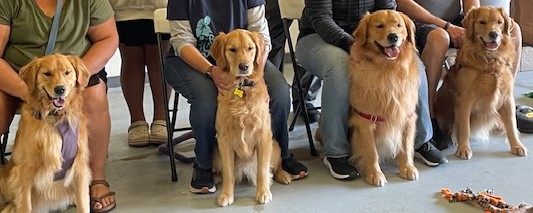
Tasi, Orly, Kaycee, and Brooklyn Orly recently got together with several of her siblings, niblings, half-siblings, and miscellaneous other relatives. Sometimes, it’s better not to be too clear on the exact relationships.

There are many family resemblances, starting with Mom Charm’s restrained whimper when gated off from the area she wanted to be in — Orly deploys similar vocalizations when she finds herself on the wrong side of a door, a frequent occurrence. The siblings sure look alike, though Orly was the lightest blond / least red of the group. They are all small for goldens, and several of them share Orly’s little “zipper” — a small patch of rough fur between the eyes that gives Orly a worried look.

Two young puppies — nieces? — were in the mix as well. Hildy was the best pup-playmate, entertaining (& exhausting) the youngsters while the sibs all went from person to person soaking up pats and cuddles.

This slideshow requires JavaScript.

Hands Off?

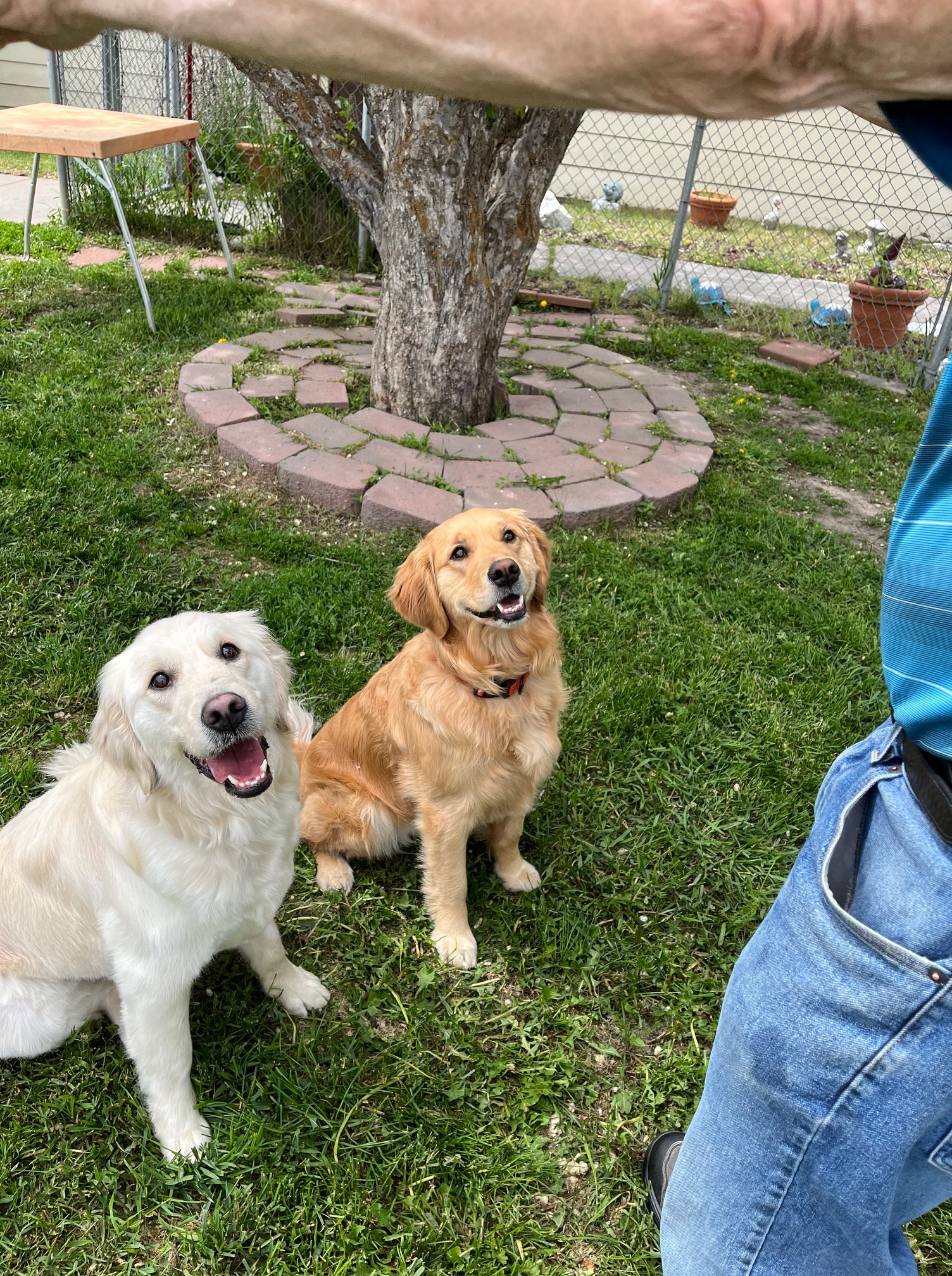
Golden retrievers Dotty and Orly sit on green grass and smile for their photo

Dotty is home for a visit! She’s calmer and a little more mature, but the silly, playful puppy is still there.

And … she is still obsessed with hands. She’s very paw-oriented and loves to dig, paw at people to say hello or ask them to play, and hold her toys with her paws.

When she first saw me after several weeks, she wanted to hold hands, maintaining constant contact by resting a paw on my hand or knee.

She’s also obsessed with human hands, and she appears to believe that the only reasons hands exist are to either feed or pet and play with dogs.

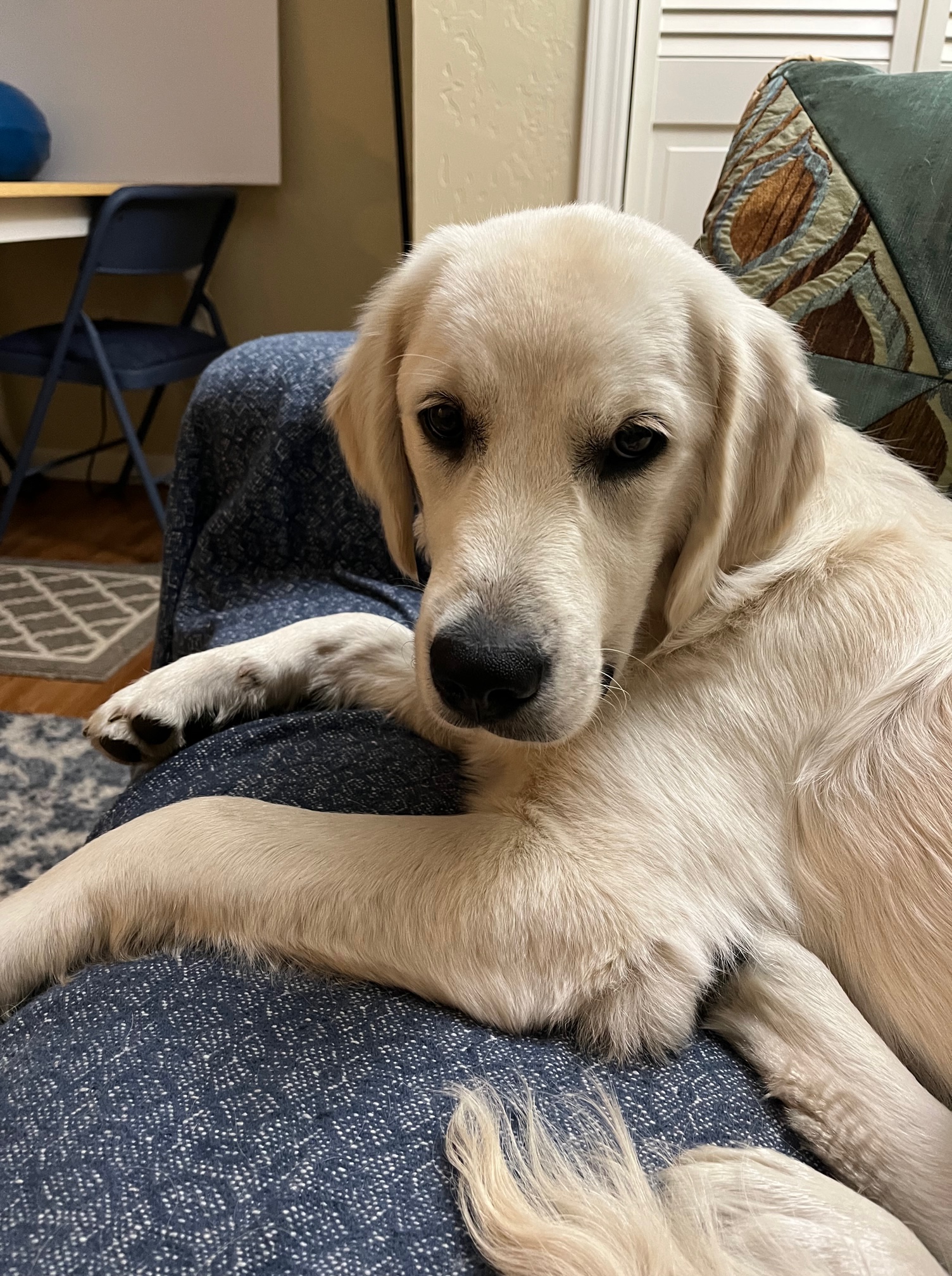
White golden retriever puppy Dotty lies on a blue sofa and looks straight at the camera
WHY are you not petting me?

Correction: Pet and play with Dotty. If I am patting Orly or, horrors! another dog, she tries everything she can think of to move my hands — and attention — over to her.

Her focus on hands is especially noticeable when I am trying to relax or to exercise. I like to stretch in the mornings, and some evenings, I try to relax with a short yoga video.

Sometimes I also just sit, watching TV or reading, with one or both hands unoccupied.

These situations are simply Unacceptable. If either or both hands are still, maybe just lying there on the floor or sofa — Dotty simply can’t stand that.

She’ll lick them. Nudge them. Paw at them. Push her nose under my hand and attempt to make it pet her. If I react at all — a laugh, even a smile — she’s encouraged to increase her efforts.

Orly is a little more restrained. While she also enjoys licking and nudging my hands, her favorite trick when I am exercising is to wait for me to close my eyes, even for a second. She darts in and gives me the tiniest kiss, right on the nose.

I’ve seen videos of people doing yoga with their dogs … and the dogs are just accompanying them. Exercising together. Doesn’t that sound nice?

Not these girls … they make it all about them. Or maybe they just understand that laughter is the best exercise and are nudging me toward more laughing, less stretching? Yep, that must be it!

Summer Fun!

This slideshow requires JavaScript.

After a cold, wet spring, summer has arrived with a furnace blast of 90-plus days.

Dotty and Orly know just how to keep cool!

They have a pool! And a splash pad! (Thanks, Aunties Maren and Christina!)

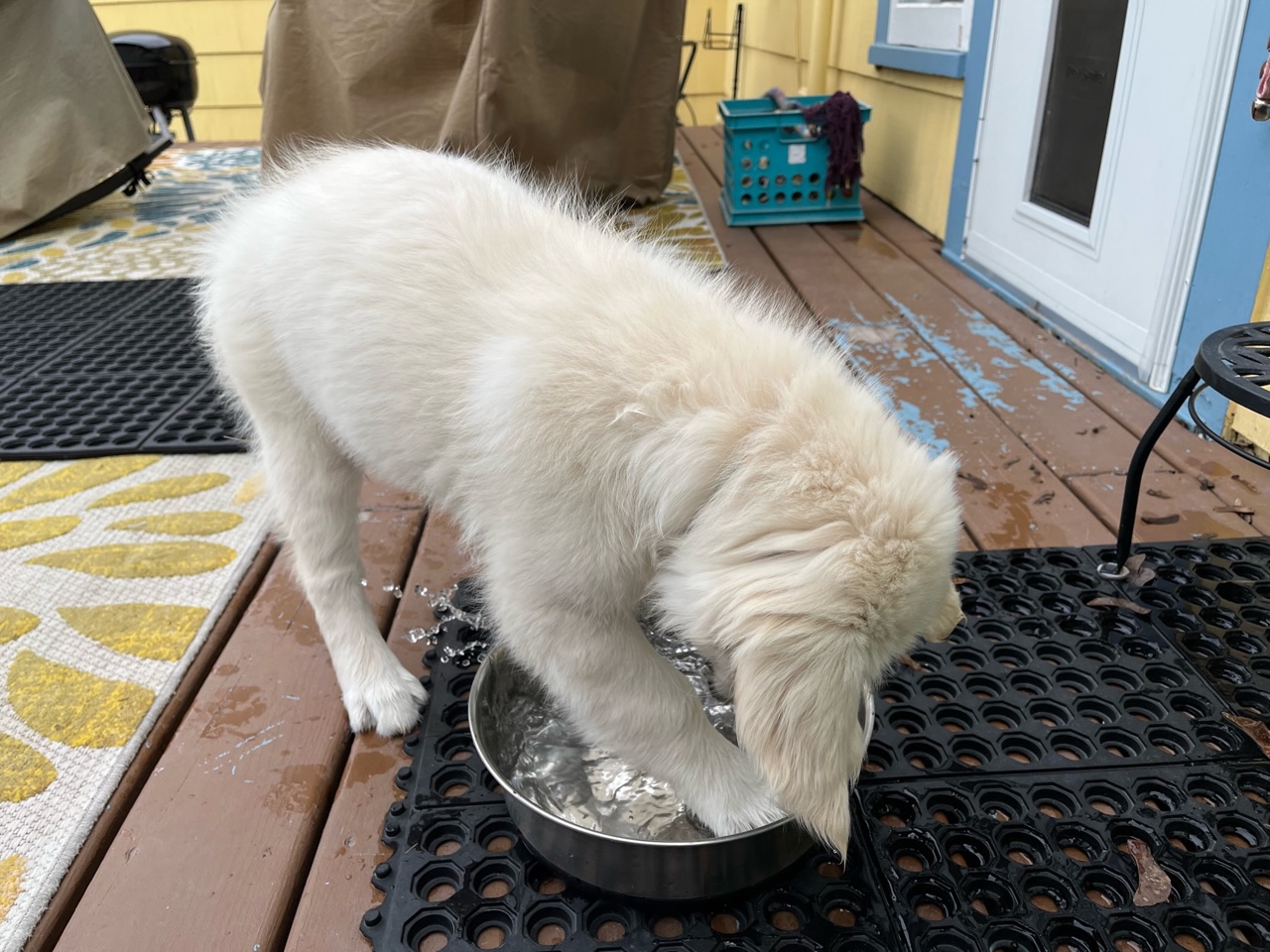
White puppy Dotty splashed with her front paws in a silver water bowlAs a pup who loves to paddle in her water bowl, Dotty took to her water toys like, well, a golden retriever to water.

Her favorite activity is rolling around to get thoroughly soaked, then finding a nice patch of backyard to dig up. Mmmmm, that dirt-and-wet-dog combination. Mom loves that … not at all.

They’re very eager to swim in the river, but we haven’t tried that yet. Maybe next week!

Leave Me Alone!

This slideshow requires JavaScript.

Orly has hit adolescence.

She’s full of energy, eager to explore the world and try out everything … and has very little common sense. She is also fearless and a little too eager to test boundaries and live on the edge.

I work from home, so I am not always available to play. I’m working on some arrangements to get her tired out — regular dog walks or hikes with a lucky someone else, play dates with the neighbors’ dogs, things like that. And I frequently offer treat toys, snuffle mats, and games of “find it,” where I hide little boxes with smelly, yummy treats inside and she and Cali use their noses to find the treats. It’s not enough.

All that adds up to a dog who bugs Cali.

The most egregious behavior occurs when we’re playing outside. Orly will launch herself off the deck and run, full-speed, toward Cali … and tackle her. Or race after Cali when Cali is racing after a tennis ball … and grab Cali’s tail or her leg and tug. Hard.

I step in each time this happens and put Orly back inside, but the lesson is not sinking in. I also let Cali out without Orly and throw the ball, while Orly looks on, sadly, from behind the screen door. Again, she’s not making the connection.

What would make the connection is a correction from Cali. A well-placed, sincere warning. But Cali is too nice. She just rolls her eyes and looks to me for help.

I could just keep them separate, but that’s not what either of them wants. They do love to play together, and Cali often initiates play, whether it’s a game of tug, wrestling, or racing around the yard together.

I’m going to call in reinforcements. The young male dog next door. The puppy who lives behind us. Koala, who is coming for a visit soon. Dogs who, like Cali, want to play with Orly but who, unlike Cali, are likely to set and enforce boundaries.

The combination of playmates who establish ground rules and additional activities to tire Orly out just might be the magic we all need. I’ll let you know!
Confident & Curious

3-month-old Orly, a golden retriever, peers from a red play tunnel
3-month-old Orly loved her play tunnel the first time she saw it

Orly is a confident puppy. She’s curious about everything — and afraid of nothing.

Those are generally good traits. Fearful dogs are challenging to train and to live with, and the very fearful or anxious ones sometimes lash out with their teeth when they feel threatened.

But Very Curious Puppies bring their own challenges.

Orly loves to explore. She’s fascinated by open cabinets and closet doors. More than once, she’s explored deeply into the basement while I was starting laundry and nearly gotten trapped behind a closed door when I finished.

I always have to warn her to move her nose before I close a cabinet or open the back door — since her nose is millimeters from the moving door. She investigates trash bins and empty boxes and pounces on every moving leaf or stick outside.

She’s also willing to try anything. She’ll tug and dig into the biggest toybox to find a buried treasure, climb on a wobble board or wobbly cushion at puppy kindergarten to test her balance, investigate any noise or movement … and walk up to anyone, human, canine, feline, or sciurid (squirrel), eager to make friends. She’s certain that they all want to be friends and will welcome a jumping puppy offering kisses and a wildly wagging tail. And she’s fascinated by the birds who frequent our feeder — they seem to know that she’s harmless.

I’m sure that this level of confidence is the result of both excellent genetics and her fabulous early puppy exposure and socialization. Her first 9 weeks were spent safely exploring and experiencing an enormous variety of sights, sounds, smells, tastes, and textures.

What she doesn’t have (yet) is impulse control or much common sense. I have to be sure to keep a close watch on her, especially outside, so she doesn’t investigate anything unsafe. I have found, though, that once I warn her off of something indoors — electrical cords, say, or chomping on a chair leg — I don’t need to tell her again. For some reason, she does not apply the same discretion to digging and chewing on things outdoors; we’re working on that…

What’s OK When Puppies Play?

I’ve accompanied friends with young puppies to puppy play sessions several times over the past few months. (Playing with puppies and then sending them home with someone else is the best …)

Puppies often play in ways that seem rough and scary to their doting parents. Those other puppies might hurt Precious, the new owners fret.

Relax. Puppies are pretty sturdy. They also tend to be quite vocal if another puppy is too rough.

Great puppy play includes:

  • Lots of chasing. One puppy leads off and others chase her. Within a few seconds, the pair or group change direction and another puppy is in front. When to worry? If only one puppy is chased (same for adult dogs) or if the chasee seems to want to end the chase and the other dogs ignore the signals. If too many puppies or dogs are chasing a single dog and seem intently focused on that dog. Good chase is fluid, not targeted at a single puppy.
  • Lots of wrestling, mouthing, and tugging. Yes, puppies have nasty, needle-sharp teeth. All the more reason to let them practice biting — and inhibiting their bite — on each other, not on our arms and hands. They let each other know what hurts and when to back off. This is one of the primary reasons why new puppy owners should insist that their puppy stay with his litter until he’s 8 weeks old. Sure, they’re weaned and yeah, the breeder might be pressuring you to take your puppy home. But those few weeks (with teeth) of play with littermates are essential to teaching initial social skills and bite inhibition. Single puppies and those taken from their litters at 6 or 7 weeks, which is way too common, are at a serious disadvantage.
  • Frequent pauses where puppies check in with their people, get a drink, pee, rest under a bench … puppies who know when they need a break are smart and self-protective. Puppy owners might need to enforce breaks, though, because the little ones don’t always make good choices. Call your puppy over, give him a treat, and send him back to re-engage.

What crosses a line?

  • Watch puppies for signs of stress. A puppy that is scratching a lot is stressed, as is one who’s constantly seeking to avoid other dogs, clings to a person’s legs, hides under a bench for long periods of time.
  • Yelps signal distress. Some puppies do vocalize while happily playing, but a distressed-sounding yelp is a call for human intervention. De-escalate the play, let the yelping puppy catch her breath, then let them all play again. Puppies usually recover quickly from a minor scrape and don’t hold grudges.
  • Too much mounting and other pushy behavior. This is a fine line. Puppies do wrestle and climb on each other, and that’s fine. Puppies of vastly different sizes can play happily together. But if a puppy seems interested only in humping or pinning other puppies and is doing it over and over, or constantly seeks out a specific puppy to mount, that puppy needs a break. And possibly larger, older playmates who will teach and enforce more acceptable play rules.

Puppy play groups are a great way for puppies to work on their social skills while working off a fraction of that endless puppy energy. Don’t avoid them because you are worried that your delicate baby might get hurt — but do pay attention and intervene when needed. In fact, that guidance serves beyond puppyhood and in any situation where dogs of any age are playing together.