Dogs and the Paleo Diet

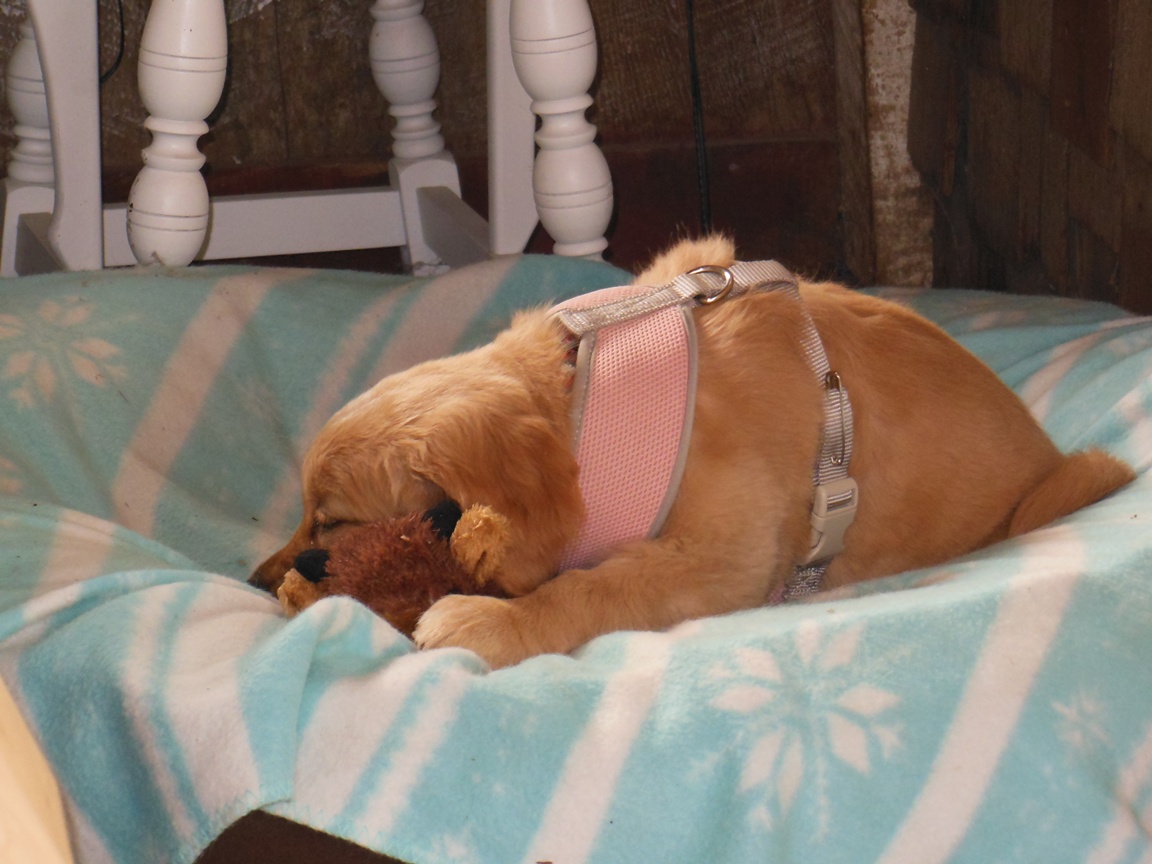
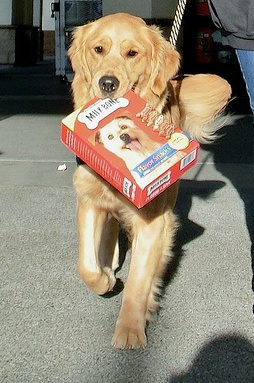
Time for a snack! (photo by Sae Hokoyama)

Figuring out what to feed a dog never used to be so complicated. For generations, dogs simply ate whatever the people in the family ate. Or, to be more precise, whatever they didn’t eat — dogs were often fed the leftovers from a family’s meals.

Then came commercial dog food. Kibble, canned, semi-moist — all were convenient and were touted as much more healthful for our canine companions. Over the past 10 years or so, dog food has gone gourmet, with organic foods, human-grade foods, foods that cost more than the average family spends on groceries for the humans … but is it better for the dogs?

The latest fads are raw food and no grain or low carb diets, all touted as closer to dogs’ “natural” diet. The “natural” diet is defined by looking at what wolves eat. Wolves eat a high-protein diet, with lots of bones mixed in. They are opportunistic omnivores and will eat fruit, greens, and vegetables if they find them or if meat is scarce, but they thrive on a high protein diet. Carbohydrates can lead to inflammation, some argue, and aggravate problems, such as arthritis, that feature painful inflammation. Raw diets are easier to digest. The less processing the better. Dogs may have evolved considerably since diverging from their wolfish ancestors, but their digestive system hasn’t changed. In short, the Paleo Diet for dogs. (The Paleo Diet encourages eating lean meats, seafood, vegetables and fruits and avoiding dairy, grains, legumes and processed foods.)

Or so one theory goes.

Yet another theory points to a recent study that shows that, in fact, dogs’ digestive systems have changed as they’ve become our housemates— they’ve evolved the ability to process and use (small amounts of) carbohydrates more efficiently than their ancestors. Their life sharing the sofa and the remote with their couch potato humans has made them more amenable to snacking on (and digesting) potato chips. This could be a boon for dog food manufacturers who pack their products with inexpensive and starchy fillers.

This theory is based on research by evolutionary geneticist Erik Axelsson. He was looking for genetic differences relating to dogs’ and wolves nervous systems. But he found something surprising: He found that the three key genes involved in digesting starch are different in dogs and wolves.

While several theories are debated concerning how dogs became domesticated, all involve wolves spending enough time around humans — and humans’ food and leftovers — to form a relationship. That the wolves hanging out with the humans evolved to eat the kind of food the humans ate makes sense. (And hey, if our early ancestors were eating starch, doesn’t that make the Paleo Diet irrelevant and wrong? Pass the popcorn!)

Which theory is right? What should we be feeding Fido?

First of all, dogs are not wolves. In dog training, myths based on idea “dogs are the same as wolves”  have done untold damage to dogs’ relationships with their humans. Is the same sort of damage now being done to their health through misguided nutritional guidelines?

Modern humans eat a wider variety of foods than our long-ago ancestors did, and our bodies work differently — though a diet high in unprocessed, whole foods and low in simple carbohydrates is still the healthiest option. The same is true, I believe, for our dogs.

In a discussion of Axelsson’s study, PetMD.com’s Daily Vet blog recommends a balanced approach. If your dog’s diet includes grains, whole grains are recommended. Less-processed food is preferable to highly processed. Starches should only form a small part of the dog’s diet.

What might matter more than whether your dog’s food includes brown rice and barley or is completely grain-free is the quality of the ingredients and the relative proportions. As I wrote in “Ask the Thinking Dog” last spring, choosing a safe, healthful dog food can be challenging. I look for U.S.-sourced, high-quality ingredients and avoid food processed in any of the large pet-food factories that are the source of the never-ending recalls. Our dogs eat Fromm Family kibble and Sojo’s, but each dog’s needs are different, so you’ll need to figure out how best to meet your dog’s needs.

A word of caution: While discussing your dog’s diet with your vet is a good place to start, I have found that many vets strongly recommend foods that they sell — but that might not be the best choice for your dog. For example, several vets over the years have recommended putting our dogs on prescription diet foods, available only (and at extremely high cost) through the vet. In most cases, a “prescription” food is not necessary, and a higher-quality food can be purchased less expensively elsewhere.

Do your research! Understanding what proteins and other ingredients work best for your dog can help you choose the correct (non-prescription) food. Talk to the people at a locally owned (not big-box) pet supply store that sells a variety of high-quality foods. Often, these folks are quite knowledgeable. Talk with other dog people, and pay attention to how your dog’s energy level, digestive system, and skin and coat health are affected by different foods.
Puppy Tries to Downsize Older Dog, Steal Her Job

At the ripe old age of not-quite-three-months, Cali made her first play for Jana’s job. She liked the idea of a paycheck, in the form of some treats, delivered as soon as the work was complete.

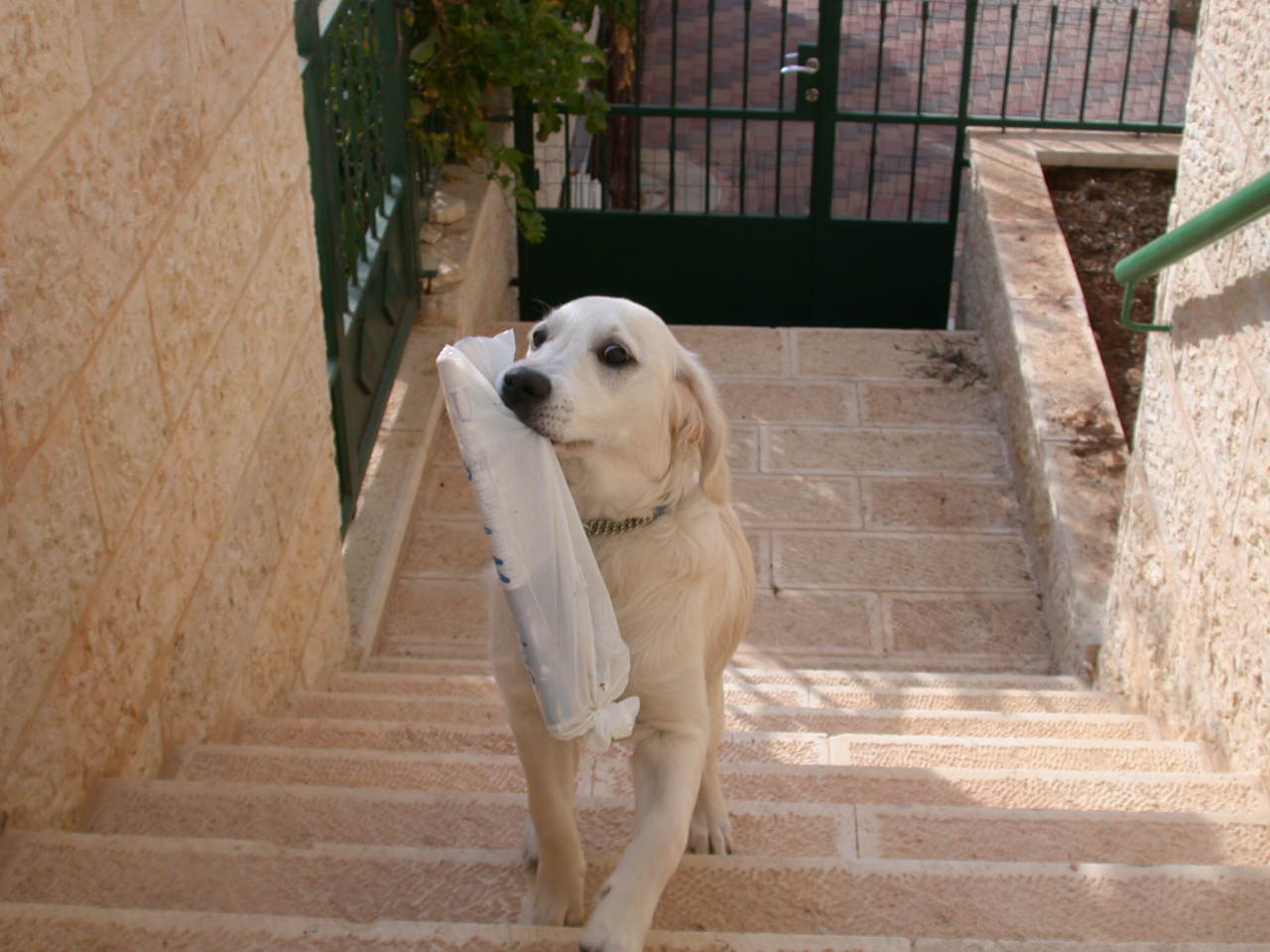
The newspaper was still bigger than Cali the first time she grabbed it and dashed off ahead of Jana. Reined in by a too-short leash, Cali was soon overtaken by Jana. Jana looked at her in annoyance, then reached over and snatched “her” newspaper back.

Jana’s held this job since she was a tiny pup, and she is not ready to retire.

get the paper

Since that day, I try to get the girls to take turns, and I give each one a reward, but Cali still wants that job. And Jana is not giving up without a fight. Sometimes the paper bears the brunt of this literal tug-of-war.

Cali and the Sunday Paper

Dogs need jobs. Ever more, dogs need opportunities to earn rewards. But I think what is really at play here is that Cali looks up to — worships — Jana and wants to do everything that Jana does. Cali learns new skills very quickly and I am sure it is partly because she is watching what her adored big sister does and copying every move, albeit in her clumsy puppy way.

Still, I think the best solution might be a second newspaper subscription.

The Best Big Sister!

play

I was worried about Jana’s reaction to the new puppy. She’s never been fond of puppies, to understate the situation. Usually, she pretends any nearby puppies simply don’t exist. If a puppy gets in her face, she usually raises a lip in warning and puts considerable distance between herself and the little brat. So, I wasn’t at all convinced that bringing a puppy into our one-room temporary home was a great idea.

Then Cali arrived with all her sunny friendliness and puppy charm.

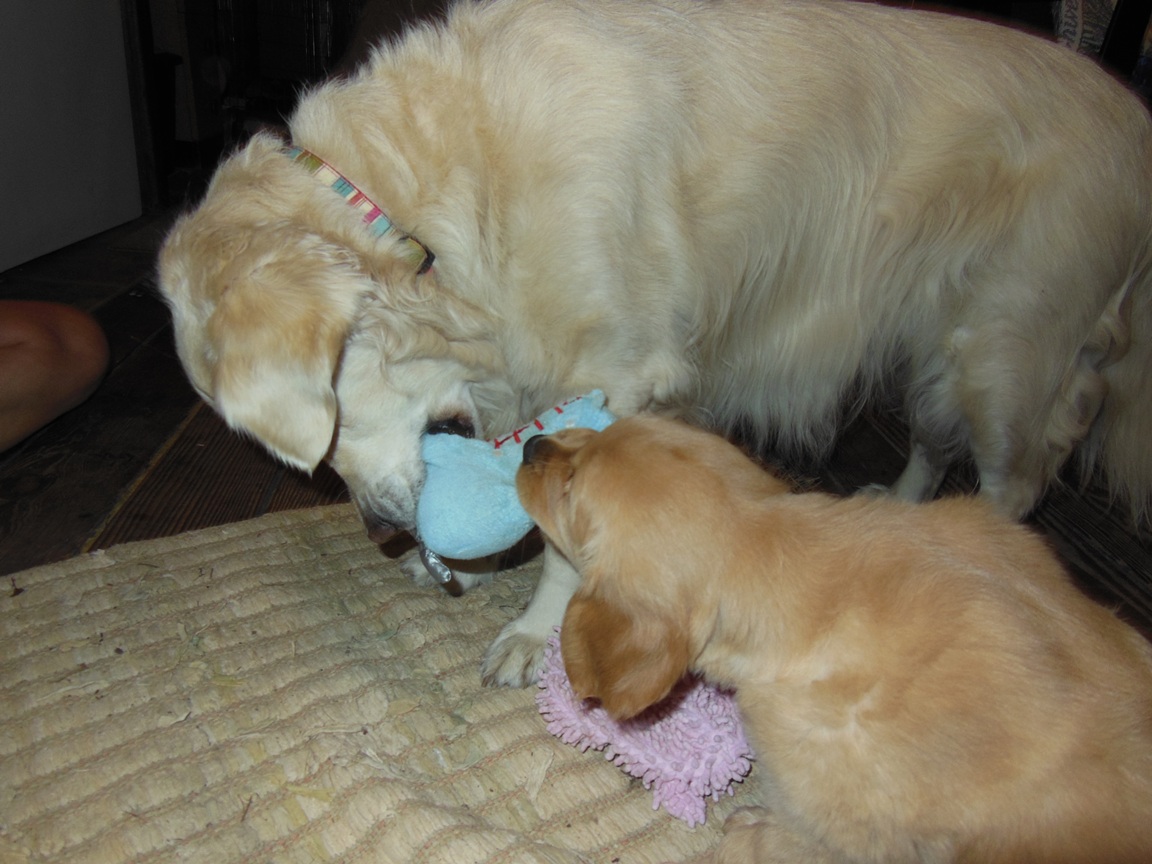
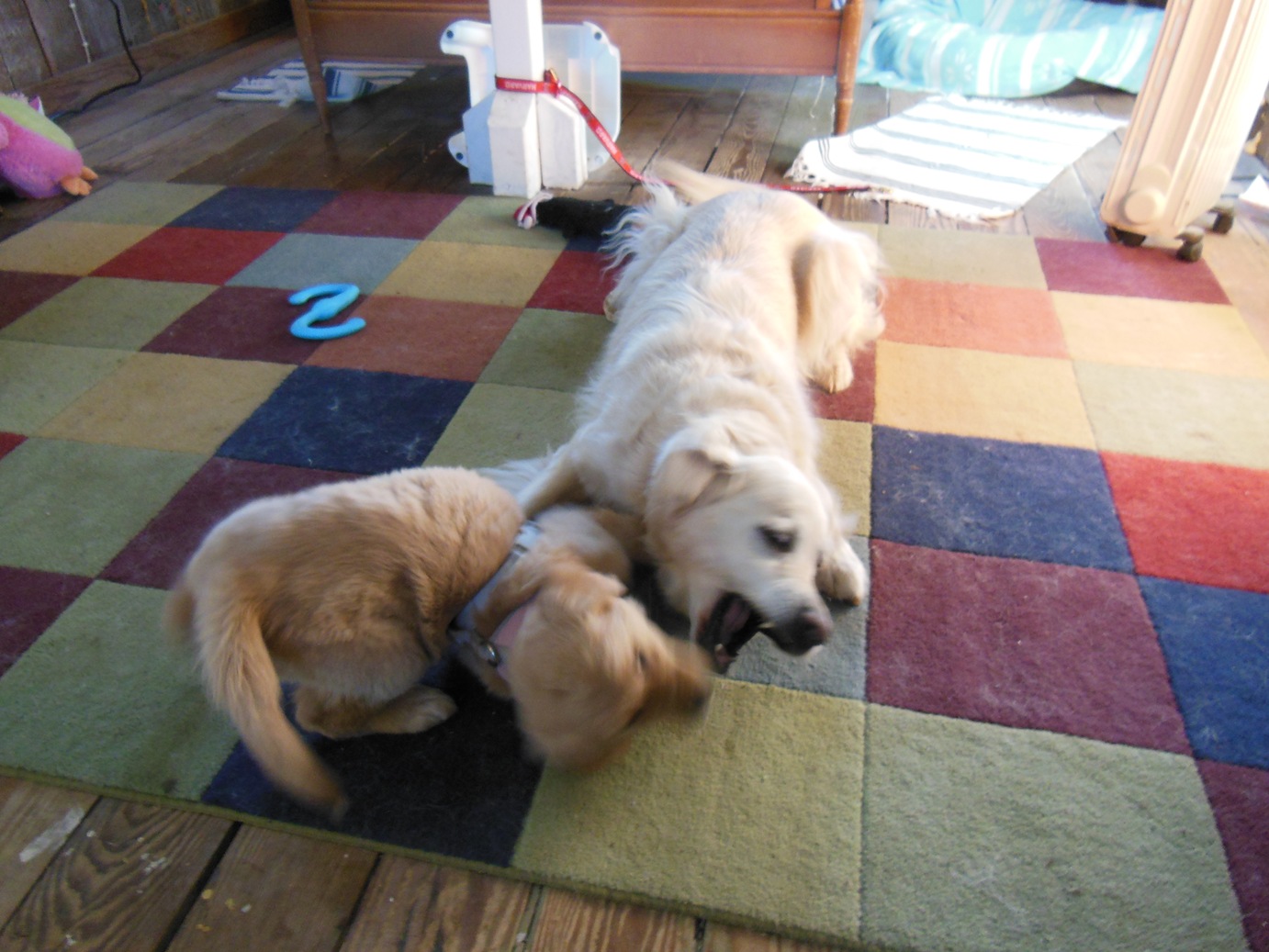
Within a few days, the first miracle: I caught them tugging on a toy, Cali’s comical puppy growls mimicking Jana’s play growl. The next day, the truly impossible happened: Jana forgot her elder-dog, anti-puppy dignity and actually invited Cali to play. It’s happened a number of times since then. In fact, when I start playing with them, they quickly re-engineer the game — to exclude me. I am beginning to feel like the waitress / doorperson / spa attendant. See them in action here: Cali and Jana playing.

Jana eagerly shows Cali what to do in training sessions and is teaching her all kinds of ways to have fun — roll in the grass! Eat mulch! Ignore Mom when she calls you to come inside! Drive Mom crazy by asking to go out every 5 minutes! Especially when it’s raining!

Cali watches worshipfully and carefully mimics everything Jana does. She so badly wants to be a big girl just like Jana.

There are lines though. Carrying the paper up the long, long driveway is Jana’s job, and Cali really needs to learn that. In fact, after wrestling the paper away from Cali this morning, Jana showed her outstanding work ethic: As we rounded the corner of the house, she spied a cat! She lunged, barked, lunged again, barked some more — all without letting go of the paper. I suspect she was putting on a show partly for Cali’s benefit.

There are minor areas of tension. Certain special bones are Jana’s. Only Jana’s. When Jana is choosing a toy, Cali had better stay away from the toy box, no matter how long it takes Jana to choose. And if Jana changes her mind and wants the toy Cali has, well, she is the big sister. Like most big sisters, Jana is often bossy and never lets Cali forget who is in charge.

At the same time, she’s amazingly patient with Cali’s boundless energy and need to play, bounce, cavort, run, jump, spin, and generally demand attention. Cali has gone too far only once, and she got a slightly nipped ear to impress upon her the foolishness of disregarding Jana’s warnings. Mostly, though, they are polite and appropriate with each other, they wrestle and tug and play happily together, and they share their toys far more amicably than most human siblings.

They are both girlie girls; their favorite toys are all pink. Small, purselike toys are popular, as is the bright pink pig that Jana selected on her first trip to a PetSmart several years ago, and a huge (pink) owl. They both like to play tug (with the pink rope), and both are highly food motivated. In some ways, though, they couldn’t be more different. Jana is very analytical and extremely selective about which people (or dogs) she’ll allow into her personal space. Cuddle? Hands off, please. Cali, on the other hand, has no concept of a “stranger.” Each human and dog on the earth, she is certain, was placed here to be her best friend — especially you. In fact, she just can’t wait to meet you. And you, you, and you. When she does, she’ll smother you with kisses, her tail madly wagging the whole time.

Come to think of it, how could Jana resist? How could anyone?

Introducing Cali!

on janas bed

Our family is growing! Meet Cali, the newest member of the Hogle and Elliott household. Except, of course, she’s in California with me and Jana now, not home in Florida with Deni.

Single puppy parenthood is a challenge! Cali is wonderful about asking to go out when she needs to … but that means that I have to be quick to respond, whatever the time of day — or night. How do parents survive months of this? After just over a week, Cali is waking up pretty consistently around 1 a.m. and again between 4 and 5 a.m. The second time, I just let her cuddle with me until it is time to get up at 5:15 or 5:30.

Yes, mornings begin early with a puppy. She’s full of energy, happily greeting her toy box like a long-lost friend, bouncing from one end of the small studio to the other, trying to get Jana to play, turning somersaults, and generally being a puppy. All while I am trying to find the ON button for the coffee pot.

By the time dogs go out, dogs come in and wipe their feet, I build a fire in the wood stove and take a shower, dogs have breakfast, we all walk down to fetch the paper (Jana does all the work here), I have breakfast, we play, puppy goes out again … well, I am ready to go back to bed. And it is only about 7 a.m.

The good thing about puppies is, they take a lot of naps. But, many of these are power naps, which means that, after 20 short minutes, Cali is wide awake, full of energy, and eager to play. I, having tried to get 3 hours’ worth of work done during those 20 minutes as well as pay some attention to Jana, am less refreshed and eager to play. Sometimes, she’s lucky she’s so cute.

She uses her cuteness on others as well. At Bergin U, where I am teaching this semester, Cali has charmed the students, staff, and volunteers. She is easily the most popular girl on campus. The benefit for me is that, the more people who come play with her, the more naps she takes! In fact, she’s taking one now, having been thoroughly worn out by a dedicated volunteer who drove in from more than a half-hour away — to play with Cali!

I was a little worried about her the first few days she was home. She didn’t show much interest in eating and even left food in her bowl! She has adjusted quickly, though, learning the attraction of food-filled Kong toys, solving her Brainy Bone puzzle (to get at the hidden Charlee Bear), and begging for meals and training treats.

Speaking of training, this puppy is clearly a genius, well on her way to learning several cues and tricks. I think she’s a lefty; she shakes with her left paw about 3 times out of 4. She’s got a nice “sit” and is catching on to “down,” “turn,” and a few others. She’ll even pick up a wooden dumbbell, but is not quite reliable about giving it back to me yet.

Most miraculous of all, Cali seems to be on her way to charming big sister Jana. She is definitely the annoying little sister sometimes — clamoring for attention, bugging Jana to play, appropriating Jana’s bed and toys. But, yesterday morning, something momentous occurred. Jana asked Cali to play. The two romped and tugged with her for a few minutes before Jana remembered her older-dog dignity and her opposition to puppies and went back to bed. The puppy tires her out too!

Tug

Teach “Incompatible” Behaviors for a Well-Mannered Pup


New puppy parents are often advised to keep a supply of puppy chew toys handy in every room. If the puppy starts to chew on something inappropriate, such as the sofa leg or a shoe, the humans can easily reach for a puppy toy and offer a trade. This is good advice and a good introduction to teaching an “incompatible behavior” to replace an undesired behavior: If the puppy is chewing on her own teething bone, she’s not destroying the furniture.

In my last blog post, The Best Alarm Clocks Ever, I mentioned procedural memory in a description of how and why dogs remind us that it is time to get up, feed them, or even take our medication. Procedural memory is even more significant in the way it affects other routines and behaviors.

Some psychologists say that procedural memories form aspects of character or habits. That means that a behavioral or emotional response to a particular situation could become an automatic or ingrained response. This is a valuable piece of knowledge in educating dogs (or humans). Old habits are hard to break, but understanding where a behavior comes from might mean that you can work to change it — replacing the “bad”  habit with an incompatible good habit. An incompatible behavior is simply any different behavior that cannot be done at the same time as the undesired behavior. Learning the new “routine” will replace the old, undesired one.

A common example is doggy greetings. Jumping up to greet people (or adult dogs) is a very common puppy behavior. This probably hearkens back to dogs’ wolf ancestors. When young wolf pups jump up and lick adults’ muzzles, it stimulates regurgitation feeding. Ick. (It’s also a submissive behavior.) When our cute puppies jump on us to greet us, we might not feed them in the style of wolves, but we do tend to reach down and pet and cuddle them. We might laugh and tell them how wonderful they are. This is fun and rewarding for puppies, and it encourages puppies to continue to jump on returning human family members and guests. Many small puppies grow, though, and become large, gangly adolescents, then 60- or 100-pound adult dogs. Jumping is not cute anymore, but the puppy has never learned not to do it; in fact, the puppy has been rewarded for jumping.

Some old-fashioned trainers might suggest stepping on the dog’s toes or kneeing the dog in the chest to stop the jumping behavior. This is cruel and does not teach the dog anything other than that his human can’t be trusted. From the dog’s perspective, his human has suddenly started hurting him for no reason. After all, the human allowed and even encouraged the jumping when the puppy was small.

A more fair and humane approach is to teach an incompatible behavior, for example teaching the puppy or dog to sit to greet people. If the puppy is sitting, she can’t jump, right? (Another option for overly enthusiastic canine greeters is to teach the puppy to fetch a toy and bring it to the visitor.)

Not exactly cocktails, but it’s a start (photo by Sae Hokoyama)

When Jana was a puppy, I wanted to teach her to sit to greet visitors. I put the “incompatible behaviors” principle to work successfully — both on puppy Jana and on our guests. First, I taught Jana to sit when I crossed my arms over my chest. Then I asked entering guests to cross their arms. This action was “incompatible” with petting the jumping puppy. It also gave Jana the cue to sit (incompatible with jumping). Viola! Jana sat and was rewarded with praise, petting, and, often, treats; I could happily greet visitors without fretting that they were teaching Jana bad habits.

In The Best Alarm Clocks Ever, I also mentioned Jana’s propensity to remind me of mealtimes — well ahead of time. Doggy dinner is at 6 p.m., but Jana often starts hinting, nudging, trying to lead me to the kitchen, pointing out her empty bowl, etc. long before 5 p.m. Do you suppose that, if I taught Jana to make cocktails at 5 p.m., she would stop bugging me for her dinner? It’s worth a try …


Pups Need Time With Mom, Siblings

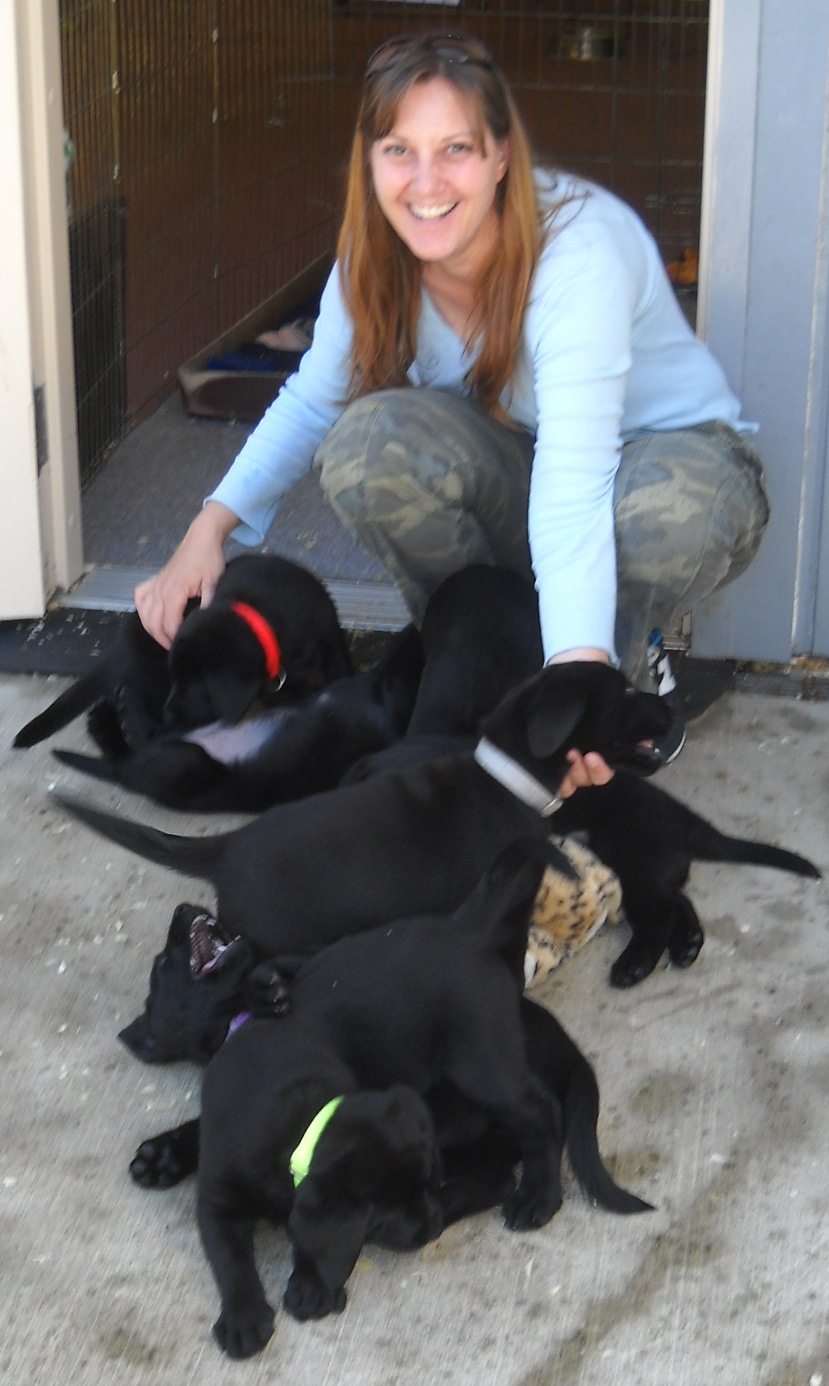
As one puppy tugged her shoelace, another went for her long hair, and yet another tugged on her pants leg, I watched my sister’s reaction. It suddenly occurred to me. “You’ve never played with an entire litter at once, have you?” I asked.

She hadn’t. In fact, her dogs were rescued as adolescents, so she’s never lived with a young puppy either. These Labs were seven weeks old, the perfect age: cute, cuddly, and playful, but still too small to be pushy or overwhelming en masse (there were seven of them, after all).

Seven weeks is also about the age that most litters are split up, each puppy being sent off to his or her new home. Some breeders (and puppy mills) try to place puppies even younger than seven weeks; responsible, caring breeders will wait at least eight weeks — maybe longer.

The puppies need that time together.

A study published in the Veterinary Record in October 2011 shows that puppies who were removed from their litters too early were far more likely to exhibit problem behaviors later in life than puppies who stayed with their sibs for 60 days or longer. The behaviors included destructiveness, excessive barking, fearfulness on walks, reactivity to noises, toy possessiveness, food possessiveness, and attention-seeking. A much larger proportion of early-separated dogs demonstrated those behaviors.

The study was based on survey responses of 140 dog owners in Italy. Their dogs were between 18 months and seven years old. Half had been adopted at age 30–40 days and half at 60 days. Half came from pet stores and the rest from friends or relatives of the owner or from a breeder; none had been adopted from shelters or had been obviously traumatized.

Dogs who had been separated early from their litters and purchased from a pet store showed the greatest tendency toward toy possessiveness, fearfulness on walks, attention-seeking, stranger aversion, excessive barking, destructiveness, and play biting. Thus, the authors concluded, the combination of early separation and temporary housing at a pet store is particularly inhibiting to a puppy’s social development.

Dog experts have long known about sensitive periods in puppy development and the importance of puppies learning, through play with their littermates, to interact appropriately with other dogs. A puppy’s experiences during this sensitive period, that starts at about 2.5-3 weeks of age and ends at 12 to 14 weeks, a puppy’s experiences can actually modify his brain, leaving lasting effects on his temperament and behavior.

In plain English, this study suggests that taking a puppy away from Mom and sibs too early could affect his ability to adjust to new environments and social relationships — for the rest of his life. It also suggests that early separation makes the puppy more likely to develop behavior problems.

Read more about this study here.


Never Too Young to Learn

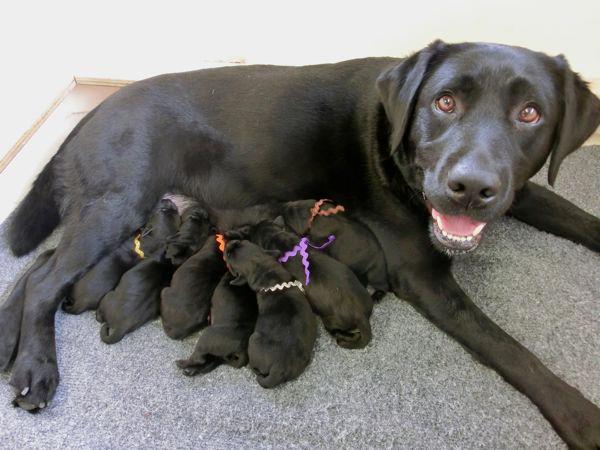
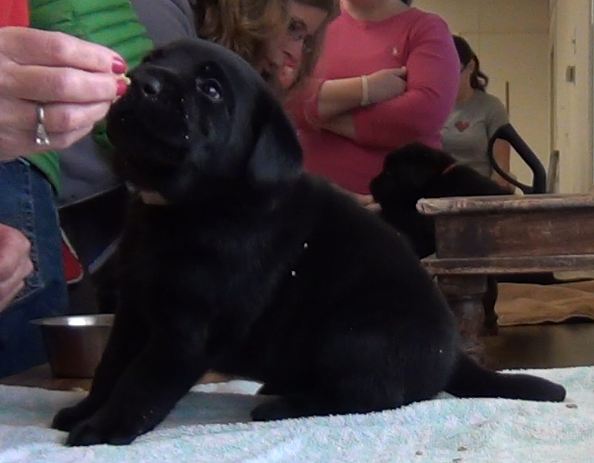
ImageBergin University has a litter of adorable black Lab puppies. (I know, puppies are all adorable, but I’ve always been a sucker for black Lab puppies.) The puppies started school last week. The puppies also turned four weeks old last week. That’s right. Four weeks. They’d had their eyes open for a full week before training started, so, honestly, I don’t know why the student trainers waited so long.

Sadly, there are still people who think that you can’t start formal training until a dog is a year old. Some more liberal people say that puppies can start training at six months. Then there are those smart puppy owners who get their pups into puppy kindergarten as soon as they can — usually once the pups are vaccinated. But even that is late. Puppies start learning the day they are born, if not before.

So why do people traditionally wait so long to begin teaching their puppies? In the history of dog training class that I am teaching this semester, the students have finally emerged from the cruel, punishment-focused training years of the early to mid-1900s. By the ’50s, people were starting to understand that so much emphasis on punishment actually got in the way of learning. A few trainers — Blanche Saunders, Winifred Strickland, and others — began incorporating praise and even rewards into their training! But the prevailing methods, up until the 1970s, were pretty harsh. Only older, stronger dogs could stand up to the punishment and the trainer’s lack of communication — and actually “learn” anything. Lots of dogs were deemed untrainable because they shut down or defended themselves by snarling or biting when treated harshly.

Learning "Sit" ...

Fortunately for puppies and people who love them, trainers like Milo Pearsall and Ian Dunbar began teaching that, like young children, puppies are eager and quick learners. Furthermore, the younger they start learning how to learn, the better they get at it. In a sense, your puppy will be “smarter” if you train her early. These trainers introduced a now-popular and ubiquitous concept:  puppy classes.

... and "Shake"

Human parents of a new puppy can reduce the number of bad habits and undesirable behaviors the puppy learns by enrolling the youngster in puppy kindergarten. Here puppies learn what to do — and what not to do — and develop good manners early on, all without harsh punishment. Good puppy classes emphasize socialization — ensuring that puppies are exposed to lots of different kinds of dogs, people, sounds, sights, smells, and experiences — all in a controlled, positive way. This helps puppies learn that new things are not always scary, that their human families will keep them safe, and that the world is an interesting and fun place to explore.

So, back to my students. These special Lab puppies are future service dogs. Thanks to Bonnie Bergin’s enlightened early training, fewer puppies need to be “released” from the program, and more will become grown-up dogs capable of doing the work needed by their owners, who have disabilities. What these puppies are learning now will pay off: The tiny bits of mushy puppy food offered as a reward for sitting or coming when called are helping the puppies build two-way communication with humans. The puppies are learning to think and problem solve, which will enable them to become full partners to the people who will rely on their assistance. Training sessions are short — only a few minutes at a time for the little pups  — and fun.

The good news is that, nowadays, training that is fun is not just for puppies. Family dogs of any age can benefit from modern training approaches that emphasize positive reinforcement, rewards, and keeping training fun. Breeders can start working with puppies at four weeks; those “adopting” a new puppy at the ripe old age of eight weeks — or an older dog — can start as soon as the dog comes home. Your dog can start today. What are you waiting for?

Special thanks to Dearing English for the puppy training photos captured from her video of the first day of training. Puppies were four weeks and one day old.