Should You Crate-Train Your Puppy?

Orly examines a sloth toy in her exercise penI’m generally not a fan of crating dogs, so I read this Washington Post article, “Should you crate your dog? It’s complicated,” with interest. It is complicated.

I have used crated while house-training young puppies and to keep them safe and out of trouble when I couldn’t supervise them. I have had young puppies sleep in a crate until they are sleeping through the night, then I keep all of us in the bedroom with a dog gate. That way, if pup needs to go out, she’s likely to wake me rather than find a remote corner of the living room where she can do her business and go back to bed. I stop gating the bedroom when I am reasonably confident in the dog’s house manners.

I have also used crates when fostering or dog-sitting anxious dogs who tended to be destructive when unsupervised. In both of those cases, the dogs seemed happy to go into and stay in the crates, and seemed less anxious in the crates than when left alone in a room (even if I was home and they could come find me). That assessment is based on their vocalizations and body language.

I think that both of those uses of crates are fine, if:

  • The dog has been acclimated to the crate using positive means
  • The crate is large enough and comfortable
  • The dog is happy to go into the crate
  • The dog is provided with safe chew toys, treats, and/or comfort items
  • The dog is only in the crate for short periods of time (never more than a couple of hours)
  • The crate is never used as place for time-outs or punishment

I have never used a crate routinely when I leave an adult dog home, even when I worked full-time in an office (!!) and the dog(s) were home for many hours. Especially then!

I work hard on house manners with puppies I raise and I have gotten all of my puppies to the point of being trustworthy by the age of 6-8 months. That is, if your definition of trustworthy allows for some unauthorized use of sofas and comfy reading chairs while you’re not there …

This is not possible with all dogs, of course. Some pups and adolescents are more destructive. In those cases, I would suggest working with a trainer and figuring out how to get the dog more exercise and enrichment. A dog hiker or dog walker is a lifesaver when you have an active young dog and work long hours.

Why all dogs need SOME crate training

I also believe that all dogs should at least be exposed to and get used to being in a crate. If you need to transport the dog somewhere, board the dog on short notice, keep the dog on “bed rest” following an injury or surgery, have someone take the dog because you had surgery or an accident — you do not want the emergency situation to be the first exposure to crating.

Some dogs hate crates

Some dogs flip out the first time they see or enter a crate, even if the door is open and they are totally free to leave. Some dogs go right in and curl up as if they’ve been sleeping in a crate their whole lives. The younger the first exposure, the easier it is to move past a bad first reaction.

Alternatives to crates

For dogs who are adamantly anti-crate or are still working on accepting the crate, there are other options. I’ve set up a puppy-safe room when possible — hard floor that is easy to clean, minimal or no furniture, dog bed, and sturdy, safe toys.

10-week-old golden pup Orly stands up in her ex pen to protest. she's holding a red toy.I’ve also set up an “ex pen” or exercise pen. These are sturdy wire mesh panels that are configurable into a square or rectangle. This can be in a living room or rec room where the dog can hang out and see and hear what’s going on — while being safely contained. At least until she learns to climb out.

I tape plastic sheeting on the floor, tape the panel bottoms to the sheeting, and add some rugs or blankets, safe toys, a water bowl if the dog will be in there for a while. It’s like a deluxe, roofless crate. Orly wasn’t impressed and regularly threw tantrums when penned, but she was safely contained while I was cooking, say, or in a meeting and unable to focus on her. And she quickly and eagerly demonstrated impeccable house manners to earn her freedom.

There’s no one answer that works for everyone. As we established, it’s complicated.

Orly’s ‘Little’ Sister

I’m taking a vacation! There won’t be a new Thinking Dog post next week. Happy Labor day!

I wanted to leave you with some photos showing how Orly’s little sister has grown … and grown, and grown. I am sure that she’ll be bigger than Orly before she is 6 months old!

This slideshow requires JavaScript.


Orly Takes On the Big 5

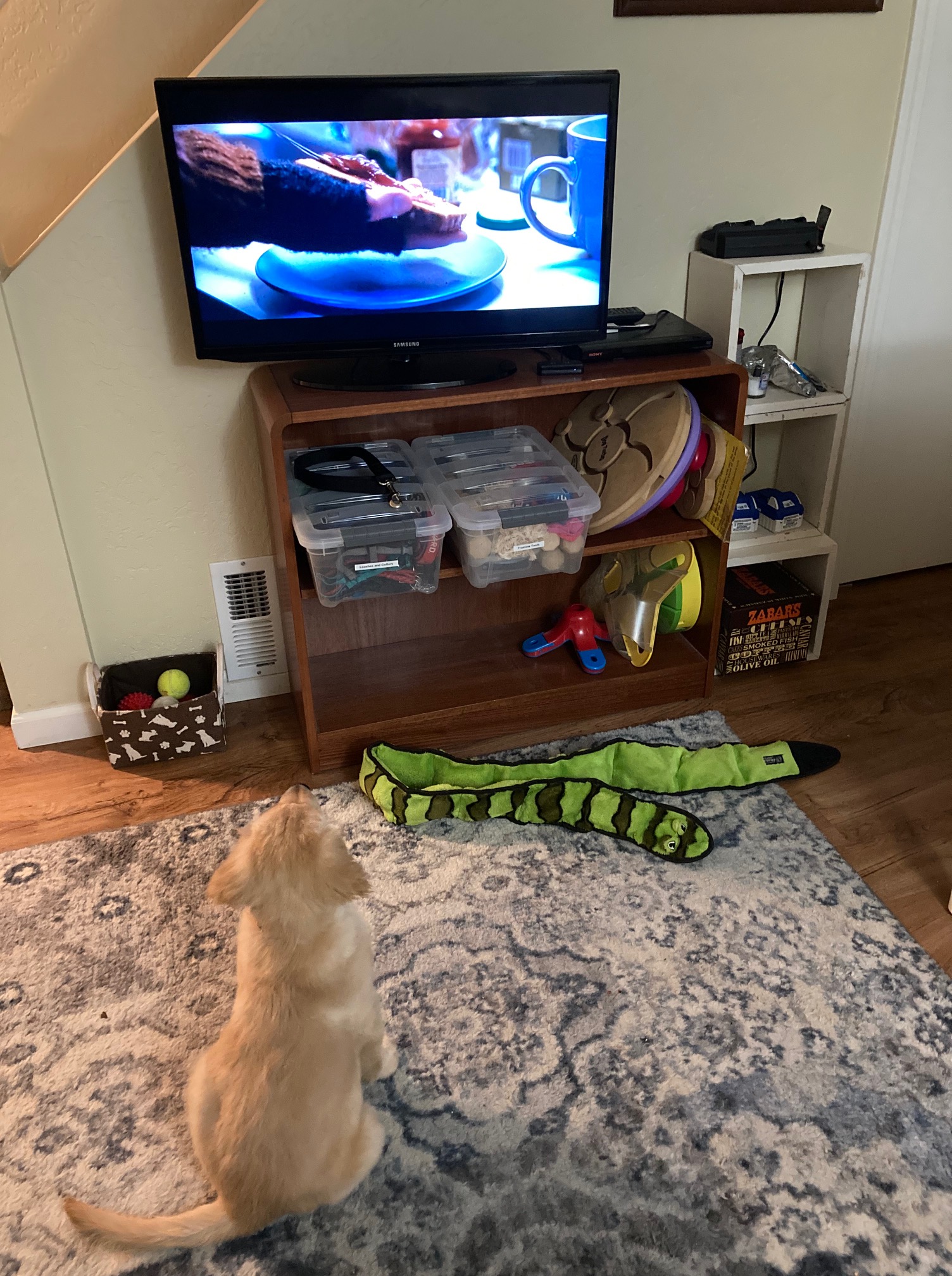
Golden retriever puppy Orly stares attentively at the TV.
How much screen time is too much?

I recently saw an article about 6 things that puppies are often mystified by or even frightened of: Vacuums, mirrors, TVs, brooms, phones, and ice cubes.

Ice cubes had me scratching my head a bit, but I haven’t given Orly an ice cube yet, so we’ll leave that one for the summer. Just a note: Dog ice cubes in my house are made with coconut water; when I’m going all-out, I prepare pina colada ice cubes, which are coconut water with mashed banana. The girls get them as a treat, sort of popsicles without the stick, on hot days. Look for an update this summer (and remember that summer starts pretty late here in Montana) …

On to the other five.

Orly loves television. She especially loves shows with animals, but she’s been as fascinated by Don’t Look Up and St. Vincent — movies we watched recently — and The Crown and Maid as she has by All Creatures Great and Small. (No judgey comments about our viewing choices please.) She does pay even closer attention when there’s a dog or another animal on screen, but she seems to know it’s not real. She’s not looking for the dog or anything like that.

Brooms and vacuums are just fun, as far as she’s concerned. She can chase and pounce on them, until her mean mom chases her away.

The phone … when I am talking on the phone, Orly has already figured out that I’m distracted and she can try to get away with things; same goes for video meetings. It’s the phone-as-camera that gets her interest. Again, no fear, but it’s hard to get candid shots of Orly: Whenever I hold my phone up and point it in her direction, she mugs for the camera.

That leaves mirrors.

Orly’s puppy kindergarten has mirrors on one full wall. A few weeks ago, the pups were taking a break while the humans were getting information. Orly wanted to keep playing, and the other puppies were actually behaving. But! She discovered a new puppy … in the mirror.

She invited this new puppy to play. They play bowed to each other a couple of times. Orly apparently got bored with this and wanted to move to the next level. She nosed the other puppy, then batted her with a paw; the mirror puppy followed her lead. Soon the puppies were playing pat-a-cake. Orly was having a blast; the other puppy parents were soon watching and laughing … which was not ideal, as we were still in class.

I’m not sure when puppies figure out that the puppy in the mirror is their own reflection, but I think it’ll happen soon, maybe at age 5 or 6 months (Orly is 4 months old). Maybe Orly will figure it out around the same time she realizes that that tail she keeps chasing is attached to her own body …

Is Orly’s Puppy License about to Expire?

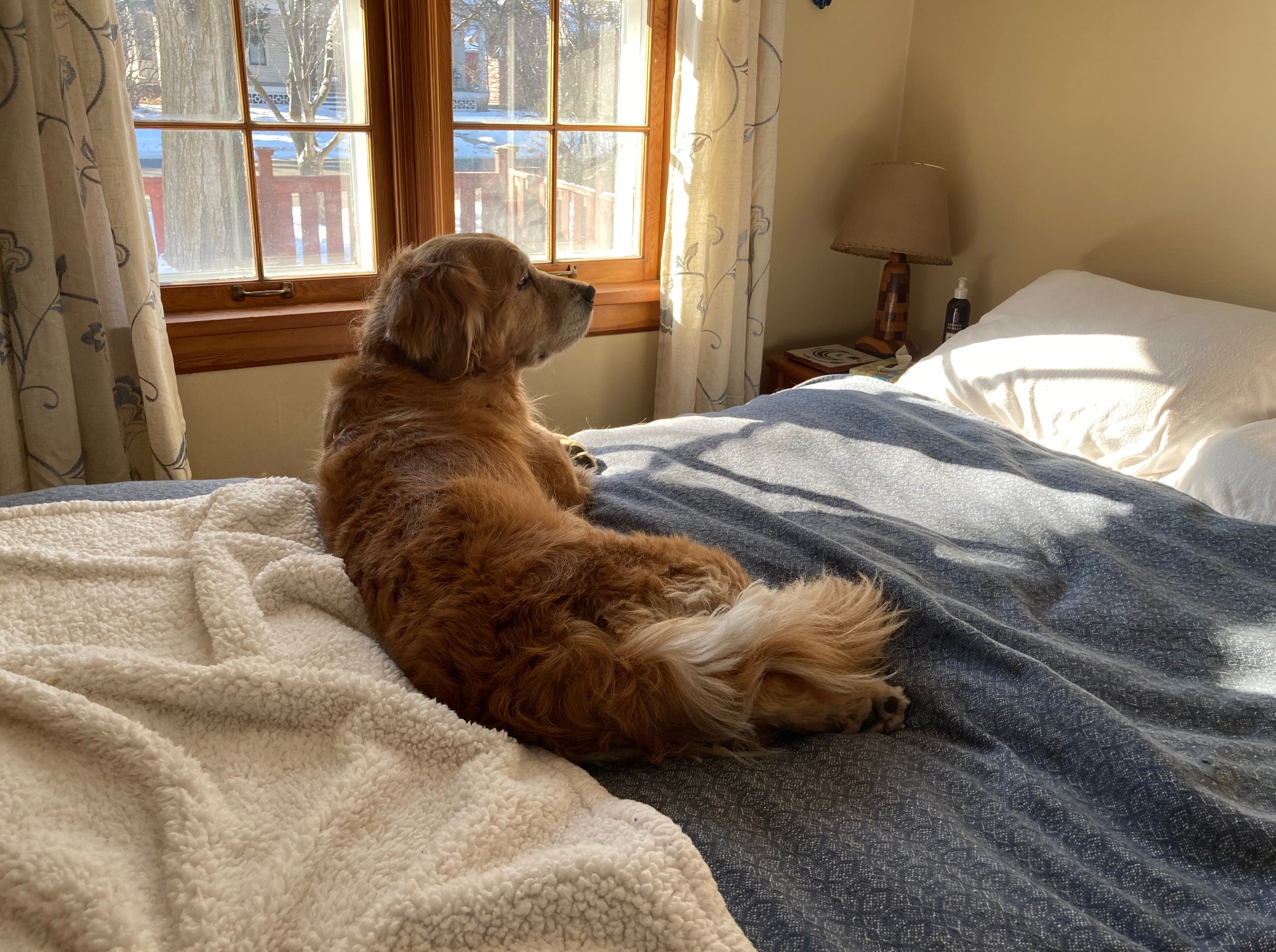
Golden retriever Cali relaxes on the people bed, a no-puppy zoneOrly’s Puppy License seems to be on the verge of expiring.

Puppy License is the very broad leeway that adult dogs grant to young puppies. It’s why they let the puppies chew on them, despite those Baby Shark teeth. It’s why they let puppies climb on them, steal their beds and toys, and generally behave rudely.

As puppies grow, though, adult dogs raise their expectations. This seems to be happening with Cali and Orly.

The other day, Cali appeared willing to maim Orly over a treat toy. After the quite serious warning she received, Orly wisely backed off. Still a little puppy, though, her next choice was less wise: Orly thought she’d munch on some electrical cords instead.

Oy. Of course this all happened while I was trying to participate in a work meeting … (with apologies to everyone else at the meeting, I quickly stepped in to save Orly from electrocution or a Cali chomp by picking her up!). Fortunately, my entire team at work consists of dog lovers.

Over the past few days, I’ve noticed Cali setting more boundaries and issuing more warnings. Ever-cheerful Orly will back off in the moment, but she hasn’t seemed to realize yet that Cali is serious.

I step in to enforce Cali’s boundaries as needed, but I do want them to work things out themselves. I also make sure that Cali is always free to leave the room where Orly is, and that Cali has special places and privileges that do not include a spotlight-stealing baby sister.

How do I provide mental stimulation for my dog?

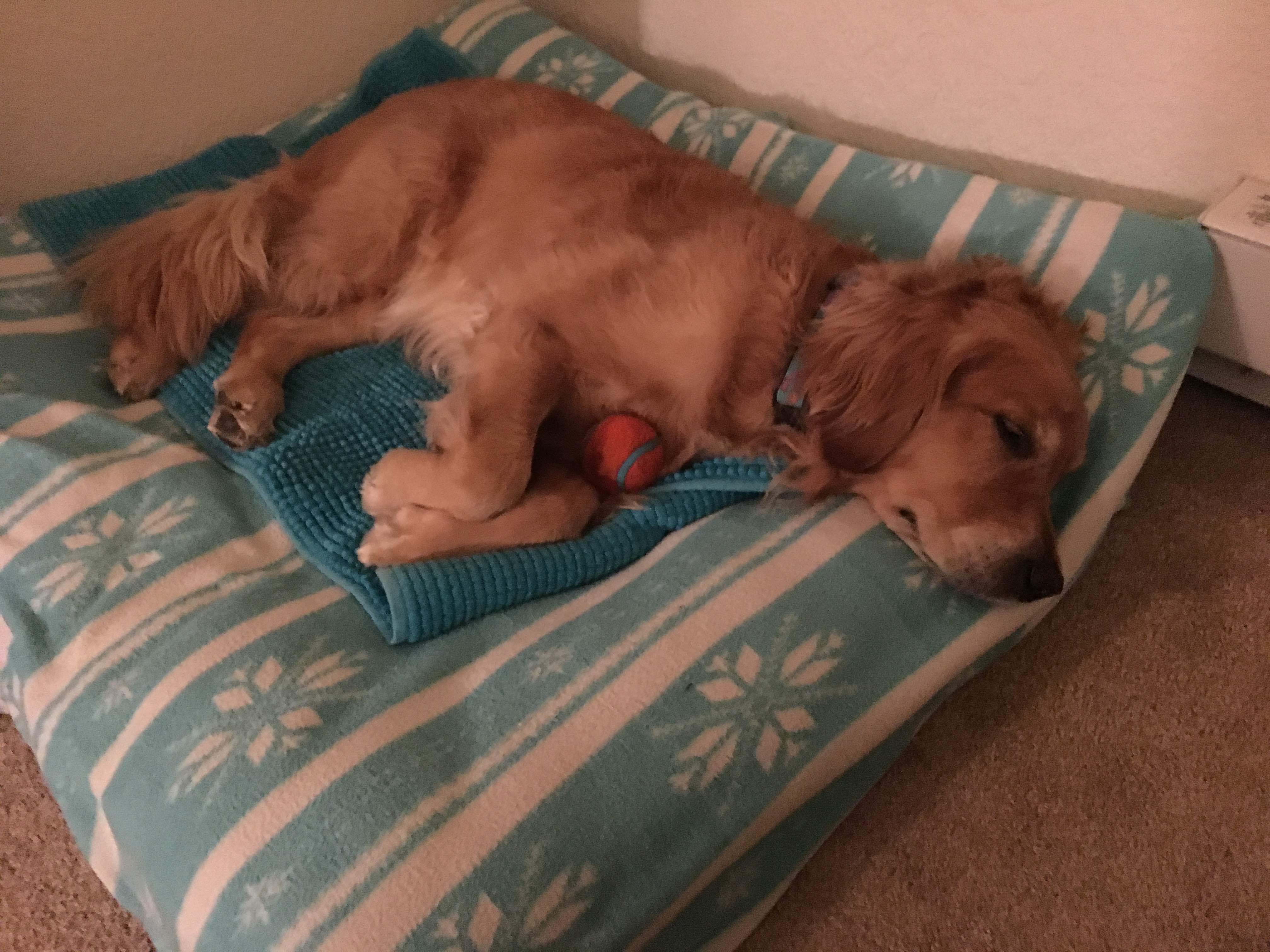
Cali sleeps on her dog bed, cradling a tennis ball with her paws.
A tired dog is a good dog.

Trainers are great at telling dog owners that their dogs’ “bad” behavior is due to boredom. The trainers might not always be as clear about what those dog owners should do about it.

Many people who have dogs also have jobs. Jobs that actually require them to show up someplace other than their home and work on things other than entertaining the dog. Unreasonable, right? So says Cali.

Fortunately for all of these dogs, a multibillion-dollar industry exists for the sole purpose of convincing us humans to fork over lots of money to purchase toys to entertain our dogs. Toys aren’t the only way to offer mental stimulation to a bored stay-at-home dog. Here are some ideas:

  • Long daily walks — This one is good for both of you! Let the dog sniff to her heart’s content. This could mean the walk takes a long time without covering much ground, but allowing for a smell walk every day — or dedicating part of an exercise walk to smell — will offer your dog more mental stimulation and make the walk much more fun.
  • Doggy daycare or hiking groups — Once or twice a week is enough for many dogs. Being with other dogs offers stimulation. Walking and sniffing in new places also does. Several hours of that can tire even the most indefatigable adolescent.
  • A class — You do have to be present for this one, but a rigorous class can provide mental and physical challenges that burn off some of that excess energy. Look for agility, Rally, nose work, basic manners, even prep for social therapy dog certification. Again, being around other dogs, even if they don’t really interact, is stimulating, as is learning new things. And you can practice for a few minutes each evening, giving you great bonding time with your dog and, you guessed it, challenging him and tiring him out. (Sense a theme here?)
  • Play games based on what you learned in that class — after doing nose work classes with both Jana and Cali, I played hide and seek games where I hid their “bait box,” the scent we used in class, and let them search. It takes only about 10 minutes to do 3-4 searches, and the dogs loved it.
  • Home-schooling — A trainer friend recommends books by Kyra Sundance for simple instructions on teaching your dog fun and easy tricks. It’s great for your relationship (unless you lose your patience …). Offer lots of treats, keep it fun, and keep sessions to about 5 minutes.
  • Treat toys — Last but certainly not least, treat toys are a staple. There’s a huge variety on the market. Some are interactive, which means you have to actually play with the dog … but many can be left with the dog when you go to work. Kongs are the most familiar, and there are literally thousands of “recipes” for stuffing Kongs if you Google it. Try several types and see what your dog likes. Experiment to find stuffings that the dog likes enough that she’ll keep working at the toy until it’s empty, but that she can’t lick clean in 5 minutes or less. Each dog is different: Jana could clean a Kong in seconds flat, but Cali loses interest when it’s still half full.
    A caveat: If you see that the dog is able to easily damage the toy, throw the toy away. You want durable toys that your dog loves but won’t destroy. Leave two or three with the dog when you head out to work in the morning. Hide them to make it even more challenging. If your dog loves treat toys, buy a bunch and rotate them. Keep it interesting. One friend who had two black Labs kept a large bin in her freezer filled with stuffed Kongs and other toys so she always had a supply ready. Inspect them every so often and toss the ones that are cracking, have chunks bitten out, or otherwise seem unsafe.
  • Safe chew toys — Identify safe chew toys and let the dog have access to these all the time. Consumables like rawhide are not safe and the dog should not have those when you are not around to supervise. I use antlers, but I know that there are many opinions on what is safe, ethical, etc. so you’ll have to figure that one out for yourself.

Offering mental stimulation pays off; even if you do the stimulating activities in the evening after work, the dog will be less bored overall. This should result in less destructive behavior. If your dog is young, particularly those 6 months to about 2 or 3 years old, there is no amount of stimulation or exercise that will truly tire him out. But the more acceptable options you offer, the less time the dog will spend destroying your home, shoes, and clothing. (Also: Young, untrustworthy dogs should not have the run of the house when you are not there. But that is a whole separate discussion.)


What’s OK When Puppies Play?

I’ve accompanied friends with young puppies to puppy play sessions several times over the past few months. (Playing with puppies and then sending them home with someone else is the best …)

Puppies often play in ways that seem rough and scary to their doting parents. Those other puppies might hurt Precious, the new owners fret.

Relax. Puppies are pretty sturdy. They also tend to be quite vocal if another puppy is too rough.

Great puppy play includes:

  • Lots of chasing. One puppy leads off and others chase her. Within a few seconds, the pair or group change direction and another puppy is in front. When to worry? If only one puppy is chased (same for adult dogs) or if the chasee seems to want to end the chase and the other dogs ignore the signals. If too many puppies or dogs are chasing a single dog and seem intently focused on that dog. Good chase is fluid, not targeted at a single puppy.
  • Lots of wrestling, mouthing, and tugging. Yes, puppies have nasty, needle-sharp teeth. All the more reason to let them practice biting — and inhibiting their bite — on each other, not on our arms and hands. They let each other know what hurts and when to back off. This is one of the primary reasons why new puppy owners should insist that their puppy stay with his litter until he’s 8 weeks old. Sure, they’re weaned and yeah, the breeder might be pressuring you to take your puppy home. But those few weeks (with teeth) of play with littermates are essential to teaching initial social skills and bite inhibition. Single puppies and those taken from their litters at 6 or 7 weeks, which is way too common, are at a serious disadvantage.
  • Frequent pauses where puppies check in with their people, get a drink, pee, rest under a bench … puppies who know when they need a break are smart and self-protective. Puppy owners might need to enforce breaks, though, because the little ones don’t always make good choices. Call your puppy over, give him a treat, and send him back to re-engage.

What crosses a line?

  • Watch puppies for signs of stress. A puppy that is scratching a lot is stressed, as is one who’s constantly seeking to avoid other dogs, clings to a person’s legs, hides under a bench for long periods of time.
  • Yelps signal distress. Some puppies do vocalize while happily playing, but a distressed-sounding yelp is a call for human intervention. De-escalate the play, let the yelping puppy catch her breath, then let them all play again. Puppies usually recover quickly from a minor scrape and don’t hold grudges.
  • Too much mounting and other pushy behavior. This is a fine line. Puppies do wrestle and climb on each other, and that’s fine. Puppies of vastly different sizes can play happily together. But if a puppy seems interested only in humping or pinning other puppies and is doing it over and over, or constantly seeks out a specific puppy to mount, that puppy needs a break. And possibly larger, older playmates who will teach and enforce more acceptable play rules.

Puppy play groups are a great way for puppies to work on their social skills while working off a fraction of that endless puppy energy. Don’t avoid them because you are worried that your delicate baby might get hurt — but do pay attention and intervene when needed. In fact, that guidance serves beyond puppyhood and in any situation where dogs of any age are playing together.

No Such Thing as a Free Lunch

A very young Jana studies her Kong toy.
Jana was a young Kong addict

There should not be any free lunches. No free breakfasts or dinners either, not for high-energy puppies whose humans work and who therefore have excess energy to burn. Note that “puppy,” as used here, can apply to a dog of any dog of high energy and limited exercise opportunities.

My friends have a new puppy. Another friend is getting one next weekend. What possesses people to get puppies in Montana, just as winter is settling in, I will never understand. These puppies will have lots of energy. The weather will be cold and gray. When my friends get home from work, darkness will have fallen. It will still be there when they leave the next morning.

That means the puppy needs to play inside. Fetch games with soft toys are great, and teaching her to play “tug” might be a good idea. But it’s not enough. That’s where the “no free food” idea is key.

Many, many treat toy options are out there. These all operate on a simple principle: Humans put food inside the toy; puppies and dogs work to get it out, burning energy and developing their problem-solving skills in the process. They chew, lick, paw, chase … and don’t chew shoes or pillows, shred their beds or the furniture, or paw and dismember the furniture. They expend their energy in a desirable manner. Everyone wins.

The trick is figuring out which toys your dog will like. Jana was easy. Was there food in it? She liked it. The only problem was, she could also empty and spit-polish any treat toy in about 3 seconds flat.

Cali is less willing to work for her meals. She’ll leave a partially emptied Kong and wander off to do something more interesting. More interesting than food?! For a golden? Weird, right? She’s more engaged by the toys that randomly dispense kibble as the dog rolls and bats them around. Koala gets her lunch in one of those every day.

When a longtime friend had two young Labradors, she also kept her freezer filled with Kongs stuffed with kibble and peanut butter. Jana liked those, as well as kibble softened with broth and frozen. Freezing it slows the dog down. (A little. If she’s not Jana.) Want more creative — and more challenging — fillings? Google “Kong recipes.” It’s a thing. Really.

If you have a high-energy dog or a young puppy, pick out a few treat toys at your nearest pet store (or online) and try them out. Spending 15 minutes once every several days prepping the toys is an investment that will really pay off. Feed each meal (or part of each meal) in the toy, and encourage the dog to work for it. Feed from a bowl only after the dog has emptied the toy and only if you can’t reasonable feed him all he needs in treat toys. You’ll soon notice a calmer, better-behaved dog. Which naturally leads to a calmer, happier you.


A New Puppy!

No, I am not getting a new puppy! A good friend is getting one though, so I have been thinking about puppy prep lately. In no particular order, here are some things we talked about.

Socialization

We visited my favorite local training school, Sit Happens, so that my friend could meet her puppy-to-be’s kindergarten teacher. We watched several young puppies play in carefully supervised small groups, and talked about drop-in playtime, classes, and, in good time, a more formal manners class. Little Maisy will be very well educated. Best of all, I get to go to puppy class, and I don’t have to get up in the middle of the night with the puppy!

Food

We selected a good quality, reasonably priced food for Maisy, making sure that it was from a brand on the Whole Dog Journal’s approved list. They do all the homework of choosing quality foods, checking on the manufacturing processes, where ingredients are sourced, and whether the foods are nutritionally sound and include high-quality, identified, meat-based proteins.

Toys

I suggested getting lots of chew toys, especially ones that can hide treats. Maisy will spend a few hours at home each morning and afternoon while her family is off at work or school. She’ll need to develop a hobby, preferably one that doesn’t entail thousands of dollars in repairs and remodels to the house. So. Chew toys.

A play pen

Little Cali, age 10 weeks, shares Jana's dog bed
Cali appreciated the comfort of her big sister’s dog bed from her first day home. She never chewed on or ripped it. Not all puppies are as wise.

I lent the doting parents an ex-pen to create a safe space for Maisy when she can’t be supervised. I suggested taping heavy-duty plastic to the floor, as my friends did when our girls (Cali and Dora) were young. Whenever the humans are away or distracted, I advised putting Maisy in her safe space with some chew toys. Of course, when they are home, they will spend lots of time playing with her and cuddling her outside the pen. And rushing her outside!

Maisy also has a large crate to sleep in, complete with cozy crate pad. And a plush bed for when she’s mature enough to sleep on it, not destroy it. Cali was ready for a big-girl bed pretty quickly, and Maisy might well show similar good sense and appreciation for creature comforts.

Grooming

I advised getting the puppy used to having her teeth brushed right away. It’s best to start slowly, letting her lick some tasty chicken-flavored dog toothpaste off the brush (or a finger), then gently starting to brush. Cali loved brushing her teeth as a puppy. Now she’s reluctantly willing to do it, for a cookie.

Same goes for nail trims and brushing. Start right away but introduce it all very gradually and use lots of treats. It’s so much easier to trim a dog’s nails when she’s used to having it done. Cali doesn’t love it, but I can Dremel her nails in a few minutes with minimal fuss. I know several people who cannot touch their dogs’ nails and whose vets or groomers need at least two helpers. It shouldn’t be that traumatic. If you are fortunate enough to get your dog as a youngster, take advantage of the opportunity to introduce grooming early and painlessly.

Sleep

I advised the new puppy parents to rest up, since Maisy will demand a lot of time and energy during the first days as she settles in — and even more throughout her adolescence. I was exhausted for several weeks after getting Cali, and she was a pretty easy puppy.

It’s worth it though; Maisy will no doubt be a great addition to the family.

Buyer Beware!

Cali came from the best breeder I know! Do your research before taking home an adorable puppy.

I shouldn’t even need to say this … but don’t ever buy a puppy online.

First of all, you’re exposing yourself to scams. Unfortunately, internet fraud is very, very common, and people are not above making a buck by offering nonexistent puppies for sale to gullible people, lured in with adorable puppy photos. Read more in this Washington Post article, “How much is that doggy on the website.”

A law passed a few years ago attempted to crack down on internet puppy sales by requiring that seller have a physical location where buyers could see and pick up the puppies, but that’s hard to enforce.

A second problem with puppy purchases is, of course, the likelihood of purchasing a puppy mill puppy. This is terrible for so many reasons, among them: It feeds a business model that is based on mistreating dogs; the breeding dogs are often not only mistreated, they are unhealthy and could pass genetic, temperamental, and other flaws on to their puppies; and the puppies’ first weeks are spent in unhealthy, frightening, and damaging conditions. This makes everything from house training to manners and socialization far more challenging and sets up new puppy owners for a lot of unnecessary challenges and, often, failure.

One way to avoid puppy mill puppies is not purchasing online. Another is not purchasing at pet stores. If the risk of puppy mill puppies isn’t enough to convince you, consider that you and your family could also get sick. Another Washington Post article (shout out here to the best newspaper in America!) has more: “People are getting sick from a bacterial disease — and pet-store puppies might be to blame.”

Where should you get a puppy?

If you are particular about getting a specific breed, look for a reputable breeder. Good signs include:

  • Very thorough interview before breeder will even consider selling you a puppy
  • Breeder will not ship puppy to you; you must pick up the puppy in person
  • Breeder does not breed huge numbers of litters
  • Breeder insists on taking puppy back if you change your mind
  • Breeder knows where “her” dogs are; all of them, even older puppies whelped years ago
  • Breeder can prove that genetic and health checks are done on all breeding dogs
  • Even better — you know dogs who came from this breeder

If you’re less attached to getting a purebred puppy, look at breed rescue and other shelters and rescues in your area. The plus: you will meet your dog before taking him home. The minus: no guarantees on breeding, health, temperament, or early experiences. These dogs could come with a lot of baggage. Then again, so can a well-bred puppy. Don’t believe me? Read The Education of Will for a harrowing example.

The bottom line is, there are no guarantees, but choosing your puppy carefully is an essential first step. Relationships are hard, even when they’re with adorable four-footed fuzzballs.


Cali Overcomes a Setback

Regular readers may be following the saga of Cali at the dog park. To bring the ball or not to bring the ball?

After getting some wonderful feedback from several readers, I decided to give the “no ball” regimen another shot. I stopped taking the ball to the park and started actively encouraging Cali to play with other dogs.

An important note here: I go to the same park at roughly the same time nearly every day. The same group of dogs is there. Occasionally, I am early or late, or there’s a new dog or an infrequent visitor. But I know most of the dogs there. A dog park with lots of unfamiliar dogs would not necessarily be a good place to encourage a shy dog to play with other dogs. But (mostly) I know that the dogs — and owners — are good people.

So, after several days spent mainly with Cali sitting, staring at me, willing me, trying to mind meld me: “Throw a ball … Throw a ball” while I talked to the amused other dog people, it happened. She played with another dog. 

She played with Daisy, a sweet Rhodesian ridgeback. She played with Zoe, a small mixed-breed. She had a great time with Bella, a gorgeous young Bernese mountain dog. She even played with Ronen, a large black Lab who’s a good friend of Alberta’s but more energetic than Cali usually will tolerate. She ran in circles around Lola and Lila and Lizzie as they played, barking and play bowing, but lacking the confidence to fully join in. She tried to engage other dogs, too, not always sure but definitely making the effort.

These bursts of play were short, but exhilarating. She returned, panting and smiling, to sit next to me and, yes, stare and mind-meld. But it was great progress.

Then the husky showed up.

I’d seen this young female husky a few times, and she seemed intense and high-energy, but otherwise fine. On this morning, though, her mom had decided to bring treats (really good ones, it seems) to try to work on the young dog’s recall.

Mom pulled out treats. Cali wandered over to investigate. I called Cali back. She came (good girl!!) but then wandered over again. Mom was calling her dog all this time. I called Cali back but, before she came back to me, the Husky saw Mom, treats — and another dog closing in. She attacked. I called Cali again, Cali ran toward me, but the husky ran after her and grabbed her again. Cali cried. I screamed at the husky as I ran toward them. I had a leash in my hand and swatted at the husky, who backed up. I grabbed Cali.

Cali and I went over to our usual group of people and I checked her for damage (there was none) and we all told her what a good girl she was. We then left. I was worried that the experience would dampen her enthusiasm for the park and make her fear other dogs.

On the walk home, she warily eyed a friendly dog who wanted to say hi. She tucked her tail and looked at me. We kept our distance.

But the next morning, she was eager to go to the park. We were early, and there were few dogs there, but she did play with a small terrier mix. The next morning, our usual friends were there, and Cali played briefly with a new puppy on her first visit to the park. And she barked and circled Lola and her friends as they played. So it seems that the attack hasn’t slowed Cali’s progress. What a relief.

Even so, if I see any huskies in the park, I am steering clear.