Snuffle Monster

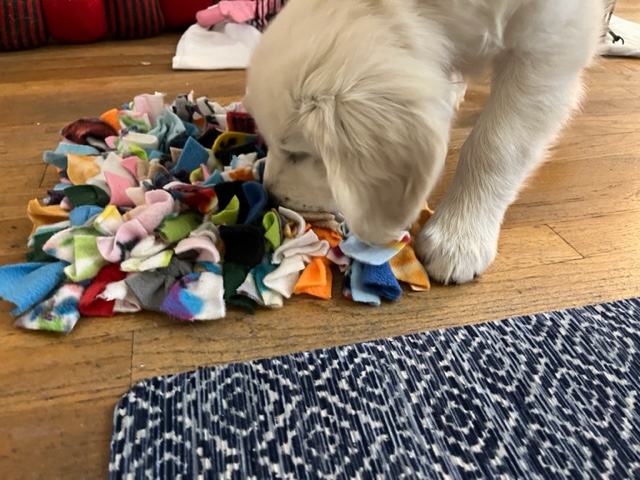
10-week-old white golden puppy sniffs a snuffle mat made of strips of fleeceI’ve created a monster. Think ‘Cookie Monster’ — not ‘JAWS.’

I introduced little Dotty to our little snuffle mat. Adorable in every possible way. She figured it out pretty much instantly. There is nothing wrong with her nose, and, true to her breed, she loves a good snack.

[A snuffle mat is a nest of fleece strips. The human servant hides yummy treats among these strips, and the dog sniffs them out and devours them. It’s a chance to let dogs use their noses and enjoy some mental stimulation. And a snack.)

I generally give Orly a snuffle mat after she hikes, and sometimes we do it after (my) lunch even on days that Orly doesn’t hike. She sometimes asks for it, but is generally happy to get the offer but not insistent.

Dotty is different.

After two — two — snuffle mat sessions, she started walking over to the shelf and trying to pull hers down. She resorted to barking at it when she couldn’t free it from the shelf.

She goes over to the snuffle mats and demands (often quite loudly) that I prepare one for her.

I ignore that, but when I am preparing the snuffle mats, she barks instructions, wriggles, tugs at the corner, pops up to watch where I am putting the treats (or is she counting to be sure that she gets as many as, or more than, Orly?!). She dives for Orly’s as I move to set it down. She impatiently sits, wriggling and sometimes barking, as I give Orly her mat and turn to give Dotty hers.

Once she’s finished clearing the treats from hers — and has thoroughly examined Orly’s mat to ensure that nothing was left behind (as if!) — she has taken to dragging one — usually Orly’s larger mat — around the room.

Snuffle Monster.

Doggy Environmentalists

Working Dogs for Conservation logo features a dog standing in the grass

“Our conservation detection dogs are agile, portable, and endlessly trainable. They are an efficient, highly sensitive, and non-invasive way to gather high-quality data.”

The above quotation is from the website of Working Dogs for Conservation (WD4C), a Montana-based organization whose dog teams literally travel the globe helping to save endangered species, find and route out invasive species, and intercept contraband cargo that includes products from endangered animals.

The coolest … okay, one of many, many cool aspects of their work is that the dogs they train are the “bad” dogs who wind up in shelters because no one can handle them. No regular family or ordinary adopter, that is. The high-energy, obsessive dogs who will do anything, anything at all, for the chance to play one more game of tug or get that silly human to throw the ball. Even better, the organization reaches out to shelters and teaches staff how to recognize these high-drive dogs and connect them with organizations, like Working Dogs for Conservation — or police, military, search and rescue, or other organizations that train and work detection dogs.

WD4C offers living proof that dogs can master more than one job. The dogs — endlessly trainable, remember — are taught to detect multiple, maybe dozens, of scents. That makes them versatile partners and enables teams to work in all kinds of places. The dogs learn to detect scents underwater as well as on land. In the water, they can detect pollutants like metals or pharmaceuticals, and they can distinguish between species of fish and aquatic plants, to identify invaders. At a talk I recently attended, the research director, Megan Parker, said that the dogs could distinguish between rainbow trout and brown trout, a feat that many Montanans would find impossible. They’re currently teaching dogs to detect brucellosis, a highly bacterial infection that affects, among others, cattle, bison, and elk in Montana.

In the service dog world, I’ve heard people claim that a single dog couldn’t be trained to, say, guide a person with impaired vision and retrieve dropped items; that person would need two service dogs. I’ve heard pet owners (and, sadly, pet trainers) claim that dogs can’t learn different rules for different situations or understand tasks that are too similar. This is absurd, of course.

So maybe the best thing about WD4C is that it believes in dogs: It believes in dogs’ ability to constantly learn — the demo dog at the talk is a 12-year-old Malinois who has been working for 11+ years. He’s still learning new tasks. It believes in the hard-to-handle dogs that others write off — and saves many of them from certain death in shelters. It even believes in humans’ ability to learn about dogs, sharing training methods and research with organizations and individuals who are eager to understand how incredibly capable dogs are — and to teach them to use their noses in countless ways.