Dogs Understand Our Words — and Our Tone of Voice

janaNYT

This week, many media outlets have run stories on a recent Hungarian study that might show that dogs not only understand the words we say to them, they also understand the tone of voice. I haven’t yet read the full paper, but based on several articles, here’s the gist.

The 13 dogs, trained to lie still in an MRI machine (so already a select group of highly educated individuals …), were tested on four sets of cues: Praise words said in a “praising intonation,” described as a higher and more varying pitch than neutral speech; the same praise words in a neutral tone; neutral words in a praise tone; and neutral words in a neutral tone.

From interactions with dogs, most of us know that we can get dogs to respond to pretty much anything we say in an excited or happy tone. And we know that they respond to some words even if we barely whisper them. For instance, a whispered “c…o…o…o…o…k…i…e…e…e…” gets a reliable response even if the dog is 100 yards away, playing happily with her buddy. But this research study, like several other MRI studies by this team and an American team, looked at the response in specific areas of the dogs’ brains, not their actions.

Praise words, regardless of tone, caused reactions in the left hemisphere of the dogs’ brain; this is similar to what the researchers would see in a human brain that is processing speech. Neutral tones, regardless of words, produced a reaction in the right hemisphere; this is similar to what the researchers would see in a human brain that is processing generic acoustic information. And, when the praise words were spoken in the praising tone, the reward centers of the dogs’ brain lit up. This shows that the dogs were able to integrate the meaning of the words and the tone and deduce meaning from them.

This study seems to show that dog brains process speech similarly to the way human brains process speech, which is what this article on Smithsonian.com reports. Other media reports said that it also means that the dogs understand human language, like this one from NPR.

Some experts, like one of my all-time-favorite scientists, Dr. Gregory Berns, told Smithsonian.com that the paper has been “wildly overinterpreted,” partly due to its methods. He pointed out that responding to speech and tone is not the same as understanding it.

That may well be true. On the other hand, the NPR article warns of the perils of life with such smart dogs, particularly if — as I do — one leaves NPR on for them to listen to all day. My dogs are, indeed, both smarter and better-informed than I am, especially now that I work in an office and do not listen to NPR all day.

However, in all seriousness, I think the overinterpretation also may be oversimplification. Yes, our dogs learn that certain words, even sentences, have specific meanings. They learn our habits and routines, and through experience with us, they associate all kinds of things with words. In our household some examples are: Leashes and fun and ball-playing with, “Who wants to go to the park?”; bowls of yummy food with “How about some dinner?”; and a careful backing up so that just her large, furry front paws are over the threshold with “Out of the kitchen, Cali.” The front feet then scootch back almost imperceptibly in response to, “The entire dog, please.” So yes, my dogs understand and respond somewhat appropriately to several sentences; I suspect that each family’s dogs have a set of favorites.

But even armed with my years of knowledge of their intelligence, along with my new realization of their eruditeness (is there a dog-oriented radio station that I could leave on instead of NPR?), I do not think that they process and understand human language in the same way that a human adult does.

What I do think, based on a combination of experience and having read dozens of research papers on dog-human communication, is that they read us really, really well. They don’t respond only to the words we say or the words combined with the tone of voice. Humans don’t either; so much communication is based on body language and other cues, even between humans. But dogs really read our body language. They also read all the scents we are giving off, including pheromones that we are completely unaware of. They read our microexpressions and our posture and our facial expression and pay attention to what we are doing as we are talking to them. They can figure out our emotions from these cues. They know when we “mean it” and when they can push the boundaries just a bit further.

Cali is much quicker to listen to my “get out of the kitchen” phrases when I am fixing her dinner than when I am doing the dishes. She’s learned that I will stop fixing her dinner and wait for her to leave the kitchen. She doesn’t like that consequence. But she doesn’t much care if I get the dishes done and maybe even wants me to stop doing them so I can pay attention to her.

The point is, looking at dogs’ response to words and voice in isolation doesn’t make sense, because in their lives with us, that is not how they use language. Another important thing to remember about dogs, as opposed to any other nonhumans, is that so much of who they are has been shaped by the fact of their lives with us. The dog-human connection is unique; our communication with them is different from our communication with any other nonhumans (even cats).

The most important point, though, is that dogs pay close enough attention to us to learn the meanings of the different things we say to them. They care whether we’re happy with them — or just whether we’re happy. I’m excited about new discoveries about dogs’ intelligence and cognitive abilities. But I am even more excited about new reasons to cherish the relationship I have with my girls and that others have with their dogs.
 

Just Hangin’ Out

Jana_aging

We all know that our dogs love us, right? It’s not enough to know that, though; researchers have to prove it. Fine. First we had the wonderful Dr. Gregory Berns and his MRI studies that showed that the pleasure center in dogs’ brains lights up when they catch a whiff of a familiar human. Then we had oxytocin studies that showed that a meaningful gaze is also therapeutic — for dogs (more about that in a future post). Now, my favorite: A study showing that dogs will actually learn and perform a task for what reward? A chance to spend a minute with their person.

The study was published in the fall issue of the Journal of Applied Behavior Analysis. Titled “Application of Functional Analysis Methods to Assess Human-Dog Interactions,” the study itself if a tough read. Do yourself a favor and read Dr. Stanley Coren’s “translation” in his column for Psychology Today.

The study only looked at three dogs, so it is not exactly definitive. But these dogs were tested on several different scenarios. First, they learned to perform a task that would open a door and allow them access to a room where their human was sitting. They actually figured out — taught themselves —a task, then performed it over and over again, just to get to be with their humans. They could hang out with (and be petted by) their person for one minute, then they were taken back to the room.

Initially the room was bare and boring. But then the researchers upped the ante. They gave the dogs some toys. Later, they added the dog’s favorite bed. In each case, performing the same task would let them out and give them access to their person. Yes, they chose to leave a relatively comfortable room and their toys to be with their humans. One dog had a harder time leaving the toys than the empty room, and one of the dogs chose not to leave the comfy bed.

The next level test put the people and dogs in the same room. Now, the dogs had no bed, no toys, and a human who was working on a computer. The door was open; the dogs were free to head to their toys, their beds, out. Yet, even though the person wasn’t paying paying any attention to them, the dogs showed a preference for being with their person. They stayed, rather than head to a more stimulating place.

Remember, this is a very small study. But it tracks with my experience of living with many dogs over many years, and spending time with dozens (hundreds?) of dogs whom I knew well but did not live with. It also lines up with our understanding of dogs as great therapy visitors, empathetic creatures, and just plain good friends.

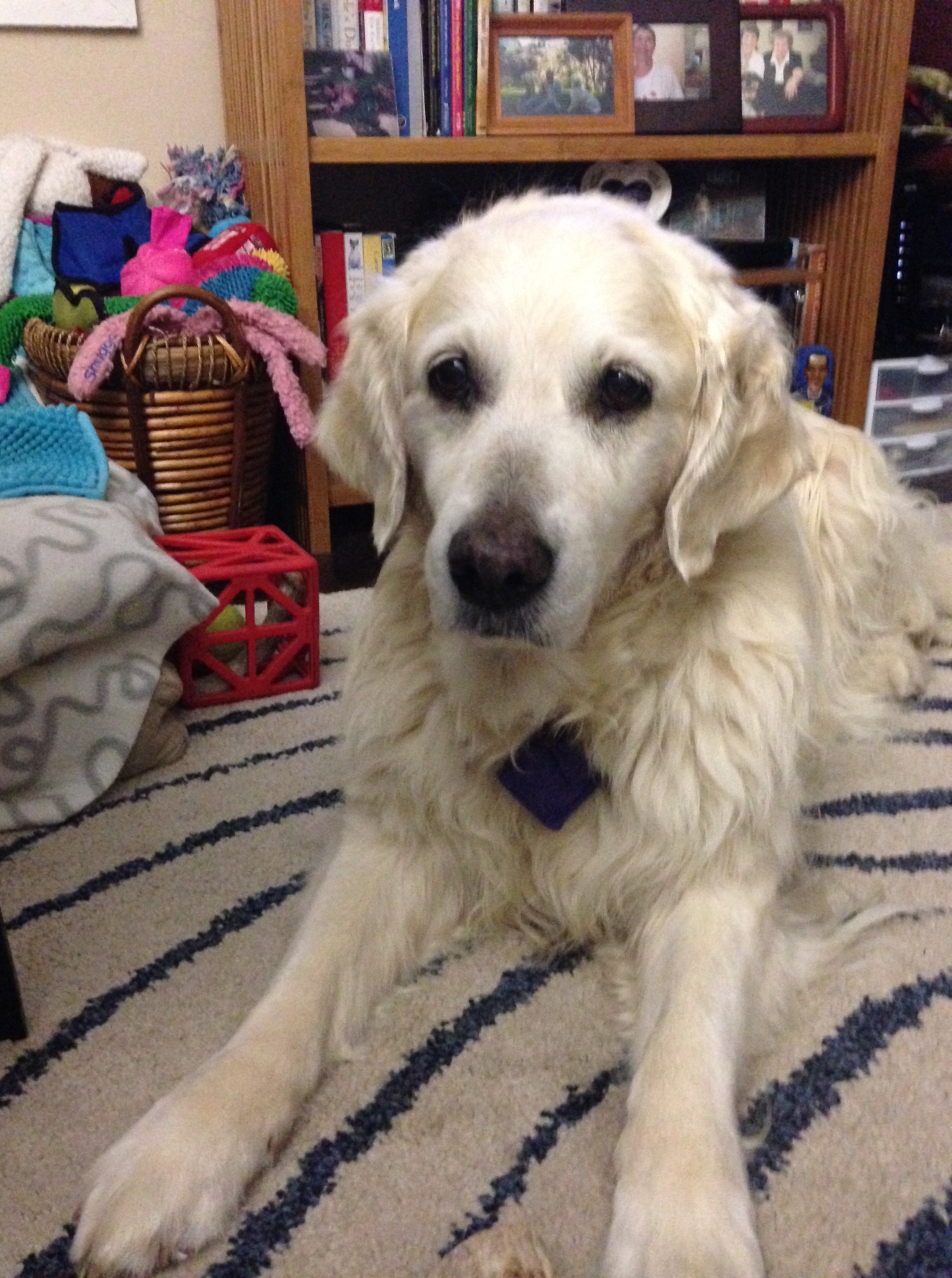
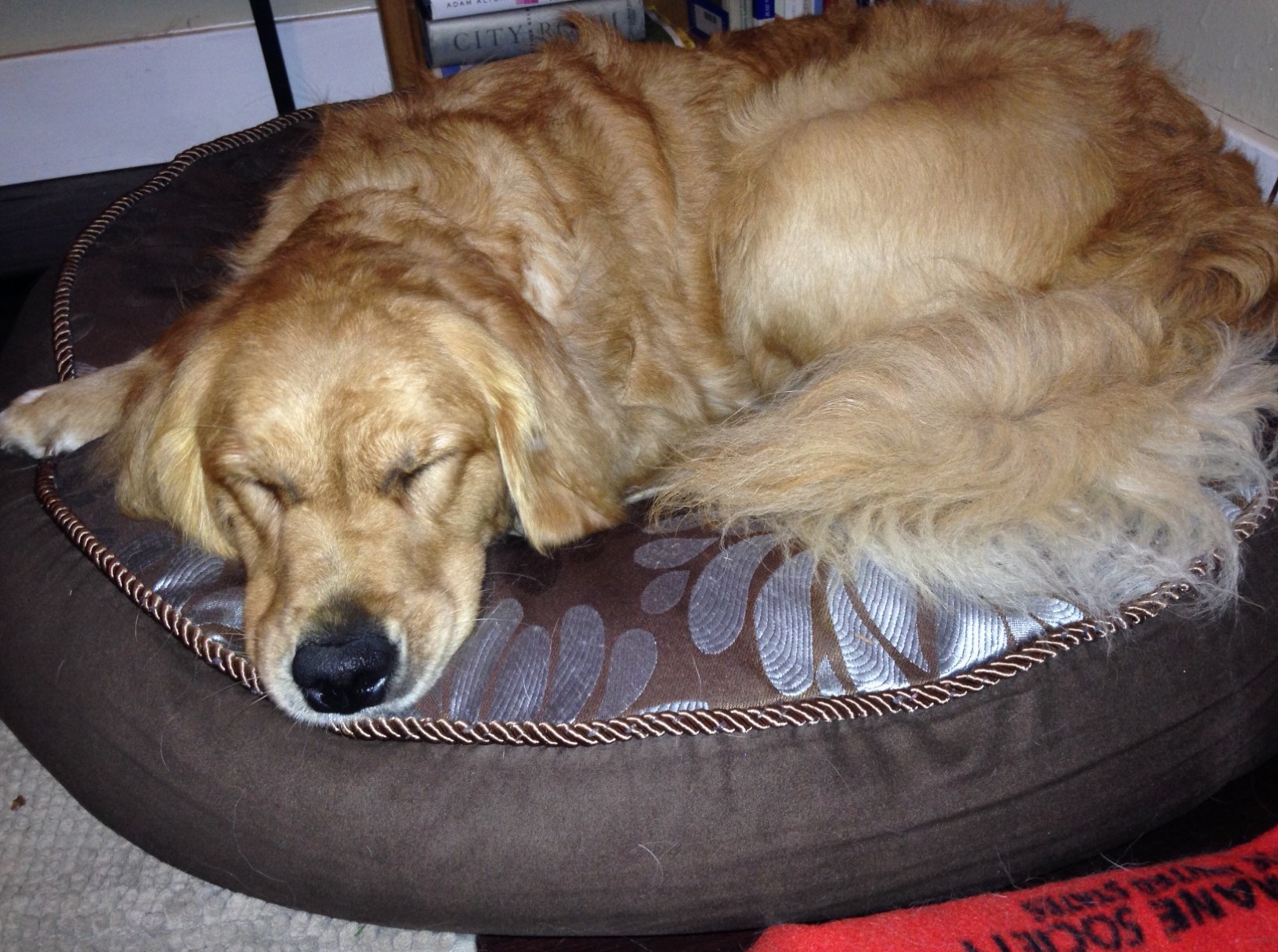
I live in a tiny apartment, but, in addition to the living room where I spend much of my time, the dogs have access to the yard most of the time, a bedroom (with very comfy dog beds), and the kitchen and bathroom,which offer a cool floor in hot weather. The vast majority of the time, Jana chooses to be in whatever room I am in. She gets up and moves if I do. Even if I tell her, “Don’t move; I am coming right back,” she goes with me. In fact, ages ago, tiny 7-week-old Jana attempted a huge flight of stairs when I ran upstairs to get something and she just didn’t want to be left alone for even a minute.Janas Bed age 2

Cali is less consistent. If I move, she always comes to see if something fun is about to happen. But she often likes to nap on my bed or hang out outside when I am working in the living room. Even then, though, she comes and checks in very frequently.

This study seems to say that dogs enjoy just hanging out with their people. I am happy to know that. The more time I spend with dogs, the more I appreciate the true friendship between us; it’s nice (though not necessary) to see research studies confirming that this bond is valued by dogs as well.


She’ll Have It HER Way

Who else is old enough to remember the Burger King jingle about having it your way?

I’m sure Jana’s never heard it, but she’s completely on board with the idea. Jana is very particular about how she wants things done.

The other day, we set out for our usual morning walk. Except that she did not want to walk a block up Petaluma Blvd. to the crosswalk. Or a block the other way to the light and crosswalk. Nope. She wanted to cross on the corner of our street and head right to the little park a block in on the other side of the street. I could not convince her to walk to the crosswalk.

When she digs her heels in, nothing I can do will budge her. And I am not about to drag 61 pounds of elderly golden retriever down the street.

So we did it her way. She got to the park, rolled in the grass, smiled broadly, sniffed and rolled some more. Happy Jana. Then we went on our usual route to the big park.

On a Saturday morning, early, there’s not much traffic on Petaluma Blvd. so it doesn’t matter if we cross at our corner or at a crosswalk. On a weekday morning, I wouldn’t chance it. Other than traffic, does it really matter which way we go? Of course not. But to Jana, being able to express a preference and make a choice, even a trivial one, matters.

To Cali, too. When we play ball, if I take the “wrong” ball from the basket, she won’t return it to me. She’ll run over, sniff it, then give me a  reproachful look. That’s not my ball. I’ve learned. I pick two balls from the basket, any two, and let her choose. Then she plays happily with her ball.

Some afternoons, if Jana seems tired, I let her choose between a walk (I offer the leash) and her favorite toy (I also offer Squirrel Dude). Contrary to my expectation, she does not always choose Squirrel Dude, who comes with a bellyful of Charlee Bear treats. She often wants a walk. She always appreciates having the choice.

The choices are not monumental. It’s probably similar to letting your two-year-old child choose between two T-shirts when getting dressed. I’m not letting the dogs take over (I keep telling myself that, but even I don’t really believe it …); I’m just letting them have some control over their environment. There’s so much that I can’t give them a choice about that I am always happy to find things that they can decide for themselves.


Please Back Off

Not all dogs are as fortunate as Molly. Molly’s parents wrote to The Thinking Dog, asking for help getting people to understand that Molly needs her personal space. In this post, I am speaking for all dogs who are not as lucky as Molly.

Personal space is a cultural issue. Americans tend to like more of a bubble around them than people in some other countries. I’m not sure whether dogs in different countries or cultures have different needs for personal space, but I am positive that all of the dogs I know need people to respect that bubble. Especially people they don’t know well.

Dog bite stories in the media often say that “it came out of nowhere” or that the dog gave no warning signs. This is rarely true. Spending a few minutes looking at Facebook postings of photos and video of dogs with babies and children is a great way to gather photos of dogs showing dozens of warning signs or pleas for space. Watching those news videos of the “bites that came out of nowhere” also offers a catalog of behaviors that are clear warnings.

It’s not only children who do things that cause annoyance or stress to dogs: A particularly chilling video I’ve used in canine communication classes is one where a news anchor is severely bitten after putting her face right in the face of a stressed, overwhelmed dog — a dog who has spent the previous couple minutes (or more; it’s a short video) asking her to back off in every way a dog can.

The problem isn’t that the dogs are not giving fair warning, asking for help, or both; the problem is that most people aren’t listening or simply don’t understand the signs. Here’s a list of the most common stress signs:

  • Licking lips or nose
  • Turning the head away
  • Whale eye — wide eyes with the whites very clearly visible
  • Yawning
  • Ears back
  • Tail tucked
  • Scratching — self or the ground
  • Sniffing
  • Shaking or shaking off (as if shaking off water)
  • Bowing
  • Stress smile
  • Red eyes
  • Sweaty paws
  • Panting
  • Hypervigilance
  • Freezing

What do we do that is stressful or threatening to our dogs? Most dogs do not like being hugged or patted on the head. Frontal approach with direct eye contact is scary for many dogs. Many dislike rough petting or play hitting or people bending down, putting their faces right up close to the dog’s face and kissing or blowing at them or baby-talking them. In short, if you would be annoyed if someone did it to you, don’t do it to a dog, especially a dog you don’t really know. This doesn’t mean you can’t cuddle your dog; it means you should look for cues that he is enjoying — or uncomfortable with — what you are doing, and respond accordingly.

Some of the signs listed above do double duty: They are also what is commonly called “calming signals.” These are body language cues that dogs use to calm themselves or others. Dogs will direct calming signals to other dogs and to humans. A well-socialized dog responds appropriately — backing off, giving the dog some space, or responding with calming signals of his own. Unfortunately,  the signals are often subtle and, when noticed, misunderstood by many humans.

Cali stress
Stressed Cali

For example, the smile. A smiling dog might be a happy dog; depends on the smile. These photos show a happy Cali and a stressed Cali. She’s “smiling” in both. But in the relaxed, happy photo, Cali’s eyes are soft, her smile is loose and relaxed; in the stress photo, her eyes are hard and tense, and her mouth is tighter. For many additional (better) photos of stress, take a look at these blog posts by Eileenanddogs: “Dog Facial Expressions: Stress” and “Is That ‘Smiling’ Dog Happy?


Happy Cali
Happy Cali

Other common calming signals that could be early signs of discomfort or stress are the licking the lips or nose, yawning, and turning the head away. When you notice these subtle signs, it’s a good idea to remove your dog from a situation that is becoming unbearable for him. Some dogs lick submissively — no, the dog is not “kissing” you because he’s enjoying the close attention — or shake or try to leave or hide behind their owners.

If the dog can’t escape the situation and the “aggressor” doesn’t back off, the dog is likely to escalate. Bared teeth, soft growls, or air snaps might be the first steps when a dog feels that he has no choice but to defend himself. And if the owners have taught the dog never to growl, as so many believe they should … the dog might just bite “without (obvious) warning.”

We’re our dogs protectors. It is our job to learn their stressors, heed their calls for help, and remove them from stressful or overwhelming situations.

Additional Resources

Want to learn more about dogs’ stress signals? Here are some articles and blog posts that offer good info and advice:

Your Dog Hates Hugs, by Melissa Dahl

It’s Only Funny Until Your Dog Runs Out of Spoons, E. Foley, Your Dog’s Friend blog

You’re Too Close! Dogs and Body Pressure, eileenanddogs blog

The Gift of Growl, Pat Miller

Preventing Dog Bites, Patricia McConnell

A Canine Stress Dictionary, and Signs That Your Dog Has Stress, and so much more on the Whole Dog Journal website


A Journey — or a Destination?

Cookie, please

Jana and Cali have vastly different understandings of our morning walks. Each girl’s interpretation also describes her approach to life.

For Cali, the point of the walk is the destination. She wants to be at the park with every cell in her body. The closer we get, the harder it is for her to contain her excitement. She does her little skip-walk dance, where she bounces ahead, remembers, bounces back, walks nicely for two steps, can no longer contain her excitement, bounces ahead, remembers … I think she burns more calories doing this dance than she does at the park. Mostly because she spends too much time at the park jealously guarding her ball rather than running around chasing it.

Jana, on the other hand, is all about the journey. Even at the park, she’s on her journey. She investigates everything along the way with her full attention. Everything. Clumps of grass. Leaves, wood chips, tendrils of ivy trailing on the sidewalk, fence posts, trees … She looks and sniffs from every angle, breathing deeply and considering the nuances of the scent. Only then is she ready to move on … to the next leaf.

At the park, she sniffs and samples the grass, which is very fresh, green, and wet these days. She then rolls in it. Her favorite thing happened the other day: The mower was just finishing up, which meant that she got to roll in the freshly cut grass, turning herself light green in the process. I think “freshly cut grass” is her favorite scent. If I had shampoo that smelled like that, she’d willingly bathe every day.

Since walking the two of them presents certain logistical challenges, with one full steam ahead and the other moseying along … I tried taking them for individual walks. Jana was having none of it. She wanted to go with us. She’d bring me my boots, stand by the door, push her way out the door if I was leashing Cali, use all of her considerable expressive talent to communicate: Take me too! So maybe her walks are a little bit about the destination too.

Which is great, because Cali also has that bit of balance. Her delight in the journey is evident when we meet other people along the way. Her excitement is channeled at them as she beelines for this new best friend. Tail wagging, huge smile on her face, she eagerly waits for the person to greet her. Most do. To her credit, Cali brushes off the rare crushing rejection with aplomb. We’re on our way to the park, after all!

A Conscious Struggle

This slideshow requires JavaScript.


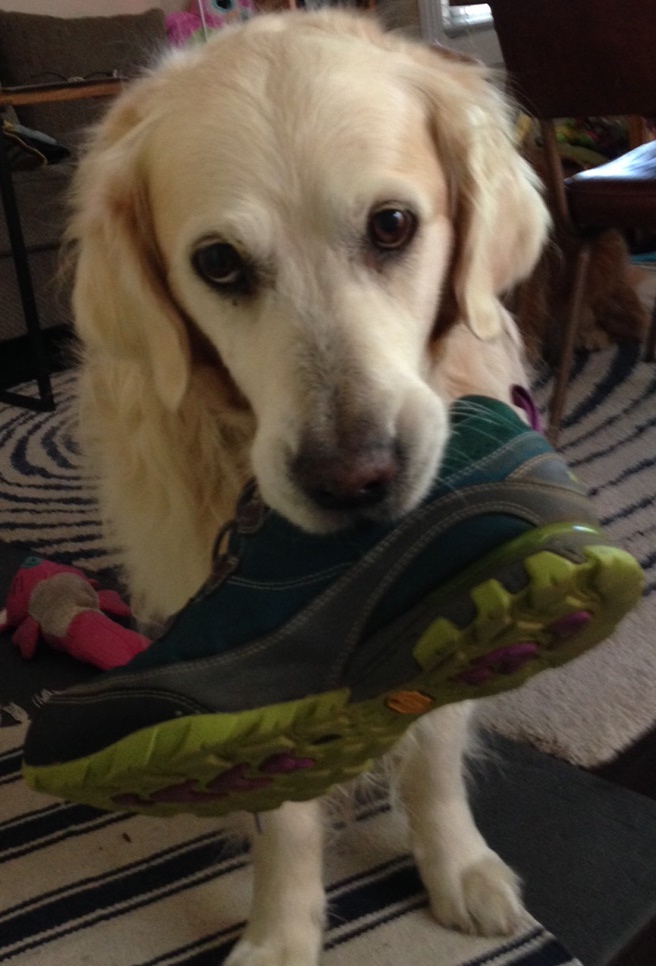
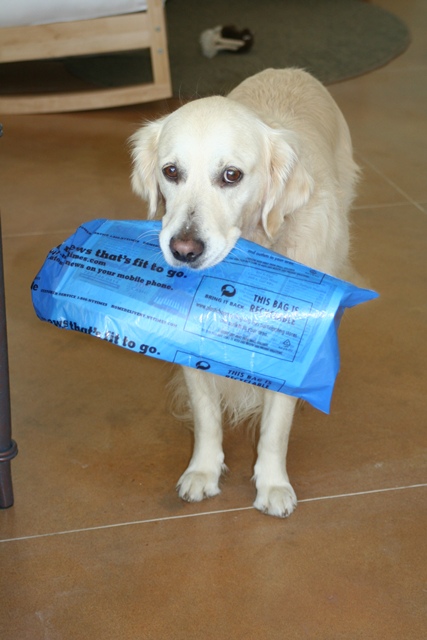
Our dogs have jobs that they are expected to do, similar to assigning household chores to a child. Jana brings in the morning paper. Jana and Cali each bring me a shoe when we’re getting ready for a walk. And each dog is expected to bring me her food bowl when she’s done eating.

Jana learned this task very quickly. She does it eagerly, always happy to receive her dessert in exchange (a small cookie). Alberta is also an eager participant, usually the first to finish her meal and deliver her bowl. If I am not paying attention, she’ll push it into my leg, hard, in a not-at-all-subtle demand for her pay. Past dogs have learned the task too, though Wylie made it quite clear that he saw this task as beneath him — girls’ work — and he would immediately depart for more masculine pursuits upon finishing his meals. Jana was happy to pick up the slack (and the extra cookie).

Then there’s Cali. For months, she’d pretend to try, lifting the bowl by one edge before dropping it with a loud clang. Putting on her saddest golden retriever face, she look at me as if to say, “I tried, Mom, but I just can’t lift it. It’s a very large bowl, and I am a very small puppy.” As the very small puppy became 56 lbs. of solid muscle, this excuse held less and less water, but the sad eyes … well, let’s just say that she does a very good “sad golden” face.

Along came Deni. Not only did we switch Cali to a smaller bowl this summer, but Deni took over much of the feeding supervision. Deni wasn’t moved by the sad face. Weeks of cajoling and praise and cookies paid off. Cali started bringing her bowl, but reluctantly and only with much encouragement. Once we knew that Cali understood what was expected and that she was fully capable of doing it, the coddling was phased out.

Now, as Deni explains, Cali broods over the looming task or “stands there and glowers at her bowl.” She knows she’s supposed to pick it up; she simply does not want to. It’s similar to her reluctant acquiescence to brushing her teeth. But, more and more, Cali talks herself into bringing the bowl with no prompting from either of us. Deni reports that if Cali sees that extra-special treats are being offered for dessert, she is able to convince herself to pick up the bowl much more quickly, and she does so with far more energy and enthusiasm.

The battle of the bowl shows Cali’s increasing maturity and offers a window on her personality and intelligence. We all sometimes choose to do things that we do not want to do. Sometimes we do them for rewards (a paycheck, working extra hours to earn a vacation …) or to avoid worse consequences (dental checkups) or because we don’t want to disappoint someone we care about. Whatever the reason, we all face large and small decisions every day. Cali is no different.

Beyond WordsIn his wonderful book Beyond Words, which I have mentioned before, Dr. Carl Safina talks about sentience, cognition, and thought as the “overlapping processes of conscious minds.” He defines sentience as “the ability to feel sensations”; cognition as “the capacity to perceive and acquire knowledge and understanding”; and thought as “the process of considering something that has been perceived” (page 21).

We see all of these at work in Cali’s struggle. She understands what she needs to do and how to do it; she feels stress, anxiety or discomfort of some kind when she thinks about this expectation, and she considers how to resolve it. Sometimes the feeling of anticipation or desire for a treat wins; sometimes, probably, the desire not to disappoint Deni or me tips the balance; sometimes she needs some prodding. But she is very definitely making a choice. Whether she decides to go for the cookie or she’s concerned about our reaction or she walks away and lets Alberta or Jana pick up her bowl, she is in control; she weighs the options and makes her choice. She is not instinctively or automatically responding to a stimulus in a conditioned way, as some behaviorists would argue. Every day, every meal, Cali shows what it means to be a thinking dog.


Play Ball!

Wanna play?
Wanna play?

“She’s such a mama’s girl,” Deni said of Cali the other day. “If we get too far ahead, she looks back and wants to stop and wait for you.”

“Nah,” I said. “She knows that I have her precious tennis ball, and she’s worried that she won’t have it when she gets to the park.”

I may be a bit too cynical, and I do know that Cali and I have a close bond, but … when it comes to morning play, I really am just the tennis-ball carrier and tennis-ball thrower.

We tested our competing theories the next morning. As Deni, Cali and Alberta set off at a brisk pace, leaving Jana and me plodding at 12-year-old-golden speed, Cali glanced back once, then marched off, tail wagging. A key difference from the previous morning: Deni was wearing the all-important black backpack with Cali’s filthy, spit-coated, utterly disgusting tennis ball — the only one that Cali wants to play with.

Soon they were out of sight. When I got to the park with Jana, I asked Deni what had happened.

“Well,” she said. “Cali did look back twice, but she did not want to stop or even slow down.”

I knew it. Tennis-ball carrier status confirmed.

As I have mentioned before, play is very important to Cali and a huge part of our daily routine. She’s a very fair and friendly dog, and makes every effort to include all the humans present in whatever game is going on. When we’re not playing, she thinks that we should be.

In fact, Cali is my best balanced-life coach, nudging me at regular intervals to gently point out that it is time to take a break from this horrid computer, go outside, and play with her. And that darned tennis ball.

Cali knows what dogs have known for thousands of years and what has contributed significantly to the human-canine partnership: People and dogs play well together. Play makes all of our lives better. And playing with ours dogs makes our relationships with them better. According to a recent study by dog expert John Bradshaw, dogs who have frequent, positive play sessions with their owners (no scolding!) are more obedient and more engaged with their humans.

So, what are you waiting for? Get out there and throw that (disgusting) tennis ball!

Let Your Dog Choose


Jana choosesIn “Communication Goes Two Ways,” I wrote about learning to read your dog’s body language, especially to recognize when she’s stressed or afraid. You can take your communication to the next level by teaching your dog new ways to communicate with you. Some ideas?

    • Hang a bell on the door your dog uses to go out in the yard for potty breaks. Encourage the dog to nudge the bell each time you let her out. She will soon connect the bell with getting you to open the door, and ring it when she needs to go out. A word of caution: Some smarty-pants dogs will use this system to train you, demanding to be let out every time you sit down or stop paying attention to them.
      One clever dog of Deni’s used this system to get rid of a pesky young puppy sibling. She’d ring the bell; puppy (and Deni) would come running; Deni would open the door; puppy would run out — and clever older dog would not. She’d stay inside to enjoy the calm, now puppyless, house.

IMG_1258

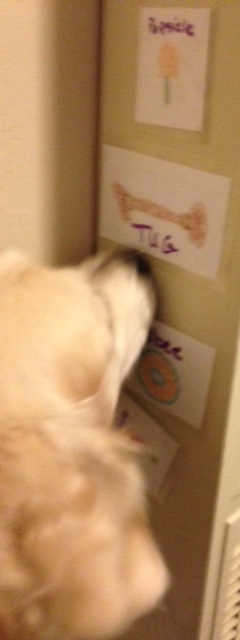
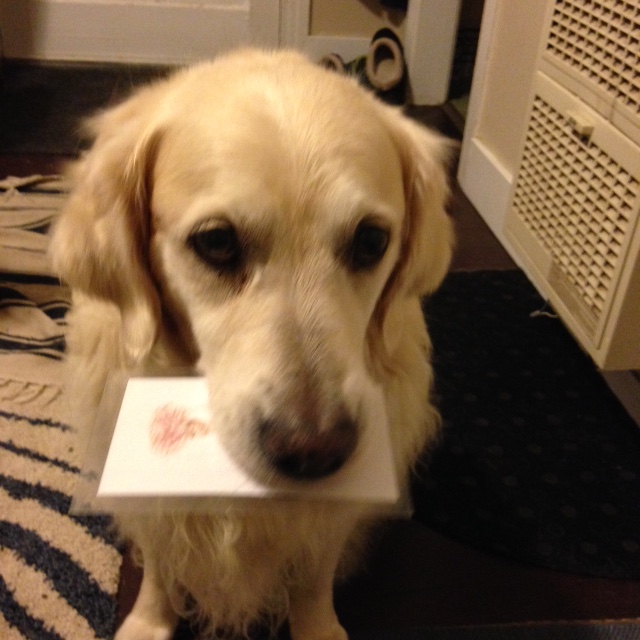
  • Offer your dog choices: Do you want to play with the tennis ball or the Frisbee? Which treat do you want? Do you want a walk or should I toss the ball? This can be as simple as offering two items for the dog to choose. But you can, with training, teach the dog to answer simple (two-option) questions. A student in my canine-human communication class taught her dog to choose between two options (sometimes yes and no) by nosing one hand or the other. A researcher in Florida taught dogs to choose a reward for a task they had completed by nosing a card with a picture of the desired reward — a ball, a food treat, a tug game, etc. She found that each dog had definite preferences!
  • Let your dog decide which direction you head on your afternoon walk. Jana and I have an informal agreement. The morning walk, which always includes Cali, is to the park where Cali plays ball. Afternoon walks, which are often just the two of us, are Jana’s choice. She likes to head toward the river and walk past her beloved dog training school, stopping along the way to visit her friend in the office on the corner (a very kind woman who always offers Jana a cookie).
  • Many people use hand signals to communicate with their dogs. These can substitute for (or work in tandem with) verbal cues — a raised hand for stay, for example, is widely used. Some trainers have made the leap to teaching dogs signals that they can use to communicate back to us, similar to the Baby Sign Language some parents use with pre-verbal babies. This takes more planning and teaching than some of the other ideas.


There are many more options, requiring various amounts of preparation and teaching, but you get the idea. Encouraging your dog to express her preferences and communicate her needs will increase her independence. It is empowering for her, and it shows that you respect her as an individual, which will enrich your relationship by making it a tiny bit more reciprocal.

The Rosetta Bone

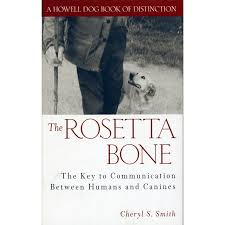
rosetta boneThe Rosetta Bone is a book I have been looking for for ages — a good book about how dogs communicate. The first several chapters address different types of communication: body language, verbal, touch, etc. Later chapters apply this information to interactions with dogs. How to solve common problems (and why they occur in the first place), teaching kids to interact appropriately with dogs, and more are addressed in a common-sense way. The author, Cheryl S. Smith, offers sound, dog-friendly advice in an easy-to-understand, clear style.