Not All Dogs Are Career Dogs

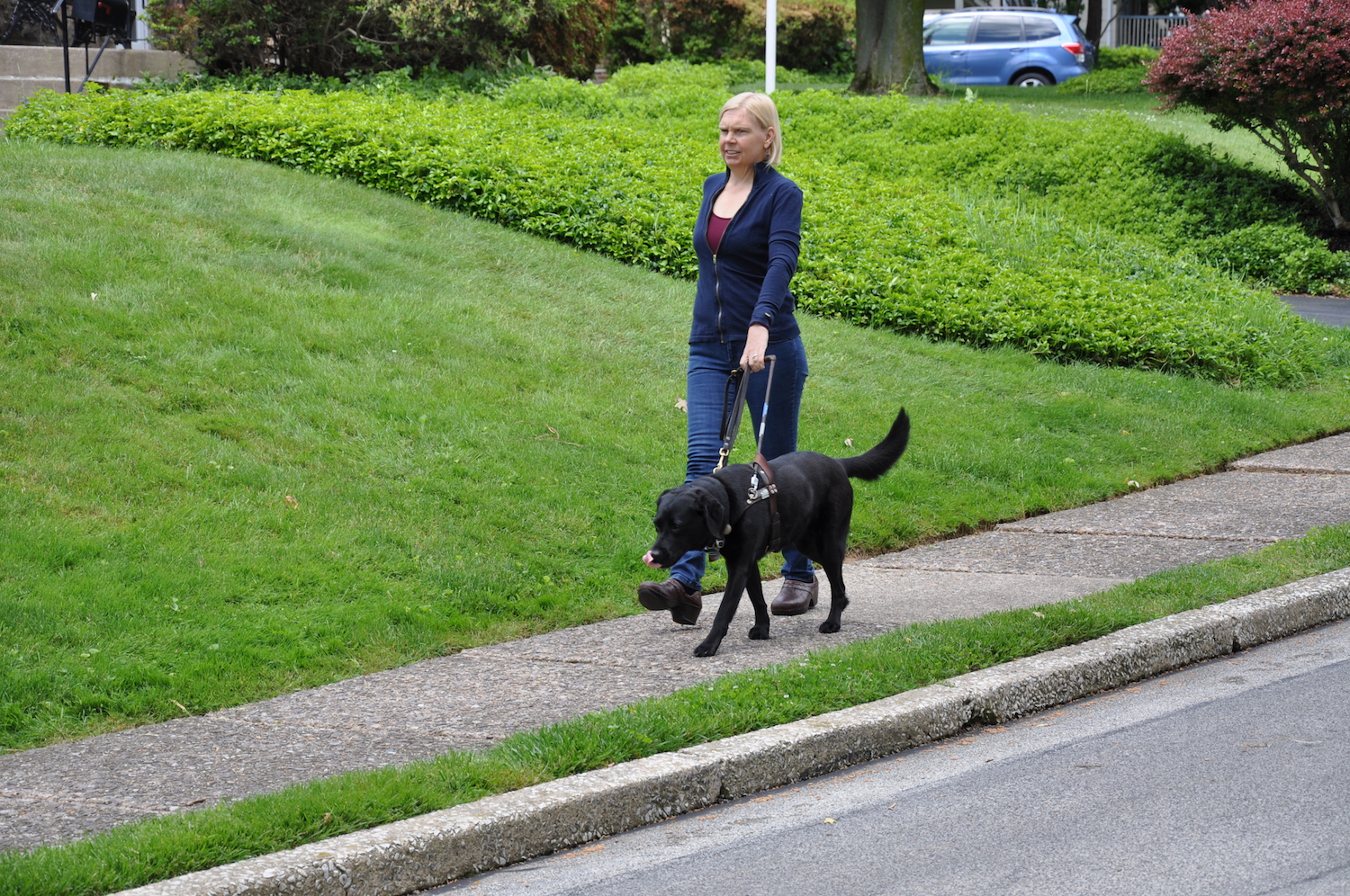
Koala, a black Labrador, wears her guide harness.The post about Ida last week and some conversations with a local service dog trainer got me thinking about the many reasons that dogs don’t succeed in a career as a service or guide dog.

For Ida, the issue was anxiety; she was uncomfortable with unpredictable sounds, with airplane travel, and possibly with other unavoidable features of life as a working dog.

Why else might a dog bred or selected for training as a guide or service dog be released?

For many puppies, and even adults or working dogs, leaving the field is the result of a health issue. Alberta retired 7 years ago after losing an eye to a benign tumor.

For others, it’s temperament. They are too nervous to work safely in public spaces, for example. I’ve known dogs with top-notch skills who simply couldn’t function in a busy public place where pets aren’t expected to be, like a grocery store or a restaurant, or even a busy park.

They may be uncomfortable around unfamiliar dogs; Deni has encountered untrained “service” or “support” dogs in airports and other public spaces who growled or lunged at her working dog. These dogs are too scared and reactive to be safe working in public.

Some dogs have specific fears, like dogs who are afraid of thunder, that mean they cannot focus on their work.

Sometimes, the problem is behavioral: A dog who is so obsessed with food or distracted by squirrels or tennis balls, for example, that she cannot focus on her work will be released.

Working dogs need to be calm under all circumstances, keep working even when they are tired, and not react to other dogs, cats, small (or adult) humans who invade their space and touch them or repeatedly call their names. They need to be flexible and resilient and able to regroup, change direction, and keep their handlers safe.

Working as a guide or service dog asks a lot of a dog and exposes the dog to many things pet dogs never have to worry about. It’s not surprising that many dogs who begin the training don’t complete it. Or, like Ida, once they see what the job is like, they quickly realize that they are overwhelmed.

I am glad I met Ida. She’s a sweet, smart girl. I’m also happy for her that she will have the kind of life she needs and deserves.


Not Meant to Be

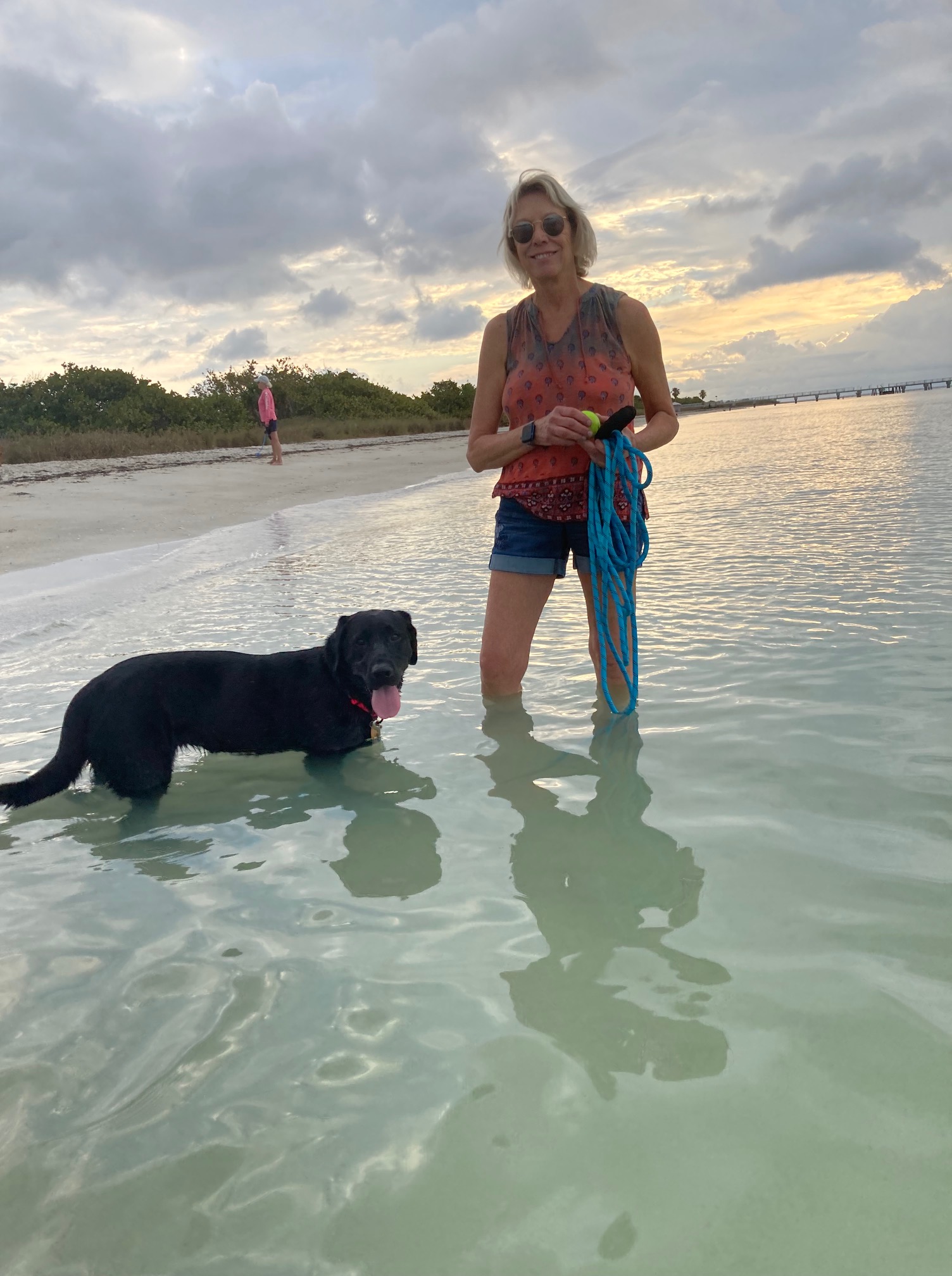
Black Lab Ida wades into the water to stand near Deni, dressed in shorts and tank top, holding a long blue leash.
Ida’s first visit to the dog beach

A guest post by Deni Elliott

The partnership that develops between a well-bred and trained guide dog and a visually impaired human looks and feels like magic. However, as was the case with Ida and me, sometimes things just don’t work out.

Alberta, my first Guiding Eyes dog, and her successor, Koala, matched me perfectly in very different ways. I wasn’t surprised that Ida was not like the others; I thought of her as my sensitive girl.

However, after three weeks with me, Ida made it clear to my Guiding Eyes home trainer and me that she really didn’t want to be a guide dog. I am grateful that Ida made her choice before we set out together on a trip in which she would have needed be comfortable at my side while I gave a professional presentation in Chicago, attended some meetings in Salt Lake City, and then got to know her golden retriever sister and life in Montana, with many hours in airports and flights on Delta in between.

Ida got the life that I suspect she wanted all along — being a pampered pet with the family who raised her from the age of 8 weeks to 16 months. My previous two guides are happy too: when Koala retired after more than 6 years of guiding, she happily returned to her puppy raiser. Alberta, who retired early due to an eye tumor,  is now 12 years old. She lovingly watches over my toddler grandniece, who has shared food with the dog since she was old enough to fling it from her high chair.

I will be fine, even though I miss having a dog at my side and am temporarily using a white cane to help with navigation. Guiding Eyes training staff and placement specialists have come to know me well over the past 10 years; They are working hard to find my next perfect match.

My first two Guiding Eyes partners taught me that dogs with different temperaments can be equally good guides:

  • Alberta exuded confidence. Give her a challenge, and she’d rise up on her toes to say, “Bring it on!” More than once she responded to my uncertainty by nuzzling me to say, “We can do this.”
  • Koala was my introvert, analytical and thoughtful about new environments, but five weeks into our relationship, she flew with Pam and me to Israel without complaint and happily worked trains and open air markets in Jerusalem, as well as guiding me safely up and down the centuries-old stairs that traverse Tzefat.

Ida was brisk, responsive, and responsible when in harness and loved being praised and rewarded for her good work. That’s why she was matched with me in the first place! But, when off duty, she increasingly startled at unexpected sounds and sights, including wind in the trees and birds flying overhead. Within a few weeks, she could no longer shake off whatever surprised her and became more intensely anxious more of the time. Ida taught me that a smart, creative dog can hide her true feelings in her eagerness to please — at least for a while.

A successful guide partnership is a tapestry of collaboration, cooperation, communication, and trust. My dog trusts me to know our ultimate destination and give her clear directions about where we are heading. I trust the dog to alert me so that I can navigate curbs and stairs and locate door handles and empty chairs. She steers us safely around obstacles that I would run into or trip over. Most importantly, she quickly gets us out of the way of vehicles that might run us down. The partnership works only when dog and person agree that the dog has final say in all guiding decisions. We live by the Guiding Eyes mantra: Trust your dog.

Sometimes puppies decide as early as 8 weeks that they are not cut out for the intensity of guide work; others make their reluctance clear as adolescents when learning guiding skills. Dogs past their prime slow down when they are in harness, signaling to their partners that they are ready to retire. Unfortunately, as with Ida, sometimes the dog’s decision comes at a sad time for all of the humans involved: When placed in a real life partnership, they decide that a guide dog’s life is not for them.


Introducing Ida: A New Thinking Dog!

Black lab Ida holds a green rubber toy with her right paw while chewing on a Nyladbone wedged inside it
Ida uses a toy to hold her chew bone steady.

The Thinking Dog Blog finally has some wonderful news to share: Deni recently welcomed Ida, a new guide dog, to the family!

Ida, who just turned 2, is a black Labrador retriever from Guiding Eyes for the Blind.

She’s a great addition to the Thinking Dog clan: She’s smart, seems to be an adept problem-solver, and learns quickly. As a young Lab, she’s also high-energy and very playful.

Black Lab Ida wades into the water to stand near Deni, dressed in shorts and tank top, holding a long blue leash.Like Deni’s first Guiding Eyes dog, Alberta, Ida loves it when Deni — or anyone, really — notices her cleverness and comments on how well she’s doing her job. She’s super-friendly and feels entitled — obligated? — to greet people on walks, even starting to head up sidewalks or driveways if neighbors are outside when she’s on a (non-working) walk.

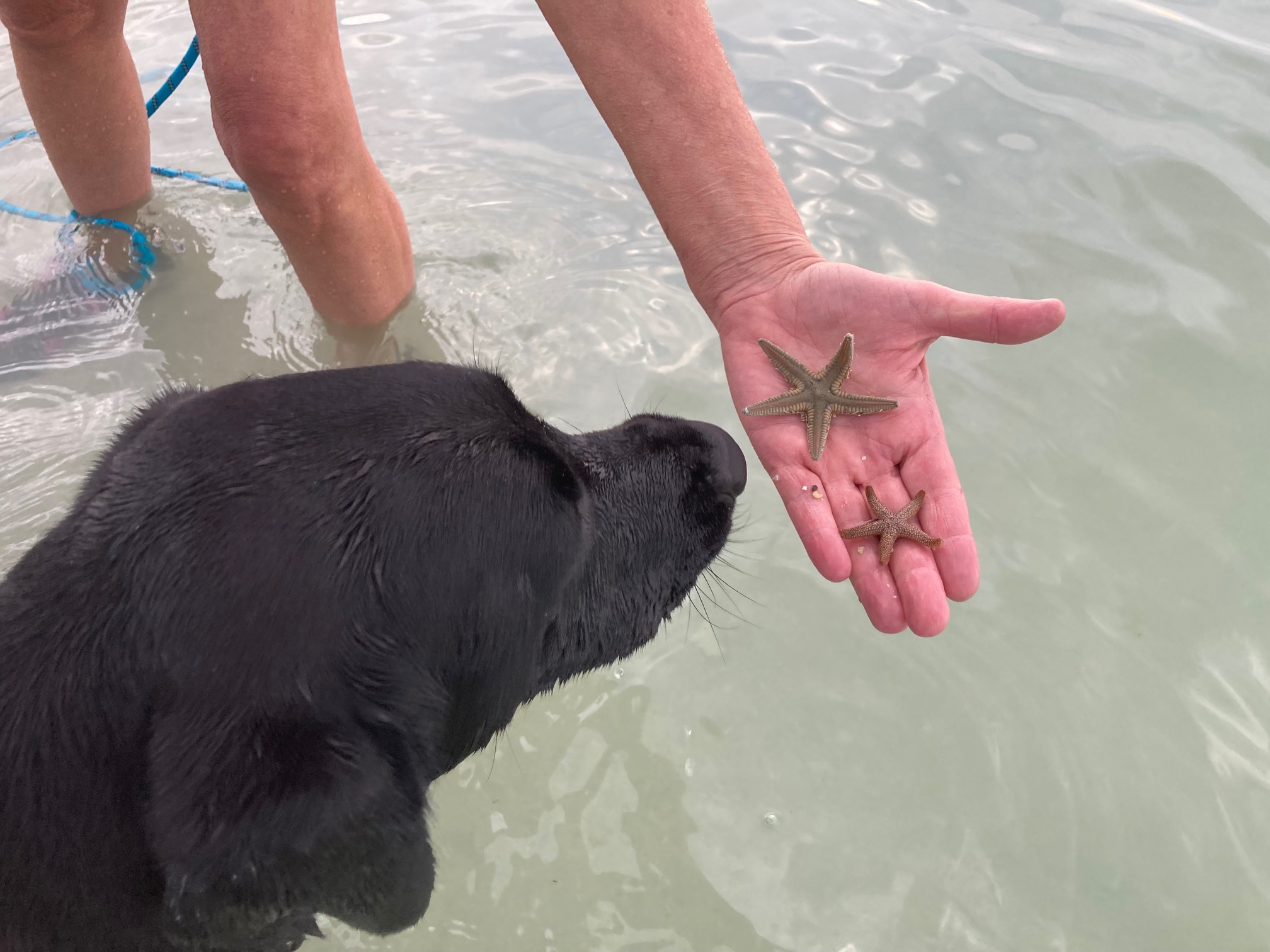
Like Koala, she’s a bit analytical and likes to think things over. During her first visit to the dog beach (on a long leash!) she needed to think about whether sand, surf, and starfish were good things.

Ida inspects two small starfish on Deni's handOnce she felt comfortable, though, she had a wonderful time. And, back in the fenced dog run area near the beach, she raced around joyfully with another young dog. And, on her second visit, she ran playful, joyful circles as she made friends with other dogs and stepped tentatively into the rough surf.

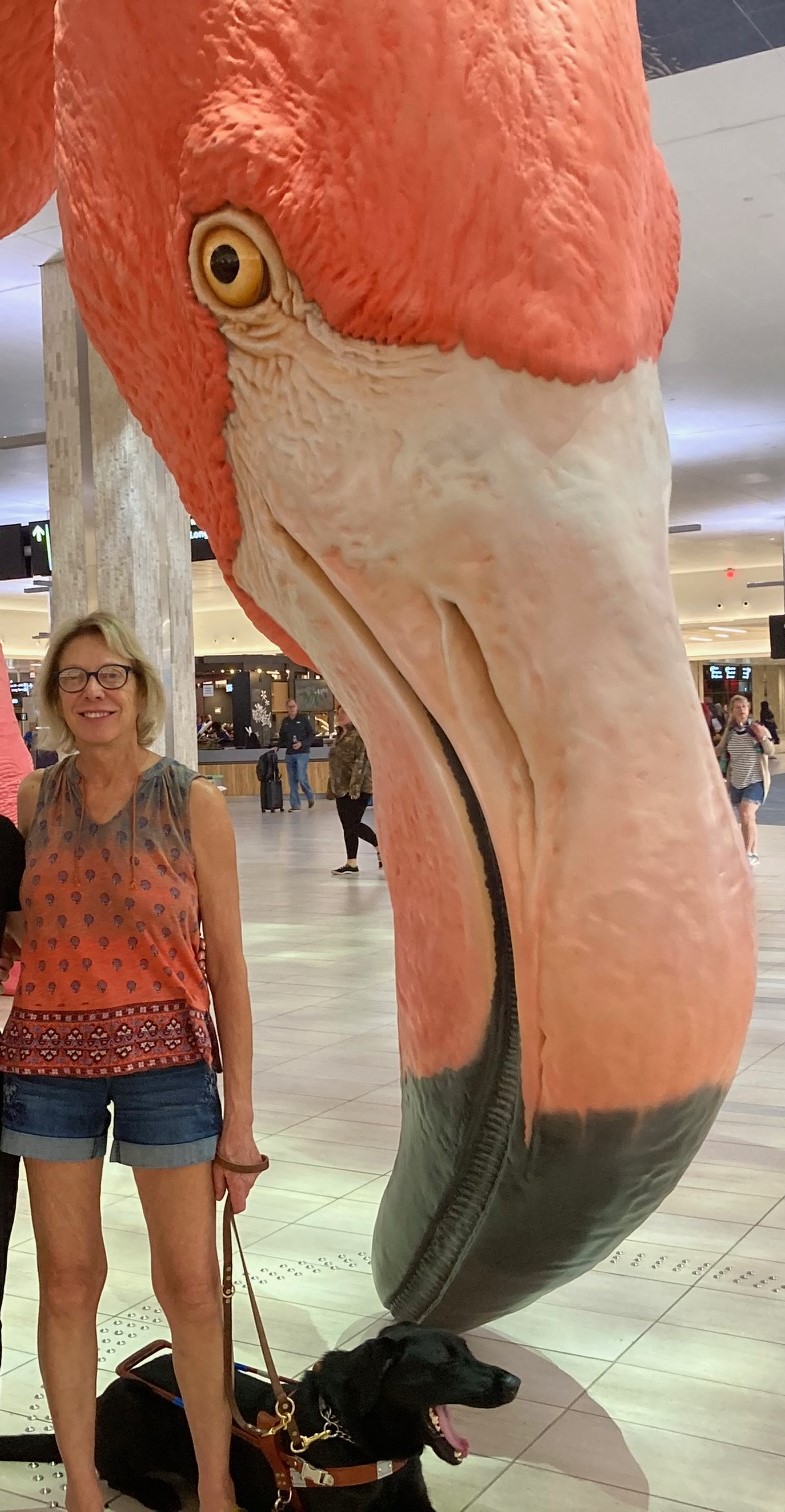
Black Lab Ida yawns as she rests near the huge bill of a flamingo sculpture, with Deni standing next to her
The Tampa-St. Petersburg airport features a gigantic (and possible scary) statue of a flamingo

Ida is a happy, bouncy, curious, very social dog who is eager to play. She is still settling in and learning what the life of a working grown-up dog is like, of course, and she might have found the giant flamingo sculpture at the Tampa airport a little unnerving … but who wouldn’t?

She’s also still learning Deni’s routines — and quickly picking up the “extra” skills that all of Deni’s dogs learn, like finding a trash can as soon as she’s done “parking” (a euphemism for pooping).

She caught on quickly to opening gifts on her 2nd birthday — and gleefully played with her new toys! She likes to use her paws, standing on one gift to keep it in place as she removed the tissue-paper wrapping. And she holds her toys while playing with or chewing on them.

Ida is young, and adjusting to a new dog — especially after several years with a precise, polished pro like Koala — is going to be a challenge for Deni. But the two seem to have forged a close connection already, with Ida responding quickly when called even while running happily with another dog.

Their next big adventure together will be a visit to Montana in May — including a few days at Yellowstone. I hope Ida isn’t afraid of bison!

This slideshow requires JavaScript.


What Happens When a Service Dog Retires?

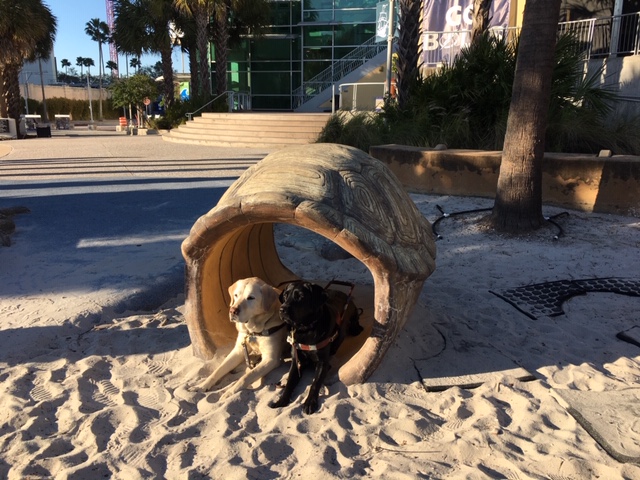
Yellow Lab Ryan and Black lab Koala relax in a play tunnel
Ryan, left, and Koala, enjoyed a short vacation in Florida just before Ryan’s 2020 retirement.

When a service or guide dog is no longer able or willing to work, what happens?

Many of them stay with their families, living a life of leisure, enjoying many belly rubs, and watching some young whippersnapper do “their” job. Poorly, of course.

But not all people who partner with service or guide dogs can keep their retired partners. There are many reasons for this: Some are elderly folks or people who live on a very tight budget, and they simply cannot care for a second dog. Some are busy professionals who travel frequently and feel that they owe their retired dog a better life than frequent stays at a kennel and long, lonely days while they — and the new dog — head to work. Sometimes a guide or service dog retires because their partner dies or becomes seriously ill.

Whatever the reason, the guide or service dog’s partner or family often looks for a retirement home for the dog. Often extended family eagerly step up: Deni’s first guide, Oriel, spent a couple of years with family in Indiana before moving to Florida to live with us. Alberta, who retired young due to an eye tumor, lives with Deni’s nephew & family, including her new charge — a human puppy!

If family placement is not an option, many guide dog partners ask dog-savvy friends and acquaintances; I was a finalist in the retirement-home search for a Guiding Eyes dog recently, but the dog opted to stay closer to her partner rather than move to Montana (her loss …).

When neither of those options works out, guide and service dog schools generally place the dog with someone on their extensive waiting lists. These are usually volunteers, donors, puppy raisers (perhaps even that dog’s puppy raisers!), or others with ties to the school.

The dogs never end up panhandling for cookies or living under a bridge somewhere.

Congratulations, Ryan!

Yellow Lab Ryan and bBlack lab Koala relax in a play tunnel
Ryan, left, and Koala, caught up on guide school news during Ryan’s visit to Florida in late February.

Our friend Ryan finally got to retire.

Ryan, a yellow Labrador, is — or was — a guide dog. He was all set to retire in March. He had his retirement planned and new toys lined up. He thoroughly enjoyed his last work trip, a visit to friends in Florida, and he looked forward to hanging up his harness.

Then COVID-19 hit.

Ryan wasn’t the only essential canine worker who had to do overtime due to the pandemic. Hundreds, maybe thousands more, had the opposite problem: Their start dates for their new jobs were delayed indefinitely.

But things are slowly starting to reopen, and Ryan was finally able to retire in early June. He even got to help train his successor. Since Ryan’s human wasn’t able to attend training camp in New York, the new dog and a human trainer came to Ryan’s house. The human trainer showed the new guy the ropes in the mornings, while in the afternoons, Ryan let the youngster know how things were going to work around the house.

Finally, just in time for summer, Ryan is retired. He’s looking forward to some well-earned rest and relaxation.

Social Distancing When You Can’t See the Distance

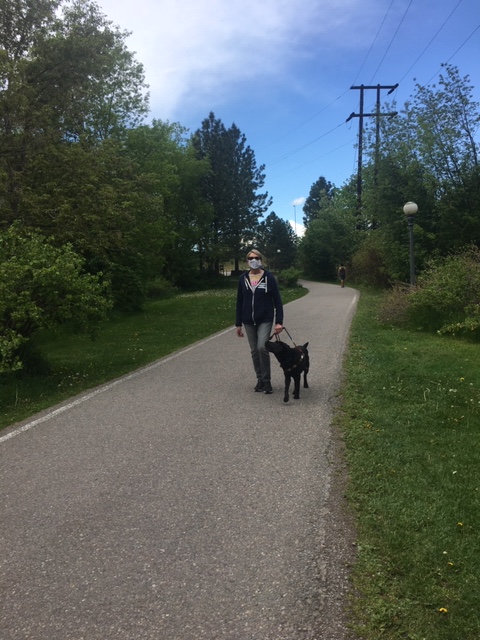
Deni walks along a path with Koala, a black Lab. Deni wears a face mask.Guest post by Deni Elliott

Guiding Eyes Koala gives me advance warning when we are about to cross paths with another dog. I can feel added tension in the rigid handle attached to her harness. She keeps walking us straight down the sidewalk, but as the person and dog get closer, I can feel Koala rise up. She walks on her tippy-toes, restraining herself from sniffing as we scoot past the dog.

A person alone on the sidewalk is way less interesting; as far as Koala is concerned, they might as well be a trash can to walk around. In that case, Koala is likely to walk by without giving any indication that there is something that needs my attention. It isn’t until I hear footsteps that I realize that the obstacle we are passing is a living, breathing human being.

In this period of cautiously returning to public contact, what my guide dog communicates has become an urgent matter of concern. Guide dogs know how to squeeze and weave themselves and their partners around any obstacles. They aren’t likely to understand the concept of staying six feet away from others. So, the question for people who are blind or visually impaired is: How can we manage social distancing when we can’t see the distance?

I’ve found that the answer depends on how crowded your community is and on whether the guide dog team is navigating outside or inside.

In areas with lower population and more attuned neighbors, if people see a guide dog working in harness, they may naturally cross the street or provide space. In high population areas or or where sighted people are more focused on their phones than on other pedestrians, the guide dog handler will have to take a more proactive approach.

When walking on harness outside, if the guide dog signals that another dog is nearby, the handler should ask the person approaching to keep the distance. “Please stay six feet away,” is normally all that is required.

It’s harder when your guide gives no warning, and the handler suddenly finds herself  shoulder-to-shoulder with someone on the sidewalk. Again saying, “Please stay six feet away,” is kinder than shouting, “Can’t you see that I’m blind?”

Working a dog in harness inside in the COVID-19 era provides new challenges that most guide dog teams can’t overcome on their own. Some grocery stores have designated aisles as one-way. Any place open for business has six-foot markers for people standing in line at the check-out counter. People with visual impairments are not likely to see any of this. It is kind for sighted shoppers to offer directions, but unfortunately, many sighted people just stop and stare.

The blind or visually impaired person can do some advance planning to make the trip to the store as efficient as possible. If the store has special hours for vulnerable populations, it is good to take advantage of the smaller crowd and the likelihood that the other shoppers will also be working to keep distance. This is one time that it is a good idea to call the store in advance, explaining to the manager that the need for employee assistance. That helper can quickly locate items and help the guide dog team stay out of the way of others, while everyone maintains a six-foot distance.

Some people have pulled out their long white canes as an additional signal for sighted people to keep the right distance. Others who aren’t coordinated enough to handle the dog in harness on one side and cane on the other – I’m one of those – may need to provide additional visual cues for those around them. Vests, tank tops, and tee shirts that say “BLIND” or “VISUALLY IMPAIRED” in high contrast are used by athletes and are available at ruseen.com. These draw more attention to disability than most of us would like in our daily lives. But at this time in the world, it is better to be noticed than infected.


What’s Missing from the Conversation

Alberta, a now-retierd yellow Labrador guide dog, leads DeniI wrote a post a few weeks ago about proposed new rules for flying with service and support animals. Lucky for me, most Thinking Dog readers are kind and thoughtful individuals.

Deni wasn’t so lucky. That could be because she had more than 2,000x as many readers as I generally do … in just the first 3 days (and no, that’s not a typo).

The comments on her article, and on the proposed rules at the DoT site, reveal much about our society. And why the concept of ESAs has been so badly abused. They follow several general themes:

  • People who hate animals, kids, anyone who writes about animals, and pretty much the whole world. (These are best ignored.)
  • People who think all animals should be banned from airplanes, including guide and service dogs, due to their own (or others’) allergies. (Not gonna happen.)
  • People who say they cannot or will not fly if they cannot bring their ESA.
  • People who use service animals and oppose any sort of behavior or health check or documentation.

What is missing from this conversation, as well as from the laws and proposed new rules, is attention to the animals’ welfare and needs.

Some of the people who can’t or won’t fly without an ESA could well be able to meet the legal threshold for a service dog. Others have generalized and severe anxiety or anxiety specifically about flying, so the presence of an animal is of comfort and helps them cope.

I am sincerely empathetic. At the same time, I think that’s a lot of responsibility to place on an animal, especially one that has not been trained to work under stressful circumstances. Public access is stressful for any animal, but especially one that essentially lives in a familiar home, rarely leaving except, in the case of some dogs and cats, for walks around the neighborhood. Airports and airplanes are about as stressful a situation as I can imagine.

I also worry that someone with severe anxiety would be stretched to the limit taking care of their own needs and would be unable to safely handle an animal, intuit and meet its needs, and keep themselves, the animal, and other passengers safe.

The untrained pets used as ESA are often terrified by the commotion, cramped quarters, noise, smells, and general awfulness of airports and airplanes. And that is exactly the problem: No one is evaluating the animals or training them to get used to public access. People with ESAs do not have the right to take them in public (the ADA gives that privilege only to people with both a disability and a trained service animal) and no training is required, so even if the people wanted to prepare their animals, they cannot legally do so.

Like other pets, most ESAs spend the majority of their time at home. Then, suddenly, they are taken to the most stressful place possible, by a person who is extremely anxious. As a living being with needs and fears, the ESA needs and deserves the protection of its person — a person who at that time is very unlikely to be able to provide that protection.

The law currently allows anyone whose mental-health professional (or internet store) supplies them with a letter attesting to their own need for the animal. Nothing addresses the suitability of the animal or its welfare, and nothing safeguards the public from terrified animals (mostly dogs) behaving like terrified animals: Growling, yowling, snarling, lunging, biting, peeing, etc. It’s a testament to how resilient and generally amazing dogs are that there have not been far more bites.

I am a former service dog trainer and am adamantly opposed to creating barriers to access for people with disabilities. At the same time, I do not think it is possible to protect public safety — including the safety of service dog teams — without limitations, such as a public access test and health requirements.

Public access with a service dog in a no-pets area is a privilege that does not include the right to endanger others or trample their rights. The ADA builds that in; a service animal that is dangerous or behaving inappropriately can legally be excluded even if the person has a disability and the animal is fully trained to mitigate that disability. The current ACAA rules on ESAs do not. And it is not reasonable or realistic to expect TSA officers or airline gate agents to be able to assess which animals are safe and which are not — and to be effective at barring those passengers and their animals.

There are ways to make health checks and public access tests easy, certainly no more complicated than getting a disabled parking placard in most states.

Thousands of dog trainers are capable of administering a CGC test, for example. A public access test could be similar, and it could be conducted by any certified dog trainer in a place the team goes anyhow, like Walmart or the supermarket.

Keeping your dog healthy and being able to show that the dog is vaccinated are minimal standards when taking your dog anywhere, even the dog park.

I don’t see these as huge obstacles or burdens. One comment I saw talked about the nearest Walmart being over an hour’s drive and said having to go to a testing site would be an enormous burden. If that person never, ever goes to that distant Walmart, or anywhere else in public with their service dog, they wouldn’t need to do the test. If they do go there, even rarely, doing a test there once every year or so is not a huge ask.

Airlines could help out by keeping paperwork on file, though, as they keep seating preferences and contact details for mileage club members. Asking people to jump through the same hoops every time they fly is absurd, especially for anyone who flies multiple times a year. Linking the health certificate and other info on the team to a flyer’s frequent flyer profile, with a flag for annual updates, is very easy in our digital age.

Allowing only trained, professionally evaluated animals to fly in the cabins of airplanes, and asking that other animals either remain in carriers that fit under a seat or that their owners make other arrangements is common sense. It respects the rights and safety of people with disabilities who have trained their (mostly) dogs and rely on those dogs’ assistance. It also respects the rights and safety of everyone else.

My comments are, of course, my opinions; reasonable people may well disagree. I think that Deni wrote a solidly researched article that presents a real problem and suggests viable solutions. I encourage you to read it, read the proposed rules, and comment. The 60-day comment period opened Feb. 5 and ends in early April.
What You All Want to Ask

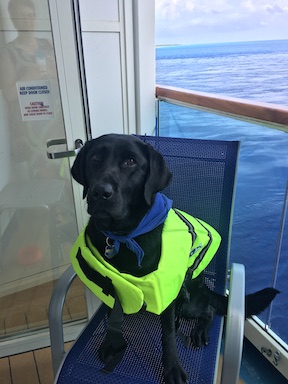
Koala, a black labrador, wears a life jacket. She sits on a chair with the ocean behind herThe night before their cruise, many of the 29 guide dogs teams stayed at the same hotel. These dogs got a head start on greeting old schoolmates, as their humans met or caught up. Many of the teams had been at the Continuing Education Seminar couple of years earlier, or had been in training together, or had met at other events.

Portable dog toilet area on ship deckThe next day, the teams, along with several hundred other passengers, boarded a huge ship. Naturally, they all wanted to know the same thing you’re now wondering: Where do the dogs go to … you know?

In the case of this group: Deck 10, near the front of the ship, just off the main elevator lobby. For some dogs, that was a very long trek from where they were bunking.

The crew set up about 10 potty stalls. Some were plastic containers topped with astro-turf. Others were large metal litter boxes with, yes, dog litter. Not to be confused with cat litter, dog litter consists of hard, absorbent pellets. The astro-turfed boxes seemed to collect the pee. In either case, the dogs’ humans were expected to pick up solid waste.

Ship staff did an admirable job of keeping the place clean-ish.

“Ish” because of many issues.

Foremost, it’s windy on a moving ship. It’s hard to balance. The astro-turf rugs shifted in the wind. Some dogs flat-out refused to try the doggy port-o-potties. Others tried, but got rattled when the astro-turf rugs slipped and slid as they crouched. Many of the refusers visited the nearby deck floor instead.

Also, the human partners, coping with their own balance issues on the moving ship, along with their dogs’ skittishness and their inability to actually see where their dogs had eliminated, sometimes failed to thoroughly clean up.

Koala took it all in stride. She’d visit several stations, and, having caught up on the news, would take care of business without a fuss.

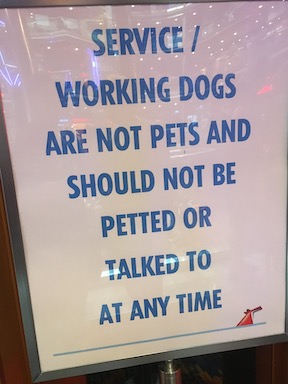
sign reads "service / working dogs are not pets and should not be petted or talked to at any time."Carnival, the cruise line, deserves special mention for the ways the dog teams were accommodated. Outside each dining area, and in other prominent places, staff had posted large signs telling people not to pet or talk to the working dogs on board. Many passengers who talked to guide dog partners mentioned the signs or said they knew they weren’t supposed to talk to the dogs (though most proceeded to do so anyhow …).

The staff ran a private safety briefing for the guide dog teams, and the leader had clearly undergone training on working with blind people. His descriptions of how to find a life jacket, what the front and back would feel like, and how to find and secure the clasps and belt were clear and full of rich description. Each guide dog had her (or his) own life jacket!

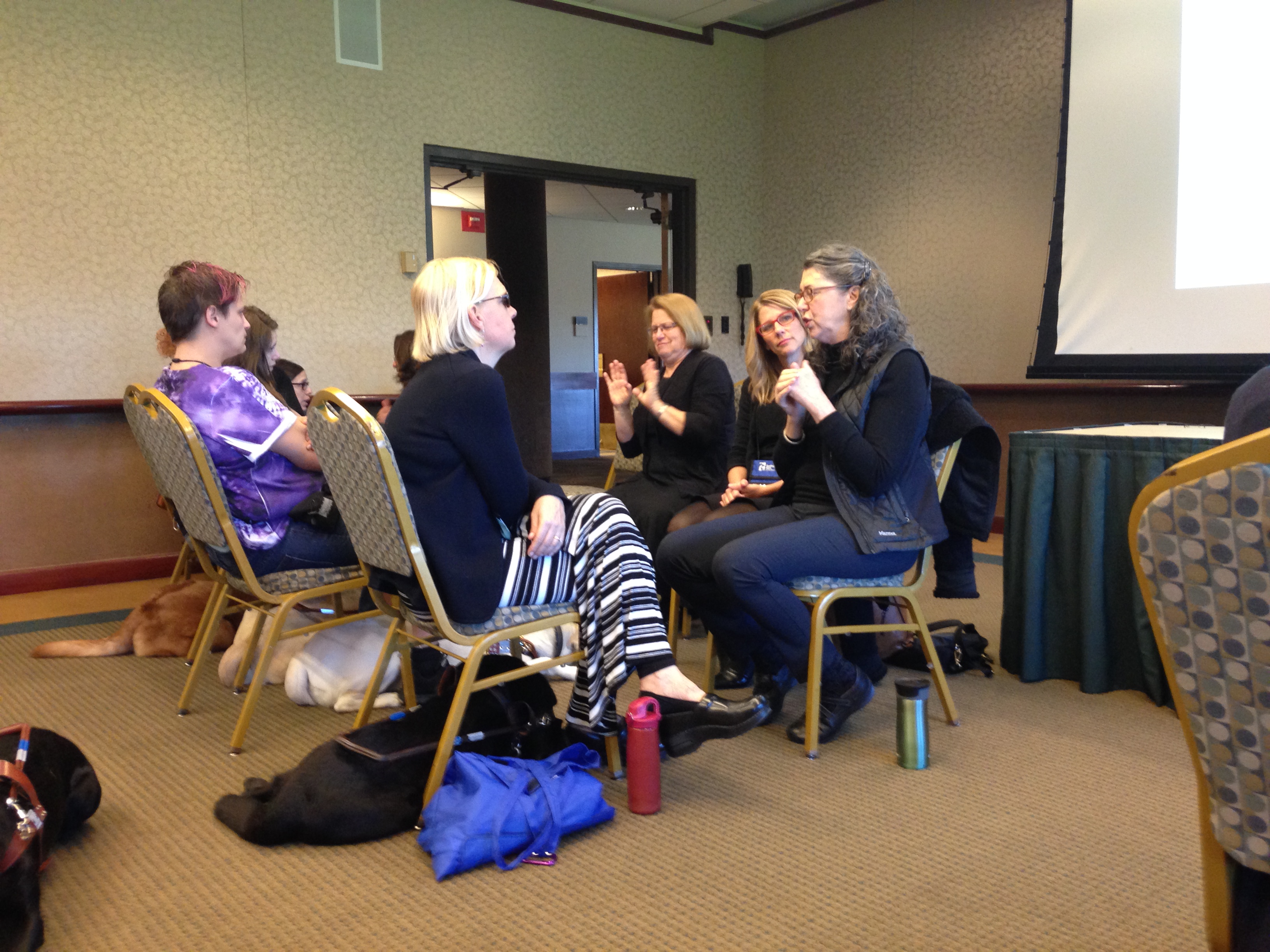
Carnival even hired interpreters for members of the group who are have both visual and hearing impairments. Through the magic of something called protactile communication, the interpreters provided a more complete experience for these passengers. Protactile communication uses touch to convey information beyond an interpreter relaying what another person is saying; it includes description of what is going on in the environment and allows for deeper two-way communication.


Guide Dog Haiku

Deni Elliott learns to work with Guiding Eyes Alberta, who is now retired.

Several Guiding Eyes dogs’ human partners recently posted haiku and other poetry to a graduates’ email list. The poems show their appreciation and love for their guides. A member of the list asked (and received) permission to share some of the poems, which appear below. Feel free to add, in the comments section, your own service- guide- or pet-dog haikus, odes, ballads … or tributes in any literary form.

Naughty puppy face
Harness on, working face on!
What to do without?

Night comes, harness off
Naughty puppy face once more
We dream together.


The trees and sky breathe
My golden girl goes forward
Our hearts together


My vision as wide
As a dog can see, hear, smell
Guiding Eyes radar


Walking by my side
You safely show me the way
Teamwork every day


Our talks as we walk
Open volumes clearly spoken
Unheard by strangers


They don’t know our language
We speak silently yet so loudly
RIGHT!  LEFT!  STOP!  I LOVE YOU!

A movement, a language, a laugh
in voices so clear to us
So invisible, so silent to strangers
Roxanne, I hear you

You speak more loudly
“You do, too, when you smile at me.”
I smile back
A wag of  tail
A snort and shake of collar
A lean against your leg
A huff, a snort.
I smile back

Strangers never know
We laugh out loud at them
Out loud but silently
Our talks when we travel
Volumes never heard so clearly spoken
So secret, so open


The partnership and communication between guides and their humans is unusual, but service-dog partners and working-dog partners often experience  a comparable connection. True communication develops best in relationships where both partners’ roles are recognized and each acknowledges the necessity and the significance of the other’s contribution. This idea goes to the heart of the Thinking Dog Blog and my reasons for writing it, which is why I wanted to share these heartfelt tributes to guide dogs, both working and retired.

A Dog Can Help You With That …

Whatever you need help with, chances are, a dog can help out. Need help finding your way around? Easy-peasy. Need a guide who also lets you know about important sounds? Dog’s got that handled too.

Funny thing is, not too many humans believe that dogs can do all that (and more). Fortunately for some people, Guiding Eyes is an organization that takes chances on people — and dogs.

As someone who’s sure that we haven’t come close to tapping dogs’ full potential, I see this as a sign that Guiding Eyes (or GEB) really “gets” dogs in a way that few people, even dog professionals, do.  This understanding leads the organization and its trainers to willingly take on challenges that few people would even think possible: Tasks that require a belief in dogs’ ability to be adaptable and to become creative problem solvers, for example. GEB dogs do things that it’s really not possible to teach them without a shared understanding and buy-in to shared goals, so the trainers have to know that dogs are capable of higher-level thinking, problem solving, and working toward goals.

What do I mean? GEB places dogs with a tremendous variety of clients, including individuals who have both visual impairments and another disability, such as a mobility or hearing impairment. The clients whose dogs alert to sounds as well as guiding range from people who are legally blind and hard of hearing to individuals who are both blind and deaf. I could be wrong about this, but I believe that GEB is the only U.S. guide dog school that is willing to provide these clients with a guide dog. In any case, it was the first organization to do so.

As registration opened for the Guiding Eyes continuing education weekend, a number of these grads registered. Planning committee member, grad, and GEB consumer outreach and graduate support manager Becky Barnes Davidson waved a magic wand and somehow found funding to bring a cadre of interpreters to the weekend, ensuring that all of the grads could participate fully in the events.

Deborah and Gypsy walk togetherI had the opportunity to chat with one of these grads, Deborah Groeber. She got her first Guiding Eyes dog in 1987. GEB didn’t yet have its “Special Needs” training program, which got off the ground in 1990, but, Deborah said, it was the only guide dog school willing to try training a guide for her.

Having guide dogs has, of course, made a tremendous difference for Deborah, especially in her frequent travels. She describes traveling with her dogs (current guide Gypsy is her fifth) as “phenomenally different” from traveling with a cane.

“I think Gypsy is a great match for me because she loves going from the suburbs into the city every day, loves taking trains, buses, escalators, stairs, revolving doors and working obstacles and construction sites. She is bright, confident and self-motivated, but she also loves praise and food rewards,” Deborah said.

Deborah is about to participate in another unique Guiding Eyes program. Gypsy is nearing retirement, and Deborah’s next guide will be a member of GEB’s new program, Running Guides.

Running Guides perform the usual guide dog work as well as guiding their partners while running. The first Running Guide team graduated in 2015. And Deborah’s dog will, as Gypsy has, learn to alert her to sounds, such as smoke alarms, phones, and doorbells. Deborah knows how to teach her additional alerts as needed. Sometimes Gypsy figures it out on her own, too.

Once, not long ago, Gypsy alerted her to a carbon monoxide alarm when Deborah’s husband was traveling for work. Gypsy is not allowed in the basement, Deborah explained, but she kept alerting to the basement door, because she heard the unexpected sound of the alarm. She’d not been trained to respond to that sound, but somehow understood that it was an urgent problem. Deborah got both the CO and smoke alarms, Gypsy told her which one was making noise, and she was able to respond and resolve the problem.

That story underscores the connection and communication that develop between members of a guide team. Many of us plain old pet-dog owners, who have the good fortune to be able to see our dogs’ body language and hear their vocalizations, are nonetheless unable to figure out what they are telling us. And I bet most of our dogs would react to an alarm and try really hard to get us to do something about it. That we’d all die of carbon monoxide poisoning anyhow would not be the dogs’ fault…

As someone who has tremendous faith in dogs’ abilities to figure things out, communicate, get what they need, figure out what their humans need, and so much more, I am not amazed that a single dog can perform both guide and hearing work, with a side gig as a personal fitness trainer. I am impressed that enough people at Guiding Eyes believed in dogs back in 1987 to give combined guiding and hearing dogs a try, and that the organization is continually coming up with new ways to stretch and grow the partnerships between their amazing dogs and clients.