 A recent post on the Whole Dog Journal blog about dogs who watch TV got me thinking about this topic. When the DogTV channel launched, I thought it was a silly gimmick that would appeal to indulgent pet parents but leave the dogs indifferent. I tried out the sample videos on Jana, who had never shown any interest in TV, and felt vindicated when she barely glanced at the screen.
But …
I remembered one evening when I came home to find my dog Timo and my mom’s dogs Buddy and Daisy all sitting on the sofa watching Animal Planet. We had not left the TV on. Hmmm…
And then there was Oriel, who perked up and watched any time a TV show featured a dog. And, of course, Cali. Cali, who is Oriel’s great niece, loves to watch TV. She got hooked, I am a bit embarrassed to admit, a year or so ago when PBS had a short series about different animals’ uh, love lives. Cali was only a year and a half old, and maybe I should have been more careful about monitoring her viewing. She seemed to like the kangaroos the most.
In any case, she’s a real fan of animal shows on TV. Recently, I was flipping through channels and paused on a PBS show about cats. Cali was riveted. I had to stay up just so she could keep watching. And she likes ads. Hulu has one that shows lots of inter-species animal friendships — she loves that one.
I read in a Popular Science article that newer TVs have a higher refresh rate for the images, so they will appear more lifelike to dogs; images on older TVs have a noticeable flicker for dogs since their eyes are sharper than ours. So maybe the TV-watching dogs of old simply had poorer eyesight than the dogs who ignored TVs, and more dogs are paying attention now that TV technology has caught up with their visual ability.
Regardless of why dogs are more interested in TV, the pertinent question is, if we ask the dog to bring us the remote, will we have to negotiate for it? Will the dog demand an equal say in choosing what we watch? I’m all for the occasional PBS nature show, but I’m not about to let Cali nix my “Grey’s Anatomy” fix.
dogs
Citizen Canine
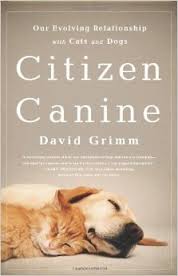
Should dogs have legal rights?
The question is not as crazy as it might sound. In Citizen Canine, author David Grimm explores this and many other questions about the rights, responsibilities, and roles of pets in contemporary life. He examines the history of pet life in American society as well as the legal status of dogs, cats, and other nonhumans. Along the way, he introduces readers to some interesting and influential people in the areas of animal welfare, animal law, animal rescue, and more.
Grimm is clearly an advocate for better treatment of dogs and cats and is very open to new possibilities — from laws that better protect pets and the people who love them to a radically new status for dogs and cats. But the book presents a mix of viewpoints and does an excellent job of presenting the very real questions posed by granting “legal personhood” to animals. Who would represent the interests of dogs and cats without families? Could a pet owner be jailed for failing to provide medical care to a standard determined by … whom? Could dogs sue people? Could they have their own money? How would we contend with the likelihood that veterinary malpractice insurance and lawsuits would dramatically increase the cost of vet care? Who would have legal standing to represent a pet? How would we handle getting dogs’ and cats’ consent before breeding (or neutering) them?
His discussion with a leader of the American Veterinary Medical Association reveals the fierce opposition among vets to any change in dogs’ legal status — and the hypocrisy of vets who appeal to pet owners by acknowledging the role of their pets as family members, and who offer, even encourage those owners to purchase vet care that costs thousands of dollars — then insist that a dog’s or cat’s value cannot exceed replacement cost. Like a toaster.
What I like best about this book is the many possibilities and viewpoints it presents. Some of the people Grimm interviews present the “personhood” question as black and white: Dogs must either remain with their current status, as property, with no more rights or protections than a toaster; or they must be elevated to a status equivalent to that of humans. As with most issues presented as a stark choice between two equally poor options, though, the reality is much more complex. Many of the objections raised, for example, can be resolved by looking for parallels in the way that we protect children’s rights or the rights of adult humans who cannot make their own legal decisions.
The final chapter introduces an idea that merits a lot of thought and that could provide pets with a status that more closely reflects their true position in our society. For details, you’ll have to read the book.
Who’s a [Good, Bad, Anxious, Happy, Aggressive, Calm] Dog?
I recently attended a two-day workshop with TTouch practitioner Lori Stevens. Of the many tips and techniques that stuck with me, this stands out: We tend to label dogs’ behavior rather than describe it.
What is an anxious dog? What is an aggressive dog? A well-behaved dog? Turns out that each dog owner — and dog professional — means something different when she uses those terms.
 I sometimes describe Jana as “anxious” because, many evenings, she seems unsettled, distracted, and uncomfortable. She whines or paces, but I can usually settle her down in a few minutes. The technique I learned from Lori, using a body wrap, seems to help a little. Jana also shows what I call anxiety on walks if a vehicle (mostly loud, big trucks, though she seems to harbor a deep-seated hatred of minivans, too) approaches from behind us and startles us. I attribute some of this “anxiety” to the possibility that she’s not hearing things as well as she used to and she gets surprised more often — perhaps she’s also losing some vision. Whatever the cause, things seem to come out of nowhere and startle her more often. Fine, so, she’s a bit anxious and I deal with it.
But I have friends whose “anxious” dogs have done hundreds of dollars in damage to their possessions, their floors and walls, their furniture … other “anxious” dogs bark nonstop or are unable to sleep through the night (pacing, whining or barking, and ensuring that no one in the household gets any sleep. Ever.). Compared with that, Jana is calm and placid, well-adjusted even.
Then there’s the “aggressive” dog. I’ve seen dogs who have been labeled as aggressive who are the sweetest, friendliest dogs … but who really dislike cats and want to chase them (or worse). Or who have maybe bitten a person, once, under what turns out (if I get the whole story) to be extreme provocation. Or who are simply terrified, stressed by being put in a situation that they cannot handle. Not all of these dogs are aggressive; they are scared and overwhelmed.
Scared and overwhelmed can be fixed; prey drive can be managed. But some dyed-in-the-wool, born-with-it aggression is not fixable and can be very hard to manage. It is important to know the difference.
Being able to describe our dogs’ behavior accurately and in detail is important for so many reasons. We can do a better job of figuring out how to manage or change that behavior if we know what it is and why it’s happening. As dog professionals, or as dog owners who want to call in a professional, a clear, detailed description of behavior is an essential starting point — does this dog need training? Medication? Treatment for some underlying, painful condition that is causing her to snap at people? Sometimes the cause is simple, even if it’s not immediately obvious.
A couple of summers ago, one evening, Jana snapped at Cali for playing roughly near her. Jana is usually amazingly patient with Cali. I reprimanded Jana for her “aggressive” act. Fortunately, within a few days, Jana was scheduled to have her annual physical. At her vet exam, the doctor found that Jana had a very painful cracked molar. A long surgery and several hundred dollars later, Jana was no longer in pain. She has never snapped at Cali again.
So, trash the catch-all labels. Instead, look at the behavior. When does it happen? Is there a trigger? Did it just start? Has behavior changed recently? Has the dog’s environment changed? Is the dog getting enough exercise, a balanced diet, regular medical checkups? If you can’t figure out the cause, call in help: doggy friends, the vet, a trainer. Post a question on the Thinking Dog Blog!
It’s usually possible to figure out what’s going on — and lots of expert help is available!
Good Mom, Bad Mom?
 A reader writes: My spouse, the “good” parent, gives our dog lots of treats. Now the dog has become a tyrant, especially when I’m trying to make dinner. Other than saying NO when she has maxed out her quota and then having to deal with nagging, or else yelling at this sensitive dog and becoming even more of the “bad” parent, what might you suggest?
This is a tough one, as is any instance where spouses’ parenting styles clash.
A couple of hints in your question suggest an area where I think you can make changes, though. One is your characterization of yourself as the “bad” mom, simply because you are a tiny bit more strict. And what, exactly, is her “quota”? Together, these tell me that you and your spouse, like many dog parents, equate giving treats with giving (or, perhaps, getting) love. And a nice mom (or dad) gives lots of treats while a mean mom stints on the cookies. That’s simply not true, regardless of what the dog says or how sadly she looks at you.
One place to start might be to not give any treats without a reason. That’s not as mean or as hard as it sounds. And even if you can’t get your spouse on board, you can convince the dog that making sad puppy eyes at you will not get her anywhere (and neither will “nagging,” whatever form it takes).
Come up with your own criteria. I ask that my dogs do something, bring me something, or submit to something they dislike in order to earn treats. This translates to cookies for bringing me the paper or my shoes or for picking up their bowls after eating; treats for coming in, sitting nicely, and stopping their insane barking when the neighbors walk by with their dog; and high-value treats for allowing me to do their nails and other hated grooming chores.
Some people set the bar lower, giving the dog a treat each time she comes in from going out to pee, for example. While I see no reason to do that, it does, at least, set a criterion. You do X, you get a cookie. That sets up a different expectation than: I am (or I am cute); therefore I deserve a cookie.
If all that seems too complicated, any time she bugs you for a treat, ask her to do something she already knows: sit and shake hands; roll over; high five. She will still be exchanging something for the treat, not just walking by and expecting rewards simply for existing.
Of course, she is not going to accept this new regimen without protest. You’ll need to hold firm for a few days or a week or so, ignoring her nagging, and she will ultimately resign herself to having to earn or pay for her rewards, just like the rest of us. She might still get freebies from your spouse — you probably can’t change that. But I seriously doubt that your dog measures her love for each of you by the number of free treats you hand out. A lot more goes into building a relationship than that!
Thinking Dogs

Many of you are thinking, Of course they do!
So, why am I even asking that question?
I recently taught a class on dog intelligence where we tried to decide what and how dogs think and how to define dog intelligence. I had just seen the movie The Imitation Game, and I mentioned the scene where the police investigator asks Alan Turing whether machines think. Turing’s response (paraphrased considerably) is that, if someone we know has different taste than we do — likes a book we hated or loves a food we don’t care for — we wouldn’t say that the person is not thinking, but that his or her thinking is different from ours. In the same vein, machines do not think as humans do, but they can follow a process that approximates human thinking, according to Turing.
Human thinking is conscious and active — that is, we are aware that we are doing it and do it intentionally. It is an attempt to understand something, solve a problem, answer a question, create connections or meaning. Human thinking is mostly done in words, though, as Temple Grandin points out in many of her books, people with autism do not always think in words but often in pictures or even video.
Dogs don’t necessarily think in the same ways as humans — or agree on everything or reach the same conclusions — but I would argue that dogs’ thinking is more similar to humans’ thinking than a computer’s is, if only because dogs are conscious and machines are not.
So, the simple answer is: Dogs do think, but they do it differently from the way humans think. They probably do not spend a lot of time planning for retirement or worrying about the bills or speculating about which stocks to invest in, for example. They do not appear to worry about things that they cannot control (unless it seems that dinner might be late …). They might think about their next meal or the dog beach or the cute shepherd down the block — not so different from some of what people think about.
Another wonderful dog book, How Dogs Love Us by Gregory Berns opens the door a little bit toward understanding how thinking in smells might work. Berns trained his own dog, and then several other dogs, to lie still in an MRI so that he could get images of their brains — while they were awake. He did several experiments, including one where he mapped dogs’ reactions to the scent of a human from their own family and the scent of a different person. He also mapped their responses to a familiar and an unfamiliar dog. These tests, and others that measured response to cues indicating a desirable reward (bits of hot dog, I think) and cues indicating no reward, showed that dogs brains look very much like human brains. Dogs scenting their own humans showed similar responses to humans viewing photos of their loved ones, for example.
Regardless of how they do it, evidence that dogs think is all around us. When they bring a toy and ask us to play, beg for a bite of our sandwich, or stand by the door asking to go out, they are thinking and planning. The dog who creates a diversion so he can steal a coveted bone from his sibling dog is thinking and planning. The ability to anticipate where the Frisbee will come down and then to jump in a graceful arc to meet it reflects thinking (and a far better grasp of physics than I ever had). Service dogs show their thinking skills constantly in their ability to intuit what their partners need and offer it. The examples are endless; share yours in the comments!
Following Our Dogs’ Example
Jana does yoga. No, really.
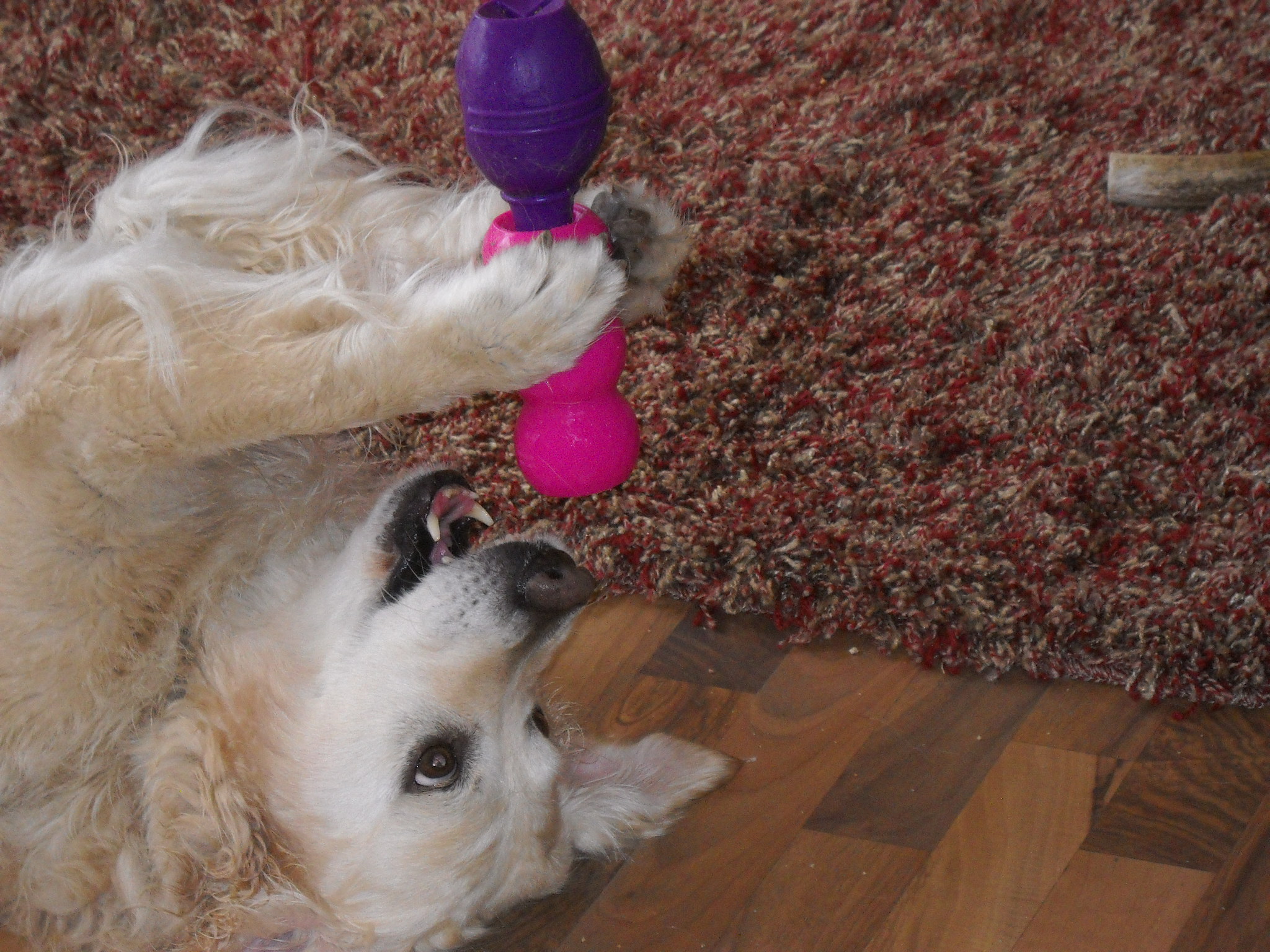
I took a yoga workshop a couple of weeks ago that focused on stretches for the back, neck, and shoulders. The instructor showed us a couple of ways that she uses a tennis ball to apply pressure to tight muscles. Watching her, I got an immediate image of Jana, who does something very similar. You can watch her here: Jana Works Out. She has always done this. She wriggles so that the tennis ball moves down her back, massaging every inch.
We can learn a lot about how to live well and take care of ourselves by watching our dogs. Think about how consistently they demand exercise. And fun. Breaks. I can get sucked into work and sit in front of the computer for several hours. Except Cali won’t let me. Play time is supposed to happen at 3:30. Dinner must happen at 5. Breaks happen every couple of hours, tops. That is such a healthy, balanced approach to life — enforced by my dogs.
Also recently, I was talking to an acupuncturist. She was lecturing me on how important it is to take probiotics. I looked at her for a moment, then said. You know, I actually know that — I do it for my dogs. I just never applied that knowledge to my own diet.
 How many of us worry more about what our pets eat than what we eat, and how many spend more time (and money) ensuring that their food is nutritious, balanced, tasty … while we eat junk food? Jana and Cali have no weight problem to contend with. They take their vitamins and supplements and exercise daily. They get better medical care than I do. And, once something becomes routine, even something like brushing their teeth, they expect it — and expect me to provide it. They remind me. (Though they have never asked me to clean their ears …)
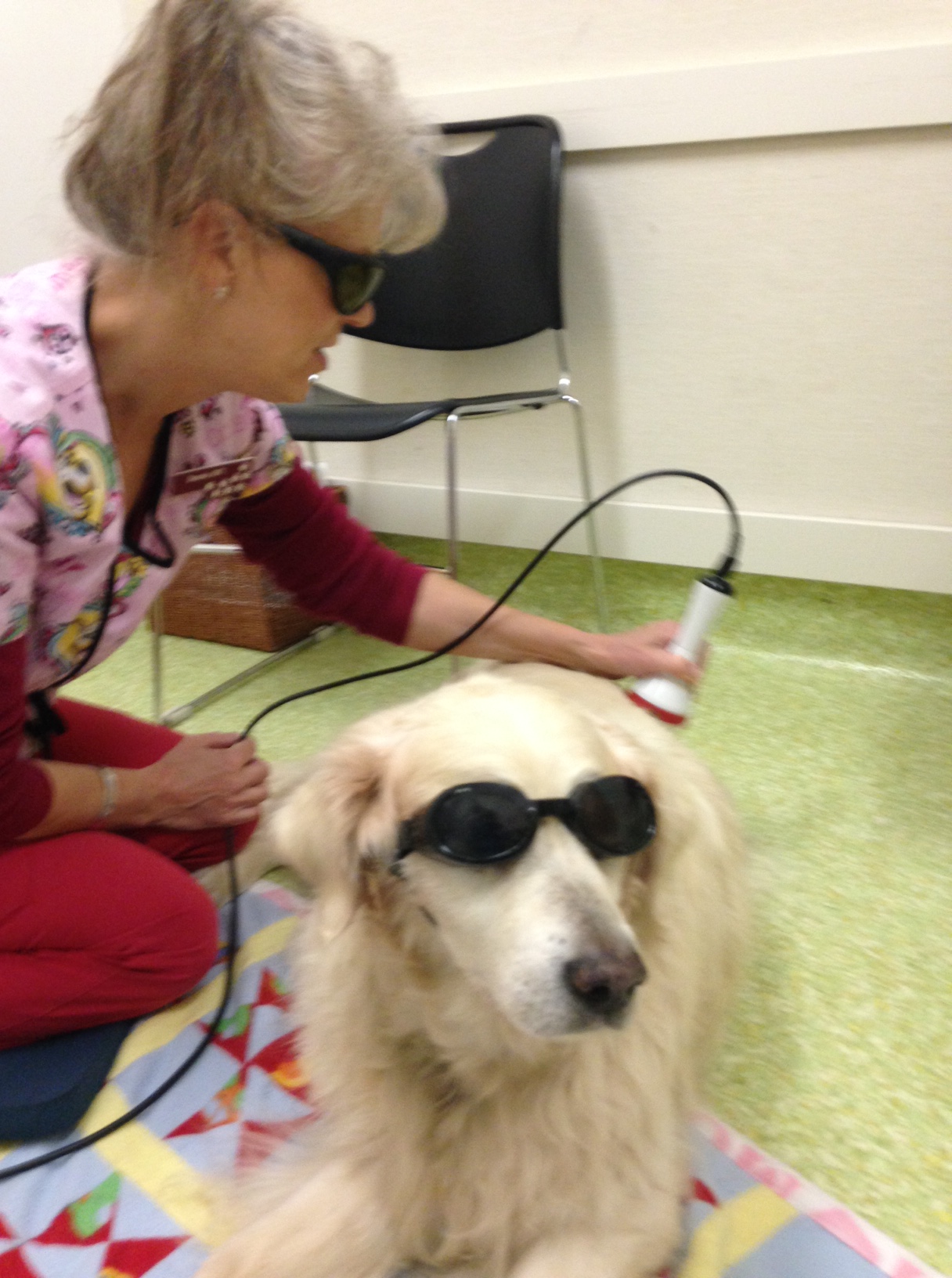
We do exercises daily to build up Jana’s shoulder muscles (which, incidentally, help me improve my balance), and Jana also gets regular laser therapy treatments for her arthritis (see photo). It keeps her (mostly) pain-free, so she can continue to wriggle and roll and do her yoga-tennis-ball exercises. For many more years, I hope!
“I’m So Angry I Could Eat a Tissue”
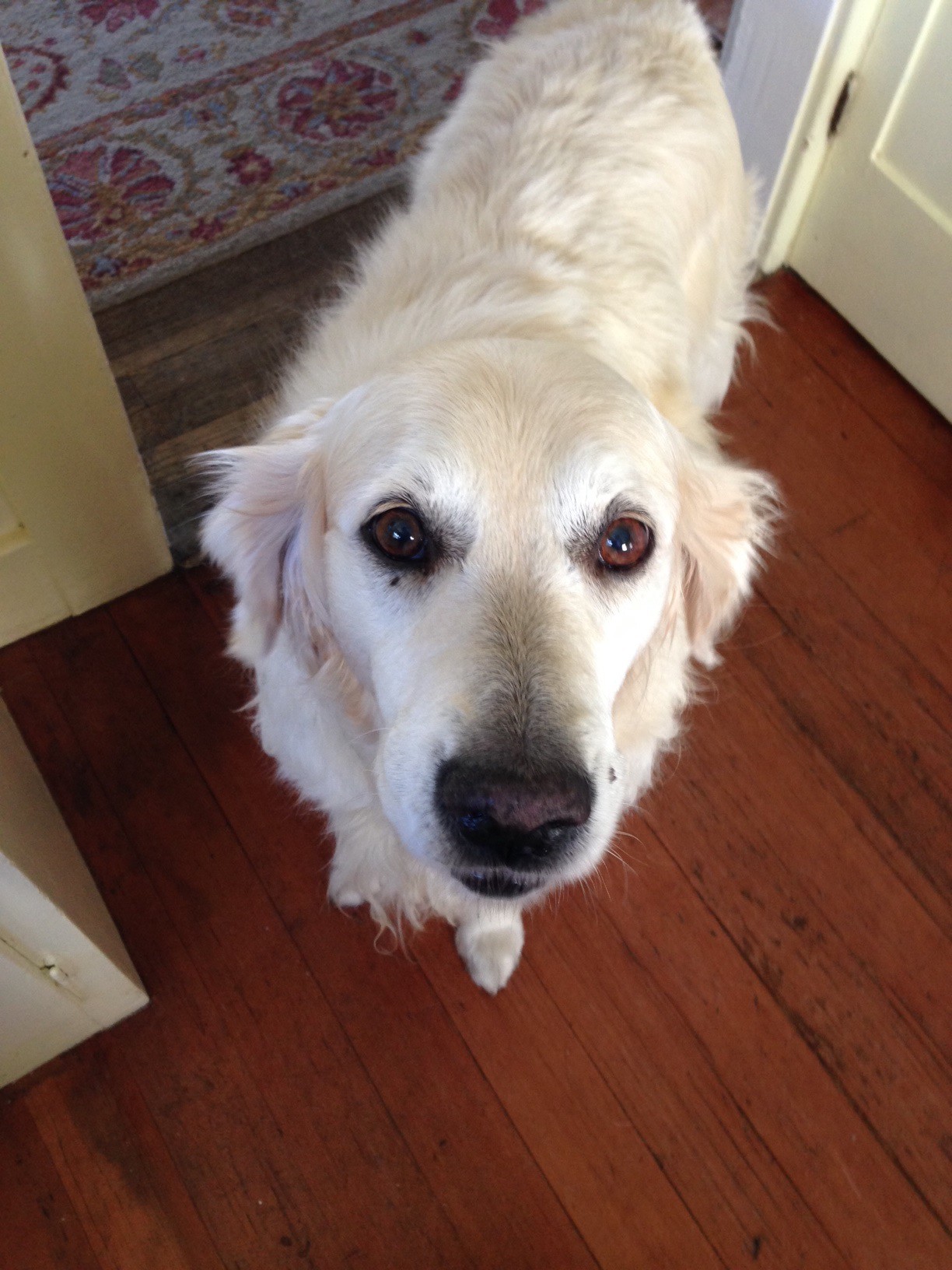
When Jana gets angry at me, she takes one thing (usually a tissue) out of the wastebasket, shreds it, and leaves the pieces next to the wastebasket.
A quick Google search will turn up dozens of articles on why dogs eat trash or how to get them to stop, and many will suggest that they’re attracted to the food or your scent on items, or that they are obeying an irresistible impulse. Some will suggest that training can solve the problem; some will suggest management (trash cans with lids). Many dogs get into the trash; why do I think it is a reflection of her anger with me? I know my dog.
When Jana was a puppy, she nearly always shredded the trash when I left her home. As a dog newbie, I once followed the advice of a trainer to put hot sauce on the trash to discourage this behavior. Instead, I discovered that Jana loves spicy food. And spicy “food.” (Her definition of food is much, much broader and more inclusive than mine.) After she had enthusiastically thanked me for adding condiments to her snack, I asked her to help me pick up the remnants and put them (back) in the trash can. She did. I never put sauce on her snack again.
As Jana matured, she became a responsible dog who follows the rules and respects boundaries. She’s very helpful and thoughtful. I could leave a steak dinner on the counter and go out for the day (unlikely; I keep a vegetarian home) and it would still be there when I got home. She is 100 percent trustworthy around guests and snacks, even if the snacks smell really good and are at dog-nose level on a coffee table. She has mostly stopped the trash-shredding behavior.
But.
When I leave her at home at a time that is just wrong — it’s close to mealtime, or I have already been gone much of the day and I come in and leave again soon after, or it looks like I am going to do something fun that should include dogs — I will come home to a single shredded tissue on the floor next to the trash can.
I know that serious dog scientists (most of whom seem to never have actually lived with a real dog) will howl over my interpretation of this behavior, but here it is anyhow. I think that Jana is expressing her hurt feelings and anger in a way that is uniquely her own. She could be very destructive; thankfully, she’s not that kind of girl. She could ignore me when I returned, but she’s not the type to hold grudges, either. I believe that she has thought this through and decided that shredding one piece of trash makes a statement.
As Cali does with hiding before brushing her teeth, Jana is telling me how she feels. Both girls do this articulately and in their own way — and then move on. Wouldn’t it be nice if everyone were so mature and as effective and clear in their communications?
What Do Dogs Want?
I am teaching a class where students attempt to analyze dog-human relationships from the dog’s perspective. I asked them to think about what dogs would want the world to look like — what dogs dream of, what the future would look like if dogs’ perspectives were given equal weight to humans’. We also looked at what several writers and editors have published as their versions of dogs’ dreams, hopes, and aspirations.
Looking at the work was informative. Much of the published work that claims to represent a canine viewpoint is undeniably anthropomorphic. Products, too — though designed for dogs, they are things that no dog would ever want. Shampoo with an overpowering, sweet fruity scent, for example.
Or Dog TV, a channel created for your dog to watch while he’s at home all day. It’s carried by several cable companies. Several of the examples we looked at described dogs’ desire to have thumbs so that they could control the remote or their desire to lie around dreaming all day. Dog TV was created for people who see dogs as furry little couch potatoes.
Another common theme is taking charge. One image from 21st Century Dog, a collection of dog-centered prophesies, appears below.
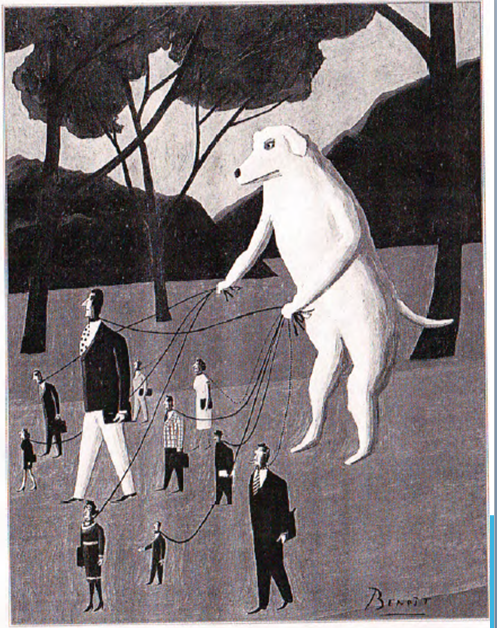
In a similar vein, several students channeled dogs who lived in a leash-free world where humans addressed their every whim or in homes where the dogs ate at the table while the humans curled up underneath. But, benefitting from an in-depth understanding of dog behavior, relative expertise on dogs’ health, well-being and psychology, and lives immersed in all things dog, several students’ views of dogs’ desires seem to get closer to what dos might, actually want.
In a book that illustrates dogs’ dreams, dogs dream of large, ornate houses, trips to Paris, and huge collections of shoes. Not likely, unless those shoes were for chewing.
Yet all is not lost to the hapless dreaming dog. Several students’ dogs dreamed of more doggy things — endless balls, growing on plants in their yard; freely available and dog-appropriate food (they are also studying canine nutrition); being free to dig, roll in the mud, and drink from a bottomless water bowl; enjoying a private stream where they could catch fresh fish.
Others envisioned a world where, rather than one species ruling another, the partnership was more even. Humans would understand their language and they’d get as much attention and company as they wanted. Dogs would not have to wear clothes; could go out to pee whenever they chose; would not be forced to interact with dogs whom they disliked; and bed-sharing would be negotiated.
One student nailed it by focusing on scent … another imagined dogs having the right to work in fulfilling jobs.
While we’ll never know for sure whether dogs dream of taking over or simply of a more equitable partnership with us, we can be sure that most dogs — like most people — want to use their intelligence and be challenged physically and mentally. Then, tired and muddy, we can all stretch out on the couch and fight over the remote.
The Happiest Dog on Earth
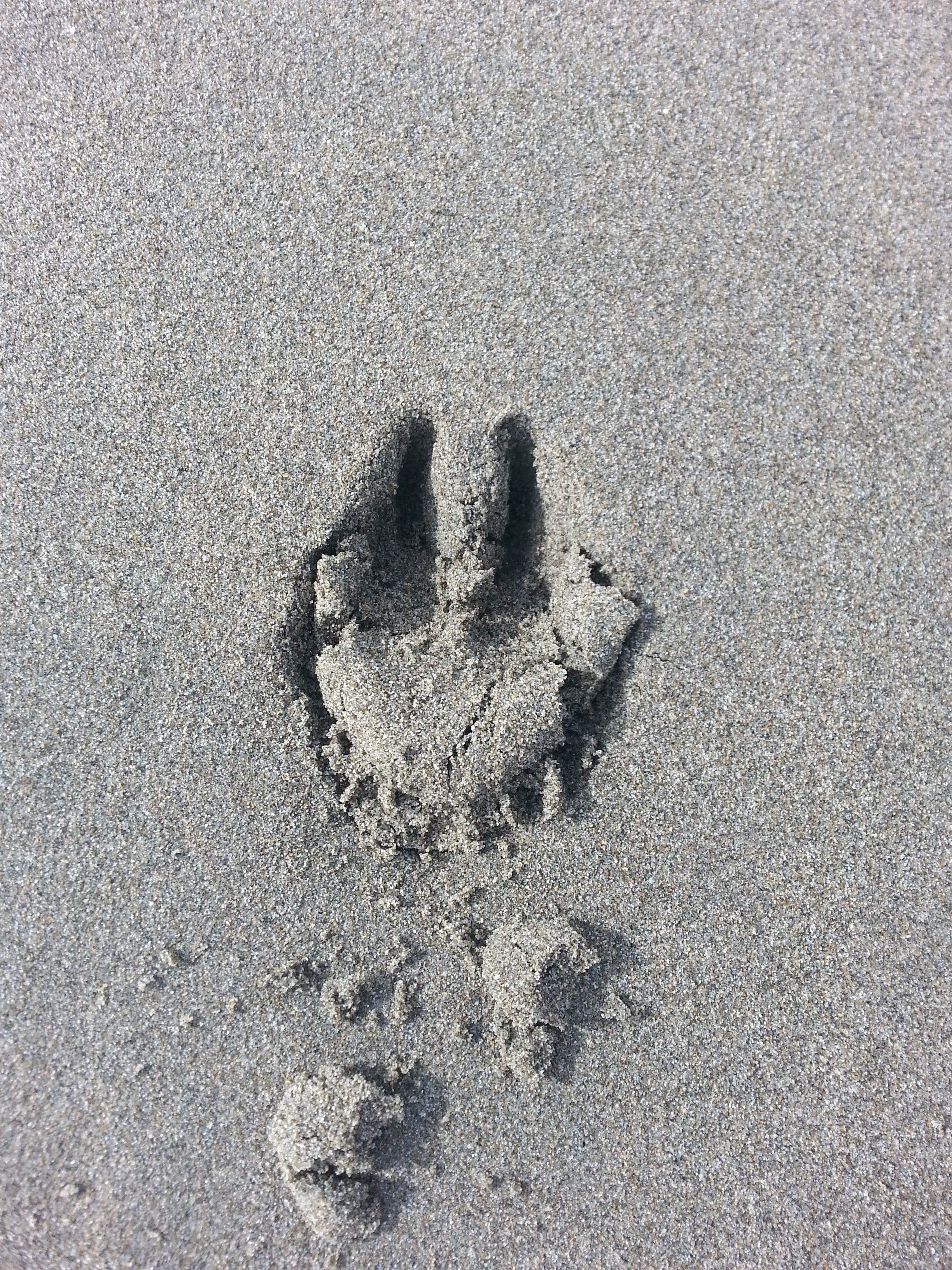
Cali’s pawprint from a recent beach day. It’s so fitting that her pawprint looks like a smiley face. Cali really is the happiest dog I have even known. She greets each morning (actually, since she gets up well before the sun, I could say that she anticipates each morning) with pure joy. She grabs a toy and waves it in my face or jumps on the bed to give me kisses or just wags her whole rear half — whatever works to get me out of bed. Lazy Mom.
She then grabs a favorite toy and runs outside where she runs around, wagging and smiling. (Yes, I can tell she’s smiling, even if she has a large toy in her mouth.) A few hugs and cuddles, more wags, and she’s off to take care of morning business.
Sometimes, in the afternoon, when she’s bored and I am working too much, she loses the smile and gives me the bored teenager sigh. But she perks up immediately when I say a magic word (“park” or “play” or “walk”).
Anticipation kicks in again sometimes. I apparently have a habit of saying, “OK,” when I am about to get up from the computer. It triggers a wild frenzy of dancing and tail wagging. Same thing happens — this is a bit embarrassing — when the end music to my latest Netflix TV series comes on each night. Cali might be comfortably napping on the huge memory foam dog bed (having kicked Jana off, no doubt), but at the first bars of music, she’s up and dancing toward the door.
Am I really that predictable (yes). More to the point, what does this tell us about dogs?
The ability to remember experiences, learn from them, and anticipate new ones based partly on those memories is a huge element of what makes humans conscious and engaged in society. Same thing is true for dogs. While I doubt that Cali lies around wondering what we’re doing next weekend or worrying about how we’ll pay for her next bag of SoJo’s (she leaves that to me), she often appears to anticipate good things happening in her future.
She seems to expect that, at 4 p.m., I will stop working and Play With the Dogs. At 5 p.m., dinner had better be in the bowl. While following a routine does not, in itself, mean that dogs are thinking, planning, or anticipating, it’s clear to me that she anticipates these events. And that her clock runs a bit fast.
Even more interesting is her certainty, whenever we get on 101 South, that fun things are in store for dogs. Not all car trips end up being fun for the dogs. She’s been on car trips that started with getting on 101 South … and ended in Florida, many long, dull days later. Sometimes, I just run errands. Mostly, though, we are heading to Berkeley, to visit Cali’s sister Dora or hang out with her friend Virgil. Sometimes we end up in San Francisco with Jana’s longtime pal Christine at the beach. So the odds of fun are strongly in Cali’s favor.
That’s enough for her. Cali’s sunny personality reflects her natural optimism. And what is optimism if not a belief that good things are bound to happen in the future?
Just Where I Left It …
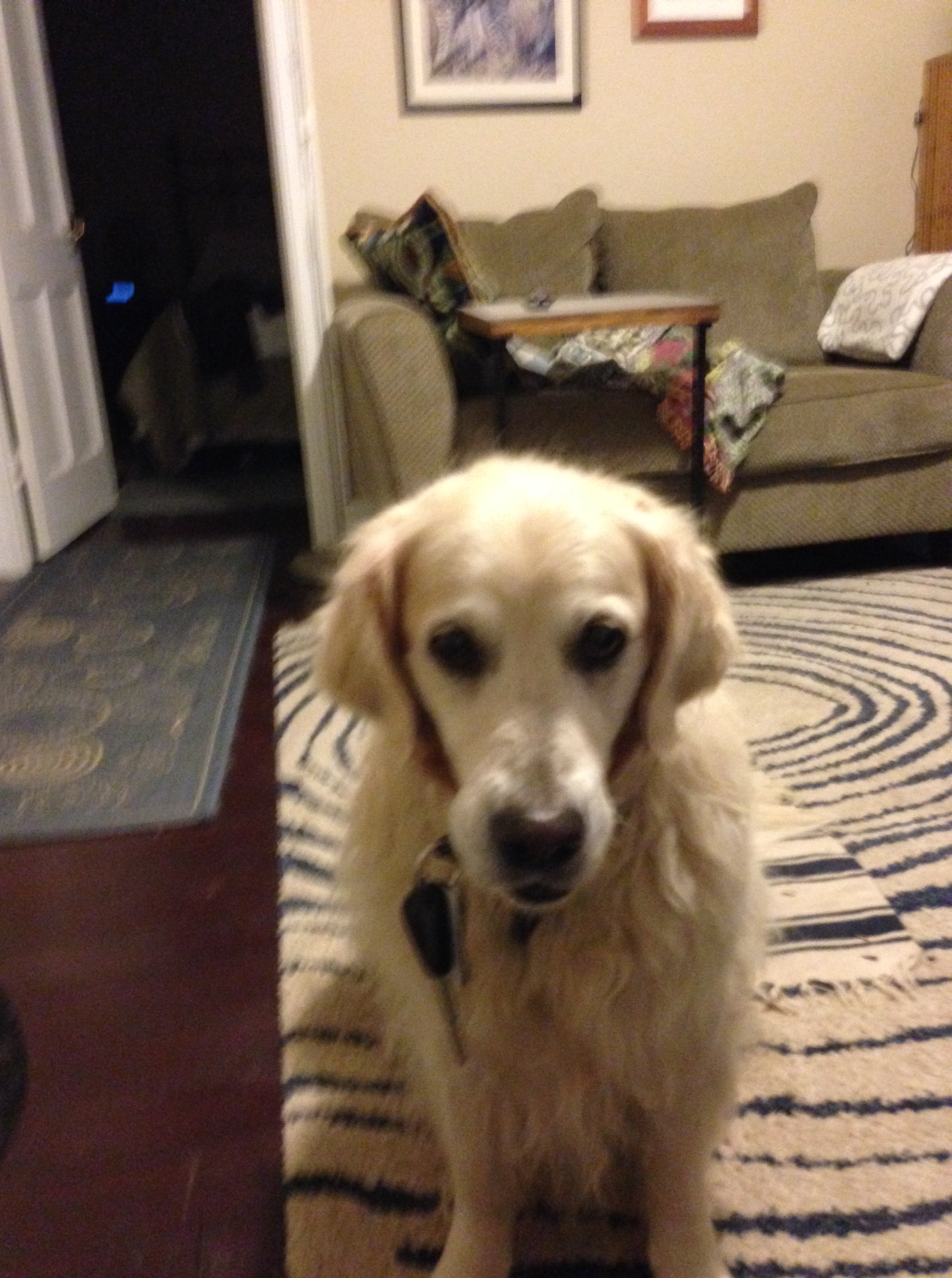
Dogs’ memories — how well they remember things over time, whether they remember people, other dogs, or their mothers and siblings years after they last met — are the topic of much speculation and, lately, of serious research.
As Jana gets older and begins to show her age in some ways, I sometimes wonder whether she’s becoming forgetful or confused in the ways that many humans do as we age. She sometimes will stand and look at me and bark (and bark and bark), for example, and I cannot figure out what she wants or needs.
But then there are the encounters with smelly things on walks. She’ll find something — scraps of food, something dead, sometimes even worse things — that she wants to eat and that I do not want her to eat (or roll in). I’ll give her a stern, “Leave it,” and encourage her past the Thing. I’ll make a mental note to remember this Thing on our way home. A half hour or 45 minutes later, we’ll be walking home. The Thing will, of course, have completely slipped my sieve-like mind. Not Jana’s though. She beelines for it.
Sure, she could be smelling it as we approach. While that’s a reasonable explanation for Thing encounters on daily walks, the same thing can happen with encounters that are weeks or even months apart. At the dog beach we used to visit in Florida, she’d remember where a really good dead Thing had been — months later. It was never still there, and the tides, the wind, the cleanup crews, the other dogs and other animals would have obliterated any remaining scent. On hikes, she’ll dash off to pick up a rock she noticed on the way in — sometimes a couple hours later, as we head to the car. She seeks out remembered toys and beds at friends’ houses, too.
While generations of scientists and dog lovers have accepted the idea that dogs live fully in the moment — and they really seem to — that does not mean they don’t also remember and plan. Dogs clearly make “mental notes” of significant things, as we do. They appear to be far better than many of us at actually remembering to seek those things out (and remembering where to look for them).
We should all enlist this talent to keep track of our eyeglasses, car keys, and cellphones!
