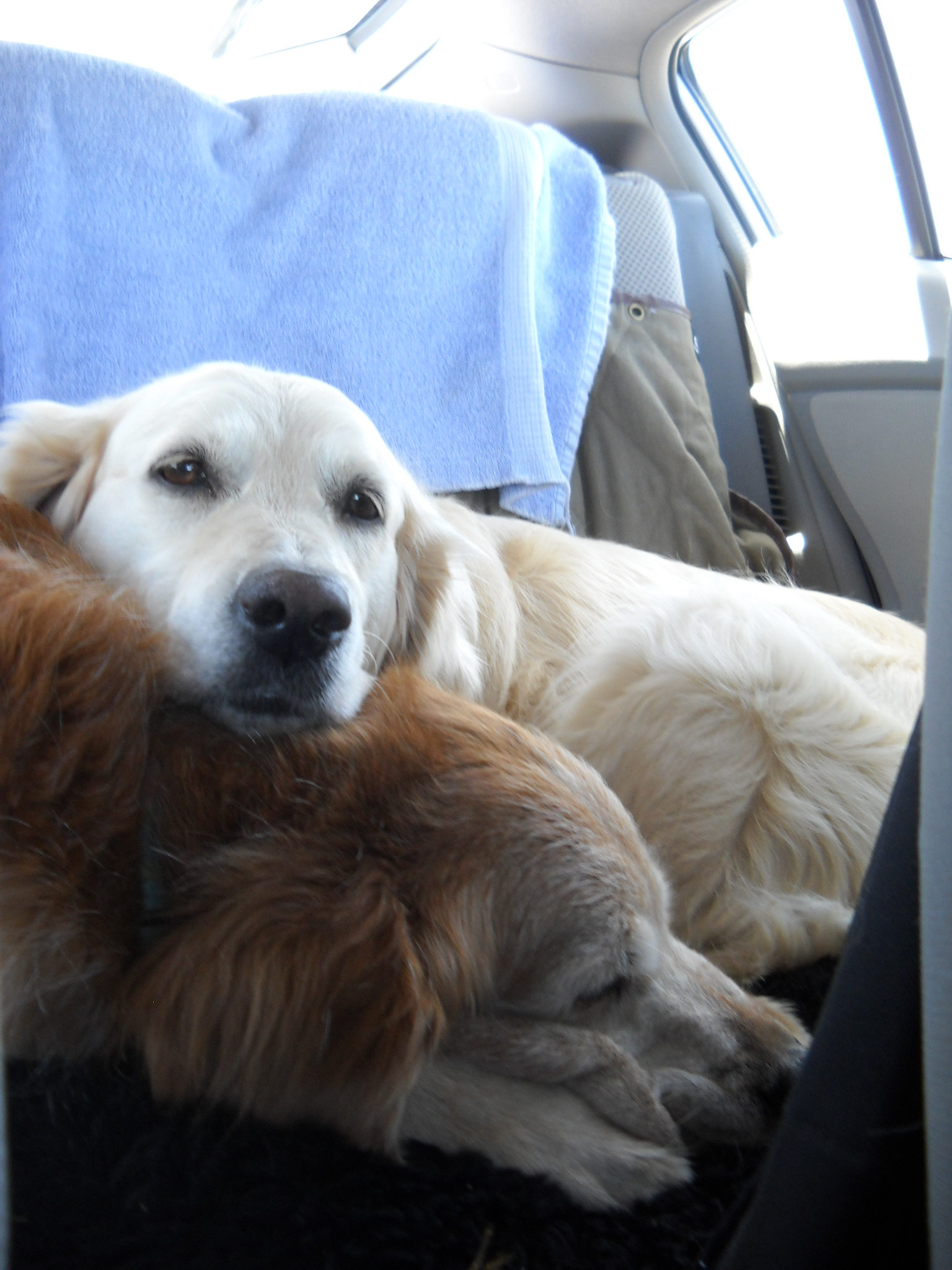
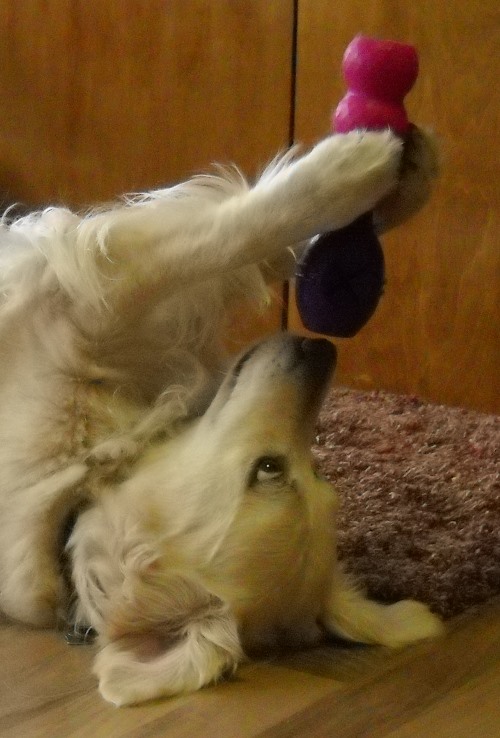
Jana Plays to Her Audience

https://www.youtube.com/watch?v=CR5M8zNOfbY

Jana has been very playful lately. While she’s the park policedog, barking at any younger dogs who get too carried away having fun and being rambunctious, she’s more relaxed at home.

I don’t know if the cooler weather has anything to do with her increased playfulness or she’s just feeling good. She often picks up a rope toy and asks for a game of tug or just grabs a favorite toy and plays with it.

A long time ago, she had a “Gefilte Fish” toy that would sigh, “Oy Vey!” and then make a bubbling sound whenever she squeezed it. It never failed to elicit a laugh from me, and she got in the habit of getting the toy, standing near me, and Oy Vey-ing away. She’d squeeze, I’d laugh on cue, and she’d do a delighted little prance. After about 15 seconds, the fish would stop burbling, and she’d look at me and do it again. And again. Over and over some days, just to make me laugh.

She was only about 2, and I think that is when I discovered that Jana has a silly sense of humor.

That sense of humor is evident in her recent game with the glowing ball that Deni sent for Hanukkah. The ball flashes red for a few seconds if it is bounced on the floor.

When she’s not playing tug, Jana is likely to dig through the toy basket for the glowy ball, bounce it, then roll it around in her mouth. She looks like a fire-breathing golden retriever. Since she thinks she’s a princess, I laugh and call her a fire-breathing princess. And this antic always gets a laugh. She really does play to her audience.

Just Playin’ Around

I don’t know if the cooler weather has anything to do with it, or a recent visit from one of the girls’ favorite aunties, but Jana and Cali have been very playful lately.

Each is playful in her own way.

As a younger dog (uh, princess), Jana played hard and liked playing with the big boys. Labrador boys. Or golden retrievers. Occasional other breeds but her reaction on seeing a Lab or golden, even from a block away, was joyful excitement; other breeds were generally greeted more warily. She’d get to know individuals and decide that certain of them could have her attentions. She’s like that with people, too.

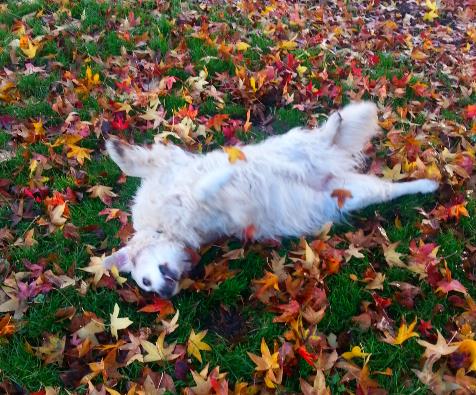
rolling in leavesNow, as she ages, she prefers gentle play. Tug with me or a (very few) special friends, whom she will approach, tug toy in mouth, and invite to play. Catch, if the again, specially selected, person gently throws the ball to her, she will either catch it or nose bump it back in the person’s direction. The person’s job is to get it from her or catch it and toss it again. She especially likes playing this game in the water.

But Jana’s all-time favorite recreation is rolling: Rolling in grass, especially if it is so freshly cut that the mower is still working. Best of all if it turns her green. Rolling in sand is also excellent, mostly because that means we must be at the beach. Mud is pretty great, too. Jana has has a lifelong goal of becoming a black golden retriever.

For Cali, of course, the only game in the world that matters is tennis ball. Frisbee will do in a pinch. I don’t call it fetch, since that is rarely what happens. (The bringing it back part, I mean … there is something about the “retriever” part of their name that eludes both girls).

Photo by Christina Phelps

Cali rarely plays with other dogs, except her sisters, Dora and Alberta. She will occasionally play with a smaller dog. Like Jana, her reaction to large dogs of other breeds is wary avoidance. Also like Jana, she’s more interested in meeting other golden retrievers and some Labradors, usually the smaller, calmer ones. Unlike Jana, Cali rarely warms up enough to play with them.

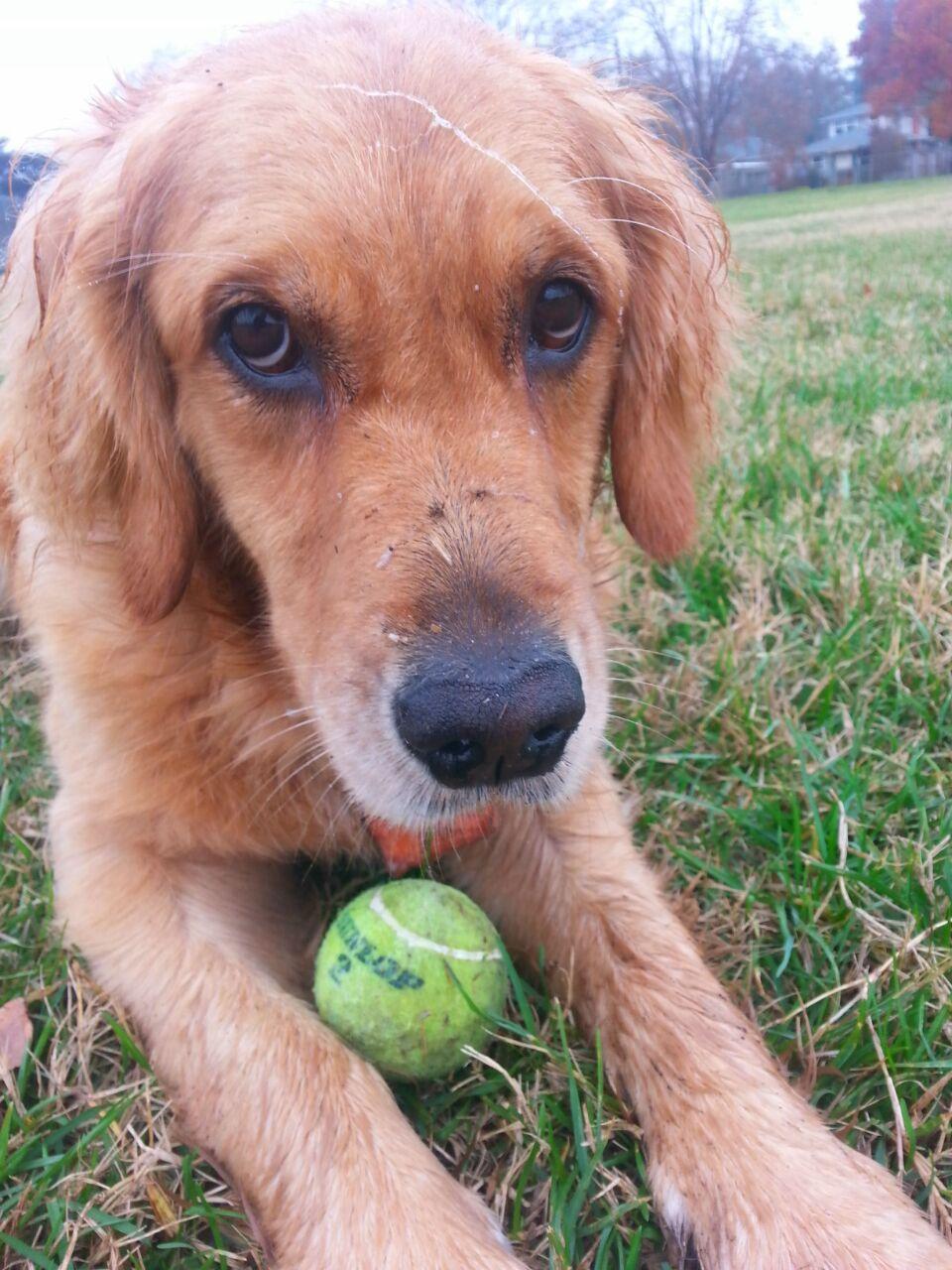
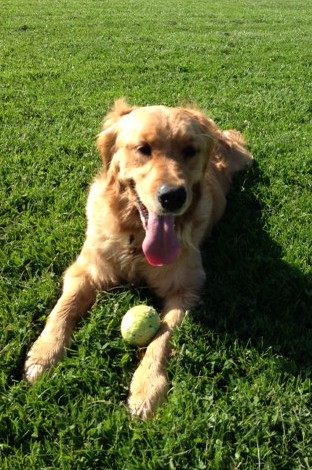
When she gets into a good game of running after her ball and sometimes bringing it back but usually just hanging out with it in the middle of the park, she gets a good drool worked up. She’s developed the unusual talent of drooling onto her own head, as the photo shows. She usually soaks her feet, too. The tennis ball gets a pretty thick coating too, mixed in with dirt and who knows what else. I know that dogs don’t sweat, but Cali also seems sweaty when she’s been running. And of course her feet and legs and tummy get covered in mud (as well as drool). Her messiness is a reliable measure of how much fun a play session has been.

Thinking Dogs ♥ New York

Alberta and Deni trainingService dogs in New York got a great Christmas present from Governor Andrew Cuomo: official recognition as the state dog.

While some states choose a breed as the official state dog, and many states (gasp!) have no official dog, New York took a novel and wonderful approach. This article from Syracuse.com points out that breed doesn’t matter; only education and ability.

The original legislation designated service dogs as the official state dog. The governor expanded the law to include working dogs like police K9s and search-and-rescue dogs, and the lawmakers have agreed to officially expand the definition.

Four paws up to New York legislators for recognizing the contributions of service dogs. Other working dogs are also heroic and deserving of recognition, but a tiny, possibly very cynical, part of me wishes the honor had been kept, as originally intended, for service dogs only.

Unlike this recognition, the “me too”-ism that wants to lump a whole bunch of dogs in with service dogs for special attention or privileges usually is negative, as described in this New York Times column: When Dog Owners Are Off the Leash.

Maybe my grumpiness stems from having read the two stories only moments apart.

While the writer of the Times column admits to schadenfreude at the news of a celebrity couple getting caught and penalized for smuggling their two dogs into Australia, breaking several laws, including avoiding the required quarantine — he also freely and unabashedly admits to committing similar misdeeds. Stating that “half the people” he knows do it, he relates stories of many other people smuggling dogs into no-pets venues, lying to get them on airplanes, and smuggling pets across borders. He even acknowledges having a fake letter attesting to his dog’s status as an emotional support dog, commenting that the law is so vague that it’s easy to cheat. The motivation ranges from simply wanting to avoid paying pet fees on airlines to feeling entitled to have your pet with you wherever you want. Even if that requires that you lie about having a disability and pretend that an untrained pet is a trained service dog.

While the author of the column briefly mentions that this fakery “makes life difficult for those who really need” service dogs, he seems not to care. He sounds much more irate about the high fees that airlines charge to transport small dogs, and approvingly cites a few recent changes, including posh hotels that now allow dogs and the news that Amtrak has started allowing small pets to ride on some trains.

The thing is, though, that faking it is not OK — and is not trivial. So many people are doing it that it really does interfere with legitimate working dogs’ ability to do their jobs. And their safety. I’ve seen so-called service dogs come tearing out of airport shops, snarling and dragging their people, reacting to people or working service dogs.

And, as my students who train service dogs have pointed out, allowing untrained pets into more and more public spaces might not be the best solution. As a pet owner, I love discovering new places that I can take my dogs. But as a person who understands the ins and outs of training and working with service dogs, I also understand the problem.

If pet dogs are very well trained and socialized and the owners are skilled handlers who are aware of what’s going on around them, then no harm is likely to be caused; unfortunately, that’s rarely the case. Most dogs are poorly prepared for the stresses of public spaces, and many dog owners are poorly equipped to handle their dogs safely and appropriately — or they are simply oblivious. As is often the case, a good remedy is more education. Education of dog owners — and of business owners, about how to spot and deal with fakers.

Kudos to New York for recognizing and increasing awareness of the incredible work that service dogs do. Let’s hope it will help more people understand how vital service dogs are to people who truly need them — and how harmful it is to fake it.


She’s Very Patient; or Is She Stubborn?

A few weeks ago, Cali showed protective behavior when another dog at the park seemed to be interested in her ball. I wrote about it in a post that was published on Dec. 14, No More Toys.

I did stop taking the ball. We’d walk to the park, and Cali would get more and more excited as we got closer. I’d turn her loose and tell her to go play. And she’d sit and stare at me.

Stubborn CaliDay one. Fixed stare. Day two. Fixed stare. Days three, four, five … this went on for more than a week.
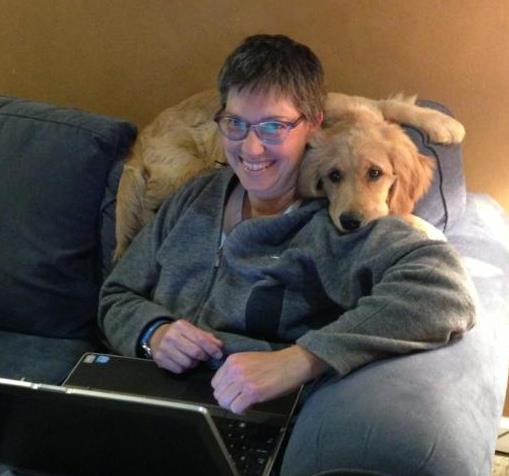

Cali did not play with another dog. She did walk around the park, following me, stopping every few feet to sit in front of me and stare.

Deni suggested that I bring a non-ball toy and try to get Cali to play with Ronen, Alberta’s Labrador friend. Cali watched Ronen run off with the tug toy. Then Cali sat. And stared at me.

A couple of times, there were no other dogs at the park when we got there. Cali sat and stared at me. Just the two of us, alone in a huge meadow, perfect for ball playing. I decided to bring a ball and only let Cali play with it if no other dogs were around.

Who was I kidding?

Now, Cali’s sit-and-stare-at-mes were punctuated by brief pop-ups. Up onto her hind feet, quick poke with her nose to my backpack (or pocket), where the ball was. Then pop back into her sit. And stare at me.

I was trying to out-stubborn Cali? I was delusional. Cali is very stubborn. Or, from her perspective, extremely patient.

My firm resolution softened. I decided to let her play ball if there were only a couple of other dogs there. Well, maybe if there were only four or five dogs. Or more, but not big ones. Or if they were far down the field … You can see where this is going.

So, once again, we play ball at the park.

I do stay far from the other dogs, and I put the ball away if the more rambunctious ball stealers are there. For her part, Cali is (a little) better about bringing the ball back to me. Sometimes. And she hasn’t so much as given another dog a dirty look.

I’m calling it a compromise.

No More Toys

https://youtu.be/lVrQ_xndw1Y

It’s so obvious that even the young girl at the park knew it: Taking toys to the dog park is a bad idea because the dogs might fight over them. So spoke the wise sage, who couldn’t have been older than eight.

And yet, for months (years?), I’ve been taking Cali to the park to play ball. She’s obsessed with her ball. Only her ball; she won’t touch any other ball. And when she’s there, she gets nervous if too many other dogs are playing nearby. They might take her ball. It has happened; and, with some dogs, it’s a challenge to get her precious ball back.

With all that I know about dogs, you’d think I would see the writing on the wall. Smell the coffee. Choose your cliché. I didn’t, until this morning, when Cali actually lunged at another dog.

Yes. Sweet, gentle Cali, who loves all humans and nearly all non-humans. Who wants to befriend the cats and birds and squirrels that Jana is trying so hard to chase. Cali, who comically crouches and grovels, trying to convince tiny Chihuahuas and toy poodles that she’s eager to play with or submit to — not harm — them.

Barley, who owns the above-mentioned wise child and their mom, is a goofy, energetic, one-year-old golden doodle. He’s at that precarious stage where he’s lost his “puppy license” but doesn’t yet understand all the rules of civilized dog play. When he gets out of bounds, the grown-up dogs at the park reprimand him rather than tolerating the puppyish misbehavior. Most are very appropriate; he usually reacts well, and the play continues. We are very lucky to have an extremely nice group of regular dogs and dog parents, and the dog play is nearly always healthy and energetic; I’ve rarely seen dogs behave aggressively.

Barley was inviting Cali to play. His energy might well have been too much for her; she’s pretty sensitive. But she usually just hunkers protectively over her ball and ignores the other dogs. Or picks up her ball and walks away.

At least, she did. Until today.

Barley ran by, seemingly trying to take her ball, and she jumped up and barked. She might have even growled a little. Cali!

I scolded her and was on my way over to leash her up and go when … she did it again! Barley’s mom was very nice about it, but I was mortified. Cali usually has better manners than that. And I should know better.

The truth is, I had been thinking about leaving the ball at home. I was not expecting Cali to lash out at another dog, but I was hoping to encourage her to play with the other dogs. When Alberta is here, Alberta plays with other dogs and tries to get Cali involved. It seems like such a great way for Cali to get exercise. A lot better than lying in the grass clutching her ball, anyhow.

So that’s it. No more toys at the dog park for Cali. And a big bonk on the head with a rolled-up newspaper for me.

Maybe She Had a Cold

I watched Cali run to and fro one morning, searching for her ball at the field where we play. She was so busy anticipating my throw that she ran full-on in the wrong direction and therefore had no idea where the ball landed.

She does not use the logical grid search technique that Wylie, the German shepherd who once shared my life, used. She often runs right past the ball without seeing it. She usually seems to follow her nose, and she always does manage to find her ball, eventually. It’s a large field and sometimes the search takes a while. She wants only her ball; she sniffs and rejects any other ball that happens to be in her path.

But her nose seemed to be broken on this particular morning. Or maybe she just had a bad cold. She ran past the ball several times, almost touching it, without noticing it.

Cali also does not appear to have read those studies that say that dogs, even very young puppies, can and do follow human pointing gestures. Or the training manuals that assure us that our body language looms large in our dogs’ minds, and they will go in the direction that our body, eyes, and feet are pointing, no matter what verbal cues we’re giving them.

Nope. My voice, arms, feet, and body were all telling her the same thing. I even walked toward the ball, stood two feet away, and pointed. No response from Cali, who glanced briefly at me before continuing her random search.

She did, ultimately, strike gold. She then watched me throw the ball once, brought it back — and lost it again on the next throw.

Another thing. Those studies about how dogs know what people can see and therefore tend to deliver the ball to a person’s front rather than her back? Cali hasn’t read those either. Or maybe she thinks that, because I am her mom, I have eyes in the back of my head (my mom did!). I tell her that doesn’t work for adopted kids. I pretend not to know where the ball is. I beg her to bring it to me. I demand that she bring it. I walk away. No luck. She loves dropping the ball behind me. Maybe she just has an odd sense of humor.

I enjoy reading all these studies about dogs’ cognitive abilities, and I really believe that (most) dogs do have great potential for problem solving, interspecies communication, and other feats of intellectual greatness. But playing with actual dogs like Cali is a good reality check sometimes.

A Little Sugar

A reader asks: We kiss our little dog all the time. She seems to understand it is something special. But is that really true?

While I spend much of my life trying to understand how dogs think and feel, I can never really know what any individual dog (or human) — or dogdom in general — thinks, feels, or understands. But I have certainly given this some thought, as have many dog people. Here’s my take.

The relationship with her humans is the most important thing in your dog’s life. Even dogs who live among doggy siblings treasure their bonds with their humans. So yes, any individual contact is special to her.

But is there something about a kiss that is special to a dog? We often interpret a dog’s licks as kisses from them to us. We might be wrong about that, or, as with many vocalizations that dogs use with their humans, a kiss or lick might be a dog’s attempt to mimic something that is a big part of how humans interact and communicate. Again, hard to be sure.

Dogs lick themselves or each other as a way to soothe or relieve tension or anxiety. They might lick us to ask us to stop doing something (ever tried to examine a dog’s hurt paw only to have him lick your hand incessantly the entire time?). Mother dogs lick their pups to clean them and, in very young puppies, to stimulate toileting. Puppies might nuzzle and lick their mom’s muzzle to ask for food. But all of these types of licking look and feel very different from the nuzzling, gentle licks that seem to indicate affection.

Cali cuddleSo how do dogs understand our kisses and hugs? Many dogs dislike hugs or even see them as threatening. Most do learn to tolerate them, but it’s never a good idea to hug or kiss a dog you do not know well.

Your own dog has probably learned that kissing, hugging, and other types of contact that might not come naturally to dogs are important parts of your relationship with her. She is much more likely to accept it from you than from a stranger, even if it’s not her favorite thing. You can watch your dog’s reaction to see whether she leans away, puts her ears back, or tenses up when you touch or pet her in certain ways; if so, try something else. If she likes what you are doing — leans in, paws you to get you to continue if you stop — you can do more of it (bring on the belly rubs!). If kissing happens when you are snuggling with your dog and she’s staying put or even snuggling closer (asking for more?) I’d guess that she is enjoying the contact and closeness — and that she does know it is one of the ways you show her that you love her.


Beyond Words: What Animals Think and Feel

Beyond WordsI’ve read a lot of academic studies of dogs and other non-humans that seemed silly, but I somehow missed this one, described by Carl Safina in Beyond Words. Safina pokes fun at a researcher who gathered and analyzed video of dogs playing for two years before reaching the somewhat obvious conclusion that when a dog wants to invite another dog to play, he behaves differently if the other dog is facing away from him: He tries to get that dog’s attention before offering a play bow. The dog either barks or uses his paw to attract the other dog’s attention. Dogs don’t play bow to other dogs’ rear ends. Amazing. (For more on this and what it can teach us, see Learning from Real Dogs.)

In ridiculing this and other studies, Safina makes the point that researchers should get out of the lab and watch how real animals interact with members of their own and other species. There is much to love in Beyond Words: The sections on elephants, wolves, and orcas are chock-full of detail, stories, and heartbreaking information about how badly humans screw things up when we don’t understand other species. I’ve written about his discussion of self-awareness and the mirror test. But my favorite section, naturally, had to do with dogs. He writes engagingly about his own dog when he takes on the controversial issue of whether dogs (or any non-humans) have “theory of mind.”

Safina offers several definitions for theory of mind drawn from real studies. My favorite is the one that claims that theory of mind is the ability “to read the minds of others.” Based on the divorce statistics and the number of wars and conflicts of all sorts, it seems that all humans would fail that test. A better definition is “knowing that another can have thoughts that differ from yours.”

Safina provides many, many examples of non-humans, including dogs, showing that they meet this definition; he calls the evidence “blinding” (his emphasis). Any time your dog anticipates your behavior — putting on those shoes means a walk — or asks for anything, like a belly rub, treat, or dinner, your dog is showing that he understands, or at least can make a plausible guess at, what you are thinking or planning and might even be able to influence your decision. Any time a dog fakes you out (or another dog) by playing keep-away with a toy or takes advantage of your inattention — barking while you are on the phone, for example — your dog is demonstrating his mastery of theory of mind.

Safina also takes on the definition of self-awareness, as well as other traits or abilities that some scientists, absurdly, continue to insist that only humans possess, skewering the human-centered irrelevance of the “tests” that purport to demonstrate other species’ lack of these abilities. A thorough discussion of humans’ penchant for believing things that we know not to be true versus non-humans’ evidence-based actions and beliefs leads to his conclusion that “maybe more than anything, what ‘makes us human’ is our ability to generate wacky ideas.”


Born to Ride

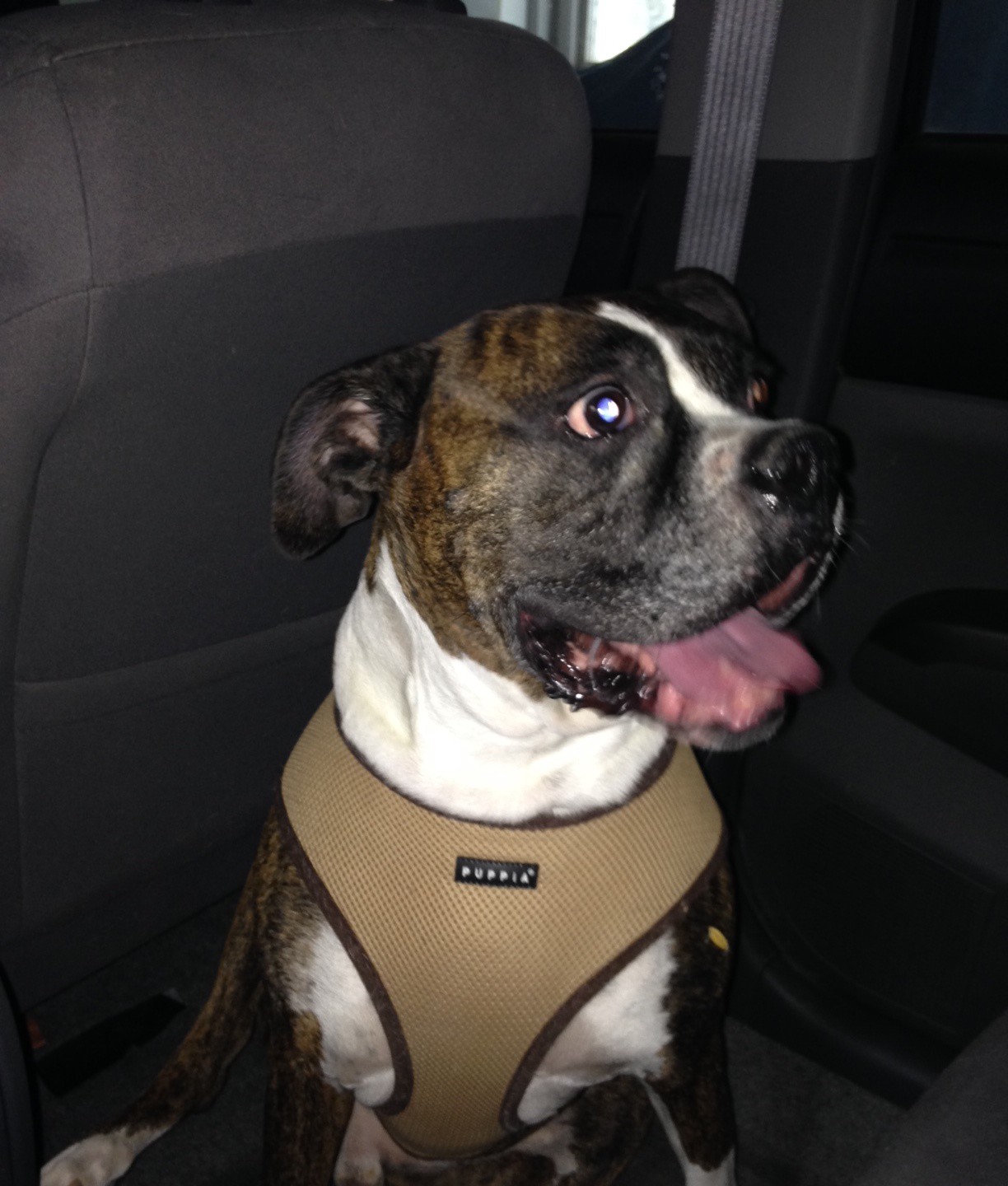
The happy person driving down the road while his buddy rides along, head hanging out the window, ears flapping in the wind, is an iconic image for dog lovers. That’s why it was so exciting when Beau, my aunt’s new dog, jumped into the car with no help — and with great enthusiasm — recently. He had surgery on both knees before my aunt adopted him from a boxer rescue group, and his hind legs are still shaky.

We were even more thrilled when he jumped onto the back seat from the foot space. He wanted to sit next to me, which was gratifying. But I’m no longer visiting, and he’s still getting up onto the seat. He seems enthusiastic about going for rides and is equally thrilled with the adventures in store when the car arrives at its destination. He’s been on walks in different places and helped drop off the recycling once. Now that Beau is willing to get onto the seat, we’re wondering what kind of rider Beau will be. Is he the head-hanging-out-the-window type? Not all dogs are.

Cali’s riding style is to sit up and look out the window, watching everything that goes by. When she realizes we’re going someplace familiar and fun — her sister’s house, for example, or the dog beach — she gets really excited and starts pacing and sometimes squealing. For this reason as well as for general safety, I usually seatbelt her (and the other dogs) when we’re off on a car adventure. Cali gets the window seat on the passenger side of the car; if she were sitting behind me, I’d have to contend with more than her vocalizations: She likes to lean over the shoulder of whoever is sitting in front and nuzzle that person’s neck — and drool on her shoulder.

Ory and Jana in carAlberta gets the middle because she likes to poke her head between the front seats and say hi to the driver and passenger. For a petite Lab, Alberta has a surprisingly heavy head. It can be hard to get into the storage console when she’s in the car, using it as a pillow. And forget about using that console as an arm rest.

Jana is the most mellow rider in the family. She curls up and snoozes. Sometimes she cuddles with Alberta. Several years ago, when Oriel was still with us, Jana and Ory spent most of a cross-country drive snuggled up together in the back seat.  On a recent trip to Yellowstone, we did get Jana to sit up and take notice, but only when the bison came right up to the car.

Fortunately, all of our dogs love car rides. But some poor dogs are scared or get carsick. For them, a car ride is worse than a nail trim! Whether Beau hangs his head out the window, drools on his driver, or just sits there and smiles, I wish him many miles of enjoyment in the car.

Minding Their Manners

I recently read a study that compared wolves’ and dogs’ ability to solve a “puzzle” — opening a plastic box with a piece of sausage inside. The wolves did much better than the dogs, and, from the articles I read about the study, it seems that many researchers are interpreting that to mean that the dogs are dumber than the wolves, at least when it comes to problem-solving. The comments were rather unkind to dogs, and, I think, wrong.

One comment, in the New York Times, came closest to “getting it.” This person suggested that perhaps the dogs had been taught not to take human food or open food containers. Paired with the fact that most dogs’ food is handed to them by humans, while most wolves must find their own food, I’d say the dogs were set up to fail.

The study was published in a British journal by an Oregon State University researcher, Monique Udell. In her own analysis, she paid more attention to the fact that the dogs spent more time looking at the familiar human (who was present for some trials of the test and who provided encouragement in some trials) than at the box. Various commenters’ interpretations of the dogs’ looks ranged from “seeking assistance” to “slavish.”

Half the dogs tested were pets; the other half were shelter dogs, but no information was provided about how many of those had spent part or most of their lives in homes before landing at the shelter. The wolves had been socialized to humans, but even a tame wolf is still a wolf, not a domestic pet.

It makes sense that the dogs would have been taught not to take food or been punished for taking food. It also makes sense that, if a familiar human were present, they would seek help, information, or even permission before helping themselves. When I give my dogs a particularly spectacular treat (a 2-inch piece of sausage would certainly qualify), they often look at me, look at it, look at me — going back and forth a few times, seemingly questioning whether this bounty is truly meant for them. They are polite. They know the rules. They are also quite happy to indulge in exceptions to those rules, once they’re sure they won’t get reprimanded for doing so.

I would have been much more surprised if the dogs didn’t look to the human for permission or help. After all, thousands of years of living together has resulted in close partnerships and, at least on the dogs’ part, exquisite ability to read human’s communication. We humans are less successful at reading the dogs, sadly. Their survival depends on reading humans’ cues and behaving accordingly. Wolves have no such hangups (nor should they).

Some comments on the study went so far as to suggest that training dogs has made them dumber and less able to solve problems, that their social connection to humans puts them at a cognitive disadvantage. I disagree. While some training approaches do discourage dogs from thinking, modern approaches to training that use motivation and reward actually encourage problem-solving. Far from dumbing dogs down, their enhanced social sensitivity to humans enables them to thrive in our world and, in many cases, enjoy comfortable lives and strong connections with their adopted families.

And if those strong connections compel dogs to ask before eating your food, what’s wrong with that? Many people wish their roommates were as considerate.

For more about the study, see these articles:

OSU study: Have we made dogs lazier or dumber than their ancestor wolves?, the Register-Guard, Oct. 2, 2015

Why Is That Dog Looking at Me?, The New York Times, Sept. 15, 2015

The study, “When dogs look back: Inhibition of independent problem-solving behavior in domestic dogs,” by Monique Udell, was published in the British journal Biology Letters on Sept. 16, 2015.

See also my related post on the PPG Barks blog.