Melatonin Might Soothe Your Anxious Pup

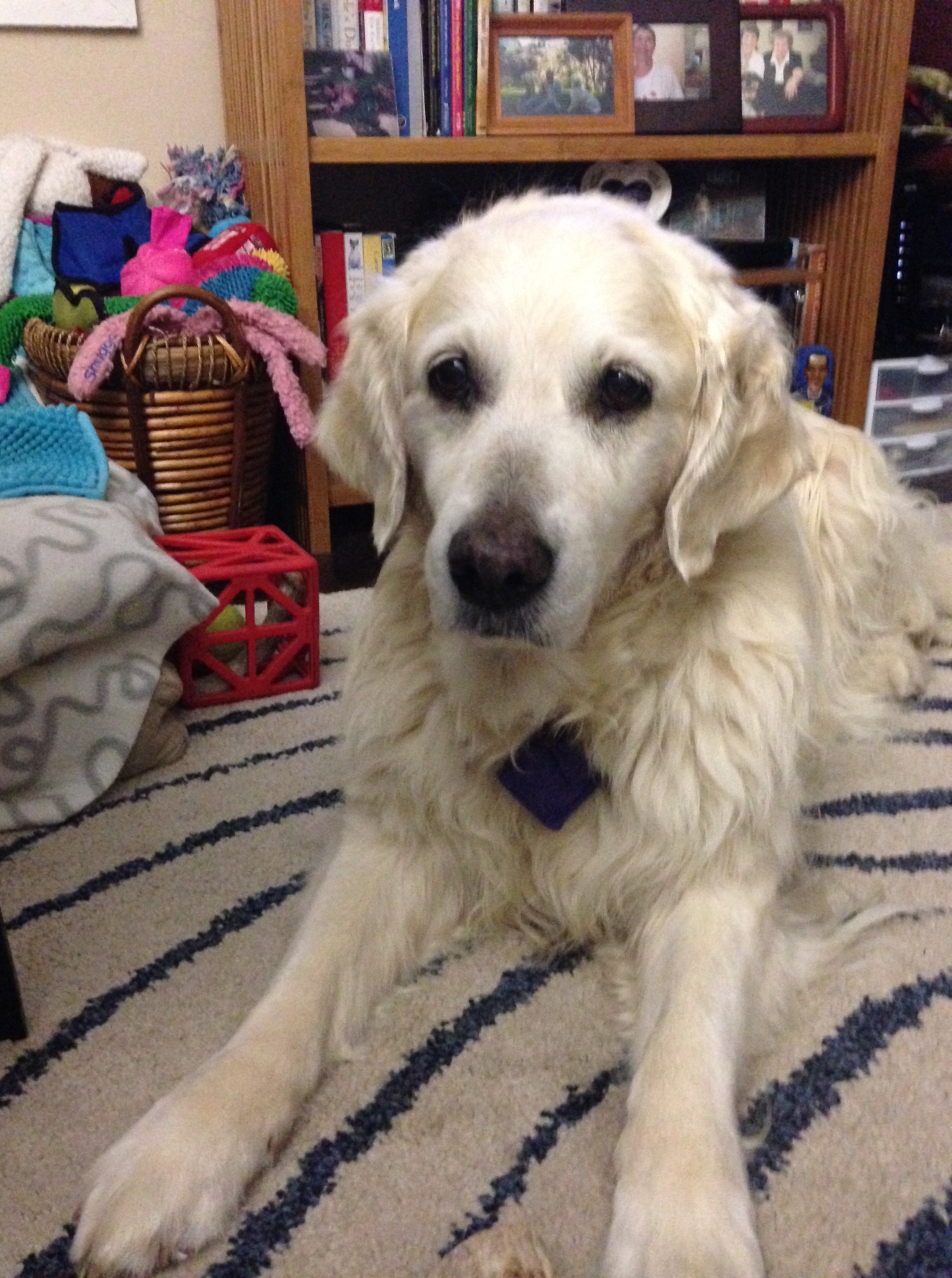
As she ages, and perhaps as her hearing and eyesight fade, Jana has become more anxious and reactive. She gets startled easily and barks when cars come up behind us on walks; we avoid busy streets. She barks at anything wheeled that moves toward us — bikes, scooters, hated skateboards and loathed minivans (and joggers, even though they lack wheels) — but that’s always been true to some extent.

What’s harder to figure out is her evening anxiety. She often (well, it used to be often) would start barking in the evenings. Anxious, high-pitched woofs. The barking sometimes went on for several minutes. Woof. Long pause. Woof woof. Long pause. Etc. Not much fun for me. Or for Cali. Definitely not for the neighbors.

I’ve had some success with the Comfort Zone DAP plug-in. Sometimes a wrap would calm her. But some evenings, nothing worked. When I asked Jana’s personal physician for ideas, stipulating that I wasn’t yet ready for hard-core anti-anxiety meds, she suggested melatonin. A good friend had also suggested melatonin that same week!

With this weird coincidence striking me as a good omen, I decided to try it. It’s not addictive, it doesn’t cause liver damage or other health problems, and it’s not expensive. And, it does seem to help. I started with a single 3 mg. tablet in the evenings, and, with Jana’s doctor’s agreement, recently upped that to 3 mg. morning and evening.

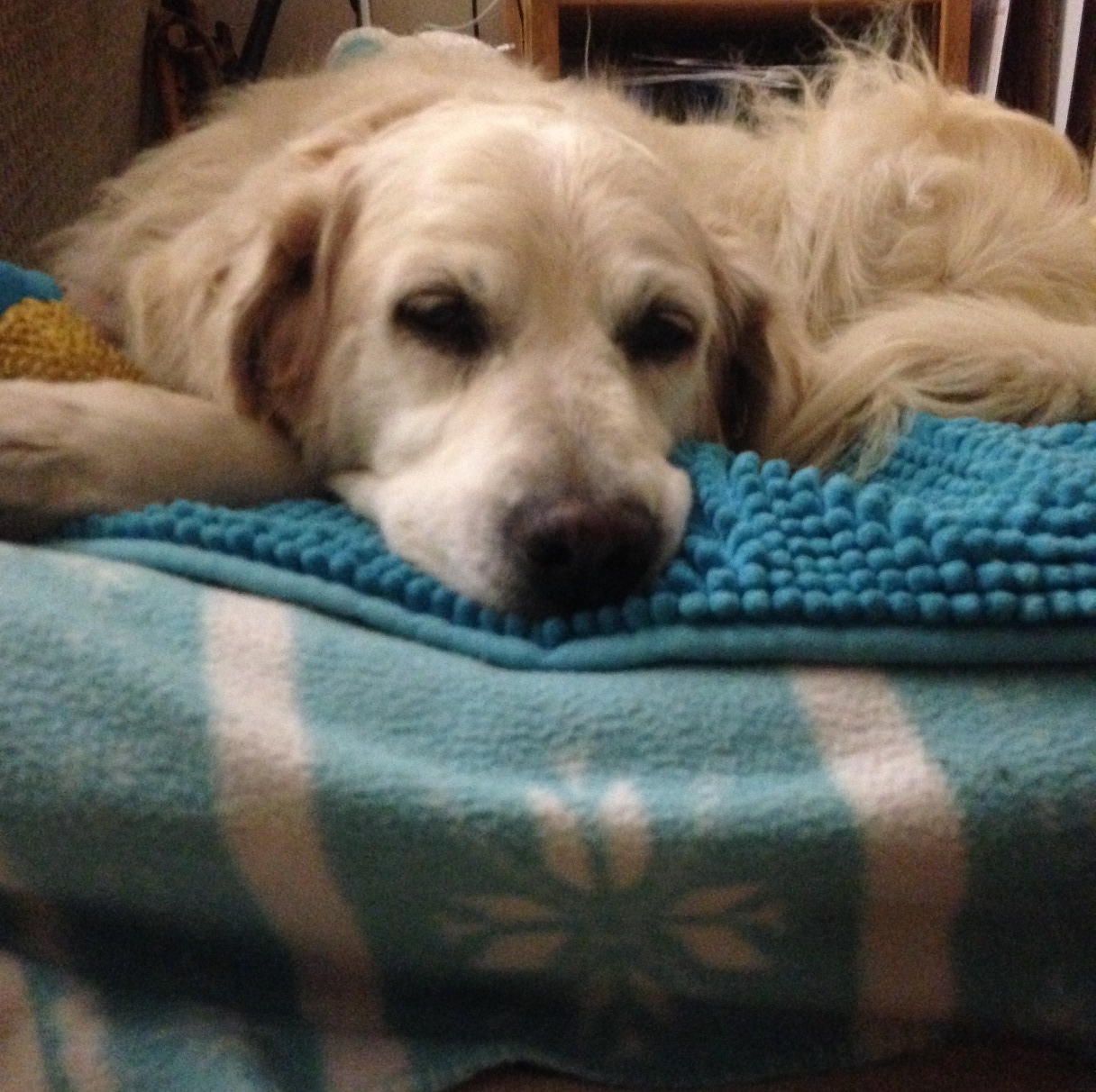
It’s not a miracle cure; Jana’s not a new dog. She still gets anxious sometimes. She still hates skateboards. But the melatonin does seem to take the edge off. She relaxes some evenings. Yesterday, she actually rested her head on my knee and let me stroke her for about 20 minutes. Yes, it really was Jana. No, I did not mix her up with Cali. True to her “no-touch cuddling” credo, she did get up an move after I petted her too many times.

Seriously, though, it is nice to see her relax; maybe a larger dose can relieve more of her anxiety. Maybe she’ll turn into a cuddler like Cali! (OK, let’s not get too carried away…)

Melatonin might have other uses for anxious dogs. The Whole Dog Journal, which tops my short list of highly trusted dog magazines, recommends melatonin for dogs who are afraid of thunderstorms (the linked story might be available only to WDJ subscribers). Some websites (none that I know well enough to put on my trusted list) say melatonin can reduce the number of seizures in epileptic dogs or help with separation anxiety. Fortunately, I don’t have either of those problems, so I can’t comment.

Whatever issue you think melatonin might help your dog resolve, check with your vet first on whether to try it and how much to give.

Also, and this is essential: Check the label. A helpful reader of the xylitol post noted that her brand of chewable melatonin tablets had xylitol! That dog poison seems to turn up everywhere, so reading the label on anything you plan to share with your dog is essential.

Is He Really “Just Playing”?

Are they playing or fighting?

My dog-human communication students recently discussed a study on how well people interpret dog body language. The study, published in 2009, compared the descriptions of dog professionals, dog owners, and people with no dog experience. They all watched the same nine videos that showed a range of behaviors, most interestingly aggression and actual play.

The study’s authors wanted to know whether the amount of dog experience a person had improved his or her skills at reading dogs’ body language. They showed the video clips to observers from four different groups: veterinarians, professional trainers, dog owners, and people with no dog experience. The dog professionals and owners had at least two years of hands-on dog experience.

After watching each clip, observers were to identify the predominant behavior, choosing from a list of eight adjectives. They were then asked to justify their choice: What about the dog’s body language suggests this behavior?

How’d they do?

Not well. Professional trainers (other than the ones participating in the study) and behaviorists have their work cut out for them.

Surprisingly, the dog professionals did no better than the people with no dog experience at identifying the dogs’ body language.

  • The scariest result was that a third of the observers saw aggressive behavior as playful.
  • A sad result was that 43 percent saw actual play as aggression.

Too many people can’t tell when a dog is playing and when the dog is being (or working up to becoming) aggressive. That’s often why people get bitten.

The observers’ descriptions of the body language they relied on to identify behavior are revealing. For example:

  • Most descriptions focused on tail movement, mouthing or vocalizing, and large, whole-body movements.
  • Nearly all tail movement was described as “wagging” and it was always identified as playful.
  • Nearly all barking was seen as aggressive and growling as defensive.
  • The only clip where a dog’s teeth could be seen was the active play video, but two-thirds of the observers who mentioned it saw it as aggression.

That’s another reason behind dog bites, especially the ones where people say “it came out of nowhere.” They look only at big, dramatic body movement and assume that barking or tail movement has only one purpose. They miss or misinterpret the more subtle body language and vocalizations.

If our dogs ever interact with other dogs, with children, even with unfamiliar adults, we need to be able to intervene if the dog is stressed or scared, remove the dog if he or another dog is showing stress, aggression, or fear, and generally pay attention to how our dogs react to different situations. This enables us to keep — and the people and dogs who interact with them — safe.

To do this, we have to look at the whole dog. A wagging tail might mean the dog is happy or wants to play — or it could indicate that he is stressed or unsure of the situation. Raised hackles might be defensive or aggressive — or could simply indicate arousal, which is more likely the case in an actively playing dog.

Not knowing this and not noticing the more subtle movements — a raised lip, ears pulled back, a stress smile — is how people miss the early signs that a situation is overwhelming or frightening to a dog, that the dog is losing patience or getting close to a literal “snapping point.”

When it’s our own dogs, the more often we watch and notice, the better we’ll get at putting together a “big picture” understanding of our dogs’ body language and of the messages they are sending us.

(Oh — those dogs in the photo? Playing. How can you tell? There are many cues: Hackles are not raised, eyes are soft, ears are loose and not pinned back, tails are low and not stiff, both dogs are showing similar energy (one is not going after the other), lips are not pulled back from teeth.)


Hidden Poison: Xylitol and Dogs

I recently read the ASPCA’s list of the toxins most commonly ingested by pets: Announcing the Top Pet Toxins of 2015. I thought it was worth sharing.

I’d rank them differently, though. The top two they list are medications (prescription and over-the-counter). While I don’t doubt that these cause many problems for pets, I also think that most of you, my readers, know to keep your meds out of pets’ reach.

Number four on the ASPCA list is where I want to focus this post — in particular, an item included under number four: Xylitol.

Xylitol is a sweetener. According to xylitol’s official website, “Xylitol is a naturally occurring carbohydrate, that looks and tastes just like regular table sugar. It is a natural sweetener that can be extracted from any woody fibrous plant material.” Who knew?

It’s perfectly safe (as far as we know …) for humans. The problem is, xylitol is highly toxic to dogs. Even a small amount can cause liver toxicity or severe hypoglycemia. It triggers the body to release insulin. Only a tiny amount — a tenth of a gram per kilo of dog’s body weight (a 60-lb. golden, Jana for instance, weighs about 27 kilos) can cause severe hypoglycemia in a dog. Keep in mind that one packet of the sweetener, what you might add to your morning coffee, has more than a gram.

When it was first introduced, xylitol showed up in things like toothpaste and mouthwash. Then it became common in mints and chewing gum — things that most people don’t share with their dogs. Now, though, xylitol has taken off as a sugar substitute for people with diabetes. It is appearing in baked goods, ice cream, even peanut butter. I give my dogs peanut butter every time one of them needs a pill (do you seriously think I can give the pill recipient some peanut butter and not give any to the other dog?). I buy natural, nothing-added-but-salt peanut butter, but … hearing that xylitol might be in peanut butter really brought home to me how essential it is to check the ingredients list, especially on anything that is “sugar free.”

Xylitol is even more dangerous than chocolate, according to this detailed article on Preventive Vet’s website: “Xylitol: The ‘sugar-free’ sweetener your dog NEEDS you to know about.” The article provides illustrations showing how much gum or sweetener powder would add up to a dangerous dose for different-sized dogs. Preventive Vet also has this list of grocery products that contain xylitol.

Symptoms of xylitol poisoning include vomiting, weakness, lack of coordination, lethargy, tremors and seizures. However, your dog’s chances of recovery are much better if you start treatment before he shows symptoms, so if you suspect that your dog ate something with xylitol, get to a vet immediately.

Better than treatment, of course, is prevention. Read the labels of products you buy and keep anything with xylitol out of your dog’s reach. If your dog sometimes gets into your purse or that niche in the car where you keep a pack of gum, don’t take chances; buy products that don’t have xylitol.

Cali Overcomes a Setback

Regular readers may be following the saga of Cali at the dog park. To bring the ball or not to bring the ball?

After getting some wonderful feedback from several readers, I decided to give the “no ball” regimen another shot. I stopped taking the ball to the park and started actively encouraging Cali to play with other dogs.

An important note here: I go to the same park at roughly the same time nearly every day. The same group of dogs is there. Occasionally, I am early or late, or there’s a new dog or an infrequent visitor. But I know most of the dogs there. A dog park with lots of unfamiliar dogs would not necessarily be a good place to encourage a shy dog to play with other dogs. But (mostly) I know that the dogs — and owners — are good people.

So, after several days spent mainly with Cali sitting, staring at me, willing me, trying to mind meld me: “Throw a ball … Throw a ball” while I talked to the amused other dog people, it happened. She played with another dog. 

She played with Daisy, a sweet Rhodesian ridgeback. She played with Zoe, a small mixed-breed. She had a great time with Bella, a gorgeous young Bernese mountain dog. She even played with Ronen, a large black Lab who’s a good friend of Alberta’s but more energetic than Cali usually will tolerate. She ran in circles around Lola and Lila and Lizzie as they played, barking and play bowing, but lacking the confidence to fully join in. She tried to engage other dogs, too, not always sure but definitely making the effort.

These bursts of play were short, but exhilarating. She returned, panting and smiling, to sit next to me and, yes, stare and mind-meld. But it was great progress.

Then the husky showed up.

I’d seen this young female husky a few times, and she seemed intense and high-energy, but otherwise fine. On this morning, though, her mom had decided to bring treats (really good ones, it seems) to try to work on the young dog’s recall.

Mom pulled out treats. Cali wandered over to investigate. I called Cali back. She came (good girl!!) but then wandered over again. Mom was calling her dog all this time. I called Cali back but, before she came back to me, the Husky saw Mom, treats — and another dog closing in. She attacked. I called Cali again, Cali ran toward me, but the husky ran after her and grabbed her again. Cali cried. I screamed at the husky as I ran toward them. I had a leash in my hand and swatted at the husky, who backed up. I grabbed Cali.

Cali and I went over to our usual group of people and I checked her for damage (there was none) and we all told her what a good girl she was. We then left. I was worried that the experience would dampen her enthusiasm for the park and make her fear other dogs.

On the walk home, she warily eyed a friendly dog who wanted to say hi. She tucked her tail and looked at me. We kept our distance.

But the next morning, she was eager to go to the park. We were early, and there were few dogs there, but she did play with a small terrier mix. The next morning, our usual friends were there, and Cali played briefly with a new puppy on her first visit to the park. And she barked and circled Lola and her friends as they played. So it seems that the attack hasn’t slowed Cali’s progress. What a relief.

Even so, if I see any huskies in the park, I am steering clear.

Bubba for President

My name is Bubba, and I approved this message.

I spent some time recently with a wonderful dog, Bubba. The first time we got to hang out was right after a particularly vulgar Republican presidential debate, and the contrast got me thinking about how this dog (and many, many other dogs) embody traits I’d like to see in a presidential candidate but that are sadly lacking in the current Republican contenders.

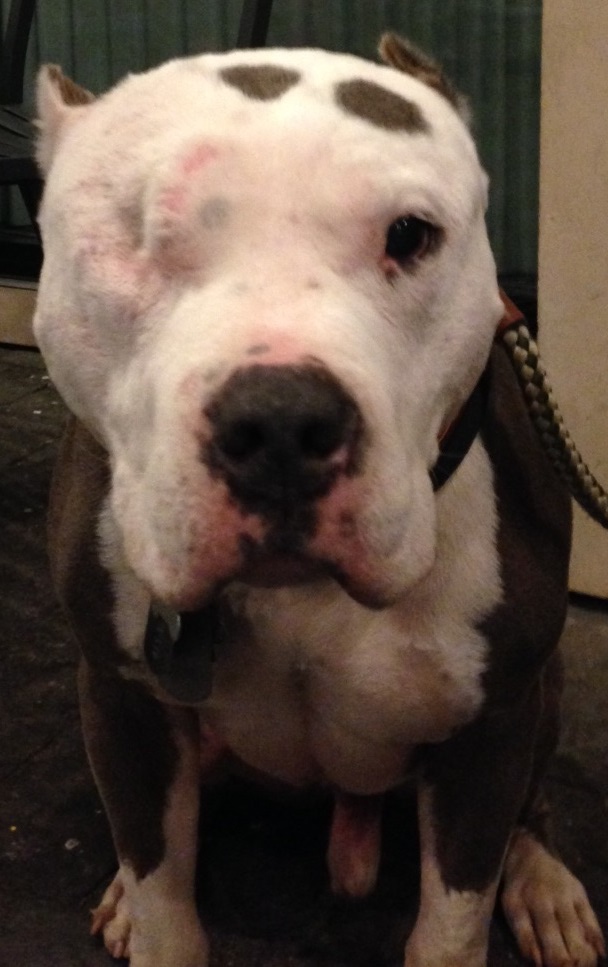
Some background: Bubba is the spokesdog for a local rescue organization, the Petaluma branch of Marley’s Mutts. He experienced some of the worst abuse that anyone can imagine. Actually, it’s worse than I could have imagined before reading his case file. The amazing Sacramento DA who put Bubba’s tormentor in prison, will be Skyping in to my dog law class, so I had to read the entire file.

I generally don’t give my students “trigger warnings,” but before posting these documents, I not only warned them, I put little Adobe sticky notes in the PDF to flag particularly graphic sections. It was that bad. I won’t go into details here, except to point out that Bubba’s missing eye is the result of repeated injuries caused by the monster who abused him.

So why does Bubba trump any current candidate in the Republican field?

He’s not angry or vindictive. He’s suffered real injury, unlike many Tea Partiers or angry primary voters. Rather than seek a scapegoat or, say, hold all white men responsible, he has forgiven all humans. He loves everyone. He eagerly approached every new person who entered the fundraiser where I was visiting with him. His tail was always wagging, his face openly welcoming and friendly. He was gentle with small children. He appropriately introduced himself to and played with a 4-month-old Rottie puppy who stopped by, and he was equally friendly with the several other dogs there.

He’s goal-oriented, too. When he detected a whiff of potential treats emanating, say, from my pocket, he focused on me like a laser, using the mind meld that Jana has perfected over the years. “Feed me a Charlee Bear. Feed me a Charlee Bear.” It worked. He also mind-melded the server, who brought him at least six cookies, and that was just what I saw. Nothing gets past this dog; he carefully checked all newcomers for the scent of treats. He just might be a Labrador wearing  a very convincing disguise.

Bubba doesn’t back down in the face of an army. When he met my class of 20 students a week later, he sized up the challenge, then gave each one a warm greeting — and the sniff test. He very quickly figured out that the little black pouches many students had contained treats, and he went to work. The students never stood a chance. Bubba probably didn’t need dinner that night.

What else does candidate Bubba have to offer? I’m not sure what his health care plan includes beyond “kisses to make it better,” but the price sure beats my current insurance, and it is a treatment with a long track record of success. His education platform emphasizes motivation and rewards. And, though we didn’t discuss specific issues, his domestic and foreign relations approach heavily focuses on interspecies cooperation, collaboration, and peacemaking; he disdains the threats, calls for attacks, and shunning of those who are different that are so much a part of the current campaign.

In all, he’s an admirable candidate. He’s overcome a difficult past, shows intelligence and integrity, and has a demonstrated ability to cross the (species) aisle and negotiate favorable deals. Bubba has my vote!

Please Back Off

Not all dogs are as fortunate as Molly. Molly’s parents wrote to The Thinking Dog, asking for help getting people to understand that Molly needs her personal space. In this post, I am speaking for all dogs who are not as lucky as Molly.

Personal space is a cultural issue. Americans tend to like more of a bubble around them than people in some other countries. I’m not sure whether dogs in different countries or cultures have different needs for personal space, but I am positive that all of the dogs I know need people to respect that bubble. Especially people they don’t know well.

Dog bite stories in the media often say that “it came out of nowhere” or that the dog gave no warning signs. This is rarely true. Spending a few minutes looking at Facebook postings of photos and video of dogs with babies and children is a great way to gather photos of dogs showing dozens of warning signs or pleas for space. Watching those news videos of the “bites that came out of nowhere” also offers a catalog of behaviors that are clear warnings.

It’s not only children who do things that cause annoyance or stress to dogs: A particularly chilling video I’ve used in canine communication classes is one where a news anchor is severely bitten after putting her face right in the face of a stressed, overwhelmed dog — a dog who has spent the previous couple minutes (or more; it’s a short video) asking her to back off in every way a dog can.

The problem isn’t that the dogs are not giving fair warning, asking for help, or both; the problem is that most people aren’t listening or simply don’t understand the signs. Here’s a list of the most common stress signs:

  • Licking lips or nose
  • Turning the head away
  • Whale eye — wide eyes with the whites very clearly visible
  • Yawning
  • Ears back
  • Tail tucked
  • Scratching — self or the ground
  • Sniffing
  • Shaking or shaking off (as if shaking off water)
  • Bowing
  • Stress smile
  • Red eyes
  • Sweaty paws
  • Panting
  • Hypervigilance
  • Freezing

What do we do that is stressful or threatening to our dogs? Most dogs do not like being hugged or patted on the head. Frontal approach with direct eye contact is scary for many dogs. Many dislike rough petting or play hitting or people bending down, putting their faces right up close to the dog’s face and kissing or blowing at them or baby-talking them. In short, if you would be annoyed if someone did it to you, don’t do it to a dog, especially a dog you don’t really know. This doesn’t mean you can’t cuddle your dog; it means you should look for cues that he is enjoying — or uncomfortable with — what you are doing, and respond accordingly.

Some of the signs listed above do double duty: They are also what is commonly called “calming signals.” These are body language cues that dogs use to calm themselves or others. Dogs will direct calming signals to other dogs and to humans. A well-socialized dog responds appropriately — backing off, giving the dog some space, or responding with calming signals of his own. Unfortunately,  the signals are often subtle and, when noticed, misunderstood by many humans.

Cali stress
Stressed Cali

For example, the smile. A smiling dog might be a happy dog; depends on the smile. These photos show a happy Cali and a stressed Cali. She’s “smiling” in both. But in the relaxed, happy photo, Cali’s eyes are soft, her smile is loose and relaxed; in the stress photo, her eyes are hard and tense, and her mouth is tighter. For many additional (better) photos of stress, take a look at these blog posts by Eileenanddogs: “Dog Facial Expressions: Stress” and “Is That ‘Smiling’ Dog Happy?


Happy Cali
Happy Cali

Other common calming signals that could be early signs of discomfort or stress are the licking the lips or nose, yawning, and turning the head away. When you notice these subtle signs, it’s a good idea to remove your dog from a situation that is becoming unbearable for him. Some dogs lick submissively — no, the dog is not “kissing” you because he’s enjoying the close attention — or shake or try to leave or hide behind their owners.

If the dog can’t escape the situation and the “aggressor” doesn’t back off, the dog is likely to escalate. Bared teeth, soft growls, or air snaps might be the first steps when a dog feels that he has no choice but to defend himself. And if the owners have taught the dog never to growl, as so many believe they should … the dog might just bite “without (obvious) warning.”

We’re our dogs protectors. It is our job to learn their stressors, heed their calls for help, and remove them from stressful or overwhelming situations.

Additional Resources

Want to learn more about dogs’ stress signals? Here are some articles and blog posts that offer good info and advice:

Your Dog Hates Hugs, by Melissa Dahl

It’s Only Funny Until Your Dog Runs Out of Spoons, E. Foley, Your Dog’s Friend blog

You’re Too Close! Dogs and Body Pressure, eileenanddogs blog

The Gift of Growl, Pat Miller

Preventing Dog Bites, Patricia McConnell

A Canine Stress Dictionary, and Signs That Your Dog Has Stress, and so much more on the Whole Dog Journal website


Rent a Dog?

NOT available for rental

Last week, I ranted about why I dislike puppy-themed corporate promotions, like the Puppy Bowl. I mentioned a new trend: “rent-a-puppy” apps and services. I don’t put these apps in the same category as Puppy Bowl and Uber Puppy, yet I am ambivalent about them.

I had a long email chat about these apps with a dog-loving but dogless friend. He works full time, lives alone, and does not have a dog because he does not feel that he could give the dog the attention and exercise the dog would need and deserve. An admirable, if lonely, choice.

We’d both read about Bark‘N’Borrow, an app (it’s not the only one … Borrow My Doggy is another) that allows dog-owning and dog-craving members to meet up and “rent” or share dogs.

I was going to write about these apps then, but I hadn’t made up my  mind  yet about what to say. I am still on that fence.

I am less ambivalent about Puppies for Rent, which is exactly what it sounds like: a rental agency for homeless puppies. They live in foster homes and can be booked, according to the website, up to a week in advance for rentals, until they are placed in permanent homes. Sounds too much like Uber Puppies for my liking. No thanks.

Why am I ambivalent about the borrow-a-dog apps? On one hand, if you do leave your dog alone a lot, the option of a regular, trusted person taking her out or hanging out with her could be appealing. Could be nice for the dog, too. And certainly I see the appeal for dog-deprived people like my friend. On another hand, it just felt wrong. Renting out your dog? Like a car or a spare bedroom? Weird.

On yet another hand, if you met the right person, it could solve your dog-sitting problems. On the other hand (I get four; we’re talking dogs, after all) what if something happened?

Maybe it’s not so different from hiring a dog walker or dog sitter. I have a great dog sitter whom I met through an online pet-sitter agency. I’d only hire a dog walker who had experience, insurance, and solid references — but it might be possible to find a person through Bark‘N’Borrow who met those criteria.

Media describing these apps talk about how good people feel when they get to interact with puppies and how nice it is for people who can’t have dogs to get to play with them. Sure, that’s all true. But does it justify the stress and potential harm to the puppies? In the case of the puppy rental, I’m pretty sure the answer is no. In the case of a loving owner who carefully selects one or two “borrowers” who might themselves develop strong bonds with the dog, if it is a dog like Cali who loves all humans …? Still not sure.

I have no good reason for my ambivalence other than the uncomfortable feeling that serving as wingman to find dates for my dog feels like crossing a line. Maybe I’m just not ready for the so-called sharing economy to include my family members. What do you think?

A Journey — or a Destination?

Cookie, please

Jana and Cali have vastly different understandings of our morning walks. Each girl’s interpretation also describes her approach to life.

For Cali, the point of the walk is the destination. She wants to be at the park with every cell in her body. The closer we get, the harder it is for her to contain her excitement. She does her little skip-walk dance, where she bounces ahead, remembers, bounces back, walks nicely for two steps, can no longer contain her excitement, bounces ahead, remembers … I think she burns more calories doing this dance than she does at the park. Mostly because she spends too much time at the park jealously guarding her ball rather than running around chasing it.

Jana, on the other hand, is all about the journey. Even at the park, she’s on her journey. She investigates everything along the way with her full attention. Everything. Clumps of grass. Leaves, wood chips, tendrils of ivy trailing on the sidewalk, fence posts, trees … She looks and sniffs from every angle, breathing deeply and considering the nuances of the scent. Only then is she ready to move on … to the next leaf.

At the park, she sniffs and samples the grass, which is very fresh, green, and wet these days. She then rolls in it. Her favorite thing happened the other day: The mower was just finishing up, which meant that she got to roll in the freshly cut grass, turning herself light green in the process. I think “freshly cut grass” is her favorite scent. If I had shampoo that smelled like that, she’d willingly bathe every day.

Since walking the two of them presents certain logistical challenges, with one full steam ahead and the other moseying along … I tried taking them for individual walks. Jana was having none of it. She wanted to go with us. She’d bring me my boots, stand by the door, push her way out the door if I was leashing Cali, use all of her considerable expressive talent to communicate: Take me too! So maybe her walks are a little bit about the destination too.

Which is great, because Cali also has that bit of balance. Her delight in the journey is evident when we meet other people along the way. Her excitement is channeled at them as she beelines for this new best friend. Tail wagging, huge smile on her face, she eagerly waits for the person to greet her. Most do. To her credit, Cali brushes off the rare crushing rejection with aplomb. We’re on our way to the park, after all!

I ♥ Senior Dogs

Christine_Crissy Field_smallI’m writing this on the 13th birthday of a good friend of Jana’s. Happy birthday, Christine! I was present at the birth of Christine and her siblings, and was lucky enough to work with one of Christine’s sisters for several months. She was very smart and went on to work at a facility for children who have been removed from their homes.

Anyhow, back to Christine. She’s been the best friend and companion of a good friend of mine since the day she was born. Christine’s mom lived with another good friend until she passed away a few years ago.

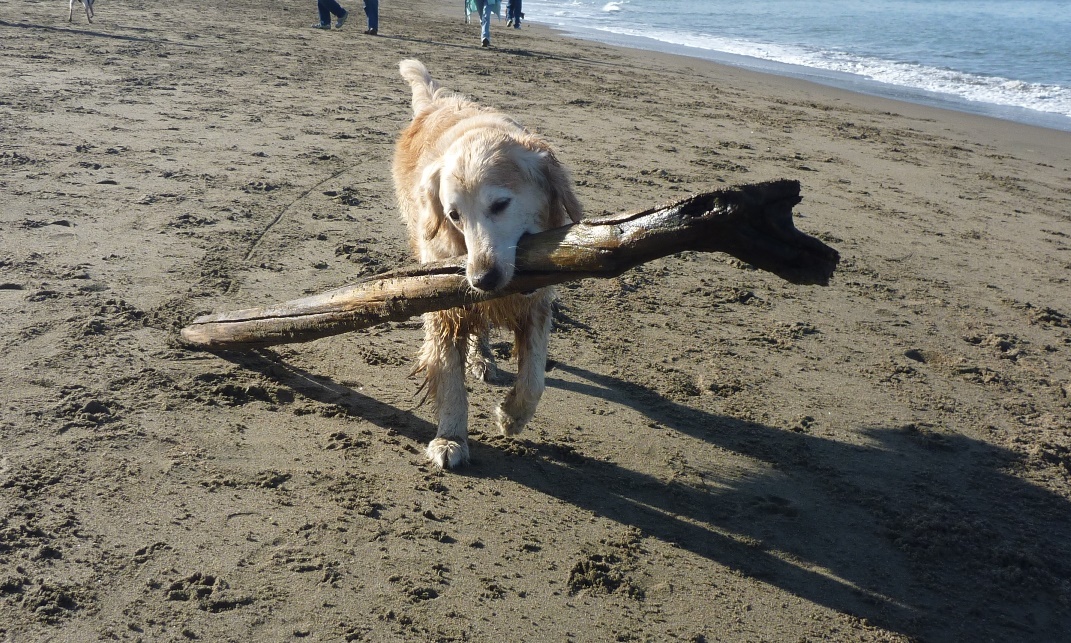
Christine, Jana, and I, along with an ever-changing supporting cast that now includes Cali, have spent many mornings at the beach at Crissy Field in San Francisco. Christina likes to find the biggest stick on the beach and then carry it all the way down the beach. That is a better beach habit than Jana’s — rolling in the sand over and over, to make sure that several pounds of sand are stuck all over her body.

Like Jana, who is only a few months younger, Christine is showing her age. She’s having a harder time walking, so we haven’t had a girls’ beach day in a while.

I’m thinking about Christine today and also about Leti, a good friend of Jana’s and mine who was a regular visitor at the park where we play each morning. I just found out that Leti, who was 15, passed away recently. My enduring image of her, as she enters the park and is released from her leash, is of an obviously happy golden bounding across the grass. She and Jana used to tag team the people at the park, begging for treats. I’ll miss her a lot … she was such a sweet and happy girl. I hope Jana is as happy and playful when she’s 15.

A couple of my local friends volunteer at a senior dog sanctuary, Lily’s Legacy. I’d love to get involved, but I’m afraid to. Their website is full of photos of elderly golden retrievers, and I am afraid I would scoop them all up and take them home. Two dogs more than fill my small apartment with toys and fur!

Happy birthday, Christine … and hugs to all the wonderful senior dogs out there!

Jana’s Fine … For Her Age

I recently had a health scare with Jana. She’s fine, but it was worrisome. Added to a number of recent losses among my friends whose dogs were Jana’s contemporaries and, well, it’s rough.

Jana was in for her semiannual check-up. She gets far better health care than I do, but then again, in human age, she’s nearly 90. I hope I am as healthy, energetic, and playful when I get there!

Anyhow, during a brief ultrasound, the vet saw what looked like a mass on Jana’s spleen. She recommended a more thorough ultrasound and exam. In the days between the checkup and the exam, I had time to Google, ask around, and worry.

I read up on spleen tumors and treatments. None of it sounded good. I thought through the various possible scenarios. I hugged Jana a lot. She hated that.

The exam, I am pleased to say, showed nothing more than some discolored patches on Jana’s spleen. Jana has the heart and lungs of a much younger dog, is at her perfect weight, and has nothing more wrong with her than some (severe) arthritis. Except for the arthritis, she’s in better shape than I am.

But I see signs that she’s more frail. She stumbles sometimes. Has senior moments. Has mornings when she chooses to go back to bed rather than trek to the park. But there are also days that she asks for extra walks and rolls happily in the grass or wants to play tug or catch.

Another sign of her age is anxiety. When she’s anxious, she barks at … well, I can’t figure out what. I think she’s not seeing as well as she used to, and she gets startled more easily. I’ve tried several remedies for her anxiety. Some of them help some of the time. Treatibles are her favorite; she’ll often go into the kitchen, stand in front of the cabinet where I keep them, and bark. Melatonin, a new addition to the lineup, also seems to help. Sometimes a Comfort Zone plug-in helps; sometimes a wrap. If our friend Christina lived closer, she could offer regular Reiki treatments; that would probably help a lot.

Sometimes, though, when she’s agitated, Jana just wants to play. Or even (those who know Jana will know just how rare this is) cuddle! Those are my favorite remedies.