Looking into the Future

Can dogs anticipate? Can they visualize a future event or state?

Certainly, our dogs learn our routines and recognize the signs that, say, we’re getting ready to take them for a walk or go to work. They might try to guess whether they get to come along on an outing. Wylie, our resident super-optimist, seems to anticipate doggy fun any time we get on a highway that has, once, led to a dog park. Then there’s mealtime. Jana gets agitated if we go out anywhere near (defined as “within a few hours”) a mealtime.

That’s all pretty typical stuff reported by many dog owners.

But Daisy, a very intelligent thinking dog who lives in Massachusetts with my friend Nancy, does something exceptional. She’s 13, and it’s possible that regular access to the “little dogs’ room” is more important to her than, say, to little brother Brandon (age 5). But she’s normally on a pretty regular going-out schedule, and is reputed to have enormous staying power. Nevertheless, she has recently started to pay close attention to Mom’s “leaving” cues. If Nancy is indicating that the outing is by car, Daisy will request an unscheduled pee break. Is she anticipating needing to go and not knowing when Mom will be home?

A similar question arises when I consider Jana’s habit of not drinking water when I am not home. I first noticed this when we lived in an apartment, and I was often gone for a few hours at a time. This was a new predicament for Jana, who has been an extremely lucky dog in mostly having a stay-at-home mom, or being able to accompany me to work, or having access to her yard via dog door. But things had changed.

I first noticed that the water bowl would be untouched while I was out. I also noticed that, the minute I came home, she’d say hello and then head straight for her bowl. The odd thing is, the not-drinking behavior persisted, even after we moved into a house with a dog door.

So, can dogs anticipate needing to go out when their human servants are not around to open the door? What else can they anticipate? How far ahead can they look forward? Is anticipation part of what dogs are doing when they warn people of impending seizures?

We’ll probably never know the answers to these questions (though I’d love to hear your thoughts!). But it seems yet another way that dogs constantly surprise and amaze us with their abilities.

A Good Dog’s Good Death

This slideshow requires JavaScript.

Guest Blog by Deni Elliott

It seemed to happen overnight. One September day, 12-and-a-half year old retired guide dog Oriel was romping and eating and playing with toys at our mountain home in Montana. The next day, her skin seemed to hang loosely, her muscle all but gone. She trotted rather than pranced to fetch a ball.

The mass in her chest on the X-ray was clear to even a non-veterinarian’s eyes, as was the prognosis. Oriel was dying. Our job was to keep her happy and comfortable and know when she needed pain relief.

September gave way to October and October to November. It was time to rethink our plans. We were on our way to Berkeley for four months. The apartment wasn’t large enough to swing a cat, much less an extra golden retriever, but, if our 83-year-old landlady was willing, it was about to become home to the five of us: Wylie, the German Shepherd and Jana, the golden, and now Oriel too. The landlady was willing and celebrated Oriel’s stamina.

It seemed to happen overnight. One January day, Oriel ate her meals and special snacks, took two walks each day, and played ball in the park. The next day, she was suddenly ravenous, even by golden retriever standards, but unwilling to go for walks or play, planting all four feet in clear protest. She wanted only to eat and spend her time between meals flat on the floor, close to the kitchen.

A visit to an old vet friend brought the expected bad news. “She’s not a happy camper,” Dr. Anne said, stroking Oriel’s ears. Ory stood in front of Anne, smiling at the attention, but panting, panting, panting. “That’s the only way that this dog will tell you she’s uncomfortable,” Anne said. She drew blood and urine to look for something that we might address, but offered no hope.

A call to Dr. Joe, Ory’s Montana vet, a discussion of blood panel comparisons, the idea of repeating chest X-rays — finally he cut to the quick. “How sick do you want her to get before you let her go?” he asked.

“No sicker,” we decided. Both vets agreed that Oriel would only get worse. The list of how “getting worse” might be for Oriel was enough for us to decide that it was better that she drift off to sleep, to death, without sudden bleeds, seizures, or intense pain. Treatment might prolong her life but would not enhance it. We made an appointment for Dr. Anne to put her to sleep.

“Isn’t this playing god?” Pam asked. Yes, but it is the choice we make every time we bring puppies into the world and into our homes, when we integrate them into our families. We are always playing god. Making the heart-wrenching choice to plan their deaths is no exception.

“One last day at the beach,” Pam said. So, days before Oriel was scheduled to be euthanized, we loaded our three dogs into the car and drove across the Bay Bridge to give Oriel a last time to stand in the sand and smell the salt water. We were a block from the beach when Oriel sat up and sniffed the air. She found her second (or third or fourth) wind. She ran on the beach, swam in the surf, and chased the dog who had stolen her stick. She rolled on her back in the sand and wriggled, with sand on her nose, tail wagging, and a huge smile on her face. We canceled her euthanasia.

“Maybe we can help her nutritionally,” Pam said. We consulted with Heidi, who owns Holistic Hounds, conveniently located a block from our apartment (this is Berkeley) and emerged with food and supplements. Oriel’s new diet (of course, Wylie and Jana enjoyed most of these treats as well — how can you indulge one and deprive the other two?) included:

Breakfast: Natural Balance kibble, Grandma Lucy’s chicken formula, Glucosamine, fish oil, Pepcid, and a handful of frozen green beans;

Midday snack: cottage cheese or scrambled egg;

Dinner: Natural Balance, Grandma Lucy’s, 4Life Transfer Factor, Pepcid, a few more beans

Evening snack: cottage cheese

The added protein would help her feel less hungry. She got plenty of freeze-dried liver treats and occasional treats of Saul’s Deli chopped liver for her anemia. We compensated for her digestive enzyme imbalance with canned green tripe. And beach therapy at least once each week. With this regimen, there was no need for Oriel to die to think that she had gone to heaven.

Days flowed into weeks and weeks into a month, and we were able to forget that she was dying. Tuesday, February 21, Oriel had a typical day. She ate well, eliminated well, walked well, and retrieved her tennis ball a few times. She joined us for an evening cuddle. We rubbed her ears and stroked her back; she responded by petting each of us in return — the only dog in my experience to use her paws to pet her people.

It happened overnight. We began our usual morning routine. I took each dog out in turn. This morning, it was Wylie saying, “Me first.” Then Jana. But, Oriel was not standing in line at the front door. I walked back to the bedroom to find Oriel still lying in her bed. At my call, “Ory, Ory,” she lifted and turned her head toward me and then dropped it back on the floor. “Oh, honey,” I said, collapsing next to her, “What’s going on with you?” She put her head on my leg, but made no attempt to stand. I grabbed some liver treats and tried again. She sniffed and reached for the cookies, but made no effort to rise. I shuddered for both of us and held her while I waited for Pam to be done with her shower.

I left the two of them together. Pam had magic with dogs that I had seen before. I took my shower, hoping that the magic would work again. When I got out of the shower, Pam was on the phone with the emergency vet.

The other dogs sniffed Oriel nose to toes before we carried her to the car. We had seen only that Oriel could not stand or support her head for long. The vet noticed that her belly was filled with fluid and that her gums were paper white. Ory was bleeding internally. Her struggle was over. She was not in pain, not distressed, just very, very tired. Ory’s blood pressure was so low that the techs could not get an IV catheter into her back leg.

Pam and I sat on the floor and held Oriel close as we said good-bye, and I said thank you for all of the years that she had served as my guide. We told her to go play with Mav, Ideal, Hams, and Spirit — and all of the other good dogs we knew who had recently died. And, as the vet administered the drugs, our perfect dog peacefully slipped away.

Pam and I returned home, shocked to realize that less than two hours had passed since we’d recognized that Oriel couldn’t stand up. Jana and Wylie sniffed us thoroughly. We had no doubt that they knew that Oriel was dead.

It was hours before I could begin to feel grateful rather than stunned. I was grateful to Oriel for choosing this week, rather than next when I would be out of town. I was grateful that Oriel didn’t suffer a slow decline or put us in the position of trying to decide when it was time to let her go. I was also grateful that Oriel didn’t die in her sleep. I needed to say good-bye and thank you.

Oriel moved through the world with calm, cheerful anticipation of what might await her. She died as she lived. Her presence was profound; her absence is huge. But her message survives: Whatever the world brings, meet it with joy.
What Are We Saying to Our Dogs?

How much of what we say to them do dogs understand? I find myself thinking about this a lot these days, as I teach both a canine language class and a class that looks at influential dog trainers in history (all of whom had definite ideas about what dogs do, or, mostly, do not understand).
Konrad Most, an early trainer whose teachings influenced the training of military and police dogs well into the mid-1900s, believed that dogs did not, could not comprehend words. Rather than describe the verbal cues given to dogs as “commands,” Most called them “utterances,” so as to avoid any chance of ascribing any comprehension abilities to the dog.

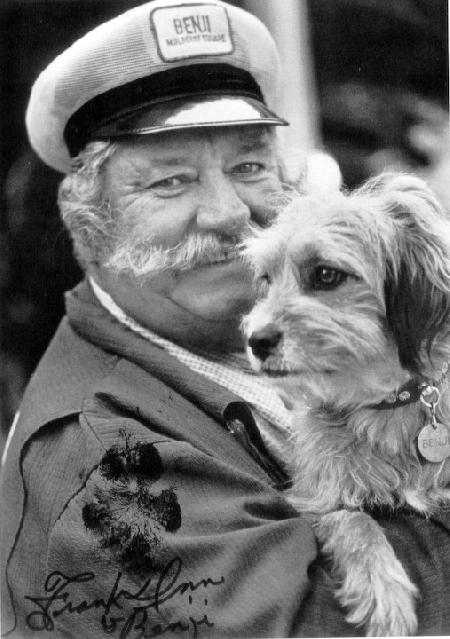
Frank Inn and Benji

At the other extreme was celebrity-animal trainer Frank Inn, who, in the 1970s, taught Benji using a conversational style consisting of full sentences.
Nearly everyone who has dogs talks to them. Some babble and speak in baby talk, others order their dogs around brusquely, but many of us chat to our dogs as if talking to a friend, despite their lack of verbal response. We often swear that they understand every word.

Do they?

Dogs are less focused on words than humans are, but they can certainly learn to associate certain actions with words and phrases and respond to verbal requests. They can learn the names of large numbers of items. However much they are understanding of our overall meaning, they appear to be good listeners, looking at us attentively and at least seeming interested.
Dogs are more visual than we are; they learn hand signals and understand other body language cues even more quickly than they build associations with our words. This can get us into trouble sometimes.
Konrad Most might have been the first trainer to write a description of creating unintended associations. His example was a handler who was teaching a dog a “down stay.” The handler would walk away from the dog (who was remaining, lying down, in place). On reaching the desired distance, the handler would turn to face the dog and immediately release the dog from the down stay. Well, very quickly, the cue to the dog would become — not the release word —the handler’s  turn. That is what Most meant by unintended associations. Nearly all novice trainers learn this lesson through personal experience, unconsciously repeating a movement when giving a particular verbal cue and creating a strong association in the dog’s mind.
Dogs are simply outstanding readers of human body language. They out-perform wolves and even other primates at following the direction of our gaze or interpreting a pointing finger. And dogs’ ability to read us goes beyond the signals we give them — intentionally or not — when we’re asking them to do something.
Very often, they will respond to things we don’t know that we’ve “said.” For example, if our body language tells them that we had a hard day or we’re feeling sad, lots of dogs will offer a cuddle, a lick, a favorite toy. Empathy. If our hand tenses up on the leash or some other cue tells them that we’re nervous or afraid of something — or someone — they might bark or growl at the scary person or thing. I’ve seen service dogs begin to intuit what their new human partners need or want after only a few days on the job.
Konrad Most, like many trainers of his day, didn’t credit dogs with the ability to think or learn concepts. He used training methods that today would be understood to be cruel to dogs. For all his faults, though, he understood dogs’ ability to read our body language. Now, if only we were as good at understanding what our dogs are saying to us!

How Dogs Became Dogs — And Why It Matters

I’m teaching the history of dog training at the Bergin University, and we’ve spent some time  talking about how dogs and people first hooked up. And, more important, why it matters.

There are several theories, starting with Creationist and Native American beliefs that God or a god designated Dog as Man’s companion, helper, and guardian. A Native American legend has dogs offering to take on that role while other creatures disdained it.

Other theories, collected and dissected in a recent book by Mark Derr, are less flattering to dogs. Dogs hung around the garbage heaps outside early human settlements, scavenging trash and scraps. Dogs slunk around the edges of early human camps, hoping the humans would toss them scraps and let them bask in the warmth of the fire. In these scenarios, early humans might have fed, then “adopted” the friendlier or tamer of the wolves and, eventually, convinced enough wolf/dogs to stick around that they eventually became domesticated.

Other theories focus on wolves’ history as successful hunters — more successful, it must be pointed out, than early humans. Somehow, these theorists suggest, stone-age humans made the wolves stay with them and got the wolves to help them hunt. How the humans, without benefit of tools or metal, convinced full-grown wolves to stick around and how the humans imposed their will on these strong, fierce hunters is left to our imaginations.

Derr does a nice job of identifying the factual and logical holes in these theories, looking at scientific and archaeological evidence (or lack of evidence); read his book, How the Dog Became the Dog, if you want lots of detail.

Timing and historical evidence aside, these theories share a huge problem: They completely ignore the point of view of the wolf/dog, considering only human wants and needs. Why would a successful predator hook up with humans and help them become better hunters (and therefore competitors)? The wolves didn’t need the humans’ help (or meager food scraps)! There had to be something in the deal for the dog.

And here’s where we get to the question of why it matters which theory we adopt.

If you see dogs — or any animals — as humans’ possession to do with what we will, it’s too easy to justify exploiting them, neglecting them, or even harming them or their habitat if their needs conflict with humans’ needs or wants.

If you think of dogs as the descendants of “sniveling offal-eaters” (Derr’s description), parasites that humans took pity on and helped, well, you won’t have much respect for dogs or their abilities.

If you adopt the flip side of that view — that dogs are descendants of fierce hunters that humans had to tame and control so as to bend the wolves to their will, well, you might be one of the dwindling-but-still-too-large pool of people who believe that you have to “get dominance over” your dog and show him who’s boss, lest he wrest back control and become the alpha in your little pack. Through much of history, this view has led to cruel treatment of both wild and domestic canines.

On the other hand, if you look at the early relationship from the wolf/dog’s point of view and acknowledge two things — that the wolf/dog got something out of the arrangement and that the dog’s progenitors freely chose to enter into a relationship with humans — you are more likely to look at that early wolf/dog’s modern-day descendants with respect and treat them as partners rather than as parasites or slaves.

Jana and the Bird

We were working in a downstairs home office on a windy day. We both heard a couple of muffled thumps, and assumed that they were objects, outdoors, being blown around.

A minute or so later, Jana wandered upstairs and began barking. There’s (unfortunately) nothing unusual in that. But this was not her “there’s a deer in the yard” bark; nor was it her “I’m scared” bark or her “I need to get that toy that rolled under the sofa.” It wasn’t even her “I can’t make the dog door work” bark.

This bark had a note of alarm or uncertainty. It very clearly told us she needed help with something. Deni went upstairs. Seconds later, her voice (with that same “I need assistance” note) wafted down to me. I went upstairs. A bird had entered the house through an open window and was standing on the living room floor, a bit stunned.

When Deni had gotten upstairs, Jana had been standing only foot or so away from the motionless bird, barking. She had not touched the bird. She had not chased the bird. She had called us. While Deni held onto Jana and Wylie, who’d finally showed up to investigate, I gently took the bird outside. After a few moments, the bird flew off, unharmed.

What was going on? Jana’s a retriever, and she has a very high prey drive. She loves to chase birds outside (and cats and squirrels and minivans). She often shows interest in dead birds she finds on our walks. But she had not chased the bird.

She could easily have grabbed and killed, even eaten, the bird. We were busy downstairs and would not have noticed until it was too late to intervene. All that we know about canine instinct would say that was the natural course of action. But she hadn’t done that.

What she did was bark — call for help — and stand there, watching, while we helped the bird.

I’ve considered her actions from every angle, and I believe that Jana’s behavior points to a thinking process where she consciously chose a response. Nothing in her behavior indicates an instinctive reaction, nor was this an automatic or “programmed” response to a stimulus. It was not an emotional reaction triggered by fear or panic. This was not a response that we’d taught her. She’d never encountered a situation like this before. She encountered a situation that she did not understand and she called for help. There might be other explanations, but I believe that she simply made the “right” choice  — to call for help — despite that choice going against her “instincts.”

Dog-O-Ween No Ordinary Dogs’ Night Out

Wednesday’s Dog-O-Ween outing was no ordinary night out with our three dogs. On arrival at Dominic’s Pizzeria, host of the costume ball, we saw many participants hiding under the tables. Or dancing on top of them.

Dominic’s staff  took it all in stride; they’re used to dogs. The Gulfport restaurant’s patio is always dog-friendly and Dominic’s hosts Yappy Hour every Wednesday. Servers carried trays piled high with bags of doggy treats and nimbly balanced food, drinks, and treats without treading on any tails.

We’d started preparing well ahead of time, seeking the perfect costumes on a weekend shopping trip. Wednesday afternoon, we pulled it all together.

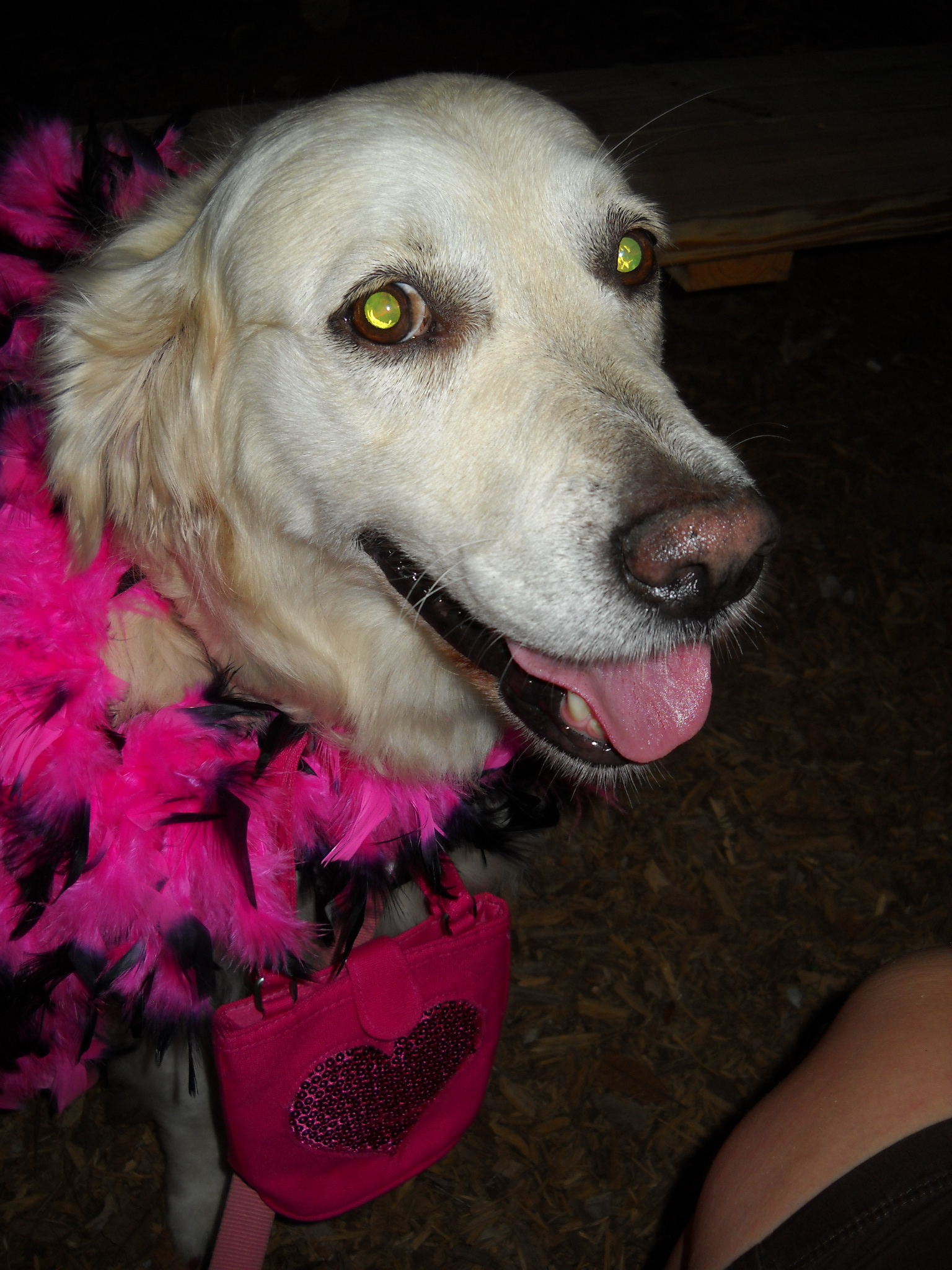
Jana, the white golden retriever, was easy. She watched approvingly as I applied her magenta nail lacquer and wagged happily at the sight of the bright pink feather boa and bling-y purse that completed her Femme Fatale costume.

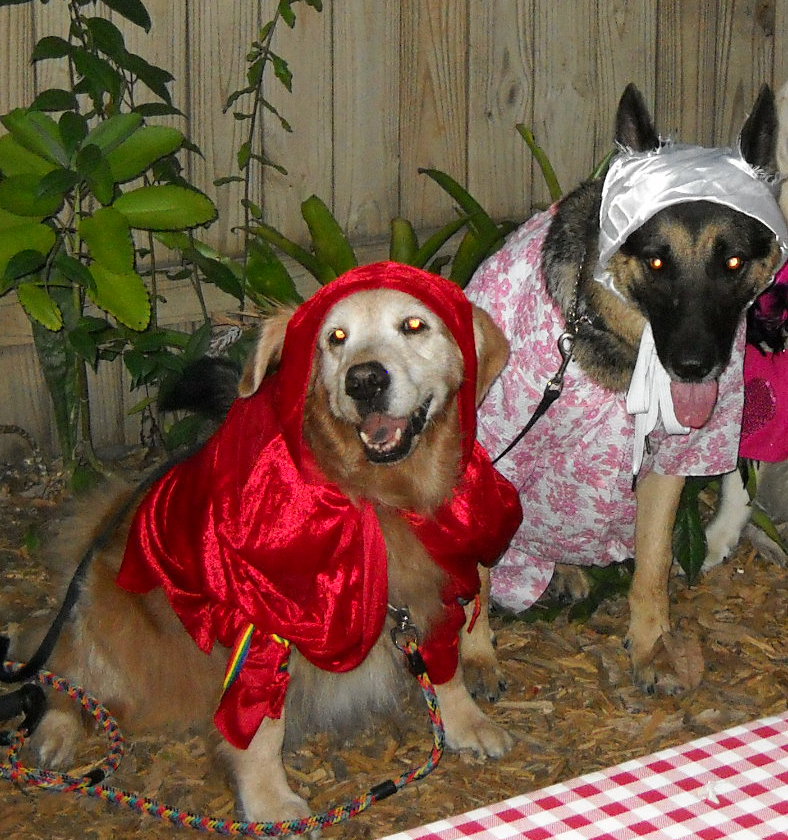
Ever-patient and cooperative, Oriel, our red golden retriever, initially tripped over her Little Red Riding Hood cape. The hood covered her eyes. Adjustments were clearly needed. Holes cut in the hood for her ears held it in place, and rainbow shoelaces reined in the cape’s flapping sides. At last, she could walk without tripping on her costume.

Grandma, what BIG teeth you have!

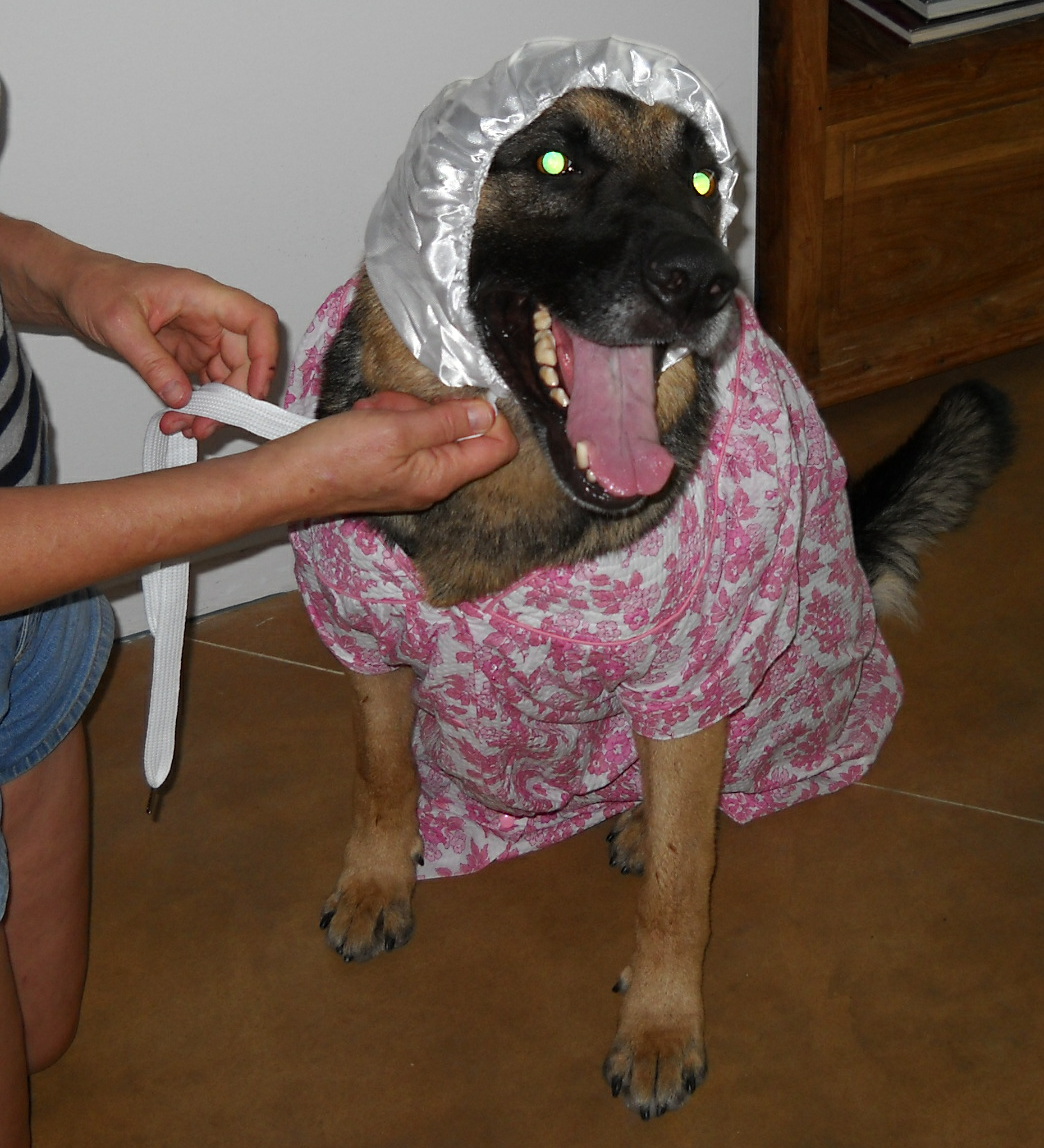
Wylie was the challenge. A tall, athletic German shepherd, Wylie was attending Dog-O-Ween as Ory’s foil: the Big Bad Wolf. His Grandma nightgown needed considerable nipping, snipping, and tucking to be wearable. Ear-holes added to his nightcap enhanced his wolf-like appearance. His expression seemed to signify resigned acceptance of human foibles.

We drove to Gulfport. With a few last-minute costume adjustments, we were ready.

Riding Hood and the Big Bad Wolf

Other guests’ attire ranged from simple T-shirts to elaborate affairs. One large dog was dressed as a doggy bag. A medium-sized dog wore a rooster suit; another was dressed as a cow (his owner wore a matching costume). The Queen of Hearts was in attendance, carried by her gentleman-in-waiting who sported an “Off with their heads” sign. Small dogs came dressed as a  hot dog, a police officer, a princess. A Southern Belle wore a ruffled skirt and gauzy hat.

The Mistress of Ceremonies, Auntie Lynda of Pet Pal Rescue, organized the two dozen or so dogs into a parade. Small dogs first, then medium-sized, and, finally, large dogs. We took our places at the end of the line and watched the contestants stroll past the judges. Many dogs, especially Jana, vamped their way through the spotlight.

Quickly dubbed “the cross-dressing shepherd” by the judges, Wylie was a runaway hit. In fact, our family swept the Large Dogs category: Jana came in third, Little Red Riding Hood took second, and the cross-dresser sashayed off with first prize.

They’ve pooled their prize money to purchase a stash of Halloween treats. Our special order will be waiting at our favorite stand at the Saturday Morning MarketFred’s Finest Pet Treats. Here’s hoping the treats will keep them quiet as we pass out candy Sunday evening!

Thinking Dog Blog now on Creative Loafing

Check out the new home of the Thinking Dog Blog — BellaDOG!

View previous posts at Creative Loafing Tampa Bay’s Daily Loaf:

http://blogs.creativeloafing.com/dailyloaf/author/pamhogle/

Dog Happiness!

I’ve been thinking (and writing) a lot about dogs and their emotions lately. I love the way Dr. Marc Bekoff describes animal emotions and says that dog joy or fox grief might not be like our experience of joy or grief but that doesn’t make it any less real. (Check out his book, The Emotional Lives of Animals).
Jana and Wylie certainly exhibit what can only be joy — pure delirious happiness — every time we let them loose in “their new front yard” — Lassing Park, on Tampa Bay.

Wylie runs in delighted circles in the water, kicking up splashes, flying toward flocks of birds, racing, racing, racing until his tongue is hanging to his knees and all he can do is stand, panting and grinning giddily.
Jana is a bit more restrained, usually seeking out the deepest pool of water and lying down in it. Then, she exuberantly rolls in the sand, the grass, any dead thing she can find. And repeats the cycle as many times as I let her. She, too, runs along the waterfront with a big smile on her face.

This undeniable dog happiness is tempered somewhat by what comes next. Bathtime. Rinsing them, we laugh at their disgusted and annoyed expressions, at Wylie’s snapping at the water spray, at Jana’s dance to avoid having all that nice smelly stuff washed off.

Some may call me anthropomorphic, but no one who has observed these — or any other — dogs closely can deny that they are happy.

Dog Happiness!

I’ve been thinking (and writing) a lot about dogs and their emotions lately. I love the way Dr. Marc Bekoff describes animal emotions and says that dog joy or fox grief might not be like our experience of joy or grief but that doesn’t make it any less real. (Check out his book, The Emotional Lives of Animals).
Jana and Wylie certainly exhibit what can only be joy — pure delirious happiness — every time we let them loose in “their new front yard” — Lassing Park, on Tampa Bay.

Wylie runs in delighted circles in the water, kicking up splashes, flying toward flocks of birds, racing, racing, racing until his tongue is hanging to his knees and all he can do is stand, panting and grinning giddily.
Jana is a bit more restrained, usually seeking out the deepest pool of water and lying down in it. Then, she exuberantly rolls in the sand, the grass, any dead thing she can find. And repeats the cycle as many times as I let her. She, too, runs along the waterfront with a big smile on her face.

This undeniable dog happiness is tempered somewhat by what comes next. Bathtime. Rinsing them, we laugh at their disgusted and annoyed expressions, at Wylie’s snapping at the water spray, at Jana’s dance to avoid having all that nice smelly stuff washed off.

Some may call me anthropomorphic, but no one who has observed these — or any other — dogs closely can deny that they are happy.

Dog Happiness!

I’ve been thinking (and writing) a lot about dogs and their emotions lately. I love the way Dr. Marc Bekoff describes animal emotions and says that dog joy or fox grief might not be like our experience of joy or grief but that doesn’t make it any less real. (Check out his book, The Emotional Lives of Animals).
Jana and Wylie certainly exhibit what can only be joy — pure delirious happiness — every time we let them loose in “their new front yard” — Lassing Park, on Tampa Bay.

Wylie runs in delighted circles in the water, kicking up splashes, flying toward flocks of birds, racing, racing, racing until his tongue is hanging to his knees and all he can do is stand, panting and grinning giddily.
Jana is a bit more restrained, usually seeking out the deepest pool of water and lying down in it. Then, she exuberantly rolls in the sand, the grass, any dead thing she can find. And repeats the cycle as many times as I let her. She, too, runs along the waterfront with a big smile on her face.

This undeniable dog happiness is tempered somewhat by what comes next. Bathtime. Rinsing them, we laugh at their disgusted and annoyed expressions, at Wylie’s snapping at the water spray, at Jana’s dance to avoid having all that nice smelly stuff washed off.

Some may call me anthropomorphic, but no one who has observed these — or any other — dogs closely can deny that they are happy.