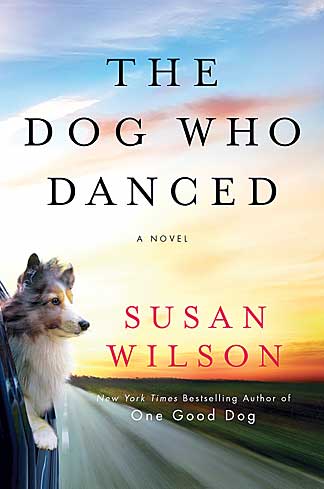
I am usually skeptical of books where the author speaks in the dog’s voice, but from its title, The Dog Who Danced, by Susan Wilson already had points in its favor. A book called The Dog That Danced might have languished, unread, on the shelf. And Wilson seems to get it. The dog, Mack / Buddy, is a Sheltie with a strong personality and viewpoint all his own. He’s believable. The human characters are real, too.
During a cross-country drive, Mack gets separated from Justine, his person. The two have a very strong bond and are talented Canine Freestyle dancers. Their relationship is well-developed, explained well, and rings true. Mack is found by a couple, Alice and Ed, who have never quite gotten over the loss of their teenage daughter. Their initial hesitancy to get attached, and their growing, separate relationships with the dog, whom they call Buddy, also ring true. These are real people. They have all made poor decisions, lived with their mistakes and their regrets, and are trying in their oh-so-human way to move on and do better.
Mack / Buddy helps Ed and Alice work through their grief and anger with one another and move into a new beginning. He helps Justine cope with her dysfunctional family — her estranged son, her cold and selfish stepmother, her dying father. But he remains a real dog, though perhaps a better-behaved dog than most. His doggy thoughts and wants are plausible; he doesn’t have the cloying or idealized character of so many human-voiced dogs.
While there are certainly elements of the story and details that seem contrived, and it is a lightweight read, The Dog Who Danced is enjoyable and fun. I don’t want to give too much away, but I would unhesitatingly recommend this book to dog lovers and “non-dog” people alike.
Journalist John Woestendiek’s Dog, Inc. traces the short history of dog cloning. Snuppy, the first “success, ” is not even six years old, after all. Woestendiek chronicles the dreams, heartbreaks, successes and many, many failures along the road to Snuppy’s birth and those of the clones who have followed. He describes the eccentric personalities and recounts the surprise of the first cloned cat, who looked (and behaved) nothing like the donor cat.
But the bigger story, what it takes to clone dogs, is what really makes this an important book: The hundreds of egg-donor dogs and surrogate mother dogs needed for each “success.” The invasive processes they endure — and their miserable lives in Korea’s dog farms and laboratories. The thousands of deformed and miscarried embryos and dead puppies. The 319 donors, 214 surrogates and astonishing 3656 implanted embryos that produced the first 16 cloned dogs and cats. The sad reality of the “extra” clones who, like Snuppy himself, have spent their entire lives in laboratory cages. Woestendiek draws a bleak picture of life for dogs in Korea, mentioning the hundreds of restaurants that offer dog meat on the menu and adding that the dog farms that exist to feed (literally) the demand are also a source of cheap egg donor and surrogate mother dogs.
While Dog, Inc. gets off track sometimes, the writing is engaging and captures the full range of human foibles. It’s narrative journalism at its best. The story, though, is horrifying. How can anyone who loves dogs — or even anyone who loves his or her own dog beyond all reason — stomach the process of cloning dogs?
Woestendiek effectively debunks the usual rationale — that they’re going to get their beloved dog back. Cloning is reproduction, not resurrection. It creates an identical twin — same genes, different personality and behavior. Scientist Mark Westhusin, comments that “People get attached to their animals, and they want to sometimes see more than is there …”
This attachment is why people have been willing to fork over $150,000 for a clone of their beloved pet. Sometimes they get more (or less) than they bargained for. The owner of Booger, a pit bull who was cloned, ended up with five clones who fought with each other and her other dogs. “All I was trying to do was have my Booger back … I have to say that cloning ruined my life,” she said to Woestendiek in one teary phone call.
While preying on the emotions of their wealthy clients, the scientists involved also reveal their true motivations: the drive to do something no one else has done, national pride, the potential for a lucrative commercial venture. These scientists are not cloning dogs out of love for dogkind. One produced 19 fluorescent green beagle pups. Why? Because his rival had produced glowing red beagle pups. Creating monster dogs for fun does not justify the pain and suffering these scientists cause.
Dogs, Inc. describes the current state of dog cloning and hints at its future. Will Korea’s commercial cloning venture take off of wither away into deserved failure? Woestendiek doesn’t prophesize, but this reader hopes that people who truly love dogs will see cloning for the travesty that it is and instead devote their time, love, and dollars to the millions of deserving dogs we already have in this country.
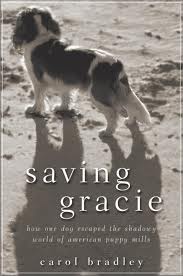
The tiny Cavalier King Charles Spaniel puppy with the checkmark “swoosh” on her leg started life like any other puppy — blind, deaf, seeking the warmth and nourishment her mother offered. Like too many other puppies, though, she was born in a puppy mill and was chosen for the worst possible fate — rather than being sold to a puppy broker or a family, she was chosen to be a breeder.
Gracie, as she eventually was named, spent about five years inside of a metal-grate cage, never feeling grass or even a regular floor. She was filthy, constantly hungry, and in pain from an eye problem that would plague her throughout her life.
Author Carol Bradley, an award-winning journalist, weaves Gracie’s story into her thorough and informative tale of American puppy mills. Packed with information, Saving Gracie chronicles the 2006 raid on a large Pennsylvania puppy mill where Gracie was one of 337 dogs removed to new lives. Bradley describes other puppy mill raids, tells the stories of heroic individuals who made these raids possible, and describes the scope of the problem and some of the ways dog lovers in Pennsylvania and nationwide are fighting the large-scale breeders who commit almost unimaginable cruelty in their greedy exploitation of dogs and pet-loving Americans.
Saving Gracie could be a difficult read; Bradley does not sugarcoat anything and the conditions that puppy mill dogs endure are as heart wrenching as they are stomach-turning. Yet, somehow, the book seems hopeful. Gracie finds a home with a loving and incredibly patient single mom, Linda. Once Gracie becomes indisputably Linda’s dog, the family adds two more retired breeding dogs. As awareness of puppy mills grows, the HSUS, ASPCA, and lawmakers in several states are beginning to take action. So much more is needed, but Bradley ends the book with a hopeful epilogue that lists some early successes.
Through her telling of Gracie’s story, and glimpses into the lives of other puppy mill rescues, Bradley explains the problems of puppy mill dogs, which begin with health problems but include lack of socialization, mistrust of humans, difficulty housebreaking, and a slew of behavioral problems that stem from the neglect and abuse the dogs suffered. While young puppies that are removed from the puppy mill escape the worst conditions early in their lives, they, too, suffer from health problems due to the filthy environment and congenital defects due to irresponsible breeding, and they are often poorly socialized.
Bradley does not paint all large-scale breeders as evil, carefully distinguishing between responsible breeders and puppy mills, and explaining the differences. She exposes other horrors, such as puppy auctions, that many readers might not know about. Without being pedantic or preachy, Bradley tells readers how to find puppies from responsible sources and what to look for in deciding where to purchase a dog. One by one, dog lovers can make a difference by refusing to buy puppy mill dogs and by supporting efforts to eradicate puppy mills. Saving Gracie is a heartwarming story of one dog’s rescue and a call to action for all readers.
It is very common for puppies — up to about six months old — to get hiccups. They are growing quickly, which can be a cause.
It is less common for adult dogs to get hiccups but it definitely happens. Dogs who eat too fast or gulp water can get hiccups, but hiccups can also be a sign of stress or occur when the dog eats something that “doesn’t agree with” him.
So, what do you do?
Saying “BOO!” does not work. I’ve tried it. I don’t think that getting the dog to breathe into a paper bag works either, though I have not tried that.
Giving the dog a drink or a small treat might work. Try some water with a teaspoonful of apple cider vinegar mixed in; it is supposed to work for our hiccups too. Or try waiting a few minutes. The hiccups don’t usually last for long.
If your dog has hiccups that do last for longer than a half-hour or so, or your dog gets hiccups frequently, talk to your vet about it. Sometimes — rarely — hiccups can be a sign of something more serious.
Gassiness is usually a sign that the dog is eating something that he shouldn’t. If your dog is especially aromatic after his regular meals, consider changing his food. There might be an ingredient that the dog has an allergy or sensitivity to. Common problem foods for dogs are corn and wheat, but dogs can be sensitive to (or allergic to) any food, just as humans can.
To deal with the unpleasant symptoms, you can give the dog Gas-X or the generic equivalent (most dogs are not brand-conscious). It works!
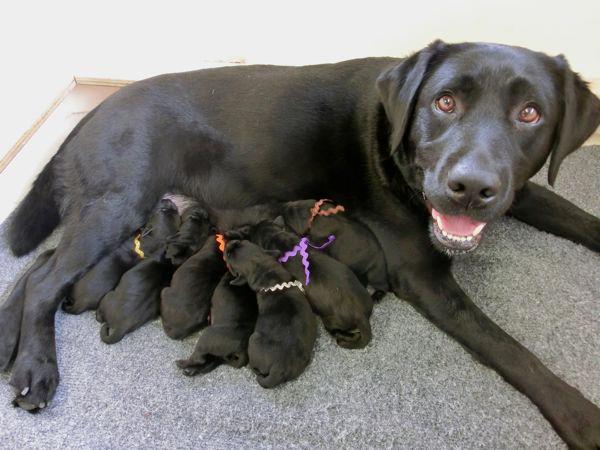
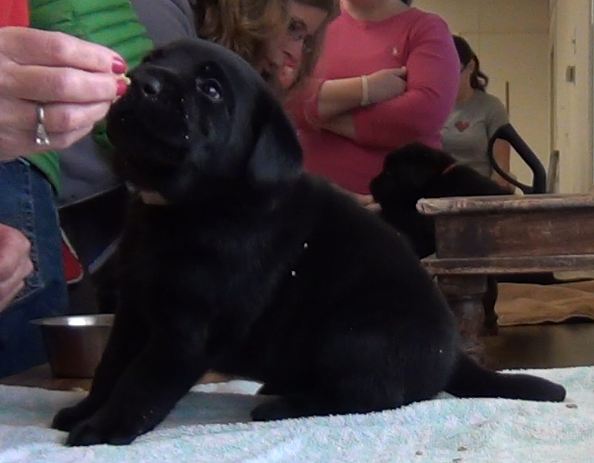
Bergin University has a litter of adorable black Lab puppies. (I know, puppies are all adorable, but I’ve always been a sucker for black Lab puppies.) The puppies started school last week. The puppies also turned four weeks old last week. That’s right. Four weeks. They’d had their eyes open for a full week before training started, so, honestly, I don’t know why the student trainers waited so long.
Sadly, there are still people who think that you can’t start formal training until a dog is a year old. Some more liberal people say that puppies can start training at six months. Then there are those smart puppy owners who get their pups into puppy kindergarten as soon as they can — usually once the pups are vaccinated. But even that is late. Puppies start learning the day they are born, if not before.
So why do people traditionally wait so long to begin teaching their puppies? In the history of dog training class that I am teaching this semester, the students have finally emerged from the cruel, punishment-focused training years of the early to mid-1900s. By the ’50s, people were starting to understand that so much emphasis on punishment actually got in the way of learning. A few trainers — Blanche Saunders, Winifred Strickland, and others — began incorporating praise and even rewards into their training! But the prevailing methods, up until the 1970s, were pretty harsh. Only older, stronger dogs could stand up to the punishment and the trainer’s lack of communication — and actually “learn” anything. Lots of dogs were deemed untrainable because they shut down or defended themselves by snarling or biting when treated harshly.
Learning "Sit" ...
Fortunately for puppies and people who love them, trainers like Milo Pearsall and Ian Dunbar began teaching that, like young children, puppies are eager and quick learners. Furthermore, the younger they start learning how to learn, the better they get at it. In a sense, your puppy will be “smarter” if you train her early. These trainers introduced a now-popular and ubiquitous concept: puppy classes.
... and "Shake"
Human parents of a new puppy can reduce the number of bad habits and undesirable behaviors the puppy learns by enrolling the youngster in puppy kindergarten. Here puppies learn what to do — and what not to do — and develop good manners early on, all without harsh punishment. Good puppy classes emphasize socialization — ensuring that puppies are exposed to lots of different kinds of dogs, people, sounds, sights, smells, and experiences — all in a controlled, positive way. This helps puppies learn that new things are not always scary, that their human families will keep them safe, and that the world is an interesting and fun place to explore.
So, back to my students. These special Lab puppies are future service dogs. Thanks to Bonnie Bergin’s enlightened early training, fewer puppies need to be “released” from the program, and more will become grown-up dogs capable of doing the work needed by their owners, who have disabilities. What these puppies are learning now will pay off: The tiny bits of mushy puppy food offered as a reward for sitting or coming when called are helping the puppies build two-way communication with humans. The puppies are learning to think and problem solve, which will enable them to become full partners to the people who will rely on their assistance. Training sessions are short — only a few minutes at a time for the little pups — and fun.
The good news is that, nowadays, training that is fun is not just for puppies. Family dogs of any age can benefit from modern training approaches that emphasize positive reinforcement, rewards, and keeping training fun. Breeders can start working with puppies at four weeks; those “adopting” a new puppy at the ripe old age of eight weeks — or an older dog — can start as soon as the dog comes home. Your dog can start today. What are you waiting for?
Special thanks to Dearing English for the puppy training photos captured from her video of the first day of training. Puppies were four weeks and one day old.
For a relatively compact book (under 200 pages), Do Over Dogs: Giving Your Dog a Second Chance for a First Class Life packs in a wealth of information. Renowned positive trainer and author Pat Miller targets a broad audience of dog parents — and manages to hit the target dead on.
A Do Over Dog is any dog who has had “issues.” This can be a dog adopted from a shelter, whether the dog was surrendered due to behavior issues or turned in by a family facing financial hardship or by an owner who was relocating and “unable” to take the dog along (Miller points out that many of these owners choose not to take the dog because of a behavior problem). A Do Over Dog can also be a puppy mill rescue or a puppy bred in a puppy mill or elsewhere and simply not socialized adequately. The do-over can even be the dog you have lovingly raised from puppyhood but who has developed a problem behavior.
The dog’s issue might be a major problem, such as dog aggression, that demands years of work and constant management, or it might be something that was a deal-breaker to the dog’s former humans but that doesn’t bother you very much.
In short, since there are no perfect dogs (or owners) out there, whatever your dog’s background and behavior issue — and no matter how much or how little dog experience you have — you are sure to find valuable hints and advice in this book.
Miller does not promise quick or easy solutions to problems. Her emphasis on managing problems while working on resolving them, as well as her sober admission that some problems require lifelong management are strong indicators of her knowledge, experience — and commitment to the dogs. After all, if all she wanted to do was convince readers to adopt dogs, she’d make it all sound easy.
Instead, Miller emphasizes the need for consistency and points out many situations where the only way to address a problem is for the humans to change their behavior. She recommends enlisting a positive trainer for assistance with difficult issues and for some problems, suggests consulting with a behaviorist.
Miller provides clear explanations and training instructions for addressing several common problem behaviors, such as digging and property destruction, offers advice on reducing stress (the dog’s!) and anxiety, and offers her thoughts on medicating dogs to modify their behavior. She effectively explains why positive training methods, besides being the humane choice, are more effective in the long run in teaching dogs the behaviors we want and discouraging the ones we do not want. She presents the science behind different approaches to dog training in easy-to-understand language with examples all readers will relate to. Despite being jam-packed with information and advice, the book is not overwhelming, nor does it drown readers in jargon.
Do Over Dogs succeeds at what many dog books attempt — presenting advice and information that is helpful and relevant to humans while respecting and explaining the dogs’ viewpoint.
Published by Dogwise Publishing, Wenatchee, Wash., 2010
The short answer is that dogs can be vegetarian, but they do not want to be.
Unlike cats, who are what is called obligate carnivores, while dogs primarily eat meat, they are opportunistic omnivores. They can survive without meat, but they cannot thrive without meat. Dogs’ digestive systems process meat protein most efficiently. They can digest some plant matter, but not very efficiently, and they do not use plant protein as well as they do meat.
A balanced dog diet will include some grains, vegetables, and fruits but will include a large proportion of animal-based protein. It is best to avoid dog foods that contain a lot of fillers and foods that many dogs don’t digest well — corn and wheat are problematic for many dogs. Symptoms of poor digestion include gas, bloating, and loose stool.
I do understand the problem of vegetarians who do not want to have meat in the house. I am a vegetarian surrounded by omnivores myself. If you are adamant about keeping a vegetarian home, perhaps a rabbit or a goat would be a better pet? Or a miniature horse?
At first glance, a book about walking the dog might not sound very exciting. But, as a person who has written about dogs extensively and who has blogged about dog walking, I was intrigued. I picked up a copy, started reading, and was entranced.
Dog Walks Man: A Six-Legged Odyssey, by John Zeaman, is delightful! A collection of essays that is part memoir, part philosophy, and part social commentary, it has something to appeal to everyone. Zeaman, an art critic, has a warm writing style and a wry humor that makes a topic as ordinary as dog-walking almost poetic. I found myself nodding in agreement frequently and laughing out loud more than once.
Though he initially regarded the daily walks with his young standard poodle, Pete, as a chore, Zeaman describes the evolution of his attitude toward their nightly outings. I am sure that many dog owners can identify with his descriptions, and, I hope, with his ultimate realization that dog-walking provides access to pleasures that the dog-deprived miss. While there are certainly times that “having to” walk the dog feels burdensome, I find Jana’s and my morning walk-and-greet (I live in a neighborhood with many regular morning walkers, some accompanied by dogs, others there to admire my dog — that’s her take on it, anyhow) a genuine pleasure.
The fact that I agree with Zeaman’s view that dog-walkers should be in the moment, focused on the dog and the walk — not talking on their cell phones, shepherding children, and doing their errands at the same time — naturally added to my enjoyment of the book. But Zeaman’s philosophizing extends beyond a description of the ways that a daily walk enhances his relationship with his dog — he touches on people’s connections with nature, community relations, solitude and friendship, family dynamics, and the joys and responsibilities of dog ownership.
Anyone who has ever walked a dog will find something in this book that evokes a smile and a warm memory. And for readers who don’t have dogs? You’ll find out what you’re missing!
Getting the paper each morning is the classic dog’s job. My friend Sally continued her newspaper subscription long after she’d lost interest in reading it — just because it gave Mav, her Lab, such pleasure to get the paper. Jana started fetching the Jerusalem Post each morning when she was just a few months old. She’s graduated to the New York Times, which is considerably weightier, especially on Sundays. Every so often, Wylie tries to nose in on her morning chore, but she’s not giving up easily.
Our dogs have also learned to pick up their bowls after they eat. Some people have expressed surprise at this, understanding why a dog might bring an empty bowl in hopes that we’ll fill it but not why a full dog would bring an empty bowl. We explain that we try to encourage our dogs to behave responsibly. The dogs give us their empty bowls rather than actually washing them, but it’s a start. Jana can be persuaded to put her toys in the toy basket as well.
Dogs like to have jobs. This is a frequent topic of discussion with my dog-training students. These students are training future service dogs, but they are also preparing to train pet dogs — and their owners. We’ve talked about the many roles and careers available to dogs these days, and the consensus among my students is that, even if the job is a dangerous one (think military and police dogs), most dogs seem happier when they have work to do.
Most pet dogs are bored most of the time. Giving underemployed dogs some small tasks to do throughout the day can relieve that boredom and challenge them a bit.
Most people’s lives are filled with tasks that dogs can learn to handle, if only given the chance. When we miss the recycle box when tossing balled-up paper from our desks, a dog (or two) is always ready to bring the trash back or put it in the box for us. Fetching slippers or shoes is a natural. Dogs who learn to fetch the leash or their owners’ walking shoes when it is time for an outing might take the initiative and bring the items when they figure that they’ve waited long enough. Our beloved Oriel decided on her own to bring the water dish to one of us for a refill when it was empty, and she often brought discarded papers from the recycle box in hopes of exchanging the trash for a cookie.
If you can’t think of tasks, challenge your dog’s mind with games or a treat toy; dogs don’t seem to differentiate between thinking tasks that are just for fun and those that are dog jobs. Interactive dog games abound these days — these ask dogs to use their noses, paws, and sometimes teeth to open compartments, slide little doors, and nudge puzzle pieces aside to reveal hidden treats. Playing “tug” can lay the foundation for teaching dogs to open doors, cabinets, and drawers. Hiding a favorite toy or treat (or person) somewhere in the house encourages the dog to think, problem solve, and use her nose to find it. Some dogs’ desire to talk can be channeled into for alerting the humans to mail and package deliveries with just one bark. Other dogs, who like to carry things, can be taught to place plastic bottles in the recycle bin or clothes in the laundry basket.
The possibilities are endless. What are you waiting for? Give your dog a job!