Bidding Farewell to Wylie

Cool

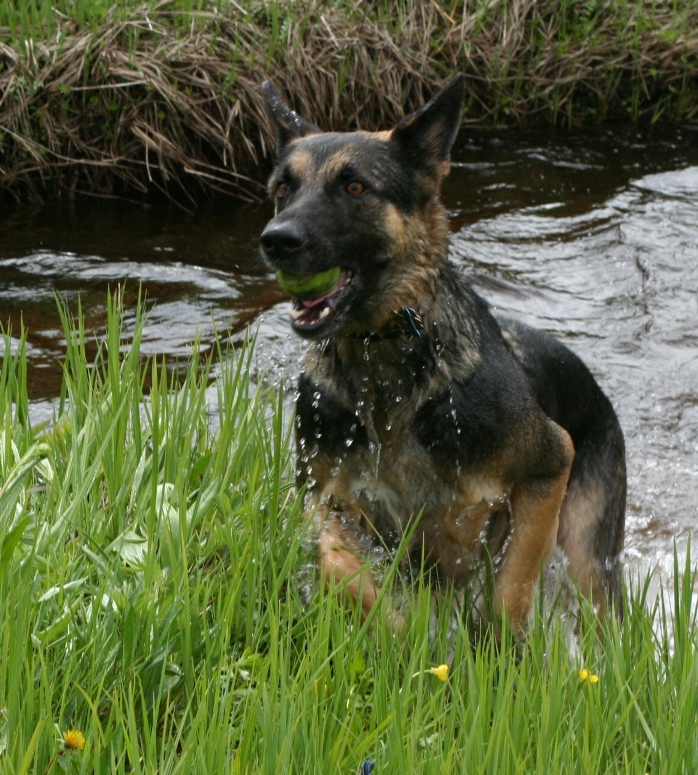
Wylie is heading off to learn his new career this week. Deni’s difficult decision to let him go and to seek a professionally trained guide dog, whom we hope will be a better fit for both her personality and her needs, is described in Loving and Letting Go, an earlier post on the Thinking Dog Blog. But Wylie was part of my pack, family, life too — and saying good-bye brings up some tough issues.

I think of dogs as family members. Taking a dog into your life, I believe, is a lifetime commitment — you take it upon yourself to care for the dog for the rest of his life (or the rest of yours). Yet I believe that letting Wylie move on to a new life is the best choice for him as well as for the rest of his pack/family. I’ve been struggling to reconcile these conflicting views.

Wylie wasn’t a pet; he was a guide dog. But he wasn’t a good fit for the job Deni had assigned to him. We’re both confident that his new job, working with a veteran, will be a better match for Wylie’s personality and needs. He’ll revel in the intense companionship and enjoy his new responsibilities. He might be matched with a young, athletic guy who can give him the exercise he craves, too.

None of that makes it easy to say good-bye. What makes it hard, I think, is that for all that I try to study human-dog communication and improve my ability to communicate with dogs, I am still human — with that human tendency to be overly reliant on words. For all his intelligence and perceptiveness, Wylie is a dog who doesn’t use language the way we do. That gap is sometimes tough to bridge.

So we can’t prepare Wylie for what is happening, can’t help him understand that we love him and want him to be happy, can’t call him on the phone to find out how his training is going. He’ll be confused and sad when Deni leaves him with Jennifer, his new trainer. There’s no way to explain to him that, after some training, he’ll get to go live with a guy who will be his best friend and constant companion. While he senses that something is up, Deni says, he doesn’t understand what.

I also know that dogs are more “now” focused than most people are, which means that Wylie will quickly adapt to his new routines. He makes new friends easily. I am sure that he’ll be the star of the training class before long. Even knowing all of that, and feeling sure that it’s the best choice for him, it still feels strange and sad to say good-bye.


Loving and Letting Go

A Guest Blog by Deni Elliott

wylie ballSometimes things just don’t work out. He is intensely athletic; I’m a stroll-on-the-beach kind of gal. He always wants to be in charge; I think that responsibility should be shared. He likes hanging out with the guys, and he unabashedly flirts with the girls; I crave a less-social life and want him to have eyes only for me. But when we are alone, I need some private time; he dogs my every move.

After four years of trying to make our partnership work and then carefully planning for our separation, I’m ready to announce this to the world: I love Wylie more than I can say. He’s smarter than I am, good-hearted, and generally well-intentioned. But Wylie and I are breaking up.

My guide dog’s career change feels a lot like ending a human relationship. As with intimacy between humans, the partnership of human and guide dog is a dance of inter-dependency and cooperation. Compatibility is required.

Wylie counts on me to give him everything that he needs to be a well-adjusted German shepherd, and he is not shy about communicating his demands to me.

I put my life in his paws every time that I slide the harness over his shoulders and say, “Forward.” I trust Wylie to choose the path as he guides me under low-hanging branches, steers me around obstacles, and takes us across streets, avoiding the traffic that I can hear but cannot see.

We communicate moods and expectations up and down the harness as we let each other know what is next in our progression from Point A to Point B. If we’re out of sync with one another, we both get frustrated. And while our ability to read one another has astounded others observing us, the frustration has become more than either of us can handle.
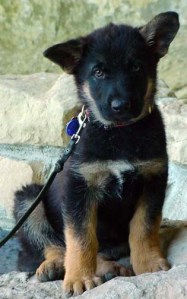
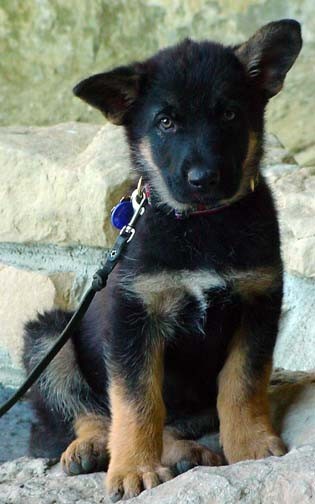
8 wks Wylie (2)Wylie is the second guide dog that I have raised from young puppyhood, enlisting the expertise of professionals to accomplish training that I couldn’t do on my own. I’ve owned and trained dogs since I was a child. My visual loss was progressive, but slow. I thought that I was better able than a guide dog school to prepare a dog to meet my special needs.

As a puppy, Wylie showed strong potential to become a guide. My successful partnership with my first guide dog, a golden retriever named Oriel, made me unrealistically confident. Oriel was, in the words of many who knew her, “the perfect dog.” When she retired, I assumed that I could make the guide relationship with young Wylie work just as well. I struggled through the first year and thought that he would mature and grow into his job. I was wrong. Wylie’s basic personality did not change; nor did mine. When I finally realized that I couldn’t make things better, I knew that I owed Wylie the chance for a better life.

On January 23, Wylie will start training to be a service dog for a veteran with Post-Traumatic Stress Disorder (PTSD). For the first time in more than 12 years, I will depend solely on my white cane to pick my way through my travels. Wylie and I will both be in transition and will grieve the loss of one another.

But not for long.
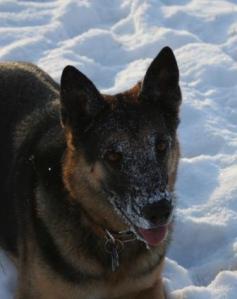
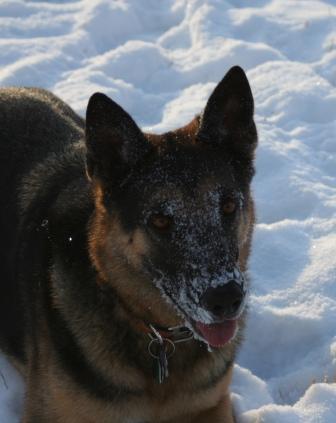
Wylie (2)Wylie will have new challenges from the start. He will live first with Jennifer Rogers, director of PAALS, a service-dog training school that is affiliated with Fort Jackson, the U.S. Army base in Columbia, South Carolina. Wylie and other dogs-in-training will spend one evening each week on the base with active-duty service members and veterans who are coping with combat-related anxiety. Under Jennifer’s supervision, the dogs will learn to help people with PTSD; the soldiers and veterans will teach the dogs how to assist others like themselves. Dogs and humans will learn to support one another.

When the time and match is right, Wylie will become an “intensive companion” dog for a veteran who is not yet ready for the challenge of working with a service dog out in the community. Dog and veteran will be encircled by a team of mental health and service dog professionals who will support their journey together.

I will be supported in a new journey as well. On March 4, I will join a training class at Guiding Eyes for the Blind in Yorktown Heights, New York. After intensive training there, I expect to return home with a 2-year-old mellow yellow Labrador retriever at my side. I’ll have a guide dog bred and trained by experts who create and maintain ethical working dog relationships. After many hours of application to, evaluation by, and conversation with Guiding Eyes personnel, I trust that they know better than I how to find me the best guide dog match.

Wylie’s new life will be very different from guiding me around obstacles that I cannot see. Crucially, it will be a life that is more in tune with his nature. The behaviors that he will be trained to do on cue include leaning against his partner, resting his head on his partner’s knee, lying on his partner’s feet, and providing a friendly-but-safe barrier between his partner and others. With me, Wylie got to connect like this only after his harness came off and he was done guiding for the day. Providing a partner such physical support 24/7 is Wylie’s dream job.

Wylie has always wanted more physical connection than I could handle. When I was done working for the day, I wanted some time free of my canine umbilical cord; Wylie wanted the intense physical contact that he lacked when he was walking two steps ahead of me, in harness.

The behaviors that have been problematic for me will be just what Wylie’s new partner needs. Wylie will bond with a veteran who needs a canine companion to guide him out of a darker place than I have ever experienced. It is likely that Wylie’s new partner — a veteran with deployments in Iraq, Afghanistan or both — will be no more than 30 years old. Wylie will finally have a young partner who is able to provide the daily intensive exercise that he craves.

Wylie will no longer endure long hours lying under a desk while I work in the office or teach my classes. He will no longer sigh and resign himself to STILL being on duty when I sternly command him to turn left to guide me to the Dean’s office when he wants to turn right to walk home and be done for the day. And, most importantly, Wylie will no longer have to pant and tremble as he struggles to guide me through airports and onto airplanes, a task that he finds increasingly stressful.
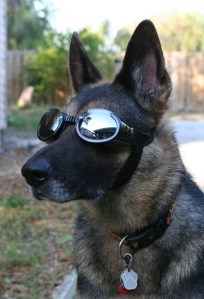
CoolSome people will criticize me for not letting Wylie retire and spend the rest of his days lounging at home. But, all dogs need stimulation; a young, intelligent dog like Wylie, who is accustomed to life out in the world, needs it more than most. Long days spent alone and doing nothing would be unbearable for him. Others will say that it is cruel for me to give him away, suggesting that I don’t love my dog as they love theirs. But I know that Wylie would not be happy watching me leave home with another dog doing “his” job, even if it is a job that he sometimes hates. I love Wylie enough to recognize that he’ll be happier moving on.

I will get over losing the goofy frat-boy who has been part of my life for 6 years. I will have learned yet one more lesson in loving and letting go. I’ll get past the guilty feeling that I failed this dog. From this perspective, it seems to me that I’ve been helping Wylie get ready to be the helper dog that he was really meant to be. I appreciate his true nature enough to let him go forward and be that dog.
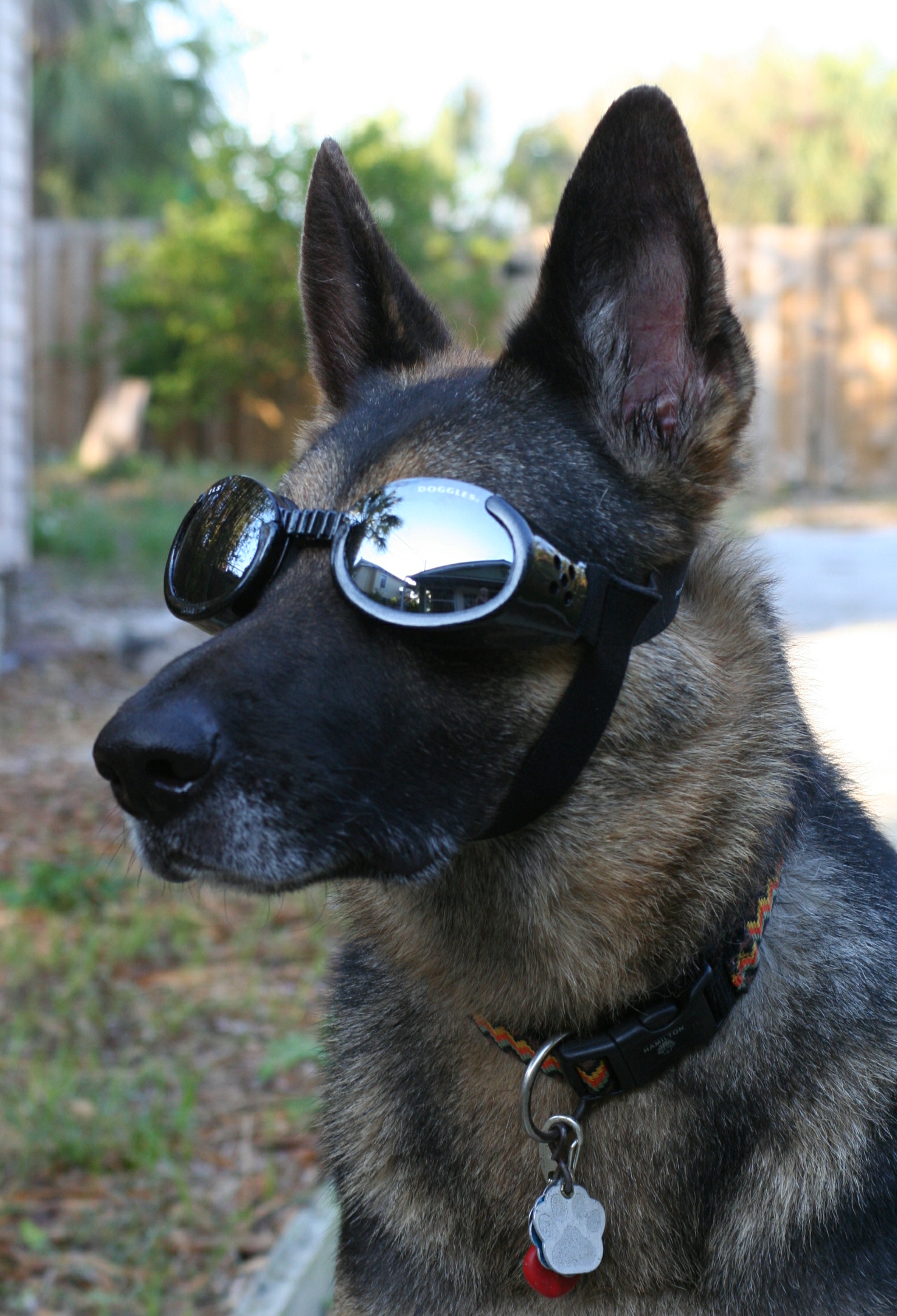


Special Delivery

A story Deni told me about Jana has been going through my mind for several weeks now. I haven’t figured out the answer; maybe the students in my spring-semester class on the dog’s perspective will help me figure it out.

We have had a lot of work done on the house lately, and somehow, the gate to the backyard got left open. I was away.

Deni reports that the dogs woke up and took themselves out the electronic dog door as usual. Then, suddenly Wylie was back at the bed, barking at her, quite insistent that she get up. Not fully awake, Deni complied (Wylie rarely takes “no” for an answer). She noticed that Jana had not come back inside. Wylie was frantically urging Deni to the back of the house, where she noticed the open gate. And no Jana.

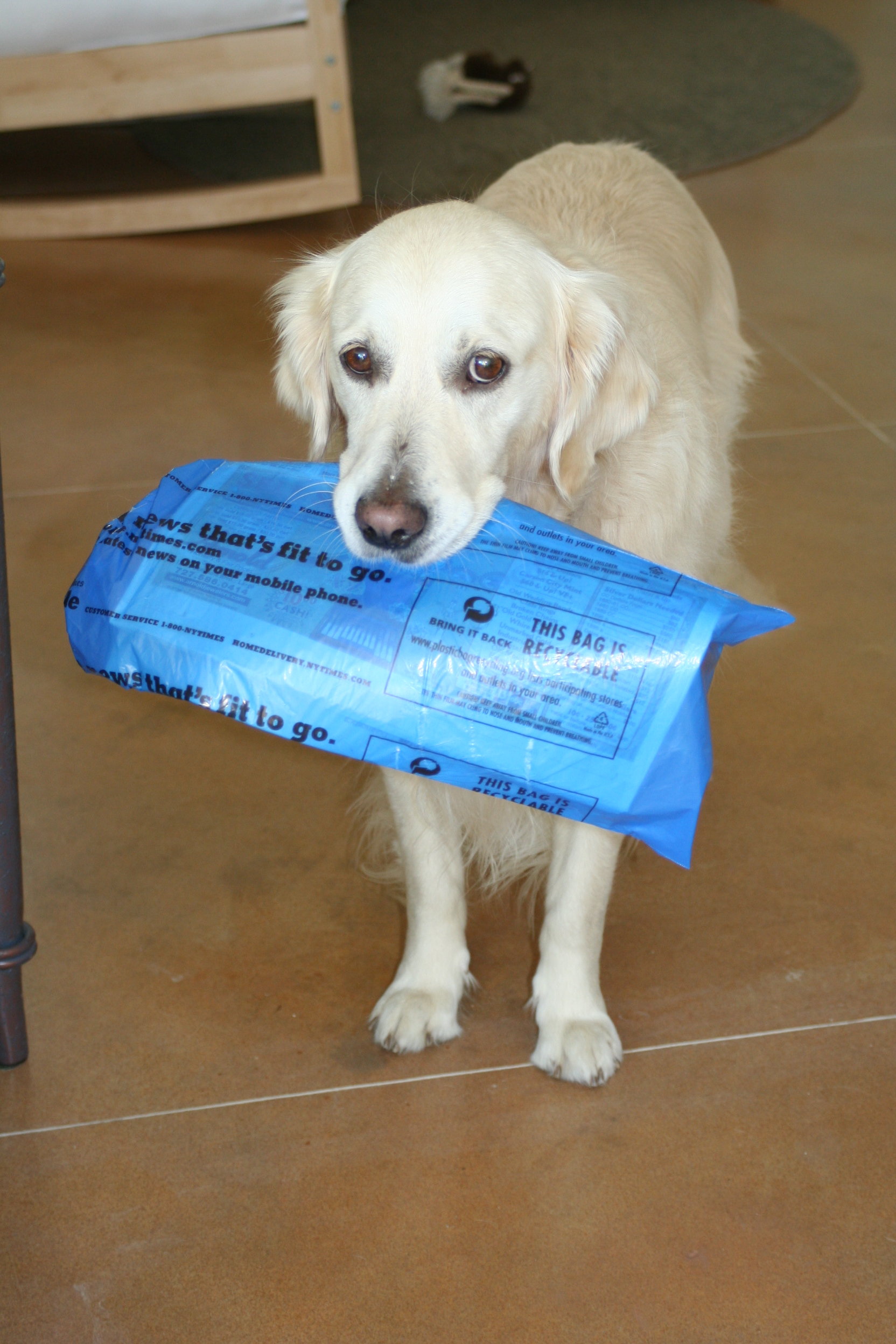
Now fully awake and worried, Deni quickly pulled on some clothes. Again, Wylie alerted her. This time, she followed him to the front of the house … where Jana was standing at the front door. Not only that, Jana was holding the morning newspaper (hmmm, too bad she didn’t nip out for fresh bagels while she was at it).

Relieved, Deni let Jana in and lavishly praised and rewarded her. But for what?

While Deni was delighted that Jana had stayed home, she and I both wonder how Jana understood the event.

Did Jana think she was being praised for simply doing her usual morning job of getting the paper? Or had she made a conscious decision to not seize the unexpected freedom and go for a swim or chase the cats next door? Did she understand that Deni was grateful for her restraint?

Maybe Jana finds too much freedom frightening and chose to return to safety.

Maybe she was afraid she’d get in trouble for being out and hoped that the paper would mollify Deni and mitigate punishment.

These are plausible explanations.

But Jana has had other opportunities to run through open gates, and she’s never passed one up. Just this week, when the roofers were packing up, I inadvertently let her out the back door before the back gate was closed behind the roofer’s truck. Within seconds, she was in the back alley. She did return immediately when I called her, though. And she’s often wandered off on her own during walks or hikes, farther than the front porch (but never so far that she could not see me or Deni).

She’s never gotten more than a scolding (and a leash) when she’s wandered too far afield in the past, so fear of punishment is unlikely.

She may have simply made the choice to stay close to home because she knew that that was the “right” thing to do. Could she have understood that Deni could not easily pursue her?

Which begs another question: Why did Wylie go to alert Deni rather than seize the moment, as it were, and go for a run? He has done so in the past. Was he worried about Jana or about keeping his pack intact? Was he delighted at the role reversal — that he got to be the good dog (and the tattletale) this time?

Though many people do not believe that dogs are capable of such deep, conceptual thinking, I do believe that Jana and Wylie are capable of making the judgment to do the “right” or the expected thing, even in the face of temptation. I have seen it many times in working dogs (including Wylie) — as well as in Jana and other pet dogs. I’ve also seen  both Jana and Wylie give in to temptation and follow their impulses or their instincts. Just as we humans sometimes “do the right thing” and sometimes do what’s fun or feels good, so do dogs.

All things considered, my best guess about that morning is that she didn’t want to miss breakfast. Your thoughts are welcome.

Squirrel Dude, the Undefeated Champion

A young Kong addict

I’ve sunk quite a bit of money into toys for Jana over the years, starting with stuffed Kongs when she was a tiny puppy. It took her only a few days to master the art of completely emptying a stuffed Kong. Soon, she had it down to mere seconds, even when I had the Kong filled with softened kibble, mixed with peanut butter and frozen (most puppies love these, and tossing in a Kong make crate training so much more fun for the puppy).

Thus, when little Jana was only a few months old, my quest began for the perfect treat toy. “Perfect” being defined as “will keep her busy for more than 10 minutes.”

I have tried everything. She has a collection of treat toys large enough to open a museum, or at least a doggy day care. Sucker that I am, I will shell out retail if I see a new toy that looks promising. Online deals are another money pit. We’ve got the Dog Puzzler, the Buster Cube, and the Twist N Treat. We’ve tried the Tricky Treat Ball, Orbee ball and TreatStik. We’ve got complete sets of Kong Genius and Busy Buddy Linkables, rubber toys of various interlocking shapes. And no, the Thinking Dog Blog does not receive any free products to try out.

Enough treat toys to stock a doggy day care

Jana is now 9 years old. She has, at long last, met her match: Squirrel Dude.

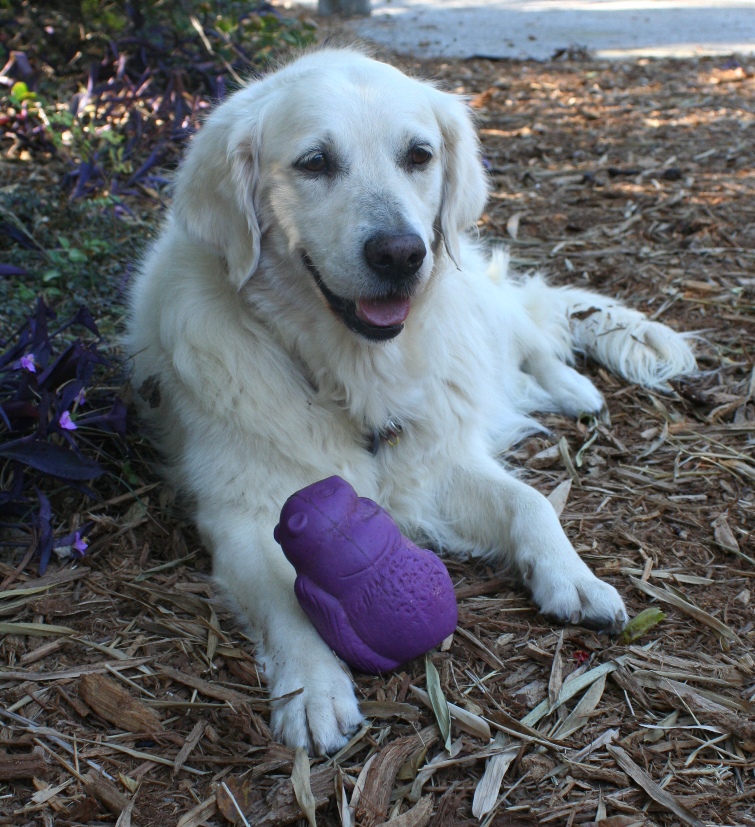
Squirrel Dude is a large purple squirrel made of hard rubber. He is hollow inside (much like Jana) so I stuff him with treats (much like Jana). Her job is to get the treats out.

Simple, no?

No.

She has been known to work at emptying Squirrel Dude for a couple of hours … and still bring him back to me with a biscuit piece or two rattling around in his belly. The introduction was made by a good friend and superior dog mommy (thanks, Emmalee!). It is a match made in heaven.

Squirrel Dude’s secret is a set of prongs or fingers that hold the treats in. That, and he’s quite fat,  so it is not easy for her to squash him enough to break the biscuits into small pieces that will fall out through the (smallish) hole.

Squirrel Dude wins the day

In many rounds of competition, Squirrel Dude has defeated Jana every time. Yet losing to this formidable purple rival has not diminished her affection for him at all. In fact, she is cradling him now, cookie bits still trapped in his belly, as she lies, exhausted, next to me.

Squirrel Dude’s closest competitor is the Busy Buddy Linkables, whose many possible configurations sometimes keep her busy for up to an hour. And the Orbee ball was an early success. Watching her figure it out — finally by rolling onto her back, squashing the ball with her jaws to break the biscuit, and manipulating the ball with her paws so the hole was lined up with her mouth and the pieces of cookie dropped right into her mouth — taught me a lot about her intelligence and problem solving ability. But she now has the whole operation down to about 3 min., and it only takes that long if I use a really thick, hard-to-crush biscuit.

What’s interesting is that Wylie is not at all interested in any of these toys. He likes the TreatStik and the Tricky Treat ball. Basically, as Deni says, he wants something he can just push around with his nose and have the treats fall out. Just goes to show that not all toys work for all dogs.

Jana, who is extraordinarily food motivated, will work much harder than Wylie to extract food from a toy. She enjoyed a TreatStik, too — only rather than push it around, she attempted to enlarge the hole the treats were falling out of. I finally took it away when she reverse-engineered it by figuring out how to unscrew the top.

I do offer her the other toys occasionally, if she needs a quick snack or if Squirrel Dude needs a day off. But, really, how can I resist a hunky purple guy who keeps my girl safely entertained for hours, challenges her mentally and wears her out?

A tired dog is a good dog, after all. And if the sweet little smile on her face is any indication, a happy dog as well.

Honoring Those Who Serve

I know this is a little late for Veterans Day, but bear with me. It’s worthwhile. Anyhow, we should honor those who serve our country every day.

In January, military dogs will finally get some recognition. The U.S. Military Working Dog Teams National Monument, honoring every dog who has served in the U.S. military since WW II, will be unveiled in California. A replica of the memorial will be featured on a float in the Tournament of Roses Parade in Pasadena on Jan. 1.

The real monument, featuring a 9-foot bronze dog handler and four 550-pound “hero sized” dogs — a Doberman, a German shepherd, a Labrador retriever, and a Malinois  — will go on tour, ending up at Lackland Air Force Base in San Antonio, Texas, where many military dogs are trained.

John Burnam, a veteran military dog handler and the man whose passion and tireless efforts have made this monument a reality, is an inspiration and a true friend to military dogs. In addition to spearheading the effort to create the monument, Burnam designed the monument.

Dogs have served in the military since the times of the Roman Empire. Many dogs have died in service. Many dogs serve in roles that pretty much guarantee they will die in service, with the goal that, in doing so, human lives will be saved.

As a dog lover, I wrestle with the ethics of this. In a class discussion of military dogs last spring, students pointed out that we send our children to serve in dangerous roles; why is sending dogs any worse? Others argued that the humans have choices and a greater understanding of the risks and benefits.

I do believe that dogs understand the concept of danger — and that some dogs freely choose to risk their own lives or safety to assist humans. Stories abound from dogs who took on snakes, challenged bulls or bears to protect humans to those who’ve saved people from fires, drowning, snowstorms, and even dogs who pull people from burning car wreckage after an accident.

The training of a military dog is intense and, in many cases these days, not based on the use of force or punishment. The dogs who just aren’t into it are unlikely to make the grade. So, in a sense, one could argue that the dogs have some choice in whether they accept their military mission. Still, the idea of dogs marching off to war is a painful one for me.

Since it’s likely, though, that humans will continue to go to war, and continue to take dogs along with them, it’s well past time to acknowledge the contributions and sacrifices of our canines in uniform.  Other countries, including  Italy, France, Russia, Belgium, Germany, Japan, the Netherlands, and Great Britain, have national monuments to their military dogs. Several U.S. cities, cemeteries, and military bases also have memorials. But a national monument, joining the ranks of Mount Rushmore, the Statue of Liberty, and other national monuments, is a tremendous — well-deserved — honor.

A Dog’s Life

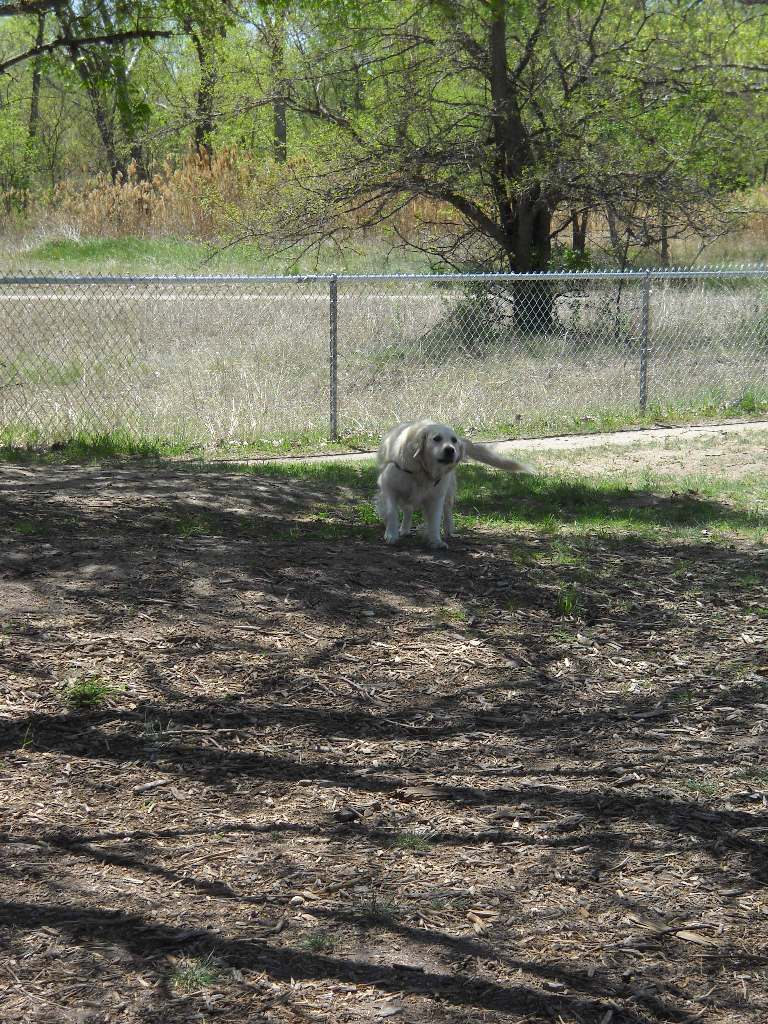
Jana has visited many dog parks around the U.S. and in Israel; this one is in North Platte, NE

I have just returned from a too-short visit to Israel, where I lived for nearly 15 years and where Jana, my golden retriever, was born. An exciting discovery was a new dog park just a few blocks from my mom’s apartment. Even nicer was a long article in the HaAretz newspaper’s weekend magazine about the social networks that are springing up at dog parks around the country. I also noticed a lot more people out walking dogs, water bowls outside shops, and people dining with their dogs at outdoor tables at restaurants in Tel Aviv and Jerusalem.

All of this, I believe, signifies wonderful changes in the status of dogs and dog-loving humans in Israel. When I moved there (in 1990), it was a challenge to find dog food. By the time I left, a few premium brands were being imported. Now, boutique pet stores are common, and they feature a full range of high quality foods, toys, and accessories. According to the HaAretz article, Israel now has more than 60 dog parks, most of them in Tel Aviv. I remember when Jerusalem’s first dog park opened in a park near Israel’s parliament building, the Knesset. When Jana was a puppy, we occasionally went there to play — and usually had the place to ourselves. Since Jana is only 9, it seems that the growth in dog park numbers and use has happened fairly quickly!

The HaAretz article describes groups of dog-park regulars who coordinate their visits to the park; many have formed friendships that extend beyond the dog park gate. The friends have helped each other out in times of economic stress, attended each other’s weddings, and formed open, honest relationships with a broader range of individuals than they otherwise would have been likely to befriend. The descriptions of these dog-centric social circles underscore the growing role that dogs are playing in people’s lives in Israel — a role that American dogs also fill — as friends and social icebreakers. “The dog makes it more likely that strangers will start talking to each other,” one interviewee says.

It also indicates, I believe, that dog owners are taking better care of their dogs and attending to the dogs’ needs for exercise and social interaction with their own doggy peers. When I worked as a dog trainer in Israel, I was often called to work with dogs who had “behavior problems” — problems that stemmed from lack of any attention at all. Not too many years ago, a lot of Israeli dogs spent their lives alone in a yard, often tied up. That still may be far too common, but this visit gives me hope that, for many Israeli dogs, things are looking up.


Body Slams and Touch-Free Cuddling

Look, but don’t touch!

Not all dogs like to be petted. Certainly not all dogs like to be petted the same way.

The thinking dog owner might ask, “Huh? Isn’t petting a big part of why we have dogs around in the first place? Isn’t being petted pretty much an integral part of their job description as pets?” Maybe, but so what? I think that all of us, human and canine, get to decide how, when, and by whom we are touched.

With that in mind, and being admittedly slower than our dogs on the uptake, I recently made a realization about an ongoing battle I have with our German shepherd, Wylie. It’s likely, though, that only I see it as a battle; he might see it as a series of very small victories. Here’s the story.

Wylie can be pushy. He wants attention. Lots of it. He likes roughhousing and hard body contact. He body slams other dogs when he’s playing, he crashes into people and dogs, he steps on our feet and tails (well, the tails of those who have tails). He also, whenever I am petting golden retriever Jana, comes over and pushes his nose, head, or entire body between my hand and Jana. I push him away. He comes back. I put up an arm to block him. He crashes into it.

I could, of course correct him by telling him to sit or lie down. But what often happens is that, when he butts in, I get annoyed. And, I want to spend some time with Jana. So, instead of asking him to sit and then petting him in turn, I block him and usually order him to “go settle — somewhere else.”

But it doesn’t work. He keeps coming back.

I was musing about this ongoing conflict one evening recently and suddenly realized that Wylie is, in fact, getting exactly the kind of “petting” that he likes. Maybe not much of it — a few seconds at most — but he is getting what he wants. When I do focus on him and pet him, I don’t massage him and use the gentle strokes Jana likes; I thump his side, and we roughhouse a bit. He likes that.

While I am sure he would prefer that I stop petting Jana and focus my full attention — and both hands — on him when he interrupts my Jana time, he might believe that some attention is better than no attention. So my shoving him back isn’t a correction but more of a reward. And Wylie might not see the encounters as an ongoing battle but more as a challenge to see how much of my attention he can claim.

This realization ties nicely in with my strong belief that we (humans who live with dogs) should try to see things from the dog’s point of view sometimes and figure out what matters to the dog — more specifically, to each individual dog. When we understand a dog’s motivation, a lot more of that dog’s behavior makes sense.

Which brings me to Jana and touch-free cuddling.

It sounds like an oxymoron, but touch-free cuddling is actually Jana’s favorite way to spend time with her people. She’ll join one of us on the bed or the sofa, curling up comfortably — close but  not touching. If we overstep our bounds and reach out to stroke her, we’ll often be “rewarded” with a dirty look and a disappearing dog. Occasionally, she will tolerate a few minutes of petting before inching away, out of reach.

It’s not that Jana  doesn’t want company; she does. She’s quite content to hang out near us and will often follow me from room to room, settling nearby. And sometimes, on her terms, she wants to be petted, stroked, massaged, or belly-rubbed. She’ll even ask for it on (rare) occasion. When she’s enjoying it, she thumps her tail happily and offers lots of body language cues that tell me to continue, primary among them the fact that she has not walked away! But it is always, very much, on her terms.

Jana has always been more aloof than most golden retrievers, and I recognize and appreciate that about her. I am not one of those people who enjoys an attention-seeking dog (or person); Jana and I understand and complement each other well. But she is often misunderstood by people who assume that all dogs (or at least all goldens) live for the touch of human hands and who feel rejected by Jana’s refusal to be petted.

Not only do our dogs deserve to be petted (or not petted) in the ways that feels good to them, each needs to be understood and appreciated for who he or she is. In doing so, we humans have a better chance of understanding our dogs’ behavior — and perhaps avoiding or resolving conflicts.

Good Owners Make Good Dog Parks

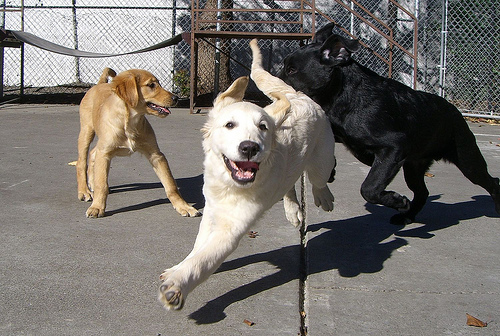
Happy dogs at play (photo by Sae Hokoyama)

In Take Me Out to the Dog Park, I described some features that contribute to a successful — fun, safe — dog park. But a perfectly designed and maintained park can be a nightmare if the dogs and humans who hang out there create a bad dog park culture. How can you tell?

Before letting your dog off leash in an unfamiliar dog park, check it out. If you can, observe the park during busy after-work or weekend hours. If not, observe for a few minutes before letting your darling out of the car.

Inattentive dog owners are a key contributor to unsafe and unpleasant dog park experiences. If the people are all clustered around the edge, chatting in small groups, or sitting on benches sipping coffee and ignoring the dogs, walk away. Some dog parks have a “let dogs be dogs” culture that encourages bullying. In Sue Sternberg’s excellent APDT Webinar[1], she showed video footage from a small urban dog park where dogs bullied and ganged up on other dogs while the oblivious humans sat on the sidelines.

You are your dog’s advocate and protector — if your dog is being bullied, get him out of there! You are also the responsible grown-up, frightening as that may be. If your dog is being a bully, get him out of there! Not all dog play is appropriate, and dog owners need to be aware of what’s happening so they can stop unsafe play.

What does dog bullying look like? If a dog keeps bugging another dog to play, even though the other dog has looked away, walked away, or barked, bared teeth, or otherwise told the first dog that he’s not interested, that dog is being a bully. If a dog pursues another dog, and nothing the other dog does can shake him, that dog is being a bully. If one dog body slams or plays roughly and the other dog is trying to get away or is not equally engaged in the roughhousing, it’s time to step in.

Watch those high-speed doggy chases, too. Sometimes it is all in good fun. The dogs chase each other, stop and restart, and look relaxed and happy, with tails up and ears back. But if the “chasee” has his ears forward and his tail tucked and looks scared, or if several dogs are chasing one dog, the dog being chased needs help. If a chase never changes directions — the same dog is always being chased — the chaser(s) might be bullying the other dog.

Entry gates at dog parks are prime spots for scary interactions. If several dogs are milling around the gate — or approach as you and your dog enter the double gate — be very careful. Walking into a mob of strange dogs is a stressful experience for your dog. The dogs might be friendly; they might also harass or attack an entering dog, especially if he seems nervous or defensive. Do your dog a favor and wait until the entryway is clear.

Not all dogs automatically learn the social graces. If your dog needs to learn some manners, try to set up one-on-one play dates with well-socialized dogs who can teach him the boundaries of appropriate dog play. And if you do take him to the dog park, remove him the instant you see him picking on another dog. He will learn that the fun stops when he acts like a bully, and the other dogs and people at the park will appreciate your conscientiousness.

Dog parks can be wonderful places for dogs to socialize and burn off energy. But some dogs are shy or timid; a dog park is too stressful for these dogs. And there are too many stories of dogs being injured or attacked to assume that all dog park experiences will be good ones. Think carefully about whether your dog will enjoy the rough-and-tumble of multi-dog play, and take the time to check out a dog park’s culture before you go.


[1] “A Look at Interactions Between Dogs in Public Dog Parks”

Take Me Out to the Dog Park …

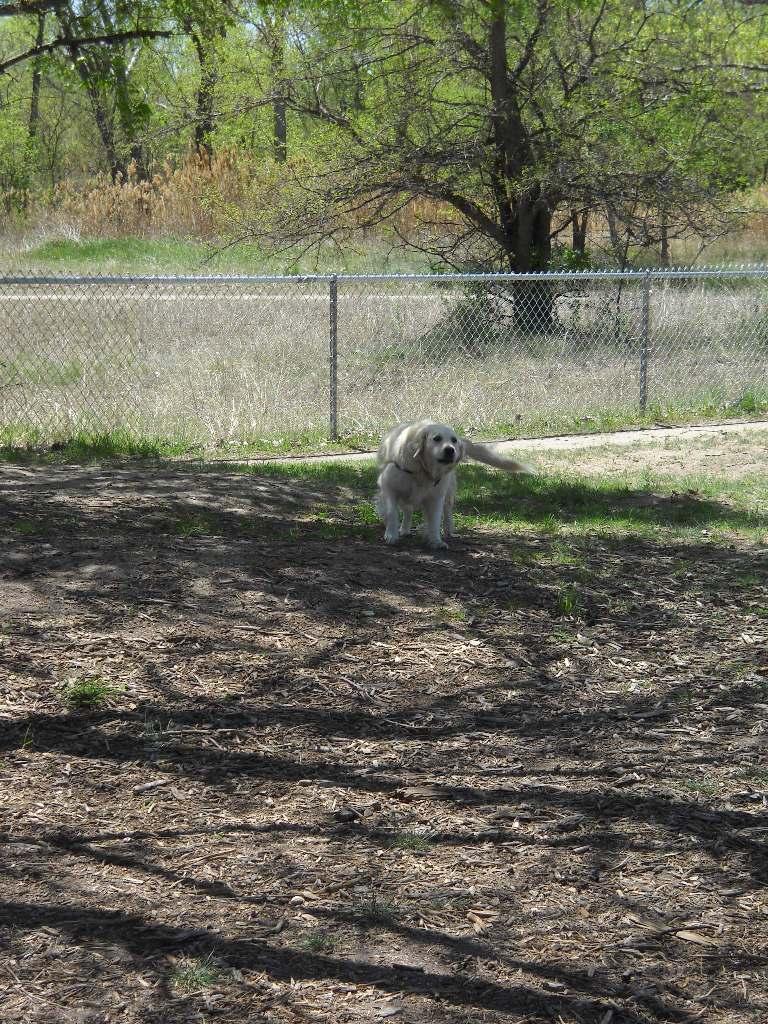
This dog park in North Platte, NE offered lots of shade, even on a 90-degree day.

Friends of ours are planning and building a dog park in their community. I am in awe of their energy and commitment; they’ve got the entire dog-owning community involved. Talking with them about their plans got me thinking about dog parks and some of the research I did with a college class I taught last spring. Dog parks can be a wonderful asset to city-dwelling dog lovers — or they can be rough-and-tumble, scary places. What makes the difference?

Planning is one of the keys to successful dog parks. The dog park culture is another. This post will talk about the physical features that contribute to making great dog parks succeed. My next post, Good Owners Make Good Dog Parks, will delve into dog park culture.[1]

As anyone with a large, fenced back yard knows, just having enclosed green space is not enough to get dogs to exercise; many dogs will just pick a sunny spot and take a nap. But add more dogs and you have a potential problem: in a plain, flat grassy area, dogs are more likely to chase other dogs. Often, once one dog starts a chase, other dogs eagerly join in.

Dog parks with natural or planned “breaks” in the open space are safer for dogs. They force running dogs to change direction or slow down, and give the “chasee” opportunities to escape. “Breaks” can be hills, paths, stands of trees or bushes, a pond or a beach. Benches can also break up open space, but benches encourage the humans to sit, chat with others, and not pay attention to their dogs — which contributes to bad dog park culture.

Besides breaks, dog parks — especially in warm climates — need shade. Plans should include lots of shade trees or even a shelter with a roof.

Water is a wonderful “break” and adds to the fun for the dogs. People tend to keep a closer eye on their dogs around water, too. If the space for a planned dog park is not on the edge of a natural body of water, consider a manmade pond! And of course, if there is a place to swim, a rinsing station is a great idea. At absolute minimum, a dog park should have a hose or fountain for drinking water.

In dog park planning — and visiting — size matters! In a smaller dog park, particularly if it is crowded, dogs are more likely to feel stressed — which leads to defensive behaviors or could make them targets for dog bullies.  In larger spaces, dogs who don’t want to play with the other dogs simply have more room to move away. Many urban areas have dog parks that are a half-acre (or less); for a large, high-energy dog, this is not enough room to really stretch those legs and burn off energy (I know; I live with a dog like that!).

In smaller parks, it is essential to have a separate small dog area. Parks that are several acres and include walking paths or a beach can be safe for dogs of all sizes (so long as the humans are paying attention), but in smaller parks, it is far too easy for small dogs to be injured, even if all of the dogs are behaving appropriately. Dogs in full play mode don’t always pay attention to what’s in their path, and they can’t (or won’t stop on a dime.

If you are choosing a dog park to visit, scope it out before releasing your dog. If it is small and crowded, you might be better off taking the dog for a leashed walk. On the other hand, if you are lucky enough to live near a large, well designed park, do what you can to ensure that the dog park culture will ensure a safe, fun experience for dogs of all sizes!


[1] Thanks to the APDT and Sue Sternberg for their wonderful Webinar, “A Look at Interactions Between Dogs in Public Dog Parks” for information referenced here.

Jana and Wylie Go to College

Jana and Wylie got accepted to Eckerd College and, last week, attended their first class, a math class. They were students in the Dog Behavior Project, a cognition study run by the psychology department. Your dog can participate too, if you live in the Tampa Bay area! The application is simple.

The dogs were excited when we got there. A human class was just letting out, and some of the students said hello. The dogs got to explore the psych lab for a few minutes, and they could tell that other dogs had been there.

Then it was time for class. Jana got to go first, so we went into the testing room. There was a chair for me, two bowls on the floor at the other end of the room, with one student serving as tester and a student who recorded what Jana did.

The current study is hoping to determine whether dogs can count or judge quantities. The tester drops treats into bowls, and the dogs get to choose one of the bowls. For each trial, she drops a different number of treats into each of the two bowls, with the dog watching. Jana got Charlee Bears, which she loves.

We went in and sat down. I told Jana to wait and held her collar loosely. She sat facing the tester. Once the treats were in both bowls, Jana was allowed to choose which bowl she wanted, run to the bowl, and eat the treats. The researcher is supposed to grab the treats in the other bowl while the dog is eating. Some “control” trials have treats in only one bowl.

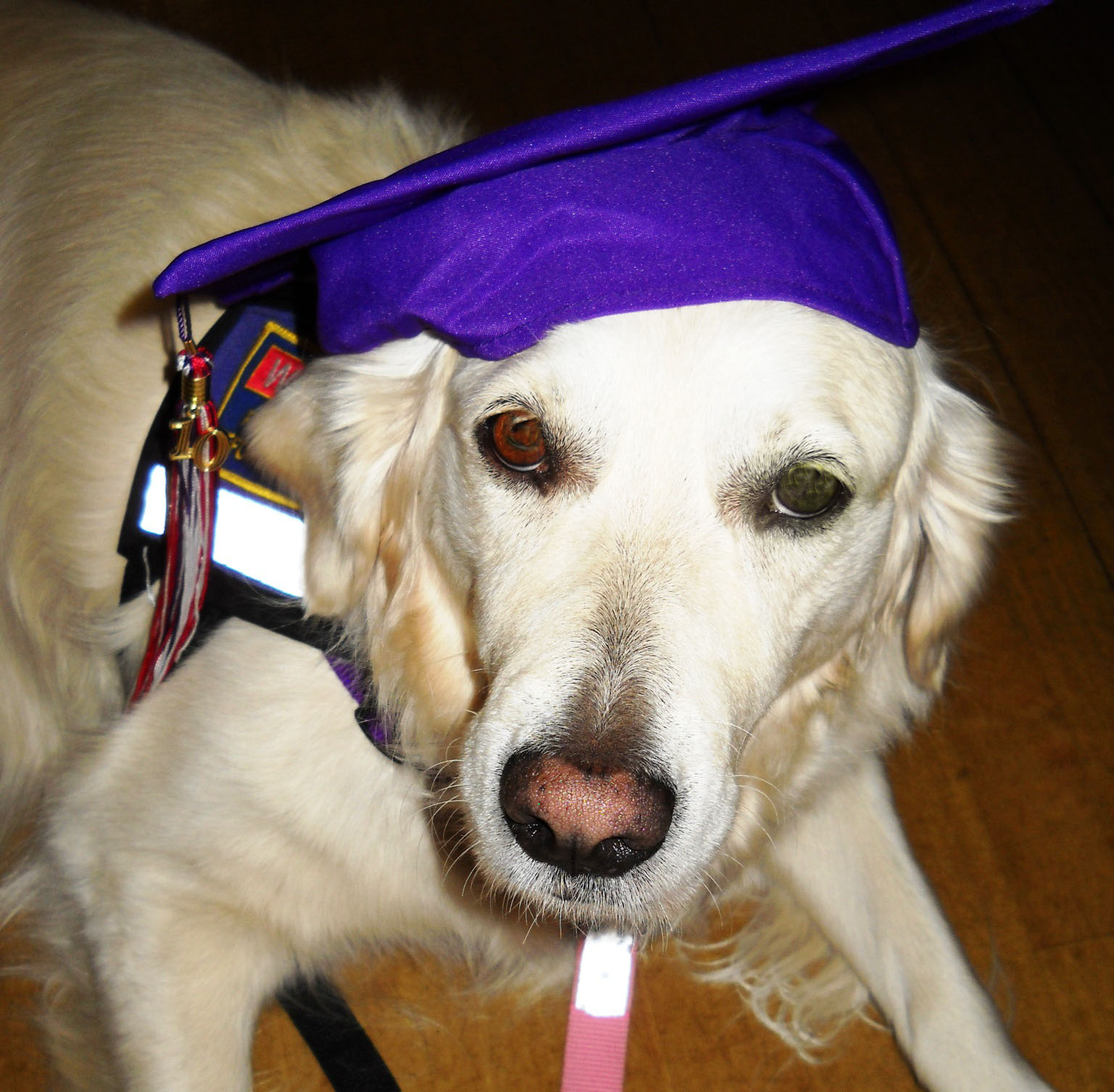
No one looks good in these graduation hats!

Jana watched intently each time treats were being dropped into the bowls. When I said OK and let go, she ran to a bowl. She chose the larger number of treats eight out of 10 times; I have no idea what happened those other two times. She was definitely paying attention. She also, not surprisingly, ran to the second bowl each time she finished eating her treats and barked at the researcher when she found it empty. What tells me that she was really paying attention is that, in the “control” trials, when the researcher had not placed treats in the second bowl, Jana did not bother going there.

When Jana finished the last trial, she brought me the empty bowl. I am sure Jana thought this was the best class ever! She would happily have done 20 or even 50 trials.

Then it was Wylie’s turn. Unfortunately,  in his first two trials, the researcher forgot to pick  up the treats from the second bowl, and he was able to get both sets of treats. From then on, he showed a clear “side bias,” always choosing the same bowl. He only got the larger number of treats six out of 10 times, but in his defense, I think he was misled about the nature of the task. My guess is that he figured that it didn’t matter which bowl he went to first. Also, he’s just not that excited about Charlee Bears. If she had put tennis balls in the bowls …

Both humans and dogs enjoyed participating in this study, and we’d do it again. Some of the studies are longer-term, with the same dogs coming back for several sessions. It’s a fun way to spend time with your dog and learn more about how her mind works.

It also shows how far dogs have come. Even as recently as 15 years ago, you’d be hard-pressed to find published academic research that focused on dogs. Now, researchers all over the world are exploring dogs’ thinking and problem solving abilities. Some of the best work is being done in Hungary, at the “Family Dog Project” at Eötvös Loránd University.

But it’s not necessary to go that far afield. Eckerd is just one of several U.S. colleges and universities where dog cognition labs recruit local canine “students.” Others are the University of Florida, Duke University, Barnard College, and the University of Kentucky. Researchers are looking at a variety of topics ranging from canine facial expressions, such as the “guilty” look to dogs’ responses to human gestures to how dogs form trusting relationships.

I get excited about anything that gives me a window into my dog’s mind. I often wonder what she’s thinking. These studies might help us better understand of our doggy best friends and improve our relationships with them. Then again, the researchers might confirm something that I have long suspected about Wylie — that he regards humans as bumbling, inept, and not very smart, and he knows that, if only dogs had opposable thumbs, the world would be a very different place.