An Idea Whose Time Is Up

A recent Freakonomics podcast featured various politicians talking about one idea about elections that they wish would die, go away, never be mentioned again. I like that idea because I have a long list of absurd ideas about dogs and other nonhumans that I wish would go away and die a miserable, lonely death.

High up on that list is one that is getting a lot of attention these days, due to the unfortunate publication of a new book by novelist Tom Wolfe: the idea that only humans use language. Though I am one of the few people I know who disliked Bonfire of the Vanities, I had some professional respect for Wolfe as a writer until I heard his interview on NPR about his new book.

Wolfe essentially suggests that if evolution occurs, it only happens to nonhumans. That’s bad enough. But what really got my blood boiling were his comments on language. In the interview, Wolfe made the absurd claim that no evidence of anything resembling a language has ever been seen in a nonhuman. Wow. He really should have done some very basic research, like a cursory Google search, before deciding that. There’s a lot of research out there on animals and language.

Wolfe uses “speech” and “language” interchangeably, which is already a clear indication he doesn’t know what he’s talking about. Many languages exist that are not based on speech, the most obvious being American (or any other) Sign Language. Thousands of nonverbal people understand and use language; some even write beautifully. Many actual scientists, even some who believe that only humans use language, have published extensive research on language and how it is separate from and does not require speech.

Wolfe also claimed that speech / language is necessary for any sort of memory or planning. Hmm, how does he explain insects, birds, mammals who store food for the winter (and remember where they put it); any critter who finds his way home once he leaves the den, ever, or who leads his pack back to the marvelous carcass or other food source he’s discovered? Even bees remember and guide others to food sources they’ve found. Memory. Memory, communication, teaching … And wouldn’t pack hunting, as wolves do, require planning? Building a nest or den requires both planning and memory. There’s a lot of research on these topics, too.But t

But really. Let’s focus on dogs for a moment. To establish that these nonhumans use language, remember, and plan, all you really need to do is spend a few days with a dog. Watch a dog come up with really clever plans for appropriating a coveted bone or toy from his sibling, or walk a dog who remembers where that lovely dead thing she rolled in last week was, or see how excited the dog gets when she recognizes the drive to the dog beach?

I could list, literally, thousands of examples from my own experience, reading, research, and students’ and friends’ stories. So could anyone who has ever paid much attention to dogs, elephants, chimps, whales, prairie dogs, birds, or any of the many other nonhumans who use language. Memory is essential to learning anything; and it is clear that millions of critters, but especially, and most near and dear to my heart, dogs, learn, remember, plan, use tools, problem-solve, and manipulate humans.

book cover of Beyond Words by Carl Safina My favorite comment on the interview came from an NPR listener who wrote that “It was the equivalent of interviewing an expert on evolutionary biology who never reads novels to get his opinions about how novelists can write better stories.” Yup. Stick to what you know: make-believe. Another good response is this column about why it matters when a famous writer dismisses evolution.

If you want to learn about language, read Chasing Doctor Doolittle or Beyond Words, both beautiful books about what language is and how various nonhumans use it. I’ve written several posts on this blog that address human communication with dogs and dogs’ ability to learn to understand human language. (I’ve never claimed that dogs have speech, and I do know the difference.) You can find those by searching this blog site.
 

Last Night Alone

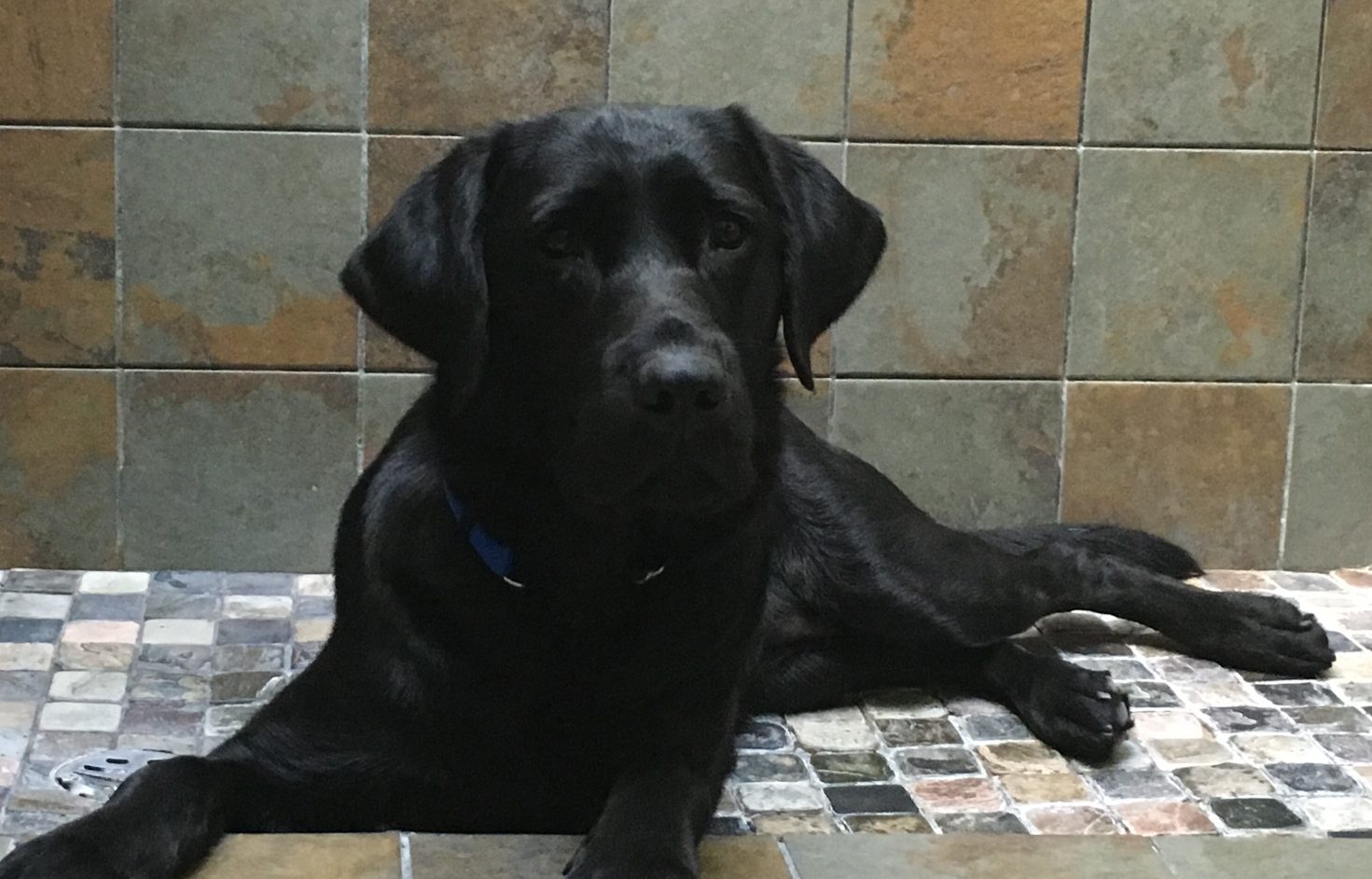
koala-in-showerA guest post by Deni Elliott

Tonight is my last night alone. After four months of crawling into bed without Guiding Eyes Alberta snorting and snoring a few feet away, tonight is my last night alone. Tomorrow I meet Guiding Eyes Koala. As hard as I’ve squinted at photos and video and as tightly as I have clutched each new piece of information, I find it odd how little I can imagine about our future together.

Koala’s passed all the tests and has exceeded expectations. I’ve heard that she leaps into her harness and back-channels routes after only one trip. She eagerly solves problems and pivots on a dime, ready for new adventure. A personality match for sure. But I remind myself that I need to go slow and not expect too much of this 2-year-old.

At the cusp of this unknown relationship curving to be real, my tummy flutters with butterflies of anxiety and anticipation. I can imagine the home trainer better than the dog he is bringing me.

Jim Gardner, GEB director of home training, will fly from New York to Tampa with Koala curled at his feet. I imagine Jim cheerfully answering the questions I am annoyed to be asked. “Are you training that dog?” someone will ask. “Yes,” he’ll smile, “This is a new, young guide dog. I am taking her to meet her blind partner.” When asked, I put on the same “please the public” smile, but say in a way that invites no further intrusion: “Every day is a training day, but I am blind, and she is my guide dog.”

I imagine Jim calmly replying, when asked the dog’s name, “We don’t tell people that because we don’t want them distracted.” Knowing that despite 16 years of guide dog use that I am still paralyzed by strangers asking my dog’s names, other trainers have had me practice giving a fake name. I don’t lie well. Saying, “I won’t tell you,” feels rude. “Leave us alone,” is definitely rude. Saying, “If I tell you the dog’s name, you will immediately say it and distract her and that is exactly what I don’t want you to do,” is too long and complicated. So, I quickly say, “This is the dog’s name, BUT DON’T SAY IT.” As those words come out of my mouth, I concurrently offer a treat so that the dog doesn’t pay attention to what the other person might say. We then hurry away.

I imagine Jim chaperoning Koala and me on our first neighborhood walk. “What can we do for our first outing?” I will ask. “Two miles? One mile? 250 steps?” I have three routes mapped out just in case.  For the months I’ve caned my way through twice-daily walks, I’ve imagined being guided by new dog instead. I whisper “Right-right,” and “To the curb please,” and “Good dog, good job.” I’ve counted the number of streets I cross on these daily laps so that I can help Koala learn streets where she needs to stop and driveways where she doesn’t. I imagine the neighbors that I pass daily expressing surprise and sending best wishes when they see me with Koala in harness instead of gripping a cane.

I cry when I imagine Jim and Koala arriving from the airport tomorrow night. I have joked about lighting candles and pouring wine for the new girl’s arrival. In truth, I have stocked the house with beds, toys, crate, food and treats. I ache with the knowledge that none of these will fill her heart tomorrow night. All I can do is make promises that she won’t understand.

She’ll wonder where her most recent caregivers, Graham and David, have gone. She’ll look for her special canine friend, Wrangler. Some visual or scent will call to mind her puppy raiser mom, Eileen, although it has been six months since they’ve seen one another. From Alberta, I know that well-raised guide dogs never forget previous family members and greet them with great joy. I suspect Koala would prefer we all live together in one pack. I can’t make that happen, but I will promise to keep her connected with the dogs and humans who matter to her most.

koala-and-deniI will promise to keep her safe. I hope that she never needs to know that I will instinctively fold her under my body for protection if anything threatens her just as I did when Alberta and I were attacked by a stray dog.

I will promise to trust her today and for all of the tomorrows we have together. When I am utterly confused, I will follow her lead, knowing that she’ll have better ideas that I about what to do next.

I can’t imagine Koala at my side because I don’t know yet the person she will turn out to be. But I can promise to show her day after day that I will love her for being her own best self and for who we can become together. Maybe that’s enough for the first day.

Postscript: Koala and Deni are off to a great start!

Dogs Understand Our Words — and Our Tone of Voice

janaNYT

This week, many media outlets have run stories on a recent Hungarian study that might show that dogs not only understand the words we say to them, they also understand the tone of voice. I haven’t yet read the full paper, but based on several articles, here’s the gist.

The 13 dogs, trained to lie still in an MRI machine (so already a select group of highly educated individuals …), were tested on four sets of cues: Praise words said in a “praising intonation,” described as a higher and more varying pitch than neutral speech; the same praise words in a neutral tone; neutral words in a praise tone; and neutral words in a neutral tone.

From interactions with dogs, most of us know that we can get dogs to respond to pretty much anything we say in an excited or happy tone. And we know that they respond to some words even if we barely whisper them. For instance, a whispered “c…o…o…o…o…k…i…e…e…e…” gets a reliable response even if the dog is 100 yards away, playing happily with her buddy. But this research study, like several other MRI studies by this team and an American team, looked at the response in specific areas of the dogs’ brains, not their actions.

Praise words, regardless of tone, caused reactions in the left hemisphere of the dogs’ brain; this is similar to what the researchers would see in a human brain that is processing speech. Neutral tones, regardless of words, produced a reaction in the right hemisphere; this is similar to what the researchers would see in a human brain that is processing generic acoustic information. And, when the praise words were spoken in the praising tone, the reward centers of the dogs’ brain lit up. This shows that the dogs were able to integrate the meaning of the words and the tone and deduce meaning from them.

This study seems to show that dog brains process speech similarly to the way human brains process speech, which is what this article on Smithsonian.com reports. Other media reports said that it also means that the dogs understand human language, like this one from NPR.

Some experts, like one of my all-time-favorite scientists, Dr. Gregory Berns, told Smithsonian.com that the paper has been “wildly overinterpreted,” partly due to its methods. He pointed out that responding to speech and tone is not the same as understanding it.

That may well be true. On the other hand, the NPR article warns of the perils of life with such smart dogs, particularly if — as I do — one leaves NPR on for them to listen to all day. My dogs are, indeed, both smarter and better-informed than I am, especially now that I work in an office and do not listen to NPR all day.

However, in all seriousness, I think the overinterpretation also may be oversimplification. Yes, our dogs learn that certain words, even sentences, have specific meanings. They learn our habits and routines, and through experience with us, they associate all kinds of things with words. In our household some examples are: Leashes and fun and ball-playing with, “Who wants to go to the park?”; bowls of yummy food with “How about some dinner?”; and a careful backing up so that just her large, furry front paws are over the threshold with “Out of the kitchen, Cali.” The front feet then scootch back almost imperceptibly in response to, “The entire dog, please.” So yes, my dogs understand and respond somewhat appropriately to several sentences; I suspect that each family’s dogs have a set of favorites.

But even armed with my years of knowledge of their intelligence, along with my new realization of their eruditeness (is there a dog-oriented radio station that I could leave on instead of NPR?), I do not think that they process and understand human language in the same way that a human adult does.

What I do think, based on a combination of experience and having read dozens of research papers on dog-human communication, is that they read us really, really well. They don’t respond only to the words we say or the words combined with the tone of voice. Humans don’t either; so much communication is based on body language and other cues, even between humans. But dogs really read our body language. They also read all the scents we are giving off, including pheromones that we are completely unaware of. They read our microexpressions and our posture and our facial expression and pay attention to what we are doing as we are talking to them. They can figure out our emotions from these cues. They know when we “mean it” and when they can push the boundaries just a bit further.

Cali is much quicker to listen to my “get out of the kitchen” phrases when I am fixing her dinner than when I am doing the dishes. She’s learned that I will stop fixing her dinner and wait for her to leave the kitchen. She doesn’t like that consequence. But she doesn’t much care if I get the dishes done and maybe even wants me to stop doing them so I can pay attention to her.

The point is, looking at dogs’ response to words and voice in isolation doesn’t make sense, because in their lives with us, that is not how they use language. Another important thing to remember about dogs, as opposed to any other nonhumans, is that so much of who they are has been shaped by the fact of their lives with us. The dog-human connection is unique; our communication with them is different from our communication with any other nonhumans (even cats).

The most important point, though, is that dogs pay close enough attention to us to learn the meanings of the different things we say to them. They care whether we’re happy with them — or just whether we’re happy. I’m excited about new discoveries about dogs’ intelligence and cognitive abilities. But I am even more excited about new reasons to cherish the relationship I have with my girls and that others have with their dogs.


That Soulful (and Loving) Gaze

Oxytocin is a hormone that plays a role in social bonding, as implied by some of its nicknames: the love hormone, cuddle chemical, or bliss hormone. It’s also something that dogs and humans share.

Studies published in 2009 found that, when dogs gazed at their owners — you know, that adoring gaze that says, “feed me; I’m yours,” owners had more oxytocin in their urine. This correlates with feeling affection and social connection.

You can see where this is going, right? They gaze at us, we interpret it as adoration, we respond by feeling loved and happy. This works well for the dog. For us, too; real or not, we have that great “someone loves me” feeling.

But there’s more to this story. A later study looked at more variables. For example, the oxytocin in dogs’ urine. Did they get the same emotional lift out of the exchange of adoring gazes? Also whether interaction with the humans affected oxytocin in either humans or dogs.

This is where things get interesting.

A note: In both studies, dogs and wolves were used, as a way to determine whether this was just a canine thing, or whether it really has to do with the dog-human relationship.

First, the study looked at the effects if the person and dog exchanged gazes only, versus when the person also interacted with the dog, talking to her or petting her. No one was given oxytocin in this study; dogs’ and humans’ levels were measured before and after. The dogs and owners who spent the longest time gazing and interacting with each other had significant increases in their oxytocin levels — the dogs’ levels as well as the people’s. The dogs like the attention — even you, Jana! The gaze-only dogs and the shorter-gazing couples had small or no increases. Neither did the wolves.

A variation of the study had researchers administer oxytocin to some of the dogs to see whether the amount of oxytocin in their bodies made a difference. Then, the dogs and humans were allowed to gaze at each other, but the humans were not allowed to intentionally interact. If the dogs touched the humans, it was noted, but the humans were not allowed to respond by petting or talking to the dog.

So, was there a change in the dogs’ behavior if they had higher (administered) oxytocin? There was — but only for female dogs. With more oxytocin, they gazed at their humans for a significantly longer time; the length of their gaze at a stranger wasn’t affected. Male dogs actually gazed at their owners longer if they had not received oxytocin. The wolves didn’t really gaze at the people.

Not to knock boy dogs, but … maybe they’re just not that into you.

Seriously, what this all means — according to the researchers, anyhow — is that a mutually reinforcing loop occurs (particularly with girl dogs). They gaze at us, we look back, babble nonsense at them, rub their bellies … Hmmm, how do they gaze at us while we’re rubbing their bellies? OK, we stroke their long, soft ears and gaze back into their eyes. And everyone feels all warm and mushy and loved, so the girls keep staring at us, to keep this good thing going. More gazing, more oxytocin, so more and longer gazing, and the cycle continues.

Gazing is important in human social bonding and communication, starting when babies nurse. Lots of research shows that dogs use humans’ gaze as communication — and use their own gaze to communicate with us. And, as I wrote a couple of weeks ago, dogs choose to hang out with us. All that, to me, adds up to a mutual bond that is very rewarding to all of us, including the dogs. That, and they need someone with working thumbs around to get access to their dinner.

Just Hangin’ Out

Jana_aging

We all know that our dogs love us, right? It’s not enough to know that, though; researchers have to prove it. Fine. First we had the wonderful Dr. Gregory Berns and his MRI studies that showed that the pleasure center in dogs’ brains lights up when they catch a whiff of a familiar human. Then we had oxytocin studies that showed that a meaningful gaze is also therapeutic — for dogs (more about that in a future post). Now, my favorite: A study showing that dogs will actually learn and perform a task for what reward? A chance to spend a minute with their person.

The study was published in the fall issue of the Journal of Applied Behavior Analysis. Titled “Application of Functional Analysis Methods to Assess Human-Dog Interactions,” the study itself if a tough read. Do yourself a favor and read Dr. Stanley Coren’s “translation” in his column for Psychology Today.

The study only looked at three dogs, so it is not exactly definitive. But these dogs were tested on several different scenarios. First, they learned to perform a task that would open a door and allow them access to a room where their human was sitting. They actually figured out — taught themselves —a task, then performed it over and over again, just to get to be with their humans. They could hang out with (and be petted by) their person for one minute, then they were taken back to the room.

Initially the room was bare and boring. But then the researchers upped the ante. They gave the dogs some toys. Later, they added the dog’s favorite bed. In each case, performing the same task would let them out and give them access to their person. Yes, they chose to leave a relatively comfortable room and their toys to be with their humans. One dog had a harder time leaving the toys than the empty room, and one of the dogs chose not to leave the comfy bed.

The next level test put the people and dogs in the same room. Now, the dogs had no bed, no toys, and a human who was working on a computer. The door was open; the dogs were free to head to their toys, their beds, out. Yet, even though the person wasn’t paying paying any attention to them, the dogs showed a preference for being with their person. They stayed, rather than head to a more stimulating place.

Remember, this is a very small study. But it tracks with my experience of living with many dogs over many years, and spending time with dozens (hundreds?) of dogs whom I knew well but did not live with. It also lines up with our understanding of dogs as great therapy visitors, empathetic creatures, and just plain good friends.

I live in a tiny apartment, but, in addition to the living room where I spend much of my time, the dogs have access to the yard most of the time, a bedroom (with very comfy dog beds), and the kitchen and bathroom,which offer a cool floor in hot weather. The vast majority of the time, Jana chooses to be in whatever room I am in. She gets up and moves if I do. Even if I tell her, “Don’t move; I am coming right back,” she goes with me. In fact, ages ago, tiny 7-week-old Jana attempted a huge flight of stairs when I ran upstairs to get something and she just didn’t want to be left alone for even a minute.Janas Bed age 2

Cali is less consistent. If I move, she always comes to see if something fun is about to happen. But she often likes to nap on my bed or hang out outside when I am working in the living room. Even then, though, she comes and checks in very frequently.

This study seems to say that dogs enjoy just hanging out with their people. I am happy to know that. The more time I spend with dogs, the more I appreciate the true friendship between us; it’s nice (though not necessary) to see research studies confirming that this bond is valued by dogs as well.


Miscommunication

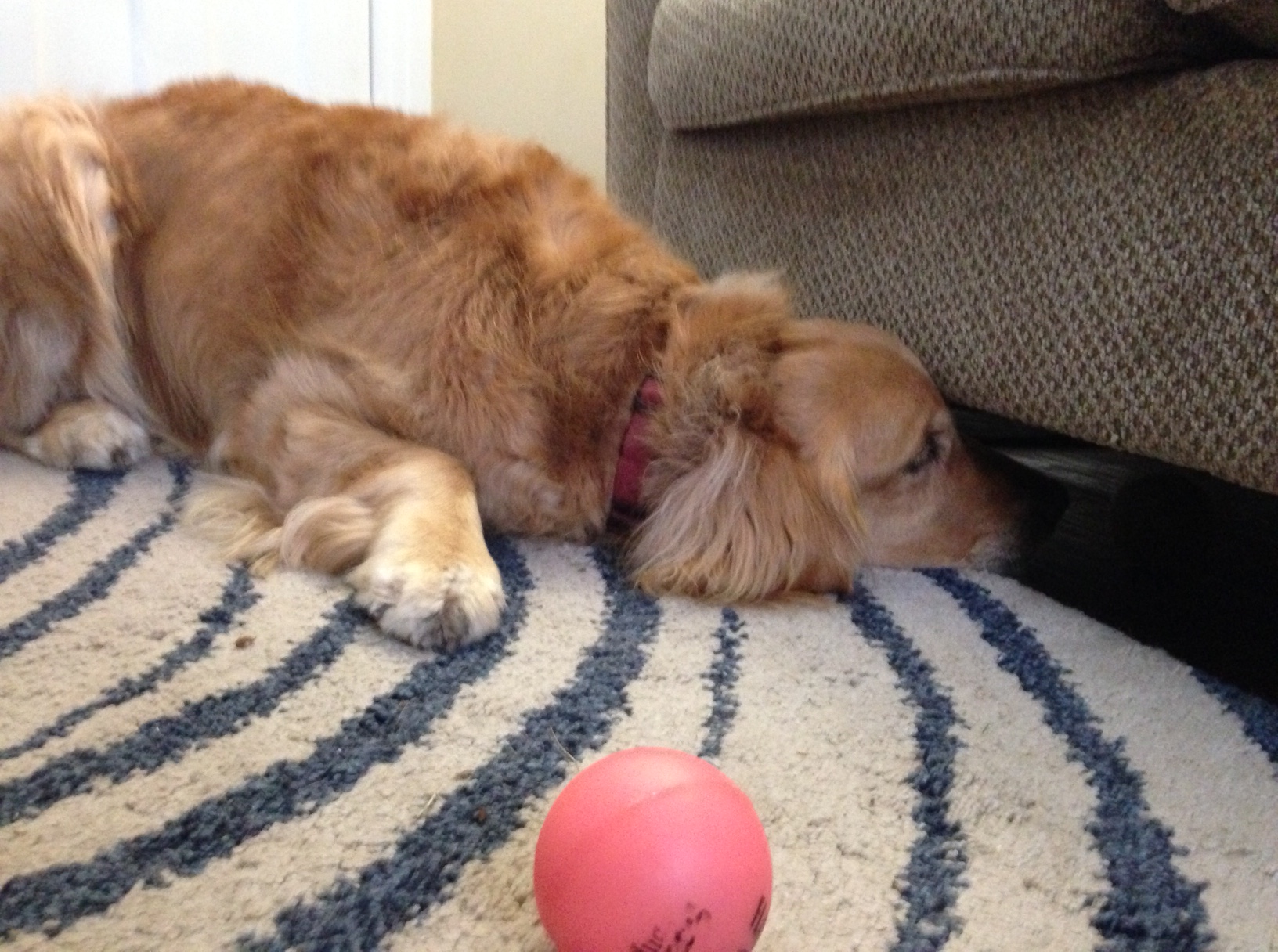
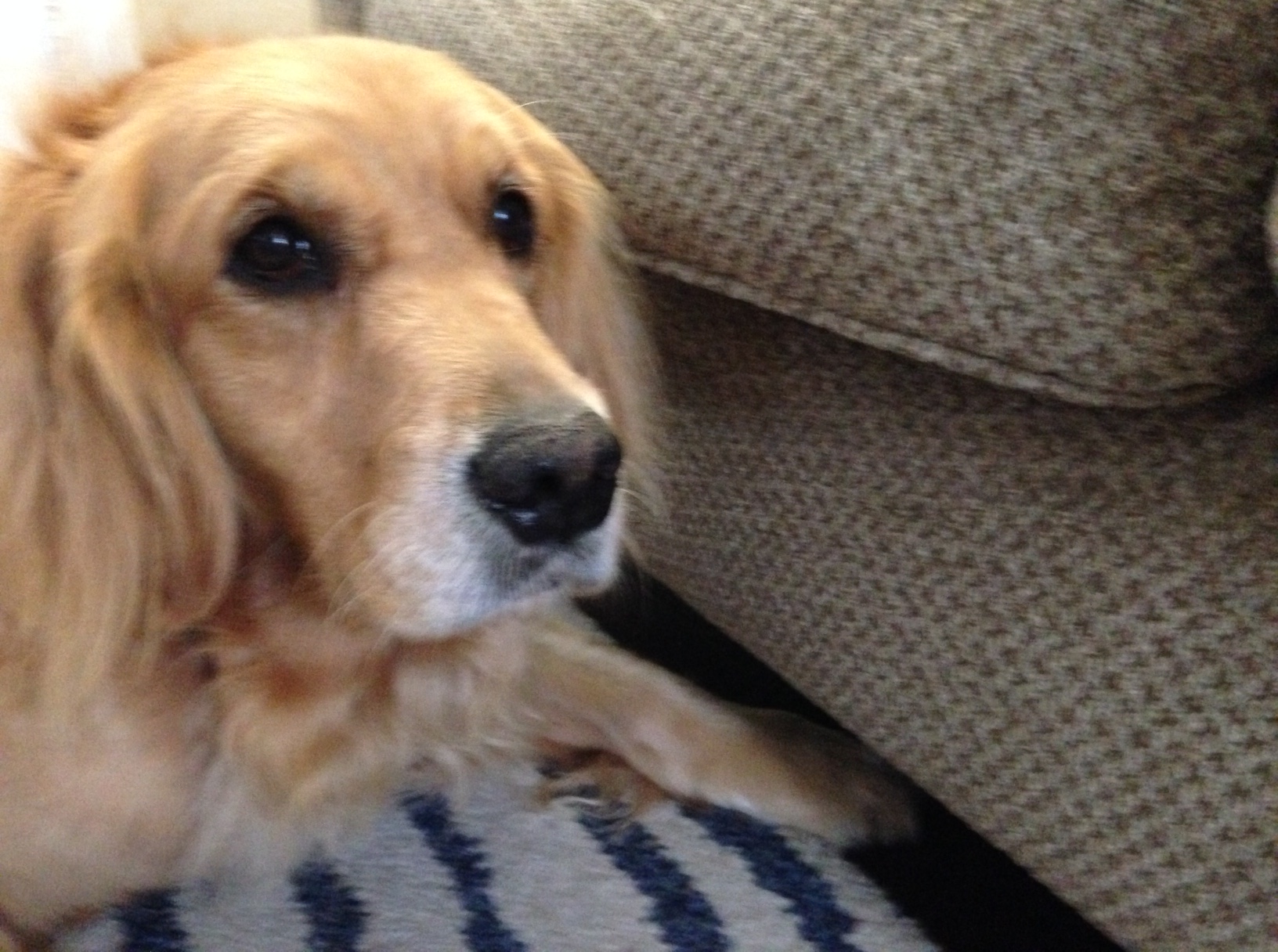
IMG_3201I was on deadline, struggling to communicate with my computer (and failing). Cali came over and ever-so-gently nudged me. I patted her and kept working. Another nudge. I had taken a ball-throwing break about 10 minutes earlier, so I distractedly said, “Not now,” and kept working.

Another nudge. I ignored her. More nudges. Insistent, but so, so gentle and sweet. I patted her, told her to wait a few minutes, told her she was cute. Not what she wanted. This went on for about 10 minutes, I’m embarrassed to admit.

Finally, deciding that rebooting my computer was the only possible step, I shut everything down, rebooted, and got up. “OK, Cali, where’s your ball?” I asked, wandering outside.

Cali wasn’t outside. Neither was her ball. I called her again and looked around the yard. No Cali, no ball.

IMG_3195I went inside. Cali was standing in front of the sofa. She came to me, then walked back to the sofa. Touched it gently. Looked under it. Touched it. Looked at me.

The ball was under the sofa. Actually two balls were under the sofa, one dry, dusty, covered with tufts of fur. So much for my housekeeping skills. And my communication skills.

I gave her back the ball. She graciously allowed me to throw it twice, but really, all she wanted was her ball. And her long-lost second ball. She happily stretched out in the yard nuzzling the balls as I went back to work.

I’m constantly amazed by how clearly our dogs communicate — if we’re paying attention. And of course, this clear and detailed exchange reveals how little actual words matter to human-dog conversations. No, our communication does not suffer from dogs’ inability to speak human language. It suffers from our inability to pay attention, to focus on what they are saying — without words, but with eloquence nonetheless.

Bubba for President

My name is Bubba, and I approved this message.

I spent some time recently with a wonderful dog, Bubba. The first time we got to hang out was right after a particularly vulgar Republican presidential debate, and the contrast got me thinking about how this dog (and many, many other dogs) embody traits I’d like to see in a presidential candidate but that are sadly lacking in the current Republican contenders.

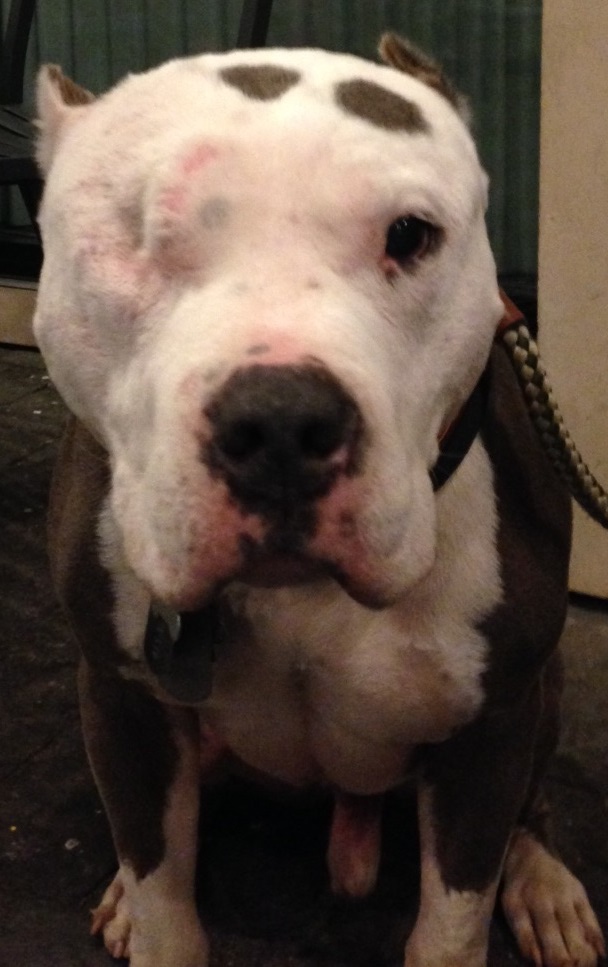
Some background: Bubba is the spokesdog for a local rescue organization, the Petaluma branch of Marley’s Mutts. He experienced some of the worst abuse that anyone can imagine. Actually, it’s worse than I could have imagined before reading his case file. The amazing Sacramento DA who put Bubba’s tormentor in prison, will be Skyping in to my dog law class, so I had to read the entire file.

I generally don’t give my students “trigger warnings,” but before posting these documents, I not only warned them, I put little Adobe sticky notes in the PDF to flag particularly graphic sections. It was that bad. I won’t go into details here, except to point out that Bubba’s missing eye is the result of repeated injuries caused by the monster who abused him.

So why does Bubba trump any current candidate in the Republican field?

He’s not angry or vindictive. He’s suffered real injury, unlike many Tea Partiers or angry primary voters. Rather than seek a scapegoat or, say, hold all white men responsible, he has forgiven all humans. He loves everyone. He eagerly approached every new person who entered the fundraiser where I was visiting with him. His tail was always wagging, his face openly welcoming and friendly. He was gentle with small children. He appropriately introduced himself to and played with a 4-month-old Rottie puppy who stopped by, and he was equally friendly with the several other dogs there.

He’s goal-oriented, too. When he detected a whiff of potential treats emanating, say, from my pocket, he focused on me like a laser, using the mind meld that Jana has perfected over the years. “Feed me a Charlee Bear. Feed me a Charlee Bear.” It worked. He also mind-melded the server, who brought him at least six cookies, and that was just what I saw. Nothing gets past this dog; he carefully checked all newcomers for the scent of treats. He just might be a Labrador wearing  a very convincing disguise.

Bubba doesn’t back down in the face of an army. When he met my class of 20 students a week later, he sized up the challenge, then gave each one a warm greeting — and the sniff test. He very quickly figured out that the little black pouches many students had contained treats, and he went to work. The students never stood a chance. Bubba probably didn’t need dinner that night.

What else does candidate Bubba have to offer? I’m not sure what his health care plan includes beyond “kisses to make it better,” but the price sure beats my current insurance, and it is a treatment with a long track record of success. His education platform emphasizes motivation and rewards. And, though we didn’t discuss specific issues, his domestic and foreign relations approach heavily focuses on interspecies cooperation, collaboration, and peacemaking; he disdains the threats, calls for attacks, and shunning of those who are different that are so much a part of the current campaign.

In all, he’s an admirable candidate. He’s overcome a difficult past, shows intelligence and integrity, and has a demonstrated ability to cross the (species) aisle and negotiate favorable deals. Bubba has my vote!

Please Back Off

Not all dogs are as fortunate as Molly. Molly’s parents wrote to The Thinking Dog, asking for help getting people to understand that Molly needs her personal space. In this post, I am speaking for all dogs who are not as lucky as Molly.

Personal space is a cultural issue. Americans tend to like more of a bubble around them than people in some other countries. I’m not sure whether dogs in different countries or cultures have different needs for personal space, but I am positive that all of the dogs I know need people to respect that bubble. Especially people they don’t know well.

Dog bite stories in the media often say that “it came out of nowhere” or that the dog gave no warning signs. This is rarely true. Spending a few minutes looking at Facebook postings of photos and video of dogs with babies and children is a great way to gather photos of dogs showing dozens of warning signs or pleas for space. Watching those news videos of the “bites that came out of nowhere” also offers a catalog of behaviors that are clear warnings.

It’s not only children who do things that cause annoyance or stress to dogs: A particularly chilling video I’ve used in canine communication classes is one where a news anchor is severely bitten after putting her face right in the face of a stressed, overwhelmed dog — a dog who has spent the previous couple minutes (or more; it’s a short video) asking her to back off in every way a dog can.

The problem isn’t that the dogs are not giving fair warning, asking for help, or both; the problem is that most people aren’t listening or simply don’t understand the signs. Here’s a list of the most common stress signs:

  • Licking lips or nose
  • Turning the head away
  • Whale eye — wide eyes with the whites very clearly visible
  • Yawning
  • Ears back
  • Tail tucked
  • Scratching — self or the ground
  • Sniffing
  • Shaking or shaking off (as if shaking off water)
  • Bowing
  • Stress smile
  • Red eyes
  • Sweaty paws
  • Panting
  • Hypervigilance
  • Freezing

What do we do that is stressful or threatening to our dogs? Most dogs do not like being hugged or patted on the head. Frontal approach with direct eye contact is scary for many dogs. Many dislike rough petting or play hitting or people bending down, putting their faces right up close to the dog’s face and kissing or blowing at them or baby-talking them. In short, if you would be annoyed if someone did it to you, don’t do it to a dog, especially a dog you don’t really know. This doesn’t mean you can’t cuddle your dog; it means you should look for cues that he is enjoying — or uncomfortable with — what you are doing, and respond accordingly.

Some of the signs listed above do double duty: They are also what is commonly called “calming signals.” These are body language cues that dogs use to calm themselves or others. Dogs will direct calming signals to other dogs and to humans. A well-socialized dog responds appropriately — backing off, giving the dog some space, or responding with calming signals of his own. Unfortunately,  the signals are often subtle and, when noticed, misunderstood by many humans.

Cali stress
Stressed Cali

For example, the smile. A smiling dog might be a happy dog; depends on the smile. These photos show a happy Cali and a stressed Cali. She’s “smiling” in both. But in the relaxed, happy photo, Cali’s eyes are soft, her smile is loose and relaxed; in the stress photo, her eyes are hard and tense, and her mouth is tighter. For many additional (better) photos of stress, take a look at these blog posts by Eileenanddogs: “Dog Facial Expressions: Stress” and “Is That ‘Smiling’ Dog Happy?


Happy Cali
Happy Cali

Other common calming signals that could be early signs of discomfort or stress are the licking the lips or nose, yawning, and turning the head away. When you notice these subtle signs, it’s a good idea to remove your dog from a situation that is becoming unbearable for him. Some dogs lick submissively — no, the dog is not “kissing” you because he’s enjoying the close attention — or shake or try to leave or hide behind their owners.

If the dog can’t escape the situation and the “aggressor” doesn’t back off, the dog is likely to escalate. Bared teeth, soft growls, or air snaps might be the first steps when a dog feels that he has no choice but to defend himself. And if the owners have taught the dog never to growl, as so many believe they should … the dog might just bite “without (obvious) warning.”

We’re our dogs protectors. It is our job to learn their stressors, heed their calls for help, and remove them from stressful or overwhelming situations.

Additional Resources

Want to learn more about dogs’ stress signals? Here are some articles and blog posts that offer good info and advice:

Your Dog Hates Hugs, by Melissa Dahl

It’s Only Funny Until Your Dog Runs Out of Spoons, E. Foley, Your Dog’s Friend blog

You’re Too Close! Dogs and Body Pressure, eileenanddogs blog

The Gift of Growl, Pat Miller

Preventing Dog Bites, Patricia McConnell

A Canine Stress Dictionary, and Signs That Your Dog Has Stress, and so much more on the Whole Dog Journal website


Agility Offers Fun for Thinking Dogs

lost in the tunnelCali and Alberta started taking agility classes a few weeks ago. Watching Cali puzzle through things and figure out what we want has been fun. I can almost see the wheels turning in her little head.

Alberta is more experienced with dog sports and classes, having nearly completed her Rally Advanced Excellent title. She catches on very quickly, but knowing what we want her to do doesn’t keep Alberta from showing her silly side in class sometimes.

In the first couple of classes, we worked on targeting a small piece of foam on the floor. Both girls are proficient at hand targeting and were able to touch our hands, on cue, no matter whether we placed them high, low, on our backs, or anywhere else. Getting them to touch the foam mat was easy, too, but … both Cali and Alberta quickly went from simply touching it to retrieving it. Alberta, in particular, has a great working retrieve and has often been rewarded for bringing Deni items that Deni didn’t even know she had dropped.

I’ve been working on teaching Cali to bring my shoes, and, like Jana and Oriel before her, she has shown some entrepreneurial spirit, bringing things that I don’t even know that I need (or want) — in hopes of exchanging them for a small cookie.

So it’s not surprising that both Cali and Alberta think that we want them to retrieve the small mat, rather than simply touch it. Or perhaps they know that we want them to touch it but prefer to retrieve it.

They both are eager to jump onto the agility equipment, out of turn or when we’re waiting for our turn at a different piece of equipment. No fear from either of them; just eagerness to learn more and try out new challenges.

Practicing at home is also fun (and can become a three-dog circus pretty quickly). Jana wants in on the action, and when I was guiding Cali through some fake weave poles, Jana knocked one over with a swish of her tail — while grabbing another and running off with it in her mouth. Meanwhile, Alberta knocked over the other two! Poor Cali never had a chance. With more practice, though, we have managed to get all three girls to walk between the poles, though we still occasionally lose a pole or two to a swishing tail.

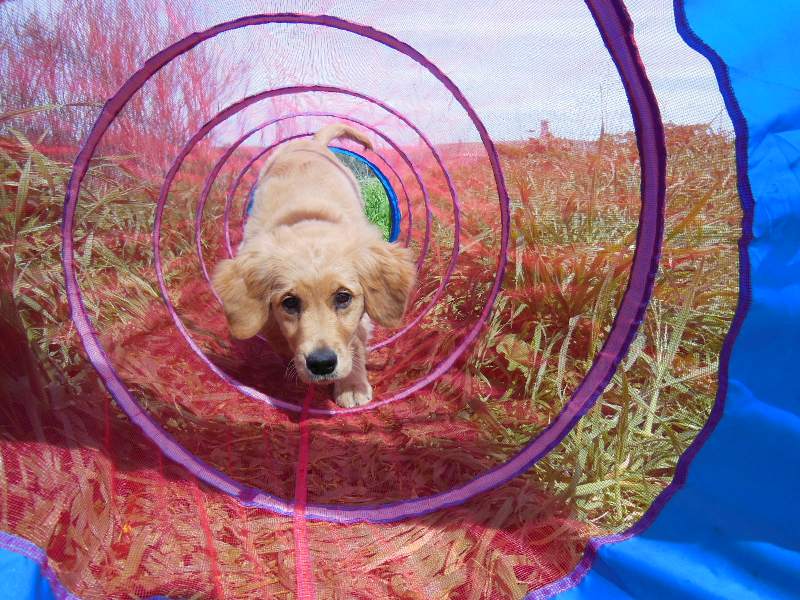
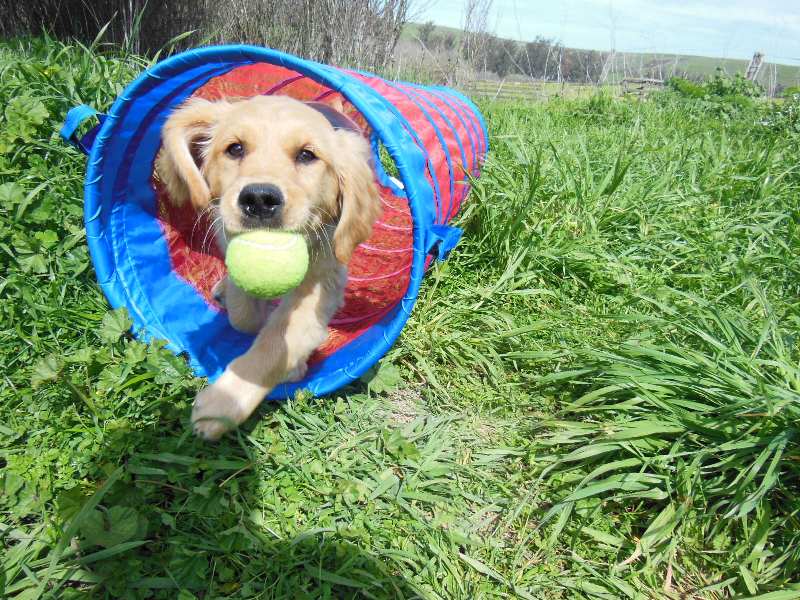
Out of the tunnelNone of our girls has any trouble with tunnels, though Cali did try to circumvent the tunnel once, taking a shortcut to where I was standing. She has always loved tunnels. Cali had a wonderful little play tunnel when she was a puppy, and Jana had plenty of exposure to tunnels before her first agility class. So neither of them hesitates, even when the tunnels are curved or have a piece of fabric covering one end, though many dogs resist entering a tunnel if they cannot see through to the end of it.

I thought about this last week as I was working with a neighbor’s dog, an adolescent golden retriever who is unwilling to use her dog door. The door flap makes her nervous. I rigged up a tunnel using a small table and a towel, and after a couple of sessions, she was willing (though still not exactly eager) to go through it for cookies. She’s uncomfortable with the small space, the towel brushing her back, and her inability to see what is coming. She’s improving, but she reminded me of how important it is to expose dogs to all sorts of tactile experiences, starting at a very young age.

Even that is not foolproof, though; this dog did use the door flap when she was younger, until she had a scary head-to-head confrontation with the cat as she went through the flap. My jerry-rigged tunnel will (I hope) help build her confidence in the same way that agility classes are boosting Cali’s confidence and awareness of where her body is. Classes in agility or other dog sports are a lot of fun — and they improve the dog’s focus on you and your communication with each other. Besides, they provide plenty of mental challenges to your thinking dog!

Get Healthy, Get a Dog

I was excited when I read about Get Healthy, Get a Dog, a new report from the Harvard Medical School that describes the connections between life with a dog (or dogs) and better health. The article I read in Bark magazine was very enthusiastic, and I immediately purchased a copy of the report, a collaboration between Harvard Medical School and Angell Animal Medical Center (in Boston). A few days later, I settled in to read the whole 50-page document … and was deeply disappointed .

It’s not that the report contains anything negative. In fact, the first section is an excellent review of the many studies that have shown physical and emotional benefits of sharing life with a dog. It offers scientific support for what we all know: Dogs are great company, get people to exercise and take better care of themselves, and help people connect socially and feel less isolated. Great!

There’s a big problem with this part of the report, though: It lacks proper citation of the studies, and there is no list of references. The report does not offer enough information for readers to find the original studies. I expected more professional work from Harvard.

As a person with considerable expertise and experience in working with service dogs, I was especially disgusted by the section on service dogs. The definition provided for service dogs is wrong and misleading, and the authors confuse therapy dogs with service dogs, a common, but inexcusable, error.

I was especially looking forward to the section mentioned in the Bark article where dogs get their turn: Half the report is dedicated to describing what responsible dog ownership entails. Sadly, this portion of the report is very superficial. It reads more like the pet column of a newspaper than a carefully researched report. An example: After a thorough description of canine obesity (complete with the ubiquitous diagram), the authors suggest “limiting” treats to 10 percent of food intake, or “about seven medium-size dog biscuits” for a 70-lb. Labrador. Seven biscuits a day? Just for existing? Not in my house!! (To be fair, they do mention the possibility of using carrots or apple slices as treats and suggest putting the treats into a Kong so the dog has to “work” for them.)

There’s a lengthy section on exercising with your dog with heavy emphasis on exercising safely. As many dog owners do, I live in a moderate climate, so I found the inclusion of skijoring on the list of suggested activities a bit odd and the absence of activities like Rally, flyball, dock diving — and other dog sports that people have actually heard of — unfortunate.

The paper concludes with a short and not comprehensive list of dog resources, primarily a disjointed collection of dog-related organizations, and a brief glossary (which defines skijoring but not service dog). While such a list can never be exhaustive, it would be easy to prepare a better, more coherent list, as well as a list of the studies and books cited.

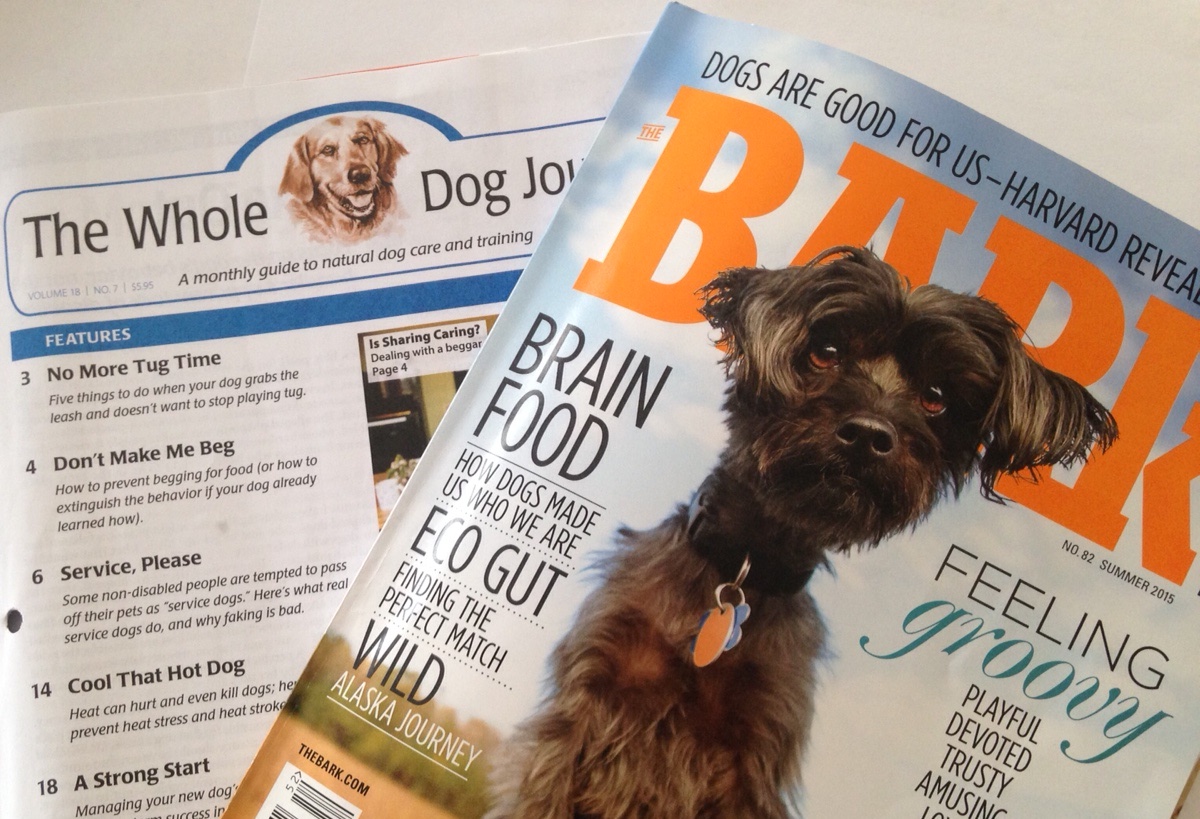
Save your $18 ($20 for a print copy); better yet, spend it on a subscription to Whole Dog Journal  or Bark. One issue of either of these outstanding dog magazines offers more, and more current, information than this second-rate report.

Note: A longer version of this blog post is published on Barks from the Guildthe blog of the Pet Professional Guild, where I am a monthly contributor.