A Helping Hand Could Keep Some Pets at Home

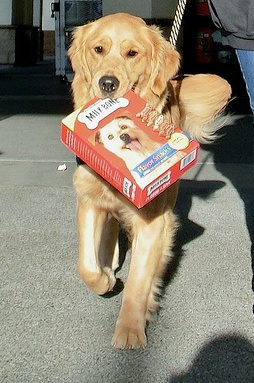
A golden retriever carries a box of dog biscuits
Delivering pet food could keep some dogs out of shelters (photo by Sae Hokoyama)

Not all dogs and cats who end up at shelters are unwanted. Some families abandon their pets because they cannot afford to feed them or house them or provide needed veterinary care.

An article I read recently in the New York Times suggests that the “no-kill” shelter movement might unintentionally contribute to the problem. By focusing on getting dogs and cats into new homes, the shelters might be neglecting the reasons many of those animals are in the shelter in the first place.

It might be time for some creative thinking and number-crunching. I’d guess that it costs less to feed a dog than to house him in a shelter until he can be placed in a new home. It certainly has less of an emotional cost for the dog and all the humans involved.

Whether they never should have gotten a pet in the first place, or they were doing fine until a health crisis, job loss, or other financial disaster hit, many people who love their pets find themselves short of cash at one time or another. Finding ways to keep these families intact (pets are family too!) makes more sense than sending the dogs and cats to languish (or die) in shelters.

I don’t for a minute think that that is the only reason animals end up in shelters, but it’s probably possible to make a significant dent in the problem.

Here in Missoula, an organization called Animeals (which also has a cat shelter and cat adoption, foster, and hospice care programs) addresses some of these issues throughout Montana. Animeals runs a pet-food bank and delivers food to homebound, disabled, and senior pet owners, often providing the help that allows them to keep their pets. It feeds homeless animals as well, delivering food to volunteers who feed feral cats and dogs. Animeals also has programs to help families in crisis and to assist impoverished pet owners with vet bills.

Some Meals on Wheels programs across the U.S. deliver donated pet food along with the humans’ meals. And I am sure that other cities or states have local initiatives. Check into what’s happening in your area and consider donating pet food or some of your time. It’s a relatively easy way to make a big difference.


A New Puppy!

No, I am not getting a new puppy! A good friend is getting one though, so I have been thinking about puppy prep lately. In no particular order, here are some things we talked about.

Socialization

We visited my favorite local training school, Sit Happens, so that my friend could meet her puppy-to-be’s kindergarten teacher. We watched several young puppies play in carefully supervised small groups, and talked about drop-in playtime, classes, and, in good time, a more formal manners class. Little Maisy will be very well educated. Best of all, I get to go to puppy class, and I don’t have to get up in the middle of the night with the puppy!

Food

We selected a good quality, reasonably priced food for Maisy, making sure that it was from a brand on the Whole Dog Journal’s approved list. They do all the homework of choosing quality foods, checking on the manufacturing processes, where ingredients are sourced, and whether the foods are nutritionally sound and include high-quality, identified, meat-based proteins.

Toys

I suggested getting lots of chew toys, especially ones that can hide treats. Maisy will spend a few hours at home each morning and afternoon while her family is off at work or school. She’ll need to develop a hobby, preferably one that doesn’t entail thousands of dollars in repairs and remodels to the house. So. Chew toys.

A play pen

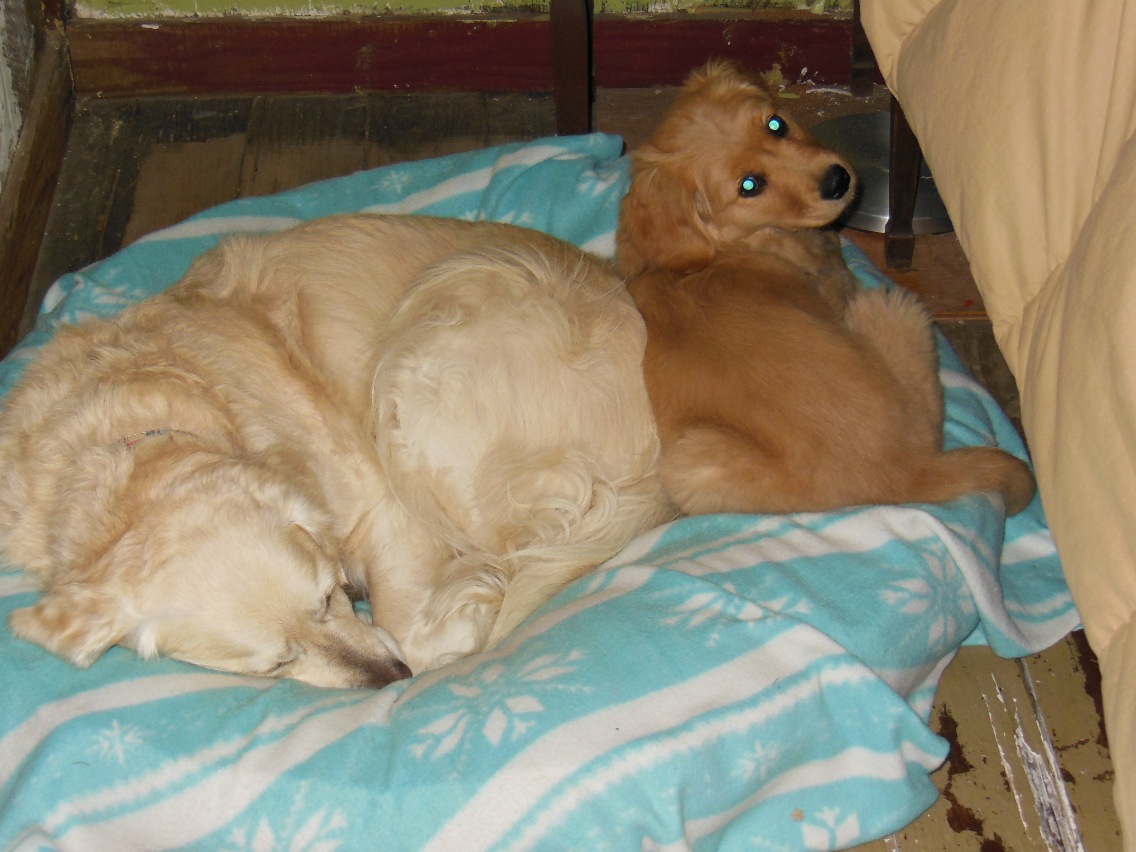
Little Cali, age 10 weeks, shares Jana's dog bed
Cali appreciated the comfort of her big sister’s dog bed from her first day home. She never chewed on or ripped it. Not all puppies are as wise.

I lent the doting parents an ex-pen to create a safe space for Maisy when she can’t be supervised. I suggested taping heavy-duty plastic to the floor, as my friends did when our girls (Cali and Dora) were young. Whenever the humans are away or distracted, I advised putting Maisy in her safe space with some chew toys. Of course, when they are home, they will spend lots of time playing with her and cuddling her outside the pen. And rushing her outside!

Maisy also has a large crate to sleep in, complete with cozy crate pad. And a plush bed for when she’s mature enough to sleep on it, not destroy it. Cali was ready for a big-girl bed pretty quickly, and Maisy might well show similar good sense and appreciation for creature comforts.

Grooming

I advised getting the puppy used to having her teeth brushed right away. It’s best to start slowly, letting her lick some tasty chicken-flavored dog toothpaste off the brush (or a finger), then gently starting to brush. Cali loved brushing her teeth as a puppy. Now she’s reluctantly willing to do it, for a cookie.

Same goes for nail trims and brushing. Start right away but introduce it all very gradually and use lots of treats. It’s so much easier to trim a dog’s nails when she’s used to having it done. Cali doesn’t love it, but I can Dremel her nails in a few minutes with minimal fuss. I know several people who cannot touch their dogs’ nails and whose vets or groomers need at least two helpers. It shouldn’t be that traumatic. If you are fortunate enough to get your dog as a youngster, take advantage of the opportunity to introduce grooming early and painlessly.

Sleep

I advised the new puppy parents to rest up, since Maisy will demand a lot of time and energy during the first days as she settles in — and even more throughout her adolescence. I was exhausted for several weeks after getting Cali, and she was a pretty easy puppy.

It’s worth it though; Maisy will no doubt be a great addition to the family.

Wrong on So Many Levels …

a poster announces that service dogs are welcomeI was in St. Petersburg when the Tampa Bay Times ran this story about a “service dog” whelping a litter of puppies at the Tampa airport. Columnist Daniel Ruth’s response is spot-on. This is so, so wrong.

The initial article said that the dogs’ owner claimed both dogs (the puppies’ dad was present for the whelping) were service dogs; it also said the puppy-mom was a service dog in training. The initial article says that the owner has mobility issues; Ruth’s column mentions blood pressure. It’s impossible to know which is accurate or whether the owner meets the ADA definition of a person with a disability. It’s also impossible to tell whether either or both dogs do anything to mitigate the disability. While the reporting could be more clear, part of the problem is that the various laws covering public access and air travel with service dogs are so vague and poorly written that they are a nightmare for gatekeepers — and an engraved invitation to fakers. (I’m not saying this person was faking; I am saying it is nearly impossible to know.)

The second problem is that it’s legal in some cases for people to use two service dogs and request public access with both simultaneously. I know that people might have multiple disabilities that a dog or dogs can help with. And if you’re an owner-trainer and want to train a dozen service dogs for yourself, I don’t think any law should stop you. But I also advocate for some common sense in access laws.

I’ve worked with dozens and dozens of service dogs. Even the best dogs get spooked in airports or on planes, and I know that it’s hard enough to find and train one dog for the really difficult, demanding job of working while traveling, through an airport, and on an airplane. Expecting someone to be able to safely handle more than one dog in these circumstances, while dealing with the many hassles of travel — that’s just not reasonable. It’s not fair to other travelers or to airline staff. No one can predict what will happen. I’ve seen “service” dogs react aggressively to working dogs, kids come out of nowhere to grab the dogs in a hug, people interfering with dogs by doing everything from reaching to pet to trying with gestures and noises to distract the dog to actually enticing working dogs with food.

Add to that the exploding number of emotional support animals traveling these days — a concept that many people, including Ruth, in his column, have trouble separating from service dogs — and I’m surprised that any dog can navigate air travel without losing her cool. Expecting a person, any person, to keep tabs on multiple service dogs with all of that going on, and keep everything under control so that the traveler, dogs, and everyone else is safe? Not realistic.

Finally, the most egregious part of this story: Who boards a plane with a dog who’s that pregnant? It’s not that hard to know when a dog is due to whelp. Gestation is about 60 days. If your dog has been bred, don’t travel after about 6-7 weeks. And that doesn’t even address the bigger issue: Any professional service or guide dog trainer will tell you that a working service dog should be spayed or neutered. Regardless, a pregnant female shouldn’t be working that close to her due date. And if she is a service dog in training, as some accounts said, she shouldn’t have been allowed to fly anyhow; no law gives access to service dogs in training. (In a probably vain attempt to forestall criticism, I will state that I think that trainers should be able to fly with dogs-in-training, but that is a whole separate issue.)

A service dog partnership is not a one-way street. The dog helps the person in a way that only a dog can. The dog also provides companionship and love. In return, the person owes the dog care and respect. I don’t doubt that the owner of these dogs loves them and appreciates their service. But she did not fill her obligations as their guardian and steward and advocate, nor did she show respect for the dog when she let a working dog become pregnant and then attempted to fly with that dog so close to her due date. The person’s needs do not always come first, and in this case, the owner was selfish and irresponsible.

As a person who cares deeply about the human-canine connection while also deeply respecting the work dogs do for us, I become angry when I see or hear about any dog owner who treats her dogs that badly, whether they are service dogs or pets. (I’m not alone; the Times apparently heard from lots of others who were outraged.) While travelers who saw the puppy birth might have thought it wonderful, miraculous, cute (or gross), that this poor dog had to whelp her puppies in such awful, public conditions is outrageous.

What It’s Like to Be a Dog

Cover of Gregory Berns's book What It's Like to Be a DogI’ve had a serious crush on Dr. Gregory Berns ever since he published his first MRI studies. Those showed that dogs’ brains’ pleasure centers light up when they catch the whiff of a beloved human (or dog). There’s so much to love about his papers and his book How Dogs Love Us. So I was really excited about reading his newer book, What It’s Like to Be a Dog.

It’s well worth reading, and I enjoyed it. But … it wasn’t what I was expecting. There’s some really cool stuff, like the explanation of how dogs’ brains look when they’re doing the equivalent of the Marshmallow Test. I’ve played around with that a bit with Koala and Alberta, though I lack access to an MRI machine. So I was very interested in his findings. It turns out that some dogs do well with deferred gratification and others … not so much. You might notice that I haven’t talked about doing a marshmallow test with Cali. I don’t need a fancy machine to tell me that she lacks impulse control.

I was a little disappointed with some of the detours from living dogs’ brains into the long-ish discussions of the brains of deceased seals and Tasmanians. And I was distressed by the chapter on dogs and language.

I know that any sentence that pairs non-human animals with language raises the hackles of many people, scientists and non-scientists alike. I also think that there are many, many definitions of language and that dogs, particularly those with close human connections, understand a lot of what we say and do and they communicate with us in sophisticated ways. Lack of understanding of their “language” does not diminish its value. I get irritated when people choose a very narrow, very human-centered definition of language, such as one that is focused on semantics and grammar and written representation of a language, and then say, ‘see, only humans do this so only humans have language.’

Dogs communicate. They use their whole bodies — ears, tails, hackles, eyes, facial expressions, as well as scent and sound, to communicate. And dogs excel at reading the nonverbal communication of other dogs, humans, and often of other animals like cats. Other non-humans do this as well. Dogs are able to read humans far better than humans can read humans.

And dogs understand a lot of what we say to them. They might be assigning meaning to a combination of words and body language cues to understand our feelings, our desires, our mood rather than attaching the specific meanings that we do to individual objects or concepts. While I don’t expect Cali to speak to me in English or read the newspaper, much of the communication that I have with Cali — and especially what I had with Jana — is clear and meaningful.

Berns’s discussion of language, how he tested dogs’ understanding of words, and his interpretation of those results are very, very human-centric. He talks about the mirror test, which I believe is not a fair test for dogs. His comments on dogs’ lack of a sense of self or others: “My beloved Callie probably didn’t have abstract representations of me or my wife or my children. No, I was just that guy who feeds me hot dogs …” are off-base.

Dogs’ sense of self and others is primarily rooted in scent, not sight or sound. Berns himself showed that dogs recognize the scent of family members and respond differently than to the scent of unfamiliar humans or dogs. So I was mystified and saddened by what felt like a dismissal of the individuality of dogs’ selves and their relationships with key humans (or non-humans).

Despite a few disappointing chapters, I do recommend the book. I the insights into how dogs’ brains work are fascinating, and even where I disagree with Berns’s conclusions, I enjoy learning about his research and his understanding of dogs. Dr. Berns is still my favorite neuroscience researcher, and he’s a great writer. Check out both of his books if you haven’t already!


Guide Dog Haiku

Deni Elliott learns to work with Guiding Eyes Alberta, who is now retired.

Several Guiding Eyes dogs’ human partners recently posted haiku and other poetry to a graduates’ email list. The poems show their appreciation and love for their guides. A member of the list asked (and received) permission to share some of the poems, which appear below. Feel free to add, in the comments section, your own service- guide- or pet-dog haikus, odes, ballads … or tributes in any literary form.

Naughty puppy face
Harness on, working face on!
What to do without?

Night comes, harness off
Naughty puppy face once more
We dream together.


The trees and sky breathe
My golden girl goes forward
Our hearts together


My vision as wide
As a dog can see, hear, smell
Guiding Eyes radar


Walking by my side
You safely show me the way
Teamwork every day


Our talks as we walk
Open volumes clearly spoken
Unheard by strangers


They don’t know our language
We speak silently yet so loudly
RIGHT!  LEFT!  STOP!  I LOVE YOU!

A movement, a language, a laugh
in voices so clear to us
So invisible, so silent to strangers
Roxanne, I hear you

You speak more loudly
“You do, too, when you smile at me.”
I smile back
A wag of  tail
A snort and shake of collar
A lean against your leg
A huff, a snort.
I smile back

Strangers never know
We laugh out loud at them
Out loud but silently
Our talks when we travel
Volumes never heard so clearly spoken
So secret, so open


The partnership and communication between guides and their humans is unusual, but service-dog partners and working-dog partners often experience  a comparable connection. True communication develops best in relationships where both partners’ roles are recognized and each acknowledges the necessity and the significance of the other’s contribution. This idea goes to the heart of the Thinking Dog Blog and my reasons for writing it, which is why I wanted to share these heartfelt tributes to guide dogs, both working and retired.

It’s Genetic

Cali relaxes on her dog bed.

People love to speculate on when, how, and why dogs and people became friends. A study published on July 19 shows that it might just be genetic.

Here’s the story. A condition in humans, Williams-Beuren Syndrome, is the result of a missing section of genetic material, a section of DNA that contains about 27 genes, according to an article in Inside Science. The syndrome affects about 1 in 10,000 people, the article says; these individuals are “hypersocial,” with bubbly, extroverted personalities, as well as some other traits.

It seems that someone else’s bubbly, extroverted personality (I’m looking at you, Cali) might be related to a similar genetic hiccup.

In the course of studies of domestication and how it has caused doggy genetics to differ from wolf genetics, Bridgett vonHoldt, the lead author of the study, tested the friendliness of dogs and 10 hand-raised, tamed wolves. They measured how much time the dogs and wolves chose to spend in close proximity to humans and whether they worked at a challenge or sought human assistance. Predictably, the dogs both spent more time with the people and sought their help in solving the puzzle. Dogs do enjoy having staff.

However, the results had some variation, and in looking for reasons that some wolves were more sociable than others, the researchers found a clue: The genetic area that showed differences in the more- and less-social wolves corresponded to the genetic area that is missing in people with Williams-Beuren Syndrome. Friendly dogs and wolves had similar genetic variants; unfriendly wolves had genetic variants similar to each other and different from the dogs and the friendly wolves.

The researchers looked deeper. They examined the corresponding genes in dogs from 13 breeds. Breeds known to be friendly had profiles similar to the friendly members of the initial research group, while breeds known to be more standoffish had profiles that looked more like the unfriendly wolves. The study says that this genetic region is “known to be under positive selection in the domestic dog genome” — over generations of breeding, people have selected for the “friendly” genetic variation; these mutations are rare in wolves and even rarer in coyotes, which tend to be far less social than dogs and wolves. The same genes had been linked to friendliness in mice in earlier research.

Of course, a small segment of genetic material is not the only thing that influences social behavior. And theories about the domestication of wolves abound. But evidence is accumulating for a theory that basically says that that wolves chose to hang out with early humans. The friendlier, or less timid, wolves started scavenging near human camps and trash heaps. Over time, young pups and friendly adults inched closer to actual contact, until a great partnership was formed.

I have always been skeptical of the various human-centered narratives that had humans capturing and holding captive and bending to their will fierce wolves, all thousands of years before humans had metalworking abilities and tools that would make it possible to hold onto a wolf who didn’t want to stick around. I doubt that those unfriendly wolves, even the hand-reared ones, would stay put if tied to a tree with a leather strap. There had to be something else going on.

That the roots of friendship could center on food makes sense (again, looking at you, Cali). But even that explanation is not enough. While dogs and wolves are opportunistic — which means they will eagerly take advantage of opportunities to help themselves to a snack — early  humans were unlikely to have huge quantities of extra food available to just hand out to large-toothed scavengers skulking on the periphery of camp. On the other hand, if the scavengers were friendly and potentially useful …

An explanation that includes a choice on the part of the wolves, or at least some wolves makes more sense than the whole deal being human-instigated and controlled. And, as more people study the human-canine connection, more bits of information point to dogs playing an active role in establishing a mutually beneficial relationship with people, like this suggestion that some wolves were genetically inclined to be friendly and seek human company.

An additional reason that this study could be important is that researchers have long sought genetic explanations for complex behavior; this could be an important first step.

None of that really makes a genetic mutation a truly satisfying explanation for that waggy tail, wriggly, “let me show you my toy” greeting I get at the door … but the bottom line is, the dog-human friendship is pretty wonderful. If that’s where it started, well, I’ll take it.
 

Too Hot for Dogs!

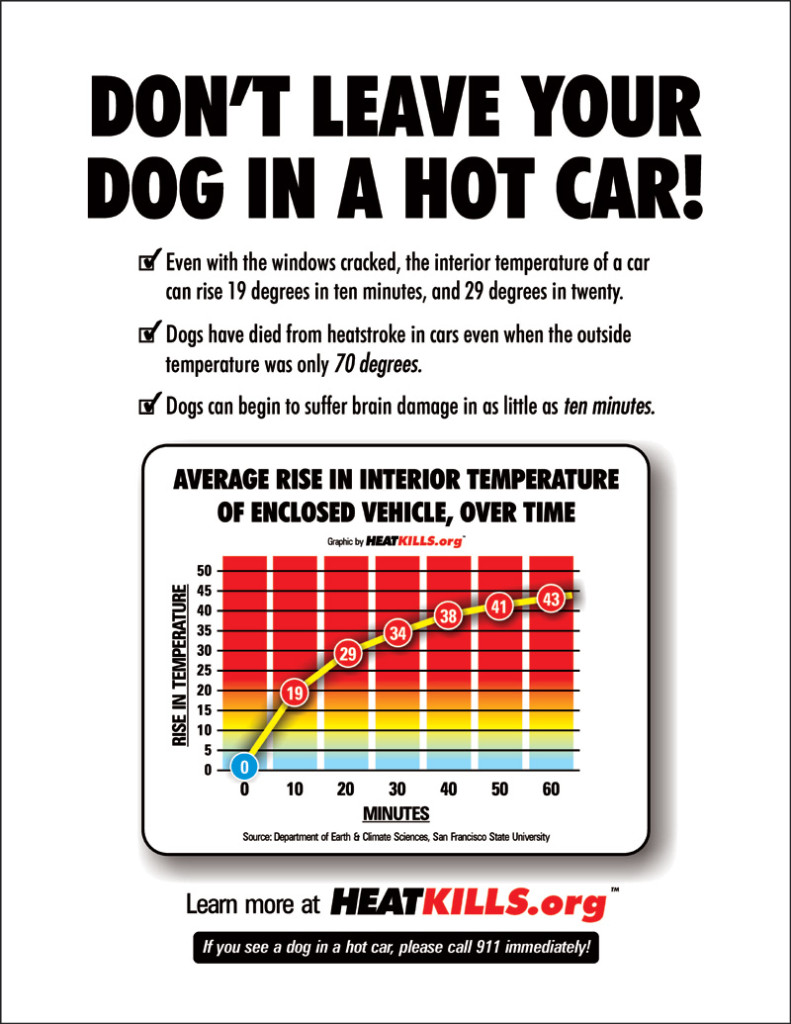
Graphic image showing how quickly a car can heat up on a hot day from heatkills.org
Downloaded from Heatkills.org

It has been in the 90s pretty much every day since we got to Missoula, Montana, our new home. If it’s this hot here … well. Dogs everywhere are suffering.

I know I don’t have to remind readers not to leave a dog in the car for even a minute in this heat. No way, no how, it is too hot for that.

But what about walking them?

Hot pavement can burn pads and paws. Sand, dry stiff grass, seeds, etc. can poke and scratch. Hazards are everywhere.

When the temperatures are in the upper-80s and above, the sidewalk can get very hot. You might not notice it through your shoe soles, but think carefully about where you ask your dog to walk. This is a huge concern for service dogs, since they are more likely to be out an about in any weather than pets. What to do?

First, avoid blacktop. Let the dog walk on grass or dirt wherever possible. Gravel gets hot, too. Light-colored sidewalks are better than asphalt, but in this heat, they will be hot too. If it feels hot to your feet or the palm of you hand, it’s uncomfortable for the dog. Let the dog stay home if possible. Or walk early in the day, before the sidewalk gets hot.

A recent discussion on a service dog email list settled on two possible solutions for dogs who must go out on hot days: booties and paw-protecting cream.

The best booties, the consensus is, are these: Ruff-Wear Grip Trex. Guiding Eyes for the Blind recommends them, too. These are more suitable than regular dog boots because they have a breathable mesh top. Even so, booties are not an ideal solution. They can be hard to put on and take off, which is an issue for many service dog partners. In addition, and possibly more critical in this heat, is that dogs need to sweat through their paw pads to cool off. These booties let some sweat evaporate, because they have that mesh top, but I still worry that the rubber sole will interfere with the dog’s ability to cool off. If you use them for short outdoor walks and remove them as soon as you get indoors, they are probably a great solution. If your dog tolerates them … and that is the final objection: Most dogs hate booties. Some people begin conditioning very young puppies to wear socks or booties, and they might have some success. Some dogs are just OK with stuff on their feet. But most dogs? Not happening.

So option two, which is also an option for winter, might be a better choice: Musher’s Secret. I just got some. It’s easy to apply, and seemed to absorb very quickly. Cali didn’t object at all, and she really isn’t crazy about having her feet handled. One review I saw online said Musher’s Secret helps dry, cracked noses heal, too. I have noticed that Cali’s nose and feet are dry and rough; I hope this helps get them back to a healthier state. Many online reviewers love Musher’s Secret; a small minority hate it. Stay tuned for a report on the state of Cali’s nose and toes.

Other ways we’ve dealt with the heat? I got out the wading pool for Cali, Mack, and Alberta the other day … and they all ignore the cool water and wondered why I had dunked their favorite toys. Silly girls. Yesterday, Cali finally got to explore Jacob’s Island, a dog park in the middle of the Clark Fork River in downtown Missoula! How great is that? A sandy-legged, smiling Cali was led reluctantly from the park after a spirited splash in the river with a young Lab mix. We’ll need to do that more often!

Lessons from the Original Thinking Dog

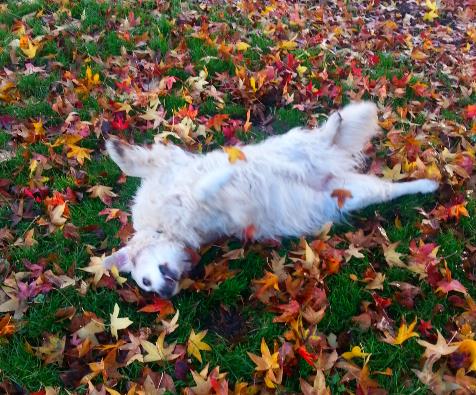
A happy Jana rolls in leaves on a lush lawnI had hoped to be celebrating Jana’s 14th birthday today, July 2. Instead, Cali and I have moved to Montana without her; we marked her birthday with a walk to a place she loved, Mormon Creek. We were with Koala, Storm, Ki, and Django. Quite a few dogs are missing from this group.

Rather than dwelling on the sadness of missing Jana, Ory, Weizer, Gus, Cedar … I am thinking about some of the most important things I learned from Jana during our years together.

Before I met Jana, I knew that dogs were smart and could start learning just about as soon as they opened their eyes. Even so, Jana astonished me.

A very young Jana studies her Kong toy.
Jana was a young Kong addict

I met Jana when she was only about 4 weeks old — not long after she opened her eyes. She came home at 7 weeks and started learning things immediately. First, of course, she learned about treats; that took about 2 seconds. She never met a treat toy that could keep her from her food for more than a few minutes.

As a puppy, and even an adolescent, Jana was an easy dog to live with. For instance, though she was the first puppy I housetrained, Jana learned to toilet outside almost immediately — she was a very clean dog in that way — and she quickly developed a strong preference for grass. She was never destructive as a puppy, though she was always vocal when displeased, starting with my initial (failed) attempt to crate train her.

Very quickly, Jana learned about stairs — mastering them when I left her downstairs and ran up to grab something. Not 2 minutes later, I walked down the stairs to find my tiny puppy hoisting herself up the huge staircase. Though she ultimately learned to accept boundaries and would respect even so flimsy a barrier as a partially closed door, she also wanted to be with me. As a young puppy, this manifested first with the stairs and later, with her flying leaps over the baby gate that was meant to keep her safely enclosed.

And Jana quickly learned to respond to verbal cues — so many that I can’t list them here. She picked up new skills so fast that I had to work hard to come up with new challenges. She would do anything, figure out anything, solve any problem for the chance to earn a cookie. Watching her was amazing. I could see the gears turning as she tackled problems and figured out the names of items she was asked to retrieve, what the laser pointer was indicating for her to do, how to brace herself on a door jamb to pull open a door, how to extract treats from the very small hole on her treat toy …

Jana lies on her back to squeeze treats from a toy into her mouth

Jana’s intelligence accompanied her fierce independence. Thus, I also learned from Jana that her agenda and priorities might often be misaligned with mine, and having opposable thumbs did not mean that I always got my way. We learned to negotiate, compromise, and respect each other’s differing perspectives. For instance, I was forced to accept her definition of cuddling: Sharing space, perhaps on the same bed, more likely in the same room. Limited physical contact on her terms only. Jana was not like the typical golden; she needed few friends, but if you were a person she’d decided she liked, you had a friend for life. Her chosen people got very warm greetings, and Jana actually chose to spend time with them, even seeking them out. The best compliment was being invited to play a game of tug.

The truth is, Jana and I shared a lot, and I could fill books with what I learned from her. I know that she had a great life, and I am grateful that she had a dignified, relatively quick and pain-free death, but I still miss my princess every day. Happy birthday, Jana.

Jana had a knack for finding large heart-shaped rocks; here is one from her collection


In Her Own Time

Koala, a black Labrador, relaxes on a hammock-style dog bed

I wrote last week’s post on Koala and her reluctance to move to a big-girl bed a few weeks before it was published. Since then, she went on a long visit (with Deni of course) to Deni’s mom’s house. There, she did not have a crate. And, she decided, upon returning home, that she was ready for her grown-up bed. She wouldn’t even look at the crate. Crates are for babies, she said. Why would I want one?

The crate is gone.

I think it is more about choice than about where Koala sleeps. She wants to — and should be able to — make choices about things that affect her quality of life (to a reasonable extent, of course … Cali does not get to do the grocery shopping, for example, and neither does Koala).

I’ve had an interesting email conversation over the last couple of weeks with a reader who has taken her dogs’ communication and ability to make choices to an unusual level. She uses an approach similar to what I have seen a few other people do, which is to present two options and have the dog choose a hand. Left for yes, right for no, or left for “go for a walk” and right for “play ball.” Things like that.

I have not taught this to very many dogs, but Jana and Cali picked up the idea pretty quickly. Cali’s favorite daily choice is between two tennis balls (yes, she’s a bit obsessed). Our morning routine goes like this: Walk to the park. She skips and dances ahead and has to be reminded not to pull. As we get close to the gate she literally wriggles with joy and excitement. She gets to the gate first and stands at attention, touching the gate with her nose. I open the gate and reach down to unhook her leash. She bounds into the park, turns and sits, looking eager and expectant. I pull the Chuckit and two tennis balls out of the bag. I offer her both balls. She sniffs each one deeply, sometimes wavering, then makes a choice. She watches carefully to make sure I don’t pull a fast one, swapping the balls. I put the rejected ball away, slip the chosen ball into the Chuckit, and throw.

Occasionally we have a variation: She somehow gets hold of a ball at home and carries it to the park. I throw that one.

She always carries her ball home from the park.

The point is that, along with getting to play her favorite game, (which is not what you think) she gets some control over that game. The game, by the way, is not fetch or catch. It’s: Run after the ball, grab it, then keep it away from everyone else, human, canine, avian, or whatever, in the vicinity. Occasionally let a human get it and throw it again. Repeat for as long as you can get the humans to cooperate.

Anyhow, in addition to that, Cali gets to choose. She takes her choice very seriously. There are other choices in her day. She occasionally gets to choose between two treats or two games; she might get to choose whether to go for a walk or have a play session; she often gets to choose which direction we go on a walk. But really, she doesn’t have that many choices in her life. The few areas where she gets to exercise some control are important to her. I think that’s true for Koala as well. And for every other intelligent creature, canine or otherwise.


Mind Your Manners

Wylie, a polite dog?Wylie hates peanut butter. It literally makes him gag. That’s why this story, from several years ago, is still one of my favorites: It tells me something really cool about dogs.

When Wylie was about to retire as a guide dog, his best friend t work brought him cookies. Very special gourmet dog cookies. One problem: They were peanut-butter cookies. Deni graciously thanked her colleague and said gently that she wasn’t sure Wylie would like them; he was fussy. The friend said, let’s see. He offered Wylie a cookie. Wylie accepted the cookie with appropriate doggy gratitude and ate it. The friend went happily on his way, feeling good that his gift had been accepted and enjoyed.

Surprised, Deni offered Wylie another cookie. He gave her what she can only describe as a disgusted “Are you nuts? I don’t eat that garbage” look, turned, and walked away. He never ate another one of those cookies.

Was Wylie “just being polite,” telling one of those little “white” lies we all tell when we want to avoid hurting someone’s feelings? Can a dog do that?

Here’s a different way to think about it, though, really, we’ll arrive at the same conclusion: Dogs are very empathetic. They excel at reading and responding to our emotions. Many dog people have stories of dogs offering comfort when they were sad; getting excited when were excited; responding in a way that many people regard as “guilty” when we are angry. In truth, the dogs are more likely to be trying to appease a person they perceive as angry, but they are accurately reading the person’s emotion.

If Wylie got excited about the cookies, he could be said to be mirroring the friend’s emotion: The guy was presenting a gift that he had selected with Wylie in mind, and he was happy to see Wylie get the gift and enjoy it. Or the friend was sad to be saying good-bye. But Wylie didn’t get excited or offer comfort. He offered a gracious and appropriate, but not overly happy, response. (I don’t think Wylie is capable of phoniness.) And he clearly rejected the gift as soon as his buddy left the room.

My explanation is that Wylie was reading the situation clearly and accurately. He’d been around lots of people in lots of social situations, and he knew these two people really well. He behaved as he’d learned was appropriate. He wasn’t, I don’t think, consciously deciding to lie — any more than we consciously decide to lie each and every time we say something that will make someone feel good — or, to more clearly match this situation, every time we say or do something that is nice and socially expected rather than blurt out our first or most honest thought.

Jana, who really has no use for children of any species, is perfectly gracious and polite when being “enthusiastically petted” (she’d say “mauled”) by a child, but she gives me that look that says loud and clear: “Get me out of here, now, please.” And Alberta would dutifully “say hello” to people she and Deni met, but she really didn’t want to; and she expected a cookie as a reward afterward.

So, I would argue, that dogs read social situations and respond appropriately. What is “appropriate” in a given situation varies widely, and it is learned, not instinctive. Some dogs, and some humans, learn better than others. Some dogs do this well with dogs and poorly with humans, or the reverse. Wylie’s social instincts with other dogs were often less astute than his social instincts in this particular human instance.

So, while I’m not arguing that dogs adopt human social manners, I would say that they learn, over time with the same people, what those people think is acceptable. Much about dog-human relationships entails dogs trying to do what they think their human wants; it’s not surprising that this can get nuanced or that Wylie and Jana are good at it.