An Idea Whose Time Is Up

A recent Freakonomics podcast featured various politicians talking about one idea about elections that they wish would die, go away, never be mentioned again. I like that idea because I have a long list of absurd ideas about dogs and other nonhumans that I wish would go away and die a miserable, lonely death.

High up on that list is one that is getting a lot of attention these days, due to the unfortunate publication of a new book by novelist Tom Wolfe: the idea that only humans use language. Though I am one of the few people I know who disliked Bonfire of the Vanities, I had some professional respect for Wolfe as a writer until I heard his interview on NPR about his new book.

Wolfe essentially suggests that if evolution occurs, it only happens to nonhumans. That’s bad enough. But what really got my blood boiling were his comments on language. In the interview, Wolfe made the absurd claim that no evidence of anything resembling a language has ever been seen in a nonhuman. Wow. He really should have done some very basic research, like a cursory Google search, before deciding that. There’s a lot of research out there on animals and language.

Wolfe uses “speech” and “language” interchangeably, which is already a clear indication he doesn’t know what he’s talking about. Many languages exist that are not based on speech, the most obvious being American (or any other) Sign Language. Thousands of nonverbal people understand and use language; some even write beautifully. Many actual scientists, even some who believe that only humans use language, have published extensive research on language and how it is separate from and does not require speech.

Wolfe also claimed that speech / language is necessary for any sort of memory or planning. Hmm, how does he explain insects, birds, mammals who store food for the winter (and remember where they put it); any critter who finds his way home once he leaves the den, ever, or who leads his pack back to the marvelous carcass or other food source he’s discovered? Even bees remember and guide others to food sources they’ve found. Memory. Memory, communication, teaching … And wouldn’t pack hunting, as wolves do, require planning? Building a nest or den requires both planning and memory. There’s a lot of research on these topics, too.But t

But really. Let’s focus on dogs for a moment. To establish that these nonhumans use language, remember, and plan, all you really need to do is spend a few days with a dog. Watch a dog come up with really clever plans for appropriating a coveted bone or toy from his sibling, or walk a dog who remembers where that lovely dead thing she rolled in last week was, or see how excited the dog gets when she recognizes the drive to the dog beach?

I could list, literally, thousands of examples from my own experience, reading, research, and students’ and friends’ stories. So could anyone who has ever paid much attention to dogs, elephants, chimps, whales, prairie dogs, birds, or any of the many other nonhumans who use language. Memory is essential to learning anything; and it is clear that millions of critters, but especially, and most near and dear to my heart, dogs, learn, remember, plan, use tools, problem-solve, and manipulate humans.

book cover of Beyond Words by Carl Safina My favorite comment on the interview came from an NPR listener who wrote that “It was the equivalent of interviewing an expert on evolutionary biology who never reads novels to get his opinions about how novelists can write better stories.” Yup. Stick to what you know: make-believe. Another good response is this column about why it matters when a famous writer dismisses evolution.

If you want to learn about language, read Chasing Doctor Doolittle or Beyond Words, both beautiful books about what language is and how various nonhumans use it. I’ve written several posts on this blog that address human communication with dogs and dogs’ ability to learn to understand human language. (I’ve never claimed that dogs have speech, and I do know the difference.) You can find those by searching this blog site.
 

Miscommunication

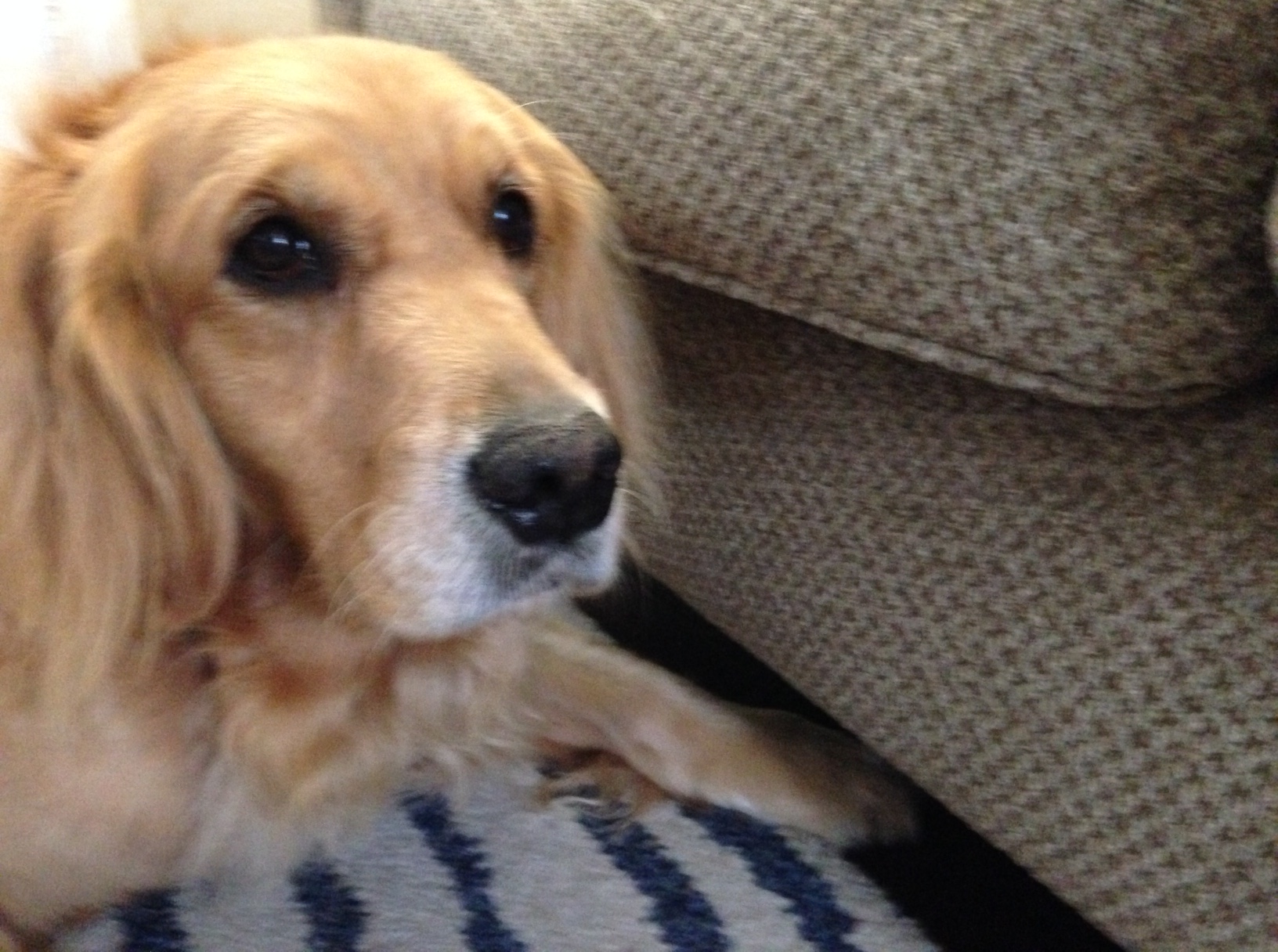
IMG_3201I was on deadline, struggling to communicate with my computer (and failing). Cali came over and ever-so-gently nudged me. I patted her and kept working. Another nudge. I had taken a ball-throwing break about 10 minutes earlier, so I distractedly said, “Not now,” and kept working.

Another nudge. I ignored her. More nudges. Insistent, but so, so gentle and sweet. I patted her, told her to wait a few minutes, told her she was cute. Not what she wanted. This went on for about 10 minutes, I’m embarrassed to admit.

Finally, deciding that rebooting my computer was the only possible step, I shut everything down, rebooted, and got up. “OK, Cali, where’s your ball?” I asked, wandering outside.

Cali wasn’t outside. Neither was her ball. I called her again and looked around the yard. No Cali, no ball.

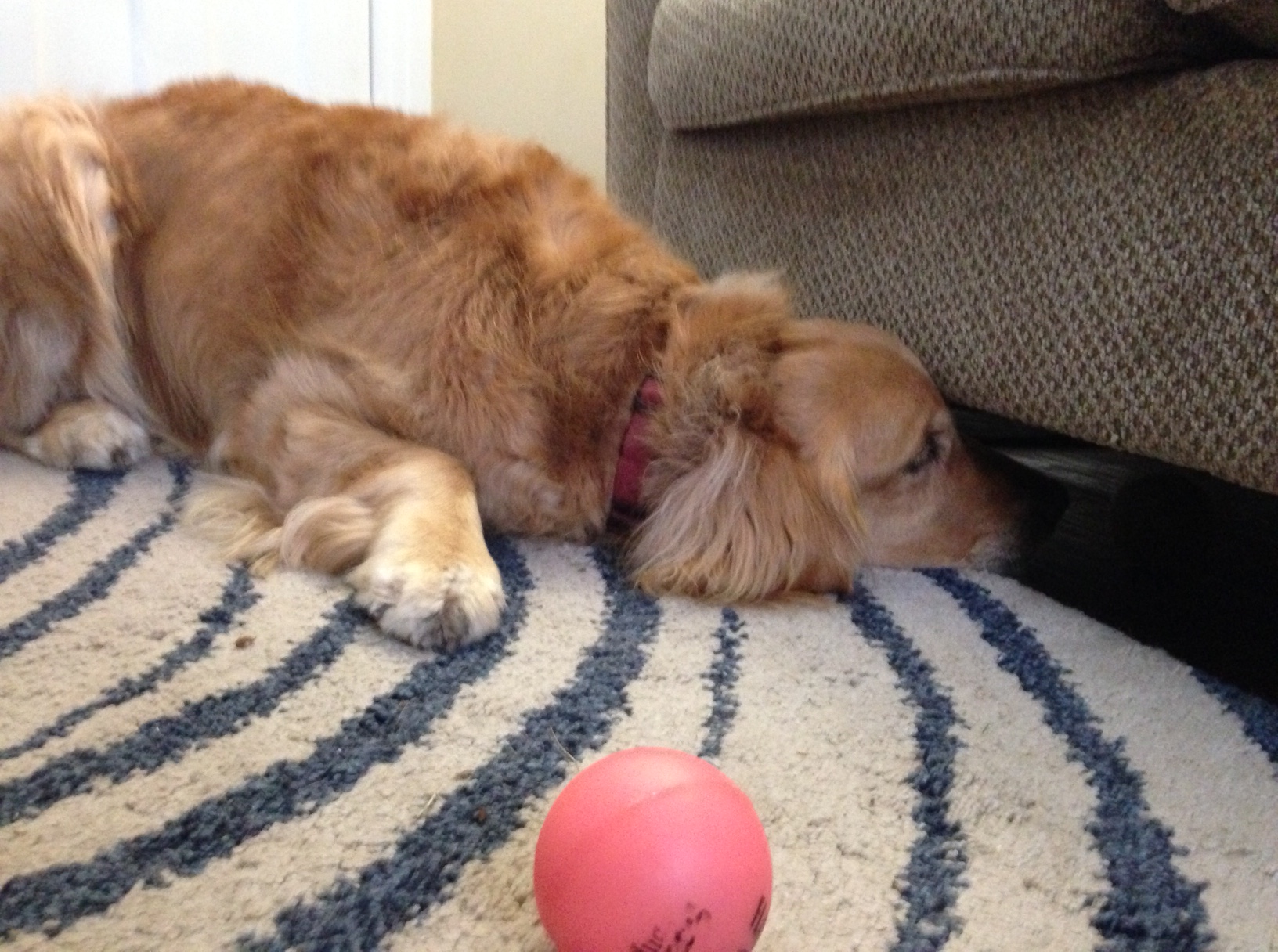
IMG_3195I went inside. Cali was standing in front of the sofa. She came to me, then walked back to the sofa. Touched it gently. Looked under it. Touched it. Looked at me.

The ball was under the sofa. Actually two balls were under the sofa, one dry, dusty, covered with tufts of fur. So much for my housekeeping skills. And my communication skills.

I gave her back the ball. She graciously allowed me to throw it twice, but really, all she wanted was her ball. And her long-lost second ball. She happily stretched out in the yard nuzzling the balls as I went back to work.

I’m constantly amazed by how clearly our dogs communicate — if we’re paying attention. And of course, this clear and detailed exchange reveals how little actual words matter to human-dog conversations. No, our communication does not suffer from dogs’ inability to speak human language. It suffers from our inability to pay attention, to focus on what they are saying — without words, but with eloquence nonetheless.

Chaser: Unlocking the Genius of the Dog Who Knows a Thousand Words

CHaserAmazing dog. Amazing and super-friendly author. I got in touch w/Dr. Pilley after reading the book (and his research papers) and he did a Skype conversation with a class I was teaching on dog-human communication. He is one in a million, as is Chaser. He is such a great example of positive training that respects a dog and her abilities… and he is a fantastic teacher as well.
No one is surprised to hear that a border collie is intelligent and learns easily. But Chaser has gone far beyond what any other dog has been documented to learn in terms of human language comprehension. Dr. Pilley set out to teach her as many words as he could — names of objects — after reading the dismissive comments that greeted publications describing the accomplishments of Rico, a border collie in Germany who learned several hundred words. Dr. Pilley analyzed the linguists’ and other academics’ critiques of the training and testing of Rico — and set out to train his dog in a way that addressed all of their objections. And he accomplished his goal. (An interesting chapter in the book describes the resistance he faced when attempting to publish his initial results.) The opposition to admitting that any creature but humans can use language is still deeply entrenched.
But it’s also dead wrong. Chaser truly does understand human language. She learned and retains the names of more than a thousand items. She has demonstrated her ability to categorize them, grouping round bouncy things into the “ball” category and flat flying things into the “Frisbee” category, for example. And, like most dogs, she clearly distinguishes the category of “my toys” from “things in the house that I’d like to chew but am not allowed to chew.”
But Dr. Pilley realized that he had not pushed the boundaries of Chaser’s abilities. So, they tackled grammar next. Chaser understands the concepts of subject, verb, object — and indirect object. As an editor and college instructor, I have to point out that many writers and college students do not reach Chaser’s level of grammatical knowledge.
Toward the end of the book, Dr. Pilley describes his initial attempts to teach Chaser to imitate long, complex strings of behaviors. His description inspired me to try simple imitation games with my dogs, which have been fun and very funny.
The best part about this book though, is its constant message: Keep training fun and rewarding for the dog; make it a game; play to your dog’s strengths and preferences and, most important, make sure she has time do play and engage in her favorite activities. For Chaser, that means regular opportunities to herd sheep at a near

Hide and Seek

hiding

Every evening, as we get ready for bed, I call the dogs to brush their teeth. Jana runs right over, ever the good dog (and ever the dog who can sense a cookie opportunity). Cali used to run over. In fact, as a small puppy, she would often ask to have her teeth brushed, going over to the shelf where the dog toothbrush was kept and nosing it, touching my hand and then walking back over to it.
Those days are gone.
Now, her ritual is to hide. First, she heads into the bedroom. When I finish Jana’s teeth and call Cali, she walks toward me, but then she hides behind the bathroom door. She’s less than a foot away from me, and when I call her again, she comes over. But she always goes through this hiding routine. She does it when I need to clean her ears or trim her nails, too.
She could really hide. She could squeeze under the bed or hide in the closet. She doesn’t. She knows (I think) that I can see her. She’s not trying very hard to avoid the inevitable. She’s not refusing to cooperate. She’s simply registering her discontent. I don’t want to do this, she’s telling me, but I will, if I have to. And I will eagerly accept a cookie afterward.
What does all of this mean? I think it shows a pretty high level of communication. Cali is sure of what she wants, and does not want, to do. She knows, too, that we follow a routine and that she has to undergo some grooming, like it or not. She has figured out that hiding lets me know how she feels.
But it also shows her cognitive development in another way. Hiding, and understanding that she and I both know to look for something hidden (rather than assume it is gone forever) is part of understanding object permanence. It’s part of developing consciousness of the world around you and your place in it and in relation to others.
I have seen very young puppies show a grasp of object permanence: I once watched 8-week-old puppies playing with an agility tunnel. One ran in, and another ran to the other end of the tunnel to wait for her sister. That showed that the puppy knew that the “missing” puppy was simply temporarily out of sight and would reappear. She even knew where the puppy would reappear.
By the way, babies begin to grasp this concept at about 8 months, and, at about a year, can retrieve an item if they see it being hidden. Those 8-week-old puppies are leap years ahead of the typical baby.
So it’s no surprise that Cali understands object permanence. What I find fascinating, though, is how she uses it to communicate with me.

I Mean It!

Cali looking2_side
Are you talking to me?

In my last blog post, Are You Talking to Me?, I said that dogs can tell when we are talking to them and when we really expect their response. They can tell when they can safely ignore us, even when they know that we are talking to them. They read our tone of voice, body language, and many other cues, most of which we are oblivious to.
So, how can we get those smart, calculating dogs to listen?
First, practice an “I mean it” tone. This can be a stern tone practiced in training class or at home; it can simply be a way of addressing your dog where you make it clear that you are completely focused on him — facing him, looking straight at him.
Fortunately, it can also be that note of fear or panic that creeps into your voice when your dog wanders too close to the street or shows too much curiosity about the ray hovering in the water just beyond her nose. In these instances, thankfully, even dogs with relatively poor recall skills will usually respond, coming to you and away from the danger.
Then, add an “emergency cue.” Practicing an “emergency recall” cue, as explained by a very dog-savvy friend, is a great way to build and maintain good listening skills in your dog: Choose a phrase, such as “right now,” and practice it with your recall cue (usually “come” or “come here”) and really, really excellent treats. Remember — your dog gets to decide what counts as a truly excellent treat.
Practice often. Use different tones of voice when you call. Surprise the dog, calling her when you are in some remote corner of the house or yard.
Soon, whenever your dog hears that cue — “Come here right now!” — regardless of tone of voice, she will know that top-quality treats are being dispensed, but only to the quickly responding dog! If you choose the right reward, you’ll see a blur of racing fur when you issue the cue. To get an even faster response, reward only the dog who arrives first, or, if you have only one dog, count to three (or five, or ten, if you have an old or slow dog), and only reward arrivals that beat the countdown clock.
I admit that I have been lazy about practicing this cue lately. Even so, when I add “right now” to a cue, any cue, I get a much-improved response. The association between “right now” and good treats is indelibly inked on Jana’s and Cali’s minds.
That’s partly due to lots of practice when Cali was little. It’s partly due to the fact that I have some really good treats hidden away. But it’s also due to the strength of our relationship — I spend a lot of time with Cali and Jana, and they can read me really well. They definitely know when they have to listen — and when they can push the boundaries a bit.

Are You Talking to Me?

Mom's not paying attention!
Mom’s not paying attention!

How does your dog know that you are talking to him rather than about him? At a friend’s recent presentation on service dogs, she was asked a great question by a member of the audience: How does your dog know when you are talking to him instead of using “command words” in a different context? For example, as both the speaker and I learned service dog training at the same University, our cue for urging a dog to toilet is “better hurry.” But this phrase, along with sit, stand, look, get it, and myriad others, are used while chatting with our friends, as well as being directives for our dogs.
My friend’s response is that not only do dogs know when we are talking directly to them. They also know when we really mean what we say. Several research teams have studied dogs’ ability to know when we are paying attention to them and whether they recognize when verbal communication is intended for them. Other studies have tested dogs’ ability to recognize non-verbal communication, such as pointing to something, or simply looking at something, that is intended for them. The results of many studies show that dogs do, indeed, know when we are talking to them.
None of this is news to a dog owner who has experienced the instant transformation of a peacefully napping dog into the canine equivalent of a hyperactive toddler who has consumed too much sugar — the instant that the owner picks up the phone.
How do our dogs know that we are talking to them rather than about them? Dogs pay attention to everything we do (I suspect that they pay attention even when we are sound asleep). They read our body language, watch our eyes, and recognize the difference between our use of “sit” as an instruction and our use of “sit” in conversation. They train every sense in our direction to see if we are seeking connection. They read our moods, anticipate our actions, and, yes, know whether we are paying attention to them or are distracted.
What does this mean for your relationship with your thinking dog? Well, think about a conversation you’ve had with someone about your latest personal crisis or sought a trusted friend’s advice, only to have her answer her cell phone while you are mid-sentence. Or you’re on the phone with your friend and you keep overhearing her conversation with someone else (or her dogs). You probably feel ignored or frustrated.
Our dogs, too, want connection. They deserve our attention and focus sometimes: Truly look at your dog, watch his body language. Try to understand what he is telling you. Our dogs spend much of their time giving us that kind of attention; they deserve a chunk of our time in return.
How? Make their walks or playtime all about them. No phones. No turning them loose at the dog park and turning your back to chat with another owner. Figure out how your dog likes to be petted, and give him the kind of attention he wants, not distracted stroking while you are focused on a book you are reading or a TV show.

Jana Rocks

What’s the best present your dog ever brought you? Mine is the rock pictured here. Jana pulled it out of Lolo Creek at Fort Fizzle, one of our favorite spots to spend a hot summer afternoon. It joins this one:

Jana pulled it out of the same swimming hole last summer.

Does Jana know that hearts have a special meaning to humans? Do dogs use symbols to communicate the way humans do?

Those questions are not as farfetched as they might sound.

Jana loves hunting for rocks in the water, and she often pulls them out to collect onshore or to hand to me for safekeeping. She’s pretty selective about the ones she picks up.

She pokes her head under water, holding her breath as she looks for the perfect rock. Once she’s selected a rock, she lifts her head out and works the rock loose with her paws, then puts her head under water and grabs it. Some of them are huge for a 60-pound dog to carry, weighing a two  pounds or more. Sometimes, I throw one back. And she pulls it out again, often giving me a disgusted look in the process.

They are not all heart-shaped, of course. This stretch of river offers her a large selection of rocks in many sizes, shapes, and weights. Yet many of the rocks Jana chooses are triangular or have an elongated shape and rounded corners.

I can’t help wondering why Jana seems to prefer heart-shaped rocks. Is she sending an intentional message?

Dogs, like humans, regularly  use symbols to communicate with their human and canine friends. Many dogs, for example, bring a leash or guide their human to where the leash hangs to ask for a walk. A human donning a certain pair of shoes can trigger a wild dance of delight in other dogs. Play, aggression, and calming signals are part of universal canine-to-canine body language.

Dogs quickly learn to associate specific actions, such as sitting, coming, or lying down with humans’ spoken words, hand signals — and even printed words or pictures.

But dogs’ abilities go far beyond understanding simple concepts and associations. Studies in canine cognition labs around the world constantly expand our knowledge of how dogs understand high-level concepts.

Dogs have shown that they recognize people in photos and can differentiate between photos of dogs and other creatures. They even associate the sound of a growl with a photo of an  appropriate-sized dog who might make such a sound, looking at a photo of a large dog upon hearing a deep, big-dog growl, for example.

Dogs also learn to associate pictures with concepts. I’ve taught dogs to respond to flashcards printed with words or stick figure dogs showing specific behaviors  (sit, down, speak, etc.). And a researcher in Florida, Dr. Lauren Highfill, recently did a study where dogs learned to ask for their preferred reward by choosing the corresponding picture. They first learned to associate a food reward with one picture, a toy with another, etc. Dr. Highfill even had a “surprise” reward category that allowed dogs to ask for an unknown reward. Some dogs consistently chose to be surprised, while others always asked for their favorite.

So, back to the heart-shaped rocks. I haven’t intentionally taught Jana any specific association with hearts, but she has seen me collecting (much smaller) heart-shaped rocks on our walks together on many different beaches. Maybe she just knows that the symbol is, for whatever reason, meaningful to me.

Jana is very bright and perceptive. Even so, it’s a bit of a stretch to think that she has somehow picked up on the idea that, in human culture, the heart shape stands for an expression of love. It’s not as much of a stretch to think that a watchful dog knows what pleases her human partner and enjoys finding ways to do that. Whatever her reasons, the heart-shaped rocks are gifts from Jana that I will always treasure.

What Are We Saying to Our Dogs?

How much of what we say to them do dogs understand? I find myself thinking about this a lot these days, as I teach both a canine language class and a class that looks at influential dog trainers in history (all of whom had definite ideas about what dogs do, or, mostly, do not understand).
Konrad Most, an early trainer whose teachings influenced the training of military and police dogs well into the mid-1900s, believed that dogs did not, could not comprehend words. Rather than describe the verbal cues given to dogs as “commands,” Most called them “utterances,” so as to avoid any chance of ascribing any comprehension abilities to the dog.

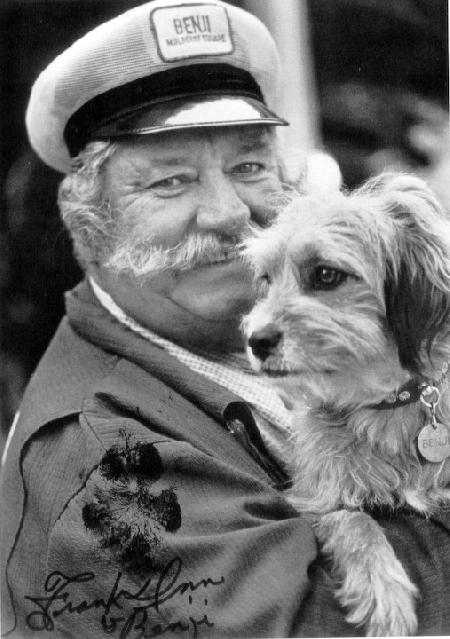
Frank Inn and Benji

At the other extreme was celebrity-animal trainer Frank Inn, who, in the 1970s, taught Benji using a conversational style consisting of full sentences.
Nearly everyone who has dogs talks to them. Some babble and speak in baby talk, others order their dogs around brusquely, but many of us chat to our dogs as if talking to a friend, despite their lack of verbal response. We often swear that they understand every word.

Do they?

Dogs are less focused on words than humans are, but they can certainly learn to associate certain actions with words and phrases and respond to verbal requests. They can learn the names of large numbers of items. However much they are understanding of our overall meaning, they appear to be good listeners, looking at us attentively and at least seeming interested.
Dogs are more visual than we are; they learn hand signals and understand other body language cues even more quickly than they build associations with our words. This can get us into trouble sometimes.
Konrad Most might have been the first trainer to write a description of creating unintended associations. His example was a handler who was teaching a dog a “down stay.” The handler would walk away from the dog (who was remaining, lying down, in place). On reaching the desired distance, the handler would turn to face the dog and immediately release the dog from the down stay. Well, very quickly, the cue to the dog would become — not the release word —the handler’s  turn. That is what Most meant by unintended associations. Nearly all novice trainers learn this lesson through personal experience, unconsciously repeating a movement when giving a particular verbal cue and creating a strong association in the dog’s mind.
Dogs are simply outstanding readers of human body language. They out-perform wolves and even other primates at following the direction of our gaze or interpreting a pointing finger. And dogs’ ability to read us goes beyond the signals we give them — intentionally or not — when we’re asking them to do something.
Very often, they will respond to things we don’t know that we’ve “said.” For example, if our body language tells them that we had a hard day or we’re feeling sad, lots of dogs will offer a cuddle, a lick, a favorite toy. Empathy. If our hand tenses up on the leash or some other cue tells them that we’re nervous or afraid of something — or someone — they might bark or growl at the scary person or thing. I’ve seen service dogs begin to intuit what their new human partners need or want after only a few days on the job.
Konrad Most, like many trainers of his day, didn’t credit dogs with the ability to think or learn concepts. He used training methods that today would be understood to be cruel to dogs. For all his faults, though, he understood dogs’ ability to read our body language. Now, if only we were as good at understanding what our dogs are saying to us!