Missed Opportunity


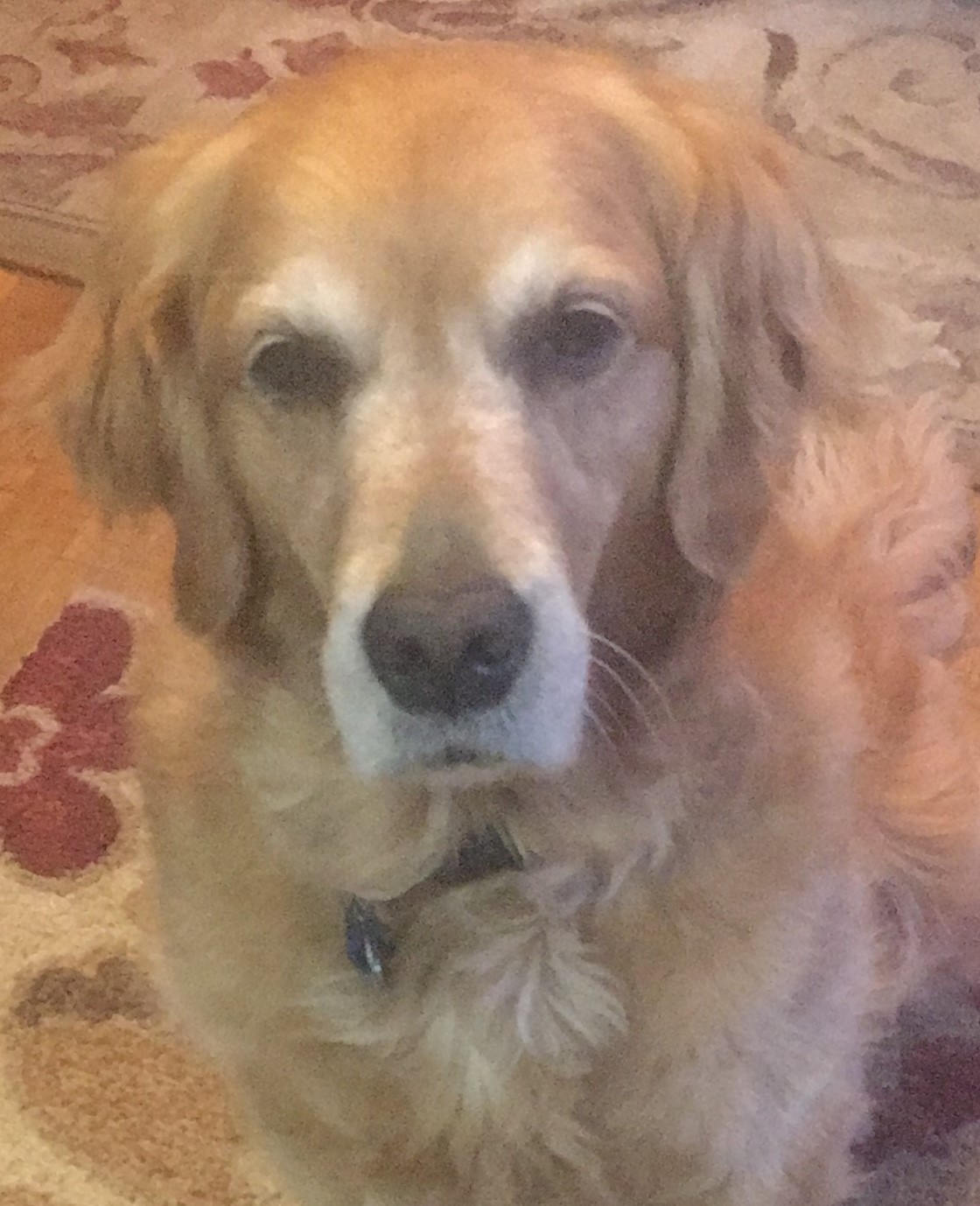
Cali, a golden retriever, looks very sad
I’m not angry; I am just disappointed …

Cali recently had a doctor’s appointment. She has a couple of small lumps, and I was thinking about having the vet remove them. So … you know what’s coming … Cali had to skip breakfast.

I apologized profusely. She did that sad face thing, where she just looks at me to let me know how disappointed she is by my behavior — my utter failure to meet her needs.

She moped around, sighing loudly, the whole time I had my coffee and washed dishes. Fewer dishes since, you know, hers was still clean from last night.

Outside, she foraged vainly among the raspberry canes, brown and sad after our early snow. She hoped she might find some overlooked berries to help her stave off her hunger. No luck. No dropped apples from the neighbor’s tree either. Greedy birds had eaten all the seed. Sigh.

We went for our morning walk. She trailed sadly behind me, her low energy the result of being starved by her cruel human.

Suddenly, she spied a miracle: Someone had dropped an entire ice-cream cone on the grass!

She stared, disbelieving. She stretched her nose over to sniff. She drooled.

She then made a critical error. She looked up, up at that cruel human. Who of course said, “No.” Seriously, is that the only word moms know?

The rest of that walk was … just exhausting.

The nice vet said Cali didn’t need surgery. Then she gave Cali a whole handful of cookies. Maybe she wants another golden retriever …

Cali gave me another look. This one said, “I’m shopping for a better mom.”

I took Cali home and gave her breakfast. We walked by the Spot, but the ice cream was gone. Some lucky dog with a nicer human …

I gave her extra treats all day. I took her out for ice cream a couple days later. I kept apologizing.

None of it matters.

We walk past that Spot, where the miracle (almost) occurred, on every walk. Cali stops, sniffs the ground where that magical cone was. She sniffs, gives me the sad face. Looks mournfully at the Spot again, sniffs again, and we walk on.

Some opportunities come once and poof! They’re gone in a second, with the “No” of a mean mom.

Cali is now firmly in the “ask for forgiveness — not permission” camp.

She’s learned her lesson: If you see a miracle, eat it right away.

Plenty of time to bat your blonde eyelashes at the angry human, look remorseful, and apologize afterward.
Cali Is Excited about Meeting Her New Best Friends

Cali is sure you’re going to be her new best friend!

Cali and I are working on becoming a visiting “therapy” dog team.

We met with the coordinator of the Wind River Canine Partners Therapy Dog Program this week for our first evaluation. We spent about an hour walking around in a Cabela’s store (very dog-friendly). Cali was excited about going shopping! And meeting new best friends!

I had warned the trainer that Cali’s main weakness is getting overly excited about meeting someone. Anyone. Especially men. She saw exactly what I meant when Cali pulled, hard, toward her. A random stranger in a parking lot? Clearly Cali’s long-awaited best friend. Oh wait, that clerk just inside the door: Definitely a best friend. Oh, there’s another one … and a shopper. Oh! A family with a kid!! A dog in a shopping cart!

After greeting a few people, Cali got down to shopping. It’s hunting season in Montana, so … lots of weird lure-type things with feathers? The plastic packaging wrap did not throw Cali off the scent, and she found them fascinating. She was not at all interested int he fake and dyed feathers, only the natural ones. She loved the fishing lures too. Mild curiosity about the actual equipment. No interest in plastic antlers.

Then … the toy department. The hobby horses who made neighing and galloping sounds were mildly interesting. But the small rocking horse, pink, with sparkly green eyes: Downright terrifying. It had a face. It moved unpredictably. And it was looking at her. She was not going near that thing no way no how … well, maybe just a quick sniff. Oh, wait, someone dropped a cookie nearby; maybe she can just reach over and … it’s looking at her again!

That was scary.

More people to greet, more toys to sniff. What’s this? A fake man with no head? Humans have the weirdest toys … Uh oh, that horse again. Huh, maybe it’s okay with cookies …

It was a tiring trip. Cali slept all the way home.

Cali passed with flying colors. Perfect temperament, obviously loves meeting people.

The handler? She needs some work.

Once we’ve improved our handling skills, we can start visiting. Cali would like to try visiting people at the hospital or maybe the veterans center. Anyplace without rocking horses is fine.

Sympathy Pains?

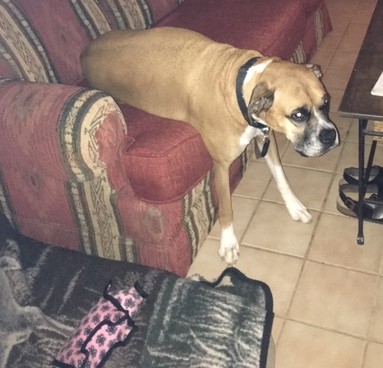
Jackson, a boxer, steps gingerly off the sofa
My leg hurts … or does it?

Jaxson’s dad had knee surgery and was using crutches to get around on his heavily bandaged left leg.

That morning, and the previous day, Jaxson had been fine. But, soon after Dad got home, Jaxson started favoring his left (rear) leg.

He was holding the leg up or touching the floor gingerly, limping around. Outside, though, he raced along the fence to chase a squirrel. Occasionally he seemed to forget his injury inside too, rushing to the window to angrily warn trespassers to get off his property if they dared walk past the house.

What was going on? For two days, we all debated whether Jaxson was injured or simply mirroring his dad’s pain. As Dad got better, Jaxson’s foot, too, spent more time on the ground. He eagerly went for a long walk (no limping) and joined Dad and a friend as they wandered down to the nearby pond.

We’ll probably never know what was going on in his mind…

This is the same dog who demonstrated his problem-solving — and engineering — skills earlier in the summer. The whole family was working in the yard. Well, the humans were working. As I heard the story, Jaxson was supervising. That’s thirsty work. And the humans hadn’t thought to provide their supervisor a cool drink.

Jaxson noticed a tiny leak in the garden hose, though. He idly licked at the drops. Then he got an idea.

He started scratching at the dirt under the drip. By the time he got yelled at for digging, he’d excavated a small hole. He wandered away when he was told off.

But several minutes later, Jaxson went back to check on his engineering project. Yep; it had worked. The dripping water had filled the hole, providing him that drink of water he was after.

Dogs like Jaxson show me — maybe show us all — that no matter how good we think we are at reading dogs, no matter how much we think we know about them and what makes them tick, we still badly underestimate them. We also are too quick to assume that they are doing something “bad” — digging — when, really, they’re just solving the problem of our human failure to meet their needs. Again.


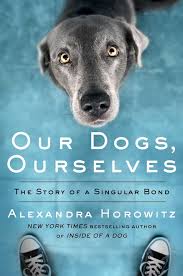
Our Dogs, Ourselves: The Story of a Singular Bond

the cover of Our Dogs, Ourselves by Alexandra Horowitz shows a dog peering up at a personI was excited about reading Alexandra Horowitz’s latest dog book. She’s the person I want to be when I grow up, after all … But, though I enjoyed it, I was also a little bit disappointed.

Her best work so far — aside from her academic papers — is Being a Dog, with its deep dive into the world of scent and how dogs experience it. Our Dogs, Ourselves lacks the insights into dog-focused science I hope for from Horowitz. It also shares little of her fascinating and groundbreaking work in dog cognition.

It’s about life with dogs. Mostly, her life with her dogs, with a few broader forays into the lives of the rest of us and our dogs — or at least the dog-owners she encounters in her New York City life with dogs.

While much of the book reads like a collection of blog posts or short essays, a couple of chapters explore larger, more serious issues. These chapters, in my opinion, redeem the book:

  • “Owning Dogs” examines dogs’ status as property. Horowitz clearly articulates how and why that’s wrong and at odds with how we think of dogs — spelling out the need for a status between “property” and “person.” Her vision of a “living property” status requires attention to dogs’ welfare as well as enabling “full dogness” — opportunities to do truly doggy things, like sniffing, digging, chasing, and chewing.
  • “The Trouble with Breeds” spells out the history and harms humans have caused through generations of selective inbreeding. She also describes related damage. One example is breed-specific laws that fail to account for individual dogs’ differences or for actual behavior. Another is many humans’ tendency to choose a breed that looks appealing to them — without considering “genetic tendencies” that, for example mean that border collies are miserable spending their lives as pets of busy, apartment-dwelling humans.
  • “Against Sex” lays bare the harms we do to dogs by “de-sexing” them, especially at very young — prepubescent — ages. Horowitz dispels many myths surrounding spay and neuter, from the impact on euthanasia rates (negligible) to a long list of the health problems it causes in our pets, including the risks of the actual surgery. She bravely confronts the uncomfortable truth that neutering our pets is an easy out for humans; we don’t have to think about, much less manage, our dogs’ reproductive lives.
  • Finally, “Humorless,” paired with the chapter on “Dog Stuff,” struck a chord with me. Horowitz eloquently describes something I share — an inability to see the “fun” or “humor” in some cultural trends that poke fun at dogs, often by projecting human feelings and motivations onto our dogs. From dog-shaming websites to embarrassing dog clothing to the thousands of so-called funny videos of dogs and kids, where the dogs look stressed and terrified, much of what humans laugh at about dogs amounts to ridiculing or even abusing the dog. This is not always the case, of course, and some functional dog clothing is fine or necessary.
    But many dog find humor in situations that really are not funny. This is largely due to misinterpreting dogs’ body language. The worst results of this are, of course, dog bites. But, and I say this as a reformed dog owner, who is guilty of putting past dogs into Halloween costumes: A lot of what’s fun or funny to humans is unpleasant or worse for the dog. A scared or frightened dog who cannot escape is likely to defend himself, possibly with a bite. Who hasn’t heard a story of a bite “with no warning,” often from people who simply missed many clear signals from the dog.

Overall, there’s enough strong chapters that I do recommend the book — it’s a fun read in parts, more serious in others. But, if you’re expecting a more scientific look at dogs, stick with Being a Dog.


Those Puppy Eyes …

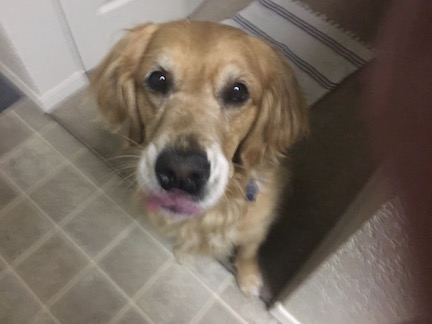
Cali looks up, licking her lips
Who can say ‘no’ to these eyes?

That sad puppy look your dog gives you… that look that Cali uses every time we’re within a block of her favorite ice cream stand … that look has been perfected by dogs over millennia. It’s no wonder we’re helpless to resist it!

It turns out that dogs’ “expressive eyebrows” enable them to raise their inner eyebrows in a way that makes their eyes look larger and, to humans, sadder. A study found “compelling” evidence “that dogs developed a muscle to raise the inner eyebrow after they were domesticated from wolves.”

What’s more, it’s mostly our own fault for breeding these manipulators: A Science Daily report on the study suggests that this eyebrow muscle, which wolves lack, “may be a result of humans unconscious preferences that influenced selection during domestication.”

It’s working out well for the dogs. The expression elicits a strong response from most humans who feel protective toward the “sad” or “worried” dogs. Dogs who use this eye movement get adopted faster from shelters, according to the study.

The muscle difference evolved very quickly, according to researchers, and seems to have had an outsize impact on human-dog relationships. Eye contact plays a huge role in dog-human communication, and the dogs have clearly learned to use their anatomical gift to full advantage.

Humans pay close attention to eyebrow movement, even if we aren’t really aware of it. “In humans, eyebrow movements seem to be particularly relevant to boost the perceived prominence of words and act as focus markers in speech,” the study points out. It hypothesizes that we’re especially tuned in to eyebrow movement because it “is a uniquely human feature.”

Or was. Until the dogs figured out how to hijack it.

DNA Test? Why?

I wrote about the pitfalls of doggy DNA tests a few months ago — how they might cause people to panic about the potential that their dog is carrying a marker for a genetic disease or lead people to make unhelpful assumptions about the dog’s behavior.

I just saw a review in Wired examining three DNA testing services. So I have to chime in again.

These tests are not very accurate. They basically compare parts of your dog’s genome with all of the other dogs in the database and make guesses based on finding snippets that match. Each service has different dogs in the database, so there will be different matches.

The caveats about deciding what training method to use or panicking about diseases that your dog doesn’t have still hold. Even so, it can be fun to explore your dog’s genetic makeup. But buyer beware.

Like much data collection that exploits human subjects, the fun wrapper is hiding business motives. The parent company of the Wisdom Panel, for example, is a gigantic dog food manufacturer. One that happens to sell overpriced (poor quality) foods targeted at specific breeds. If your dog is found to have a significant proportion of Breed X, guess what? Little ads will start stalking you, trying to get you to buy food tailored to that breed — a concept which is absurd.

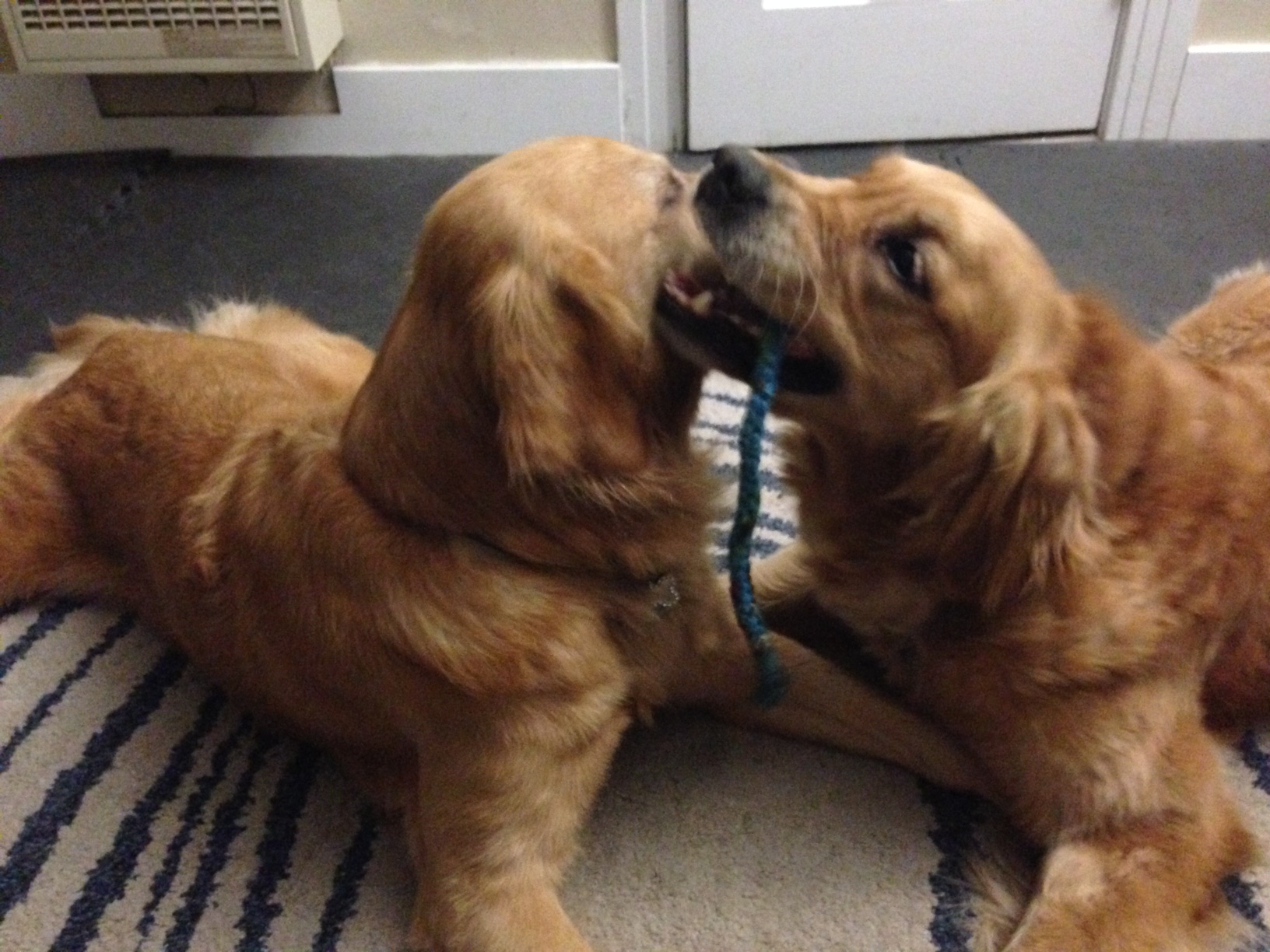
Cali sure loves playing with her sister Dora!

On the other hand, Embark is a spinoff of Cornell’s canine genomics initiative, according to Wired. They look at many more disease markers and are building a database that could someday contribute to research on all sorts of doggy health issues. Cool. It’s also the only one that claims to help you find your dog’s relatives. That’s also the most expensive one, of course.

For me, the bottom line is why you’re doing it. The test itself can be mildly uncomfortable for the dog, and the dog certainly doesn’t care about the results. If it’s all in fun, great. But if you’re trying to discover some deep truth about your dog, you’re better off just hanging out with him and getting to know him better. Instead, donate the $70 — $200 you’d spend on the test to your local shelter.

Cali’s Pseudo-Marshmallow Test

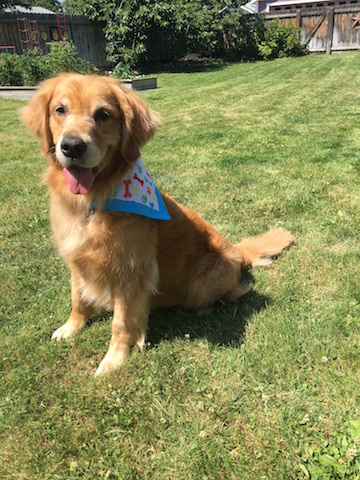
Cali, a golden retriever, smiles happily and wears a colorful bandanna after her grooming.

Cali went to the groomer a few weeks ago. Our groomer, conveniently located around the corner, has a nice antique brass coal hod in the entryway, usually filled with dog biscuits. And cleverly located at golden-retriever-nose height.

Cali beelined for the cookie basket, which had only three biscuits. She looked at them, at me, at them, etc. I gave her one, then handed her leash over to the groomer.

A couple of hours later, I returned to pick Cali up. She came out from the back and headed straight to the basket. I gave her one of the remaining cookies, and stood chatting with the groomer and paying the bill for a few minutes.

When we looked back at Cali, she was standing at full attention, chin resting on the edge of the basket, staring at the one remaining biscuit. She could easily have taken it; we hadn’t been paying close attention. The groomer even said that most dogs do, indeed, help themselves. She was impressed with Cali’s manners.

I saw that as Cali’s version of the marshmallow test, and I was pleased that she showed self-restraint and good manners. She’s not always so disciplined, but she has never taken food that wasn’t hers, and she’s generally a very Good Dog.

Is Your Dog Famous?

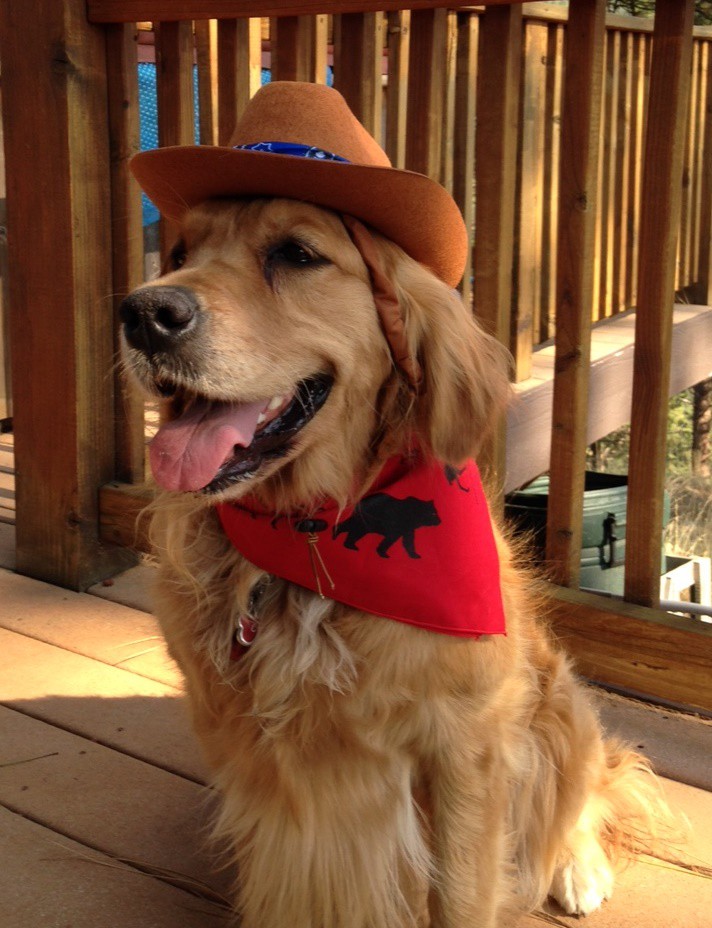
Cali, wearing a cowboy hat, smiles broadly

Is your dog an internet star? Does she want to be?

Perhaps she needs to sign on with The Dog Agency (home to the most influential animals in the world).

It seems that dogs can no longer become viral sensations without an agent. Loni Edwards, the founder and CEO, is quoted in Fast Company as saying, “We help them think about how to grow their brands.” I think she means the humans who are associated with the celebrity pooches.

She’ll advise clients (and their humans) on how to get ads, book personal (or doginal) appearances, get book deals … all the elements in becoming and remaining a pet influencer.

Not just any dog can sign on, though. She’ll only take clients who already have at least 50,000 followers on Instagram. The human also has to have what it takes.

The top influencers bring in thousands of dollars per post — not to mention the income from all those other deals.

Cali’s out of luck. I don’t even have an Instagram account (though who knows; Cali might …). Maybe we should check it out. Rugged, athletic cowdog types might be in demand. Being supported by my dog would be a nice change …

A Win for the Greyhounds

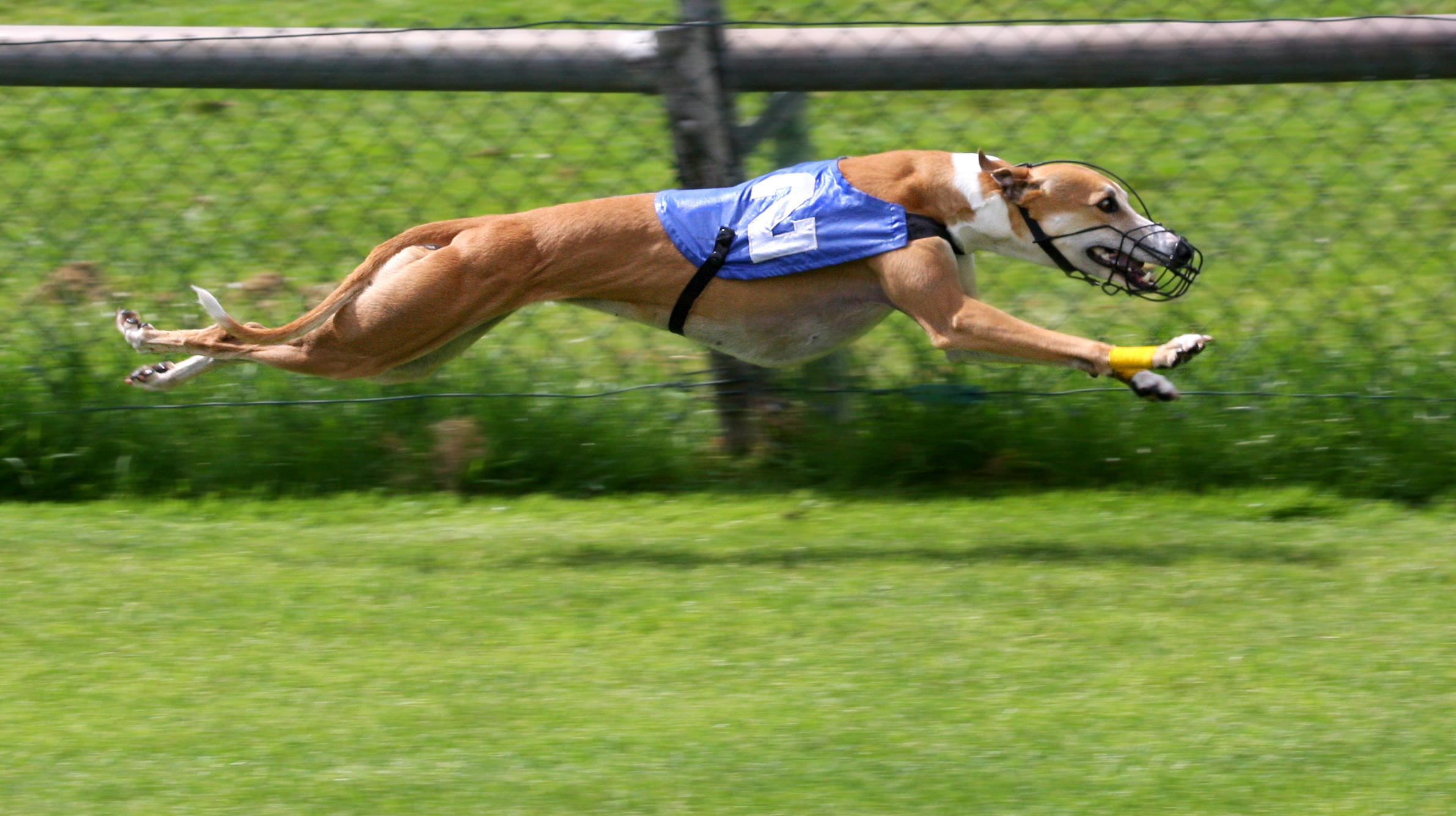
A greyhound racing dog runs, wearing a cape and a muzzle.
Florida votes to ban greyhound racing!

Hooray for Florida! Odd words for me to write as contentious election contests morph into contentious vote recounts … but Floridians of all political stripes stepped up for the dogs. The measure to ban greyhound racing passed with 69 percent of the vote.

Greyhound racing will at long last be phased out in Florida. According to the Orlando Sentinel, the 11 active tracks have until January 1, 2021, to end dog races.

Grey2K and other rescue and shelter organizations are already gearing up to handle an expected flood of retiring racedogs. Thousands of greyhounds currently race in Florida, and, though some will be moved to states that still allow racing, most will probably need homes.

And rehabilitation. Several years ago, while working on an article on prison-based dog-training programs, I visited a prison in Michigan. The head of the training program there, where dogs from a nearby shelter and retired racing greyhounds were getting training prior to placement, explained how much the greyhounds needed to learn.

They spend their racing lives in cages and don’t understand how to function in a normal environment. It took three men and a boatload of patience to teach the rescued greyhounds how to walk down stairs, for example — something that can be easily taught to a puppy in a few short sessions.

The few rescued greyhounds I’ve interacted with all seemed to grasp some of the greatest comforts of life-with-kind-humans pretty easily though, enjoying soft beds, warm sweaters, and yummy regular meals. They are large but quite gentle and often shy — perhaps a result of spending much of their early lives isolated from most other dogs and humans.

Spokespeople for the industry claim there was no abuse of the dogs, who were well cared-for; 500 deaths of racing greyhounds in Florida in just the last 5 years says otherwise, as do state reports of injuries and deaths, some with video documentation. Add in the rabid opposition from the industry to any kind of  regulation, like tracking injuries or prohibiting steroid use, and I somehow am having difficulty feeling too bad for the people whose livelihoods will be affected by the ban — track operators, breeders, track workers. I do hope they find work in a less-cruel industry.

Bubba for President

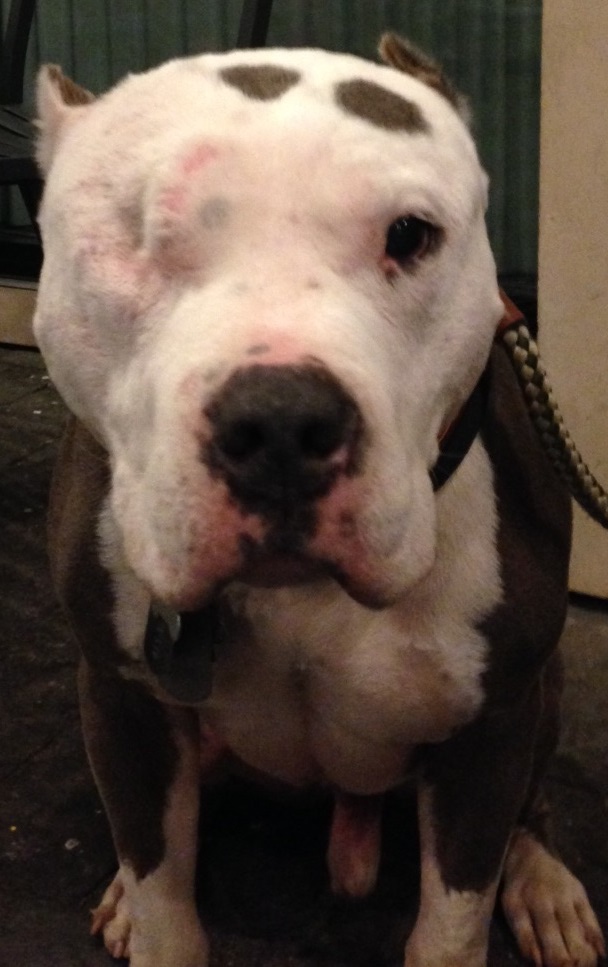
My name is Bubba, and I approved this message.

I spent some time recently with a wonderful dog, Bubba. The first time we got to hang out was right after a particularly vulgar Republican presidential debate, and the contrast got me thinking about how this dog (and many, many other dogs) embody traits I’d like to see in a presidential candidate but that are sadly lacking in the current Republican contenders.

Some background: Bubba is the spokesdog for a local rescue organization, the Petaluma branch of Marley’s Mutts. He experienced some of the worst abuse that anyone can imagine. Actually, it’s worse than I could have imagined before reading his case file. The amazing Sacramento DA who put Bubba’s tormentor in prison, will be Skyping in to my dog law class, so I had to read the entire file.

I generally don’t give my students “trigger warnings,” but before posting these documents, I not only warned them, I put little Adobe sticky notes in the PDF to flag particularly graphic sections. It was that bad. I won’t go into details here, except to point out that Bubba’s missing eye is the result of repeated injuries caused by the monster who abused him.

So why does Bubba trump any current candidate in the Republican field?

He’s not angry or vindictive. He’s suffered real injury, unlike many Tea Partiers or angry primary voters. Rather than seek a scapegoat or, say, hold all white men responsible, he has forgiven all humans. He loves everyone. He eagerly approached every new person who entered the fundraiser where I was visiting with him. His tail was always wagging, his face openly welcoming and friendly. He was gentle with small children. He appropriately introduced himself to and played with a 4-month-old Rottie puppy who stopped by, and he was equally friendly with the several other dogs there.

He’s goal-oriented, too. When he detected a whiff of potential treats emanating, say, from my pocket, he focused on me like a laser, using the mind meld that Jana has perfected over the years. “Feed me a Charlee Bear. Feed me a Charlee Bear.” It worked. He also mind-melded the server, who brought him at least six cookies, and that was just what I saw. Nothing gets past this dog; he carefully checked all newcomers for the scent of treats. He just might be a Labrador wearing  a very convincing disguise.

Bubba doesn’t back down in the face of an army. When he met my class of 20 students a week later, he sized up the challenge, then gave each one a warm greeting — and the sniff test. He very quickly figured out that the little black pouches many students had contained treats, and he went to work. The students never stood a chance. Bubba probably didn’t need dinner that night.

What else does candidate Bubba have to offer? I’m not sure what his health care plan includes beyond “kisses to make it better,” but the price sure beats my current insurance, and it is a treatment with a long track record of success. His education platform emphasizes motivation and rewards. And, though we didn’t discuss specific issues, his domestic and foreign relations approach heavily focuses on interspecies cooperation, collaboration, and peacemaking; he disdains the threats, calls for attacks, and shunning of those who are different that are so much a part of the current campaign.

In all, he’s an admirable candidate. He’s overcome a difficult past, shows intelligence and integrity, and has a demonstrated ability to cross the (species) aisle and negotiate favorable deals. Bubba has my vote!